Walking Meditation

POSTCARD#447: Walking meditation is wonderful, especially in the early morning. Often when you get up early in the morning, in particular when you’re not used to getting up so early, you’re quite tired and the mind isn’t bright. One of the advantages of walking meditation is that you can’t nod off while you’re walking. So if you’re tired, walking meditation is very good to do. It brings up some energy, and also you can get very peaceful. Walking meditation was both praised and practiced by the Buddha. If you read the suttas (teachings in the Pāli canon), you find that the Buddha would usually do walking meditation in the early morning. He wouldn’t be sitting; he’d be walking. Many monks and nuns have become enlightened on the walking meditation path. It’s a very effective way of developing both calm and insight (but not to the extent of jhāna). For some monks that I know in Thailand, their main practice is walking meditation. They do very little sitting. They do a lot of walking, and many get tremendously powerful insights while they’re walking.

Another benefit of walking meditation is that it is especially suitable for those who have physical discomfort when sitting for long periods. If you find it difficult to sit in meditation because of pains in the body, walking meditation can be a very effective alternative. Don’t consider walking meditation as a “second-class” meditation. If you want to spend most of your meditation time this way, please do so. But do it well and do it carefully. See if you can develop the happiness born of serenity as you’re walking back and forth.

Setting Up Walking Meditation

Choose a clear, straight path between twenty to thirty paces long. This can be a corridor in a house, a path in the garden, or just a track on the grass. Use whatever is available, even if it’s a bit less than twenty paces long. If it’s comfortable to do so, walk without shoes, enjoying the contact of your bare feet on the ground.

Stand at one end of your path. Compose the mind. Relax the body and begin walking. Walk back and forth at a pace that seems natural to you. While you are walking, clasp your hands comfortably in front of you, and rest your gaze on the ground about two meters ahead. Be careful not to look around. If you’re doing walking meditation, it’s a waste of time to look here and there, because that would be distracting.

The Stages of Meditation Apply Here Too

The first four stages of meditation described in the first two chapters apply here as well. But in walking meditation attention eventually comes to rest on the feet rather than the breath. At first, aim to develop present-moment awareness, as in stage one. Use the techniques described there to reach the state of just walking, easily, in the here and now. When you feel that you have settled into the present moment, where thoughts concerning the past and future are absent from the mind, then aim to develop silent walking in the present moment. Just as described earlier in stage two, gradually let go of all thinking. Walk without any inner speech. Make use of some of the techniques described in chapter 1 to reach this stage of silent walking. Once the inner commentary has slowed to a bare trickle of inner speech, deliberately focus your attention on the feeling of movement in the feet and lower legs. Do so to the extent that you clearly notice every step on the path. Know every left step, know every right step—one after the other without missing any. Know every step as you turn around at the end of the path. The famous Chinese saying that the “journey of one thousand miles begins with a single step” is helpful here. Such a journey is in fact only one step long—the step that you are walking now. So just be silently aware of this “one step,” and let everything else go. When you have completed ten return trips up and down the path without missing a single left or right step, then you have fulfilled stage three of the walking meditation and may proceed to the next stage. Now increase the attention so that you notice every feeling of movement in the left step, from the very beginning when the left foot starts to move and lift up from the ground. Notice as it goes up, forward, down, and then rests on the ground again, taking the weight of the body. Develop this continuous awareness of the left step, and then similar smooth, unbroken awareness of the right step. Do this throughout every step to the end of the path. And as you turn around, notice every feeling in the turning-around procedure, not missing a movement.

When you can walk for fifteen minutes comfortably sustaining the attention on every moment of walking, without a single break, then you have reached the fourth stage of walking meditation, full sustained awareness of walking. At this point the process of walking so fully occupies the attention that the mind cannot be distracted. You know when this happens, because the mind goes into a state of samādhi, or attentive stillness, and becomes very peaceful.

Samādhi on the Walking Path

Even the sound of the birds disappears as your attention is fully focused on the experience of walking. Your attention is easily settled, content, and sustained on one thing. You will find this a very pleasant experience indeed. As your mindfulness increases, you will know more and more of the sensations of walking. Then you find that walking does have this sense of beauty and peace to it. Every step becomes a “beautiful step.” And it can very easily absorb all your attention as you become fascinated by just walking. You can receive a great deal of samādhi through walking meditation in this way. That samādhi is experienced as peacefulness, a sense of stillness, a sense of the mind being very comfortable and very

happy in its own corner.

I started my walking meditation practice when I was first ordained as a monk in a temple in Bangkok. I would choose a path and quite naturally, without forcing it, I’d walk very slowly. (You don’t need to walk fast, and you don’t need to walk slowly. Just do what feels comfortable.) I used to get into beautiful samādhi states during walking meditation. I recall once being disturbed because I’d been walking too long. I hadn’t noticed the time pass, and I was needed to go to an important ceremony. One of the monks had been sent to get me. I recall this monk came up to me and said, “Brahmavamso, you’ve got to come to a dāna” (an alms offering). I was looking at a space about two meters ahead. My hands were clasped in front of me. When I heard the monk’s voice, it seemed as if it came from a thousand miles away because I was so absorbed into my walking meditation. He repeated, “Brahmavamso, you have to come now!” It took me more than a minute to actually lift my gaze from the ground and to turn it around to the side where this senior monk was trying to get my attention. And as I met his eyes, all I could say was “What?” It took such a long time to get out of that samādhi and react at normal speed. The mind was so cool and so peaceful and so still. Many people who practice walking meditation for the first time say, “This is amazing. Beautiful.” Just slowing down gives you a sense of peace. You become calm just by watching the sensations as you walk. So walking meditation is another type of meditation that I suggest you experiment with.

Choosing the Right Meditation for the Right Time

Wherever you have choice you may also find confusion. Now that you have read about several different methods of meditation, which one should you choose? Master meditators who are about to begin meditating will first examine the state of mind that they are to work with. If they have been very busy, they know that they will be starting out with quite a coarse mind. So they may start with a simple letting-be meditation. Perhaps they see that their body is stiff, so they choose to do some walking meditation. When they see that their mind is not so rough, they take up present-moment awareness and then silent present-moment awareness. Master meditators know from experience when their mind is able to watch the breath or ready to begin mettā meditation. They know when to apply the finer tools such as full sustained awareness of the breath or of the beautiful breath. Meditation masters become so proficient in their craft that they know the right time to turn to the nimitta and how to polish it deftly until the mind enters jhāna. Thus a coarse mind straight from the busy office is transformed by the master meditator into the most beautiful, smooth, and radiant mind.

Sometimes meditation masters begin with a mind that is already cool and mindful. They examine their state of mind and quickly know that they can bypass present-moment awareness and silence and go straight to the breath or to mettā. They may even see that their mind is so joyfully at peace that they can easily begin with awareness of the beautiful breath. On rare occasions, master meditators realize that they already possess such a poised and powerful mind that they can arouse a nimitta within a few seconds and quickly enter a jhāna. Such are the skills of a meditation master.

On the other hand, inept meditators, in a rush of arrogance, don’t even take time to notice the coarseness of their mind and try to use mindfulness of the breathing from the very beginning. They waste much time and create many problems for themselves. So, please become familiar with the various types of meditation until you know when and how they should be used. Then every time you meditate, begin by examining the mind you have to work with, and you will understand which meditation method to use. You will become a doctor of meditation, diagnosing accurately before treating effectively.

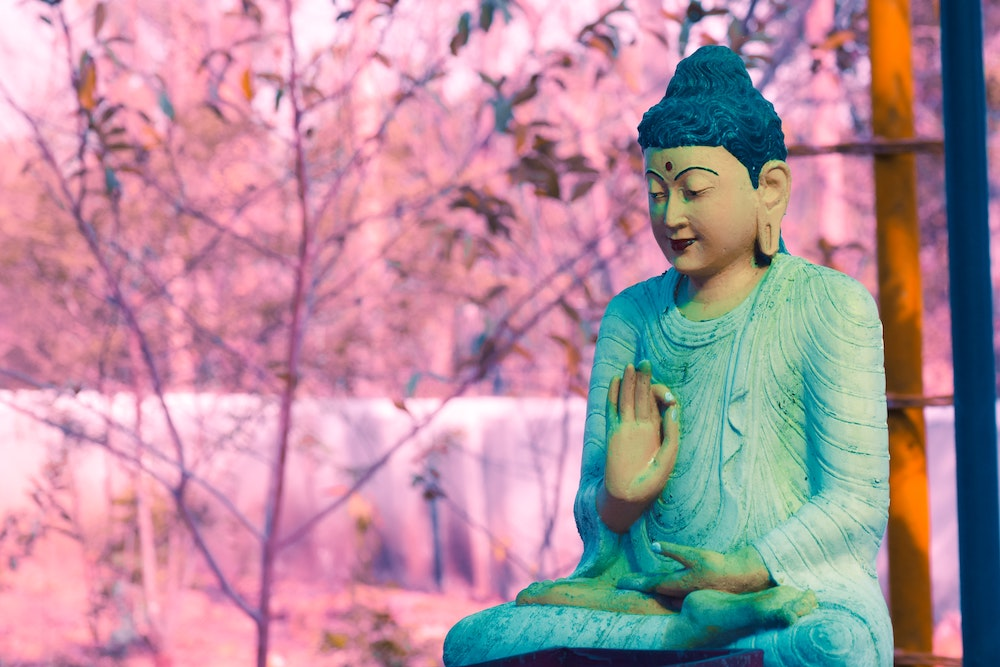
Photo details: Buddha-Weekly-Sunrise_Dinajpur_Bangladesh-Buddhism.jpg

Text continued 2nd December 2021

Letting Be

POSTCARD#446: Bangkok: Continuing with Ajahn Brahm’s text: “Mindfulness, Bliss and Beyond

Sometimes the best thing my mind needs at the moment is just to let things be. Basically, letting-be meditation is simply this second stage of breath meditation, just silent awareness of the present moment. It has to be silent, because to really let things be means you give no orders and have no complaints; you’ve got nothing to talk about. Letting be happens in the present moment. You’re aware of things as they appear right now, and you allow them to come in or stay or go, whenever they want. Letting-be meditation is like sitting in a room, and whoever comes in the door, you let in. They can stay as long as they like. Even if they are terrible demons, you allow them to come in and sit down. You are not at all fazed. If the Buddha himself enters in all his glory, you just sit here just the same, completely equanimous. “Come in if you want.” “You can go whenever.” Whatever comes into your mind, the beautiful or the gross, you stand back and let it be, with no reactions at all—quietly observing and practicing silent awareness in the present moment. This is letting-be meditation.

The Garden Simile

Many English men and women have gardens in their homes where they often spend many hours working. But a garden is to be enjoyed, not just to be worked in. So I advise my students that they should frequently go sit in their own garden and enjoy its great beauty.

The least adept of my students believe that they must mow the grass, prune the bushes, water the flower bed, rake the leaves, and get the garden perfect before they can sit down to enjoy it. Of course, the garden never is perfect, no matter how hard they work. So they never get to rest.

Mediocre students, on the other hand, refrain from work. Instead they sit in their garden and begin to think. “The grass needs mowing and the bushes should be pruned. The flowers are looking dry and the leaves really need raking, and a native bush would look better over there,” and so on. They spend their time pondering how to make their garden perfect rather than simply enjoying it. They too find no peace.

The third type of student is the wise meditator. They have done a lot of work in their garden, but now is their time for rest. They say, “The lawn could be mown, the bushes could be pruned, the flowers could be watered and the leaves raked—but not now! The garden is good enough as it is.” And they can rest a while, not feeling guilty about unfinished business.

Letting-be meditation is just the same. Don’t try to make everything perfect or tie up all those loose ends before you let things be. Life is never perfect and duties are never finished. Letting be is having the courage to sit quietly and rest the mind in the midst of imperfection.

Letting Be Can Become Quite Powerful

If your breath meditation or mettā meditation or any other type of meditation isn’t working, very often it’s because the foundation is incorrect. So just do the letting-be meditation. You can “sit out in the garden” and just let things be. Whatever is happening, that’s OK. Whatever you’re experiencing is fine—no preference, no choice, no good or bad, no argument, and no commentary. Just let things be. You can have a little bit of a inner speech, but only a commentary about “letting be.” Just be with what is. Just be with thoughts concerned with the meditation subject, but not about anything else. That way the meditation comes close to complete silent awareness of the present moment.

If I’m in pain, if I have a headache, stomachache, or some other ache, or if the mosquitoes are biting, I say, “Just let it be.” I don’t argue with it, don’t get upset about it. I just watch the feelings in my body as the mosquito pushes its nose into my flesh and itching sensations follow. “Just let things be.” If you’re lying in bed at night and you can’t go to sleep: “Let it be.” Or if there’s a pain that won’t go away: “Just let it be.” Just be with it. Don’t try running away. If demons have come into your room, you’re not going to push them out, but you’re not going to invite them to stay either. You’re just going to let them be. Letting be is the practice of equanimity.

Continued next week 26th November 2021

A Softening of the Mind

POSTCARD#445: Mettā meditation softens the mind and turns it toward care, goodwill, and acceptance. You become more selfless, less concerned with your own needs and more willing to peacefully interact with others. The emotion that is mettā feels delightful and pure. As you develop it repeatedly, it soon remains constant in your heart. You become a compassionate person, and your kindness is a source of joy to all beings and to yourself.

Mettā enables you to embrace another being just as they are. Most people find this impossible because of their fault-finding mind. They only see part of the whole, the part that is flawed, and refuse to accept it. Loving-kindness, on the other hand, embraces the wholeness of something and accepts it as it is. Through the practice of mettā meditation, you find yourself becoming less conscious of the faults in yourself and other beings, and more able to embrace them just the way they are. This ability to see the beauty in an object and ignore its flaws is a powerful aid to all types of meditation. To sustain your attention in the present moment, for example, you must accept the way things are now, embracing this moment and not being critical. When you persist in finding faults in the present moment, you will find you cannot remain there.

It is possible to combine mettā meditation with breath meditation. When you begin stage three, awareness of the breath, you observe your breath with loving-kindness. You think something like “breath, the door of my heart is open to you no matter how you feel, no matter what you do.” You will soon be looking at your breathing with compassion, embracing it as it is instead of finding fault. By adding mettā to the process of awareness, you have no expectations, since the breath seems more than good enough. Because of loving-kindness, you soon feel this attractive warmth toward the breath that brings joy to every in-breath and out breath. It becomes so nice to watch your breath that in a very short time you have reached stage five, the beautiful breath.

Taking Mettā into Jhāna

Jhānas are emotional summits and not intellectual heights. You cannot think your way into a jhāna, you can only feel your way in. To succeed you require familiarity with your emotional world, enough to trust in it silently without any controlling. Perhaps this is why female meditators seem to enter jhāna more easily than males. Mettā meditation trains everyone to become more at ease with the power of emotions. Sometimes you may cry during mettā meditation, even weep uncontrollably. If so, let it come. On the path to nibbāna we all have to learn to embrace the intensity of the purest emotions, and the jhānas are the purest of all. Therefore mettā meditation makes jhāna more accessible. You can even take mettā meditation directly into jhāna. When you have reached the stage described above where you are radiating this limitless golden glow of loving-kindness throughout the whole universe, drenching every sentient being with the immense power of your boundless love, then take the next step. Forget about all beings and ignore where the power is coming from. Focus your attention instead on the experience of mettā in itself. This step often happens  automatically with no decision coming from you. The meditation object is being simplified, freed from the perception of separate beings. All that remains in your mind is what I call disembodied mettā, similar to the disembodied grin of the Cheshire Cat in the simile in chapter 2. You experience this as a blissful sphere of gorgeous golden light in your mind’s eye. It is a nimitta. It’s the mettā nimitta.

A nimitta that is generated through mettā meditation is always incredibly beautiful, only sometimes it isn’t so stable. Excitement is the usual problem. However, its nature is so alluring that you cannot resist hanging out with such intense bliss. Thus, in a short time the brilliant golden mettā nimitta becomes still and you fall into jhāna. This is how mettā meditation takes you into jhāna.

chap six, loving-kindness meditation

POSTCARD#444: Bangkok: In this chapter I will present three different types of meditation: 1. loving-kindness, 2. letting be, and 3. walking meditation.

Loving-Kindness Meditation.

The Buddha’s word for loving-kindness is mettā. It refers to an emotion, to that feeling of goodwill that can sustain thoughts wishing happiness for another, and that is willing to forgive any fault. My favorite expression of mettā is encompassed by the words “the door of my heart is fully open to you, forever, whoever you are and whatever you have done.” Mettā is love without a self, arising from inspiration, expecting nothing back in return, and without any conditions. The Buddha compared mettā to a mother’s love for her child (Sn 149). A mother might not always like her child or agree with everything it does, but she will always care for her child and wish it only happiness. Such an open-hearted, non-discriminating, and liberating kindness is mettā.

In mettā meditation you focus your attention on the feeling of loving-kindness, developing that delightful emotion until it fills the whole mind. The way this is achieved can be compared to the way you light a campfire. You start with paper or anything else that is easy to light. Then you add kindling, small twigs, or strips of wood. When the kindling is on fire you add thicker pieces of wood, and after a time the thick logs. Once the fire is roaring and very hot, you can even put on wet and sappy logs and they are soon alight.

Mettā can accurately be compared with a warm and radiant fire burning in your heart. You cannot expect to light the fire of loving-kindness by starting with a difficult object, no more than you can expect to light a campfire by striking a match under a thick log. So do not begin mettā meditation by spreading mettā to yourself or to an enemy. Instead begin by spreading loving-kindness to something that is easy to ignite with loving-kindness.

I prepare myself for mettā meditation by grounding my mindfulness in the present moment, establishing stage one of the meditation method described in chapter 1. Then I initiate mettā meditation by imagining a little kitten. I like cats, especially kittens, so my imaginary kitten is to loving-kindness as gas is to a flame. I only need to think of my little kitten and my heart lights up with mettā. I continue to visualize my imaginary friend, picturing it as abandoned, hungry, and very afraid. In its short span of life it has only known rejection, violence, and loneliness. I imagine its bones sticking out from its emaciated body, its fur soiled with grime and some blood, and its body rigid with terror. I consider that if I don’t care for this vulnerable little being then no one will, and it will die such a horrible, lonely, terrified death. I feel that kitten’s pain fully, in all its forms, and my heart opens up releasing a flood of compassion. I will care for that little kitten. I will protect it and feed it. I imagine myself looking deeply into its anxious eyes, trying to melt its apprehension with the mettā flowing through my own eyes. I reach out to it slowly, reassuringly, never losing eye contact. Gently, I pick up that little kitten and bring it to my chest. I remove the kitten’s cold with the warmth from my own body, I take away its fear with the softness of my embrace, and I feel the kitten’s trust grow. I speak to the kitten on my chest: “Little being, never feel alone again. Never feel so afraid. I will always look after you, be your protector and friend. I love you, little kitten. Wherever you go, whatever you do, my heart will always welcome you. I give you my limitless loving-kindness always.” I feel my kitten become warm, relax, and finally purr.

This is but an outline of how I begin my meditation on mettā. I usually take much more time. I use my imagination and inner commentary (inner speech) to paint a picture in my mind, to create a scenario where the first flames of mettā can arise. At the end of the mental exercise, my eyes still closed, I focus the attention on the region around my heart and feel the first warm glow of the emotion of loving-kindness.

My kitten is like the paper that you use to start the campfire. You may not like kittens, so choose something else, a puppy or a baby perhaps. Whatever you choose as your first object of mettā, make it an imaginary being and not a real one. In your mind you can make a kitten or a puppy or a baby into anything you like. You have more freedom to generate mettā when you make use of a fantasy creature rather than one from the real world. My imaginary kitten purrs at the right time and never poops in my lap. Having chosen your first object, use your powers of imagination to create a story around that being that arouses your loving-kindness. With practice this innovative method becomes one of the most successful and enjoyable ways to begin mettā meditation.

Some years ago a female student complained to me that this method did not work for her. She regarded small animals, especially mischievous kittens, as little pests, nor did she like crying-and-wailing nappy-soiling babies. She had a severe case of what I now call “mettā-block.” She went on to tell me that in her apartment in Sydney she had been growing some flowers in pots. So I suggested that she choose one of her plants as her first object of mettā. She imagined a seedling so delicate and tender. It was so fragile that it needed all her care, love, and protection to survive. She directed all her motherly instincts to that vulnerable little potted plant, nurturing and feeding her friend until it burst from its bud to repay her kindness with a beautiful, fragrant flower. She really took to that method. That was the first time mettā meditation worked for her. During the retreat when this happened, she said it was the only session when she wasn’t waiting for me to ring the bell.

After the first flames of mettā have been established in this way, let go of your imaginary creature and put in its place a real person, someone very close to you emotionally such as your partner, a well-loved relation, or even your very best friend. It must be someone for whom it is easy to generate and sustain loving-kindness. In the metaphor of the campfire, they will be the thin pieces of wood called kindling. Once again use your inner speech to paint a picture around them in your mind. They too need your friendship and love. They are also emotionally vulnerable, subject to the disappointments and frustrations of life. Using your inner commentary say: “Dearest friend, I sincerely wish you happiness. May your body be free from pain and your mind find contentment. I give you my love with no conditions. I’ll always be there for you. You will always have a place in my heart. I truly care for you”—or similar words of your own design. Use whatever phrases arouse the warm glow of mettā in your heart. Stay with this person. Imagine they are right before you until the mettā grows bright and constant around them. Now briefly place your attention on your body near your heart and feel the physical sensation associated with mettā. You will find it feels delightful.

Let go of the image of that person and substitute that of another close acquaintance, creating the feeling of mettā around them by using your inner speech in the same way: “May you live in happiness…” Imagine them right before you until the mettā glows bright and constant around them.

Next substitute an entire group of people, perhaps all the people who live in your house. Develop the caring glow of mettā around them in the same way: “May you be well and happy…” In the simile of the campfire, you are now putting on the logs.

See if you can imagine mettā to be a golden radiance emanating from a beautiful white lotus flower in the middle of your heart. Allow that radiance of loving-kindness to expand in all directions, embracing more and more living beings until it becomes boundless, filling up all that you can imagine. “May all living beings, near or far, great or small, be happy and at peace…” Bathe the whole universe in the warmth of the golden light of loving-kindness. Stay there for a while.

In the simile of the campfire, the fire is now roaring and very hot and can now burn the wet and sappy logs. Think about your enemy. Visualize someone who has hurt you badly. You will be astonished that your mettā is now strong enough for you to forgive them. You are now able to share the healing golden glow of loving-kindness with them as well: “Friend, whatever you have done to me, revenge will not help either of us, so instead I wish you well. I sincerely wish you freedom from the pain of the past and joy in all your future. May the beauty of this unconditional loving-kindness reach you as well, bringing you happiness and contentment.” When the fire of mettā burns strong, nothing can withstand it. Next, there is one final “wet and sappy stick” to be tossed into the fire of mettā. Most meditators find that the hardest person to give loving-kindness to…is themselves.

Imagine that you are looking at yourself in a mirror. Say with your inner speech and with total sincerity: “I wish myself with your inner speech and with total sincerity: “I wish myself well. I now give myself the gift of happiness. Too long the door of my heart has been closed to me; now I open it. No matter what I have done, or will ever do, the door to my own love and respect is always open to me. I forgive myself unreservedly. Come home. I now give myself the love that does not judge. I care for this vulnerable being called ‘me.’ I embrace all of me with the loving-kindness of mettā.” Invent your own words here to let the warmth of loving-kindness sink deep inside of you, to the part that is most frightened. Let it melt all resistance until you are at one with mettā, unlimited loving-kindness, like a mother’s care for her child.

Before you end the mettā meditation, pause for a minute or two and reflect on how you feel inside. Notice the effect that this meditation has had on you. Mettā meditation can produce heavenly bliss.

To bring the meditation to an elegant conclusion, once more imagine mettā as a golden glow radiating from the beautiful white lotus located in your heart. Visualize the golden radiance being drawn back into the lotus, leaving the warmth outside. When the golden glow becomes like a condensed ball of incandescent energy in the center of the white lotus, imagine the petals closing around the ball of mettā, guarding the seed of loving-kindness within your heart, ready to be released again in your next mettā meditation. Open your eyes and get up slowly.