blessedness

POSTCARD # 493: Bangkok: I’ve written often enough about the headache that has been with me since 2015. Here I’m writing about joyfulness and bliss… maybe ‘blessedness’ is a better word than bliss. About ‘blessedness,’ it’s worth saying here that Theravadin Buddhism is Apophatic, and when I feel blessed during the Buddhist chanting, it’s hearing the sound of the voices of the monks reaching back 2,500 years into the past, coming alive again, rather than witnessing a devotional image. I remember Ajahn Vajiro, a few years back, passing through town and we met him at the house where he was staying for a few days. I told him about my 24/7 headache, and the medicine I take for it, which interferes with my understanding of meditational mind states, and what could I do to improve the situation. He said to get back to the one who knows. In Thai it’s poo roo (poo: person, roo(v): to know. At the time, I wasn’t able to discuss this further because Ajahn began chanting the blessings of the Four Brahma-Viharas (the Four Immeasurables), while explaining the quality and meaning of the words.
1) Metta, Loving kindness.
2) Karuna, Compassion
3) Mudita, Empathetic joy, what goodwill feels when it encounters happiness.
4) Upekkha, Equanimity, inner composure, balance.
The acoustics of Ajahn Vajiro’s chanting remain in present time, and everything about who I am disappears for an instant leaving only a state of awareness. When this is so, I experience an indescribable awareness in the centre of the chest. In Pali it’s citta, the heart. I notice a loving, joyful, sensation in that central place that grows in intensity as I become aware of it.

I can focus on each of the immeasurables and understand how that individual characteristic quality or attribute works for myself and for other people, I can also understand how Upekkha may be a foundation shared with all of the immeasurables. But I wish I could develop the understanding and awareness of the immeasurables’ relationship with each other, and have the ability to notice the subtle difference between them. For example, Karuna and Metta: “Karuna is the desire to remove harm and suffering from others; while mettā is the desire to bring about the well-being and happiness of others.”

Leaving the 4 Brahma Viharas aside, for now, there is another mind state that could be said to have this quality of ‘blessedness,’ and that is bhavaṅga. Theravada Buddhism identifies it as “luminous mind.” Bhavaṅga is a passive mode of intentional consciousness; the state of the mind at rest when no active consciousness process is occurring. Although I’d read about bhavaṅga a long time ago, I simply stumbled upon the way to do it in these circumstances of head-ache; noticing every single aspect of how the body reacts, responds, and the mind reveals there’s a slightly deeper awareness in here, dormant until I notice it. Then it’s activated… and the state of bhavaṅga arises momentarily between each item of consciousness. I notice when it appears, it is what seems to be happening when nothing is going on… I have to allow it to come into the present time. There are no words for it,

Seated in a comfortable chair, arms on each arm rest, and feet flat on the floor, and bhavaṅga occurs when the cognitive process is focused on nothing at all. Sometimes it’s emptiness (śūnyatā), and this is the preferred state; agreeable enough to observe any discomfort, therefore allowing time to pass in a gentle meditational, introspective state… contemplating the empty space. The bhavaṅga practice can alter perception, which enables me to endure the headache discomfort better than before.

Sometimes this embodied identity I call ‘me’ is just not helpful at all… no, no, thank you. So, I can draw confidence from the reserve of underlying calm, that goes with bhavaṅga, and look for/find an empty space before it is occupied by ‘Self,’ and wait there for a moment until bhavaṅga is fully in place. Allowing the muscles at the back of the head to relax, mind can rest and all that remains is this floating feeling in the head, which is quite wonderful for me, considering the times I’ve suffered pain in that same location – and it’s this that motivates me to develop the bhavaṅga practice that seems to allow me a very different headspace which can accommodate the times of head-ache.

“There exists only the present instant… a Now which always and without end is itself new. There is no yesterday nor any tomorrow, but only Now, as it was a thousand years ago and as it will be a thousand years hence.”
Meister Eckhart 1260 – 1328

*Note: Bhavaṅga-citta is also a mental process which conditions the next mental process at the moment of death and rebirth: patisandhi. To find out more, I recommend you copy and paste – https://www.budsas.org/ebud/nina-abhidhamma/nina-abhi-12.htm -into your browser.

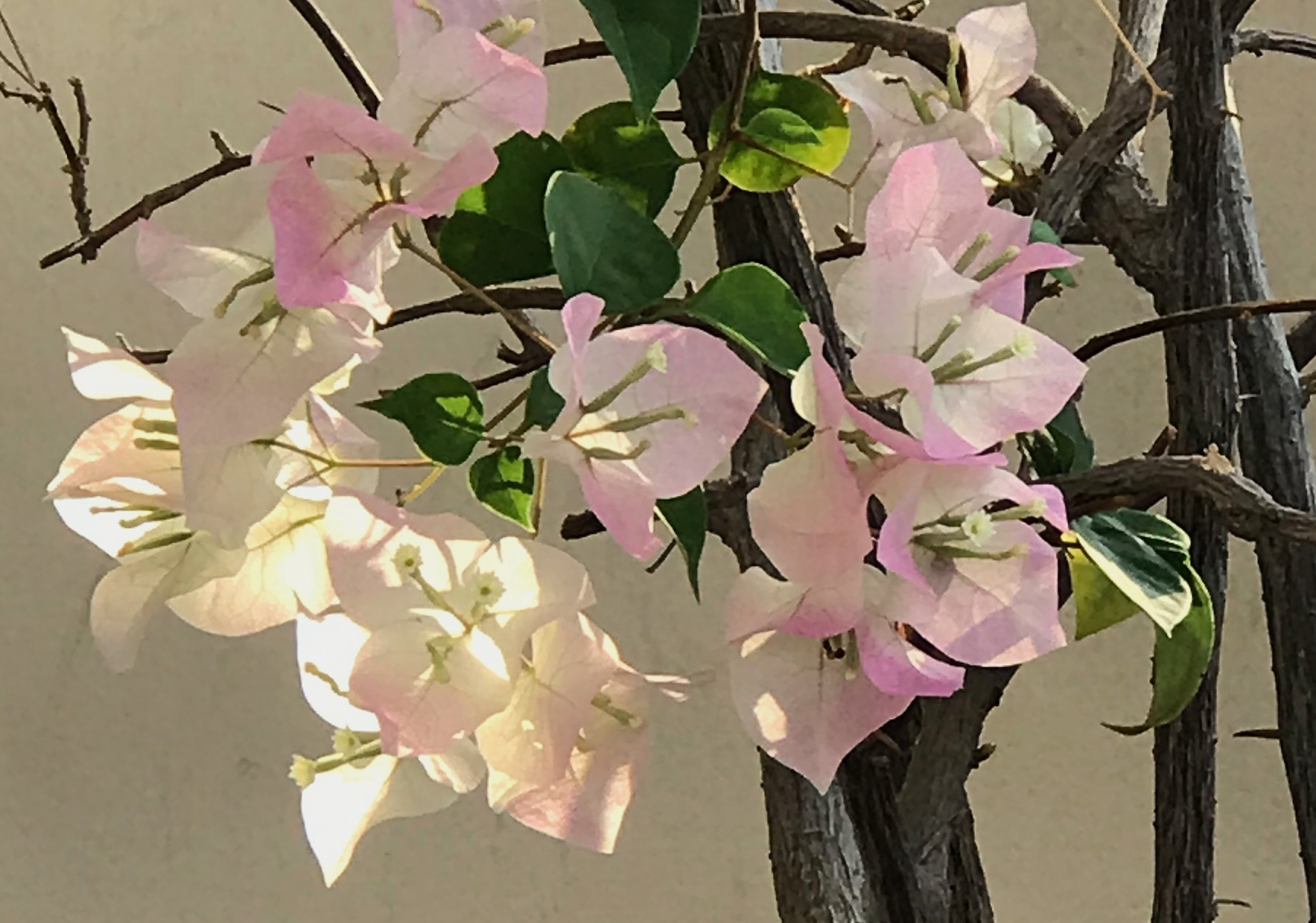
*About the image: it is a photo taken of the bougainvillea plant on our balcony, caught in a sunbeam.

the in-between space

POSTCARD # 492: Bangkok: Some years ago, before the Headache1 arrived, I wrote a post, titled: ‘The in-between thing,’ dated: August 12, 2012. I had just started to meditate and became aware that the focus of attention can be in two places at the same time, located in this in-between space. I can be focused on one item of thought and at the same time there is sufficient focus on another item of thought to be able to see it’s possible to be focused on both at the same time. It moves and changes and at times there’s a bit more focus on one than the other but I am able to see it’s an awareness of one item of thought that includes awareness of another (note: and a third place of awareness that knows the other two places).

Although you could call this is the neutral state of mind, the Headache has now been with me since 2015, and I feel the ‘in between space’, is a specific place where I can go to find refuge from the pain, rather than a neutral state of mind, which doesn’t seem to be anything. Particularly when there is a sudden stab of head pain, ringing in urgency like an alarm bell that triggers an automatic reaction from Self to get out of there immediately! Nowadays, when that alarm bell rings, there’s an immediate leap away from the pain and into the refuge of the in-between space.

There’s an awareness of the painful area (around the right side of the head), and there’s another awareness that knows this – awareness of awareness. It means I can stay with the headache and just step back from the proximity to the pain because I realize I’m seeing it from somewhere else. In the Buddhist sense I’m drawing attention to an awareness of Suffering and the cause of suffering, but not just labeling it; ‘the cause’ of Suffering is ‘desire,’ the 2nd Noble Truth, no, I’m asking, what is this cause? It’s not ‘What is the cause of Suffering,’ it’s what is the cause of the cause?

I discovered that wanting-it-not-to-be-there is causing more of a problem than anything else. It pulls me into a confrontation with the pain (vibhava tanha2: the desire for it not to exist), and I can get caught up in this awkward attachment to the pain, and I have to get away from that mind state in addition to getting away from everything else! Instead of all that, find the space between thoughts, and the emergency mode is switched off. I can ease back from it, thinking, if there’s this awareness of the pain, there’s another awareness that knows it’s there – what is this ‘other’ awareness?

I can be engaged in some kind of difficult attachment and at the same time be aware that it is happening. There is another location from which I can be focused and the thinking process surrounding that pain scenario can be observed from that other location. If it’s seen, the attachment to Self is less intense (or not intense at all) and without anything to which it can adhere, gradually it’s not there anymore.

I learned how to do this by trial and error, and now it’s possible to contemplate the state of the body and to contemplate the mind contemplating this. I’m seeing it from somewhere else. The reaction to the pain caused me to stumble upon this space that’s in-between. I just didn’t know how to get to it before.

1headache caused by Post-Herpetic Neuralgia

2 three kinds of desire: 1. kama tanha (the desire to have) 2. bhava tanha (the desire to become) and 3. vibhava tanha (the desire to get rid of)

Image by Loris Lambert: Ibiraçu, state of espírito santo, Brazil

Han Shan’s “Looking at the Mind”

Look at what your body is – it is not you
But an image in the mirror of awareness,
Just like the reflection of the moon on the water.

Look at what your mind is – it is not
The thoughts and feelings that appear within it
But the bright knowing space that holds them.

When not a single thought arises, your mind is
Open, perceptive, serene and luminous;
It is complete as great all-embracing space
And holds all kinds of wondrous aspects.

Your mind does not come or go away,
Has no particular shape, nor a special way of being.
But a great many beneficial qualities
Come all forth from this one knowing being.

It does not depend on material existence,
Material existence covers it up!
Do (therefore) not take vain hopes seriously,
Vain hopes lead to illusory phenomena.

Closely investigate this mind, which is
A knowing emptiness, not containing a thing.
When you are suddenly flooded with emotions
Your vision gets unclear, your experience confused.

Then at once bring back your presence of mind
And gather all your strengths to reflect.
The clouds will disperse and the sky will clear:
The sun of awareness spreads brightly its light.

If no feelings or thoughts arise within
No (worrying) circumstance is found without.
So where lies the original reality,
Of all that has characteristics?

If you can be aware of a thought as it arises
This awareness dissolves the thought at once.
Sweep away whatever state of mind may come,
Be present and aware – and you will be free.

Good and evil, internal or external,
Transform when you turn towards the heart of it.
Worldly and spiritual forms
Come into being through what you think.

Using a mantra and looking at your mind
Are means to polish the mirror of awareness;
Once the obscurations have been removed
They have no more use and can be dropped.

All great and deep spiritual abilities
Are already complete within your mind
And you can roam as you wish
To the Pure Land or Heavenly Palace.

There is no need to seek the Truth
As your mind is from the start already enlightened.
When ripe, all things are fresh and new
When fresh and new, they are inherently already ripe.

Day and night all things are wondrous
And you will have faith in whatever you meet.
The above is what you need to know
Regarding the mind.

Hānshān Déqīng (1546–1623)

the story-teller is the story told

POSTCARD # 491: Bangkok: The Buddhist no-self (anatta) is mentioned many times in these posts, which indicates the special place it has in Theravadin Buddhism, but there is also a place for the self or selves; the ‘costumes’ we wear when we speak, discuss, and converse with others. This is of course, how we live our lives, we think of ‘ourself’ as our ‘self,’ and others as the ‘selves’ we may know or those we meet incidentally who just slot into place as individuals we speak with in the course of a day. The way we communicate can be thought of as story-telling… we are all narrators. In conversation we tell others our stories and we listen to the stories told to us by another speaker. Spoken dialogue is usually completely unrehearsed stories that just come tumbling out in a spontaneous leap of words, intuitively arranging themselves as they fall into place. Maybe with a return at the end, to indicate an opening where another speaker can join the conversation.

The television/video screen enters our world with words spoken by professional speakers or actors, along with studio-created images and the whole production is presented as a story supported by enhanced colour and artful lighting. TV News is a more ‘live’ telling of a story about (international) events. The storyline is edited to suit unseen sponsors and others’ requirements. We’re all just seeing ‘the seeing of it’ with stories built upon stories, swirling around events that actually took place. Adverts between programs are stories sliced up into key words and images and Mind puts it together, creates the story of ‘me’ reading all this, me going forward, and ‘me’ as someone just arriving in present time. Who’s that mirrored in the glass wall? This could be a story about me.

In the mind, I believe I am the story and the story is everywhere in my social environment, excerpts of it overheard in the places I visit and the friends I share my time with. We’re always only part the way through whatever story it is before another starts up. Unknowingly we follow up on incomplete stories, searching for an ending – a satisfactory ending. Looking through beginnings, middles and ends of stories that are not satisfactory, but there is no satisfactory ending, in reality… and so, in the mind, we invent endings to make them satisfactory. We tell others stories about ourselves., in so doing, we also tell them to ourselves, assuming there is a self to tell something to, a someone else serving as an audience who is oneself or one’s self.

The Buddhist cognitive sense is the sixth sense, the sense that knows the other five senses and knows itself as the ‘self’ until attachment to that self-aspect is seen through. There is no permanent enduring self, only fleeting selves that arise when thought of, then disappear as soon as they are forgotten.

This post was influenced by a book by David Loy, ‘The World is Made of Stories’

‘No identification can be secure in an impermanent world where all phenomena arise and disappear according to conditions. Liberation occurs when I wake up to the “emptiness” of my true nature. In terms of stories, without realizing the no-thing-ness that transcends all the sedimented roles in “my” stories, I remain stuck in those narratives and their consequences for good and ill.’

back from where we came

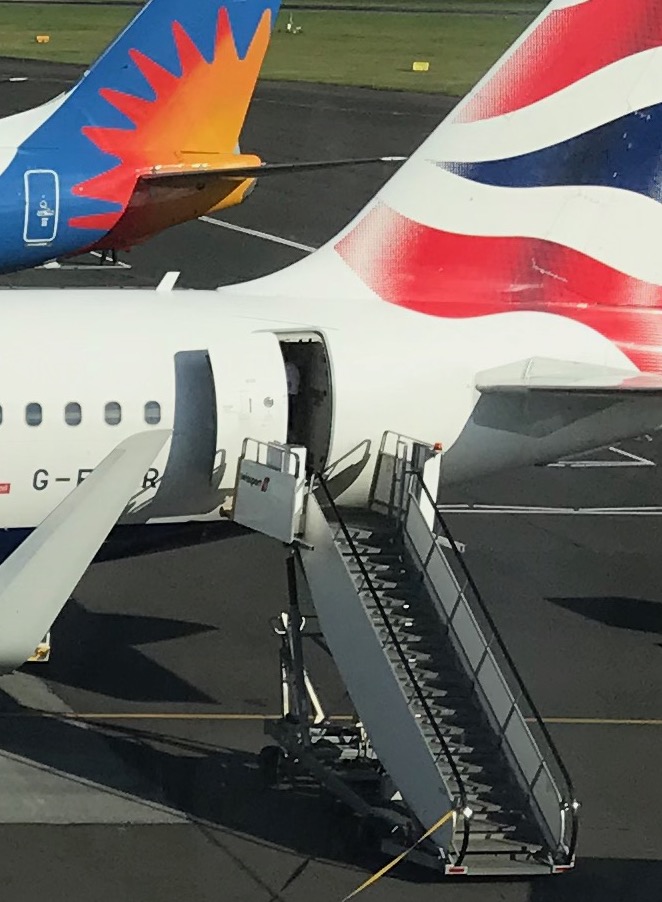
POSTCARD # 490: Newcastle Airport: I get a lift to the airport, not far, check in for the flight back to Bangkok, and it’s done… boarding pass and passport in shirt pocket, and they tell me to sit down for a while. Soon after that the wheelchair guy arrives. Jiab convinced me to go on a wheelchair, my problem is balance, if I turn too quickly, I can fall over. There have been a few falls. Hands go out, reflex reaction, in the midst of a fall, and bracing for impact. I broke the little finger of my left hand in a fall, and it never got set properly, it doesn’t go flat, it’s curved. Now I’m walking with a stick that folds away into a plastic case. Don’t need it now, I’m wheeled through the airport security portals and glitzy duty-free sections, straight ahead, the shortest possible route to Departures.

There is something about being in a wheelchair, upright dignity is just gone. I am in a truly passive state, humbled by the generosity of everyone giving way. Exhilarated by zooming into the great perspective of long airport walkways, huge architectural structures move towards me and pass through. Seeing the world from a lower eye level – déjà vu memory of being a child again. It comes with the acceptance of aging, an understanding of what helplessness is, the existential plight; insight into the realization that most of us are held in a trance-like state, pulled into the ‘self’ fiction by the mirror of Western society’s misconstrued fear of the unknown void, emptiness śūnyatā, therefore stuck with the belief in gratification of sensory desires, suffering and the fear of death. Wheelchairs are allowed to go straight through the lines of waiting people and up to the entry to the plane. I’m helped into my seat and the stewardess puts my bag away in overhead luggage space.

The transition takes place from terra firma to blue sky, and fluffy clouds of the heaven realms. Some hours later, we’ve had food and drinks and the lights are turned down so people can sleep. I’m just sitting here with the sound of the plane engines going on and on, a penetrating noise/vibration and the hissing of air. I have to get on good terms with this noise, get used to it, otherwise it could trigger a monstrous headache (but it didn’t).

For a while, I’m able to forget the noise and fall into a partial sleep. A dissatisfactory world of thinking about this and that, pondering over who did what, where and when – a ‘self’ is acting the part of characters portrayed in thoughts, being her and him and us and them and entangled in bits and pieces of related thoughts. The only constant in all this is the hypnotic one-note song I’m singing. So, I have to wake up to see what’s going on… immediately there’s the noise of the engines again. Why do we have it upfront like this? And I try to understand it better.

At first it seems as if there’s a noticeable regular beat in it, like the pacing of a runner, the hissing, whooshing noise suggests speed. But it just goes on and on, there is no ending, no runner arriving at the finish line, no congratulatory roar of cheering and applause… the sound doesn’t ever let up or change. It remains stretched out like that – a prolonged state of going but not arriving. The tedium of it is exhausting. I stand up to flex my knees and visit the toilet. I get inside that small space and close the door, but the noise is in here too! The sound and the hiss are in the centre of my consciousness. I remember now from other flights, everywhere you go inside the aircraft, the noise is the same. Where does it come from?

Anyway, it doesn’t sound like a mechanistic sound, no faults, irregularities, no rising or falling intonation.  How could there be engines that run so totally perfect for twelve hours in a flat continuum of engine noise? This seems strange to me, and a more reasonable explanation comes to mind; the sound and the hiss are being played on a sound track, the intention being to mask the actuality of engine sound and lessen the panic passengers would feel, over the various small changes in the engines’ sound that might happen.

Thus, I find myself situated in the illusion; the engine noise is not real, besides, the plane itself is held on its flight path by automatic pilot… things are done but there is no do-er; ‘no-self,’ (anatta). The aircraft is 6 miles up in thin air, going at 600 mph, like a streak of light across the curvature of the planet. Yet, inside here, passengers are lounging around, looking at videos, playing cards, chatting, having drinks. Impossible to get my head around this, I settle into a meditative state, watching the breath and the sound is now like a warm embrace. The ongoing thinking about things doesn’t bother me… no-self, they’re not ‘my’ thoughts, just random phenomena that arise and fall away.

Otherwise having a silent mind, silent awareness of the present moment, no preferences, simply aware of things as they appear right now. Nothing to say, no opinions about visitors who come in, and stay, or go… let them. No reactions, no responses at all – quietly observing and practicing silent awareness in the present moment with the background of sound masking out all irrelevant things. 

It didn’t take long to start the descent and I forgot to listen for any change in the ‘engine’ sound. Then the ear-popping fall into the lower realms, and bing, bang, bop the plane landed in Bangkok. I had to wait for the passengers to deplane then the Thai wheelchair man was there, a small person with big shoulders. He looked like he was capable of heaving my heavy weight up the inclines and along these long corridors. I needn’t have worried he was pushing me along faster than I‘ve ever done it on foot! In no time at all we had the passport stamped, got the luggage from the belt, out of the exit into the waiting car. I gave the man a good tip. There and back again in 10 days! Like a video on fast-rewind stops at the beginning not the end, the memory of the hassle and stress I suffered when leaving Bangkok was erased.