
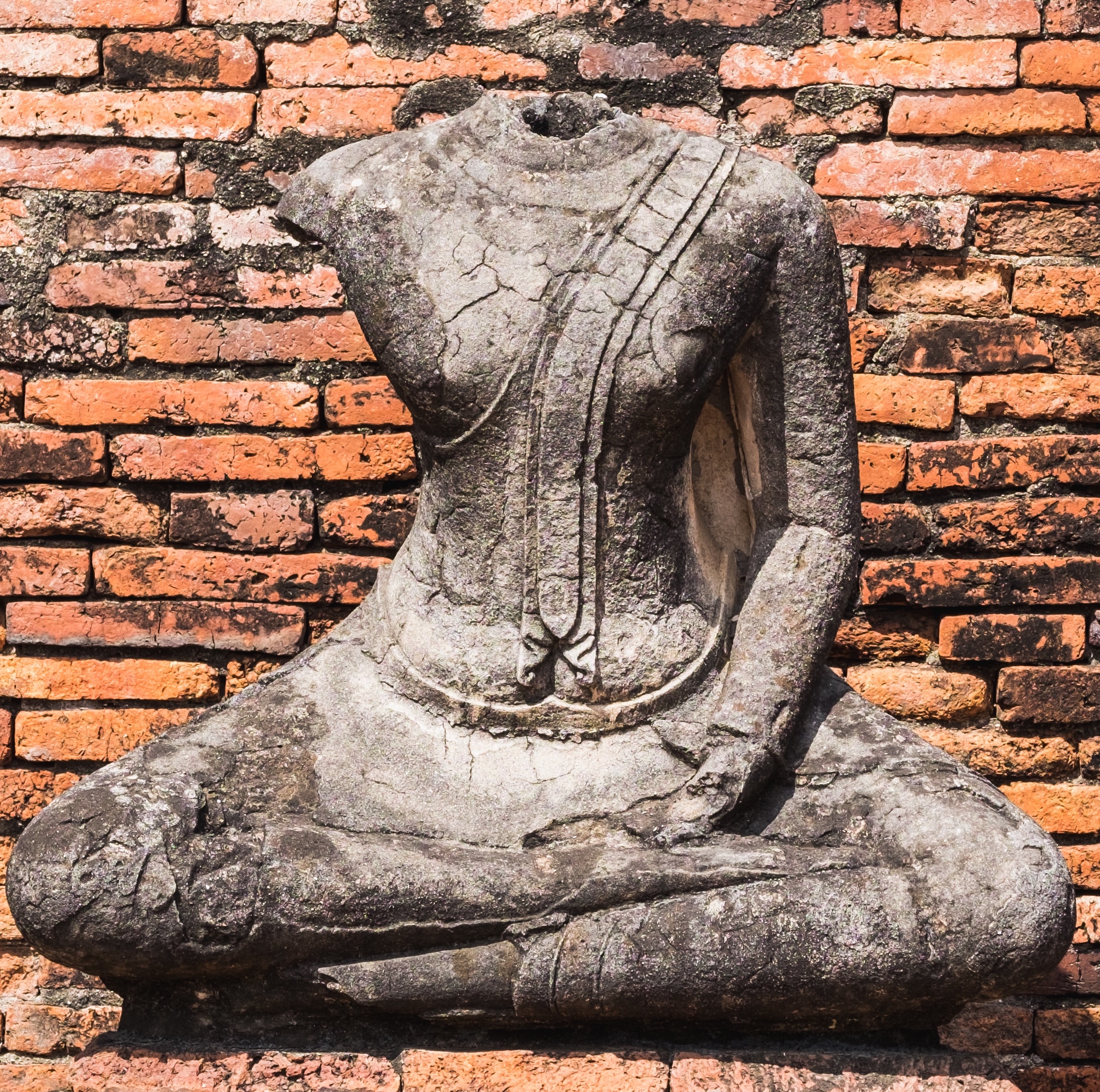
The Anattalakkhaṇa Sutta ‘is the second discourse delivered by the Buddha. The first is the Four Noble Truths. In Buddhism, the term anattā refers to the doctrine of “non-self” – that no unchanging, permanent self or essence can be found in any phenomenon. While often interpreted as a teaching denying the existence of a self, anattā is more accurately described as a strategy to attain non-attachment by recognizing everything as impermanent, while staying silent on the ultimate existence of an unchanging essence. According to Peter Harvey, while the Suttas criticize notions of an eternal, unchanging Self as baseless, they see an enlightened being as one whose empirical self is highly developed. This is paradoxical, in that “the Self-like nibbana state” is a mature self that knows “everything as Selfless”. An Arahat, states Harvey, has a fully enlightened state of empirical self, one that lacks the “sense of both ‘I am’ and ‘this I am'”, which are illusions that the Arahat has transcended. [Wikipedia]
There are many presentations of the Anattalakkhaṇa Sutta, the following is one of my favorites. It was published only a few days ago by Tashi Nyima in The Great Middle Way and is the inspiration for this post. Click on the link at the end of this text to find the original.
This is not me’
Any form, feeling, perception, volition, or consciousness whatsoever that is past, future, or present; internal or external; blatant or subtle; common or sublime; far or near, is to be seen as it actually is with right discernment: ‘This is not me. This is not mine. This is not my self.’
Seeing thus, the well-instructed disciples of the Noble Ones grow disenchanted with form, disenchanted with feeling, disenchanted with perception, disenchanted with fabrications, disenchanted with consciousness. Disenchanted, they become dispassionate. Through dispassion, they are fully released. With full release, there is the knowledge, ‘Fully released.’ They discern that ‘Birth is ended, the holy life fulfilled, the task done. There is nothing further for this world.’”
𑁋Buddha Shakyamuni, Anattalakkhana Sutta
[The following is a reblog of excepts from a post first published here ten years ago, titled Redefining the Question] April 12, 2013, 04:00 New Delhi: There’s no doctrine of God-worship in Buddhism, in Christianity, there is only belief – ‘I believe (I believe) in God. There’s no real teaching on how to understand life, the world. In Buddhism, there is the Anattā Teaching; the separate ‘self’ is an illusion, ‘a cluster of memories, thoughts, habits and conditioning’, maintained due to this basic human tendency to hold on to stuff. It’s not about self, it’s not about our origin, our Creator or what we are made of, it’s about how the whole thing works. It’s a 2600-year-old teaching about learning how to see what our hang-ups are, and easing the burden of emotionalism and wrong-view.
It’s not about living for our(selves): seeking, acquiring and hoarding, it’s about generosity, relinquishment and giving it all away. It’s about mindfulness and the way things exist, rather than what exists. It’s about realities that fit into our world today, exactly as it was in ancient times. The Buddha anticipated modern physics: all matter is energy; beings exist as “bundles of energies” (five khandhas). It’s not about ‘self’, it’s about non-self, anattā, it’s about consciousness, viññāna, and the perennial question: what is consciousness? Without a basic understanding of what the Buddhist non-self is, it’s impossible to contemplate the existential ‘is-ness’ of consciousness.
I go to lie down for an hour or so; still not yet dawn. Watch the in-breath/ out-breath, conscious of the sound of the ceiling fan above me in the shadows, constant spinning cycle that somehow says something about the weight of the rotary blades. It looks like how it sounds: a spinning propeller of an old-fashioned aircraft – consciousness of the visual image. Always there’s consciousness of something: consciousness of the smell of coffee and a breakfast crust of toast in the kitchen, the taste of it; consciousness of the soft bedding I’m lying in. There’s consciousness of thought and then there’s consciousness of no-thought – my perception of it… consciousness without an object, the still mind, unsupported consciousness – unconditioned? The non-dual perspective is that it’s like this anyway….
“The “empirical self” is the citta (mind/heart, mindset, emotional nature), and the development of self in the Suttas is the development of this citta.” [Peter Harvey, ‘The Selfless Mind: Personality, Consciousness and Nirvana in Early Buddhism.’] Consciousness without an object in the sense that it is different from the basic functions of interacting with the world through sensory organs: eye, ear, nose, skin, mouth and mind; different from the state of being conscious of what’s going on in the body/mind organism, phassa, as a result of responses to the world outside. Not consciousness of… just consciousness itself – what is this? Is this the kind of consciousness that’s needed to find the answer to the question or to redefine the question, maybe, or whatever… is it the true self?
‘…this true self is also the fundamental source of all attachment to being and becoming… attachment to the allure of this primordial radiance of mind that causes living beings to wander indefinitely through the world of becoming and ceasing.’ [Luangta Maha Boowa]
Link to Tashi Nyima’s original post in The Great Middle Way:https://greatmiddleway.wordpress.com/2023/08/28/this-is-not-me-2/
 dhamma footsteps
You must be logged in to post a comment.