
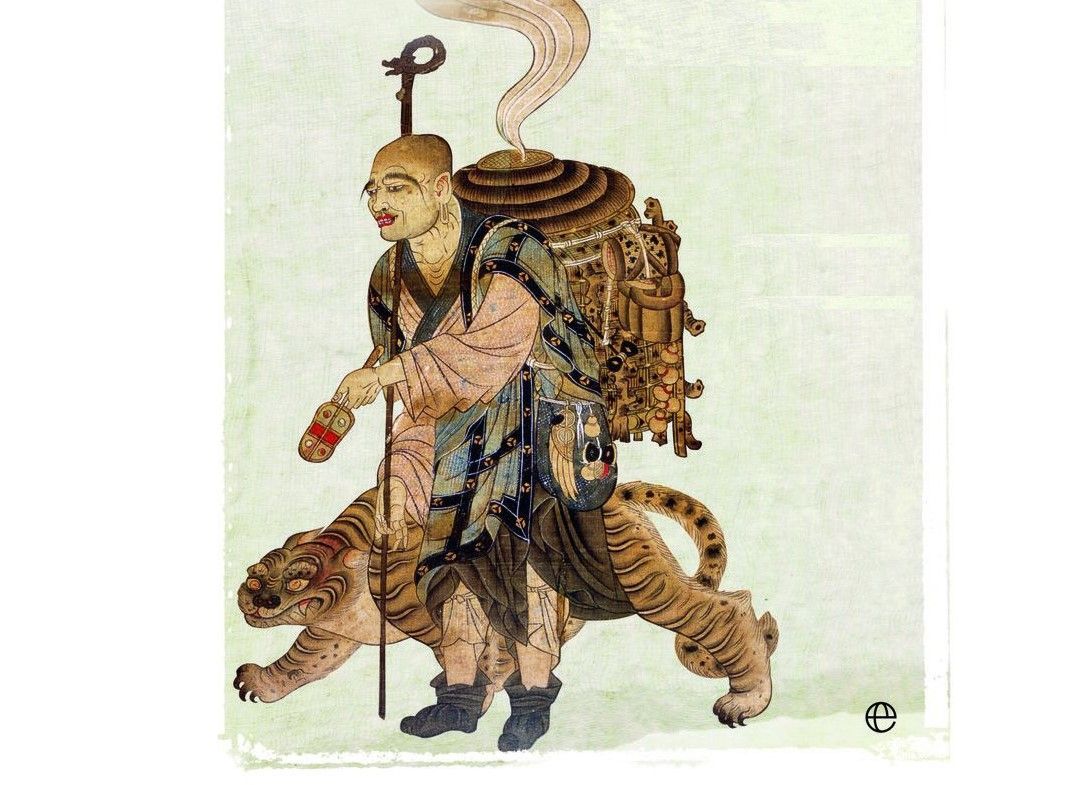
[Editor’s note: I was reading about Fa Xian, the Sixth Century Chinee Buddhist monk who, at the age of sixty, walked overland to India and I thought what is it that drives a person to do something extraordinary like that? Then I listened to Ajahn Sucitto’s Dhamma talk given at the ordination of a young monk and he was talking about the ‘call’ or the whisper that doesn’t have a sound and it doesn’t come from thought. It’s the citta, a special quality you could call faith – except that it doesn’t come from a belief in anything. It seemed to me that the ‘call’ in Ajahn Sucitto’s talk is what Fa Xian heard or became aware of. So, I transcribed some parts of Ajahn’s talk and that is attached at the end of the Fa Xian story for you to decide.]
FAXIAN
Faxian, also referred to as Fa-Hien, Fa-hsien and Sehi, was a Chinese Buddhist monk and translator who traveled by foot from China to India to acquire Buddhist texts. Faxian’s visit to India occurred during the reign of Chandragupta II. He entered the Indian subcontinent through the northwest. His memoirs describe his 10 year stay in India. He visited the major sites associated with the Buddha, as well the renowned centers of education and Buddhist monasteries. He visited Kapilvastu (Lumbini), Bodh Gaya, Benares (Varanasi), Shravasti, and Kushinagar, all linked to events in Buddha’s life. Faxian learned Sanskrit, and collected Indian literature from Pataliputra (Patna), Oddiyana, and Taxila in Gandhara. His memoirs mention the Hinayana (Theravada) and emerging Mahayana traditions, as well as the splintering and dissenting Theravada sub-traditions in 5th-century Indian Buddhism. Before he had begun his journey back to China, he had amassed a large number of Sanskrit texts of his times.

On Faxian’s way back to China, after a two-year stay in Sri Lanka, a violent storm drove his ship onto an island, probably Java. After five months there, Faxian took another ship for southern China, but again it was blown off course and he ended up landing at Mount Lao in what is now Shandong in northern China, 30 kilometres (19 mi) east of the city of Qingdao. He spent the rest of his life translating and editing the scriptures he had collected. These were influential to the history of Chinese Buddhism that followed. Faxian wrote a book on his travels, filled with accounts of early Buddhism and the geography and history of numerous countries along the Silk Road, as they were, at the turn of the 5th century CE. He wrote about cities like Taxila, Pataliputra, Mathura, and Kannauj in Madhyadesha. He also wrote that inhabitants of Madhyadesha eat and dress like Chinese people. He declared Patliputra to be a prosperous city. He returned in 412 and settled in what is now Nanjing. In 414, he wrote (or dictated) Foguoji (A Record of Buddhistic Kingdoms; also known as Faxian’s Account). He spent the next decade, until his death, translating the Buddhist sutras he had brought with him from India.
~~~~~~~~~~~~~~~~~~~~~~~~~~~~~~~~~~~~~~~~~~~~~~~~~~~~~~~~~~~~~~~~~~
The Call
[Excerpts from a Dhamma talk by Ajahn Sucitto showing on You Tube, link at the end of this text.]
This ordination ceremony is the beginning, the entry point, and we can all perhaps resonate with the sense that there’s an occasion here. Someone is making a declaration to put aside the normal, the ‘knowns,’ the familiar forms of the domestic situation, the job, the family. Put aside having things my own way, we come to serve.
All these opportunities, we gave them up. We gave them up because they weren’t taking us far enough. Something else started to call; a sense of the ‘call; it’s something that’s not about what normally shapes our lives. Something else begins to whisper, or call in a louder voice than all that. It’s Faith – doesn’t mean a belief in anything. The way I understand it is, my home is in the world of sense consciousness; sight, sound, touch, hearing, odours, fragrance and the measuring mind, the thinking, planning, opinionizing, dogmatic, believing, mind. It moves around the other senses, deciding, judging, comparing, contrasting and reflects upon itself, thinks about its thoughts, thinks about its ideas, thinks about its psychologies. It’s very engrossing, gets very dense and becomes a territory called ‘Mine.’
Other people are in their world. It’s Her world or it’s His world – not My world. There’s conflict, disappointment, frustration. Everything is flooded with dogma media, chat shop, chat shows, chat rooms. People chat, chat, chat, opinions about this, opinions about that; this-that, this-that, Right-wing, left-wing, middle wing, going up, going down and the whole thing blabbing away and you’re thinking about your own opinions about yourself.
Then there is the ‘Call’ – not necessarily a sound, it’s some sense of, ‘I want to get out of this, even though I’m looked after, well fed. I’m not being brutalized. I’ve got a car or a flat or a partner’. Even though I’ve got a reasonable deal in life, compared with some people, I’m still not satisfied and this isn’t taking me anywhere that really makes my life feel bright, clear, confident. And that something begins to dawn, a sign of Faith.
The Buddha said its root condition is actually not a belief in anything but the realization that things don’t work, nothing fits… there’s got to be something better than this (dukkha). Maybe this is the point where we begin to recognize some sense of ‘I am,” a sense of being that’s not a thought, it’s not a possession, it’s a sense that’s not associated with sight, sound or all the other senses. This is the citta, it’s a kind of an immaterial quality whereby we’re able to review and get a perspective on what the six senses are bringing in.
That’s what enables us to recognize this is not my true home, this is the building, these are the clothes, that is my name on the passport but it’s is not my true home. My home is something more fundamental. We begin to recognize as soon as we step back from just adopting what’s seen or heard or thought, that it’s enough to just barely notice it. This is hearing, this is a sound, this is a sight, or this is a thought. This is feeling stirred-up, this is feeling disappointed, this is feeling irritated, this is feeling glad. We step back from it and notice there’s an awareness of it, and there’s something else here that could support you – not easily revealed without quite a considerable amount of cultivation, purification, and clearing away and firming up of this experience, this, citta, the awareness; firming it up till it becomes a refuge and the Buddha said this is the refuge, there is no other refuge.
Early on, in my own situation, my own life, I had the certainty that something wasn’t working, even though I was ticking all the boxes and I was in Thailand and that was supposed to be interesting and fun and so on. But, no… it wasn’t working, what do I do next? So, I stumble into one of these meditation sessions, meditate for Fifteen minutes. I thought well… it’s worth a try. Just sit and be with your breathing for Fifteen minutes, but…‘Whoa!’ The mind was going all over the place and I couldn’t watch one breath. But I was able to recognize there was something there that was able to see my mind going like a crazy monkey. This is, of course, the citta (awareness). ‘Okay I don’t know about that right now, what I need to have, is the encouragement and support to get that measuring mind, with all its wishes and wills, tethered down. So, I’ll go to a monastery. When I go there, I won’t have so much sense impact and so many choices.’
So, I got there, and thought well, it’s testing to just unplug, but I could do this for a couple of weeks. I could sense something stirring, something awakening because when I left Thailand to get a new visa, things were different. I had decided to spend a couple of months travelling around in Malaysia and Indonesia, but all I wanted to do was sit and meditate. So, I went back to the monastery and decided to stay there for a while. They didn’t have anagārika in the place I was, so I became a sāmaṇera. After six months I decided to stop thinking about how long I was planning to stay there because the measuring mind cannot comprehend what’s going on or where this is coming from, you just have to trust the process.
And that’s what it is, essentially; something wants to do this, something wants to wake up. This is special, this is sacred, and it comes from that Call. There’s the mind, then there’s the body. So what does the body reveal by itself? The body is not seen or heard, by itself. It has a sensitivity to it that is twofold. There is a tactile sense; it’s always being touched by furniture and clothes. Other times there’s just space all around except for say the sensation of feet touching the ground.
The body also has an inner sense which deals with things like being intense, relaxed, excited, angry, sick and in this very body is the beginning of my world. My world begins right here, and this is where you travel, right through to the end. It’s here that we practice breathing, sensing the energy of the body moving within the body. How the body brightens up when we breathe in and gets calm when you breathe out – basic meditation, and that quality of brightening and subsiding is not a physical sense it’s an energetic sense. In this you’ve got something that will never leave you as long as you’re alive. It acts as an inner refuge. where we can contemplate our emotions and thoughts and yet not get caught up in them. When we feel things like worry, anger the body reacts. Anger flushes into our face, fear cramps around our belly, excitement thumps into our heart.
As for thinking, there are all these forms of contact that stir, arouse, disappoint, excite and present possibilities of grasping. Thinking is the king and leader. At the drop of a hat, the thinking mind will proliferate immense scenarios of ‘my’ world and immense pantomimes of other people and their world. A major part of our training, is how to notice the tendency to proliferate and to realize this is what we need to get free from.
There is a way, and this way is supported by the presence of the body which doesn’t proliferate, has no future, no past, does not establish me and mine. It establishes life, and we take refuge in life itself, as long as this life lasts. It’s an extremely helpful tool where the citta gets support gets stabilized by that presence of body. It keeps you grounded. You tune into that and you can sense thoughts, sights, sounds moving around. Their nature is to come and go, they’re interchangeable they’re insecure. And you’ve got this (body and mind). And this practice is centred on meditation,
This is an enormous practice, really when it comes down to it, your cultivation, your meditation is meeting in these places we would normally grasp, normally rush, normally tighten. Meeting these places where reflexes start firing and at that very point, come into awareness and presence and let’s see what we can do.
That’s practice… practice is about driving to the airport… leaving you think, a good two hours to get to the airport but you hit a traffic jam. Watching the clock go tick, tick, tick, and here we are, insecurity, uncertainty… I can’t make what should happen, happen! Ah practice, practice is about cultivating that point where we start to learn about situations that we would normally find infuriating, difficult and we begin to rephrase it… a chance for equanimity to be developed. A chance for patience to be developed, good. These tremendous strengths, patience, equanimity, resolutions mean you keep returning time and time again to your ground which is steady which will always look after you, which will carry you through life and into death and beyond.
This solemnizes our occasion; this makes it all worthwhile. I wish you all the best.
Ajahn Sucitto
Link to Ajahn Sucitto’s Wikipedia page:https://en.wikipedia.org/wiki/Ajahn_Sucitto
Link to Ajahn Sucitto’s Dhamma talk on You Tube: https://www.youtube.com/watch?v=N_1n3pfnAuw
(You need to go back to the beginning of the video to hear the whole talk)
 dhamma footsteps
You must be logged in to post a comment.