

By Ajahn Sucitto
(From last week): Thus, the old perception shapes me; in this case, as a fearful or confident person. And I act from that basis. This is why it is said: ‘Contact is the cause of kamma.’
To summarize: contact touches the citta, attention focuses it, and intention launches its response. This dynamic and formative process and the ‘track’ or ‘formation’ that it leaves in the citta is a saṇkhāra – the formative aspect of mental kamma, and what it forms. Saṇkhārā are crucial because they shape both action and actor – following their tracks, I become the tracker.
Now you could say that all meaning is factual: in the above instance, maybe a dog did bite me when I was four. That’s why I see dogs like that, and it’s quite reasonable. And it may well be the case that men in uniforms/red-headed women/people who talk fast (etc., etc.) have frightened me or let me down at some time or another. And it may also be the case that my fear or suspicion is based purely on somebody else’s opinion. But what the Buddha is pointing to is not historical circumstance or the attitudes of others – over which we have no say – but how fresh action arises when the felt sense that comes with designation-contact pushes a button on the citta and the established meaning jumps up.
What we might be encouraged to do then, is not to run away from, poison, slander, or get paranoid about dogs or people, but to handle the felt meaning and assess its validity in the here and now. Because to base one’s responses on one piece of data alone, even though it touches a sensitive spot, is only going to intensify the impression and bind you to it. Yes, as that’s a sensitive spot, that felt meaning should be responded to – but with skilful attention both to the actual dog, now (‘Is this dog, here and now, growling or baring its teeth? Or just sniffing around?’), and to your state of mind (feel the fear and pause on reacting to it). This is the kamma of handling and reviewing contact, attention and impulse – the kamma that leads to the end of further kamma (from that historical bias, at any rate).
Otherwise, it can be the case that even when there are no dogs (and so on) around, one can still be anxious that one might come by soon. Sounds ridiculous? No, paranoia is part of social life, even encouraged: look out for ‘suspicious’ people, Communists, radicals, atheists, men wearing hoodies, etc. … and when the citta collapses under all this, it’s chronic anxiety and medication. However, if we at least get the idea that these felt meanings are established in the citta, not in the object, we might also acknowledge the possibility that these historically-based perceptions could be reset or disbanded; also that positive ones – such as those associated with goodwill, generosity, integrity, and the many qualities perfected by the Buddha, proclaimed in his Dhamma teachings, and practised by his disciples – could be established. These perceptions can help the heart settle and bring forth the truth of its own goodness. This is the rationale behind devotion and recollection.
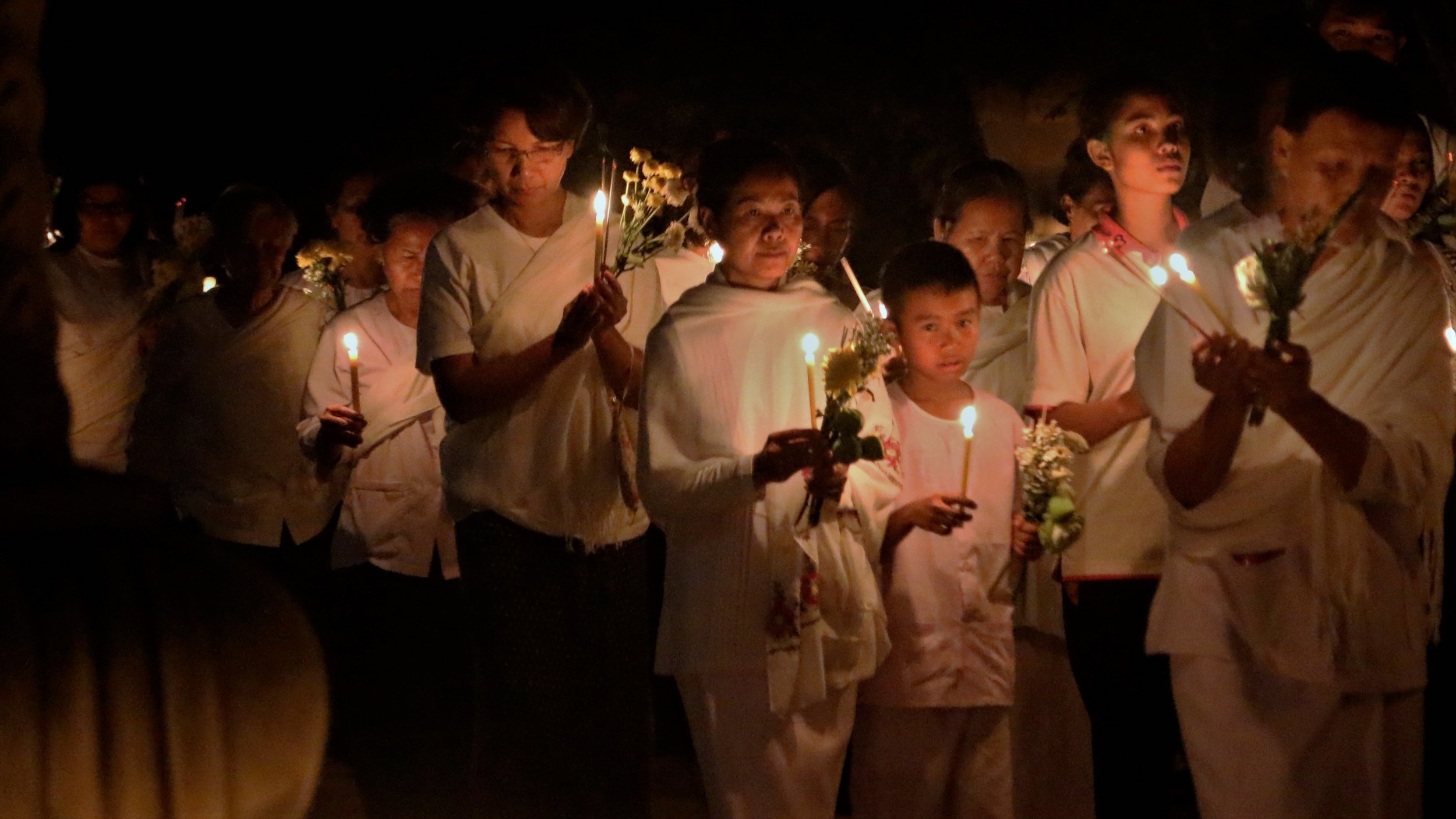
Pūja’: Ritual that Brightens the Heart
In Buddhism, and in other religions, access to and dwelling in the heart-tone of bright kamma is occasioned by devotion and recollection. In Buddhism, this is called ‘pūja’ – an act of raising up, and honouring that which is worthy of our respect. The very fact that there are human models and actions that one can feel deep respect for is itself a blessing to take note of: honouring opens and uplifts the heart. With pūja, we attend to a skilful felt meaning, linger there and allow the effects to nourish the citta. From this basis, it’s likely that inclinations or even specific ideas in line with bright kamma will arise. Either that, or the mind easily settles into a state that supports meditation. This is how and why one should linger in any bright kamma.
So, in the act of honouring the Buddha, one first opens the heart in respect and brings to mind the meaning of an Awakened One: someone of deep clarity; a speaker of truths that penetrate and bring healing to the human condition; one accomplished in understanding and action – a sage whose teachings can still be tested and put into action. If one has a Buddha-image, it’s something that should be held with respect – one cleans it, illuminates it with light, and offers flowers and incense to it. We place it on an altar, bow to it and chant recollections and teachings.
This is not a mindless activity; we use ritual means and resound words and phrases because this full engagement embodies and strengthens the quality of respect in a way that thinking can’t. With the openness of heart that these attitudes bring, any aspect of the teaching that’s brought to mind goes deeper. The act of offering that begins a pūja is a case in point: offering flowers “symbolizes bringing forth virtue, offering light is about bringing forth clarity, and incense does the same for meditative concentration. In this way, pūja introduces the heart to important Dhamma themes.
Pūja is especially helpful when people perform it as a group. Then we are participating in the Dhamma as both the expression and the Way of awakening, as well as in the collective commitment to, and engagement with, that Dhamma. This collective engagement ritualizes the ‘Sangha’, that is, the assembly of disciples. Chanting in a group has a harmonizing, settling effect: sonorous and unhurried, it steadies bodily and mental energies and supports an atmosphere of harmony with fellow practitioners. Tuning in and participating brings us out of ourselves and into a deep resonance with heart-impressions of the sacred. We can be touched by a sense of timeless stability, purpose and beauty. If these intentions, felt senses and recollections are established regularly, we know where to find good heart, how to attend to it, and how to allow ourselves to be uplifted. Such kamma feels bright.

The Benefits of Recollection
‘At any time when a disciple of the noble ones is recollecting the Tathāgata … the Dhamma … the Sangha … their own virtues: “[They are] untorn, unbroken, unspotted, unsplattered, liberating, praised by the wise, untarnished, conducive to concentration.” At any time when a disciple of the noble ones is recollecting virtue, his mind is not overcome with passion, not overcome with aversion, not overcome with delusion. His mind heads straight, based on virtue. And when the mind is headed straight, the disciple of the noble “ones gains a sense of the goal, gains a sense of the Dhamma, gains joy connected with the Dhamma. In one who is joyful, rapture arises. In one who is rapturous, the body grows calm. One whose body is calmed experiences ease. In one at ease, the mind becomes concentrated.
‘Mahānāma, you should develop this recollection of virtue while you are walking, while you are standing, while you are sitting, while you are lying down, while you are busy at work, while you are resting in your home crowded with children.’
(A.11:12; B. BODHI, TRANS.)
The expressions that are used in recollecting Dhamma are that it is experienced directly (not just as a theory), is of timeless significance, and is accessible and furthering for those who practise it. So that gives us an encouragement to look into what the Buddha taught and modelled: the way to the end of suffering and stress. With this, we recollect aspiration, learning and commitment as our common touchstone, and suffering and ignorance as our common challenge. Then we no longer feel so alone with our difficult mind-states, and we can handle them in a more open and aware way. Recollection of Sangha reminds us that although there is greed, anger and confusion in the human world, there are also people who cultivate a way out of that.
If you use pūja on a regular basis, it aligns you to the ‘Triple Gem’ – Buddha, Dhamma and Sangha – by presenting content in terms of images, ideas and themes, and values and practices that guide the heart. It also occasions acts of steering and composing attention. So pūja works both on what the mind is dealing with, and how it operates [Continued next week 22 August 2024].
Link to the original:
https://www.abhayagiri.org/books/458-kamma-and-the-end-of-kamma
 dhamma footsteps
Would you say then that therapy that leads to understanding and therefore helping to destroy learned fearful, upsetting, etc. associations with stimuli would be conducive to practice of any kind. The more one knows about the self, the more able to rise above bad associations one is, it would seem. But it is a life long process.
This is a complex question and no answer comes to mind that would cover all the aspects. I know you are a regular contributor so maybe we could leave it until another opportunity comes along where we could discuss it in more detail.
Sure thing. It can be left as is. It is not important.
I’m glad it’s ok and that’s settled now