
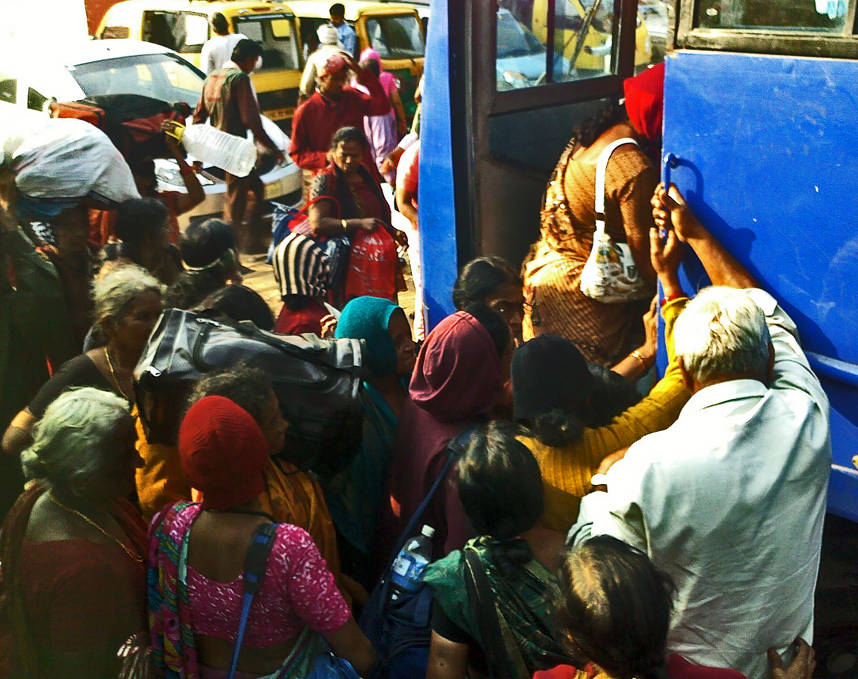
 India-Nepal highway: more like a simple farmyard road than a highway leading to an international border crossing; rough surface and missing chunks of tarmac create an incredible, bump, crash and rattle in the bus that goes on without end. Too much vibration to be able to sleep and impossible because of the noise the bus driver is making with the horn, a high volume squeak-and-squeal alternating between two notes. Cows and goats wandering around scramble to get out of the way; people on bicycles scatter to make room. If there’s a traffic jam, he gets angry, leans out the window and shouts. There’s a co-driver in the cab and he’s sent out to bully, threaten and persuade the drivers of the vehicles to move to one side. Co-driver gets back in again, then another obstruction. I’m sitting at the front of the bus behind the driver, looking through the large windscreen and it’s like everything is held together in a makeshift, temporary way; no time to do it properly, we have to hurry on – what is it? I’m thinking along the lines of a war-zone or some kind of catastrophic event has taken place and this is an emergency vehicle; there is danger and we are fleeing for our lives. But it’s not that, it’s just normal.

The bus gets seriously stuck behind a buffalo walking slowly, with her calf, down the middle of the road; despite the driver’s trumpeting two-note horn, mother buffalo won’t move from her place in the center of the road. Co-driver is sent out to chase the buffalos to the side so the bus can get through and he whacks mother buffalo hard on the rump, an audible WHACK! I can hear above all the racket. Unfortunately, this sends mother and calf off into a frantic gallop straight down the middle of the road. The bus still can’t overtake and has to follow these galloping buffalos for some distance. The driver is getting worked up into a fury, bus lurches to and fro while he’s yelling like a wild man out of the window, and barely in control of the vehicle. Eventually the buffalos run off to the side of the road, the engine roars into life and we accelerate away. Co-driver climbs back into the cab, breathless from trying to steer the buffalos and for a few minutes he has to defer to the driver’s seething anger directed at him. It’s bizarre and funny, but nobody on the bus is laughing.
I’m with a Thai tour group, reserved, polite, quiet behaviour, small body movements and everyone is sitting straight up, dressed in white top and black trousers or sarong. Could be they’re in a state of shock, never having experienced anything like this before. Somehow they all thought (and I did too) that in India there would be vestiges of the Buddhist loving-kindness and the generosity of letting-go but instead of that the whole thing seems to be about blatant greed, hatred and delusion; a skeletal hell realm of holding on tight and mad with desire. India is discovering it’s identity in the media and advertising. The bus went past a poster showing the actor Riz Khan in an advert for whiskey and the slogan is: ‘I have yet to become me’. I managed to get a slightly blurred photo of it.
What happened to Buddhism in India? There were the Islamic invasions and what little remained was assimilated into Hinduism. It could be that, long before that, King Ashoka considered that one day Buddhism in India would come to an end because it has no built-in mechanism to withstand a forceful take-over; it’s fragile and light and doesn’t attach to anything. For this reason he erected simple stone pillars in places where significant Buddhist events took place; they function like markers on Google maps. The locations are verified and Buddhists coming to India, foreigners like me, visit the sites, Bodh Gaya, Sravasti, Lumbini, see these pillars and take a moment to consider that, yes, it happened here. And if it weren’t for King Ashoka’s sense of urgency that these places could eventually be lost in history, there might be no traces of Buddhism in India at all.


 dhamma footsteps
You must be logged in to post a comment.