Homer & the 1st Noble Truth

Switzerland: An old Simpsons episode appears out of nowhere, just as I’m beginning to despair here in the long journey through Central European TV channels; one end to the other, then back again. The samsara of television. So I do find something I can identify with in Homer’s world view, but afterwards, I notice, there’s this strange, unreal quality; the Simpsons effect. Everything else on TV seems changed and it takes some time for this altered perception to pass. The way I find to emerge from the ennui mind is through recognition of the Noble Truth of Suffering: dukkha, the characteristic ruminations of thought, same old thing, and I can just say: oh, that’s what it is, let it go and be done with it. But, how about poor old Homer? I wonder if the creators of the Simpsons ever properly considered that Homer might have a basic understanding of the Noble Truth of Suffering? It seems unkind if they didn’t. He’s so close to it but never quite gets there.

Whether it’s intended or not, Homer is at the very beginning of the spiritual search. He is pre-first Noble Truth, doesn’t know this is dukkha; he doesn’t know what it is. He hates it, he loves it, he’s indifferent to it, he is in denial. He’s so totally immersed in the experience of it, there’s just a dull glow of obscured awareness – enough to see that this is the fundamental human condition? Probably not, Homer is so busy ‘wanting’ things to be different from what they are, he doesn’t realise that this involvement with tanha craving/desire is exactly the reason he’s in the unpleasant situation he’s in.

He tries to see beyond desire and sees only more desire. The idea of ’giving up desire’ triggers the conditioning that desire is ‘bad’. It does stuff to Homer’s head. That’s why he got the idea inverted somehow and managed to explain it to himself that giving up desire is ‘bad’. This means he’s not able to see that (even if he did get it the right way round) we don’t give up desire because it’s ‘bad’, we give it up because it’s what’s causing the pain.

The possibility of release: 3. nirodha [there is a way out], and: 4. magga [this is how you do it], these things are not on his to-do list. Homer has the wrong idea, completely, but I have to remember he is a cartoon character – and I have to consciously remind myself about this. There is no ‘Homer’, there is no ‘self’, there is only the driving mechanism of craving and attachment. Homer can’t see it in this way because he’s conditioned to believe that if there’s desire, it must be happening to ‘somebody’ and that’s Homer. So, it looks like the way to go is to gratify that desire immediately, rather than stop and look at how it came to be like this.

Everyone would be very happy if the creators of Homer could get around to thinking about Homer’s predicament: what does it take for him to get closer to his desire urge and look at what’s really going on there? Without responding to the tugs and pulls, just observing, he’d see that the desire is there because it’s in the nature of desire to be like that. Homer’s curiosity, a dim glimmer of wisdom, is all it needs to clear away the ignorance – there is understanding and desire loosens the tenacity of its hold on him.

Accepting the Noble Truth of Suffering means he can let it go. He’s not confused by it or perplexed by the fact that he doesn’t know what’s wrong. He knows what it is. Knowledge displaces ignorance, so he can let it go. The difficulty of being bound up in difficulty is suddenly not there anymore. Instead there’s the familiar feeling that things are fine just as they are and something about this says to him there can be a profound awakening to the allrightness of just being in the moment.

This small glimpse of the innate quality of peace all beings share might be enough for Homer to seek the Path to Liberation.

————————-

‘The first of the four noble truths of Buddhism, that there is suffering in life, was enormously important to me. No one had ever said it out loud. That had been my experience, of course, but no one had ever talked about it. I didn’t know what to do with all the fear and emotions within, and here was the Buddha saying this truth right out loud. I wasn’t alone, I wasn’t weird, and I didn’t have to feel isolated. For the first time I didn’t feel so utterly alone, like I had a shameful secret…. Then I learned the next three noble truths – I could do something about the suffering. I could change how I dealt with it. I could approach my pain with compassion instead of bitterness, in community rather than isolation. I could change my relationship to pleasure. The Buddha offered a very simple, pragmatic tool — meditation – to transform one’s relationship to everything.’ [Sharon Salzberg, except from an interview in Huffington Post Aug 30 2012]
Birds on the Balcony 3

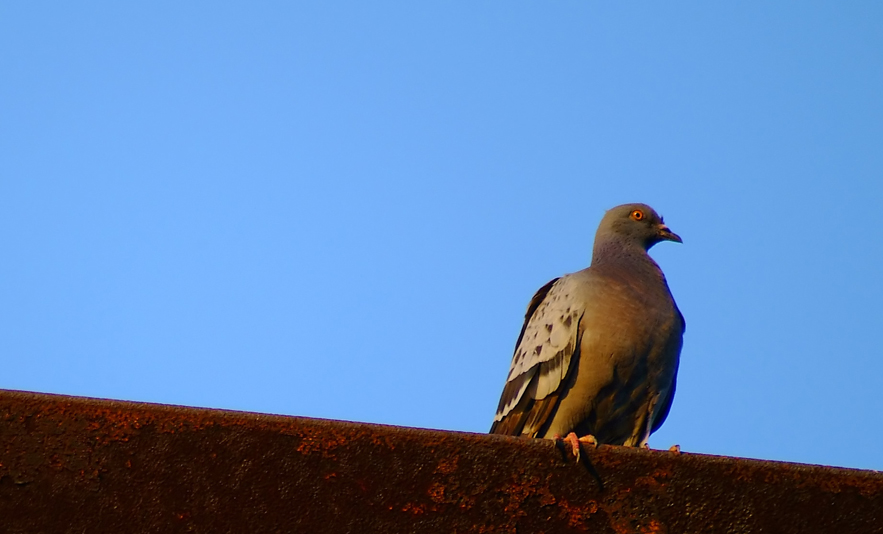
Switzerland, August: Awake at 4:00 AM this morning, came through and switched on the kitchen light: neon tube fluorescent, flicker-flicker flick. Light everywhere, through the windows illuminating the outdoor furniture on the balcony of this 7th floor apartment and the pigeons sleeping there wake up: croo-croo, croo-croo! Had to switch off the light again and they were quiet as soon as I did that. Now I’m sitting in the darkness, held back in my domestic activities by the wildlife on the balcony. What to do now? It takes me a while to get round to noticing this silence the pigeons are in. I get my meditation cushion and place it on the sofa with other cushions to stop it from sinking into the softness and get up on that, a little unsteady but balanced at this slightly higher elevation so I’m able to see the round shapes of the sleeping birds through the window. I’m in their quiet space, we share the peace of this Sunday morning – so silent here, high above street level. There’s a presence around these sleeping birds; there’s an immediate focus on metta loving-kindness to all beings:

‘All people, all animals, all creatures, all those in existence, near and far, known to us and unknown to us. All beings on the earth, in the air, in the water. Those being born, those dying. May all beings everywhere live in safety, be happy, be healthy, live with ease…’

Attention wanders and the mind enters into the story of it all: the bird out on the balcony, nesting in the Christmas tree bucket then there were two eggs, they hatched out and there were two babies and Ajahn V even did a little blessing for them when he came to visit [Link to: Birds on the Balcony1 and Birds on the Balcony2]. The young birds became adults and now we have a small family group inhabiting the balcony. Two adults and two young birds and there’s another one – the mysterious ‘other’ … the alpha male has taken a second wife? I’m saying this because there’s often some upset out there; some extended flapping of wings in the evening as they get their places in the hierarchy settled for the night – it’s like who gets to perch next to whom. I can’t imagine… return to mindfulness mode:

Let them not do the slightest thing that the wise would later reprove. Wishing: in gladness and in safety, may all beings be at ease. Whatever living beings there may be; whether they are weak or strong, omitting none, the great or the mighty, medium, short or small, the seen and the unseen, those living near and far away, those born and to-be-born — may all beings be at ease.’

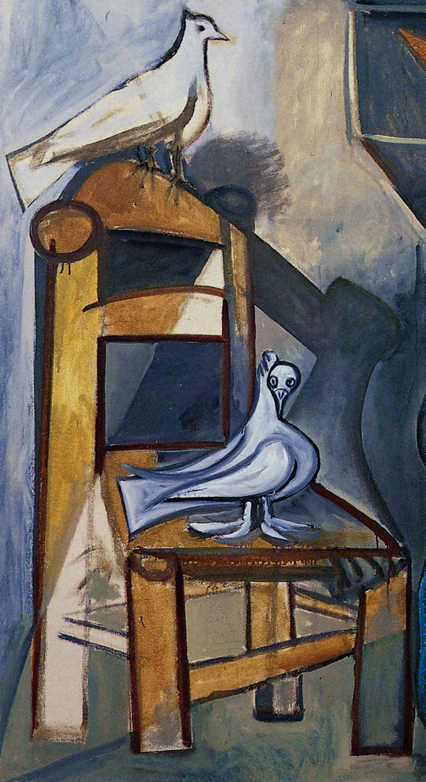
Eyes open slightly in the half-darkness. I’m perched on my high cushion like one of the birds. Morning light is coming up. I see them more clearly now. They’re sitting on different parts of the old artist’s easel that I left out there because it’s too big to have inside the apartment. It looks strangely like a work of art, some kind of out-of-context aesthetic event, but can’t think what that might be…. Picasso did some paintings of pigeons and doves that had moved into his studio in the South of France. I look at these pictures and I just know what that must have been like.

One bird begins to waken up, wing stretch, flutter, flap. They’re here with us, sharing the same worldview. Without us, the birds wouldn’t be on this balcony – they’d be on someone else’s balcony, okay, but the whole thing is about inter-dependency. We all need each other. I am one part in the vast body of life, distinct yet intimately bound up with all living beings. Eyes close again, return to meditation mode:

‘… so with a boundless heart should one cherish all living beings; radiating kindness over the entire world: spreading upwards to the skies, and downwards to the depths; outwards and unbounded, freed from hatred and ill-will. Whether standing or walking, seated or lying down free from drowsiness, one should sustain this recollection.’

After a while, in the light of early morning, I notice an odd silence in the bird group out there; no wing-flap. Get up and go over to see. They’re poised on the balcony handrail; all looking out, little necks stretched out and eyes focused on the space outside; the great swimming-pool of sky. Still no movement. Then simultaneously they burst into flight, and gone. As one unit they drop over the balcony and down. A moment later I see them swoop and swirl in a great arc in the sky then on eye level with this 7th floor and in a direct line away from me, they vanish in the distance.

————————-

[Excerpts from: Karaniya Metta Sutta also excerpts from loving-kindness meditation by Jack Kornfield, Susan Salzberg]


bird in the mall

THE NUMBER 9 BUS drops me in town and I find a place with tables and umbrellas in a shopping mall. Order something and open my bookmarked page: ‘Satisfaction is a moment of relief from the pressure of wanting.’ [‘Who Dies’ by Stephen and Ondrea Levine] That small moment of relief from the pressure of wanting comes with an increasing thirst for more.

Just then, a little bird appears at the table; hops over, quite close to me, where there are crumbs scattered, looks at me with a flick of the head, picks up a crumb and flies away, whrrrt. Mall sparrows are incredible, living in a totally artificial environment, high ceilings, glass roof, enclosed – this place doesn’t really look like what it’s trying to be; obviously artificial green foliage descending from stylized pillars made from polystyrene, surfaced with a resin that makes it look like marble.

I go on reading and the bird comes back, picks up another big crumb and flies off, whrrrt. I can see it going up to the top of a pillar and now perched on the plastic leaves, then disappears in the foliage. Hmmm… a nest constructed from woven drinking straws, paper serviettes, fragments of cash till receipts, hidden in the simulated foliage up there. Generations of sparrows and other creatures have lived inside these places for years, urban wild life, that has long since lost the way back to the ‘real’ world. The birds wouldn’t survive out there, they’ve adapted to conditions in here; proximity to table crumbs.

The small sparrow comes back to my table, takes another crumb, flies off again, whrrrt. The speed of the action… snatch, fly, eat. Feed the offspring and that’s how it evolved. The dukkha of endless searching is not an issue for this bold little bird. It has everything it needs maybe. Time for me to go. Across the road and the tram I need arrives at the stop, traffic lights change and I cross over and jump on. Light and easy, moving from one thing to the next. Not driven by wanting things to be how I’d like them to be. It’s got to do with the way you see it; the tram speeds up and glides along on smooth rails.

————————-

‘When desire does not shape the mind and limit it to thought, consciousness becomes translucent. Entering into the spaciousness of the original mind, we become the vastness itself. Inseparable from all else, at one with all that is.’ [Stephen and Ondrea Levine, ‘Who Dies’, chapter 4: ‘The Thirsty Mind’]

Finding Dipa Ma

DipaMaSwitzerland: Somehow I’ve been thinking about Dipa Ma lately; the Bengali meditation teacher who had such a large influence on IMS teachers like Sharon Salzberg, Joseph Goldstein, Jack Kornfield and others who believe she was an enlightened being. Just looking at her face on the cover of the book, such a welcoming presence. There are accounts of people who never met Dipa Ma having seen/felt Dipa Ma’s grace, her loving kindness – not in a strange or exceptional way, quite ordinary. Whenever there’s a moment that requires special compassion, the presence of Dipa Ma is there.

That’s how it is for me now; it’s like she’s here by my side. It’s as if she is saying to me that this present moment is absolutely right as it is, no need for anything else. Gone are all stray and wandering thoughts that tend to cling; they just disappear. How can it be possible to have the feeling you are close to someone you’ve never met and all you know is what you’ve read about her? I think, it’s because that’s just how she was; always approachable, she welcomed everyone. Dipa Ma was asked once about loving-kindness and mindfulness: ‘From my own experience, there is no difference between mindfulness and loving kindness.’ For her, love and awareness were one…. When you are fully loving, aren’t you also mindful? When you are mindful, is this not also the essence of love?’[Amy Schmidt]

These days I often think about her, whenever I’m in a difficult situation I find Dipa Ma is here too, deep breaths, and everything is ok.

————————-

‘Saintly beings, whether they are the Dalai Lama, Mother Theresa, Dipa Ma, or one thousand unknown saintly beings living amongst us, share the same fundamental characteristic of selflessness, great compassion, and peace. Each one of us can carry Dipa Ma’s legacy in terms of having that much peace and love. It takes its own time, yet it’s possible for anyone. In the end the point is not to be like Dipa Ma or some other great yogi or saint you might read about. The point is something much more difficult: to be yourself and to discover that all you seek is to be found, here and now, in your own heart.’ [Jack Kornfield]

the seer & the seen

I’M ON THE DOWNTOWN BUS, on the way to meet Jiab to help her choose a new pair of shoes. There is this short piece I’m reading from ‘The Essential Ken Wilber’: ‘… the mystics are not describing the real self as being inside you – they are pointing inside you. They are indeed saying to look within, not because the final answer actually resides within you and not without, but because as you carefully and consistently look inside, you sooner or later find outside. You realize, in other words, that the inside and the outside, the subject and the object, the seer and the seen are one, and thus you spontaneously fall into the natural state.’ I have an understanding of this but cannot experience it right now because I’m holding on to something that’s causing it not to happen. I’m a ship sailing away but only as far as the anchor chain allows… tug! The anchor is firmly embedded in the duality of the world – I need to see that the anchor is part of subjectivity too.

Bus arrives at the stop and I get off. Go find Jiab and we look at a few pairs of shoes. She is browsing so I slip away unnoticed and wander into the men’s department to look around there. In the corner there’s a chair in the section where they have folded socks placed in display stands. Nobody here, secluded, I could sit on the chair and read my book. Okay, sit down, open at the page and then thinking there’s something interesting about this totally unknown place, it feels nice. And a quick decision, I’ll try some meditation, let go, and see what happens.

Eyes are closed for a while but flickering eyelids: the ‘public’ aspect of it is making me a bit uneasy. There is the tendency to open my eyes whenever there’s a sound nearby, wondering if somebody is coming. Difficult to concentrate, so I try it with eyes half-open. After a while I can gradually relax into this state of focusing, not on anything in particular, just focusing on focusing; the act of focusing itself. Looking at everything that occurs with mindful alertness.

It’s about the experience of just being here; random sounds, voices, and the patterns of socks folded in packs to show off their colourful designs. Folded socks all around, up above my head and down almost to floor level. There’s a kind of peripheral vision thing going on, pulsating colour: maroon, bottle green, cream coloured diamonds and brown/orange diagonal dashed lines – like North African ceramic floor tiles. All the sock patterns start to move and vibrate. This must be exactly how the sock manufacturers would want the sock-buying customer to view their product.

Phone rings; it’s Jiab. I have to go and take a look at shoes she likes. I can hear my voice in this small space I’m in, but it’s somehow not the ‘me’ I’m used to. I get out of there and next thing is I’m looking at Jiab’s feet in different types of stylish footwear. A purchase is made and we head for the exit. I have to wait there for a moment as Jiab goes back inside to get something and really for the first time I’m able to let go of a whole lot of habitual stuff.

Just standing there at the exit watching the people go by, the traffic, the noise; there’s something about doing this in a public place that makes it more meaningful. It’s also the first time for me to enter this kind of contemplative mind state outside of Asia – and in the familiarity of European surroundings. Then walking through the streets, I’m seeing blurred images of people going by in a strangely different time and space. What I’m thinking is that this kind of contemplation in Europe, in close proximity to other human beings in a public place where, normally, nothing like this ever happens, initiates a special kind of mindful alertness; and it is, what you could call, quite exceptional.

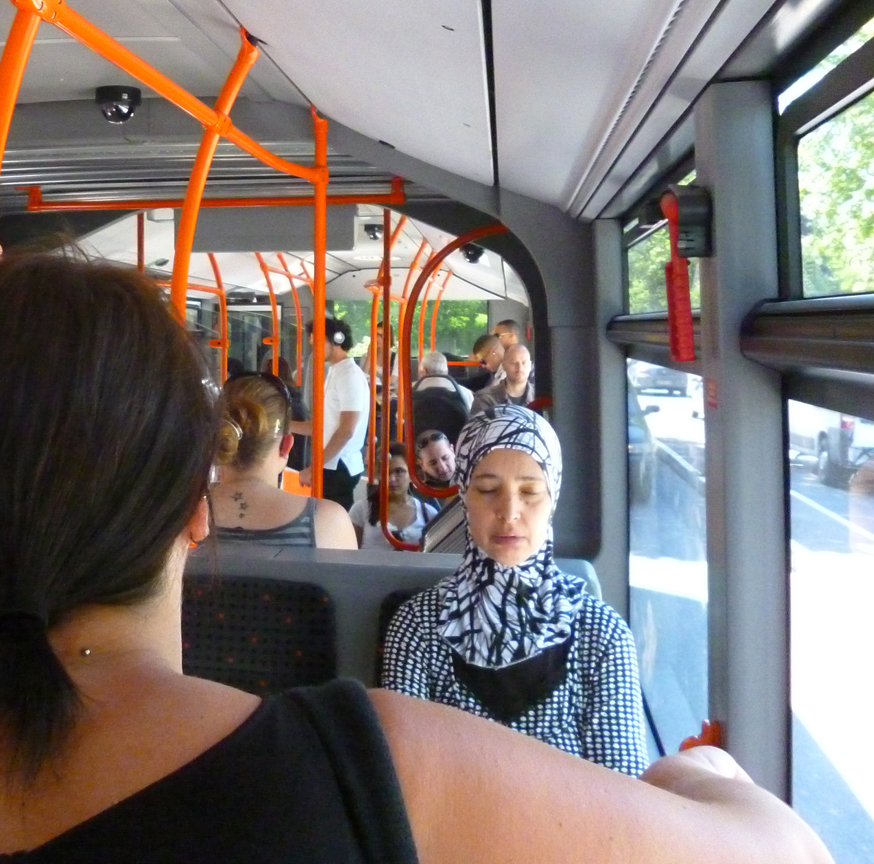
It goes on like this; moments of mindful alertness all over the town; easily falling into a state of no thought, just colours/sounds in the immediate environment. Then waiting for the bus, just watching that moment, and suddenly the bus looms up silently, fills my vision, get on, sit down and we sail away as one group contained in a large vehicle. Public transport is wonderful. All senses awake, functioning. Alert and wakeful about the surroundings, idle thoughts just become silence.

I am a human being on a moving bus, large windows and whole landscapes move through the interior of the bus in waves, washing away mind processes as we go on. Here, in all this movement, I can have a sense of: ‘…what I am looking out of is what I am looking at’, and what that means right now. I can see it’s about the journey to get there rather than the arrival because after that there’d be the full understanding of it and none of this would be important.

————————-

‘The Absolute Subjectivity that can never be objectified or conceptualized is free from the limitations of space and time; it is not subject to life and death; it goes beyond subject and object, and although it lives in an individual, it is not restricted to the individual.’ [The Essential Ken Wilber, The Real Self, page 23](see summary in Texts)


Choosing Liberation

Van Gogh 'Miners' 1880 (detail)

I’M ON THE BUS, going to an early morning class in zone industrielle. As we get near, the bus is stopping at every stop to pick up people employed in the factories. Migrant workers from East Europe; men and women speaking a language unknown to me. Thin, sad, serious faces; reminds me of Van Gogh’s drawings of the miners in 19th Century. He was there as a clergyman and convinced that he could help them find ‘liberation’. But he wasn’t successful, poor old Vincent….

Bus is getting crowded, I have a book to read: ‘The Noble Eightfold Path’ by Bhikkhu Bodhi and I’m looking at this partly because there’s nowhere else to look without encountering another pair of eyes looking back at me. ‘The search for a spiritual path is born of suffering. It does not start with lights and ecstasy but with the hard tacks of pain, disappointment and confusion… for suffering to give birth to a genuine spiritual search, it must amount to more than something passively received…’ 

Urgent circumstances; this is about a level of suffering hard to endure and there’s just no getting away from it. In the past, my first reaction would have been to look for a way of easing the suffering, and I’d have gone for that straight away. And when it became obvious that such a thing is only a temporary solution I’d have continued with it anyway for as long as it took to find some other similar easing. The real way out, the way to the end of suffering is more deeply embedded.

More stops, more migrant workers get on the bus. Maybe they’re looking at me and thinking I shouldn’t be here, with my shirt and tie, polished shoes. What they don’t realise is that I’m a foreign worker too. I know how it feels to live in someone else’s country – I’ve been doing this for about 25 years. Okay, guys! I’m a teacher of English, and I’m on my way to teach your bosses, yes – but, as far as I’m concerned, we’re all the same here. And that’s how it is now, squashed up against the window glass; thin shoulders and arms pressing against me.

‘It has to trigger an inner realization, a perception which pierces through the facile complacency of our usual encounter with the world to glimpse the insecurity perpetually gaping underfoot. When this insight dawns, even if only momentarily, it can precipitate a profound personal crisis. It overturns accustomed goals and values, mocks our routine preoccupations, leaves old enjoyments stubbornly unsatisfying.’

It’s about being right out there; on the edge. And there was a time for me when it was like that; a confrontation with the obstruction. I had to give in to it. As soon as I did, there was something unseen that tipped the balance. There was the easing, but different this time – I got a little preview of the Way; nirodha: 3rd Noble Truth. Then the question of what to do next and this led to the Noble Eightfold Path magga. It was at Wat Pahnanchat and Ajahn J. explained all this to me later because at the time I didn’t know much about the Buddha’s teachings. What I’d experienced was a knee-jerk reaction; an ordinary human response. Same as it would be for anybody on this bus.

What would it take for the kind of insight described here by Bhikkhu Bodhi to be meaningful to these migrant workers? The endurance threshold would need to be lower than it is. As long as they have the ability to withstand hardship, it will go on like this because, for them, it’s about holding on, not letting go; they’re putting their small amounts of money together to send back home to support the family. So they choose to pursue this endeavour, I choose liberation. Does this mean I’ve taken the ‘soft’ way out?

Buddhism has always attracted the elite of whatever society it has traveled to, partly because you need to have traveled through a certain experience of materialism in order to arrive at the sense that there is something problematic about desire and longing, how they don’t lead to happiness, and more often than not lead to unhappiness. If you are still struggling to fulfil your fantasies of wealth, power, status, Buddhism is less likely to appeal to you.’ [‘An End to Suffering’ Pankaj Mishra]

The Buddha’s Teachings offer an opportunity for liberation that really only comes about if you already have a certain distance from economic concerns. In Thailand there’s always the option of living in the monastery for a period of time and following a spiritual path. This kind of choice is held in high regard. In the West, people have to structure their lives around employment. Their innate ability to be happy is exploited by commercial strategies and a fleeting, temporary happiness has come to be built-in to the system. People can’t escape from that unless they step out of the social status momentum they’re in and this means there’s the risk of losing everything.

The bus gets to the terminus, stops, air suspension lets out in one long last gasp, and the bus lowers itself on to its structure. I get out with everyone else in this strangely remote place with factory smells and set off walking along the path to the industrial buildings in the distance. Behind me the bus starts up, a worrying moment, no wish to be stranded in this particular reality. I look back at it as it rumbles off on its little round wheels.

 ————————-

(Link to: The Noble Eightfold Path: Way to the End of Suffering’ by Bhikkhu Bodhi)

[Image: Vincent van Gogh 
Drawing, “Miners”, Pencil on Paper,
Cuesmes: September, 1880, Kröller-Müller Museum]

In-Between-Thing

THE BUS IS ON IT’S WAY to a place on the edge of town. There’s an English class I agreed to do for a teacher who’s on holiday, so I’ve not been down this way before; just highway and the lake all along the left side, mile after mile of flat water. It’ll take 20 minutes; not many stops on this route, no interruptions so I can try to slow down everything in ‘mind’ and see how that goes. Focus on the breath, getting comfortable, sounds and movements all around and some memory suddenly presents itself, related to something I was thinking about earlier. It must have been one of those ‘in-between’ things – how did that happen? The mind finds the space between moments?

Then back to the rumble and noise of the bus and busy with the confused flow of thoughts, moving from one scenario to another, trying to get everything to quieten down. No good saying: I don’t want to have these thoughts, because the mind state of ‘not wanting’ causes me to become even more attached to the confusion and I cannot easily disengage from the activity. So, leave that be and look for that space between thoughts – find refuge in that quiet space – it’s the only way. And there it is, the space that’s absent of thought: the space-in-between.

So, the way out is to be found by looking for the space in between. It’s prepositional? Reminded of a line from Ajahn Munindo’s commentary on Dhammapada Verse 380: ‘… carefully feeling our way into, around, over and under, the many moments of obstruction, life teaches us how to let go….’ [NEW MOON – Wednesday 18th July 2012] On either side and all around is the ‘busy-ness’ of thought and outside is the bus speeding along. Depending on what’s going on, the focus can move through these items of thought like a bird flutters through a tree – and still I’m in the space-in-between.

The bus engine is in top gear and accelerating. There’s an irregular swaying and I can focus on that and see the inner landscape at the same time. Focus on one item of thought and at the same time there is sufficient focus on another item of thought to be able to see it’s possible to be focused on both at the same time. It moves and changes and there’s a bit more focus on one than the other but I am able to see awareness can be in two or more places at the same time or it’s an awareness of one item of thought that includes awareness of another.

There’s a curiosity about this because it helps in getting relief from pain. I can momentarily ease back from the thought of a painful, aching back muscle for example, thinking, if there’s awareness of the painful back muscle, there’s another awareness that knows this – what is this ‘other’ awareness? There’s that small in-between space again that allows me to consider this; I’m seeing it from somewhere else. The reaction to the pain may have caused me to stumble upon this secret; this space-in-between. I just didn’t know how to get to it before.

It means I can be engaged in some kind of attachment and at the same time be aware that it is happening. I have another location from which I can be focused and the thinking process surrounding that clinging scenario can be observed from that ‘other’ location. If it’s seen, the attachment is less demanding (or not demanding at all) and without anything to which it can adhere, it ceases to be – gradually it’s just not there anymore. This awareness can be applied to everything. It is possible to contemplate the state of the body and it is possible to contemplate the mind contemplating this. Given time and the right circumstances, the various characteristics of the constructed ‘self’ can be seen. And, beyond that, everything that led to this….

In the meantime, if it all gets swept away in the confused traffic of thought again, it’s reasonable to say, OK, time to be absent now and the space-in-between is always there. Bus is approaching my stop, I gather my things and get ready to get off.

————————-

[Image: detail from a photo by Louk Vreeswijk]

‘more like this’

exit

Bruxelles Arrivals: Out of the aircraft and into the airport hallways, pulling the wheels behind, following signs pointing to immigration /douane. Overnight flight from Delhi, weary and dull. Dukkha is basically the sense that everything feels like it’s not as good as it could be and choosing, thus, to search for and be engaged in activities that will take the mind away from the discomfort (into the ‘happy’ zone) only perpetuates suffering. Endless searching is all there is: the human condition. Click the ‘search’ button, for no good reason, and receive millions of possible answers, filling up all the available space, replacing possible answers that were already there. And when it comes down to it, there is really only one possible answer: craving and attachment is what you’re searching for; samsara … ‘more like this’.

It’s difficult to see it in any other way right now, faced with great rivers of people pouring down long corridors on moving walkways. The whole world is in transit. I can see all the people, but they’re somehow not there. There’s only the information about them: itineraries, Arrivals point A – Departures point B, Gate numbers, passport numbers, visa details, security cameras, facial recognition software, vast amounts of figures and the support services that keep it all going – data on its own

Walking along the moving walkway at high speed; a foot keeps appearing out in front, down there on the floor: one at a time, left foot then right foot… pulling the wheels behind, heading for immigration /douane. Just moving along, mindful of body movements and associated events, let everything else go and there’s only the walking – other than that, try to focus on empty space.

Then mindfulness goes off, unnoticed; I’m distracted, wide-eyed and sleepless like a small nocturnal creature placed in TV studio lighting. Something occurs, and I enter into that seen event, a short scenario about something that happened before I got here. The mind considers that; why and what could that be? But there’s no reason for it; just one part of a great network of beginnings, middles and ends one has access to at any point in time, in any direction and it’s always leading back to the same thing; ‘me,’ just being me like this; ‘me,’ just being me like that ….

Then mindfulness cuts in, where’ve I been? and I’m back again, watching feet step out below me, walking down the moving walkway, pulling the wheels behind, pleased with the sense of movement and surprised to discover that without the wandering thoughts, there is just silence. There’s just a kind of physical awareness of body movements. And reminded of Ajahn Munindo’s talk  (Selling Samsara); about when he was here in Brussels airport some years ago, between flights and walking through the shopping area; mobile phones, handbags, perfume; just walking up and down to pass the time:

‘I’d done a few laps of the area when a lady, dressed in a blood red costume, comes out of a perfume shop and over to where I am, asks me what I’m doing. I tell her I’m a Buddhist monk just walking up and down and, ‘What are you doing?’ And she said, ‘Well, I’m selling Samsara, it’s a perfume.’ I say, ‘well, that’s interesting, do you know what Samsara means?’ She says, ‘No, tell me.’ I say ‘Samsara means: the endless cycle of deluded existence.’ ‘Oh, that’s wonderful!’ she says, and rushes inside the perfume shop. After a moment, she comes out with all the other ladies dressed in blood red costumes. ‘Tell them, tell them’, she says to me.’

Immigration, luggage belt and out of the airport into a taxi. I give the address, it’s a downtown area where Jiab’s younger brother, Nong T, has a shared aparment in a student area. Taxi glides out of the airport network, on to elevated highways and along wide roads, glass buildings, large yellow trams. Into the old town, narrow streets, North African eating places, bright colours, people everywhere, parked cars and look for the house number. Get out, ring the bell at the top of a small column of doorbells covered in paint and with names written in ballpoint pen held on with ancient scotchtape.

After a long time I can hear footsteps coming down. An image appears in the frosted glass panel of the door, it opens and Nong T is there. Hi, how was the flight and come on in. We start up the staircase which is so steep it’s like a stepladder where it spirals around at the corners and all the way up to the top. Lifting the luggage in front, step by step up and into a large studio type attic room with sloped roof ceiling and stove chimney pipe winding up to the top. Roof windows; quiet here, above the traffic noise.

Collapse on the sofa. The London Olympics on TV, last day. What else is on? I find a movie I think I’ve seen before, not sure, Dutch and French subtitles. I remember seeing the end of this. So I watch that for a while and when the adverts come on I switch to another channel to see if there’s something interesting there. Then switch back to where I was before, but find I’m somewhere else instead – how did that happen? So I return to where I was a moment ago and try to get orientated from there. But that seems different too, everything has moved on on time? Maybe I clicked the wrong thing. Go back, then forget completely how this started.

Then I’m wandering through animal programs, other movies, curious discussions in strange languages, news headlines with the same footage of Olympic events unfolding and, after that, the same thing backwards. Open the laptop, internet connection, go to google, key in ‘homelessness’, find an interesting post on the the homeless nature of thought [Link to: Thought is Homeless]. ‘… we, and our thoughts, are homeless because we are searching for a home that doesn’t exist…. when we let go of the mind that is constantly seeking to form attachments, when thought is comfortable in its homelessness, we can abide in the home of no-home.’ It expresses something very well that I’d not been able to focus on properly before. There’s all this constant restlessness that’s just going on. Let it go. No need to try to get it to stop, it’s just there, flowing like the river. There’s something comforting about this. Soon after that I take a shower and fall into deep sleep.

Birds on the Balcony 2

Switzerland, June: I wrote in another post [Birds on the Balcony 1] about pigeons nesting on my balcony up here on the 7th floor. The nest is in an old Christmas tree bucket with some of the bells and everything still dangling from the branches. The faded Christmas paper now getting dusty and sad, Christmas is long past but it is amazing, really, that the bird just went ahead and built a nest there. After that there was not just one egg in the nest but two and, to cut a long story short, the two eggs became two living beings with wings. I saw the whole thing; their development, their getting fed from the beak of the parent bird and the flapping of little downy wings. The birds on the balcony were the main focus of my attention for a long time. I feel I know such a lot about rearing birds, I’m sort of associated with the species.

At the time of writing this post, Jiab is away for a few days so I’m on my own. I’ve arranged my chair and table to be near to the window without getting too close to the parent bird sitting in the half filled bucket of earth, babies underneath. And if I’m moving around too much, it watches me with one eye then twists its neck completely round in a totally impossible way and looks at me with the other eye. How do they do that? So I sit quite still and watch.

I’m a part of the security system here – less danger from things like the crow population and the parent bird probably feels safe here, recognizes the right degree of proximity to humans because humans chase away crows and don’t chase away pigeons? So, it looks like I’m taking care of this little family situation and me and the bird are ok together.

More than that, in fact, I’m the great patron and benefactor, in this case, the saviour and I’ll tell you why. There was one day, I was sitting in my chair next to the pigeon nest with the two cute little baby birds all huddled up in there, parent bird off to get food and I’m in charge, just gazing out at the clouds. All is well in the natural world of animals, birds and baby pigeons safe and secure. But something was about to happen in the very next moment ….

I become aware of a black shape in the centre of my vision. Vision consciousness takes a certain amount of time to send the message and it doesn’t immediately click in my brain that it’s a large crow and looking so black and mysterious I cannot see it’s features, like a photographic negative, glinting a kind of deep purple and blue. Just arrived on the balcony rail, folding away it’s wings, here on the seventh floor where crows don’t usually go; just materialised out of the deathly world of nowhere. And I’m kinda, speechless; hypnotized by it’s presence.

It slants it’s head in the direction of the baby birds and makes a hop in their direction. And there’s a sort of slow-motion thing going in my mind; that’s a crow, yes …. ok, that’s it, then. Can’t get there quick enough to stop the inevitable, it’s nature. The birds are going to get eaten, swallowed up, can’t be helped. Fatalistic. Crow takes a few hops closer to the nest, and I’m transfixed – it’s all happened already, crow makes a few lunges and flies away with a beakfull of baby pigeons…

I suddenly ‘wake up’ and fall out of my chairs knocking over a few things in the scramble to get to the balcony door; hurt my knee in the collisions with the furniture: ‘No-oh!’ then a primal roar: ‘OAAAAAHHH!’ and by the time I get up off the floor and fling open the sliding glass door, arms flying around in desperation, the crow has gone. And the little birds are where they were, all happy and safe, barely aware of the interruption.

A relief, to say the least, but the shock of it remained for a while after. And, even though my relationship with the birds became more bonded since the visit of the crow and I felt like we’d been through stuff together, I started to notice I was getting off on things like: am I getting too attached to these cute little birds, I mean they’re just food for the predators? And was developing a kind of morbid view of the whole thing.

I tried to explain it to Jiab when she got back from Peru but it didn’t seem to have any impact. Instead, she said something about all creatures in the world, good or bad, being just as they are. That led me to read, again, the talk by Ajahn Amaro on ‘Forgiveness’ [link to: Forest Sangha publications, ‘Seeing the Way’ vol. two – 2011]

‘The act of wishing well to even those who do us harm is a recognition of our common humanity, our common nature as living beings. It is a recognition that carrying around resentment only creates greater division, greater disharmony, and greater discord and sows the seeds of greater suffering in the future.

“Those who are friendly, indifferent or hostile; may all beings receive the blessings of my life, may they soon attain the threefold bliss and realize the Deathless.”

[“Reflections on Sharing Blessings”, page 26 of the Chanting Book]

Fragrant Illusion

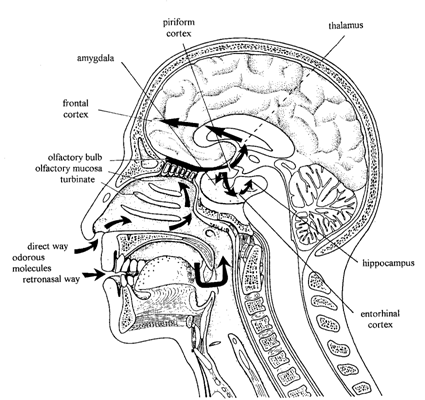
I’M WAITING AT THE BUS STOP in the zone industrielle and there’s that slightly odd fragrant smell in the air again. I asked somebody about it and they told me there’s a laboratory here that creates different kinds of commercial smells: odorants, aromas; the air is full of fragrance. It’s the smell of fruit jam today. Another day, it’ll be a different smell, maybe a more subtle thing that you can’t identify easily, an essential component of a popular smell – not unpleasant, just odd. Interesting that the fragrance of fruit jam that strikes the nose when I open the jar is not as fruity as I thought. It’s a ‘replacement aroma’ created under laboratory conditions by chemists. How weird.

The manufactured smell is a chemical compound designed to trigger an olfactory experience. My smell process is activated and even though this is completely artificial, I’ll react in the same way. I’m just as likely to respond to the aroma and go into the ‘wanting’ mode, whether it’s been created in the laboratory or it’s the real thing – I can’t tell the difference. The chain reaction of consciousness is saying this is real, go for it, and that’s all it takes.

I’m thinking about the wonderful aromatic fragrance of bread and bakery items that wafts towards me from the bakery near the station. I’m drawn to it because of the aroma. And I realise now the bakery cannot produce that smell as a result of baking – I doubt if it even has a baker’s oven on the premises. But I respond to the smell as if it were real.

In the paticcasamuppada the smell of fresh bread starts a sequence that looks like this: The aroma of fresh bread is at Sense Gates salayatana. In itself, it’s not anything, then it makes Contact phassa and shortly after that there’s the beginnings of recognition, which leads to Feeling vedana and I’m taking out my wallet. There’s Craving tanha and after that I’m caught. The purchase is about to be made but before we close the deal: ‘…autre chose, monsieur?’  (anything else, sir?)

I experience Grasping, upadana and it seems like a good idea maybe to get a couple of other things as well. Then Becoming bhava happens, I’ve made the purchase – it’s mine! There’s a brief moment of joy: Birth jati and I get outside and look in the nicely wrapped carton of donuts, pain aux chocolate, almond croissants…. What did I get all these for?

At some point, it may be now; it may be later, I experience Sorrow, lamentation. pain, grief and despair soka, parideva, dukkha, domanassa upayasa (Note: the actual ps cycle includes: old age, death, jara, marana) and the lingering smell means I might, later, try to revisit the baker’s shop to see if I can do it again but somehow manage to avoid the suffering this time?

Not only food, there’s the smell of leather upholstery in a new car, for example. That distinctive odor, created by chemical processes, may tip the balance and … sold! The smell of a new carpet; it may not be an attractive odor but it does trigger something; there’s a familiarity about it – ok, proceed to checkout! The company that manufactures and promotes the aroma is engaged in the commercial exploitation of smell – and we are caught by the nose.

I used to travel regularly on a small jet, a short flight and the steward would come along the aisle of this tiny plane to serve a coffee and a rather sad-looking sandwich. But before that, before it was served, the cabin would be filled with a wonderful, exotic aroma mix of French cognac, a hint of cigar smoke, ground coffee, crème caramel, port, liqueur. The snack is served, it’s a terrible let-down.

Do they really think we might not suspect it’s something entirely manufactured, a puff of a spray that releases the odorant in the air? But I realise that it doesn’t matter. The steward who serves the snack and everyone in the plane know it’s an illusion. There’s a basic acceptance of illusion; it might even appeal to a competitive cleverness that ‘I’ can see through this illusion: “… isn’t it interesting how they can create artificial smells?”

It’s saying this is acceptable, it’s okay to do this, there’s illusionary stuff everywhere; TV, videos, and mind states are just the same; the ‘self’ we have created from the five khandas. And there’s a familiarity with the ‘trick’; a recognition of the whole panorama of illusion that we have created in our world. So what if it’s artificial? The whole ‘thing’ is artificial. We like it like that!

That’s the way to go if you think you like endless proliferation, but it does need to be maintained and the novelty wears off. The seeing of it dispels ignorance: Phenomena are sustained only so long as their sustaining factors remain.’ Take out the sustaining factors and the whole thing comes to pieces.

The bus arrives and we all get on. It rumbles off down the road and the smell of fruity jam is almost gone, I can still smell slight traces, then I get distracted and forget to smell for a moment. When I remember, the smell is gone completely. Soon after that I’ve forgotten all about it.

‘When this exists, that comes to be. With the arising of this, that arises. When this does not exist, that does not come to be. With the cessation of this, that ceases.’ [Samyutta Nikaya 12.6]

…………………………………

 (For the whole analysis of the paticcasamuppada, click on this link: Buddha’s Teaching on Causality, Dependent Origination paticcasamuppada.)

[link to more info on artificial aromas]

[image source link]