a kind of ignoring

PP5POSTCARD #26 Delhi: Putting in eyedrops and I’m not used to it, eyelid reacts just as the drop is coming, blinks before the drop hits the eye, face is wet with eye-drop fluid. Try again… drip. Same thing happens. I’ve just started a two week schedule of eye-drops because of a dryness in the eyes after the recent operation. Hoping it’ll get easier and learning how to not-react, to resist the body’s automatic knee-jerk response to whatever it is that’s coming into the eye. There’s this natural tendency to reject, to refuse, to say ‘no’. The mind has it figured out but the body is still unconvinced.

It’s something like a deliberate not-seeing; the not-wanting-to-have-anything-to-do-with-it thing. Not wishing to engage; a kind of ignoring. It’s denial… “Who me? … in denial? I’m not in denial!” (denial of denial). I’m not going to pay attention to what you’re saying about me ignoring you. Pretending it’s not there and maybe it’ll go away? Ostrich-head-in-the-sand syndrome [see note1 below] The ‘self’ illusion itself, is a trancelike state. Even though it’s really obvious, people are conditioned to ignore basic truths that conflict with the habitual way of doing things. ‘We don’t look at things, we overlook things’ [Alan Watts].

Ignoring the truth about climate change, seemingly unconcerned about what kind of future we’re passing on to future generations. Ignoring deeply held misgivings about wars created by politicians, weapons of mass ‘distraction’, slipperiness, underhandedness, cunning ploys and guile. Ignoring the 1st Noble Truth of Suffering; tolerating the suffering permits a sort of attachment to it? Or maybe we are genuinely searching for another way to live our lives, but we’re sidetracked by Television, consumer goods, and fall into the world of ‘choices’ and ‘preferences’; burdened with these dependencies. So we might say: NO, this is not it at all… go to the doctor, tell him about it and he says take these pills, something to get us back on track – education cleverly teaches children there’s only one option: consumerism, and to engage with that you need to learn about career, job, debt, house, rent, marriage, car, bills… It’s doesn’t say WHY (ignore that question). Consumerism is what people believe in; consumerism is ‘God’.

Try another eye-drop… head back, look at the ceiling. The eyelid flutters, blinks involuntarily, and an eyelash deflects the intrusive drop, fluid trickles down the cheek like an actual tear drop and falls into the ear. I wipe it away with a tissue – this action triggers a memory of something emotional – why am I crying… trying to do something I can’t, and don’t know why. It’s the squeezing of the bottle between thumb and forefinger, a small intense muscular action, that’s in conflict with the feeling of vulnerability. Reluctantly I see, in close-up, the bubble of the drop emerging from the point of the bottle and glance away from it, anticipating the tiny impact on sensitive eyeball… splish! I have to learn to look elsewhere – a skilful ignoring – and focus on something like the ceiling fan, a light bulb, the flaking piece of plaster in the corner of the cornice.

Mindfulness and being calm. Earlier today, I downloaded 11 hours of Tibetan Healing Bell Chimes and as I’m writing this now I’m already on hour 5. It’s playing quietly in a different window; sweet random sounds, intentional wind chimes; the IS-ness of it. Meditation practice means I can gently ease back from the intensity the mind creates for as long as it takes to see what’s going on; this action feels right – I’m able to emerge from ignorance into the knowing. A wonderful emptiness or the wholeness of it? A great peace in the space of the mind.

‘The sensation of “I” as a lonely and isolated center of being is so powerful and commonsensical, and so fundamental to our modes of speech and thought, to our laws and social institutions, that we cannot experience selfhood except as something superficial in the scheme of the universe. I seem to be a brief light that flashes but once in all the aeons of time—a rare, complicated, and all-too-delicate organism on the fringe of biological evolution, where the wave of life bursts into individual, sparkling, and multicolored drops that gleam for a moment only to vanish forever. Under such conditioning it seems impossible and even absurd to realize that myself does not reside in the drop alone, but in the whole surge of energy which ranges from the galaxies to the nuclear fields in my body. At this level of existence “I” am immeasurably old; my forms are infinite and their comings and goings are simply the pulses or vibrations of a single and eternal flow of energy.’ [Alan Watts, ‘The Book: On The Taboo Against Knowing Who You Are’ (link to downloadable pdf)]

————————-
Note 1: I discovered that, in fact, the ostrich doesn’t bury its head in the sand when there’s danger, it’s digging a hole and covering the egg with sand and, seen from a distance, it just looks like that’s what it’s doing.
Note 2: ‘If You Are Having Trouble Getting The Drop Into Your Eye: Lay on your back, and place a drop in the inner corner of your eyelid (the side closest to the bridge of your nose).  Tilt your head, open your eyes slowly, and the drop should fall right into your eye.’
Note 3: ‘slipperiness, underhandedness, cunning ploys and guile’ taken from Ajahn Sucitto’s ‘Parami: Ways To Cross Life’s Floods’
Note 4:  Listening to 11 hours of  Tibetan Healing Sounds in Zen Flash
Note 5: Reference to: ‘career, job, debt, house, rent, marriage, car, bills, children…’ taken from blogpost: What Do You Want? by Jack Saunsea
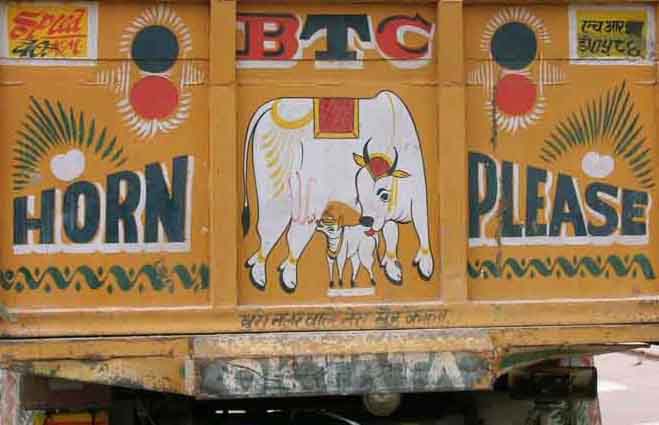
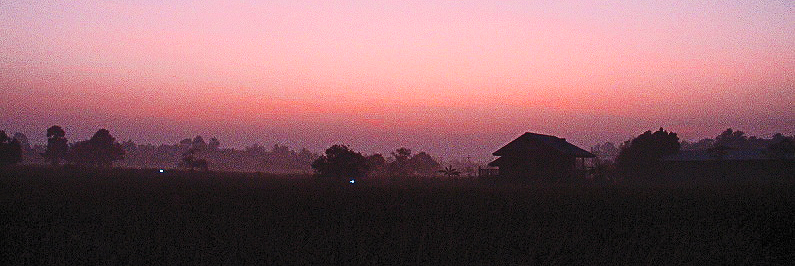
Note 6: Upper image taken from the series: “Only In India”

the ‘now’ moment

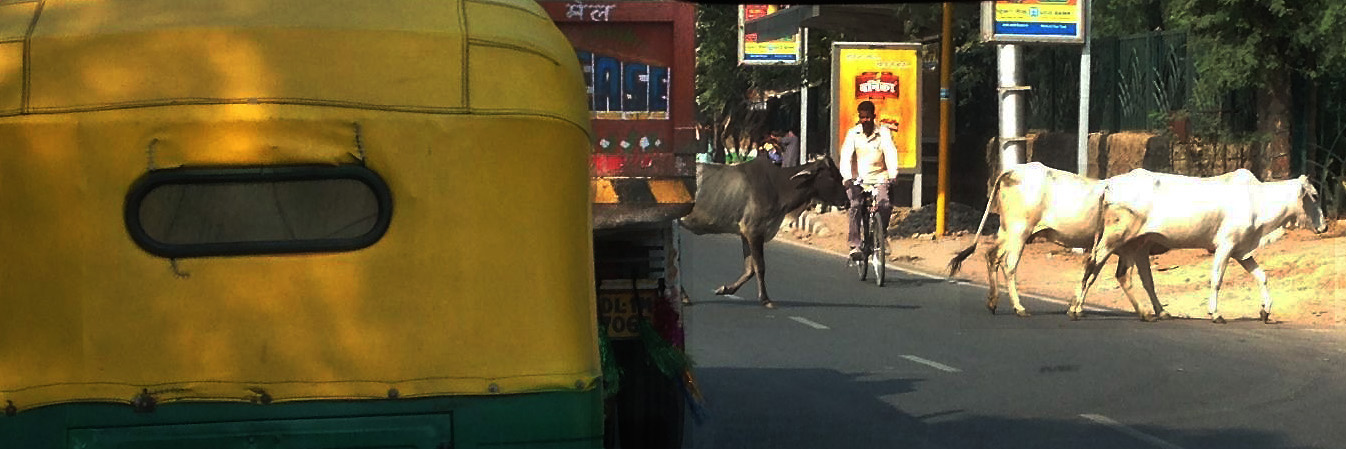
IMG_0246bPOSTCARD #25 Delhi: Traffic stops. A great noise of beeping horns and eventually we can see it’s caused by cows crossing the road. Unusual to see cows being herded in the middle of the city – there must be a cowherder at the end of the column driving them, and others to clear the path through the traffic. The cows do seem a little anxious now, hurrying along. Usually they’re relaxed – placid is the word. I see them sometimes, sitting at the side of the road, cars moving around them, or they’re at rest on a traffic roundabout, ruminating, gazing out at the world.

The presence of the bovine mother, with its horns and all its wet-nose, smooth-hide, cowness, creates a kind of out-of-context NOW moment for me, a foreigner in this part of the world – although really, it’s ‘now’ all the time. ‘Now’ is not located anywhere in particular in time or space, it is always ‘now’ – the whole thing is ‘now’. The cow with its long eyelashes and good-looking face, just uncompromisingly ‘there’, is part of the environment and events taking place in the flow of occurrences, always in the present moment. I’m kinda blown-away by the immediate here-and-now reality of traffic flow around a seated cow, like a river moves round the boulders in a stream of tiny moments linked together, a seamless whole; cause becomes effect, what happened before it becomes what happened after that, and out into every available space in the city. It’s everywhere at the same time.

Usually I don’t see it; caught up in the thinking process; watching a movie in my head, driven by the requirements of a constructed ‘me’ and seeing the world in these terms. THINKING ABOUT THINGS so much, I don’t pay attention to the ‘now’ moment, the small period of pause that occurs… that empty space where nothing is happening, just before the next thought arises – a kind of non-event. Focus on it and everything stops shifting around, gradually settles down; time begins to stretch out in a vastness, reaching out over the horizon on all sides. Surrounding traffic is somewhere down below, locked-in, waiting for the cows to pass through.

This lasts as long as it takes for me to forget what I’m doing, attention wanders, and a passing wave of thought spins me off in the thinking process, the automatic default that brings me back to the functioning of the mind-body organism. The “self” getting in the way, feeling it didn’t quite have what it should have had, wanting this, happy with that, glad there are signs of movement at last and the ‘now’ moment is changed to something else. We’re on the road again, the cow obstruction has gone. Revving car engines, horns beep-beep, jostling for space. Car bodies like brightly coloured Lego pieces fit together to create a form, then immediately separate themselves and become a different form; join with other forms and larger constructs fit together with surrounding pieces. Traffic roars, screaming horns, it all begins to spread out, moving as one, then it’s quickly dispersed into separate units, more acceleration, and we’re away like a wave rushing back out to sea. The speed is breathtaking….

hornpleaseRedFort

‘The human body is not a frozen sculpture fixed in space and time. The human body is a dynamic bundle of energy, information and intelligence that constantly is renewing itself and is in exchange with the larger field of energy, information and intelligence that we call the universe. In fact if we could really see the human body as it is, not through the artifact of sensory experience, you would see it to be much more exciting.’ [Deepak Chopra, ‘The Basics of Quantum Healing’]

————————-

Source for lower image: Martin S. Gotfrit

the forgotten thing

IMG_0924POSTCARD #23: Delhi: There’s something cozy about having to have the lights on in the daytime; skies are quite dark, a curious colourless light. Feels nice, just pottering around in the house wearing indoor slippers; walking along the corridor to get something in the kitchen, flip flop flip flop flip flip… I arrive there and can’t remember what it was I wanted. Strange, how a thought can simply vanish like that, leaving only the context of it. Walk back down to the living room and as soon as I’m there I remember what it was, ah yes… there’s something about this action that seems to retrieve the memory. Walk back along to the kitchen, and, goodness me, I’ve forgotten again – pause for a moment… there’s no memory of it at all.

A curious reality, the forgotten thing is associated with the idea it’s a lost object and it’ll turn up later, but when it does, how will I recognize it (if I don’t know what it is)? Let it go and the thought has gone, taking with it the thinker of the thought… thoughts without a thinker [Mark Epstein]. Conscious experience is filtered through the conceptualizing process. Without that, there’s no ‘me’; there’s nothing; a state of no ‘thing-ness’. It’s not the object, it’s the space it’s in; this ‘something’ within which things seem to exist, then unexist.

Shortly after that, I remember what it is I’m looking for; the eye-drop bottle – I have a schedule of eye-drops to take because of the eye operation. Walk back to the kitchen repeating the words: eye-drop bottle, eye-drop bottle, eye-drop bottle, and there it is sitting on the counter in plain sight – how could an object like that become invisible? Back to the living room where I’m distracted by other events for a while and when I look for the eye-drop bottle later on… can’t find it, oh no (this is giving me a headache). Then it’s there, sitting in the place where it was placed, an existential presence; nature morte avec bouteille d’oeil-baisse, “Still Life With Eye-Drop Bottle”. It holds my attention now – have I taken the eye-drop already, or not yet, and feeling my eyes for moisture, trying to remember…

‘The range of what we think and do is limited by what we fail to notice. And because we fail to notice that we fail to notice, there is little we can do to change; until we notice how failing to notice shapes our thoughts and deeds.’ [R. D. Laing]

————————-

Upper image: floating small candle boats on the Ganges river, taken from last year’s visit to the Buddhist sites

where I’m calling from

IMG_0213POSTCARD #19: Chiang Mai: M came to visit for the day, my Thai niece aged 9yrs, and her mum brought a bag of pa tong ko (Thai donuts) she got in the Saturday market. And just before we ate them all I remembered to take a photo [click this link for recipe]. But I’m getting ahead of myself, it began quite early this morning. I open my eyes and there’s a sound, a Skype call – where’s the phone? Stumble out of bed, follow the sound… phone has slid down the side cushion on the sofa, singing and buzzing in there; hello? It’s M, hello? Her video appears – hello, hello? I can see the top of her head, she’s watching a YouTube video at the same time as skyping me.

Where are you now Toong Ting? She calls me Toong Ting, a remnant of her baby-talk days. I tell her I’m in the condo, arrived last night from Bangkok; this is what it looks like, where I’m calling from, then slowly move the camera-phone around so she can see the interior of the room.

What you do there? She speaks English like text messaging – maybe social media is how she learned? I tell her I’m not properly awake yet and that’s why my hair is all mussed up.

What’s mussed-up mean? I tell her that I was sleeping, just woke. But it’s difficult to hear what she’s saying, I need to adjust the volume control. Where’s the clicker? Can’t see well with these glasses, I’ll have to hold the phone so I’m able to see her face on the screen then put it to my ear to hear her voice – she’s laughing because there’s my big ear in close-up, filling her screen. Laughter…

Why you do that Toong Ting? The conversation lasts about a minute. She asks me, Can I come stay with you today, mummy go out, OK? I say yes; see you soon, bye-bye.

Shower, dressed, wash dishes, tidy up and in 1 hour, ping-pong! door opens, M is scooting down the corridor, running around the rooms and jumping on the sofa: yaaaaay! Her mum gives me the pa tong ko and some of M’s items in a bag and other food things, asks if I’m sure it’s okay… yes, of course, and there’s the handing over of responsibility with a few last words of caution to M and bye! Mummy is gone.

We put everything on the breakfast table, and taking the photo of the pa tong ko reminds me about the problem with the phone-camera earlier, with the sound – not finding the volume control and I tell her about this – can she fix it for me? M holds the phone in her small hands then clicks the little button with a tiny pointed finger.

I feel heavy and clumsy by comparison. She tells me I need to change the ringtone… so let’s choose one together, okay? There’s a long list, the names read like a poem; apex, beacon, by the seaside, chimes, crystals, night owl, playtime, presto, radar, radiate, stargaze, summit, twinkle, waves and we go through them all, one after another, like a strange inter-related melody; a breathtaking journey through the diverse world of heavenly and celestial, twinkling ringtones.

Which one you like Toong Ting? I’d like to make a choice but it’s like a kind of hilarious madness to me, they’re all good… M makes her choice and I’m wearing my glasses to see how she’s doing it. It’s this that causes her to quit the ringtone selection as the discussion moves round to my recent eye operation.

What the doctor do? M comes close to my face and looks at my left eye, carefully, then looks at my right eye. She’s a bit scared of the thought of it, yet kinda fascinated when I tell her about making a hole in the eye and sucking out the lens shloooorp! then putting in the new lens folded over to get it into the hole and it’s made of plastic, so it opens out flap when it’s inside and lies down flat.

I see her small face and almond-shaped eyes absorbing the story into consciousness. It’s a mirror I can see myself in. The ‘I am’ feeling – the sense of ‘I-Amness’. All the way through one’s life, the constant. It’s the same today as it was when I was 9 years old. Absolute subjectivity.

‘Consciousness veils itself from itself by pretending to limit itself to a separate entity and then forgets that it is pretending.’ [‘The Transparency of Things’, Rupert Spira]

We take other photos of the rest of the food things brought by M’s mum and here they are:

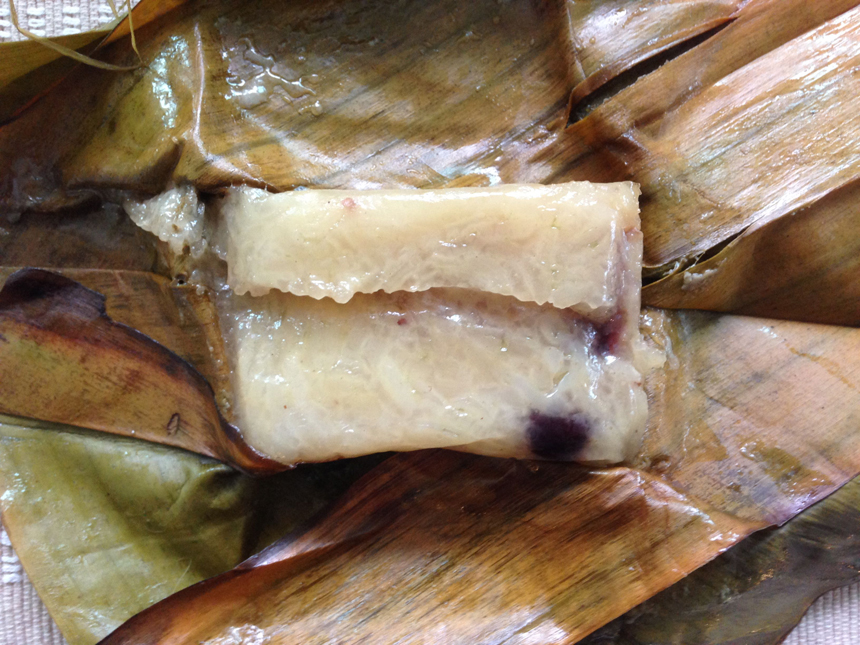
1. (below) Kao nyaow: glutinous rice cooked in banana leaves

IMG_02152. (below) Ground nuts, the original version of the salted peanuts we buy in a can. They’re actually a purplish-green colour.

IMG_02163. (below) Thai kanom: a glutinous rice paste flavoured with panyan

IMG_0214

————————-

References to Absolute Subjectivity taken from a Ken Wilbur video: Subject becomes object.
The title of this post: ‘where I’m calling from’ is taken from a collection of short stories by Raymond Carver

the attributes of self

110520131818POSTCARD #18: Bangkok/Chiang Mai flight: They paint a face on the nose of the aircraft, the ‘cute’ concept – a Thai version of Japanese kawaii かわいい . It looks like a bird because the shape of it is beak-like but it’s recognizably a human face wearing sunglasses. Personifications, masks, fictional characters with human attributes respond in a childlike way to a world full of fear and joy. Goldilocks and the three bears finding the Buddhist Middle Way by trial-and-error: the first try is too hot; the second try, too cold; the third try is just right. Why not? This is a non-serious, one-hour flight; no sooner have we departed than we arrive. Smiling doll-like stewardesses in yellow costumes have just enough time to come up the aisle with a light snack in a paper bag for everyone, back down again to clear everything away and we’re descending into Chiang Mai.

Slightly bumpy, due to weather conditions, the vibration causes the luggage compartments to shake and creak for a moment. Sounds like something nautical; the rattle of rope harness striking the mast of a sailing ship… searching for something it resembles – something to account for this phenomenon of flying above the clouds at an incredible speed. Maybe I’m seeing the journey from Bangkok to Chiang Mai as if we were driving over something solid, bumps caused by an uneven road surface; a highway in the sky, an imagined bridge that spans the distance, 373 miles from there to here – a huge curved span in the sky. Logical mind attempts to create an explanation for it, based on what’s known, a figure of speech, something to help me ease back from contracting around the uneasiness, the unknown… that edgy feeling. Without the metaphor, all I’m aware of is tremendous velocity and a sense of vulnerability. The immediacy of the moment sweeps away all thought-constructs like the ground is gone from beneath my feet. Mindfulness of breathing, deeply in and all the way out…

Further into the descent I become a little deaf, it feels like being underwater, and no amount of swallowing or blowing of air into sinus cavities seems to clear it. Near to landing there’s the sound of the hydraulics, out go the flaps, down go the wheels and the earth rises up to meet us; 300 people contained in a structure the size of a building colliding with the surface of the Earth at 200 mph. A great yawning abyss of existential anxiety; I need something to hold on to – but there isn’t anything that’ll prepare me for such a colossal event; the roller-coaster experience. Aircraft wheels take the weight, first one then the other and the deep lurch, sink-down/bounce-back – for a moment it feels like we’re going to go out of control and disaster… then it’s okay.

There’s something about it being in a public context, we’re all in this together, and the sense of a letting-go of something tightly held: woooooo! The small ‘self’ is seen and relinquished; there’s nobody there… just this unattached feeling that couldn’t happen in any other circumstance. The Buddhist cessation – no words for it, consciousness doesn’t normally reach that far. No person, no identity. Before the Greeks created the Buddha image we know and accept today, there were only symbols, a riderless horse, the empty seat… footprints left behind in the place where he was.

 ‘… that dimension where there is neither earth nor water, nor fire nor wind, nor dimension of the infinitude of space, nor dimension of the infinitude of consciousness, nor dimension of nothingness, nor dimension of neither perception nor non-perception, nor this world, nor the next world, nor sun, nor moon. And there, I say, there is neither coming, nor going, nor stasis, nor passing away, nor arising: without stance, without foundation, without support [mental object]. This, just this, is the end of stress.’ [Ud 8.1]

————————-

9/11: a buddhist reflection

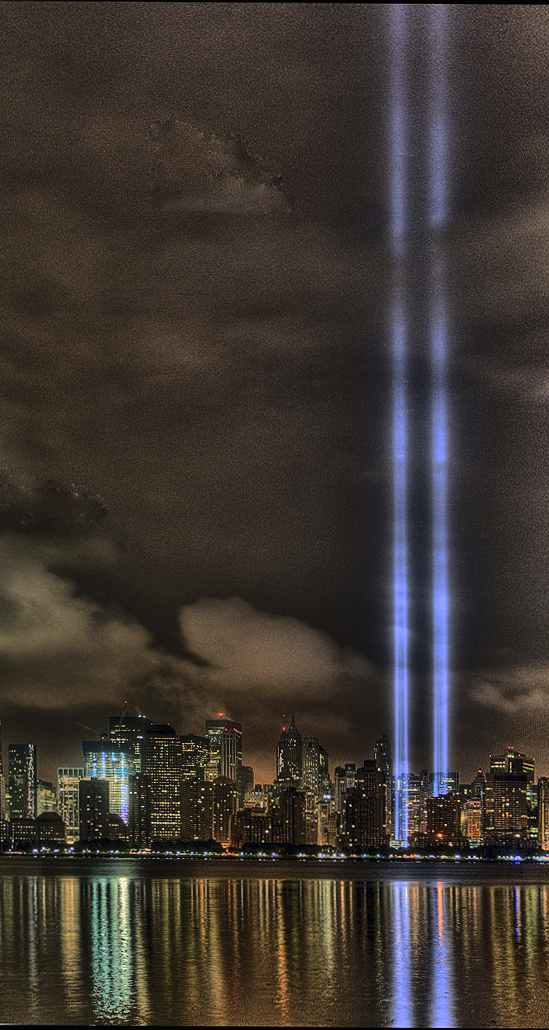
680px-911_Tribute_(wiki)The root cause for such an inhuman act is a fundamental lack of wisdom and understanding of the human condition. All human beings are companions in birth, in old age, in sickness and in death. Buddhists may train themselves to cope with that type of situation through stillness, wisdom and reflection.

[Excerpt from A Buddhist Reflection on the Tragedy of September 11’  by Ajahn Jayasaro, 2001]

Buddhism considers the quest for a direct experiential understanding of the human condition as the heart of spiritual life. It employs a vast array of skillful means and ways of reflecting on life, which people of other religious traditions or indeed people of no religious tradition, might benefit. The more profound our understanding of our existence as human beings is, the more we are protected from blind identification with narrow categories, whether they be social, ethnic or religious. We all as human beings have the capacity to reflect on experience, to learn from it. Whatever religion we profess, we can for instance, look at the effect on our mind of the strong attachment to ideas of us and them. Theists, atheists, polytheists are equally capable of observing how the idea of us and them affects how and what information we absorb from our surroundings, how we interpret that information, and how we express ourselves in our actions and words. We can begin to notice our tendency to believe in the labels we attach to things, and what strong negative emotions are conditioned by those beliefs.

As Buddhists, we devote ourselves to learning how to maintain clarity of mind, fundamental compassion and intelligence, as a constant inner refuge. It is not so difficult to be clear about issues which don’t personally affect us, or those which provoke no strong feelings. The real challenge is to be awake even in the midst of a hurricane of emotions — when we are hurt and betrayed, angry and afraid. Clarity of mind means that when things get rough we can still receive the blessings of the principles we uphold. Inner clarity is thus the ground in which the dignity and meaning of life can grow.

An inner refuge does not come easily. It can only be brought about by a thoroughgoing commitment to this life education, a training of the way we live internally and externally. Buddhist teachings are seen then, in summary, not as dogmas to be believed in (or rejected), but tools to be made use of. We use the teachings to understand ourselves and our experiences in life, to understand other people and the world we live in. Then basing ourselves on that understanding, we seek to create as much authentic happiness and benefit for ourselves and others as we can.

It is very easy to brand people who do terrible things as being evil, and perhaps almost as easy to assume that because we find evil acts repugnant, that therefore we are good. But when we look more closely, we see that our bogeymen, the so-called “evil people” sometimes act well and “good people” may, on occasion, act cruelly.

There is no fixed entity, “the evil person”, who is evil 24 hours a day, 365 days of the year. Similarly, (apart from fully enlightened beings), there is no unchangeably good person. That being the case, the most constructive response to the suffering that human beings inflict on each other is surely to seek to understand and affect the factors conditioning the arising and cessation of good and evil in the human mind.

Armed with this knowledge we may then look at ways of reducing the power of evil wherever it arises, no matter whether it be in the group of people that we consider as them, or within the group of people that we consider as us. At the same time, we must be constantly looking to develop and support those qualities – both within that group we consider them and that group we consider us – which are good, wise and compassionate. Our most pressing task though, because nobody else can do this for us, is to look within our own hearts. [For another excerpt from Ajahn Jayasaro’s talk, click on this link: 9/11 (2012)]

————————-

context & content

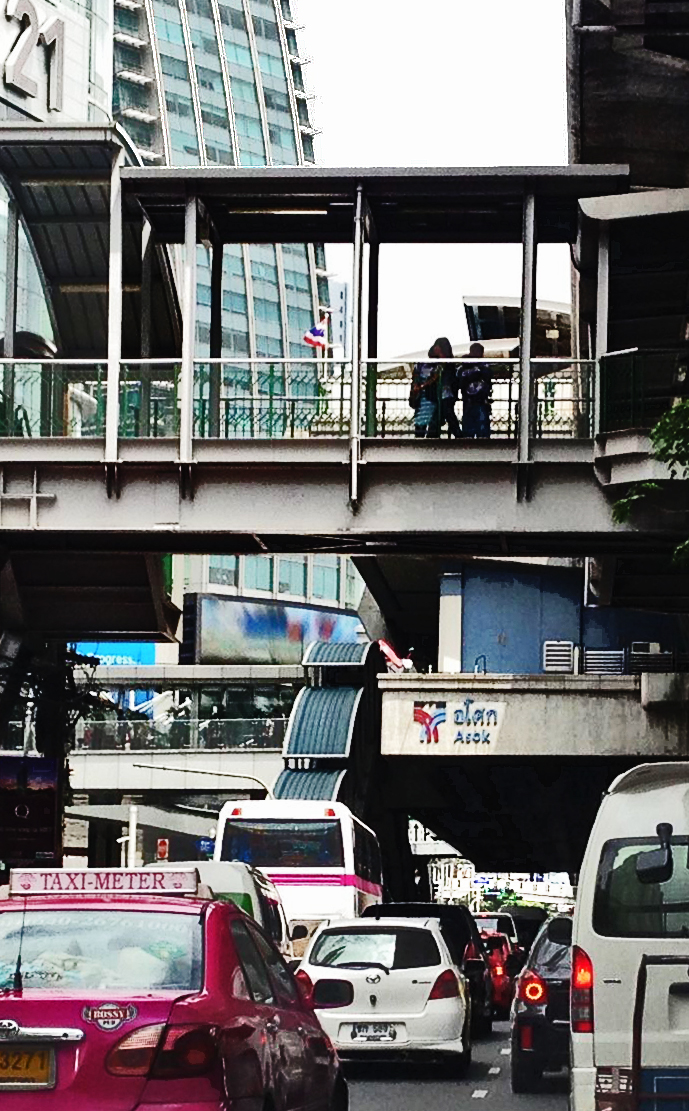
AsokBTSBangkok: Near Asoke, downtown, on my way to the eye hospital for an appointment at 3.20pm. I have a lens implant in the left eye and the surgeon is going to take out the stitch that’s been in the eye for 2 weeks. Today’s the day… dum-dee-dum, sing a song and forget about that (resistance to the thought of needles and eyes). A space in the mind opens up for a moment, and I take refuge in there, calm abiding; if a feeling is not present, I am not aware of it. Thoughts return, the fragility of things; eyeballs and eardrums, taste buds and nerve endings, vulnerability, perishability, finely tuned, limited lifespan. Get involved with my surroundings; crowds of browsers in the Asoke shopping area, a wealth of attractive objects. There was something I was supposed to get but I’ve forgotten what it was; new input replaces existing memory. How much time before the eye appointment? The memory comes back again… somewhere else, the needle-and-eye situation is happening to some other person, not me. Abide in the space of no-thought, remembering about the thing I’m looking for that I’d forgotten (I’ll remember what it was later), and just contemplating the empty space where it used to be.

It’s not just forgotten, it’s not there at all; replaced with a kind of consciousness I can’t identify, an awareness of the seeking? Seeking leads to the sense that something is missing, the suffering caused by wandering in a created world of being lost. The mind that seeks is restless, searching for things endlessly but never finds what it’s looking for. Always, always reaching out for something beyond the here-and-now: the sense there’s got to be something that’s better than this. There’s a place somewhere else where I’ll find the thing I’m looking for… but how will I recognize it if I don’t know what it is… ho hum, depending on the belief there’ll just be some kind of extraordinary familiarity and recognition? Somebody wise said: ‘What we are looking for is that which is looking…’ The mind that sees this relentless searching sees that other mind that seeks this; two minds. What am I seeing? Mindfulness and the curious situation of just seeing the seeking – and there’s no object. Seeking non-objects means seeking the seeking itself; seeing ‘the seeing’, the situation before the question arose, the motionless space in which everything exists; context and content.

Walking through the doors of the eye hospital as if in a dream, wait in the waiting area for my number to be called, then into a cubicle. Lie down on the bed, stare at the ceiling and the nurse bathes the eye with antiseptic eye-drops every 5 mins for 30 mins, then into the surgeon’s room. Lean back and more eye drops, anesthetic this time. I sit facing the opthamologist, a lady, place your chin here, she says and there’s a kind of binocular device for seeing into my eyes in an adjustable stainless steel structure with chin-rest and my head is held in the steel frame. I tell her I’m nervous, Painless, she says, it’s painless… and smiles at me reassuringly. I hear a sound like plucking violin strings, pizzicato, in the upper registers, ‘ting, ting’. Am I really hearing this small musical sound? I catch a glimpse of the surgeon’s tiny cutting tool as it releases the cords of the held stitch. She says it’s over… can’t believe it.

Sometime later that day, I remember what it was I’d forgotten in the Asoke shopping area*. I’ll have to leave that until I come back for the next operation on September 20th.

‘… eternity is realized at the cessation of striving for any event, looking for nothing’ – not looking for anything? …. Not looking for anything reduces the constant searching for it, so you can discover it was there all the time…’ [David Loy]

————————-

*I wanted to buy a jar of Chyawanprash at the Indian market near Asoke
This post contains references to the Betty Edwards text: ‘The New Drawing on the Right Side of the Brain‘ and the text ‘The Path of No-path: Śaṅkara and Dogen on the Paradox of Practice’ by David Loy.

just this

Sunrise (1)WPNChiang Mai: 05.30 hrs., ‘… down the long and silent street, the dawn, with silver-sandalled feet…’ daylight creeps into the rooms and it’s my birthday today! I suppose one’s birthday is something to be possessive about: ‘my’ birthday. I was born on this day quite a long time ago in the North of Scotland and now I’m here in the silence of a Chiang Mai morning in the North of Thailand. Open all the windows and a breeze blows through in all directions, curtains and fabrics that haven’t moved for a month in the stillness of this interior, flutter and flap against the walls – a sheet of paper flies off my desk, lands on the smooth floor tiles and slides away. It feels like the world outside is inside; all of a one-ness and this mind/body awareness (that is ‘me’) spreads out from here, through the trees, up and into the dome of the sky as far as the eye can see.

Skype call from Jiab in Delhi, happy birthday, and in the video window I can see our room, the place I usually inhabit. Jiab is at the desk where I normally sit. It’s still dark there, daylight here. Two people talking with each other but often occupied with the tiny image of themselves that appears in the Skype window, lower right. Eyes are sometimes directed away, how does my hair look? Jiab tells me the story about how she was born on the night of the full moon and so her actual birthday is not always on the same day. The family lived in an old forest area in the South of Thailand. Jiab remembers her father saying it was the light of the full moon that guided him through the trees to bring the midwife to their house. And a phone-call from M, happy birthday Toong Ting! She calls me that because she’s my 9 year-old niece. Toong Ting, when you go to Inkland? She asks me this, meaning ‘England’ but I like ‘Inkland’ (the place that makes ink?), so I tell her I’m going to Inkland on Saturday 13th, but it’ll be Sunday 14th by the time I get there. We have a discussion about the time difference thing and M knows about this, having visited Japan earlier this year. Only 9 years old, but she has an understanding of the world and systems that’s so much in the present moment it takes my breath away.

http://www.dreamstime.com/-image17433969Children teach us about birth and the great mystery. About 10 years ago, there was an episode from a BBC series on the human body that showed a woman giving birth – so vivid, I suddenly felt this immediacy of it happening to me: the blinding light, echoing sounds; the coldness, the impact of air entering the nasal passages? Revisiting the birth experience. Emerging into the world,  the first total sensory consciousness sweeps through and the body/mind organism is turned inside-out. That TV film left me quite transformed… Now it’s later, many years later, and there’s ‘me’ and this old body, getting settled on the cushion for a 30 minute meditation sit on ‘my’ birthday. These are the same body parts, regenerated, expanded in a lifetime, worn a bit smooth, puckered up at the edges. Skin, muscle, flesh; soft rubberoid plasticity, and these mysterious organs held by ligaments bonded into solid bone. The whole thing maintaned by the tremendous heat and energy processed from food, the fuel for the engine. And there’s the fluidity enclosed in bubble-like spaces, gurgling away all the time. The breath enters the body as a kind of wind, gusting in and out. It comes back and blows everything all over the place, withdraws in a moment and it’s gone again. Mind mesmerized by the form and function of the body, seemingly trapped in this limited temporality; cause/effect – then for an instant, seeing the truth of the Five Khandas. Thin skin of eyelid slides over surface of smooth eyeball and the dimly seen light entering my darkness; just this…

‘Each and every mental and physical process (namarupa) must be observed as it really occurs so that we can rightly understand it in its true nature. That right understanding will lead us to remove ignorance (avijja). When ignorance has been removed, then we do not take these mind-body processes to be a person, a being, a soul or a self. If we take these mind-body processes to be just natural processes, then there will not arise any attachment. When attachment has been destroyed, we are free from all kinds of suffering and have attained the cessation of suffering.’ [Venerable Mahasi Sayadaw]

————————-
‘…down the long and silent street, the dawn, with silver-sandalled feet…’ taken from ‘The Harlot’s House’ by Oscar Wilde. Upper photo image taken from the WPN archive. Lower photo image: dreamstime. Gratitude to Rory and his post for the inspiration: http://beyondthedream.co.uk/2013/07/05/tao-te-ching-28-keep-to-the-feminine/

Kiki

kiki arrived

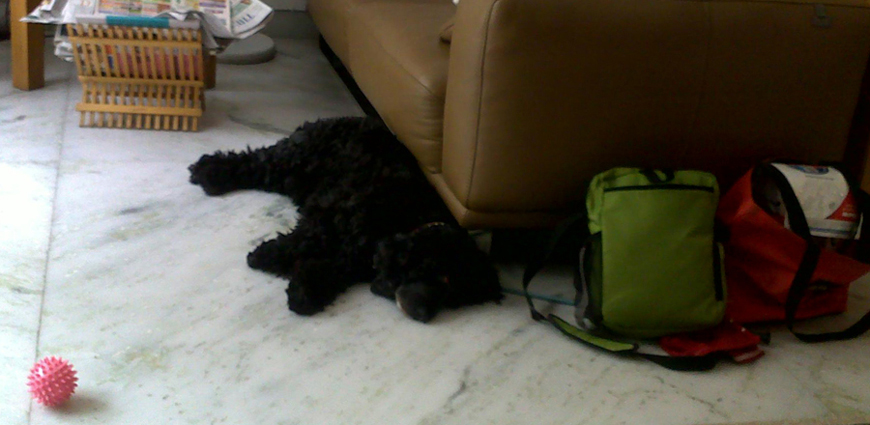
New Delhi: Kiki came to stay with us for a few days. Her owners went to Calcutta on business. Kiki is a black Cocker Spaniel, 10 years old in October this year and people say if you multiply a dog’s age by seven, you get the equivalent age in humans; so she’s like an oldish lady now. Kiki was born in Thailand, moved to Japan with her Japanese owner, then to Bangladesh, Vietnam, back to Japan and now she’s in India. A much-travelled small dog, Kiki has her own immigration documents, a kind of doggie passport. I first met Kiki in Bangladesh 4 years ago and it’s a bit sad to see she doesn’t remember me at all. But she’s older now, seen a lot, she’s slower and can’t be expected to remember everything. Kiki comes towards me with her little pink ball held in the mouth, drops it in a practiced way so that it rolls towards me. I pick it up and throw it and she runs to get it, but after about four throws she has to stop and have a rest.

We are given Kiki’s things in two small bags, food, blanket, toilet equipment, ball and her owners say bye-bye Kiki! and leave. Kiki spends a long time sitting at the patio door looking out, waiting to see if they’re coming back. But they’re not coming back; I try to engage with her, I try to speak with her in a kind of doggie-speak, cute high pitched baby chatter. But it’s not working very well because most of the time her owners speak to Kiki in Japanese. Kiki just looks at me, looks at Jiab, responds in a friendly way, but there’s a distance. Jiab and I are just the faces of this moment; she knows we are the carers. Kiki has had carers speaking to her in Thai, Bengali, Vietnamese and Japanese and, anyway, she’s limited because she’s a dog…. Now she’s just wondering which one of us, Jiab or me, is the one to whom she will be answerable; which one is the main provider of food and taker-out-for-walks? And it’s a new experience for us too, we don’t know much about looking after dogs. So I’m wondering how this’ll go, and thinking Kiki probably has that figured out already; the pros and cons of this situation, a naïve, abundant provider of tasty scraps from the table?

So we’re eyeballing each other like this, a certain curiosity and interest in the air and Kiki is totally black like a photographic negative, I can’t see any face, only a strip of pink tongue hanging out. I’d be staring at her intently looking for a face then I discover it, see the black eyes, black nose and aware, all of a sudden, that Kiki is looking back at me! An encounter. Quite a lot of licking; affectionate doggie wetness – I put her food in the dish and there’s great excitement but she doesn’t eat, just sits there looking at it. I’m thinking maybe she doesn’t like it… but then she turns around and looks at me, face to face, eye-contact, quite a meaningful moment. A recognition; is it about gratitude? I say something like, go on then Kiki… and she starts to eat, tremendous crunching noise, her bowl-shaped dish amplifies the sound, and the scrape and clatter of the dish sliding on the hard floor as it gets pushed along by a long black nose. Maybe the hesitation at the start was her saying: look, I’m sorry, this is going to be noisy, okay? Same thing with water, I’m sitting at the desk quietly and there’s this huge shlooshing, splooshing sound.

kikiphoto1The ‘face’ of Kiki got to be more and more of a significant element in our communication – no expression, quite plain, just a kind of awareness: non-verbal gazing at each other. At one point I say to her: where’s your ball? and she immediately starts running around looking for it. I realise then that her Japanese owners must say that in English. So I get down on the floor and we are both looking under the sofa and the chairs. In the middle of all this, we look at each other, I’m on my knees, at her level. I say to her: I don’t know where it is… hold that gentle look for a moment: I don’t know… consider the enigma of our shared existence. There’s something about this that gets my attention, she just looks. I come closer and look again at her dark face placed in a dark wooly body. There’s a little movement of the head. I look under the sofa she’s sitting next to and there is the ball! Difficult to reach because it’s behind the bar but I can just get it, flick it out and Kiki runs off across the room chasing it. She catches it and comes back to me, drops it and I have to throw it again….

————————-

nothing cannot be anything

hand image3Delhi: There’s a needle in my arm. Strange how the body accepts this intrusive object and the antibiotic fluid coming through it that enters the blood stream. Veins have a plasticity like something synthetic we recognize from the world of manufactured polymer substances. But human tissue is better; you can make a hole in it and it repairs itself. You can cut it, stitch it up, remove parts of it and replace these with other parts that fit. The human body is a miracle. The pain of this needle, though, has a directness, increasing, then easing off, over and over, dukkha, there’s no getting away from it.

I don’t want it to be there, vibhava-tanha, I want to disconnect it from the plastic tube leading to the upside-down bottle suspended from the hook above my head. It feels unnatural; it shouldn’t be like this…. Lying here on the bed looking up and counting the drips that fall into the receptor that fills the tube; one drop every 4 seconds and that’s the rate of the fluid flowing down the tube into my pierced blood vessel. It’s a full bottle, and there are others I have to take after this one… treatment for an intestinal infection – nothing really extraordinary in a country like India, in the hot season, when all kinds of bacteria thrive. Caused by drinking water from a filtered system that didn’t filter. Organisms survive the filtering system; bugs everywhere in this intensity of 43°C.

I need to find a way of getting through this period of invalid status and prolonged boredom of a plain room with hospital fittings, plugs and sockets in the walls, hospital furniture and a TV screen I’m not interested in. Dissatisfaction with things; clicking the buttons that control the position of the hospital bed; down/up and up/down. Lying here with eyes closed, listening to the metal trash bin; it makes a satisfying percussive sound when the cleaner presses the pedal with his foot, lid springs open and strikes the wall next to it Clang! He releases the pedal and the lid closes: Flumpf an airtight trash bin with plastic bag liner. Crash! Flumpf! again and it’s joyful and funny.

I need some joy here, there are men in dark navy uniforms in the room; cleaners with large grey floor mops that look like they’re soaked in muddy water swabbing the tiles; smell of Dettol stings the eyes. Muddy grey mops and dark navy uniforms seem out of place in an environment of lemon yellow, soft pink walls; pastel shades and shiny chromium fittings. The muddy grey mops are a bit scary also, because I’m sensitive to things that appear dirty, having fallen into this sickness as a result of drinking water from a filter machine installed at home that allows dirty water to come through.

‘We’re not in Kansas anymore Toto…’ The doctor said always drink boiled water in the hot season, organisms are present in the water, filter or no filter. I feel some frustration with the company that sold me the water filter: ‘it shouldn’t be like this’but we don’t live in a world of ‘should’ and ‘shouldn’t – western theory applied in an Indian context. We expect it to work, and it doesn’t. Western systems are deductive and life is inductive. Organic growth has no beginning no end. How to understand that, what to do? Don’t make it into a structure. Let it be nothing.

So I can lie here on the bed with my eyes closed and the cleaners expect me to be like this because I’m a hospital patient. And in this curious public place, enter meditative contemplation, watching the breath, the rising and falling of the chest. Allow the thoughts that arise to fall away and be replaced by others that I allow to fall away and allow everything to fall away and cease, as far as possible – just the effort of trying to do this leads to a quietness in the mind; spaces of no thought. There’s some peace to be found in this activity. And from here consider nothingness, just nothing, no thought. It’s not an idea of nothingness, that’s a concept. Nothing cannot be  anything. Nothing cannot be located anywhere in time or space; no before, no after. If it is truly nothing, it can have no cause or effect. I can’t work towards some mind state in future time when I’ll see what ‘nothing’ really is, it has to be now, it’s always ‘now’. Nothing cuts through, penetrates, and dissolves everything. It’s just nothing.

————————-

‘One must have a mind of winter… (to behold) the nothing that is not there and the nothing that is.’ [ Wallace Stevens, The Snow Man]

Photo image: http://www.jeffzinn.com/wp-content/uploads/2011/12/poor.jpg