how it seems (1)

2013-01-09 11.48.37I SEE THE WORLD through a built-in selection process that reflects and supports the default state of mind; it’s like fish cannot see the water they swim in; so obvious, yet… but I can get it to fit, more or less, according to my likes and dislikes and fall deeper into the dream. I make it into something good or bad or whatever and the fact that I can’t see it – well, it just does that. I call it reality. How I perceive the world is dependent on causes and conditions that were here before I was born; you could say it comes with the software. I think I’m an independent being not affected by anything or not affecting or influencing anything else. I can’t see this is a work of fiction and it’s all being monitored by the ongoing needs and requirements of an entity I created; a ‘self’ that has no real substance. I’m dismayed, of course, by how it all gets swept away in randomness; subject to the kamma, unknowingly created at some earlier time.

 ‘… It’s because of not understanding and not penetrating this Dhamma that this generation is like a tangled skein, a knotted ball of string, like matted rushes and reeds, and does not go beyond the cycle of the planes of deprivation, woe, and bad destinations.’ [Tanha Sutta: Craving” (AN 4.199)]

The outer world just rolls along, as it does, in all its diversity, and totally neutral. Whether there’s belief it’s this or that, makes no difference; it’s just how it seems. The devastating emptiness of it all means the population is driven to get and do and attain and protect and defend. It’s a battlefield. To avoid and deny, to have fear and anxiety and be controlled by authority and feel threatened with the flimsy nature of existence, although the absolute fragility anicca, is the beauty of it. But the population can’t see it like that. They are clutching at straws but don’t see it like that; don’t see they are maintained in an unknowingness of the world like penned animals are by the farmer, well intentioned though he may be, in order to cultivate a special kind of hunger, upadana tanha (clinging and craving) – and the economy depends on this. The greater the craving, the faster the turnover of stock and the Western style of God together with governments and the corporations are simply involved in farming the population.

I can understand why the Buddha was thinking the Dhamma was too subtle and there was no point in teaching it because no one would understand. I can see how, in those historical times of feudal hierarchy, it would have seemed impossible to create social change…. and is it any different now? It seems just as impossible for people to understand today. I wonder if I really fully understand it myself. I’m no different from other people, this is our shared suffering. But the Buddha changed his mind about it being too subtle. He said there is a way out and we can find it in the framework of the Four Noble Truths. The teaching has survived 2600 years. Understanding replaces misunderstanding; ignorance is pushed out. There’s a simple curiosity and this quiet state of at-ease knowingness….

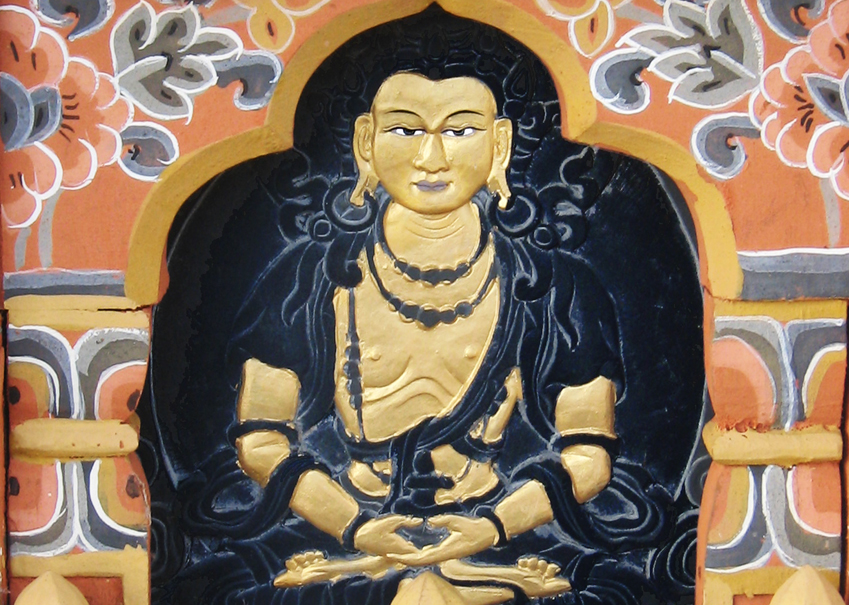
Big_Buddha_statue,_Bodhgaya

————————-

the conditioned realm

CambodiaAnkorApril00(6)detailChiang Mai Airport: Waiting in departures to board the delayed flight to Bangkok. Three flights leaving around the same time, very crowded and all seats near the gate are taken. It’s the peak tourist season, young Caucasians sprawled around on the floor, everywhere. Long legs, pointed elbows sticking out – This Is Our Way – a sea of brightly coloured T-shirts, shorts, rubber slippers. And no room in the small coffee shop either; a forest of exposed limbs, tattooed legs, bosoms, identity obscured behind dark glasses, headphones, peaked caps and hunched over iPhones and digital devices, sucking up drinks through a plastic straw and I’m thinking of the tubular proboscis of a large alien insectoid. This is how the Gap Year looks. Like they’re sensory-experience junkies, got to have that input by way of the sense gates ayatana – closed to the world and the thought of emptiness is a seriously bad dream.

They do have that intense look, though, that says they know the ego of the West is a self-sustaining concept running out of battery and most likely to fizzle out quite soon; you could say impermanence, annican there’s no substance to it, same with all things. There’s the Christian God of the West everyone is trying to distance themselves from; the one-and-only-God, elite club that disincludes two thirds of the world’s population because they’re not Christian. It’s like a right wing supremacist movement, same as the so-called Muslim extremist groups – spot the difference – pretty ugly; there’s a war and both sides pray to God to win. God gets confused and there’s another war, and another…. So they can’t be talking about God, the Ultimate Reality, what they’re talking about is one of the gods of the conditioned realm. The logic of this is inescapable – how could God be something that one religion has and another doesn’t have? But there’s a kind of nobody-at-home look on the faces of my Christian friends when it seems like I’m going to want to try to discuss this point further.

These young people are all ordinary, well-intentioned folk and, just on this level, doing what they believe is the right thing, believe in the naiivity; subject to their conditioning in the West, their peers, parents, school, government. Maybe they’ve come here as part of a response to the human wake-up call – the built-in awakening opportunity that exists in mystical religions, Muslim, Hindu, Buddhist and others. It’s there too in the postmodern world; deconstructing, breaking it all down until there’s absolutely nothing left and the wake-up call is activated. Some people wake up, but some just don’t wake up at all.

It gets complicated and that’s why the Buddha was saying life is difficult enough as it is so let’s not get engaged with the God concept, okay? Attachment to the idea of it becomes a desire in itself and that’s what’s causing the problem. Ultimate reality is so fragile and subtle you can never be absolutely sure you’re not still setting it up so you’re seeing it the way you want it to be, still in the conditioned realm and far from the Truth. The best thing to do is not call it anything, cultivate mindfulness, clear comprehension, discerning awareness and take care; see how that goes.…

————————-

‘… the illusory world is through attachment. We think we all live in the same world as personalities, but every one of us lives in a world of our own creation. We have certain things in common but so much of our life is personal and unique to ourselves. That world we create is not the objective world we believe we’re living in, we’re living in a world of our own creation. That’s why it’s so difficult relating to each other, isn’t it? We’re coming from different worlds – you feel, sometimes, you’re living with a bunch of aliens!’ [Ajahn Sumedho, ‘In Awareness There is No Dukkha’]

Photo: Louk Vreeswijk

the end of the world

dreamstimefree_97357

‘In my beginning is my end. In succession
, houses rise and fall, crumble, are extended,
 are removed, destroyed, restored, or in their place
 is an open field, or a factory, or a by-pass.
 Old stone to new building, old timber to new fires, 
old fires to ashes, and ashes to the earth 
which is already flesh, fur and faeces. Bone of man and beast, cornstalk and leaf.
 Houses live and die: there is a time for building 
and a time for living and for generation 
and a time for the wind to break the loosened pane
 and to shake the wainscot where the field-mouse trots
 and to shake the tattered arras woven with a silent motto.’ [T. S. Eliot, Four Quartets, East Coker 1]

Delhi-Bangkok flight: The stewardess comes to my seat and asks me, would you like a hot towel sir? I say OK, thinking, do I need that too…? Altitude of 28,000 feet, travelling at 500 miles per hour; we must all be moving along here like extended strings of spaghetti in a streak of light. She takes one out with her little forceps from the small box she’s holding, drops it in my hands so I can catch it and it burns my fingers for a moment then becomes a cold and clammy thing with which to wipe the face and hands. Not the ‘hot-towel’ experience I thought it’d be and I notice in passing it’s like all other sensory experience, a bit of a let-down. The sensitivity of the mind is not held by the limitations of the body and I’m always looking for more than what there is. The mind continually searching beyond the present instance; using one thing as a springboard to get to the next, means that everything is driven on and on, and the present time is not here at all.

Consciousness, perception, and reality interact by way of the six sense doors: eye, ear, nose, tongue, feeling, and mind. The one that is accessible is the mind sense-door, leading to awareness of all the other senses, including the sense that it is self-aware; a cognitive functioning focussed on the sense of awareness. Everything falls away, leaving only the arising and ceasing of things. Then that falls away too and there is ‘the end of the world’. Beyond that, awareness continues – not dependent on conditions supporting awareness.

‘When no personal image is created… there is nothing to lose, a sense of gladness, uplift, joy and serenity.
 With the cessation of such a death-bound frame of reference there is the living of the True life, the Holy life. [Ajahn Sucitto, from the Introduction to “The Way It Is”
 by Ajahn Sumedho]

————————-

161120121610

“And what is the ending of the world? … Dependent on the intellect & mental qualities there arises intellect-consciousness. The meeting of the three is contact. From contact as a requisite condition comes feeling. From feeling as a requisite condition comes craving. Now, from the remainderless cessation & fading away of that very craving comes the cessation of clinging/sustenance. From the cessation of clinging/sustenance comes the cessation of becoming. From the cessation of becoming comes the cessation of birth. From the cessation of birth, then aging & death, sorrow, lamentation, pain, distress, & despair all cease. Such is the cessation of this entire mass of stress & suffering. This is the ending of the world.” [Loka Sutta: The World” (SN 12.44), translated from the Pali by Thanissaro Bhikkhu]

More Than Enough

Mitt Romney’s 47% remark drew a lot of attention, perhaps revealing an uncharitable, grudging attitude but it does inevitably bring us around to seeing a quality we all possess: generosity of spirit. Generosity, as a mental, emotional letting go, means releasing the tenacity of holding on to things. Baggage, all that heavy stuff we burden ourselves with, is removed in one single act of generosity. What’s wrong with being generous; cultivating an inward disposition to give? A glad willingness to share what we have with others – why not? We have more than enough. Give it away. Ease the discomfort of being driven to fulfill that urge to ‘have’, a hunger created by always wanting more. All of it is gone when you’re generous.

Brainstorm the word ‘generosity’ and you come up with loving-kindness, compassion, empathy, well being, freedom. You find gratitude, grace, honour, motivation, encouragement. Generosity is everything. It’s nature is to share, recycle, circulate; it can only be given, never taken. With generosity we can accept, we can share, we can forgive. Generosity leads to wisdom – the truth is without bias. There is an understanding of things as they really are.

In Buddhism, generosity is seen as a way to counteract greed. It’s a way of helping others and a means of lessening the economic disparities in society. Generosity is part of Right View. The dhamma of generosity is a gift for all of society as we struggle for meaning in a world of dollars, logos, oil and military spectacle. The dhamma of giving is a disinfectant, a gunk dissolver, an antidiote for the monetary values, brand names that clutch at our hearts.

‘The complex American culture of healthy (that is, democratic) and unhealthy (worship of profit) elements…. Even middle-class Americans, rich by the standards of most of the worlds people, spend much of their money on indulgences, entertainment and addictions.’ [Practising Generosity in a Consumer World]

The cultivation of generosity directly debilitates greed and hate, while facilitating that pliancy of mind that allows for the eradication of delusion. In Buddhist countries, babies are taught when they are about six months old to put food into the monk’s alms-bowl. The whole family applauds as the sticky rice drops from that little hand into the monk’s bowl. The kid gets the idea early on: when stuff leaves your hand, you feel happy. It feels good to give. Everything the Buddhist monk receives is a gift, an offering. Ajahn Amaro describes it in this way: ‘Our bodies are fueled by the food that is offered to us. In fact, scientists say that all the cells of the body are replaced every seven years, so any of us who has been ordained for that long now has a body that is completely donated. If it were not for the accumulated kindnesses, efforts, and good will of countless hundreds and thousands of people, this body would not be able to sustain itself. Kindness is the actual physical fabric of what we think of as ‘me.” [Generosity in the Land of the Individualist]

There’s the story about a seeker and a wise man talking together and the wise person has a most incredible jewel. The seeker is absolutely dazzled by the jewel and asks the wise man if he would give him the jewel. And the wise man gives it to him. The seeker is very excited and afraid that the old wise man is going to change his mind, so he hastily says goodbye and goes off. A short while after that he reappears, approaches the wise man with great humility and respect, lays the jewel down in front of him on the ground and says he’d like to make a trade. He’d like to exchange this jewel. And the wise man asks him what he wants to exchange it for. The seeker says he would like to exchange the jewel for knowledge of how to gain the sort of mind that could give up a jewel like that without a second thought. [This story appears in Khanti – Patient Endurance]

————————-

The gift of Dhamma excels all gifts. The flavour of Dhamma surpasses all flavours. The delight of Dhamma transcends all delights. Freedom from craving is the end of all suffering. Dhammapada 354

This post was created from the following references: Bhikkhu Bodhi: ‘Dana: The practice of Giving’. Ajahn Amaro: ‘Generosity in the Land of the Individualist’. Ajahn Jayasaro: ‘2. Khanti – Patient Endurance’ from ‘The Real Practice’ (Three Talks to the Monastic Community of Wat Pah Nanachat). Bhante Shravasti Dhammika – Link to source for: ‘Dāna, the development of its concept and practice’, Toshiichi Endo. Santikaro: ‘Practicing Generosity in a Consumer World’ from ‘Hooked’ (Buddhist Writings on Greed, Desire, and the Urge to Consume) page 198

Photos: Kathina at Wat Pahnanachat 2010 by PB

Mitt Romney & Right Speech

Mitt Romney making mileage (one way or another) from events in Libya? He’s saying all the wrong things. As a general rule, Right Speech is not something politicians are good at. Their intention is to get people to believe in an illusion. Probably not very different from how things were 2600 years ago. The Buddha’s Teaching on Right Speech may well have been introduced after hearing the politicians of his day manipulating the truth for all the usual reasons. And that’s why we have the Teaching on Right Speech. It’s called ‘right’ speech because language doesn’t stretch far enough to accurately express all the subtleties of how people communicate. The important thing is to get it right and I’ve used Mitt Romney here as an example of getting it wrong.

‘The importance of speech in the context of Buddhist ethics is obvious: words can break or save lives, make enemies or friends, start war or create peace. The Buddha explained right speech as follows: 1. to abstain from false speech, especially not to tell deliberate lies and not to speak deceitfully, 2. to abstain from slanderous speech and not to use words maliciously against others, 3. to abstain from harsh words that offend or hurt others, and 4. to abstain from idle chatter that lacks purpose or depth.’ [Link to: thebigview/eightfoldpath]

‘Abandoning divisive speech… What he has heard here he does not tell there to break those people apart from these people here…Thus reconciling those who have broken apart or cementing those who are united, he loves concord, delights in concord, enjoys concord, speaks things that create concord…

Abandoning abusive speech… He speaks words that are soothing to the ear, that are affectionate, that go to the heart, that are polite, appealing and pleasing to people at large…

Abandoning idle chatter… He speaks in season, speaks what is factual, what is in accordance with the goal, the Dhamma, and the Vinaya. He speaks words worth treasuring, seasonable, reasonable, circumscribed, connected with the goal… [The Samaññaphala Sutta, Kevatta Sutta and Cunda Kammaraputta Sutta]

————————-

‘In the case of words that the Tathagata knows to be factual, true, beneficial, and endearing and agreeable to others, he has a sense of the proper time for saying them. Why is that? Because the Tathagata has sympathy for living beings.’ [Abhaya Sutta]

[This post is based on an idea put forward by HLS]
Photo image: Yakshas (Thai: Yak) are common as guardians of the gates in Buddhist temples throughout the country. The yakshas are the attendants of Vaiśravana, a beneficent god who protects the righteous.


9/11 (2012)

September_11_(Wiki)Excerpt from ‘A Buddhist Reflection on the Tragedy of September 11’ by Ajahn Jayasaro, 2001: In this excerpt, Ajahn Jayasaro is talking about how we can learn, through the Buddha’s Teaching, to face this tragedy and here he refers to the three-fold training: sila (morality) samadhi (focus) panya (wisdom). Excerpt begins with sila (morality) and the link with volition: ‘Linking morality to volition means that to be consistently moral we need to educate ourselves about volition, not in the abstract as an intellectual exercise, but in the concrete present, as it manifests in our experience. The central role played by volition demands that we develop a power of introspection, an honesty and willingness, and an ability to look very clearly at our mind. We need to develop this form of education to the extent that we don’t rationalize our cravings and fears so automatically, that we are unable to lie to ourself as we used to do. In responding to a painful situation, for instance, we have to observe to what extent we are affected by the desire for justice, and to what extent for revenge. Is anger present, self-righteousness, fear? Are these wholesome or unwholesome qualities of mind, — to be trusted or not?

Morality here then is not a matter of following a number of rules or commandments, but of using precepts as tools in which to be clearly aware of and responsible for the motives behind one’s actions. Although the moral training in Buddhism demands a certain amount of awareness and a capacity for introspection, it is not the whole of the training. There are also specific practices for educating our emotions and discernment.

Thus we refer to a three-fold training, one which provides a framework within which to address the difficulties or dilemmas that we face in our lives. The training in morality is the foundation. It involves firstly the intelligent adoption of standards of conduct towards the external world and particularly other human beings, and then learning how to be mindful of them in daily life and bring them to bear on our behavior.

It is at this level of the training that we see the central role of self-discipline. But self-discipline is far from being a panacea for all our ills. We can’t decide not to get angry as an act of will, we can’t decide not to feel vengeful, we can’t decide not to have emotions. If we misapply self discipline then we create the conditions for guilt and repression.

Emotions are one natural part of our  life. We have to understand them. Some emotions deserve to be cultivated, others do not. In our gardens we distinguish between weeds and flowers. Although we remove weeds we don’t consider our garden evil for having them. So the first principle of training the emotions and mental states is that force doesn’t work; intelligence, sincerity and patience do.

The second can soon be clearly seen: the ability to abandon the unwholesome qualities in our minds and encourage the wholesome is conditioned to a great extent by our ability to focus and concentrate our mind. This aspect of mental culture has been neglected in the Western world for many centuries. An educated person, in Buddhist view, is not only someone who can think rationally, analytically, but is also someone who can, on the necessary occasion, stop  thinking altogether.

The mind, which is bound to mental states, tends to see things as clear cut, black-and-white, and often over simplifies the complexity of situations; it reacts in habitual ways. The mind which can put down habitual thinking processes, stand back from the rush of thought and emotion, suddenly has access to far more choices and pathways.

The Buddhist insistence is merely that the most constructive action springs from stillness. The wisest reflection takes into consideration, not only our own immediate interest or the interest of our particular group or nation; it also bears in mind the interests of our children, our children’s children and many generations in the future who are yet to be born. And this kind of thinking demands the ability to step back from one’s immediate attachments. It is dependent on mental culture, mental development.

The third aspect of this training is the training of wisdom and understanding, teaching people how to really look at their actions and their consequences, seeking to understand situations more clearly. Initially it means regularly contemplating the very simple facts of life which we tend to overlook, in particular the nature of change. Changes may be slow methodical, expected, welcome but they may also quite often be sudden, unexpected and unwelcome. It is an inarguable fact that every one of us, sooner or later, will have to be separated from those whom we love.

The Buddha encouraged us to be students of change and to understand its nature. We should be looking at change, looking at uncertainty, looking at insecurity face-to-face everyday. Life is insecure. There is no real security in a changing world and the frantic search for an unrealistic security is only going to lead to tension and pain. There has to be a certain point where we create the conditions for security as best we can, but humbly acknowledge the fact that ultimately we have no defence against uncertainty and change. We have no rights. We can and should create conventions about human rights and it is important that such rights are vigorously upheld in human society. But ultimately, we have rights to nothing except the way things are: we are born, we get old, we get sick, and we die. We must be patient and willing to keep going against the grain of self-indulgence, looking again and again at the way things are; educating ourselves about those things which brighten and clarify our minds; those attitudes, those thoughts, those emotions which cloud and brutalize our minds. The more we do this work, the more we see that we have a choice which way we want to go, the way of darkness or the way of light.’

————————

Lower photo by Louk Vresswijk, taken in July before the attacks, shows the twin towers in a modern New York setting. Location, a column in Cathedral Saint John the Divine, 1047 Amsterdam Avenue, NYC.
DSC_1404


Ajahn Jayasaro [Link to: 9/11 A Buddhist Reflection pdf]


Curious Blessings

Aug 19: US President Barak Obama wished Muslims around the world “Eid Mubarak” for the festival marking the end of the holy month of Ramadan. In a statement released by the White House the President extended warm wishes to Muslim communities in the United States and around the world as they celebrate Eid al-Fitr. President Obama said: “we congratulate Muslim Americans and Muslims around the world on this joyous day. Eid Mubarak.”

This morning around 5 am I open the laptop and get the news. Yes, I’d forgotten about the Eid, it’s not something you’d really notice unless you’re living in a Muslim community. Around this time of year, at the end of Ramadan the sighting of a sliver of the new moon at sunset signals that this is Eid al-Fitr – it happens at different times for Muslims in various parts of the world. The only time I experienced this was when Jiab and I were in Dhaka Bangladesh. And by coincidence we had a visit from a Buddhist monk from Thailand at that time. We hadn’t realised that his visit would be on the day of the Eid, and when I noticed the date on the calendar I sent an email to Ajahn suggesting we postpone the visit because of the Eid, but he insisted it was ok; in fact, a good time to come.

My hesitation was that Eid is when they slaughter cows and distribute meat to all members of the community. It’s a big day of benevolence and all the poor gather around the houses of the rich waiting to receive their share. If you’re a vegetarian, it’s hard to look at this. The thing is, there are all kinds of things we’d like to turn away from, and we can, but we’re deluding ourselves if we do – this is why Ajahn insisted we go ahead with the schedule. So, it wasn’t easy for me and I didn’t know what to expect. My Muslim friends said that in Dhaka city the presence of cow carcasses on that day would be hard to avoid. In Dhaka, like all Asian cities, everything happens on the street, in the public area, and there’d not be any route coming in from the airport that would not go through these sites. I needn’t have worried, though, because Ajahn was completely okay about it.

I went to the airport, found Ajahn in the crowd, not difficult to find him, the only one there in the pale tangerine-brown robe standing in the line beaming with joy. We left there for the apartment and on the way into the town all the places at the side of the road where the killings had taken place were pretty obvious and thankfully the killing had already happened, some hours before, at dawn. Muslim friends tell me there is a special way it’s done so that the animal feels no pain, no stress. We made our way through the slow moving traffic and could see piles of red and white animal parts and people milling around and it was like a butcher’s section in the food store on every street corner.

Ajahn pointed out that, when you think about it, it’s no different from what’s happening every day, animals are slaughtered for food. This is the reality of our world. All the time, somewhere in the world, maybe at this very moment, large numbers of cows, poultry, fish, goats, pigs are being killed and prepared for human consumption, let’s not delude ourselves. Yes, it’s quite a thought; we just prefer not to think about it and I hadn’t considered it that way. Reassuring to have Ajahn here because before he came I was finding it a bit difficult to accept.

There had been cows (and goats) everywhere in the city. For about a week before Eid, these animals were being taken into the city in lorries, in the back of pick-up trucks or led by farmers walking in from the rural areas. There were cow markets I’d pass through where animals were being sold and all the cows looked the same, white, pale fawn colour with curved vertical horns and that hump on the shoulder. There were cows in every part of the urban area – a farmyard smell of dung and straw. Cows were sitting at the roadside moving the jaw in a chewing motion as the traffic went by; they were in the carpark tethered to railings and street lights; all were being very well looked after and so they were just calmly and quietly sitting and standing around in pairs, usually, in a state of placid contentment. Some had garlands round their necks, painted horns, painted faces with eyes blackened around the edges like theatrical mascara and white and red make-up. It was a bizarre and colourful sight.

But now, of course they were all gone; transformed. No evidence that they’d ever been there, all was forgotten. Instead there were stacks of neatly cut animal parts laid out as if in a supermarket meat department.

At the apartment, the Buddhist event was starting, the group arriving with food offerings, flowers. All quiet, small, neat Thais wearing black and white costumes. There were about 15 people there on the first floor in that apartment in the Gulshan district – where all the foreign residents are and wealthy Bangladesh families. The Thai community in Dhaka is quite small, some business people, employees in hairdresser’s shops, Thai food stores, the Thai embassy staff and all were here to take the five precepts. Jiab is, of course, a Thai Buddhist – not like me, a Western buddhist and still learning how it works. Jiab’s mum and dad were Buddhist and it goes all the way back through her family lineage.

The ceremony took place; chanting, meditation, repetition of each part of the Five Precepts and more chanting. Ajahn gave a short talk about sila in the context of sila samadhi punya. And throughout the whole meeting there was the sound of sawing and banging: boom, boom, bang-bang-bang. At first I thought, what’s going on? Sounds like construction or people hammering things. But, after a while, I realised what it was. When the talk was over and as everyone was leaving I had a quick look out the back window where the noise had been coming from. There were these same heaps of butchered animal parts again. A whole carcass had been cut up here. There were large butchers wooden chopping boards, saws and the sound had been cleavers and small axes chopping and sawing through bones. Just below the window where the Buddhist monk was chanting….

And I don’t see it particularly as a characteristic of the Muslim faith, the same thing happens in all of the supply networks for the food industry; meat production in America and Europe, it’s the same thing. The only difference is that in the West it’s hidden and we’re not usually aware of it.

I’m glad it happened, as it did. Having the Buddhist monk there on that day to create blessings in the midst of everything was quite wonderful for us.

Success-Failure

Switzerland: I’m on the DOWN escalator at Gare Cornavin leading to the underground shopping area, and up to where the bus stop is. Phone rings in my pocket. Hello? It’s Jiab calling from the house in Delhi. Reception is not good so when I reach the bottom, I change to the UP escalator and come back to street level. How’s things? In the background I can hear the neighbour’s dog barking: woof-woof, woof-woof, woof-woof, woof! [Link to: Mindfulness of Irritation] The familiarity of it … for a moment I’m there; the sense of ‘me’ from that time starts to  become the ‘me’ here 5,737 miles away (as the crow flies). Interaction with the feeling only serves to energise it. The ‘I’ wants to experience it again but that’s gone now. ‘Did you see the end of the Olympics?’ Jiab asks me. And I did but have to say that watching the Olympics hasn’t been a priority these last couple of weeks. So, if you asked me about who won which medal, I couldn’t tell you. ‘Hello?’ no signal… I go down the escalator to the bus stop, pulling my small case on wheels behind.

There is this sports enthusiast friend of mine who was coming round to watch the tennis on TV and I’d be sitting there reading a book in the TV room with him, not really involved in the game, then he’d suddenly BELLOW without warning. I’d jump out of my chair, and he’d apologise for giving me a fright; thrust into the euphoric awareness of the tennis court ‘moment’. It isn’t very ‘sporting’ of me but when I see the athletic events on TV, it’s more like an opportunity to practice non engagement; being ‘with’ it and not ‘in’ it than something I ‘enjoy’ watching. The fierce competiveness is a bit unnerving; winner gloats triumphantly and loser totally devastated – gladiators slaughtering their opponents in the arena, spectators wild with joy. And if we are cheering in excitement about our athlete winning the gold medal, the opposing side will be groaning in despair about their athlete losing; making a big thing out of our success encourages their failure. It works both ways, of course, we may be on the losing side as often as we’re on the winning side.

The number 3 bus arrives and I put my bag in the luggage section; no seat, hold on to the hand supports as the bus swings off. Holding on to what I like means that some things I dislike come along as well; two for the price of one. The feeling that I ‘like’ something will stay around for as long as I hold on to it. If it’s something I ‘dislike’, the aversion I feel towards it is an attachment I struggle to disengage from. It’s a form of holding and that means the ‘dislike’ tends to stay around as much as the ‘like’ does. In terms of the Buddhist experience, like-dislike are the same thing; I’m driven endlessly to seek what I like because I dread having only what I dislike – thus end up holding on tightly to both.

These are the Eight Worldly Dhammas: ’… four pairs of opposites – four things that we like and become attached to and four things that we don’t like and try to avoid [pleasure/pain, praise/criticism and blame, fame/disgrace, gain and getting what we want/losing what we have]. We might feel that somehow we should try to eradicate these feelings of pleasure and pain, loss and gain, praise and blame, fame and disgrace. A more practical approach would be to get to know them, see how they hook us, see how they color our perception of reality, see how they aren’t all that solid. Then the eight worldly dharmas become the means for growing wiser as well as kinder and more content.’ [Pema Chodron]

The dilemma of the ‘I’ experience caught in the Eight Worldly Dhammas is serious and traumatic in the context of violence, war and natural disasters. The Pakistan earthquake in 2005 where 3.3 million people became homeless and so many lives were lost is one example [Link to: Power Failure/ Comments/ Saadya]. Many people there were convinced about a sort of Sodom and Gomorrah type of retributional justice; it’s all our fault, etc. We are being blamed for ‘our’ actions in the past. An extreme reaction in an extraordinary situation. Samsara of distress, pain, fear and the sense that something is ‘wrong’. The human tendency is to contract into ‘self’ and the assumption arises that ‘I’ caused it to be ‘wrong’ – I am to ‘blame’. It troubles me to think that this may be quite a common reaction when people are faced with death. When there’s no knowledge or experience of how to be mindful and aware, the mind follows this route.

This guilt syndrome that happened during the Pakistan earthquake was/is another example of the habitual ‘self’ response, no more than that, when everything came back to normal, the intense urgency of thought simply evaporated. ‘Everything that arises passes away.’ At the time it’s happening, it’s difficult to see that. What can I do to abide in equanimity….

Bus arriving, get off at the stop, cross the road and well-behaved Swiss traffic actually stops at the pedestrian crossing to allow me to cross. I hesitate, Bangkok traffic has the right of way, then I remember it’s ok to cross. How nice! Up the hill to the apartment building, pulling my small case on wheels behind. Good to be back in the fresh air and chilly mountain winds.

————————-

‘External conditions don’t make you suffer, suffering arises from wrong understanding. Feelings of pleasure and pain, like and dislike, arise from sense-contact – you must catch them as they arise, not follow them, not giving rise to craving and attachment – which is in turn causing mental birth and becoming. If you hear people talking, it may stir you up, you think it destroys your calm, your meditation, but you hear a bird chirping and you don’t think anything of it, you just let it go as sound, not giving it any meaning or value.’ [Ajahn Chah]

Landing on Mars

Curiosity landingThe Curiosity Rover landed on Mars. It’s an astounding thing and hard to believe but there are photos to prove that it is there. Conscious awareness goes off in search of this new location. It’s a basic human reaction: where is this place that wasn’t there before but it is now? A natural curiosity about it motivates me to find out. There’s an idea of something very distant, yet quite near; in terms of the Buddhist experience, it’s ‘here’ – the same space where we all ‘exist’. It’s somewhere in the known universe, in the sky, obviously, and the mind looks for a way to incline towards that place, move in that direction. I can see a part of the sky out there, through my window. So I go over and have a look: Mars is out there somewhere….

There’s a sense of distance, large empty space, and my focus reaches into this hugeness. It’s a bit like receiving an SMS from my sister in the Scottish Highlands, where she lives, up there in the cold mountains with a very faint network signal, and I read her SMS and think, what’s it like there, right now? Conscious awareness stretches out to that location and in a moment, I feel as if I’m there, then I’m back in physical reality, ‘here’ again: Delhi 30° Centigrade. I know she is there in Scotland and, for a moment, I was there too.

Another example is, I’m in Japan in the classroom and Jiab calls me on the phone: hello I’m in Helsinki! It takes a moment for me to figure it out. Where is that… ‘Helsinki?’ And all the Japanese students look at me, thinking: What’d he say, Helsinki? And I remember, oh yes, that’s in Finland … isn’t it? I’d no way of knowing she was going to be there – Jiab does this kind of thing. In the moment of recognition, consciousness flies away to what is known to be ‘Helsinki’ and flies back again. It may not have actually gone to Helsinki –  it is all ‘here’ anyway – but I’m left with the distinct sense of having travelled somewhere in consciousness. It feels like I’ve been away from where the mind normally resides and now the ‘world’ seems to be bigger than it was before.

In the same way, I know Mars is there – a very definite feeling that it’s there now, the proof is that the Curiosity Rover landed on that planet and is sending us photos, much like SMS messages sent by cell phone. Before I got the news about Curiosity, I’d no idea of that location; now I think I do.

It kind of supports an idea I’ve had for some time, about conscious awareness having the ability to (seem to) move in space, across some distance. A short while ago I was in Switzerland sitting on the cushion quietly in meditation and it seemed like it was possible to hold a picture in the mind; a view I was familiar with, from the apartment there on the seventh floor. So I did that, I focused on the picture I know so well: a group of trees on the horizon, maybe 5 or 10 miles away, and sometimes you can see these trees as clear as if they were miniatures on the windowsill. When a small patch of sunlight illuminates that distant place you can even see a shadow below the trees; and they become things of substance, solid; they have weight.

There it was, in the mind’s eye, a small group of trees in the distance, illuminated by the sunshine, all the tiny details of foliage and dark shadow cast on the green field below. It occurred to me then that eye-consciousness links with its object and if that object is 5 or 10 miles away, then eye-consciousness links with it in the same way it does with objects that are close. So eye-consciousness must, somehow, travel that distance to reach it’s object. It is puzzling but how could it not be like that? There’s an aspect of eye-consciousness that spans distance; eye-consciousness is transported as far as the eye can see. But, at any rate, it most certainly involves an attitude of ‘reaching out’ or ‘peering’, and trying to ‘see’ and in a similar way there’s this phenomenon of reaching out to a known location on the planet Mars.

In this meditational landscape I was viewing at that time in Switzerland, I started to contemplate this eye-consciousness transportation phenomenon simply as a possibility – a logical possibility – and suddenly the strangest thing happened. I was being rushed off, whisked away towards that horizon point I’d visualised! Just accelerating off at a tremendous speed and for it to continue happening like this, all I had to do was keep an open mind. It went on for as long as it held my attention and eventually, of course, something caused me to let go and it began to change. After that experience, I started to see how it’s possible to have extensions of consciousness in all kinds of quite ordinary ways.

So what I’m saying is, landing the Curiosity Rover on the planet Mars, is about scientific research but it’s also about how we can use consciousness to understand the scale of it. It’s the great space starting from my doorstep and out, all around and stretching into the infinite distance. All of that is simply ‘here’.

Loving-Kindness to Animals 1

flying gull

I was on a cliff path by the sea, in the North of Scotland, cold and windy, and there were all these nesting gulls making a terrific high-pitched screaming sound. Suddenly this large gull flew past my head, so close I could see its eye looking at me as it passed. I felt its body heat, was aware of the complexity of its massed intestinal organs, lungs, heartbeat and all this in just that ‘gull’ moment caught zooming through the air. Some piece of it’s time zone made an impact on me – an unexpected contact with a living creature in nature that you don’t normally have. It was protecting its nest, I was the predator, a wild animal on two legs; an egg thief coming to steal away its offspring.

I hurried on out of the nesting area, chased away by the gull, and spent some time in thought about the carnivorous relationship I have with the animal world. A friend told me about these two girls, twins in fact, who had their 15th birthday and their parents asked them what they would like to have as a birthday gift. After some discussion – twins always have to agree on birthday gifts – they decided they would like to ‘liberate’ a lobster. I saw on a webpage  that scientists believe lobsters can live to 100 years but the normal life span is about 15 years. I’d not heard of the Lobster Liberation Front before. Mum and Dad said OK to the plan and they went around all the storage areas where lobsters are kept for consumption in sea food restaurants, chose a lobster, bought it, put it in a bucket went out to sea in a boat and set it free.

I am a vegetarian, mostly, it’s a sensitive area. The fact that I sometimes eat animal products is not something I like to think about. There was one time in rural Thailand I was walking with Jiab in the fields around her home, and she takes me to see the little cow they have there. It has a bamboo bell around its neck: takata-takata. We stop and look at the cow, and it looks at us. A miniature creature, it comes towards me with cautious movements and swinging head in motion with the way it walks, raises it’s head and points a snuffling, sniffing wet snout in my direction; large snorts, extends long tongue and sticks it in it’s nostril (how do they do that?), comes a bit closer and quite a bit of sniffing of the air around me – not in Jiab’s direction. This cute little cow is curious about me due to a certain familiar milky smell coming through the pores of my skin? Thais don’t drink much milk so I was thinking, wow! here is proof that the (Western) body releases a noticeable odour of milk. I know this little cow has never been near to a Western person before in its life. The smell was familiar; a naïve recognition of an upright, standing-on-it’s-hind-legs member of the species – a cow person?

But we are carnivores. And there’s this unpleasant conceit about being at the top end of the food chain bothering me now while eating a breakfast of grains, nuts, fruit and cow’s milk. Jaws move in a slightly circular motion; down up, down, up, down, grind, grind, and swallow. I’m an animal too. I consume the environment, whether it’s other animals, fish, vegetables, eggs, milk – we are the cow’s babies (there’s a thought!). And cutting up vegetables is a bit of a sacrifice really; every time I start to cook food there is the opportunity for this kind of contemplation. Vegetables and fruit may not have the obvious characteristics of sentient beings but we may eat their reproductive organs along with everything else [link to: Buddhism and Beef].

There’s a couple of lines of text somewhere in an essay by Tan Ajahn Buddhadassa, that I cannot find at the moment; it’s about consciousness of all the things we eat, bits of animals, poultry and fish and how all their ghosts will come back to haunt us in the end. Pretty scary, nowhere to run, everything we are: mental, physiological, flesh, blood, and bones is a composite of what we have eaten, internalized. And it extends back through the generations to the beginning of time. The cellular substance of what we are is a genetic composite of all kinds of animal fats and enzymes and there’s just no getting away from it.

So, it has to be about being aware of the reality of it all. Contemplating the eating of meat helps me to see the true extent of my voracious appetite for all consumables. Things I feel drawn to consume surround me – and I mean, here, non-food items: ‘mind’ hungers for mind object. Consciousness is dominated by habitual ‘mind’. Remove habitual ‘mind’ and there may be something like a deluge of reality comes along and with it comes a deluge of understanding. Somewhere in there is an explanation for the fact that people eat animals.

When Acharn Mun was at the end of his life, weak and lying in a village in NE Thailand, a very large number of his followers began to assemble. He asked the bhikkhus to take him away from the village because the villagers would have to kill many animals to feed those people. They took him to a nearby town where there were market places and various kinds of prepared food could be easily obtained. Shortly after that Ajahn Mun passed away.

‘From the day of my ordination I have never thought of harming (animals), let alone killing them. I have always extended my loving-kindness to them, never neglecting to share with them all the fruits of my merit. It would be ironic if my death were to be the cause of their deaths (‘The Venerable Phra Acharn Mun Bhuridatta Thera, Meditation Master’, page 201 – 202).

[link to: Ajahn Mun Bhuridatta Thera, Wiki]

[link to: Image source]