the deathless citta

Ajahn Maha Bua observes the essential enduring truth of the sentient being, composed of the indestructible reality of the citta (heart/mind). But as long as there is a ‘self’ the citta is not free. This ‘self’ is the ‘Ultimate Danger’ because of its alluring radiance that causes attachment. The Ultimate Danger disguises itself as the Ultimate Virtue. When the perception of anatta (not-self) is applied, the agitated citta becomes calm and impassive with no interest in either atta (self) or anatta (not-self). The perception of anatta causes the self to be let go of and is totally destroyed, along with the ignorance that causes all beings enthralled by ‘self’ to wander in samsara.

The citta, intrinsically bright, clear, and aware, gets superficially tangled up in samsara but ultimately cannot be destroyed by any samsaric phenomenon. The citta may be caught up in the vortex of conditioned phenomena, but is not subject to destruction, It is ultimately not beholden to these laws of conditioned existence. The citta is bright, radiant, and deathless, and is its own independent reality.

The fundamental problem that besets human beings, is that they have taken untruth as their true self and unknowingly they allow the wiles and deceits of the mental defilements to generate fear and anxiety in their minds. Fear and anxiety are not inherent within the citta; in fact, the citta is ultimately beyond all such things and indeed is beyond time and space. But it needs to be cleansed of its inner defilements (the kilesas) before that truth can be realised. When the cleansing of defilements is complete, the citta remains, experientially abiding in its own firm foundation, yet ultimately indescribable.

Some of the notions found here are reminiscent of the Tathagatagarbha tradition found in Mahayana Buddhism— although the latter posits an original, primordial purity to the mind, whereas Bua sees that purity as needing to be established through mental and moral cultivation. [Re: Ajahn Maha Bua Wikipedia page: “Some basic teachings on the ‘Citta’”]

Excerpts from a talk by Ajahn Maha Bua, London, June 1974

We are here today to train our minds to be calm and cool. The normal state of the mind is such that it has no Middle Way. It continually tends to go to extremes of thinking and imagining and its moods are in confusion. What the heart (citta) is used to and likes to do, leads it away from what it should be doing. We must therefore make use of the Dhamma principles of the Buddha as a means to train the Citta to be calm — and however much or little one does this will not be without result.

Whoever makes use of any method of meditation, as, for example, paying attention to one’s breath (Ānāpānasati) or the repetition (Parikamma) of “Buddho,” “Dhammo,” or “Sangho,” should have mindfulness to control the Citta. The Citta should not be allowed to wander for if it does, one will not get results and the Citta will not get calm. In the Dhamma it says “Natthi santi param sukham,” which means “there is no happiness greater than peace.” The heart (citta) must be peaceful or calm to attain happiness, so we should try to help it to be calm. The Citta which is not calm will tend to be agitated continually and even when it is asleep it dreams of all sorts of things. If one’s Citta thinks a lot it will create fantastic dreams and talking in one’s sleep, for if one’s sleep is not deep, dreaming will occur, whereas a deep sleep is a sleep without dreams. So, one trains to make the Citta calm down, but whether the Citta becomes calm and to what degree will depend on the ability of each person. If the Citta is very calm, there will be a great deal of happiness and this is the first step of the training.

The value of the mind will then be apparent because there is nothing greater than a quiet mind. I would ask you to try to have your minds steadily overcome the difficulties and laziness, which are usually in control. We believe that we cannot overcome them because we have seen their power, but if we think we are able to challenge them, and if we really do fight them, then the time will arrive when we do overcome them. We still hear of victories in regard to such things as sports and such like, but with regard to Kilesas (defilements) we only hear of giving in to them. Perhaps this is because we fall on our faces before the Kilesas and let them walk all over us.

Citta likes to go wherever it pleases and in whatever the Citta does, it is not afraid of doing wrong, nor is it afraid of danger. If mindfulness does not restrain it, it may stray and go for unchecked pleasure seeking, possessed by Kilesas. But if the Citta is trained and controlled by mindfulness, it will slowly become disciplined and the Kilesas can then be eradicated. When it is accompanied by wisdom (Pañña) which investigates and extracts the Kilesas, the Citta will become clearer and brighter and one will discover the Citta is becoming more and more subtle and it has more strength and power. The Citta can become pure through the practice of meditation, but one cannot understand the Citta merely by reading books, for one can only come to know the real Citta by practicing the way. Then one will gradually come to see the true nature of the Citta a little more each time until one sees it clearly and all doubts vanish. Practice is therefore extremely important if one wants to know the Citta, because one can come to know the real Citta absolutely clearly and eliminate all doubts by means of practice. There is no other way in which one can come to know.

Question:

People in England study Buddhism from books. They do not know that there is a Citta and Buddhism is not taught here according to the Satipaṭṭhāna Sutta. The result is that people are led to understand that the Citta is mindfulness and wisdom. I therefore think it necessary for Ven. Paññavaddho to have the Venerable Acharn give us some understanding of the Citta.

Ven Paññavaddho to the Venerable Acharn in Thai:

People here in England understand “Citta” to mean thinking and that the Citta is divided into those forms of the Citta which come from seeing, hearing, & touching; in other words, “consciousness” (Viññāṇa).

Answer:

That aspect of the Citta which arises when something comes into contact with eyes, ears, nose, etc., and which knows and receives that contact is called “consciousness” (Viññana). It arises and ceases together with that contact. As for the Citta which waits and knows these things, it does not cease together with the consciousness when it ceases, it does not cease even though the body ceases, for it will go on and take rebirth in the future. There is no end to it if the “sap of the heart” which is the Kilesas and Ignorance (Avijja) are still in the heart. But when this “sap” has been removed from the heart, there is an end to continual becoming and birth, as happened with the Buddha and his arahant disciples.

Reference: The Dhamma Teachings of Acariya Maha Boowa in London:

Link: https://www.accesstoinsight.org/lib/thai/boowa/london.html

Become love

Another one from the Irish Mindfulness blog

Karl Duffy's avatarMindfulbalance

If you want to know God,
become love. If you want
to know others, become love.
If you want to know yourself,
become love. And if you want
to know love, forget all you
thought you knew or needed
to know, and become love
.

Meister Eckhart, 1260 – c. 1328, German theologian, philosopher and mystic

View original post

Guanyin, gender-neutral bodhisattva

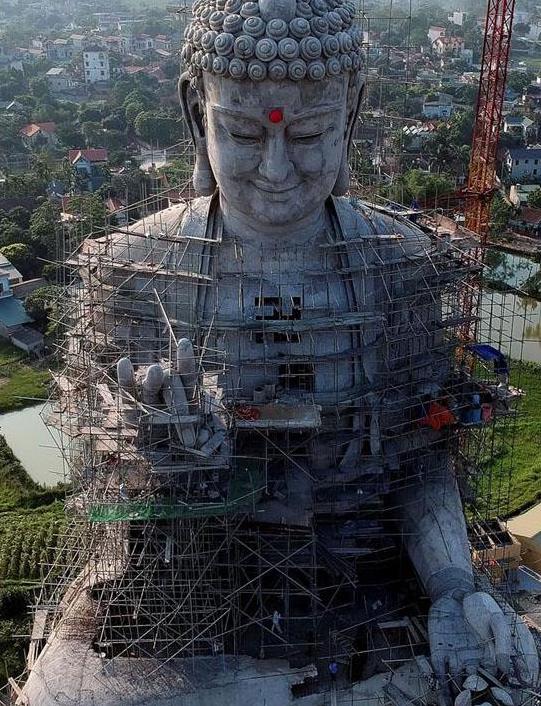
The Guanyin of Nanshan is a 108-metre statue of the bodhisattva Guanyin, sited on the south coast of China’s island province Hainan near the Nanshan Temple of Sanya.

Guanyin is the Chinese translation of Avalokiteśvara, the bodhisattva of compassion. Bodhisattvas are enlightened beings who chose to stay on earth as accessible examples for Buddhist faithful to follow. Originally depicted as a male or gender-neutral entity able to take on thirty-three manifestations, Avalokiteśvara is a compassionate savior who hears the woes of humankind, regardless of age, gender, or social class.

https://www.metmuseum.org/art/collection/search/42731

However, in imperial China, Guanyin became increasingly cemented as a female figure. Similar to the Virgin Mary, Guanyin became a popular intercessor for humanity to understand divine salvation. While there are a few different names to refer to this Bodhisattva, there are even more different forms that Guanyin can take when appearing to sentient beings in order to guide them away from suffering.

Traditionally, China was a very patriarchal society; a system reinforced by Confucian principles which put pressure on women to obey their husbands and give birth to sons (instead of daughters). As a result, women were generally the ones asking for Guanyin’s help in order to achieve these goals. In addition, it was thought that a woman must commit to one man for her whole life (even after his death), therefore it seemed more appropriate for a woman to worship a deity in female form. In this way, Guanyin starts to take on more feminine qualities such as kindness and grace and, in female form, she is seen as more accessible to women.

It is believed that Guanyin is androgynous or perhaps without gender. According to the Mahāyāna sūtras, it makes no difference whether Guanyin is male, female, or genderless, as the ultimate reality is in emptiness (Skt. śūnyatā). Guanyin can take the form of any type of God including Indra or Brahma; any type of Buddha, as well as any gender male or female, adult or child, human or non-human being, in order to teach the Dharma to all sentient beings.

This post comprises excerpts from:

Wikipedia Guanyin page

Guanyin: the Bodhisatva of Great Compassion

the timeless time

[Excerpts from an article by Loch Kelly in “When am I?” : Tricycle : September 08, 2015. The writer explains something about the present moment that’s held my attention for a long time, vis-à-vis the concept of present moment awareness as in “Postcards from the Present Moment” : dhammafootsteps.com]

In Tibetan Buddhism, the Now is considered the “timeless time” that includes the three relative times of past, present, and future. We know not to get caught in the past or the future, but in order to be in the Now, we also have to let go of the present. The Now is not confined by relative clock time, yet it is also not pure timelessness. The Now is the meeting place of timeless spacious awareness with the relative world and its conventional time. The Now does not come and go, but includes everything all at once. When we’re aware of being in the Now, present moments come and go, like ripples and waves in the ocean of awake awareness.

We cannot enter present moments because they move too fast and change continuously. Contemporary Tibetan Buddhist teacher Mingyur Rinpoche says, “If you examine even the present moment carefully, you find that it also is made up of earlier and later moments. In the end, if you keep examining the present moment, you find that there is no present moment that exists either.”

One of the great insights we can get from mindfulness meditation practice is that each moment of experience arises and passes. Having a direct experience of this impermanence, from observing awareness, helps us let go of the attempt to calcify any single moment of time, to try to make something stable that is not. When we really get a feeling for the coming and going of moments, it helps us break the illusion of a solid, separate self, which gives us relief from suffering.

The present time is not the Now. When Gampopa, an 11th-century Buddhist teacher, said, “Don’t invite the future. Don’t pursue the past. Let go of the present. Relax right now,” he was pointing to the fact that trying to locate yourself in any of the three relative times, including the present, can cause suffering – it’s not always a benefit to strive to be in the present. While working as a psychotherapist, I saw that the distinguishing feature of clinical depression is feeling stuck in the present. As one client said, “It feels like there is only this present, unbearable pain and no hope of it changing.”

The most important thing to know is that we are always already in the Now—however, we are not always aware of being in the Now. You can only know the Now from awake awareness. Many of us have experienced being in the Now when we were “in the zone” or in a panoramic flow state, but we can’t be aware of being in the Now from our everyday, ego-identified state of mind. We can shift through the door of the Now into awake awareness, or when abiding in awake awareness, we can begin to notice the feeling of being in the Now. The purpose of clarifying and distinguishing the Now from the present and present moment is for us to be able to shift into being in the Now and know we are here.

From Shift Into Freedom: The Science and Practice of Open-hearted Awareness, by Loch Kelly.

(Photo: Phuket coastal palms by Penn B.)

Daily prayers

Another beauty from Mindful Balance

Karl Duffy's avatarMindfulbalance

What I know in my bones is that I forgot to take time to remember what I know.

The world is holy. We are holy. All life is holy.

Daily prayers are delivered on the lips of breaking waves, the whisperings of grasses, the shimmering of leaves.

Terry Tempest Williams, 1955 – American writer, educator, conservationist, Talking to God: Portrait of a World at Prayer.

View original post

Creating the future

This reminded me of the Dhamma Footsteps theme, Postcards from the Present Moment: “having a lovely time, wish you were here!”

Karl Duffy's avatarMindfulbalance

Now is the only time.

How we relate to it creates the future.

In other words, if we’re going to be more cheerful in the future, it’s because of our aspiration and exertion to be cheerful in the present. What we do accumulates; the future is the result of what we do right now.

Pema Chodron, When things fall apart

View original post

the prevalence of 23

Closing#2: Bangkok: Now we are here  in the year twenty-three, I thought it worthwhile to offer a few thoughts about the number 23. What I mean is the belief that the number 23 has some sort of magical or mystical significance, because of all the instances in which it occurs. A quick dive into internet and the many web pages exploring the “enigma of 23” tells me: All of us humans have 23 pairs of chromosomes in our genetic makeup.The Earth is inclined on its orbital plane by 23.5 degrees. The “point-five” can be represented as 5 = 2 + 3. The September 11 attacks occurred on 9/11/2001, 9 + 11 + 2 + 1 = 23. Psalm 23 The Lord is my shepherd; I shall not want. The letter W has 2 points down and 3 up = 23. It is also the 23rd letter of the alphabet. Harpo Marx’s birthday was Nov. 23, 1888, and Bonnie and Clyde’s death on May 23, 1934. There are more. Twenty-three seems to pop up when you least expect it… That’s how it was for me, many years ago, a friend told me that he had learned about the mystery of 23 on his 23rd birthday by somebody else who said, once you start to think about it, the number twenty-three seems to arrive in your awareness in all kinds of ways: a bookmarked page number, parts of car numbers, parts of phone numbers, house numbers… and if you have the ability to perceive “truth” in nearly anything, you can associate 23 with; all sorts of extraordinary things. But you don’t have to do that, he said; just note the incidental nature of it appearing in ordinary consciousness. So that’s what my friend did and after a while it just started to appear in daily life. When we were driving around town, he’d point out 23 here and there, so I decide to start doing that too and sure enough, it begins to get my attention every now and then… or maybe it doesn’t for quite a long time, then suddenly it’s the 23rd of the month, or a utilities bill arrives and the first two digits of the reference number are 23 – it is significant if only because it appears in so many forms. And so, it seemed to follow along with me for many years. Then I came to live in Thailand and it disappeared, maybe because there isn’t so much communicative imagery out there, trying to get my attention, or if there is, I don’t pay attention to it because it’s all in Thai.The prevalence of 23 can be explained as an example of ‘apophenia,’ the tendency to see connections or meaningful patterns between unrelated or random things. Or ‘selection bias,’ which refers to the falsification of a statistical analysis, resulting from the method of collecting samples. Also ‘confirmation bias,’ the tendency to search for, or interpret information in a way that confirms or supports prior beliefs or values.Whatever, what I’m saying is; if after reading this, you find the number 23 appearing in ordinary incidental awareness from time to time, check back here and see if anybody else has noticed it. That’s all, and have a good day.

our permanent house guests

Closing#1: Bangkok: Hi everybody, I thought I’d introduce two members of the household. The grey and white has a French name, he is Benoit [ben-wa]. The ginger one is Croissant [kwa-son] … when she curls up to sleep, she looks like a croissant. Their owner is M our niece who lives with us. She came down from Chiang Mai with the cattos (note; they are not cats, they are cattos; it’s a special species) … so the cattos came in a friend’s car, a seven-hour journey. A long time, but Benoit and Croissant were free to explore the whole of the interior of the car – look out the windows, ‘where are we now?’ Food and water and toilet box behind the back seats… then sleep together somewhere among the blankets.

Now they are here, and it’s been nearly a year. They integrate with nearly every aspect of our lives; this is their residence; this is their world. They can’t go out to the garden beyond the screen doors. Everything they need is in here, a staircase they can run up and down on, get exercise, fall asleep together somewhere upstairs or downstairs – get lost in sleep… [more later]

year’s end and the unconditioned

OLD NOTEBOOKS: Bangkok: In Buddhism there is no continuing, personal Self, only a temporary, constantly changing, aggregation of mental and physical elements. For all intents and purposes there is no self. There is no God, no divine being in human form. There is, however, an understanding of the Divine Spark’ of the Gnostics; the spark of knowing: gnosis, consciousness. Christian Gnostic groups in the first century AD, emphasized personal spiritual knowledge above the orthodox teachings, and traditions. The quiet struggle against the authority of religious institutions continues up to the present day. Franciscan friar, Richard Rohr says people are disillusioned with conservative churches that teach that nonbelievers go to Hell.

So, what happened to the Gnostic writings which flourished among Christian groups in the Mediterranean world? Fathers of the early Church in the second century, denounced them as heresy. Efforts to destroy these texts proved largely successful, resulting in the survival of very little writing by Gnostic theologians. What were these early Gnostics mainly concerned about? According to the Jewish Torah (the first five books of the Christian Bible), God plants the two trees of knowledge and immortality in the Garden of Eden, yet forbids Adam and Eve to eat from them. He warns the other gods, the Elohim, that if humans should taste omniscience and everlasting life, they will become divine like God himself, and this must be prevented at all costs.

The Gnostics felt that if God was truly good, he wouldn’t want to keep these divine gifts from humankind, and therefore concluded that the God of the Old Testament is evil, a malignant being who traps human souls in the world of matter he created. In order to keep them subject to his power, they believed, he must prevent them from realizing their true nature—that they are divine beings from a kingdom of light which transcends the world of suffering in which he keeps them enslaved.

This alternative reading of the book of Genesis can be found in the Nag Hammadi texts ‘On the Origin of the World and The Hypostasis of the Archons.’ The Nag Hammadi texts were discovered in Egypt in 1945. There is so much to find in these texts, including the dialogue between Jesus and his brother James. Jesus explicitly tells James, “Free yourself from this blind idea, that you are merely the case of flesh which encircles you. Then you will reach Him Who is. Then you will no longer be James; rather you are the One Who is.” It’s amazing to find this Vedantic teaching, from India, claiming that the individual soul (Atman) is identical with God himself (Brahman), spelled out so clearly in an early Christian text. Today Christians believe that only Christ was “one” with God, but Jesus seems to be saying that the rest of us are too.

“We cannot attain the presence of God because we’re already totally in the presence of God. What’s missing is awareness.” [Richard Rohr] According to Rohr’s teachings, a person does not have to follow Jesus or practice any formal religion to come by salvation, but rather “fall in love with the divine presence, under whatever name.” The Perennial Tradition, or Perennial Philosophy, forms the basis of much of his teaching. “God’s love for the world has existed since the beginning of time, suffuses everything in creation, and has been present in all cultures and civilizations. Jesus is an incarnation of that spirit. But this spirit can also be found through Buddhist meditation, or through communing with nature. This is the Cosmic Christ, who always was, who became incarnate in time, and who is still being revealed.”

In an early Latin work Eckhart asserts, ‘God is existence’ (Deus est esse), that ‘existence is God’(esse est deus). The ‘isness’ of all that exists is God. This is the ‘birth of the Son of God in the soul.’ In Eckhart’s Christology the reason for the Incarnation (indeed, for the Creation) is that human beings might come to a realization or conscious awareness of themselves as the ‘image and likeness of God’, bringing forth or ‘giving birth’ to the Son of God within their innermost soul. Christ is understood not as Redeemer but as Reminder: ‘Christ came to remind us of our blessed and divine origins as images and likenesses of God in a grace-filled universe. The purpose of his coming is more our divinization than our redemption from sin and guilt.’

“The ineffable reality of God lies beyond our ordinary comprehension.” I have only just started finding out about this special kind of Christian contemplation (apophaticism) that rejects all the attributes and ideas about God we’ve known since we were children, and staying in the ‘darkness’ of a state of “unknowing.” Thus, arriving at this experiential union with the divine.

There are many things about this kind of Christian contemplation that seem very ‘Buddhist’ to me, I recognise the state of unknowing as being that which is outside human experience. Not impossible that the Buddha’s Dhamma had an influence on the Jesus Teachings. Maybe that’s why I had this strange recognition of it, déjà vu, when I first went to Wat Pah Nanachat in 1984. Studying Buddhism revealed fragments of an innate knowledge.

Instead of being deluded by the conditioned realm, I observe it. There is the state of knowing, of being aware of the changingness of conditioned phenomena – behind which there is the Unconditioned. With intuitive awareness – we find that silence, the unconditioned, as an embracing background, within which the conditions are in perspective. They are the way they are, they’re like this: but then they end, they cease. [Ajahn Sumedho. Escape. Forest Sangha Newsletter: October 2000]

Excerpts from the following:

Richard Rohr: “Richard Rohr Reorders the Universe,” The New Yorker, February2, 2020

Christopher Malcolm Knauf: Meister Eckhart and the ‘Wayless Way’.

Lynda Johnsen: Gnostic Texts Reveal Jesus in a New Light

Photo: Sunset on Phuket Island, by M.

flying away

POSTCARD#500: Bangkok: Three years have passed since we were last on this Bangkok-Chiang Mai flight, the marker in time is COVID-19. Hard to believe it’s been three years. These days, the passing of time is all of a oneness… I’m ‘flying away’ in a manner of speaking, as the mind wanders where it will. Grateful for the mindful collectedness to ‘know’ the mind has gone adrift and bring it back to where it’s at. We landed in Chiang Mai and made our way to the apartment, stepping back into the quietude of mountains and trees all around.

An easefulness, this is how it was on the flight today, maybe it was that airborne feeling, but as soon as I close my eyes, I stop thinking, and there’s just nothing there. Awareness of the cold air on my head coming from the air vent above – that specific feeling. Otherwise, no thinking, no input, nothing. There’s a huge empty space where my thinking used to be… it leads me to consider that this is why the world exists; the desire to be thinking – but then I realise I’m thinking again.

I spend most of the time thinking about how to see it, how to get there, but not actually “seeing it” or “getting there.” How to get out of this conundrum? You have to be an accomplished meditator to do that, and there are only a few in this world, I have to find them and observe and see how it’s done. One Buddhist monk we can follow is Ajahn Brahm and I want to bring you into his world in the examination of this wonderful Pali word which means: ‘one-pointedness’ (ekaggatā)… he is talking about the first jhāna:

“One-pointedness is mindfulness that is sharply focused on a minute area of existence. It is one-pointed in space because it sees only the point-source of bliss. It is one-pointed in time because it perceives only the present moment, so exclusively and precisely that all notion of time completely disappears. And it is one-pointed in phenomena because it knows only one object – the mental object of pīti-sukha (joy happiness), and is totally oblivious to the world of the five senses and one’s physical body.

Such one-pointedness in space produces the peculiar experience, only found in jhāna, of non-dual consciousness, where one is fully aware but only of one thing, and from one angle, for timeless periods. Consciousness is so focused on the one thing that the faculty of comprehension is suspended a while. Only after the one-pointedness is dissipated, and one has emerged from the jhāna, will one be able to recognize these features of the first jhāna and comprehend them all.

The one-pointedness in time produces the extraordinary stability of the first jhāna (Note the Wobble), allowing it to last effortlessly for such a long period of time. The concept of time relies on measuring intervals from past to present or present to future of from past to future. When all that is perceived within the first jhāna is the precise moment of now, then there is no room for measuring time. All intervals have closed. It is replaced with timelessness unmoving.

One-pointedness of phenomena produces the exceptional occurrence of bliss upon bliss, unchanging throughout the duration of the jhāna. Mystic traditions more recent than Buddhism have been so overwhelmed by the pure otherworldliness of the first jhāna, they have understood the experience as ‘union with God.’ (April 29, 2022) However, the first jhāna is the first level of supramundane bliss and there are another seven levels of jhāna to experience.” [Mindfulness, Bliss, and Beyond, Ajahn Brahm]

Following up on the Eckhart and Zen discussion recently, I came across another Buddhist monk who can bridge the gap between Christian and Buddhist Mystics:

“Just because Buddhism rejects a discussion of a personified Godhead, does not mean there are not many parallels that can be drawn to mystics in the various theistic religions.  Since theists tend to describe their God in terms of an infinite dimension, then I believe it is reasonable to acknowledge that the nonmaterial absorptions (arupa-jhanas) are fundamentally the experience of the union (yoga) with the infinite God/Jehovah/Brahma.” [Jhanananda (Jeffrey S. Brooks)]

There’s more to be said on this subject and I’ll continue to research the parallels between the theists and the atheists. In doing so we will perhaps move away from the way the dhammafootsteps blog has been going since 2012 (Note: This is the 500th post), and mark the new decade with a new format. What I’m planning to do is reblog or reprint texts from related sources and write a short analysis here and there, similar to recent posts on Meister Eckhart. Let’s see, what I’m saying dear readers, is I cannot continue blogging the way I’ve been doing these last ten years. My eyesight is not good enough; macular degeneration in the right eye.

The condition alters what I see around the centre of vision; horizontal lines appear to have a ‘bend’ in the middle, it means lines of text are distorted and I can’t read the words unless I close my right eye and look through my left eye. Also, these small black spots like mosquitos moving over the page take the place of random punctuation marks. Treatment started in June 2022 and is ‘ongoing.’

You can imagine then; it takes a very long time to write a post and I depend on the spell checker app to tell me when I have the spacing between words all wrong. I’m dependent also on the automated suggestions app for rewriting sentences that don’t make sense in their present form. With the help of these aids, and my keen interest in the subject, I expect to be propelled into finding the texts to re-blog, re-publish… and re-new!

Let other people do the talking and I shall take a back seat for a while. Remember, your comments and dialogue are the actual Postcards from the Present Moment. Merry Christmas to One and All

Tiramit, 23 December 2022