POSTCARD # 491: Bangkok: The Buddhist no-self (anatta) is mentioned many times in these posts, which indicates the special place it has in Theravadin Buddhism, but there is also a place for the self or selves; the ‘costumes’ we wear when we speak, discuss, and converse with others. This is of course, how we live our lives, we think of ‘ourself’ as our ‘self,’ and others as the ‘selves’ we may know or those we meet incidentally who just slot into place as individuals we speak with in the course of a day. The way we communicate can be thought of as story-telling… we are all narrators. In conversation we tell others our stories and we listen to the stories told to us by another speaker. Spoken dialogue is usually completely unrehearsed stories that just come tumbling out in a spontaneous leap of words, intuitively arranging themselves as they fall into place. Maybe with a return at the end, to indicate an opening where another speaker can join the conversation.
The television/video screen enters our world with words spoken by professional speakers or actors, along with studio-created images and the whole production is presented as a story supported by enhanced colour and artful lighting. TV News is a more ‘live’ telling of a story about (international) events. The storyline is edited to suit unseen sponsors and others’ requirements. We’re all just seeing ‘the seeing of it’ with stories built upon stories, swirling around events that actually took place. Adverts between programs are stories sliced up into key words and images and Mind puts it together, creates the story of ‘me’ reading all this, me going forward, and ‘me’ as someone just arriving in present time. Who’s that mirrored in the glass wall? This could be a story about me.
In the mind, I believe I am the story and the story is everywhere in my social environment, excerpts of it overheard in the places I visit and the friends I share my time with. We’re always only part the way through whatever story it is before another starts up. Unknowingly we follow up on incomplete stories, searching for an ending – a satisfactory ending. Looking through beginnings, middles and ends of stories that are not satisfactory, but there is no satisfactory ending, in reality… and so, in the mind, we invent endings to make them satisfactory. We tell others stories about ourselves., in so doing, we also tell them to ourselves, assuming there is a self to tell something to, a someone else serving as an audience who is oneself or one’s self.
The Buddhist cognitive sense is the sixth sense, the sense that knows the other five senses and knows itself as the ‘self’ until attachment to that self-aspect is seen through. There is no permanent enduring self, only fleeting selves that arise when thought of, then disappear as soon as they are forgotten.
This post was influenced by a book by David Loy, ‘The World is Made of Stories’
‘No identification can be secure in an impermanent world where all phenomena arise and disappear according to conditions. Liberation occurs when I wake up to the “emptiness” of my true nature. In terms of stories, without realizing the no-thing-ness that transcends all the sedimented roles in “my” stories, I remain stuck in those narratives and their consequences for good and ill.’
POSTCARD # 490: Newcastle Airport: I get a lift to the airport, not far, check in for the flight back to Bangkok, and it’s done… boarding pass and passport in shirt pocket, and they tell me to sit down for a while. Soon after that the wheelchair guy arrives. Jiab convinced me to go on a wheelchair, my problem is balance, if I turn too quickly, I can fall over. There have been a few falls. Hands go out, reflex reaction, in the midst of a fall, and bracing for impact. I broke the little finger of my left hand in a fall, and it never got set properly, it doesn’t go flat, it’s curved. Now I’m walking with a stick that folds away into a plastic case. Don’t need it now, I’m wheeled through the airport security portals and glitzy duty-free sections, straight ahead, the shortest possible route to Departures.
There is something about being in a wheelchair, upright dignity is just gone. I am in a truly passive state, humbled by the generosity of everyone giving way. Exhilarated by zooming into the great perspective of long airport walkways, huge architectural structures move towards me and pass through. Seeing the world from a lower eye level – déjà vu memory of being a child again. It comes with the acceptance of aging, an understanding of what helplessness is, the existential plight; insight into the realization that most of us are held in a trance-like state, pulled into the ‘self’ fiction by the mirror of Western society’s misconstrued fear of the unknown void, emptiness śūnyatā, therefore stuck with the belief in gratification of sensory desires, suffering and the fear of death. Wheelchairs are allowed to go straight through the lines of waiting people and up to the entry to the plane. I’m helped into my seat and the stewardess puts my bag away in overhead luggage space.
The transition takes place from terra firma to blue sky, and fluffy clouds of the heaven realms. Some hours later, we’ve had food and drinks and the lights are turned down so people can sleep. I’m just sitting here with the sound of the plane engines going on and on, a penetrating noise/vibration and the hissing of air. I have to get on good terms with this noise, get used to it, otherwise it could trigger a monstrous headache (but it didn’t).
For a while, I’m able to forget the noise and fall into a partial sleep. A dissatisfactory world of thinking about this and that, pondering over who did what, where and when – a ‘self’ is acting the part of characters portrayed in thoughts, being her and him and us and them and entangled in bits and pieces of related thoughts. The only constant in all this is the hypnotic one-note song I’m singing. So, I have to wake up to see what’s going on… immediately there’s the noise of the engines again. Why do we have it upfront like this? And I try to understand it better.
At first it seems as if there’s a noticeable regular beat in it, like the pacing of a runner, the hissing, whooshing noise suggests speed. But it just goes on and on, there is no ending, no runner arriving at the finish line, no congratulatory roar of cheering and applause… the sound doesn’t ever let up or change. It remains stretched out like that – a prolonged state of going but not arriving. The tedium of it is exhausting. I stand up to flex my knees and visit the toilet. I get inside that small space and close the door, but the noise is in here too! The sound and the hiss are in the centre of my consciousness. I remember now from other flights, everywhere you go inside the aircraft, the noise is the same. Where does it come from?
Anyway, it doesn’t sound like a mechanistic sound, no faults, irregularities, no rising or falling intonation. How could there be engines that run so totally perfect for twelve hours in a flat continuum of engine noise? This seems strange to me, and a more reasonable explanation comes to mind; the sound and the hiss are being played on a sound track, the intention being to mask the actuality of engine sound and lessen the panic passengers would feel, over the various small changes in the engines’ sound that might happen.
Thus, I find myself situated in the illusion; the engine noise is not real, besides, the plane itself is held on its flight path by automatic pilot… things are done but there is no do-er; ‘no-self,’ (anatta). The aircraft is 6 miles up in thin air, going at 600 mph, like a streak of light across the curvature of the planet. Yet, inside here, passengers are lounging around, looking at videos, playing cards, chatting, having drinks. Impossible to get my head around this, I settle into a meditative state, watching the breath and the sound is now like a warm embrace. The ongoing thinking about things doesn’t bother me… no-self, they’re not ‘my’ thoughts, just random phenomena that arise and fall away.
Otherwise having a silent mind, silent awareness of the present moment, no preferences, simply aware of things as they appear right now. Nothing to say, no opinions about visitors who come in, and stay, or go… let them. No reactions, no responses at all – quietly observing and practicing silent awareness in the present moment with the background of sound masking out all irrelevant things.
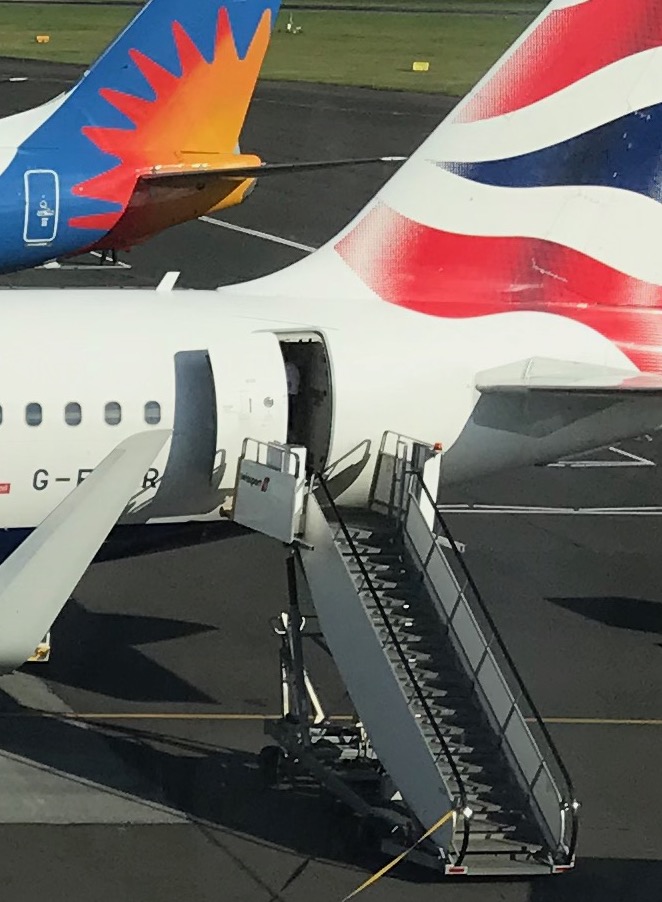
It didn’t take long to start the descent and I forgot to listen for any change in the ‘engine’ sound. Then the ear-popping fall into the lower realms, and bing, bang, bop the plane landed in Bangkok. I had to wait for the passengers to deplane then the Thai wheelchair man was there, a small person with big shoulders. He looked like he was capable of heaving my heavy weight up the inclines and along these long corridors. I needn’t have worried he was pushing me along faster than I‘ve ever done it on foot! In no time at all we had the passport stamped, got the luggage from the belt, out of the exit into the waiting car. I gave the man a good tip. There and back again in 10 days! Like a video on fast-rewind stops at the beginning not the end, the memory of the hassle and stress I suffered when leaving Bangkok was erased.
POSTCARD # 489: Dated 12th September 2022: Aruna Ratanagiri Buddhist Monastery, Northumberland: I arrived at the monastery in a taxi from Newcastle, after an absence of seven years. First things you see are the stone walls and rundown farm buildings repaired and rebuilt. Grass, hedges, small gardens and trees grown up and all filled out. The monastery looks like it’s nestled into the landscape and everything has made room for it. The guest accommodation is down the hill, two dormitories, male and female and a few individual rooms. I have one of these rooms. There is a Dhamma hall where we sit in meditation, early morning and evening.
My first thoughts about the place were that even though there were these outer transformations, it had hardly changed in the seven years I’d been away – check out an earlier post about this monastery: [‘The thingness of things,’ POSTCARD # 81, dated: July 19th 2014]. I met the senior monk again and he didn’t look a day older. Some of the passageways were repaired and painted but basically it was just the same. It’s as if I’ve been away to the town to get a few things, in the car and coming back only now.
The monks, in brown/faded tangerine colour robes of ancient times, chanting together the historical Pali suttas: Nammo Tassa Bhagavato, Arahato SammasamBuddhassa [Homage to the Blessed] Noble and Perfectly Enlightened One]. Seeing this, and lifted in spirit by the sound of the chanting, I felt well prepared at the end of my UK trip, to step into the Buddha’s Teaching at the start of my return to Thailand.
The bell signals the beginning of a forty-five-minute meditation period. So, I’m getting comfortable on a chair nowadays, because my knees complain if I sit on the floor, and on the chair, the body/mind can get settled into the meditative state. The Theravada practice is not so much about the blissful experience, it’s more to do with the observation and analysis of the mind; the nature of thoughts leading to associated thoughts, headed for some kind of conclusion but never getting there. I’ve learned that this is ‘the doer’ compulsively doing things and we need this ‘doing’ to stop, and make way for ‘being.’ Drop the active driving force and allow the passive form, ‘to be.’
It’s hard to do this, the thinking process is being compulsively driven. You discover that it is after all, the doer, still busy with this and that. It’s possible then, to identify the Self behind it all, and ask that Self to leave the stage. The performance starts to quieten down after that, although the world ‘out there’ is still seen as Self, the doer, the ‘me’ in here, in the realm of ‘doing’, the metaphorical self, ‘I think therefore I am.’ Descartes and his unfortunate self-view – and that’s not the way to go.
Then it all starts to disperse and I’m inside a curious extended freeze-frame moment, vestiges of thoughts dissolve and the whole thing comes to a stop – a sense of immensely distant things and the ‘unthinking’ state arises. The compulsive ‘doer’ is seen in the shadows, but we are not having anything to do with that today, thank you. Then there is only the space and a curious light illuminates everything.
Incidental thinking episodes float by looking for a place to settle, but there’s nowhere that’s not occupied right now. The spaces between thoughts are being kept empty, those intervals that start and finish before the next thought arises. There’s the awareness of how one thought includes an awareness of another thought; awareness can be in two places at the same time. I contemplate something, and contemplate the mind contemplating that but I can’t go any further with this because the bell rings and we have to get up and put our cushions and things away. Now it’s later, I’m in my room writing this and it’s uncomfortably cold here, fingertips touch the laptop tentatively, unwilling to make contact with its cold surface. I’m feeling chilled, can’t seem to get warm. There’s this uncertainty, all this moving from place to place, every second day. I came from Thailand only seven days ago, and I’ve been in four places – all over the place. Here in the monastery has been the longest stay, nice people, good conversations in Kusala House, and time to consider how the trip has worked out… it has gone well, I think. Everything is still uncertain, like the weather in UK. They were saying that things changed the day before yesterday… Summer became Autumn all of a sudden and the nearness to winter is not a pleasing thought for me. Yet I feel a connection with this kind of climate and this monastery, unfortunately, I’ll be away when the snowy weather comes. Thank you everyone, thank you Ajahn. Sorry to leave but looking forward to being back in the land of blue sky and summer all the time, departure on 13 September, 2 days remaining…
“… I went to Ajahn Chah once, totally beside myself with doubt and worry. After we talked awhile, he looked at me and said, ‘If something is uncertain and you want to make it certain, you are going to suffer.’ Well, that’s obvious. But he really knew what he was talking about, he really knew. If it’s uncertain, you’ve got to see it as uncertain – why try and make it certain? It’s only because of our attachment to certainty that we can’t learn from uncertainty; yet it’s only when we’re uncertain that we learn. When we’re uncertain, we can wake up, and look around and say, ‘What’s going on, what’s happening?’ We can be alert and attentive when we’re uncertain; when we’re sure, we just sit back and get fat and lazy. People who are really certain don’t have this sense of openness and vitality and investigation of life, everything’s very closed and sure.” [Ajahn Munindo, Forest Sangha Newsletter, Number 16, April 1991, “In Doubt We Trust.”]
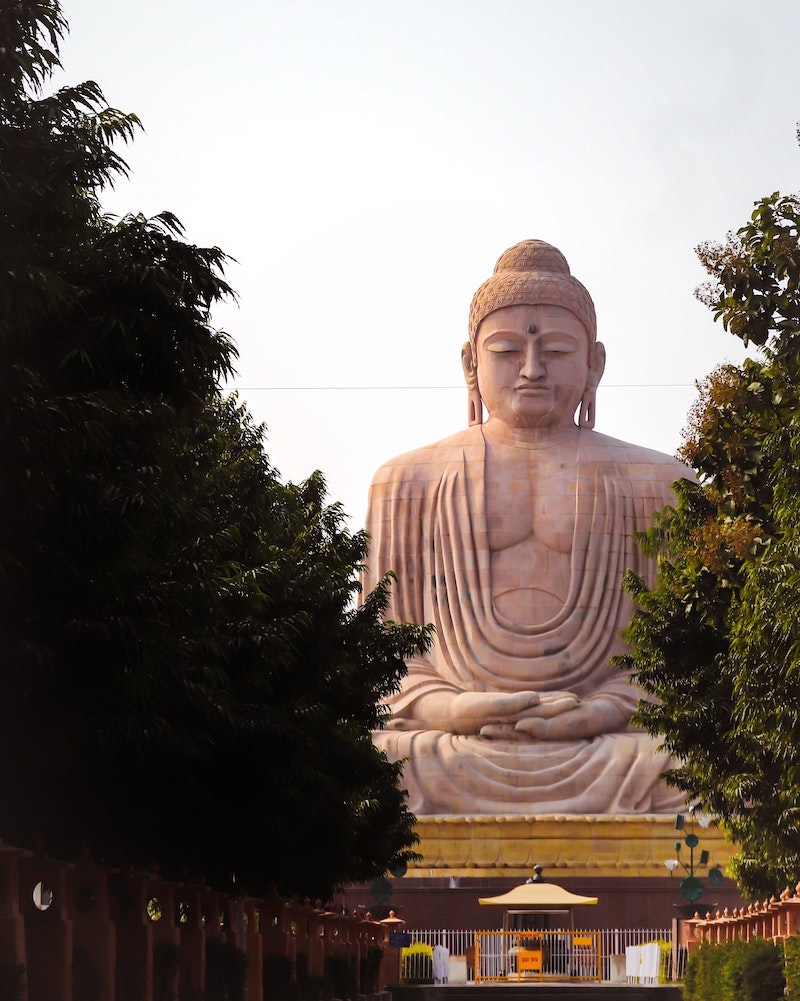
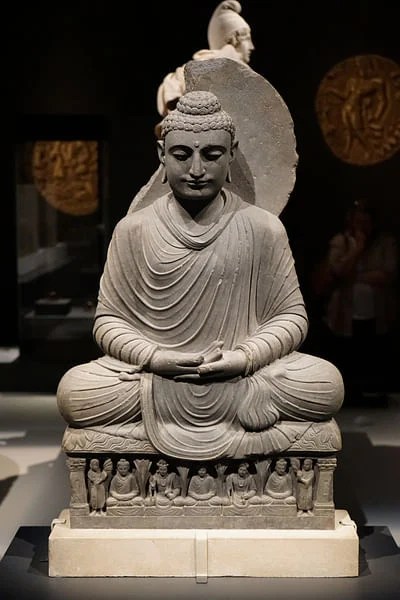
Image by Herman Ettema: Buddha Rupa by the lake at Aruna Ratanagiri Monastery
POSTCARD 488# : Glasgow Queen Street Station: Dated 7th September 2022: Sitting on a bench with hundreds of people going here and there, some sitting like me, but they’re occupied with their phones, while I’m writing notes on pieces of paper, hoping I’ll remember when time comes to key in the gist of what I’m seeing here. Meanwhile, raggedy pigeons walking around my feet looking for scraps, they peck at this and that, maybe trying to give me a hint but I don’t have anything edible to give.
Everywhere there is the picture of a particular place in space and time presented before our eyes, a series of events tell the story, and this is how it happens: a child stumbles into the parameters of my vision, corrects herself, then loses balance again, falls over, and sits up on the floor, slightly shocked by the fall. For a moment I think she’s going to cry, arms held out, wanting to be picked up, but mum is carrying all the luggage and pulling a large case on wheels and there is no dad in the picture. Instead, mum stands there, looking back at her daughter and calls out, in a Scottish dialect, a little harshly, I thought. Daughter remains sitting looking at her options, shouts a one syllable utterance and mother replies with a short encouraging sound but I can’t bear to be in this picture any more.
If you’ve lived in the East for any length of time, or any Third World country, you’ll know that when people have to travel, they go as a family unit, able-bodied grannies, aunties, older sisters, cousins or paid helpers – there would always be someone to pick the child up from the dirty floor. It goes without saying, but here in Northern Europe they have more or less lost that kindness.
For the sake of the economy, the authorities disbanded the clans, ‘every man for himself,’ and we were each reduced to a single unit of consumable human energy, or left to survive by whatever means. (We mustn’t dwell on unhelpful thinking, nor chase after a fleeting happiness, to the extent we forget what we’re doing.) It happened like that because of a misguided belief in Self – there is no enduring Self [anatta]. “The self exists conceptually, dependent on mind and body, not an entity in itself.” [Dalai Lama].
Getting back to reality, I’m waiting for a train to Newcastle via Edinburgh. Meanwhile, situated here in Glasgow Rail Station. There’s a familiarity about this city, although so much has changed. I was at the Glasgow School of Art for four years. The constant sweeping along of things brings me back to the place where I started off from. It was here I had a belief in Self, as we all did, then one day I woke up from the dream but three decades had passed – why didn’t I get here sooner? It’s an adherence that looks more difficult to unstick from than it really is. There is no Self, nobody at home, Elvis has left the building. The concept of no-self can be applied here and now – see the nothingness at the centre of everything. The entire thing is a construct.
We call it a grain of sand,
but it calls itself neither grain nor sand.
It does just fine without a name,
whether general, particular,
permanent, passing,
incorrect or apt. The window has a wonderful view of a lake,
but the view doesn’t view itself.
It exists in this world,
colorless, shapeless,
soundless, odorless, and painless. The lake’s floor exists floorlessly,
and its shore exists shorelessly.
The water feels itself neither wet nor dry,
and its waves to themselves are neither singular or plural.
They splash deaf to their own noise
on pebbles neither large nor small. And all this beneath a sky by nature skyless
in which the sun sets without setting at all
and hides without hiding behind an unminding cloud.
POSTCARD 487# : Bangkok, Suvarnabhumi Airport: Dated, Near Midnight, 1st September 2022: We were in the car and nearing the airport when Jiab suddenly realised I had left my jacket in the wardrobe – I never wear it, too hot, in fact it’s been hanging in the wardrobe since the last time I went to Europe seven years ago. But now I needed it, September is usually quite cold in the North of Scotland. No time to go back and get it, what to do? I’ll have to buy one as soon as I get there. So, we reach the airport, bye-bye, and I was off through the endless passageways, security zones and portals that lead to the plane. No worries, still warm in the airport and on the plane, it was a night flight, warm enough with a blanket and a place to put your feet up, not bad, got some sleep, twelve hours later, arrival in Amsterdam was a different story, darkness, got the shivers, every now and then, a huge blast of North Sea air, enormously cold.
Then on the plane to Scotland we were up above the clouds and a brilliant sun in the vastness of blue sky, shining straight on to the right side of head and shoulders (the side where the headache strikes), wonderful to feel that warming, and felt a sunbeam warming all the way through to the ear drum itself. How strange, but I recall this happening previously in Scotland – the sun must be shining from a different angle in this part of the world, than how it is in Thailand.
At the airport my cousin was waiting in arrivals and he swiftly took me away to a discount shop where I got a light-weight jacket with a zip and a hood. Just right for September weather. So, we couldn’t believe it was seven years since I last visited Scotland (also our own ageing, that face that looks at you in the mirror) and later with my sister the thought of it being seven years was just ‘too much’ and we preferred to see it as a time somewhere out there in the past. Then I met her daughter again and two grandchildren who had grown so much, they were visible proof of that span of time.
How to understand the concept of time? There is the ‘now,’ a point in time. The present moment as it was then, when I was last here, is the same present moment I experience today, seven years later in linear time. Therefore, you could say that chunk of time is one long stretched-out present moment. And, on the larger scale of things, the Whole History of the World is just one entire present moment… beyond comprehension, wow! Cannot be thought of in terms of Self, better to think of it as no-self (anatta), and emptiness (sunyata). But so much has been said in this blog about no-self. My cousin who is a Church-goer visibly flinched when I first brought it up in conversation. I need to pay more attention to what this means and how it is best expressed.
But maybe there is no best way of expressing or explaining no-self. Just let them get on with it and not have to think about the whole picture as it is. Meister Eckhart in the 14th Century paid a heavy price when he expressed some radical ideas in the context of the Christian belief at that time. There were two distinct factions; the Cataphatic division (Franciscan) whose spirituality was entirely devotional, and the Apophatic division (Dominican), which included Eckhart, whose spirituality was almost entirely analytical. In a few words we can say Eckhart wanted there to be a complete rejection of everything learned and cherished in a person, until there was only the empty ‘soul’, then Christ should be ‘born’ in us spiritually. From a Buddhist point of view, this resembles some aspects of the Theravada practice, which culminates in emptiness (sunyata) and no-self (anatta). Of course, there is no Jesus and no soul in the Theravadin Buddhism. Rather we allow the emptiness to be as it is, without any Christian intervention.
Needless to say, there was outright disagreement from the Devotional division, who were the Franciscans (Eckhart was Dominican). The Pope and other Church authorities created a huge upheaval concerning Eckhart’s sermons and teachings, calling him a heretic.
I spent some time with my cousin’s Church group (Devotional) and in the past, I’ve dropped into their discussions and surprised to see their reaction to the concept of no-self (anatta), I shall not bring it up again.
Returning to my journey, I left for Glasgow on the 6th September to see a friend you may know from the blog, Manish Jain, who is a follower of Ishwar Puri Ji and I’d like to write more in the blog in the near future, about the devotional aspect of Ishwar Ji’s teaching. I spent one night there and, on the 7th, left Glasgow for Edinburgh and Newcastle and through to Hartridge Buddhist monastery. By the end of this trip, I’ll have experienced both the analytical and devotional aspects of spirituality.
“When the sensation that I am in control of my life and must make it happen ends, then life is simply lived and relaxation takes place. There is a sense of ease with whatever is the case and an end to grasping for what might be.” [Richard Sylvester]
POSTCARD# 486: Bangkok: There’s really nothing left to do, just waiting for the hours to pass before it’s getting-on-the-plane time – everything else seems kinda irrelevant. If you’re reading this on the day of publication, 02.09.22, I’ll be gone… hop, skip, jump, up and over to Northern Europe, where it’s around seven in the morning, local time, I’m still in Airplane Mode, but near to where I get off the bus. A significant moment in my childhood in Scotland; the bus would stop in the middle of nowhere and my mother, my sister and I would step down with all our bags, to the quiet of the countryside, watch the bus go rumbling off and it was the start of the summer holidays spent in my grandfather’s farm. A happy time, and I like to think of this trip back ‘home’ in the same way, remembering how it was in those childhood days. We re-live our childhood through our children and although I never had any of my own, there was M our Thai niece. Some readers will know about M through reading the early posts – the first time she makes an appearance is in a post titled: “No more than this,” dated: May 10, 2013. I think she must have been 7 at that time and even then, there was a ‘conversational’ style about her English, skipping over vocabulary items she couldn’t reach with that spontaneity that seeks/finds creative solutions to problems in the here-and-now, and moving on.
The last time M appears in the blog is in a post titled ‘2021 looking forward,’ when she was 16 and had dyed her hair a yellow-blond colour. By this time, she was racing ahead in her ‘free-flow’ English style, disregarding errors. It was a direct result of the daily confrontation with English-speaking kids when she went to New Zealand for a few months on an exchange student program – liked it so much she went back a second year.
After NZ, she went to international school in Chiang Mai for a year, then she came to stay with us in Bangkok, just as the Covid lock-down happened and there was nothing to do, other than take on-line classes, and work on her GED and SAT scores. She’s on a ‘Gap’ year now, studying Japanese and planning to go to Waseda University, Japan next year. Maybe she has an affinity with the Japanese language because her grandfather was Japanese.
Nowadays, she is completely fluent in English and chooses to spend her time with my wife Jiab, who speaks English well. It amazes me that even though they are both Thai, their conversation is in English all the time. She speaks Thai with her mother (Jiab’s younger sister) and other members of the family, but she’s out there on her own in the English speaking world – not necessarily native English speakers but those in the South East Asia region who use English as a link-language.
Mostly she is quietly being her own self and surprisingly communicative at times – other times the earphones cable disappears in curtains of hair – sorry, she’s not available at the moment, plugged into two phones, watching YouTube videos while checking for messages at the same time… our questions addressed to her remain unanswered. She is becoming a person, a lengthy process. The whole thing dependent on the time needed to grow, of course – sometimes sleeps til noon then phones a food delivery from her room and appears downstairs to get it from the motorbike guy, goes back to her room to eat it there. Some of us might think this is a bit, well, antisocial? But here, nobody gets upset, it’s included in the Thai way, let it go…
I’ve included part of a post here ‘A kind of subjectivity’ March 30, 2014, that highlights M as an eight-year-old:
…being the only foreigner in the family, I’ve learned to go along with the preferences of others when it comes to food. As it was this morning, for example, faced with Korean kimchi at 10.30 AM because somebody thought it was a good idea to go to the Korean food buffet downtown, and if it were up to me, I’d have chosen something less exotic so early in the day, but Jiab thinks M, needs to eat something substantial so maybe she’ll like this. Okay go for it.
We get there, M tries the kimchi and tells me: not spicy, Toong-Ting, her name for me (key in Toong-Ting in the Search Box for all the M posts). She’s waiting for a response… I taste it, blood red and trailing strands of human skin and tissue – a vampire thing? But there’s nothing wrong with kimchi really, I’ve had things far more out-of-this-world than that. I nod with approval and give her a smile I think is convincing. But M can see kimchi doesn’t quite hit the spot. She comes over and tells me quietly they have ice-cream here. I’m thinking, yeh… well, do I need ice-cream? But if I said I didn’t want ice cream, I’d lose all credibility; so, I say, Nice! I’ll have chocolate chip. M goes off to tell the waitress, who comes with the ice creams… 30 years further on in the journey and I’m eating ice-cream with a nine-year-old.
I’m amazed that she seems to like me and her English language is as it is, without any corrections from me or being told she got it wrong. The kind of thing Western people remember in their own childhood and may suffer from. Maybe M responds to this quality of improvised simplicity I’ve developed partly because I want to avoid the systems of thought I grew up with, besides M thinks differently from kids her age in the UK.
It’s fun to have M in the world with all her made-up statements and short-cut questions. Besides, she corrects my Thai pronunciation (the tones), has a continuous chattering bird-like dialogue with me and discovers useful-to-know things about my phone I never knew were there. M has a kind of subjectivity she shares with me, she is an empath – no words for it, maybe because she’s a child in a bilingual situation and has to find the easiest route to understanding what I’m saying, and composing what she’s going to say in her head, or maybe all children are like this to an extent, and because I never had any children of my own, it seems special to me.
Being part of her world means there’s less of me holding on to my Western ‘self.’ I am the odd-man-out here in Thailand, a largely Buddhist population and unique in Asia, in that it was never colonized by a Western power. I learned early on, the importance of listening to the local people. It’s not appropriate to be imposing my Western ‘standards’ here, creating supporting statements to prove what I’ve already decided is the correct way of going about things, and convinced about this simply because my continuing engagement with it somehow seems to confirm it has objective reality. In the East, the starting point and the answer are revealed in the interaction with the context of the question – inductive reasoning, it takes longer, it’s more revelatory, exploratory, open-ended.
It reminds me of M’s intuitive way of figuring things out, there is no structure to hold things together if it all falls apart – but all nine year-olds must have this inductive way of expressing their reflection on ‘the world,’ more so for bi-lingual kids who have to invent a bridge from one set of behaviours to another – it’s all part of the game.
To close, I’ve included part of another post at the end of one of our Bangkok/Chiang Mai flights titled: ‘Windows,’ and dated: March 14, 2014. We come in from the airport in a taxi to the Nontaburi house, put the key in the door and get inside. Nobody at home, M runs around discovering the familiarity of the last time we were here… her energy is noticeable and my attempts to keep up with it:
We’re in a corner of the room where she has her playthings scattered around. Everything lying in disarray after a particularly large creative frenzy of cutting out and the sticking of things with glue, scotch tape, adhesive coloured paper and bits of old Christmas decorations, recycled. And when every additional use these items might be put to is thoroughly exhausted, M moves to Minecraft videos on my iPad: “Look Toong-Ting, look…” she says.
I position myself so I can see the screen, participate when I’m needed, and otherwise pleasantly distracted by the surroundings; the world suddenly thrust into a clear, enhanced three-dimensional presence. Objects become somehow… known? All our bags and things just lying where they got dropped, extensions and extrapolations of the environment of rooms, the furniture, the plants and trees outside. A momentary happiness, bien-être, no words for it…
POSTCARD # 485: Bangkok: This time next week I will have arrived in Northern Europe. There’s the countdown of course but that’s just going by itself, I live in a kind of corridor between here and there. I’m aware of a sense of ‘separateness,’ it’s not something new to me, more like it’s that British island-mentality. There’s a tentative belief in ‘self’ but now I’m seeing only the lack of it, and lifetimes used up with searching for completeness, sadly. More and more I’ve stopped looking for it. These days I’m a homeless person in UK, staying in Buddhist monasteries on the way – washing dishes and sitting meditation. Staying in hotels, staying with people I’ve met in Buddhist groups, friends, of friends, kalyanamitra. And the anchor point is my cousin who receives the junk mail from my bank and patiently puts it aside. He is my identity in the North of Scotland, and for that, I am truly grateful.
I really don’t feel comfortable in Northern Europe. I’m the Western cultural migrant assimilated in the East (resistance is futile), these last three decades in Thailand. I have user ID, password; there’s a connectedness with the East, although I’m still carrying the weight of Western thinking. All these years attempting to get away from that heaviness of thought, that which built the construct I grew up to believe in, stately and tall constructed of welded metal, concrete, brick and iron embedded in stone. But it came to nothing, all of it demolished in a day’. ‘Melted into thin air… the baseless fabric of this vision… we are such stuff as dreams are made on…’
My last foothold was a little old house in East Anglia, but about ten years ago it was sold. A printout of the email from the lawyer signed, enveloped, stamped and sent by DHL to England, 4000 miles away. My signature, exposed for all to see; idiosyncratic squiggle recognised by law as being ‘me’ saying ‘yes I agree to the foregoing; I relinquish, renounce, I have read and understood the above-mentioned.’ Box ticked, it’s all yours… sayonara, goodbye little house that sheltered me for 36 years, my small cave, burrow in the side of a hill. Somebody else is living there now… somebody more suited to a 24/7 commitment to the house.
It would have to be mortgage repayments, more than likely, and I didn’t have that obligation because the house was mine by Deed of Gift from my Great Aunt L. The cottage was a ruin of course and I had endless bills for repairs but I was ‘free’ of financial commitments, relatively speaking. This led to that quality of ‘unbinding’– I’m thinking of the Buddhist word: dhukka(suffering)…” an important concept in Buddhism, Jainism, and Hinduism, commonly translated as ‘suffering,’ ‘unhappiness,’ ‘unsatisfactoriness,’ or ‘stress.’ It refers to the habitual experience of mundane life as fundamentally dissatisfactory…” so, what I’m saying is living in the cottage for 36 years was the ‘unbinding’ – I was liberated from ‘suffering,’ not permanently of course but I learned so much from the experience.
Note, dated: OCTOBER 10, 2012: Today is the last day. Getting ready for the flight to Thailand… that familiar feeling of departures is in the air. Yesterday was a day of hoover and broom and the place is now totally clean, pity I’ll not be here to appreciate it. Everything gets a major clean-up a couple of days before I go. It’s always like this; then, on the last morning, I have breakfast, wash out my coffee cup, place it on the edge of the sink; wash my breakfast plate and leave it to dry in the dish-rack – it’ll have plenty time to dry…. The house is locked up, sealed like a time capsule; I am in a taxi and gone. The house remains as I left it, exactly like this, for countless days and nights and afternoons and early mornings, sun peeps in the window, nobody at home; all through winter, all through Spring and then one day I come back, open the door, break through the spider webs, trip over the mountain of junk mail and enter into this same moment enclosed here now. Same cup sitting on the edge of the sink, same plate in the dish-rack. And the whole house slowly wakes up, I’m given a hug by the armchair next to the fireplace, but
now I know I’ll never be back there again. Stirring the ashes of a fire gone out, still holding on to a life I think I wanted… it was as if I were just ‘passing through,’ nothing is permanent. The generosity of letting go, relinquishment, renunciation.
The posts for each year 2012 thru 2015 are now available as eBooks on Amazon. The plan is to continue publishing the remaining year-books from 2016 thru 2022. And all will be done and available by the end of December 2022. It will then be the end of our ten-year anniversary, and time for us to consider how much further we can go with things… is there a retirement home for WordPress bloggers? A time also to reflect on the decade we will have shared together here, so now, some acknowledgements and a little history of how the Blog began, and evolved and is what it is today.
It started as a discussion between Tavaro and Tiramit in 2011, driving by car from London to Kandersteg Buddhist Monastery in Switzerland. In the beginning, Tavaro had the skills in WordPress and he was (is) the Master. Tiramit the learner, quickly gathered speed and eventually went on alone. Before that there were discussions on all kinds of things, the name of the blog; early titles included ‘BudInTransit,’ the idea of travelling here and there and anicca the Buddhist term for impermanence. The subtitle “Postcards from the Present Moment” first arose at this time. As for the title Dhamma footsteps, it suggested a child learning to walk. Also as adults, each new writing/reading was a step in the dhamma, towards a clearer understanding of dukkha and an end to suffering.
The collection was intended as a Buddhist journal, presenting a series of short written pieces, ‘posts’ on the Dhamma Footsteps blog [dhammafootsteps.com], and the dhamma is everywhere, starting at the end of 2011 and moving on to 2012. The idea at that time was about how the present moment is always with us, the here-and-now. In the past, the here-and-now becomes there-and-then, of course but is significant that ‘there-and-then’ also refers to the here-and-now in the future – no other designation for future time… language never got around to inventing a future form because future doesn’t exist, except in the realms of imagined content – the same can be said of the remembered past. So, there-and-then in both the past and the future becomes here-and-now in present time which it always was, and is.
The posts then became the ‘post cards’ thus, “Postcards from the Present Moment;” the Buddha’s teachings applied as day-to-day events in a stream of consciousness. Each entry is an analysis of these short events (cittas) noted in the course of a day, or in an instant, an analysis of causally linked mind moments in the paticcasamuppada, Dependent Origination. This kind of investigation into the nature of mind and being is accessed through the practice of meditation. The simplest of things carry meaning. There is mindfulness, meditation, and careful analysis of awareness, moment by moment in the expanded present moment.
Special thanks also Chadarat for technical support. Also, to Manish Jain for extended technical support and inspiration. He is with me now… I would also like to thank all my co-travellers who have been following my blog and occasionally sharing their own experiences in the comment section. As a gesture of gratitude to you, I am sharing an eBook from 2013 for free/ no-cost, in PDF format. You can simply download it from the eBooks section on my blog or please click here to reach that page. That’s all for now.
Postcard# 484: Bangkok: Thinking about the order things take, first this, then that, now it’s near to the getting-ready-to-go time and I have my flight schedule; departure BKK 01 September: 23:40pm. Arrive Amsterdam: 06:35 am. Then from there, another flight to the North of Scotland. I see it in the mind’s eye, although there’s not much to see, because the entire flight will be in darkness, from Bangkok departure 01 Sep., teetering on the brink of a new day that has not arrived yet – and will not be seen to arrive until an hour before we get to Amsterdam, and a small glimmer of light.
All flights to Europe leave Bangkok around midnight because of connecting flights coming in from Japan and the West coast of US. I will be situated in the C class section of the plane, cushioned, carpeted, right up to the ceiling and over the cabin space – in case we lose gravity and I feel like walking barefoot upside-down on the ceiling. I have a clear picture of it; there we are in darkness until some light gets in, at the edges of the window screen – somewhere over the Northern edge of the planet, and I want to see the early dawn rising and the curvature of the Earth. But not allowed to raise the small window screen because people are sleeping or watching video. Me? I’m watching a movie in my head,based on what I see in the half light, people’s silhouettes waiting in line to use the toilet. These are the constraints of air travel.
Take off the headset and watch the video; intense dialogue without sound. Close-ups on faces, an exercise in portraiture. I watch it while going on with a search through the image files in my phone, gathering things from here and there – copy and paste back in one large folder.
The screen catches my eye again, sit to watch, and the credits come up… is that the end already? But it’s not the end it’s the beginning! An extremely long intro to the story itself. Go back to the image files, what’s this? A photo of words written on the back of boarding pass stub. What did I write there… doesn’t seem to make sense?
More writing on crumpled up bits and pieces of smoothened-out paper, I remember fragments of imagery and a story appear in the mind so fast I could not keep up with the pace of it, but no notebook pages to write on, so… scribbling it down on scraps of paper, on the backs of till receipts in my wallet, jacket pockets… reduce the size of handwriting to get it all in the space, then take a photo of it and zoom in to see. These are the constraints of one whose memory is all shot to pieces.
I perceive the world as a solid tangible thing, I see, hear, smell, taste, touch and due to basic repetition, I believe this to be so. But long ago – I forgot when it was exactly – I understood it as a hologram… outer and inner, subject/object split as One; all of it, holographic. It couldn’t be more obvious, enclosed in this small space in a winged aerodynamic flying missile, that is separate from, yet connected to the planet Earth, which is seen from outer space, shining with shades of blue, a holographic image. If that is so, all neighbouring worlds, seen to be dead planets, could be teeming with life and we can’t see it because our sensory mechanisms are not compatible with their operating system, so to speak. In the same way, those other-world populations are seeing their holographic extension of themselves, and our world is a dead planet? It’s an idea for an SF story… the way it is, so clear to me now, there’s the image of a journey that leads from ‘here’ to ‘there’, or ‘there’ to ‘here’ whether you’re coming or going the route we take is an elevated highway in the sky, we’re in a long silver night coach with the moon and stars. Occasional air turbulence suggests small bumps on an otherwise very smooth road surface – sufficient to tip me over and fall asleep, with not even the sense that we’re going anywhere… just the noise of the engines and hiss of the air. At one with the urgency of speed, aware of the immense engine sound that could be deafening, but sound-proofed and hidden; acoustically obscured and this bubble-like enclosure built over it, designed within the dynamics of flight … the same plane flying to and from the same route all of its working life, and the ‘to’ becomes the ‘from’… no end, no beginning. Maintenance crews service the parts whenever it lands – both ends of the journey. From the engines’ point of view, everything is stationary… it’s the world that moves.
POSTCARD # 483: Bangkok: The days are running out… quick, close that door! Too late, some have escaped. Down two steps and off they go into the garden. How many do we have left? Only twenty days left? Less than three weeks. Twenty days, and counting, before the flight to the North of Scotland, the great catapult into the sky – up and over… where everything is just the same, except it’s quite different.
Up until now, I’ve not been able to think about arriving, It’s the in-between thing, the flight time, itself. The actual process of getting there, but not seen as something with a beginning and an end, it’s a sort of neither here-nor-here, period of twelve hours.
Now seeing it, not as something I’m getting started, more like something’ I’m leaving behind (“But Och! I backward cast my e’e, On prospects drear! Robert Burns ). No, no, something more cheerful than that. I look out the window and see the far and distant shore slipping away… terra firma is slipping away, there’s a feeling I could be on an old sailing ship, clouds and air currents cause turbulence of the waves and jolts of hard contact with the swell of the sea. Then the announcement: Passengers have to fasten their seat belts and remain seated.”
Better to think of dropping the desire to control, and I’m reminded of Ajahn S saying, as long as the world is experienced as ‘me’ and ‘it’, there will always be views and judgments about ‘it.’ I’m aware of the ease to be found in releasing control and allowing ‘it,’ that ‘something’ to be a part of it all. ‘There is,’ is a non-dualist statement, but it’s not saying ‘There is that out there’; instead, it is allowing the dualistic consciousness to relax until we no longer interpret the situation as, ‘I’m here and that’s there’.
“We hold the mind open so that its dualistic tendency can be relaxed and we let go of all the defences, the projections, denials, and fascinations.” Then we come to ‘there is.’ ‘There is suffering (dukkha).’ This has to be understood, not in the intellectual sense, but gnostically, seeing its origins in the desires, aversions and attachments, which are usually built into the personality way of seeing things.”
This feeling of being in the middle of nowhere is a good place to forget what’s been and what’ll be. And I’m saying this in readiness for the actuality of it, I haven’t left the surface of the planet yet – and the science of it that comes to mind: we are spinning at 1000 mph, not what we could say is ‘stable’ in any way. Better to think of it all as ‘unheld.’
It’s the investigation; layers reveal themselves bit by bit until there is only that which is beyond the dualism of experience. See where that gets us. It’s not easy, but the kind of effort required is not impossible. I see how it’s done, and returning to this in the posts that remain before 1st September arriving 2nd September 2022.
"To me, photography is an art of observation. It’s about finding something interesting in an ordinary place. . . I’ve found it has little to do with the things you see and everything to do with the way you see them." – Elliott Erwin (Documentary photographer)





 dhamma footsteps
You must be logged in to post a comment.