leaving

IMG_0500POSTCARD#44: Chiang Mai: Time to close this chapter of the story. I’m leaving soon for New Delhi, transit in Bangkok for some days. The flight departs at 16.20 and before that there are things to do in the apartment: a basket of laundry to iron; ironing table set up and I’m standing there. Pointed end of the iron smoothens its way among the creases, sailing through mountains and valleys of fragrant laundered cloth, leaving a warm, flat plain of patterned textile in its wake. Place the heavy iron on its metal stand and there’s that pleasing little sound: clink-clink… then pick it up again to do another part of the garment. Doing the front, the back, the shoulders, the collar – place it on its stand again: clink-clink. Ironing is such a peaceful thing, the hot smoothness of it, all these landscapes of wrinkled cotton eased away.

Pictures unfold in the mind, a memory appears, the story begins. It’s wintertime, I’m in Kamakura, Japan, snow everywhere and the colourless luminosity of reflected light inside the dark interior of my cute little house (everything is small in Japan) high up on the slope of a hill, in the precincts of Zuisenji temple. The ironing table set up by the window; just enough room if I move carefully, laundry basket placed at hand and on the corner of a small table, a pile of folded ironed things. The brightness of reflected light outside illuminates what I’m doing. A time of sleepy afternoon days, the clink-clink sound of the iron at intervals intrudes gently into this comfortable silence.

There’s a small slooshing sound of someone walking through the snow – look out the window; a blinding whiteness, a photographic negative. Black tracks of footsteps on the path leading to the steps to the temple. It’s a lady walking with great care, taking smaller steps than Japanese ladies usually take. She is dressed in a long dark maroon coat and indigo coloured costume down to the ankles, feet in wooden geta slippers secured by a small V-shaped thong passing between the first and second toe over tabi, white stockings specially stitched for the purpose, and the entire foot encased in transparent galoshes with pretty floral designs. Holding her hand is a little girl about 8 years old, and it just happens that as I’m looking at the girl and her small white face, alert eyes, she turns to look at me… a faint smile, a moment of intelligent understanding; she sees me, a gaijin, framed in my window at eye level with the street: a foreigner lives there, in a house the same as ours… or maybe there are no words for it, just some kind of recognition, an enigma suddenly cleared away and knowing this.

How did life turn out for her? I feel sad that we only had the shared experience for that instant. Maybe it’s the remembering of events like these, returning many years later; a moment recalled, a thing that was puzzling for a long time suddenly understood, somehow – beyond words. These small moments of understanding, overlapping each other and it could be the more I’m aware of it, the more conscious experience includes the possibility of revelation. And this is the reason why there’s always a fascination with the remembered moment; an event or an accumulation of events that make sense… somehow. Language doesn’t stretch that far; the whole thing just carries meaning.

Ironing along the seams, the waistband, how good these garments look, just as they are, stitched art objects – clink-clink goes the iron. Pictures unfolding in the mind, a memory of an event is a story with a beginning, a middle, an end – although I might arrive in the middle and have to work it out from that entry point; searching for the ending of it so that I have some idea of what the beginning could have been – then re-order it so the story starts as it should (“… once upon a time….”). Language insists on a structure, I have to ‘story’ it (verb: to story), think about how to get it to work; what happened after that? Create a sequence of events. Listening to a story I’m telling myself as if it were being told to me by someone else.

Getting this place cleared up and ready now so that it can enfold itself quietly in hibernation while I’m away living in another world. Soon it’ll be time to jump into the taxi and off…

‘We are forever telling stories about ourselves. In telling these self-stories to others we may, for most purposes, be said to be performing straightforward narrative actions. In saying that we also tell them to ourselves, however, we are enclosing one story within another. This is the story that there is a self to tell something to, a someone else serving as an audience who is oneself or one’s self…. On this view the self is a telling.’ [Roy Schafer]

————————-

appearances

IMG_0488POSTCARD#43: Chiang Mai: It’s been a long extended morning, awake before dawn. My day began at 3 am – not a day, a night… correction, not ‘a’ night, just ‘night’, no defining characteristics. Night, as in: ‘the state of night.’ Night as an abstract noun, the darkness that envelops all beings in sleep, including a few birds, head-under-wing, perched on small branches in the treetops, level with my apartment on the third floor. All the lights are on here, dishes make noise, kettle boiling; cups rattle but there’s no coffee, and I can’t go out to get some because everything is closed… a long time to wait before the little supermarket round the corner is open. I sit near the window and look at the birds breathing,  their small chest movements sometimes visible.

A couple of hours reading friends’ blogs in the UK and the East coast of the US. And by the time it’s daylight, and Chiang Mai is awake, I feel like going back to bed. But instead, I’m walking along the road blinking in the sunshine. The air is warm like a soft blanket; no heaviness of winter clothing or hard shoes.  T-shirt, shorts and rubber slippers, everything light and easy. Noise and clatter, traffic, smells of food cooking. Everywhere you look it’s like a children’s picture book, blue sky and golden people who smile all the time. The world has been photo shopped, vivid, maximum-pixels. Everything appears as if lit from within, bananas are almost luminous; papaya fruit is a magic-marker orange. Too bright for me, I feel like an owl in the daylight, a nocturnal shadow… let me hide in the shade of my sunglasses; deep, cool, blue-green, cloaked in my dark, quiet space.

After the eye operation I’ve been disturbed by bright light. The doctor says the surface of the cornea is exposed, I have “the eyes of a twenty-year-old’ (wow). It’ll take a couple of years to adjust to the world. The sunlight in Thailand is bright like a television studio and I might have felt less sensitive about light, maybe, if I’d been living in the North of Scotland, where I’m from, and been the pale, indistinct, colourless being that I really am, with the pigmentation of a plant growing in the darkness – long and extended tendrils seeking out tiny sources of sunshine and taking on the glow of colour only when the growing tip finds its way through a crack and into a glimmer of light.

So I’m making my way along the small pavement, looking out for traffic hazards in this busy place and staying alert because of the rough paving underfoot I could stumble on – all kinds of obstructions and sometimes no pavement at all. A small temporary restaurant has arrived that wasn’t here yesterday, the owner just drives up in a pickup truck, sets up his stuff on the pavement, tiny tables unfolded and stools to sit on. It blocks the way, pedestrians cannot get past, have to step down on the road and walk out in the traffic, then back up on the pavement again. Can’t help feeling they ‘shouldn’t’ be allowed to do that… I notice though, that nobody here seems unduly affected by the inconvenience. Thais don’t impose their ‘preferences’ on a world that is for the most part neutral. It’s a Western thing to try to customize it according to what it ‘should’ be like, and engage with all the feelings conjured up by a ‘self’ that makes ‘my’ world into something good, bad or whatever.

Suffering a bit and thinking about this turmoil of having to adjust my expectations of the world according to how things appear to be and why bother with all that because things never turn out exactly as I want them to be – but the best is yet to come, really, because when I get to the little supermarket, the whole place has been demolished! It is totally not there. Doors taken out and nothing remains of the place that I recognize, just this very large, dark, dusty hole in the building. Some kind of major renovation. Hmmm looks like I’ll not get the coffee I came here for… but on the way back I see the temporary shop erected on the pavement is selling coffee. So I sit down and have one there.

‘For life in the present there is no death. Death is not an event in life. It is not a fact in the world. Our life is endless, in just the same way that our field of vision has no boundaries.’ [Wittgenstein]

————————-

light-headedness

IMG_0460POSTCARD#42: Chiang Mai: Don’t know why or how it can be like this, but there’s a sense of joyfulness, today – floating free. An easeful vertigo that’s comfortably not lost its balance. I’ve been looking at the building under construction next door, and seeing it expanding upwards daily. It’s like something sculptural. The floors and wall surfaces that will hold the enclosed space we recognize as rooms and corridors are not complete, just the shape of the space within which things exists, a 3 dimensional photographic negative in the mind’s eye. The builders do everything in negative form.

They’ve done one new floor since I last wrote about it [structures]. Bricks and mortar with foundations deep in the earth. So fast, almost like everything is made out of paper, no gravity, no heaviness, and we’re in the realm of birds and flying. The guy in the red shirt seems to be the one who always goes up first; climbing into the sky. I don’t know what his life can be like, maybe bonded to his job, burdened with hardships, and struggling with the contractor over pay… but how could he not feel good today, standing up there in the cool morning and looking out, blue sky as far as the eye can see.

These builders are the heroes of the story, men and women in their wide brimmed straw hats, faces covered with cloth to protect the skin from the sun and regulation hard-hats squeezed down over the straw crown. The big bankers and investors might open bottles of champagne when it’s finished, but they’re nothing compared with these ordinary folk on the scaffolding who climb up into the sky on their flimsy structures and boards and the building follows on up behind them. It’s as if there was a hook in the sky they attach their ropes to and from there, can haul the building up, suspended.

IMG_0462BBuildings are the mountains of the city and the created world. These builders are rural/urban migrants; they’re from the villages and the mountains themselves; mountain climbers who build the mountains they climb. And seen from where I am, on the third floor, this mountain/building next to me appears above the tree line and looks strangely separate from the ground below – I can’t see the foundation, there’s sky above and (I assume) sky below. It’s a floating building.

A strange illusion, I’ve seen it in Switzerland, on walks around Dhammapala Buddhist Monastery. When you’re high up there on a steep incline, with trees near enough so you can see the forest floor below, the mountain above the treetops looks like it has disconnected itself from the earth, drifted away from its moorings; a gravity-free mass of rocky earth and vegetation floating in the sky. Thinking of the floating Hallelujah Mountains in the Avatar movie; based on the Huang Shan mountains in China.

There’s a light-headedness about this because, today, I’m somehow free from attachment to things in the mind. Considering the possibility that one reason human beings tend to be in a state of ‘holding’ a lot of the time, is that we’re all earth-bound creatures; attached by gravity to a spinning planet and the default mindset is this holding-on thing – can be difficult to feel comfortable about letting go. But today I feel released from that pressure; climbing the mountains in the mind. This freedom has always has been like this. I just didn’t notice.

‘The Buddha taught that clinging was the ninth link in the chain of Dependent Origination. In that chain, craving led to clinging, and clinging to “becoming” (bhava), i.e., to continued stuckness in cyclical existence. There are two places where the chain of dependent origination can be broken: at the point where a pleasant feeling turns to craving, and at the point where craving leads to clinging.  We can break the link of craving through awareness of its dangers and insight into where it will lead us.  We can break the link of clinging by simply letting go.’ [Seth Zuihō Segall]

————————-

fragments

tuktuk1aPOSTCARD #41: Chiang Mai: Awake with the sound of birdsong and the first signs of daylight. A kinship with all beings. We breathe the same air, experience the same kind of heart beat – the tastes, the smells, light, sound, body sensations and consciousness. Suddenly a thought arrives, a memory of something that happened a long time ago; not important, like an aspect of another thought that got overlooked somehow – now seen in a different way, simple and easy to be with. I’m sitting on the edge of the bed, bare feet on cold floor; not completely awake, contemplating the start of the day and it takes a moment to notice this thought is still here. I have the feeling that I understand more about it now than ever before. Quickly! Get up, search around for a pen, I’ll have to write it down in my notebook before I forget.

In the next few minutes, the thought seems to expand, occupies my whole attention. It’s as if I’m seeing it all for the first time. Even as I’m going around doing early morning things, the thought remains – like a stationary object. A feeling of meaningfulness, a sense of amazement with the functioning of the mind; watching to see what it’ll do next, where’ll it’ll go after this. What’s it like? Getting to know it, like a child understands a thing directly. Got keys, wallet and down in the elevator, still thinking about it. Out on the street and walk to the main road. Aware of mind phenomena and looking at that thought in particular; the fragility of non-grasping and allowing things to be un-held. Where did it come from, where was it before it arrived here? Somewhere in The Great Space, fragments of it dispersed in actions not yet taken… am I creating the thought by noticing it?

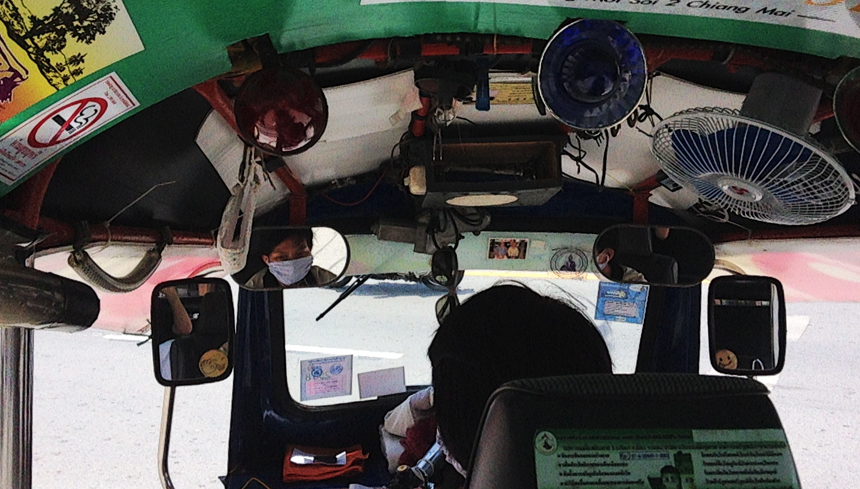
A tuktuk stops, I get in, we accelerate along the road; wind in the face, noise all around. The present moment is an accumulation of pieced-together thought-items; bits of language imagery from environmental-input and memories of past-time brought into present-time, projected into future-time. Time is a human measurement: applied time. Reminds me of something I read in a book written by somebody wise, saying that TIME is just God’s way of preventing everything happening in the same instant. In one microsecond, the entire history of the world, up to the present and off into the future… watch it as it flies past.

Pause for a moment. Traffic lights at the intersection and everything stops; a curious extended, stretched-out moment – just the circumstance itself. It takes a conscious effort to get it started again. Is conscious awareness moving from one moment to the next? If so, is this the next moment yet? Are all the fragments of the next moment combined sufficiently in the endless stream of things so that I can now say definitively, THIS IS THE NEXT MOMENT? And all of a sudden it’s the past again. There’s only one moment, always has been. One long moment that includes immensely distant things. A single passing thought lasts a thousand years. Its parts so remotely scattered, a great ocean of nothingness invades the space between things. No easily seen reference points, objects get forgotten about eventually and all that remains is the idea that, a long time ago, I think I was searching for something but I can’t really remember. Anyway, I was never able to find it – still distracted sometimes by the idea that I might stumble upon it by chance one day, but otherwise at peace with everything the way it is.

IMG_0221b‘The fact that we can never “fully know” reality is not a sign of the limitation of our knowledge, but the sign that reality itself is “incomplete,” open, an actualization of the underlying virtual process of Becoming.’ [Slavoj Žižek]

————————-

structures

IMG_0395bPOSTCARD #40: Chiang Mai: Watching the construction of a new condominium next door that’s been going on for 6 months or more. It’s like a story: Once upon a time there was a construction site. Then there was the first floor. Now they’re up to the fifth floor and the structure is above the tree tops. I can see the workers, including women workers wearing wide brimmed hats, sitting there creating the metal reinforcement of the support pillar. They’re doing it by hand; twisting flexible metal wires around the vertical and horizontal parts, like you tie a plastic bag closed with a plastic cable tie. Not moving around too much, aware of the flimsy platform they’re on. No safety measures, other than the mindfulness of being careful.

There are another two condos being built on the other side. A constant coming and going of cement trucks through the narrow streets, and all around the clangs and bangs of construction site sounds. Noisy but I’m attracted by the creativity of it. These large structure were once an idea in an architect’s office and I can see the plans and diagrams that were drawn on draftsman’s paper coming to life in three dimensions. Throughout the day, I stop what I’m doing and go over to stand by one of my windows and maybe watch the huge crane lifting things up from the floor below and placing them on the new floor above. Then to the other window and see what’s happening there. The workers are active the whole time; rural/urban migrants from another strata in society, pluralism. Where they come from you could buy 5 acres of land with the money paid for one small unit in the condo they’re building here. What they get from this is an income, and there’s stablity, their children can go to school here, an opportunity to break out of the mould, social change is generational.

Their stamina humbles me, I’m a foreigner living in their country, my life style is so distant from theirs. I wonder if they have times when they get fed-up with it all? Are they as dissatisfied as I am? Would they understand how I sometimes pause in the writing of a piece, reflect on how much my original idea has changed since the beginning of it, and what I’d really like to do is take the whole thing to pieces and start again? Probably not, and I’m trying not to give up on it because this is already the third revision. In the West we can’t think of constructing without deconstructing. In the process of learning how to build things up, we learned how to knock things down. Click the remote and we’re watching a different movie; basic truths were disassembled overnight. Postmodernism arrived and everything came to pieces – nothing to hold on to. A world that’s always a work in progress, no final ‘finished state’.

New possibilites arise and one of these is the thought that maybe I’m not seeing the real world at all, what I’m seeing is something created in the mind; something ’seen’ in the way I want it to be. I can change the world to get it to fit when it doesn’t seem right according to the image I have of it – so how can I be sure I’m not simply thinking up a theory and creating supporting statements to prove it? My continuing engagement with it somehow confirms its reality… but is it really real? The question is the answer, it’s open-ended, exploratory – inductive reasoning. The solution is revealed in the process of examining the question. No subject/object dualism. Instead of trying to impose a structure on Nature, things take place subjectively. Finding the way that has a starting point inside, not outside; something I recognize in the interaction with the question.

Around noon, all the noise and clatter suddenly goes quiet. Lunchbreak. From my window I see the workers sitting in groups and some lying  in makeshift hammocks strung across the scaffolding supports in the cooler shaded floors: zzzzzzzz… the world is a kind of analogy, a figure of speech – the metaphor and reality. No final conclusion, forever on-going….

IMG_0403‘… houses rise and fall, crumble, are extended,
 are removed, destroyed, restored, or in their place
 is an open field, or a factory, or a by-pass.
 Old stone to new building, old timber to new fires,
 old fires to ashes, and ashes to the earth
 which is already flesh, fur and faeces,
 bone of man and beast, cornstalk and leaf.
 Houses live and die: there is a time for building 
and a time for living and for generation
 and a time for the wind to break the loosened pane…’ [The Four Quartets, East Coker, T. S. Eliot 1943]

————————-

thralldom

IMG_0388bPOSTCARD #39: Chiang Mai: Coming up to Chiang Mai from Hat Yai was done in two stages, with the stopover at Bangkok, as we did going down. It was the same thing, the other way round. Everything already seen, but occuring in reverse order and the hassle and stress we experienced on the way down got cancelled out on the return journey. Like a video on fast-rewind, it stops at the beginning not the end and the memory of ever having gone or been away is erased.

A short trip, six days only. The point of it was to visit Jiab’s youngest brother and his wife and their new-born baby – a truly amazing child with a wonderful smile. It was a bit like the Three Wise Men following the star to the stable where the baby Jesus lay in the manger – not really like that… there was Jiab and her sister, me and M, who is 9 years old and dismayed by lack of internet, sadly playing the same old games on the iPad and not interested in being in a rubber plantation, with its curious waftings of latex smells. I was quite blown away with the experience of being surrounded by rubber trees – I knew that rubber came from trees of course but it was sort of bizzare somehow… trees made of rubber?

Now back here in Chiang Mai and friends have sent pics of the monks blessing everyone for the coming year. These quiet humble events are meaningful in a way I’ve not seen in the Church and all the gusty hymn singing, great heaviness of acoustics and out-of-sync organ suggesting a fearsome power and immensity. What my Sunday School teacher taught me was that “God made the world,” and I wrote that down in my little exercise book but had absolutely no understanding of it; an imponderable, a Zen koan: God made the world…

But who made God? The world and God are two separate things, one of them made the other, therefore seeing this from a place created in the mind for the purpose of looking for God and finding only a complexity of half understood truths. In the end, I stopped worrying about it; there is no God (in that way of thinking) and decades later the whole thing vanished – with it went the concept of ‘self’. Liberated from ‘the thralldom of the senses’. Quite an ordinary epiphany, like one might be sitting in a quiet room with furniture and objects and light coming in through the window then suddenly a letting-go moment takes place and ‘I’ no longer have the burden of ‘my’ thoughts about ‘me’. Released from the subject/object duality. God is not ‘out there’, but ‘in here’. God is subjectivity, conscious awareness.

Conscious awareness is everywhere. In the blogging world, for example,  it’s what we’re talking about or describing all the time, one way or another, in our different locations, circumstances and in our various states of mind and body. Sometimes there’s an instant understanding of what conscious awareness means but it’s beyond words. Sometimes  awareness is there but I think I can’t see it. Thinking I can’t see it, is another mind moment that exists temporarily in awareness. The mind doesn’t create awareness, mind is contained in the awareness. Other times there’s the simple knowing of it and a feeling of quiet purpose in every step, every move.

IMG_0389‘Only by liberating oneself from the thralldom of the senses and the thinking function – both of them servants and not masters – by withdrawing attention from “things seen” to give it to to things “unseen” can this awakening be accomplished.” [E. F. Schumacher, “A Guide For The Perplexed”, p.79]

————————-

Excerpts from an earlier post: Being here

evenness of 2014

IMG_0382POSTCARD #38: A village near Hat Yai: Here in a house surrounded by trees above window height on the ground floor and in the daytime everything is seen in a translucent green light. It’s an old rubber plantation, with some palms and huge banana trees. Now it’s night and I’m pretty well seeing double having been staring at words all day. Struggling a bit to stay awake to see the coming of New Year – thinking the number 14 is somehow nicer than 13 and also the number 2014 has a pleasant evenness about it? But maybe I’ll go to sleep, it doesn’t seem right to be awake when all the small creatures in the forest are either asleep or being strangely nocturnal and kinda scary in their stealth. I feel a bit obvious here with all the lights on in the house.

IMG_0380Cannot see well, the spellchecker rejects all the Thai and Pali words and onomatopoeias and my spelling innovations; and when it doesn’t know a word I’ve been clicking the ‘Add’ option so much it’ll render the spellchecker obsolete eventually. It’s getting difficult too because small insects attracted by luminosity of screen are walking around in my vision seemingly dotting the letter ‘i’ and crossing the ‘t’ or making an ending to a word that isn’t there. Cannot understand how they get through the mosquito mesh on the windows. I notice that the larger insects stop flying around when you put the lights out because they bump into things, it takes them a few moments to stop where they are, anywhere’ll do and just immediately go to sleep.  I’ll do that too, have to call it a day and shall set this Post so it’ll go out at midnight, and it’ll be the New Year then, Thai time: +7hrs GMT. So, all that remains is for me to say thank you friends and fellow bloggers for visiting me here in the year 2013, and best wishes for 2014. Metta, Loving Kindness, may your year be one of Mindfulness and Letting Go

– HAPPY NEW YEAR TO ONE AND ALL –

IMG_0367

patient understanding

IMG_0291POSTCARD #37: Chiang Mai/Hat Yai journey: The Chiang Mai flight to Hat Yai was discontinued just before our departure date, so the journey had to be made in two parts; the first flight to Bangkok the second to Hat Yai – a bit frustrating, yes, but that’s how my Western thinking can be fixated on the way things ‘should’ be, and not how they are. This is Thailand and no upset, just the sense that people were a tiny bit miffed about it. Then we discover the baggage can’t be checked through either, it means we have to collect everything from the luggage belt at Arrivals when we get to Bangkok then to Departures and check in again for the next flight. There were a lot of bags, and we had little M with us who is 9 years old and she’d have to be guided through the crowds safely. I felt I was beginning to lose it at that point but still no reaction from the others, just a kind of ‘no comment’ attitude and the sense of something being ‘held’.

I go along with the way everyone else is doing it; chai yen yen (keep a cool heart) chai ron mai dai (being angry is no good). Patient understanding, putting up with it quietly; othon, in Thai, it’s about accepting things as they are and not fuelling the fires. There’s a cultural tradition of this kind of inhibition of anger in public. It’s a big no-no. Why? Because when people really lose their cool they can go crazy. The word in Thai is baa, a kind of madness; political demonstrations with crowds running into a hail of bullets and not stopping until the cease-fire. So, we don’t want to go there. Thais have acquired the skill of abiding in the suppressed anger state so that the feeling can be allowed to pass and there’s sufficient clarity of mind to see what action can be taken.

We arrive at Bangkok, wait for the luggage at the belt, I get it all on to two trolleys, with little M sitting up on top of the bags and we make our way through the crowds to the elevator. Up to the second floor and enter through security and the baggage X-ray machines to the check-in desk again. There’s not much room and a large congestion of luggage trolleys. Tense pale faces, no anger, only the difficulty that people are having suppressing it. Sweat forming on the forehead, no expression, a tight smile when required, a mutual understanding and a calm appearance. Tread carefully, the fear of becoming angry makes the whole thing kinda fragile.

Recent political demonstrations highlighting the underhanded manipulative strategies that take advantage of this cultural quietness are an example of there being suddenly a legitimate reason for everything to go totally irrational. In this case, organised public protest against a Prime Minister who was put in place by a group of behind-the-scenes bad guys; a situation not unlike the period of George Dubya, the 43rd U.S. president. Both leaders were puppet-like, inarticulate, and the public fell into a kind of embarrassed silence; how can our leader appear to be so hopeless like this? This odd acceptance allowed the controlling group to manipulate events behind the facade. It was tolerated for a while due to the cultural ‘holding’ behaviour, then it exploded. These public protests pull things back into balance because Thais value peace. Anarchy and lawlessness are a scary alternative – almost like insanity. There will be stability, but only for a short time, it seems. Sadly, it’s likely to break out again. An impossible cycle…

IMG_0285

We get on the next flight, take-off and up into the clear blue sky again; out there, where there are no problems, the beautiful great curvature of the Earth. One hour and fifteen minutes later we descend into Hat Yai. The outer arrivals section full of Thai muslims in colourful head scarves and matching costumes, children running around. Into the car and out on the great North/South highway that connects Thailand to Malaysia and all the way South to Singapore.

 “In essence, the process of division is a way of thinking about things that is convenient and useful mainly in the domain of practical, technical and functional activities (e.g., to divide up an area of land into different fields where various crops are to be grown). However, when this mode of thought is applied more broadly to man’s notion of himself and the whole world in which he lives (i.e. to his self-world view), then man ceases to regard the resulting divisions as merely useful or convenient and begins to see and experience himself and his world as actually constituted of separately existent fragments.” [David Bohm]

————————-
The David Bohm quote above comes from The Ptero Card Post: I Fall to Pieces
–   G   R   A   T   I   T   U   D   E   –
Upper photo: Don Muan airport Bangkok
Lower photo: part of the whistle-blowing anti-government demonstration passing through the Siam Paragon shopping area in Bangkok 

maya & christmas

IMG_0220POSTCARD #36: Chiang Mai: Going around town in a tuk-tuk, seeing all these new shopping areas getting built and a huge shopping mall opens here soon called MAYA – a Sanskrit word meaning illusion. In Thailand the word maya is applied to the lifestyle of movie stars who have everything money can buy and their lives are thought to be unreal. In an intelligent way, everybody knows what maya is and what ‘reality’ is. But in the shopping mall context maya is presented as an attractive idea; it’s appealing, even though it’s an illusion, we’re partly agreeing with it; complicit in its being there. We might say well, okay it’s an illusion, but what’s wrong with that? Nobody wants to see it as calculated corporate planning to create a market for consumer goods… that would destroy the pretty illusion. Nobody wants to know that the local population, sons and daughters of rural/urban migrants, and naïve hill-tribe folk are likely to be swept away in the wave of purchasing choices. Unseen, built-in strategies contained in an imported Western model that doesn’t suit this culture… and we’re not willing to say there’s anything wrong with it because we’re all in some way compromised.

A kind of tacit approval of consumerist schemes embedded in our lives that has resulted in our losing so much of our inherited cultural traditions. The Christmas festival is layered over with the maya of santaclausisms and the Jesus Teachings are nearly lost in it. It’s as if the essential part of our spiritual Truth got forgotten along the way and consumerism came along in its place. It’s a mystery really, why it should be like this, but for some reason the early Church disapproved of the gnosis (knowledge) part of the teaching. Out went the pragmatic instructions on seeing the constructed nature of appearances and the stepping-through to discover the non-duality between ourselves and God. ‘His disciples said to him, “When will the kingdom come?” 
<Jesus said,> “It will not come by waiting for it. It will not be a matter of saying ‘here it is’ or ‘there it is.’ Rather, the kingdom of the father is spread out upon the earth, and men do not see it (113).”’[Nag Hammadi Manuscripts].

After an extended period of study and contemplation, one simply ‘wakes up’ to the Truth of it; the reality that surrounds us all the time; Brahman, the Oneness, the God state that’s here and now. You’ll notice I’m presenting the Jesus teachings as an instance of the Advaita experience, sourced in the Upanishads [I wrote another post about this, link to: Jesus and Advaita Vedanta]. I’m also including the Jesus Teaching in a oneness of spiritual teaching centred in that geographical region where the three Abrahamic religions arose: Christianity, Judaism, Islam and the connection with Brahmanic religions and Advaita Vedanta. Others related to this include Buddhism and Jainism. That region, from North India through to Israel and the Mediterranean, a distance of about 3000 miles, say from New York to San Francisco? I see it like a highway of knowledge, wisdom and information. All of it coming and going along the route many centuries before Jesus was born and many centuries after. All the world’s religions arose here.

Somewhere in this context lies the actuality of our Jesus experience; only traces of it remain – enough to know there is this huge feeling of goodwill towards all beings in the world and the universe.

Merry Christmas friends and fellow bloggers ~ Christmas 2013

————————-

Excerpts from: meta-narratives

static electricity haiku

Static electricityPOSTCARD #35: Chiang Mai: How to explain Static Electricity to a nine-year-old who speaks English as a second language? M my Thai niece, jumps in surprise when I’m handing her some coins and it happens: ZAP! Looks at me, like I just played a trick on her or something: “What’s that Toong Ting?” (for some reason she has called me Toong Ting since she was a baby) It’s electricity,  fai-fáa sà-tìt ไฟฟ้าสถิต in Thai. M looks suspicious of me, “Yes but what is it?” she says. Okay so that still doesn’t make sense; I say it’s like a small spark… What does spark mean? So I start to speak about positive and negative electric charges inside our bodies, and eyes glaze over… losing the audience, I’m not making a very good job of the explanation, say it’s like lightning in the sky and make a big gesture with my arms. Thinks about that for a while, this has her attention… Yes but why? I tell her it’s like this strange thing that happens in the cool season, you unexpectedly get zapped when touching a doorknob – like an electrical charge, and sometimes it happens when you touch nylon clothing – it happens during the cold dry season. In countries like Thailand that are hot and humid most of the year, you notice it more than in cold countries. But this doesn’t really answer the question either, so we look it up in Google. There are all kinds of examples of it, still kinda hard to understand, I decide it has to be more like an experiential thing, learning from the feeling of it.

It reminds me of the haiku written by my friend Andosan, in Japan. ‘Static Electricity’ is a haiku seasonal word seidenki 静電気 and it’s thought to be quite charming – maybe because it’s quite mild in Japan, less of a shock than in the Western world. Usually experienced when buying something from the station kiosk, receiving coins or touching hands. Contact between people creates this small spark, it’s a surprising, instantaneous, friendly and communicative thing. It creates a link between people; a moment when we can’t explain something and share this small event that we can’t get any further with than “What was that?” A glance down at the coins held in the  fingertips, conscious awareness; the mysterious feeling of the spark somehow becomes the physical reality of the coins in the hand.

[Haiku translation: I receive small change/ and I am very surprised/ I have been given/ static electricity]

————————-

Haiku by Tatsuhiko Ando