POSTCARD #104: Delhi: 05.00 hrs: The sound of the generator – a power cut, no lights. Holding my phone so it shines like an electric torch I come out from the bedroom and through to the front of the house. Startled by the flashing light reflection in the large glass patio window; light beams swinging over the walls, forwards and back with the movement of walking. My own reflection catches me unawares at this early hour of the day confused by large sound of generator. It triggers a memory from long ago; some time before dawn, me and grandfather on the tractor going over the hill to see the sheep.
When I tell people my grandfather was a shepherd, there’s a moment of… let’s see, no words for it really – kinda Biblical, mediaeval? It helps to think of him like a veterinarian. We’d get down from the tractor and set off on the track across the hill. Grandfather with his huge steps and I must have been only nine or ten years old, holding the big old torch with both hands, aiming the beam along the path to ancient things, ancestors I never knew.
Grandfather had a shepherd’s crook; a long pole he used like a walking stick, but with an iron hook on the end to catch the sheep. On this night we mingled amongst the flock until he saw the one he was looking for, quickly caught its leg with the hook and it fell over on its side. I was then told to quickly hold its head. He was a big man, wore two totally ragged old jackets, one on top of the other. No polyester in those days, no machine-washable hooded shell coats with velcro fastenings and good-looking yellow nylon zipper. No, my grandfather looked like a homeless person.
He’d roll up the sleeve of his right arm, hands like the hoof and horn of the sheep itself; not beautiful hands, birthing hands. Push his fingers into the back end of the sheep, then his whole hand up past the wrist and part the way up the forearm. Quite a long time spent feeling with fingers in the darkness before birth, find the lamb’s feet and nose, and pull the whole thing out with a steaming slither and plop on the grass. I’d be at the other end, holding down the beast’s curled horns, struggling head, a fog of breath in the air, spittle froth, tongue, nostrils, and these wild, wide staring eyes. Then from behind me, there’d be this small bleat: mae….
On Grandfather’s signal I let go of the head, jump back and the sheep is up, turns around and long nose nuzzling the small bundle shivering on the grass. Mae…says the lamb. Baah…says the sheep, licking away the afterbirth around the face of the lamb… mae-ae-ae…baah-baah…mae-ae-ae…baah…mae-ae-ae… (sheep language). The whole thing quite astonishing. An event there on the side of a hill, illuminated in the beam of a torchlight in the long shadows of remembered past.
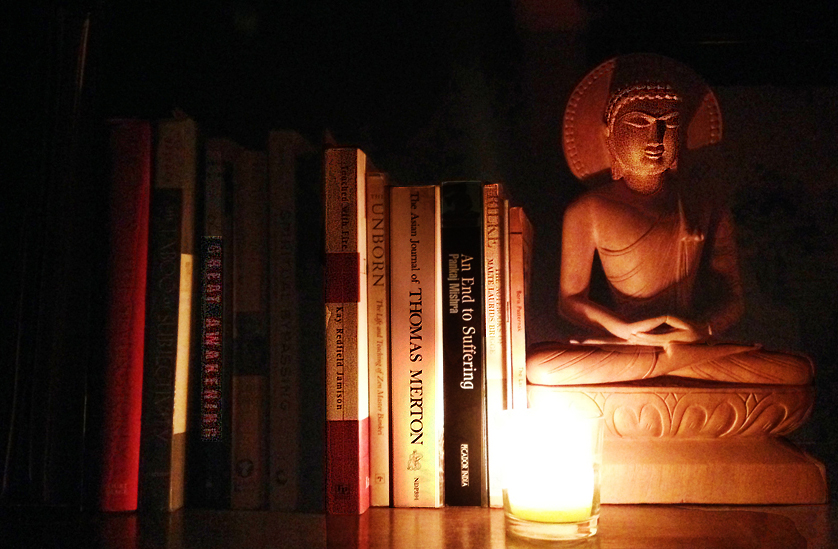
Fifty years later and I’m here in Delhi, about the same age as grandfather was then. Light the candle by the Buddha on the bookshelf – familiarity of candlewax, oil lamps and no electricity; it’s another day no different from that day then or any other day. Outside, a faint smell of dung; cows and sheep sleeping in some corner of the street, at rest in these urban surroundings as if they were in a landscape of fields and meadows.
“I am not yet born; provide me with water to dandle me, grass to grow for me, trees to talk to me, sky to sing to me, birds and a white light in the back of my mind to guide me.” [Prayer Before Birth, Louis Macniece]
————————-
Note: First posted November 24, 2014; this is another reblog during the time I’m away from my desk – as it happens I’m in Scotland, shadows of the ancestors appear in conscious awareness
POSTCARD#73: Delhi: The rain stops around 5am. It’s been going most of the night, rattling down on the atelier roof window. Pleasantly deafening… the novelty of it. Rain! So long since we’ve had rain – the hot season is coming to an end! It’s enough to just lie in bed and listen to it falling in great patterns of syncopated rhythm I feel must have had a beginning somewhere… drifting in and out of sleep until it stops. Stillness, the sense of a sailing ship becalmed. The feeling of the in-breath in the nasal cavities, allowing the universe to enter and pass through this sensory organism. The deep knowledge of it – awareness of these surroundings, these circumstances and this quiet state of at-ease alertness.
Daylight. Time to get up, bare feet on cool stone slabs: pita, pata, pit, pat, pata, pit, pit… stop and look out the window; everything is totally wet out there. Aware, suddenly, of cold feet, consciousness of a physical object, contact with the world. Aware of thought and aware of no-thought. Awareness of the cognitive function and waking up to this pastel coloured pinkish, grey-blue dawn light spreading through the rooms, along the corridor leading to the front and out through glass doors to the tiled patio, shiny with wetness… and up there, a silver sky. In the darkness of the room things slowly begin to be seen, and the memory of the night before returns; objects, a pen, a cup, papers scattered around, left in the position they were in, unmoved. Cup handle sticks out, waiting for fingers to come and hold it… a quiet presence. The silence of inanimate things, neutrality, accepting it all as it is, awareness of objects and non-objects, the motionless space where everything is situated, context and content, awareness of that which normally passes unseen.
Tall buildings all around us, standing there like huge objects placed in a vast landscape… the clouds above, layer upon layer up into the vaulted sky. Their shadows cast over our small house, single storied, old wood-frame windows, thatched structure on top, roof garden and trees at the door… as if we were in a mountain valley surrounded by tall cliffs and the sun reaches us for only a few hours a day. Our perception of the universe is as tiny as it is for micro-organisms that live at the bottom of the ocean, remotely aware that far above them the sun is shining. The slightest change in light conditions in that underwater glimmer, the smallest increase in light calibration enters consciousness and brings with it a great brilliance of illumination. They can contemplate being present to their cold darkness, knowing that this is not the only experience in the world because the sun is shining inside their heart.
“If you want to awaken all of humanity, then awaken all of yourself, if you want to eliminated the suffering in the world, then eliminate all that is dark and negative in yourself. Truly the greatest gift you have to give is that of your own self-transformation.” [Lao Tzu]
————————-
Note: this post contains excerpts from an earlier post titled Spaciousness of Being. Image: Francisco de Zurbarán, Bodegón or Still Life with Pottery Jars, 1636
[The second part of last week’s reblogged post titled ‘Consciousness’ taken from a chapter in ‘Intuitive Awareness’ by Ajahn Sumedho]
Buddha-Dhamma, when you look at it, is not a cultural teaching. It’s not about Indian culture or civilization. It’s about the natural laws we live with, the arising and ceasing of phenomena. Dhamma teachings are pointing to the way things are – things that aren’t bound by cultural limitations. We talk about anicca, dukkha, anattā. That’s not Indian philosophy or culture; these are things to be realized. You are not operating from some basic belief system that’s cultural. The Buddha’s emphasis is on waking up, on paying attention rather than on grasping some doctrinal position. This is why many of us can relate to it, because we’re not trying to become Indians or convert to some religious doctrine that came out of India.
The Buddha awakened to the way it is, to the natural law. So, when we are exploring consciousness, these teachings like the five khandhas are skilful or expedient means in order to explore and examine our experience. They are not, ‘You have got to believe in the five khandhas and believe that there is no self. You cannot believe in God any more. To be a Buddhist you have to believe that there is no God.’ There are Buddhists who do have this mentality. They want to make doctrinal positions about being Buddhist. To me that teaching is not based on a doctrine, but on this encouragement to awaken. You are starting from here and now, from awakened attention rather than from trying to prove that the Buddha actually lived. Somebody might say, ‘Maybe there was never any Buddha; maybe it was just a myth,’ but it doesn’t matter because we don’t need to prove that Gotama Buddha actually lived; that’s not the issue. We are not trying to prove historical facts, but to recognize that what we are actually experiencing now is like this.
When we allow ourselves just to rest in conscious awareness, this is a natural state; it’s not created. It’s not a refined conditioning that we are after, where we are moving from coarser conditions to increasingly more refined ones, where we experience a bliss and tranquillity that comes from refining conscious experience. That is very dependent. This world, this conscious realm that we are a part of, includes the coarse and the refined.
This is not a refined realm that we are experiencing. In terms of human or planetary life, this is not a devaloka or a brahmaloka, those divine or highest celestial realms which are more refined. This is a coarse realm where we run the gamut from that which is coarse to that which is refined. We have got to deal with the realities of a physical body, which is quite a coarse condition. In deva realms they do not have physical bodies, they have ethereal ones. We would all like to have ethereal bodies, made out of ether rather than all these slimy things that go on inside our bodies – bones, pus and blood, all of these yucky conditions that we have to live with. To defecate every day – devatās don’t have to do things like that. Sometimes we like to create the illusion that we are devatās. We don’t like these functions; we like privacy. We don’t want people to notice, because the physical conditions that we are living with are actually pretty coarse. But consciousness includes all that, all the gradations from the coarse to the most refined.
Ajahn Sumedho
[The second part of last week’s reblogged post titled ‘Consciousness’ taken from a chapter in ‘Intuitive Awareness’ by Ajahn Sumedho]Buddha-Dhamma, when you look at it, is not a cultural teaching. It’s not about Indian culture or civilization. It’s about the natural laws we live with, the arising and ceasing of phenomena. Dhamma teachings are pointing to the way things are – things that aren’t bound by cultural limitations. We talk about anicca, dukkha, anattā. That’s not Indian philosophy or culture; these are things to be realized. You are not operating from some basic belief system that’s cultural. The Buddha’s emphasis is on waking up, on paying attention rather than on grasping some doctrinal position. This is why many of us can relate to it, because we’re not trying to become Indians or convert to some religious doctrine that came out of India.
The Buddha awakened to the way it is, to the natural law. So, when we are exploring consciousness, these teachings like the five khandhas are skilful or expedient means in order to explore and examine our experience. They are not, ‘You have got to believe in the five khandhas and believe that there is no self. You cannot believe in God any more. To be a Buddhist you have to believe that there is no God.’ There are Buddhists who do have this mentality. They want to make doctrinal positions about being Buddhist. To me that teaching is not based on a doctrine, but on this encouragement to awaken. You are starting from here and now, from awakened attention rather than from trying to prove that the Buddha actually lived. Somebody might say, ‘Maybe there was never any Buddha; maybe it was just a myth,’ but it doesn’t matter because we don’t need to prove that Gotama Buddha actually lived; that’s not the issue. We are not trying to prove historical facts, but to recognize that what we are actually experiencing now is like this.
When we allow ourselves just to rest in conscious awareness, this is a natural state; it’s not created. It’s not a refined conditioning that we are after, where we are moving from coarser conditions to increasingly more refined ones, where we experience a bliss and tranquillity that comes from refining conscious experience. That is very dependent. This world, this conscious realm that we are a part of, includes the coarse and the refined.
This is not a refined realm that we are experiencing. In terms of human or planetary life, this is not a devaloka or a brahmaloka, those divine or highest celestial realms which are more refined. This is a coarse realm where we run the gamut from that which is coarse to that which is refined. We have got to deal with the realities of a physical body, which is quite a coarse condition. In deva realms they do not have physical bodies, they have ethereal ones. We would all like to have ethereal bodies, made out of ether rather than all these slimy things that go on inside our bodies – bones, pus and blood, all of these yucky conditions that we have to live with. To defecate every day – devatās don’t have to do things like that. Sometimes we like to create the illusion that we are devatās. We don’t like these functions; we like privacy. We don’t want people to notice, because the physical conditions that we are living with are actually pretty coarse. But consciousness includes all that, all the gradations from the coarse to the most refined.
Another thing to notice is compulsive feelings of having to do something, having to get something that you don’t have, having to attain something or get rid of your defilements. When you’re trusting in ‘your real home’, then you can have perspective on this conditioning of the emotions. For example, we come from competitive goal-oriented societies, so we’re very much programmed to always feel that there is something that we have got to do. That we’re always lacking something and we have got to find out what it is, and we’ve got to get it. Or that we have got to get rid of our weaknesses, faults and bad habits. Notice that this attitude is just something that arises and ceases. It’s the competitive world, the world of a self.
We can always see ourselves in terms of what’s wrong with us as a person. As a person there are always so many flaws and inadequacies. There is no perfect personality that I have ever noticed. Personality is all over the place; some of it is all right and some of it is really wacky. There is no personality you can take refuge in. You are never going to make yourself into a perfect personality. So, when you are judging yourself on a personal level, there seem to be so many problems, inadequacies, flaws and weaknesses. Maybe you are comparing yourself to some ideal person, some unselfish and superlative personality. That which is aware of personality is not personal. You can be aware of the personality as a mental object. The conditions for personality arise and cease. Suddenly you can find yourself feeling very insecure or acting very childish because the conditions for that personality have arisen.
When my parents were alive, I went to stay with them for about three weeks, because they were really sick. I was abbot of Amaravati, a fifty-five-year-old Ajahn Sumedho going home and living in the same little house with my mother and father. It brought up all kinds of childish emotions, because the conditions were there for that. We were all born through our parents, and our memories and connections are from infancy onwards. A lot of the conditions that arise in families are conditions for feeling like a child again – even when you’re a fifty-five-year-old Buddhist monk and abbot of a monastery! [Note, at the time of publication Ajahn Sumedho is 89.] My mother and father would easily go back to seeing me as a child. Rationally they could see, ‘He’s a middle-aged man,’ but they would still sometimes act like I was their child. Then I would feel this rebelliousness and adolescent kind of resentment about being treated like a child. So don’t be surprised at some of the emotional states that arise. Throughout your life, as you get old, kamma ripens and then these conditions appear in consciousness. Don’t despair if you find yourself feeling very childish at fifty years old. Just be aware of that for what it is. It is what it is. The conditions for that particular emotion are present, so then it becomes conscious. Your refuge is in this awareness rather than in trying to make yourself into an ideal man or woman – mature, responsible, capable, successful, ‘normal’ and all the rest – these are the ideals.
Here at Amaravati, I am not looked at as a child. I’m the oldest person here! You may see me in terms of a father figure, because an old man like me brings out the sense of authority. I’m an authority figure, a patriarch, a father figure, a male figure – a grandfatherly figure to some of you. It’s interesting to see this state when the conditions are there. Rationally you can say, ‘He’s not my father,’ but emotionally you may feel like that, acting towards me like I’m a father. It’s an emotional habit. When the conditions for that kind of male authority figure are present, then this is what you are feeling, it’s like this. There is nothing wrong with it, just notice it’s the way it is. Trust your refuge in this awareness, not in some idea that you shouldn’t project fatherly images onto me, or that you shouldn’t feel disempowered by a male authority figure and things like this. If you feel disempowered by me, then simply recognize it as a condition that has arisen, rather than blaming me or blaming yourself, because then you are back into the world you are creating – your personal world – and believing in that as your reality.
I used to get really angry when women would get bossy. When any woman would show any kind of bossiness, I would feel rage. I wondered why even a tone of voice would make me so upset, why I could get so enraged over a bossy attitude. I could see it was like when I was a boy, trying to get my way against my mother. If that has not yet been fully resolved, if the conditions for that rage are present, then this is what will arise. It’s through “awareness of it that you resolve it. As you understand it and see it in terms of what it is, then you can resolve it or let it go, so that you are not just stuck with the same old reactions all the time.
Our refuge is in this awareness, rather than in trying to sustain refined experiences in consciousness as our refuge, because you can’t do that. Maybe you can learn to increase your experience of refinement through developing skilful means, but inevitably you have to allow the coarse to manifest, to be a part of your conscious experience. Resting in this conscious awareness is referred to as ‘coming home’ or ‘our real home.’ It’s a place to rest, a home. The idea of a home is a place where you belong. You are no longer a foreigner or an alien. You begin to recognize this through a sense of relief, of just being home at last, of not being a stranger, a wanderer out in the wilderness. Then the world of Ajahn Sumedho arises and it’s like I’m not at home anymore, because Ajahn Sumedho is an alien, a stranger. He never feels quite at home anywhere. Am I American now? Am I British or am I Thai? Where do I feel at home as Ajahn Sumedho? I don’t even know what nationality I am anymore, or where I feel most at home. I feel more at home here than in America because I’ve lived here for so long. In Thailand I feel at home because it’s a paradise for Buddhist monks and they treat you so well, but still you have to get visas and you’re always a phra farang (foreign monk). Here in England, no matter how many years I have lived here, to most people I am still an American. But when I go back to America, I don’t know what I am; people say: ‘You don’t look like an American anymore. You’ve got a funny accent; we don’t know where you are from!’ That’s the world that is created. When all that drops away, what’s left is our real home.
Continued same time next week. Note: I am still away from my desk and reblogging some older posts on the theme of consciousness
In terms of this moment, right now, this is consciousness. We are reading words on a page – pure consciousness before you start thinking. Just make a note of this: consciousness is like this. I am reading, I am with this present moment, being present, being here now. I’m taking the word consciousness and making a mental note: ‘consciousness is like this.’ It’s where thought, feeling and emotion arise. When we are unconscious, we don’t feel, we don’t think. Consciousness, then, is like the field that allows thought, memory, emotion and feeling to appear and disappear.
Consciousness is not personal. For something to become personal you have to make a claim to it: ‘I am a conscious person.’ But there’s just awareness, this entrance into noting the present, and at this moment consciousness is like this. Then one can notice the sound of silence, the sense of sustaining, being able to rest in a natural state of consciousness that is non-personal and non-attached. Noting this is like informing or educating oneself to the way it is. When we are born, consciousness within this separate form starts operating. A new-born baby is conscious, yet it doesn’t have a concept of itself being male or female or anything like that. Those are conditions we acquire after birth.
This is a conscious realm. We might think of a universal consciousness, and consciousness as it is used in the five khandhas: rūpa (form), vedanā (feeling), saññā (perception), saṅkhārā (mental formations), and viññāṇa sense-consciousness). But there is also this consciousness which is unattached, unlimited, Deathless. In two places in the Tipiṭaka, there is reference to viññāṇaṁ anidassanaṁ anantaṁ sabbato pabhaṁ – a mouthful of words that point to this state of natural consciousness, this reality. For myself, I find it very useful to clearly note: ‘Consciousness is like this.’ If I start thinking about it, then I want to define it: ‘Is there an immortal consciousness?’ Or we want to make it into a metaphysical doctrine or just deny it, saying, ‘Consciousness is anicca, dukkha, anattā.’ We want to pin it down or define it either as impermanent, unsatisfactory and not-self, or raise it up as something we hold to as a metaphysical position. But we are not interested in proclaiming metaphysical doctrines, or in limiting ourselves to an interpretation that we may have acquired through this tradition. Instead, we are trying to explore consciousness in terms of experience. This is Ajahn Chah’s pen paccattaṁ – that is, ‘something that you realize for yourself.’ What I am saying now is an exploration. I’m not trying to convince you or convert you to ‘my viewpoint.’
Consciousness is like this. Right now, there is definitely consciousness. There is alertness and awareness. Then conditions arise and cease. If you sustain and rest in consciousness, unattached, not trying to do anything, find anything or become anything, but just relax and trust, then things arise. Suddenly you may be aware of a physical feeling, a memory or an emotion. That memory or sensation becomes conscious, then it ceases. Consciousness is like a vehicle; it’s the way things are.
Is consciousness something to do with the brain? We tend to think of it as some kind of mental state that depends on the brain. The attitude of Western scientists is that consciousness is in the brain. But the more you explore it with sati-sampajañña, you see that the brain, the nervous system, the whole psychophysical formation arises in this consciousness; it is imbued with this consciousness. That is why we can be aware of the body and reflect on the four postures – sitting, standing, walking and lying down. Being aware of the body’s posture as it is being experienced now, you are not limited to something that is in the brain, but the body is in consciousness. You are aware of the whole body in the position it’s in at this moment.
This consciousness is not personal. It’s not consciousness in my head and then consciousness in your head. Each of us has our own conscious experience going on. But is this consciousness the thing that unites us? Is it our ‘oneness’? I’m just questioning; there are different ways of looking at it. When we let go of the differences – ‘I am Ajahn Sumedho and you are this person’ – when we let go of these identities and attachments, then consciousness is still functioning. It’s pure. It has no quality of being personal, and no condition of being male or female. You can’t put a quality into it. It’s like this.
When we begin to recognize that which binds us together, that our common ground is consciousness, then we see this is universal. When we spread mettā to a billion Chinese over in China, maybe it’s not just sentimentality and nice thoughts, maybe there is power there. I don’t know myself; I am questioning. I am not going to limit myself to a particular viewpoint that has been conditioned by my cultural background, because most of that is pretty flawed anyway. I do not find my cultural conditioning very dependable. Sometimes Theravada Buddhism can come across as annihilationism. You get into this ‘no soul, no God, no self’ fixation, this attachment to a view. Or are the Buddha’s teachings there to be investigated and explored? We are not trying to confirm somebody’s view about the Pali Canon, but rather we use the Pali Canon to explore our own experience. It’s a different way of looking at it. If we investigate this a lot, we begin to see the difference between pure consciousness and when self arises. It’s not hazy or fuzzy, ‘Is there Self now?’ It’s a clear knowing. So, then the self arises. I start thinking about myself, my feelings, my memories, my past, my fears and desires, and the whole world arises around ‘Ajahn Sumedho.’ It takes off into orbit – my views, my feelings and my opinions. I can get caught into that world, that view of ‘me’ that arises in consciousness. But if I know that, then my refuge is no longer in being a person, I’m not taking refuge in being a personality or my views and opinions. Then I can let go; the world of Ajahn Sumedho ends. When the world ends, what remains is the anidassana viññāṇa – this primal, non-discriminative consciousness. It’s still operating. It doesn’t mean Ajahn Sumedho dies and the world ends, or that I’m unconscious. Talking about the end of the world, I remember somebody getting very frightened by this, saying, ‘Buddhists are just practising meditation to see the end of the world. They really want to destroy the world. They hate the world and they want to see it end’ – this kind of panic reaction. To us the world is seen in physical terms – this planet, the world of continents and oceans, North Pole and South Pole. But in Buddha-Dhamma, the ‘world’ is the world we create in consciousness. That’s why we can be living in different worlds. The world of Ajahn Sumedho is not going to be the same as the world you create, but that world arises and ceases. That which is aware of the world arising and ceasing transcends the world. It’s lokuttara, transcendent, rather than lokiya, worldly. When we are born into physical birth, we have consciousness within a separate form. This point of consciousness starts operating, and then we acquire the sense of ourselves through our mothers and fathers and cultural background. We acquire different values or sense of ourself as a person that’s based on avijjā, not on Dhamma – based on views, opinions and preferences that cultures have. That’s why there can be endless problems around different cultural attitudes. As with living in a multicultural community like this monastery is, it’s easy to misunderstand each other because we’re conditioned in different ways of looking at ourselves and the world around us. But remember that cultural conditioning comes out of avijjā, ignorance of Dhamma. So, what we are doing now is informing consciousness with paññā – which is a universal wisdom rather than a cultural philosophy.
Continued same time next week Editor’s note: I’m away from my desk until 14 August, visiting family in Scotland. I’ve set it up so the posts will continue on the usual dates, hopefully.
The word atammayata literally means ‘not made of that.’ It can also be rendered as ‘non-identification,’ focusing on the subject side of the equation. Other translators have it as ‘non-fashioning’ or ‘unconcoctability’ – thus hinting more at the object dimension of it. Either way, it refers primarily to the quality of experience prior to, or without, a subject/object duality arising. This insight leads us into a contemplation of the relationship of the apparent subject and object – how the tension between the two generates the world of things and its experiencer, and more importantly how, when that duality is seen through, the heart’s liberation is the result.
“In the seen there is only the seen, in the heard, there is only the heard, in the sensed there is only the sensed, in the cognized there is only the cognized: This, Bahiya, is how you should train yourself.”
“When, Bahiya, there is for you in the seen only the seen, in the heard, only the heard, in the sensed only the sensed, in the cognized only the cognized, then, Bahiya, there is no ‘you’ in connection with that. When, Bahiya, there is no ‘you’ in connection with that, there is no ‘you’ there. When, Bahiya, there is no ‘you’ there, then, Bahiya, you are neither here nor there nor in between the two. This, just this, is the end of suffering.” [ ~Ud 1.10]
In more recent times, Ajahn Buddhadasa outlined three qualities which describe the upper reaches of spiritual refinement: sunnata– voidness or emptiness; tathata – thusness or suchness; atammayata – nonidentification or ‘not-thatness. When the qualities of emptiness and suchness are considered, even though the conceit of identity (self) might already have been seen through, there can still remain subtle traces of clinging; clinging to the idea of an objective world being known by a subjective knowing even though no sense of ‘I’ is discernible at all. There can be the feeling of a ‘this’ which is knowing a ‘that,’ and either saying “Yes” to it, in the case of suchness, or “No” in the case of emptiness. Atammayata is the closure of that whole domain, expressing the insight that “there is no ‘that.” It is the genuine collapse of both the illusion of separateness of subject and object and also of the discrimination between phenomena as being somehow substantially different from each other.
The ninth of the Ten Fetters is uddhacca – restlessness. The restlessness to which this refers is the subtlest of feelings that there might be something better over there or just in the future; a feeling that ‘that’ (which is out of reach) might have more value in some way than ‘this.’ It is the ever-so-insidious addiction to time and its promises. Atammayata is the utter abandonment of this root delusion: one sees that in ultimate truth there is no time, no self, no here and no there. So rather than “Be here now” as a spiritual exhortation, perhaps instead we should say: “Let go of identity, space and time,” or: “Realize unlocated, timeless selflessness.”
6.4) [I]n the Vedanta … to be wholly and exclusively aware of Brahman (Hindu Godhead) was at the same time to be Brahman… The origins of this idea seem to lie in a theory of sense perception in which the grasping hand supplies a dominant analogy. It takes the shape of what it apprehends. Vision was similarly explained: the eye sends out some kind of ray which takes the shape of what we see and comes back with it. Similarly thought: a thought conforms to its object. This idea is encapsulated in the term tanmayata, ‘consisting of that’: that the thought of the gnostic or meditator becomes con-substantial with the thing realized. ~ Richard Gombrich, ‘Metaphor, Allegory, Satire,’ in ‘How Buddhism Began: The Conditioned Genesis of the Early Teachings,’ pp 86-7 That is to say, with the opposite quality, a-tammayata, the mind’s ‘energy’ does not go out to the object and occupy it. It neither makes an objective ‘thing’ or a subjective ‘observer’ knowing it; hence ‘non-identification’ refers to the subjective aspect and ‘non-fabrication’ mostly to the objective.
The reader should also carefully bear in mind the words “The origins of this idea…” and not take the Vedic concept and imagery as representing the Buddhist use of the word entirely accurately. In the state of atammayata, in its Buddhist usage, there is no actual ‘becoming con-substantial’ with the thing that is being known; it is more that the deluded identification of the mind with the object is being dispelled (see also §6.7)
One helpful way of understanding atammayata’s role and significance is to relate it to the other two items in the final triad of the nine insights as outlined by Ajahn Buddhadasa. These three qualities describe the upper reaches of spiritual refinement: sunnata – voidness or emptiness; tathata – thusness or suchness; atammayata – nonidentification or ‘not-thatness.’ The three qualities speak to the nature of experience when many of the coarser defilements have fallen away. When the qualities of emptiness and suchness are considered, even though the conceit of identity might already have been seen through, there can still remain subtle traces of clinging; clinging to the idea of an objective world being known by a subjective knowing even though no sense of “I” is discernible at all.
There can be the feeling of a ‘this’ which is knowing a ‘that,’ and either saying “Yes” to it, in the case of suchness, or “No” in the case of emptiness. Atammayata is the closure of that whole domain, expressing the insight that “There is no ‘that.'” It is the genuine collapse of both the illusion of separateness of subject and object and also of the discrimination between phenomena as being somehow substantially different from each other.
Perhaps one of the simplest, clearest and most practical expressions of the principle of atammayata – ‘not-made-of-that-ness’ – has come down to us from the teachings of Luang Pu Dun, a direct disciple of Ven. Ajahn Mun and one of the great lights of Dhamma in Asia in recent years. Here is his reformulation of the 117 Four Noble Truths, based on the depiction of ignorance (avijja) as the fundamental error of the mind attempting to ‘go out’ and pursue ‘thatness’ in the form of perceptions, feelings and ideas. In reflecting on these four formulae, it might be helpful to recollect the analogy of the grasping hand, mentioned in §6.4, reaching out to become con-substantial with its object and then returning with it. 6.6)
The mind that goes out in order to satisfy its moods is the Cause of Suffering (II); The result that comes from the mind going out in order to satisfy its moods is Suffering (I); The mind seeing the mind clearly is the Path Leading to the Cessation of Suffering (IV); The result of the mind seeing the mind clearly is the Cessation of Suffering (III).
~ Luang Pu Dun, ‘Atulo,‘ collected teachings compiled by Phra Bodhinandamuni
Selected excerpts from “The Island: An Anthology of the Buddha’s Teachings on Nibbana” by Ajahn Amaro and Ajahn Pasanno.
One of the most subtle and invaluable aspects of the Buddha’s teaching is the way in which it illuminates the conundrum of selfhood, together with its treatment of the age-old questions of being and non-being, existence and non-existence. The main thrust of the Buddha’s insight into this area is hinted at by the title of this chapter; that is to say, much of the confusion and strife in the conceptual realm over these issues seems to have come from asking the wrong questions – questions based on axioms and unconscious presuppositions which do not accord with reality. If one adopts the world view embedded in the wording of such biased questions, then no response which accords with reality can come forth.
Central to the path of insight into this area is a recognition that the sense of self is a conditioned, natural quality. Neither eternally self-existent nor essentially non-existent, it arises and passes away dependent on causes and conditions. 5.2) “Bhikkhu, ‘I am’ is a conceiving; ‘I am this’ is a conceiving; ‘I shall be’ is a conceiving; ‘I shall not be’ is a conceiving; ‘I shall be possessed of form’ is a conceiving; ‘I shall be formless’ is a conceiving; ‘I shall be percipient’ is a conceiving; ‘I shall be non-percipient’ is a conceiving. Conceiving is a disease, conceiving is a tumour, conceiving is a barb. By overcoming all conceivings, bhikkhu, one is called a sage at peace. And the sage at peace is not born, does not age, does not die; they are not shaken and are not agitated. For there is nothing present in them by which they might be born. Not being born, how could they age? Not ageing, how could they die? Not dying, how could they be shaken? Not being shaken, why should they be agitated?” ~M 140.31
There is some controversy as to the view tentatively expressed by Acariya Buddhaghosa in the ‘Visuddhimagga’ that the dependent origination teachings can refer to both the microcosm of the present moment and present life, and the macrocosm of the span of several lives [Note: this is a subject we can examine some other time… let’s return to the present discussion.]
“5.11) Now the Ven. Sariputta went to visit the Blessed One… As he sat at one side the Blessed One said this to him:
“Sariputta, you must train yourself thus: In this body together with its consciousness, there shall be no notion of ‘I’ and ‘mine,’ no tendency to conceit. Likewise in all external objects there shall be no such notion or tendency. We will abide in the attainment of the heart’s release, the release through insight, so that we have no notion of ‘I’ and ‘mine,’ no tendency to conceit. That is how you must train yourselves. “Insofar as a bhikkhu has no such notions, no such tendency… and abides in such attainment… he is called ‘A bhikkhu who has cut off craving, broken the bond: one who, by perfect comprehension of conceit, has made an end of dukkha.’ “Moreover, in this connection, Sariputta, I spoke thus in the chapter on The Goal in (the sutta called) The Questions of Udaya: “The abandoning of lust and grief, both these, and sloth’s destruction too, restraint of mental restlessness “and pure tranquility of mind, the equipoise of wholesome thought these I call ‘Release by knowledge’ and ‘The breaking up of ignorance.'” ~ A 3.32
Or the conceits of identity can be quite clumsy and coarse: 5.12) “People get stuck on ‘this was made by me,’ equally they attach to ‘made by someone else.’ Those who haven’t seen this, don’t know it as a barb. 91 “One who truly sees it, has taken out the hook, ‘I do this,’ doesn’t rise in them; nor ‘Another does…’ “Humanity is possessed by conceit – fettered, bound by it and spiteful speech spews from their views: “they don’t escape samsara.” ~Ud6.6 5.13) “This is how they attend unwisely: ‘Was I in the past? Was I not in the past? What was I in the past? How was I in the past? Having been what, what did I become in the past? Shall I be in the future? Shall I not be in the future? What shall I be in the future? How shall I be in the future? Having been what, what shall I become in the future?’ Or else they are inwardly perplexed about the present thus: ‘Am I? Am I not? What am I? How am I? Where has this being come from? Where will it go?’ “When they attend unwisely in this way, one of six views arises in them. The view ‘self exists for me’ arises in them as true and established; […] or else they have some such view as this: ‘It is this self of mine that speaks and feels and experiences here and there the result of good and bad actions; but this self of mine is permanent, everlasting, eternal, not subject to change, and it will endure as long as eternity.’ These speculative views, bhikkhus, are called the thicket of views, the wilderness of views, the contortion of views, the vacillation of views, the fetter of views. Fettered by the fetter of views, the untaught ordinary person is not freed from birth, ageing, and death, from sorrow, lamentation, pain, grief, and despair; they are not freed from suffering, I say.” ~ M 2.7-8 92
Sometimes the Buddha responded to suchlike dilemmas and confusions with careful explanations – e.g., the exquisitely framed example at §11.2 On other occasions his response was silence, but perhaps just as explicit: 5.14)
The wanderer Vacchagotta approached the Blessed One… and said to him: “How is it, Master Gotama, is there a self?” When this was said, the Blessed One was silent. “Then, Master Gotama, is there no self?” A second time the Blessed One was silent. Then the wanderer Vacchagotta rose from his seat and departed. Not long after the wanderer Vacchagotta had left, the Venerable Ananda said to the Blessed One: “Why is it, venerable sir, that when the Blessed One was questioned by the wanderer Vacchagotta, he did not answer?” “If, Ananda, when I was asked by the wanderer Vacchagotta, ‘Is there a self?’ I had answered, ‘There is a self,’ this would have been siding with those samanas and brahmins who are eternalists. And if, when I was asked by him, ‘Is there no self?’ I had answered, ‘There is no self,’ this would have been siding with those samanas and brahmins who are annihilationists. “If, Ananda, when I was asked by the wanderer Vacchagotta, ‘Is there a self?’ I had answered, ‘There is a self,’ would this have been consistent on my part with the arising of the knowledge that ‘all phenomena are not-self?'” “No, venerable sir.” “if, when I was asked by him, ‘Is there no self?’ I had answered, ‘There is no self,’ the wanderer Vacchagotta, already confused, would have fallen into even greater confusion, thinking, ‘It seems that the self I formerly had does not exist now.'” ~S 44.10
In the very first discourse of the Middle Length collection, the Mulapariyaya Sutta, ‘The Root of All Things,’ the Buddha makes “a very thorough analysis of this error of conceit. He begins: 93 5.15) “Here, bhikkhus, an untaught ordinary person, who has no regard for noble ones and is unskilled and undisciplined in their Dhamma, perceives earth as earth. Having perceived earth as earth, such a one conceives [themself as] earth, they conceive [themselves] in earth, they conceive [themselves apart] from earth, they conceive earth to be ‘mine,’ they delight in earth. Why is that? Because they have not fully understood it, I say… He then continues the theme, applying it to the rest of the Four Elements, through ‘beings,’ ‘gods,’ ‘Pajapati,’ the Brahma gods of the Abhassara, Subhakinna. and Vehapphala realms (representing the second, third and fourth jhanas), the ‘Overlord’ (Abhibhu), the realms of the four formless jhanas, the ‘seen,’ the ‘heard,’ the ‘sensed,’ the ‘cognized,’ finally reaching ‘unity,’ ‘diversity’ and then, to complete the picture: “They perceive All as All. Having perceived All as All, they conceive [themselves as] All, they conceive [themselves] in All, they conceive [themselves apart] from All, they conceive All to be ‘mine,’ they delight in All. Why is that? Because they have not fully understood it, I say. “They perceive Nibbana as Nibbana. Having perceived Nibbana as Nibbana, they conceive [themselves as] Nibbana, they conceive [themselves] in Nibbana, they conceive [themselves apart] from Nibbana, they conceive Nibbana to be ‘mine,’ they delight in Nibbana. Why is that? Because they have not fully understood it, I say…” The Buddha then goes on to repeat the entire pattern seven times … He concludes with: “Bhikkhus, the Tathagata, accomplished and fully enlightened, directly knows earth as earth. Having directly known earth as “earth, he does not conceive [himself as] earth, he does not conceive [himself] in earth, he does not conceive [himself apart] from earth, he does not conceive earth to be ‘mine,’ he does not delight in earth. Why is that? Because he has understood that delight is the root of suffering, and that with being [as condition] there is birth and that for whatever has come to be there is ageing and death. Therefore, bhikkhus, through the complete 9i destruction, fading away, cessation, giving up and relinquishing of cravings, the Tathagata has awakened to supreme, full enlightenment, I say.” “He directly knows water as water… the All as All… Nibbana as Nibbana, he does not conceive [himself as] Nibbana, he does not conceive [himself] in Nibbana, he does not conceive [himself] apart [or coming] from Nibbana, he does not conceive Nibbana to be ‘mine,’ he does not delight in Nibbana. Why is that? Because he has understood that delight is the root of suffering, and that with being [as condition] there is birth and that for whatever has come to be there is ageing and death. Therefore, bhikkhus, through the complete destruction, fading away, cessation, giving up and relinquishing of cravings, the Tathagata has awakened to supreme, full enlightenment, I say.” ~M 1.3-194 (abridged)
Here are a few selected excerpts from “The Island: An Anthology of the Buddha’s Teachings on Nibbana” by Ajahn Amaro and Ajahn Pasanno.
We often feel that there is a me in here that’s experiencing a world out there, and we can even experience thoughts and feelings as part of the world that ‘I’ am aware of. However, one of the most profound and liberating insights of the Buddha was that the feeling of I-ness (ahamkara) was just as much of a causally created construct as any other perceptual object. He saw that the solidity of the world of things, and of the ‘I’ that apparently experiences them, were both equally illusory, both void of substance.
This insight leads us into a contemplation of the relationship of the apparent subject and object – how the tension between the two generates the world of things and its experience and more importantly how, when that duality is seen through, the heart’s liberation is the result.
Probably the clearest and most often quoted of the Buddha’s teachings on this is that given to a wanderer called Bahiya Daruciriya. According to the scriptures, Bahiya was a well-respected religious teacher who lived in northern India, somewhere on the seacoast. He was an ascetic of some spiritual accomplishment and he assumed that he was a fully enlightened being. One night a devata, who had been a relative of his in a former life, came to him and informed him that: “No, you are not an arahant and you are not on the way to becoming one either.” Bahiya was disturbed by this announcement and asked then, if there were any genuine arahants in the world. He was told: “Yes indeed,” and his celestial visitor described both the Buddha and where he was residing. Bahiya is said to have started the walk of several hundred miles then and there. Some days later, having reached the district capital of Savatthi, he encountered the Buddha and a group of his monks as they walked on their morning alms round through the narrow, dusty streets of the town. He strode right up and bowed before the Buddha, stopping him in his tracks – and asked to receive teachings on the Dhamma. The Buddha pointed out that this was not a convenient time to teach him, as they were in the middle of collecting their alms food and around them was all the surge and bustle of an Indian market town at the start of the day; however Bahiya was undeterred and responded by saying “Life is a very uncertain thing, venerable sir, it is unknown when either you or I might die, please therefore teach me the Dhamma here and now.” As often occurs in Buddhist scriptures, this exchange was repeated three times. Finally, both because the Buddha could see the truth of Bahiya’s assertion (he himself regularly used the fact of such uncertainty in encouraging a sense of urgency in his students) and because when pressed up to the third time on any question a Buddha has to respond, he then relented and gave Bahiya this brief but pithy teaching: “In the seen there is only the seen, In the heard, there is only the heard, in the sensed there is only the sensed, in the cognized there is only the cognized: This, Bahiya, is how you should train yourself. When, Bahiya, there is for you in the seen only the seen, in the heard, only the heard, in the sensed only the sensed, in the cognized only the cognized, then, Bahiya, there is no ‘you’ in connection with that. When, Bahiya, there is no ‘you’ in connection with that, there is no ‘you’ there. When, Bahiya, there is no ‘you’ there, then, Bahiya, you are neither here nor there nor in between the two. This, just this, is the end of suffering.” Bahiya realized full enlightenment even as he heard the few words of this teaching, kneeling in the dust and clamour of Savatthi that morning; and furthermore, true to his own sense of the fragile nature of existence, moments later he was impaled by a runaway cow and breathed his last.
It was customary of the Budd ha to honour those of his disciples who excelled in particular ways, for example: Sariputta was declared by him to be the keenest in wisdom, Dhammadinna as the nun most skilled in expounding on the Dhamma – and to Bahiya he (posthumously) accorded the honour of being the one to gain the swiftest full understanding of his teaching.
This instruction to Bahiya bears a close relation to the Kalaka.ra.ma Sutta, A 4.24, (at §6.8) and is well worth contemplating in connection with that teaching. In addition, this discourse to Bahiya, particularly in its references to non-locality, is comparable to Ud 8.1 (at §9-2), while it also has resonances with the brief comment made by Ajahn Maha Boowa, included at §9-1. This abandonment of subject/object dualities is largely contingent upon the correct apprehension of the perceptual process, and thus the breaking down of the apparent inside/outside dichotomy of the observer and the observed. A bhikkhu should so investigate that, as he investigates, his consciousness is not distracted and diffused externally, and internally is not fixed, and by not grasping anything he should remain undisturbed. If his consciousness is… undisturbed, then there is no coming into existence of birth, ageing, death and suffering. ~ Iti 94 This passage is comparable to one spoken in reference to the nun Jatila Bhagika, A 9-37, (included at §7.7). It is also reminiscent of the following commentary on a sutra of the Northern Buddhist tradition, given by a contemporary meditation master and scholar.
3.8) Using your inherent wisdom, observe inwardly the mind and body and outwardly the world. Completely understand both, as you would look through a pane of glass: from the outside seeing in and from the inside seeing out. Inwardly, there is no body and mind, and, outwardly, there is no world. But, although there is no body nor mind nor world, the body and mind and the world function in accord with one another. Although they function together, they are not attached to one another. This is called, “recognizing your own original mind.” The original self-nature, the true mind, clearly penetrates within and without. The recognition of your original mind is liberation. When you are not attached to sense objects or false thought, you obtain liberation. ~ Master Hsiian Hua, ‘The Sixth Patriarch’s Dharma Jewel Platform Sutra,’ p149.
A spectacularly thorough analysis of the perceptual process and the inability to find oneself anywhere within it (as demonstrated in the brief teaching to Bahiya) is to be found in the Surangama Sutra, a key text on meditation for the Ch’an school of China. This passage revolves around the Buddha’s pressing of Ananda, his closest disciple and ever-watchful attendant, to describe exactly where his mind is: 3.9)“It is the fault of your mind and eyes that you flow and turn. I am now asking you specifically about your mind and eyes: where are they now?” ~ The SMrangama Sutra, 1.169, p7 (BTTS 2003 edn).The investigation is scrupulous in the extreme, with the trusty Ananda repeatedly being confounded by the Buddha’s wisdom – as he regularly was. Every nuance of object, sense organ and sense consciousness, every possible dimension of subject and object, are explored and demonstrated to be no abiding place for an independent identity. At its conclusion the analysis arrives at the same conclusion as the teaching to Bahiya: any clinging whatsoever to this/that, here/there, subject/object, inside/outside or anything in between is synonymous with dukkha; abandon such clinging and dukkha necessarily ceases.
Selected excerpts from, “Kamma and the end of Kamma: by Ajahn Sucitto” Editor’s note: You have reached the end of the text. Please let me know how you feel about reading these words over the weeks and months that have passed. Thank you. All that remains now is Ajahn’s final meditation guidance.
Meditation
Come into embodied awareness, centring on the upright axis of the body as it breathes in and breathes out. By connecting your attention to the rhythm, speed and time span of the breath, come into embodied time.
As awareness gets centred in your bodily presence, widen its span. Extend awareness through the body to its edges. These will be defined by the contact with the ground beneath you, the clothes that wrap you, the space above your head, or the air that meets your skin. Establish that wide focus, referring to these contact points, until the wide focus becomes sustainable. You may also find it helpful to connect to your breathing and imagine that flow extending slowly in all directions as you breathe out, and being drawn in from the space around you as you breathe in. As your embodied awareness gradually unfolds, linger in it and savour it. At some point it will settle into the uncontracted state – the norm of meditation.
Contemplate and be aware of – but not involved with – the changing energies within that field of embodied awareness. From time to time, you might benefit from lingering in the centre of that field, taking in the quality of ease or stability. When awareness does feels settled and full, linger in it and bring it to the felt edge of your body. It will extend beyond those edges, permeating that wide area.
Disturbances will arise. These may be a reaction to a sound, or connected to an unpleasant physical feeling Feel your awareness ripple or contract at the edge of that disturbance. Maybe things start to speed up, or there are pushes to overcome or get away from the source of the disturbance. Acknowledge what is going on, and relax the responses that are attempting to deal with the disturbance. Instead, just be with, but not in, the disturbance – as if you are sitting, standing or walking beside it. Relax the edge of resistance to the disturbance, so that your awareness spreads over it – and while encompassing the disturbance, touches into a space beyond it. Contemplate the effect of that. How, for example, does this affect the sense of your body?
From time to time, mental disturbances will occur. These may be linked to something sensory, such as a sound in the next room. Or they may be purely mental – thoughts about things you have to do, or a happy memory, or a doubt, or a plan, or an intriguing puzzle that seems to ask you to get involved with it. While resisting the urge to go into any of these impressions, acknowledge the rippling or agitating effect, and how its speed and energy contrasts with the more agreeable calm state. But don’t react or be in a hurry to change anything. Instead, soften your attitude to the agitation and its energy. Put aside comparing it with what you’d prefer to be experiencing. Find the edge of the agitation, meet it and widen your awareness over it and beyond. It’s like drawing a blanket over your body and smoothing it out over a very large bed that you’re lying on. Where is the edge of that bed? Can you smooth and spread your awareness until there are no hard edges or boundaries?
If such a practice seems manageable and helpful, you can subsequently bring to mind the notion of your self. That is, the conglomerate of your concerns, plans, duties, ideas and memories. Don’t focus or go into any one of these, but as if you’re listening to a gathering of people conversing, and occasionally laughing or arguing, widen your awareness to include it all. It might be helpful to summarise this totality or field as: ‘a business meeting’; or ‘a critical audience commenting on the show’; or ‘a noisy classroom’; or ‘a city street in the middle of the day’; or ‘a farmyard’; or ‘an open beach with the occasional gull’ – and so on. Extend your awareness over that total field of self and, without losing touch with it, find the quiet place beyond its edges. Contemplate the effect of that. What attitudes, for example, arise in the uncontracted state?
As you find a way of being with, but not in, yourself, ask if there’s anything you wish you would be. Be accurate, and acknowledge it – whether it’s ‘more vigorous’, ‘unburdened’, ‘admired’, ‘effective’ or ‘compassionate’, for example. (Of course, there may be a mixture, but select one that sums them all up, or seems to have the priority.) What ripple or effect does that send across the field of self? There may be a bodily change – such as a flush in the chest or face. The mental aspect may sharpen or unify. How would you name that firmed-up effect? ‘Vibrant?’ ‘Wider?’ ‘Richer?’ ‘Lighter?’ Give attention to that effect – not the details of the wish – and widen as before, until your awareness rests in an extended and inclusive state. Stay with that, letting the details of the wish fade, but attuning to the tone and the breadth of awareness.
As another exercise, imagine what you feel you can’t be. You might, for example, compare your current condition with a better one. Or you might compare yourself with another who you see as ‘better’ or more advantaged than yourself. Once you get the sense of how that affects your field of self in terms of mental or bodily effects, extend your awareness over it and beyond. Regard the field of self with that uncontracted awareness: is there an attitude that arises, by itself? And how does that affect the self?
Eventually the impression of the other and the ripple of your response to them may merge. Extend awareness over that, letting all of this soften –and even fade.
When you feel it’s time to leave the meditation, wait; sense the energy of that intention. Widen your awareness over that arising intention. Contemplate and open to the sense of ‘end of that’ or ‘and now, I’m going to …’ Let those impressions be felt within awareness, so that they don’t dominate it. Then incline to the centre of the embodied state, and the flow of breathing. When you can keep your intention within that uncontracted norm, gradually open to the space around you, the sounds and eventually the visual field.
As a reminder, the exercises around the sense of self may well be the most stirring – so fully establish the practice with reference to the body over a few meditation periods before going further (if you choose to do so). Also bear in mind that the accuracy of how you report on your wishes, your feeling of incapacity, or your responses to another, is not meant to be clinical or an ultimate statement of who you are. That ‘felt sense’ is just an impression in the present; your practice is not about analysing it – or adjusting it. Relate to it (even picture it) as if it were a creature emerging out of the field of awareness – to be given open regard. It will appreciate that – and may respond, or change. Be the awareness of all of that.
As you learn from any of these exercises, you can practise with the self/other comparisons that arise in the day-to-day presence of other people’s appearance or behaviour.
………………………………………………..
Glossary
In the list below, the English words used to render Buddhist terminology are followed by their Pali equivalents and alternative English renditions.
This book is offered as a gift of Dhamma. It has been made available through the faith, effort and generosity of people who wish to share the understanding it contains with whomever is interested. This act of freely offering is itself part of what makes this a ‘Dhamma publication,’ a book based on spiritual values. Please do not sell this book in any form, nor otherwise use it for commercial purposes.
You are free to:
copy and redistribute the material in any medium or format
The licensor cannot revoke these freedoms as long as you
follow the license terms.
Under the following terms:
Attribution: You must give appropriate credit, provide a link
to the license, and indicate if changes were made. You may do
so in any reasonable manner, but not in any way that suggests
the licensor endorses you or your use.
Non-Commercial: You may not use this work for commercial purposes.
No Derivatives: If you remix, transform, or build upon the material,
you may not distribute the modified material.
No additional restrictions:
You may not apply legal terms or technological measures that legally restrict others from doing anything the license permits.
Notices:
You do not have to comply with the license for elements of the “material in the public domain or where your use is permitted by
an applicable exception or limitation.
No warranties are given. The license may not give you all of the
permissions necessary for your intended use. For example,
other rights such as publicity, privacy, or moral rights may
Selected excerpts from “Kamma and the end of Kamma” by Ajahn Sucitto. Continued from last week: …don’t get fazed by the arising of old habits, but reflect on them to remind yourself to avoid old ways: don’t follow outdated maps and false guides. Of these, a good number will also crop up in one’s thinking mind. After all, this too is conditioned in terms of content (education, media) and in the authority we give to it. In the world in general, thinking is held to be the supreme intelligence, and a guide to truth and fulfilment. Hmm. Really? How many of your thoughts fall into that category? A few meditation sessions will disabuse you of that notion. Many thoughts will be running on autopilot. Some will be planning, some brooding over the past, some playing themes that one has heard many, many times to no good end. All around ‘me’. Then look around at the great unknowables: ‘Why do things, even our own minds, occur? Am I or am I not? Is there a purpose to life? What happens when we die? Is there a soul, an afterlife, or what?’ What good would it do you if you could have all these worked out in your head anyway? Thinking can’t take you to where you know enough to not need more thinking.
But mindfulness opens another kind of intelligence. It surveys the process of thinking, cleans it, prunes it, trains it to report accurately on presently arising phenomena – and with dispassion turns down its voltage. When mindfulness is combined with other factors of awakening, the relative and changeable nature of experience becomes clear. You can notice the moment when a thought has ended; or acknowledge that a particular obsession isn’t running like it used to. This full knowing reduces suffering. You get to glimpse non-clinging, and with some calming and steadying you can consolidate awareness of that area where the mind isn’t seeking stimulation through thoughts or memories. That basis, where manas ceases and perceptions based on any ideas fade out, can yet be ‘sensed’.[**]
These resources and insights make it possible to bear with unpleasant feeling, as one recollects: ‘Unpleasant feeling sits on the life path; it is to be met, understood and handled with awareness.’ For example, when there is physical pain, can you cultivate the attention that notices where the pain isn’t? If you have pain in your legs, can you notice the ease in your neck? The habit of perception is to generate global felt meanings out of local feelings; and from that comes the experience ‘I’m in pain.’ To shift from that to ‘there is pain; it draws attention to the leg,’ is a good start. It checks the saṇkhāra program that is attracted to feeling, gathers around it and generates ‘I am’. To go against that trend, you widen awareness: you include your entire body, and you consider that all bodies experience painful feeling. But by referring to the relativity of the discomfort – that only a part of the body, and only a fraction of potential awareness, are occupied by any one feeling – and by not fighting the dukkha, a piece of the suffering of ‘I am’ can be abandoned. That dispassion allows a shift to a more manageable standpoint regarding the pain. This view of how stress lessens has to be realized, kept alive, and expanded. With this, you get a window into the domain of the mind which isn’t about feeling and interpreting and reacting.
This is significant when it comes down to psychological and emotional pain – because that is based on perceptions, meanings, assumptions and self-view, and could cease more completely than bodily pain.[56] Perceptions of being blamed, being overlooked or not treated sympathetically; impressions of betrayal and being a failure – they all cut deeply and engender painful feeling for a long time. Understandably, we don’t want or support such actions – but they happen. So, we have to cultivate an awareness that can be steady and spacious enough to feel unpleasant feeling without tightening, collapsing or reacting. That’s a part of anyone’s awakening process. And if the factors of awakening are strong, they can do the job. To them, feeling is just feeling. Mental feeling is generated through the manas activity of interpreting and hitting the sore spots of the citta in its programmed ways. This kind of feeling arises dependent on favouring or opposing what the mind itself has created. But when feelings and reactions have already arisen, or are associated with memory, getting upset about them is of no use. If we can mindfully widen around our reactions (‘what to do?’), then around our perceptions and patterns (‘I am this’), until we just feel the feeling – the feeling can pass. Then, although it may be the case that one has done something wrong or been treated unfairly, there’s no suffering.
For example: shifting the mind from irritation to patience can be brought around through noting the unpleasant quality of irritation, and any non-irritating aspect of the person or the event that is bothering us. ‘Waiting for an hour for someone isn’t much fun, but I’m safe here; I can practise with this and waiting won’t kill me.’ So, maybe we recollect patience, deliberately evoke it and attend to that quality. As another example: if we’re impassioned with a body or some consumer item, we might bring to mind the unattractive or the undesirable feature of it. In other words, to move from suffering to non-suffering we can substitute one image or mind-state for another.
However, the mind can eventually learn to move from the perceptions and programs that condition suffering without having an alternative image or thought to go to. It does this through penetrating that convincing mesh of ‘me and them and what I want to do’, and expanding awareness of a heart-impression – such as (in the above example) ‘I’m being treated like an idiot’ – until it is no longer ‘me’ and ‘mine’ but an impression (‘contracted, frustrated’). Then, by steadying and suffusing the citta with Dhamma resources, the perception, impression and feeling can dissolve. Suffering can cease whenever the factors of awakening gather round, remove the ‘person’ from the negative scenario, and attend to the citta directly. Then there’s no further kamma created: you don’t have to prove, contend, or defend; as the saṇkhāra releases, the hurt fades.
Through humble everyday practice such as this, the experience of the Third Noble Truth deepens. The mind steps back from the outflows, and as citta senses that, the flow of mental energy quietens. That is, if the mind is steadied, opened and dispassionate, an intrinsic and clear stillness can be experienced. It has no intention, and it doesn’t support becoming and self-view. It’s a kind of weightlessness which at the same time is the most grounded and steady thing you can know.
This has a long-term effect in terms of understanding: I don’t have to be something, simply because I never have been able to be anything in the first place – all that happened was a tangle of confused activity. The apparently trapped owner of the mind is exposed as a phantom, a confusion of consciousness. And as that confusion and that person abate, so also does the drive of intention; there is a sense of lightness and freedom.
As long as there’s the view that a real self is the owner, perpetrator and inheritor of kamma, that view supports pleasing or displeasing impressions and patterns, and a need to do something about it. When that view is relinquished, there is peace, because there’s nothing nagging away at the heart.[57] But it’s not that there’s now a view of being a self who is independent of kamma, or a view that there’s no need to do anything. In the domain of kamma, of cause and effect, skills around kamma have to be exercised – so it’s helpful to inquire into how to act co-operatively, and to mutually address our assumptions and programs. The Buddha demonstrated and encouraged such action throughout his life; it’s just that for an awakened being, there’s no outflow, no craving, no becoming to have to deal with. For the awakened, these are the actions that have utterly ceased.
Selected excerpts from “Kamma and the end of Kamma” by Ajahn Sucitto. Continued from last week: “Like this, you relinquish. Can you mentally share whatever good has arisen, and release wherever dukkha has got stuck? Like this, you relinquish. Can you begin the day with a dedication towards bringing skilful qualities into being, commit to that and learn to not ask for results? If you develop a practice like that, do it more often: whatever comes into being in the morning … in the afternoon … in the evening – you relinquish it, you let it go. Or around scenarios: whatever arises with this project … with this event … with this conversation … And so on. Even as you’re doing it, in every act, relinquish the actor. This check-in with relinquishment restrains ignorance, so one’s awareness can shift to being a presence through which qualities can stream in response to what arises. The liberated citta doesn’t impose, or require, a lot of conditions.“
The full scope of this ‘no-conditions’ view is encapsulated in the teaching of the Four Noble Truths: of suffering, its origin, its ceasing and the Path to that ceasing. All of these arise through fine-tuned intention. It’s rather like using an X-ray or an angiogram to look into aspects of your body. You’re not looking to the normal self-image with its definitions. Instead, you’re exploring where you’re stuck, what you need to do about it, where you’re getting free and how to develop that. The Four Noble Truths present us with a map of the old kamma we carry, of how fresh kamma gets generated, of how it doesn’t, and of the kamma that leads to that ceasing.
As we work on our mental patterns and programs, we acknowledge the suffering and stress involved with identifying with them: First Noble Truth. This takes us into the Second Noble Truth: that dukkha has an origin – in the reflex of craving and aversion that powers sense-desire, becoming and not-becoming. This suggests actions to get the mind clear enough and firm enough to arrest those reflexes.
The Third Noble Truth, that dukkha can stop, brings with it the intention that the stopping is to be fully realized and made into a path. This means expanding awareness into the full range of experience. It’s subtle because our attention is partial. That is, we readily notice the pressure and the snags in the heart; we give great significance to the ‘wow!’ and the ‘why me?’ of our emotive patterns. But to acknowledge non-suffering and non-passion takes the intention to develop and linger in qualities such as spaciousness and evenness of mind. Can we acknowledge the times when we’re not constructing some future, past or present; or anywhere in our bodies or minds where we feel settled? Because the Third Truth is also an acknowledgement that the dukkha that we could end arises dependent on the distorting influence of craving. So instead of looking for what might or ought to be, why not notice more fully what’s already here? For instance, there’s always awareness.
The Fourth Truth, the Truth of the Path, carries the intention that non-stress is to be integrated into life. This intention integrates all the practices of ethics, of meditation and of understanding; it causes us to consider right view, right attitude, right speech, right action, right livelihood, right effort, right mindfulness and right concentration. What is ‘right’ about all of them is that they are based not on feeling, but on bright intention. (And that does have an agreeable feeling to it.) So, intention is paramount, and to be developed within the range of one’s actions and interactions.
Whole-Life Path [Part 1] You can curtail some stressful kamma through willpower, rather like rapping your knuckles when you’re about to seriously go astray. Willpower has its uses. If you’re hypnotized, don’t keep gazing at and meditating on the swinging pendulum – instead, use willpower to break free. So it is with addictive habits – don’t follow them. But that action has to be backed up with firm and committed resolve, and with addressing the causes whereby we get addicted. If you only operate from willpower, you get brutal and stupid – and addicted to willpower. Powerful people need to have something to get wilful about, because they feel disoriented without willpower’s galvanising effect. But the more wilful the mind is, the less receptive and flexible it is; and that limits its capacity for inquiry and learning. What’s really needed is a full range of intentions – such as learning to act cooperatively with others, reviewing assumptions, and breaking old habits. We also need to linger in and absorb the good, and to maintain patience with the unpredictable that is at the heart of life.
For the supreme skill of coming out of the outflows, the Buddha listed a range of intentions: to focus with deep attention; to restrain the sense-faculties; to use material resources and requisites only as they are needed; to endure the disagreeable; to steer clear of one’s weak spots; to cut off the torrent of unskilful thoughts; and to develop the factors of awakening.[55] It’s a range that can cover one’s life.
This whole-life Path is founded in deep attention: in seeing experience not in terms of self and becoming, but in terms of qualities that lead out of suffering and stress or into it. This sets us up to meet contact-impressions without reactivity; and that changes intention on a wider scale – away from getting things done on time, or my way, to one of a patient assessment of what is skilful right now. Also, the shifting of attention from inflammatory topics to ones that deepen the mind and open the heart, leads to a fuller and more balanced approach to life. Above all, when we shift our view from ‘me’ and ‘my way’ and ‘why is life so unfair?’ to one of ‘where is there stress, and where does it stop?’, suffering and stress get curtailed, some long-term programs get switched off and liberating wisdom arises. The axiom is ‘What’s getting in my way, is the Way’ – if we use deep attention. It’s the most universally applicable tool for stepping out of stress.
With that understanding, we approach life like a pilgrimage – first with the unspoken inquiry: what do we need to take with us? How much do we delight in, depend on and consume material things? It’s a far-reaching series of questions. The fever for more, springing as it does from the neglect of our heart-resources, consumes everything: one’s attention, one’s generosity, one’s compassion, one’s society – as well as aspects of the biosphere that sustain our lives. In terms of the pilgrimage, this ignorance is a death trap.
So, it’s worthwhile looking into how much one uses and exploring why that is. I often look at my belongings and think: ‘If I had to leave here, say there was a fire, could I carry all I really need with me?’ It’s a good exercise. Another one is to scan one’s living space and reflect: ‘I can either have this (book, item of clothing, etc.) or I can have the space. Which do I prefer?’ I have a box in which I put anything I haven’t used for a while. If I don’t take it out of the box inside a month – why keep it? Maybe someone else can use it.
Also look out for where you tend to get caught. Be truthful about the weak spots; linger and scrutinize the blur of habitual activity, or of acting on assumptions or social pressure. Within these, the outflows run – with ignorance acting as their cover. This is old kamma. To the extent that one’s mind has followed the consumer ethic of the mainstream; to the extent that one’s attention has been trained in the ‘business model’ of a narrow focus on external goals and minimal introspection; to the extent that one has identified with power and status, or got caught up with social trends – through any of that, the citta is bound to have acquired residual habits. It will also be undernourished in terms of deep attention and qualities that lead to awakening. This condition can change, but that does entail cultivating deep attention and keeping away from where the outflows stream. Meanwhile, don’t get fazed by the arising of old habits, but reflect on them to remind yourself to avoid old ways: don’t follow outdated maps and false guides. Of these, a good number will also crop up in one’s thinking mind. After all, this too is conditioned in terms of content (education, media) and in the authority we give to it.
"To me, photography is an art of observation. It’s about finding something interesting in an ordinary place. . . I’ve found it has little to do with the things you see and everything to do with the way you see them." – Elliott Erwin (Documentary photographer)
















 dhamma footsteps
You must be logged in to post a comment.