Backwards

P1000542r3Switzerland: The number nine bus arrives but the destination shown on the front is saying the bus is going in the opposite direction to where it should be going. It takes me a while to figure it out. The driver forgot to change the destination sign for the return journey when he got to the terminus and he’s just carrying on with it as it is. How could that happen? I’m tired. I just want to get home, it’s the end of the day, I step up on to the bus and ask the bus driver where it’s going: où ce bus va, monsieur? Simple question really, it’s not a personal remark: hey, what’s happening? Indirect, where’s this bus going, sir? But he doesn’t reply, the francophone shrug – eyebrows raised, pout of lips, shrug of shoulders and held like that; a freeze in video downloading: buffering … no further response. I get off and look at the front again to make sure and, there it is, according to the sign, this bus is going backwards? I see other people asking the driver the same question and he’s still locked into his downloading ‘freeze’ – the same question being asked over and over can lead to induced hypnosis? I don’t know and neither does anybody else, so I get on, find a seat and wait to see what happens next. Not at ease, turbulent thoughts spinning around: it shouldn’t be like this. Accelerating into different scenarios that end with the same old ‘UNABLE TO FIND THE SERVER’ window. At some point I manage to get it together enough to know it’s necessary to take note of this.

Not getting hijacked by how horrible it is. Everything is okay, the bus is not going backwards; the driver is not involved in a subversive act, he just forgot to change the sign – or maybe it’s broken. Yeh, but there are these waves of unease; passengers are talking about it, grumbling discontent, nursing a negativity about the driver. Deep breathing. I try to allow it to be what it is and not get injured with the thought of it. Meanwhile, tightrope-walking high above the raging inferno of things not being right. Mindfulness keeps the balance. Not easy… it’s not possible to be completely sure that this driver isn’t actually having a nervous breakdown.

What to do? There’s a place coming up where the 9 bus intersects with the 10. The 10 can take me to the station where I can change to a 3 and then I’m on the way home. So jump off the bus, run across the street – fortunately traffic lights change just at the right time – the 10 bus is arriving. I get on and the bus moves off, all in one movement. This in itself is quite a satisfying achievement. Now I’m on the 10, speeding along, looking out the window. The 10 drops me at the station, and it so happens a number 3 is waiting at the stop. Jump on that and I’m on my way home – a fortunate sequence of connections and I’ve already forgotten about the 9 bus going backwards (unless I consciously bring it to mind). Wonderful! And I’m glad it happened as it did, I had an opportunity to practise uppekha. I hope the driver is okay and found out what his problem was.

Later that night I’m up in the apartment, sitting on the cushion and just being with the pleasant quietness up here on the 7th floor. Away in the distance, I can hear the bus just leaving the stop at the end of the road. The sound of it is present here in the room. So familiar; I recognise everything about it. The engine noise increases with the accelerator as it moves away from the stop, I can see it in my mind. It’s coming to the corner. The sound becomes less as it slows down for the corner. Then increases but I can’t hear it as it passes behind the buildings (I know this so well). Then in a short while there’s a break in the buildings and I hear it quite clearly for a moment. After that it becomes faint again and fades away, becomes less and less. It’s really quite far away now. I follow the sound until it becomes just a distinctness in the bzzz of the hearing mechanism… then it’s gone. Some time, soon after that, I bring the meditation to a close, crash out on the bed and fall asleep.

‘When we feel assailed by the fluctuations of experience, where do we turn for refuge? When we can’t see our way through complexity and confusion, how can we make sense of things? Dhamma directs us to an awareness informed by understanding’ [Ajahn Munindo’s Comment in Hilltop Newsletter on the Eight Worldly Winds]
Photo Image: Ajahn Vajiro’s Portugal Collection

Paper Day

Switzerland: Woke up this morning and it was a paper day, according to Jiab – meaning the day the garbage truck comes to collect cardboard and paper for recycling: ‘jeter les papiers’. The garbage guys are fast so I have to go down to the basement immediately, get all the newspapers, then up one floor to ground level and put everything out by the entrance. Waiting for the elevator to arrive, check the phone is in my pocket because the basement is 8 floors down, below ground level and there’s only one key. The key fits in a keyhole inside the elevator that takes you down to this strangely claustrophobic space. I wouldn’t want to get stuck in the basement. Unless I meet any other tenant, it’s a solitary experience. I come down here and it feels like entering the death state.

“… death is as near to him as drying up is to rivulets in the summer heat, as falling is to the fruits of the trees when the sap reaches their attachments in the morning, as breaking is to clay pots tapped by a mallet, as vanishing is to dewdrops touched by the sun’s rays …” [Visuddhimagga, Mindfullness of Death]

Elevator drops all the way down and stops, solidly at the bottom. Door opens, I’m inside a large mysterious network of small rooms, white walls, grey doors. It’s a reinforced concrete nuclear fall-out shelter built for the occupants of the apartment building. This is the law in Switzerland. A lingering sense of paranoia all around here; strangely thick doors on huge hinges held open with large iron stays. Lighting system is permanently on, they just replace the bulbs. Years from now, it’ll be exactly like this; and maybe even generations into the future, a vast supply of continually replenished light bulb stock keeps this space illuminated.

I find our concrete room, number painted on the door, another key on the ring opens the lock and I step into this familiar place. Discarded old things, vestiges of a former life. Papers in stacks, carboard cartons flattened into sections and bundled up. What a curious space. I suppose this is where we’d sleep, in the event of a nuclear catastrophe up above. ‘All that is mine beloved and pleasing will become otherwise, will become separated from me.’ The simple fact of being alive seems to take on a whole different meaning when you’re aware of the nearness of death. There’s some old furniture here, a broken chair. I can squeeze around, back against the wall, and there’s just enough space to ease the body down on the old chair and sit. What does this feel like?

Rupa kandha, a distinct sense of ‘body’ just sitting there, patiently waiting for instructions, quite still and at ease, inert. I am ‘contained’; internal organs in a sack of skin. Meditation in a subterranean room; reinforced walls to create the space I’m in. The grave. This is how it’ll be when I’m dead? Focus on the breath, after a moment, it’s calm. Strange acoustics. The silence is exceptional. There’s the solidity of the body, the totality and weight of all the internal systems, the earth, fluids, heat and breathing; just being comfortable in the taking up of the space it’s occupying.

Mind flow drops down a notch, thought patterns and changing images, flitting around, have no identity; darting all over the place like little flashes of energy. Body acts as a conductor, through which the sparkling electric current flow of small thoughts can be earthed. It’s like a fireworks display. Strange how, in contemplating death, it ends up that you’re contemplating life.

Phone rings. An extremely loud ringtone. It’s Jiab: what are you doing down there? Breakfast is ready! Okay, coming now. Pick up the paper bundles, lock up the room. Into the elevator and up one floor. Out of the door into the daylight, drop the papers and there’s the fresh mountain air. Into the elevator and up again to the 7th floor. Large, spacious interior, picture windows, landscape below, white clouds above; clear open sky. It feels like nothing really matters. It’s a paper day.

‘As contemplation deepens, the contents of the mind become increasingly rarefied. Irrelevant flights of thought, imagination, and emotion subside, mindfulness becomes clearer, the mind remains intently aware, watching its own process of becoming. At times there might appear to be a persisting observer behind the process, but with continued practice even this apparent observer disappears. The mind itself — the seemingly solid, stable mind — dissolves into a stream of cittas flashing in and out of being moment by moment, coming from nowhere and going nowhere, yet continuing in sequence without pause.’ [The Noble Eightfold Path, Bhikkhu Bodhi, page 82 – 83, Contemplation of the State of Mind (cittanupassana)]

Causes and Conditions

I’M STANDING AT THE BUS STOP. It’s a public holiday, the bus times are Horaires Vacances (holiday schedule). Some buses are cancelled and I can’t be sure of anything. Heavy urban traffic situation, heat, noise and it’s been a day of struggling to be calm. Try to remember everything is as it should be. I’m just having to deal with this contracted mind, right now, that’s all. I’m tightly focussed on something very much ‘held’. I need to ease back from that. It’s the ‘letting-go’ thing again.

On the other side of the road there’s a noticeboard with the holiday schedule times displayed. I’ll have to go and take a look, but the constant flow of traffic means it’s difficult to get across; everything seems charged with the energy of: get out-of-the-way please? I manage to get over eventually and studying the bus times on the schedule and, at the same time, watching for the possibility of the bus coming on the other side; I have to be ready to make a dash back across the road to catch it. Causes and conditions by themselves; things seem unattached and random. ‘I am a construct; a body/mind existing within time and space. On some level prior to this, I selected elements that resulted in this problematic sense of self; this calamitous world I now experience.’1

A huge lorry pulls in next to me, squeal of brakes, hiss of decompression and it blocks out the view of the street entirely. I’m suddenly in deep shadow. The driver climbs down from the cab, holding an ice cream cone in his teeth so that his hands are free to hold the various handles and negotiate the steps down to street level. He takes ice cream cone out of teeth in order to speak. ‘Bonjour monsieur,’ holds ice cream cone in one hand and unfolds a piece of paper with the fingers of the other hand; difficult to do this and keep the ice cream cone upright, but completely calm. He studies the paper and reads out a company address.

Mr Ice-Cream man wants to know where such-and-such a place is and I can’t hear clearly because of the noise of car horns behind the lorry, and drivers shouting about him blocking the road. But Mr Ice-Cream man remains completely okay about that, looks at me politely with arched eyebrow as I tell him that he needs to go to zone industrielle and how to get to the road that leads in that direction. ‘Merci monsieur’, he says and climbs back up, ice-cream cone held again in teeth; gears wrench into place and lorry lumbers off, followed by a long convoy of harassed cars who’ve probably been following him for some time through these narrow streets.

After he’s gone, I get back across the road to wait for the bus at my stop. It still hasn’t come and I’m worried now that it could have passed behind Mr Ice-Cream Man’s huge lorry when I was talking with him – hmmm, this is not good… or maybe I didn’t read the schedule correctly? I should go back over and read it again, but if I do that, what’ll happen if the bus arrives over here and I’m over there and not able to get back to this side in time? Deep breath. The entanglement of anticipation; the actively ‘waiting-for-things-to-happen’ mode. I’ll stay on this side. After a few moments the bus comes round the corner, I’m reassured; a wonderful system that has it’s contingency plan monitoring function built-in.

Double doors hiss open, cool air-conditioning, I enter into the familiar world of ‘being taken’ and join the passengers facing the direction of travel: ‘We are going THIS WAY’. Bus moves off into the town. I’m seated, looking at the back of people’s heads and beyond that to the back of the driver’s head and the view of the street out front. I can see where we are going and I can turn around, look out the back window and see where we are coming from. The whole outside world is coming in through these large windows, passing through the inside and out again; it feels like there really is no bus.

I wonder if Mr Ice-Cream man found his way allright and where he is now ….

————————-

… Ramakrishna came out of his trance and acknowledged that if the world is an illusion of our senses then we ourselves are part of that same illusion…. The mind is a construct of the mind and therefore does not truly exist.’ [Peter Harvey, Wikipedia, 86.27.37.82 (talk) 22:36, 30 November 2011 (UTC)]

1[Link to: David Bingham, Conscious TV]

Bus Image: detail from a photo by Louk Vreeswijk

Homer & the 1st Noble Truth

Switzerland: An old Simpsons episode appears out of nowhere, just as I’m beginning to despair here in the long journey through Central European TV channels; one end to the other, then back again. The samsara of television. So I do find something I can identify with in Homer’s world view, but afterwards, I notice, there’s this strange, unreal quality; the Simpsons effect. Everything else on TV seems changed and it takes some time for this altered perception to pass. The way I find to emerge from the ennui mind is through recognition of the Noble Truth of Suffering: dukkha, the characteristic ruminations of thought, same old thing, and I can just say: oh, that’s what it is, let it go and be done with it. But, how about poor old Homer? I wonder if the creators of the Simpsons ever properly considered that Homer might have a basic understanding of the Noble Truth of Suffering? It seems unkind if they didn’t. He’s so close to it but never quite gets there.

Whether it’s intended or not, Homer is at the very beginning of the spiritual search. He is pre-first Noble Truth, doesn’t know this is dukkha; he doesn’t know what it is. He hates it, he loves it, he’s indifferent to it, he is in denial. He’s so totally immersed in the experience of it, there’s just a dull glow of obscured awareness – enough to see that this is the fundamental human condition? Probably not, Homer is so busy ‘wanting’ things to be different from what they are, he doesn’t realise that this involvement with tanha craving/desire is exactly the reason he’s in the unpleasant situation he’s in.

He tries to see beyond desire and sees only more desire. The idea of ’giving up desire’ triggers the conditioning that desire is ‘bad’. It does stuff to Homer’s head. That’s why he got the idea inverted somehow and managed to explain it to himself that giving up desire is ‘bad’. This means he’s not able to see that (even if he did get it the right way round) we don’t give up desire because it’s ‘bad’, we give it up because it’s what’s causing the pain.

The possibility of release: 3. nirodha [there is a way out], and: 4. magga [this is how you do it], these things are not on his to-do list. Homer has the wrong idea, completely, but I have to remember he is a cartoon character – and I have to consciously remind myself about this. There is no ‘Homer’, there is no ‘self’, there is only the driving mechanism of craving and attachment. Homer can’t see it in this way because he’s conditioned to believe that if there’s desire, it must be happening to ‘somebody’ and that’s Homer. So, it looks like the way to go is to gratify that desire immediately, rather than stop and look at how it came to be like this.

Everyone would be very happy if the creators of Homer could get around to thinking about Homer’s predicament: what does it take for him to get closer to his desire urge and look at what’s really going on there? Without responding to the tugs and pulls, just observing, he’d see that the desire is there because it’s in the nature of desire to be like that. Homer’s curiosity, a dim glimmer of wisdom, is all it needs to clear away the ignorance – there is understanding and desire loosens the tenacity of its hold on him.

Accepting the Noble Truth of Suffering means he can let it go. He’s not confused by it or perplexed by the fact that he doesn’t know what’s wrong. He knows what it is. Knowledge displaces ignorance, so he can let it go. The difficulty of being bound up in difficulty is suddenly not there anymore. Instead there’s the familiar feeling that things are fine just as they are and something about this says to him there can be a profound awakening to the allrightness of just being in the moment.

This small glimpse of the innate quality of peace all beings share might be enough for Homer to seek the Path to Liberation.

————————-

‘The first of the four noble truths of Buddhism, that there is suffering in life, was enormously important to me. No one had ever said it out loud. That had been my experience, of course, but no one had ever talked about it. I didn’t know what to do with all the fear and emotions within, and here was the Buddha saying this truth right out loud. I wasn’t alone, I wasn’t weird, and I didn’t have to feel isolated. For the first time I didn’t feel so utterly alone, like I had a shameful secret…. Then I learned the next three noble truths – I could do something about the suffering. I could change how I dealt with it. I could approach my pain with compassion instead of bitterness, in community rather than isolation. I could change my relationship to pleasure. The Buddha offered a very simple, pragmatic tool — meditation – to transform one’s relationship to everything.’ [Sharon Salzberg, except from an interview in Huffington Post Aug 30 2012]

Birds on the Balcony 3

Switzerland, August: Awake at 4:00 AM this morning, came through and switched on the kitchen light: neon tube fluorescent, flicker-flicker flick. Light everywhere, through the windows illuminating the outdoor furniture on the balcony of this 7th floor apartment and the pigeons sleeping there wake up: croo-croo, croo-croo! Had to switch off the light again and they were quiet as soon as I did that. Now I’m sitting in the darkness, held back in my domestic activities by the wildlife on the balcony. What to do now? It takes me a while to get round to noticing this silence the pigeons are in. I get my meditation cushion and place it on the sofa with other cushions to stop it from sinking into the softness and get up on that, a little unsteady but balanced at this slightly higher elevation so I’m able to see the round shapes of the sleeping birds through the window. I’m in their quiet space, we share the peace of this Sunday morning – so silent here, high above street level. There’s a presence around these sleeping birds; there’s an immediate focus on metta loving-kindness to all beings:

‘All people, all animals, all creatures, all those in existence, near and far, known to us and unknown to us. All beings on the earth, in the air, in the water. Those being born, those dying. May all beings everywhere live in safety, be happy, be healthy, live with ease…’

Attention wanders and the mind enters into the story of it all: the bird out on the balcony, nesting in the Christmas tree bucket then there were two eggs, they hatched out and there were two babies and Ajahn V even did a little blessing for them when he came to visit [Link to: Birds on the Balcony1 and Birds on the Balcony2]. The young birds became adults and now we have a small family group inhabiting the balcony. Two adults and two young birds and there’s another one – the mysterious ‘other’ … the alpha male has taken a second wife? I’m saying this because there’s often some upset out there; some extended flapping of wings in the evening as they get their places in the hierarchy settled for the night – it’s like who gets to perch next to whom. I can’t imagine… return to mindfulness mode:

Let them not do the slightest thing that the wise would later reprove. Wishing: in gladness and in safety, may all beings be at ease. Whatever living beings there may be; whether they are weak or strong, omitting none, the great or the mighty, medium, short or small, the seen and the unseen, those living near and far away, those born and to-be-born — may all beings be at ease.’

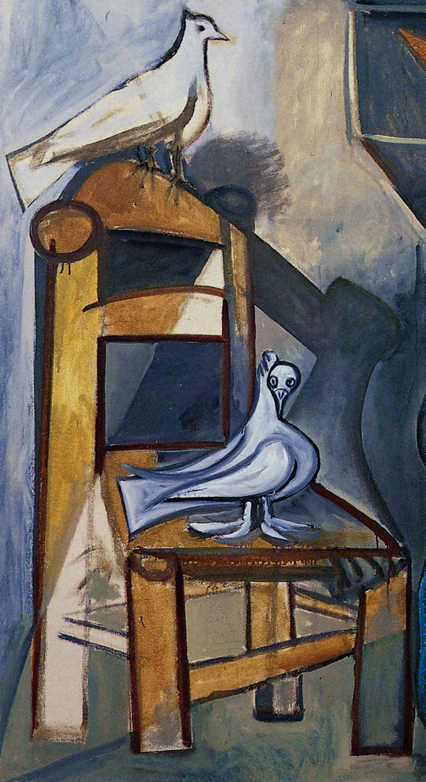
Eyes open slightly in the half-darkness. I’m perched on my high cushion like one of the birds. Morning light is coming up. I see them more clearly now. They’re sitting on different parts of the old artist’s easel that I left out there because it’s too big to have inside the apartment. It looks strangely like a work of art, some kind of out-of-context aesthetic event, but can’t think what that might be…. Picasso did some paintings of pigeons and doves that had moved into his studio in the South of France. I look at these pictures and I just know what that must have been like.

One bird begins to waken up, wing stretch, flutter, flap. They’re here with us, sharing the same worldview. Without us, the birds wouldn’t be on this balcony – they’d be on someone else’s balcony, okay, but the whole thing is about inter-dependency. We all need each other. I am one part in the vast body of life, distinct yet intimately bound up with all living beings. Eyes close again, return to meditation mode:

‘… so with a boundless heart should one cherish all living beings; radiating kindness over the entire world: spreading upwards to the skies, and downwards to the depths; outwards and unbounded, freed from hatred and ill-will. Whether standing or walking, seated or lying down free from drowsiness, one should sustain this recollection.’

After a while, in the light of early morning, I notice an odd silence in the bird group out there; no wing-flap. Get up and go over to see. They’re poised on the balcony handrail; all looking out, little necks stretched out and eyes focused on the space outside; the great swimming-pool of sky. Still no movement. Then simultaneously they burst into flight, and gone. As one unit they drop over the balcony and down. A moment later I see them swoop and swirl in a great arc in the sky then on eye level with this 7th floor and in a direct line away from me, they vanish in the distance.

————————-

[Excerpts from: Karaniya Metta Sutta also excerpts from loving-kindness meditation by Jack Kornfield, Susan Salzberg]


bird in the mall

THE NUMBER 9 BUS drops me in town and I find a place with tables and umbrellas in a shopping mall. Order something and open my bookmarked page: ‘Satisfaction is a moment of relief from the pressure of wanting.’ [‘Who Dies’ by Stephen and Ondrea Levine] That small moment of relief from the pressure of wanting comes with an increasing thirst for more.

Just then, a little bird appears at the table; hops over, quite close to me, where there are crumbs scattered, looks at me with a flick of the head, picks up a crumb and flies away, whrrrt. Mall sparrows are incredible, living in a totally artificial environment, high ceilings, glass roof, enclosed – this place doesn’t really look like what it’s trying to be; obviously artificial green foliage descending from stylized pillars made from polystyrene, surfaced with a resin that makes it look like marble.

I go on reading and the bird comes back, picks up another big crumb and flies off, whrrrt. I can see it going up to the top of a pillar and now perched on the plastic leaves, then disappears in the foliage. Hmmm… a nest constructed from woven drinking straws, paper serviettes, fragments of cash till receipts, hidden in the simulated foliage up there. Generations of sparrows and other creatures have lived inside these places for years, urban wild life, that has long since lost the way back to the ‘real’ world. The birds wouldn’t survive out there, they’ve adapted to conditions in here; proximity to table crumbs.

The small sparrow comes back to my table, takes another crumb, flies off again, whrrrt. The speed of the action… snatch, fly, eat. Feed the offspring and that’s how it evolved. The dukkha of endless searching is not an issue for this bold little bird. It has everything it needs maybe. Time for me to go. Across the road and the tram I need arrives at the stop, traffic lights change and I cross over and jump on. Light and easy, moving from one thing to the next. Not driven by wanting things to be how I’d like them to be. It’s got to do with the way you see it; the tram speeds up and glides along on smooth rails.

————————-

‘When desire does not shape the mind and limit it to thought, consciousness becomes translucent. Entering into the spaciousness of the original mind, we become the vastness itself. Inseparable from all else, at one with all that is.’ [Stephen and Ondrea Levine, ‘Who Dies’, chapter 4: ‘The Thirsty Mind’]

Finding Dipa Ma

DipaMaSwitzerland: Somehow I’ve been thinking about Dipa Ma lately; the Bengali meditation teacher who had such a large influence on IMS teachers like Sharon Salzberg, Joseph Goldstein, Jack Kornfield and others who believe she was an enlightened being. Just looking at her face on the cover of the book, such a welcoming presence. There are accounts of people who never met Dipa Ma having seen/felt Dipa Ma’s grace, her loving kindness – not in a strange or exceptional way, quite ordinary. Whenever there’s a moment that requires special compassion, the presence of Dipa Ma is there.

That’s how it is for me now; it’s like she’s here by my side. It’s as if she is saying to me that this present moment is absolutely right as it is, no need for anything else. Gone are all stray and wandering thoughts that tend to cling; they just disappear. How can it be possible to have the feeling you are close to someone you’ve never met and all you know is what you’ve read about her? I think, it’s because that’s just how she was; always approachable, she welcomed everyone. Dipa Ma was asked once about loving-kindness and mindfulness: ‘From my own experience, there is no difference between mindfulness and loving kindness.’ For her, love and awareness were one…. When you are fully loving, aren’t you also mindful? When you are mindful, is this not also the essence of love?’[Amy Schmidt]

These days I often think about her, whenever I’m in a difficult situation I find Dipa Ma is here too, deep breaths, and everything is ok.

————————-

‘Saintly beings, whether they are the Dalai Lama, Mother Theresa, Dipa Ma, or one thousand unknown saintly beings living amongst us, share the same fundamental characteristic of selflessness, great compassion, and peace. Each one of us can carry Dipa Ma’s legacy in terms of having that much peace and love. It takes its own time, yet it’s possible for anyone. In the end the point is not to be like Dipa Ma or some other great yogi or saint you might read about. The point is something much more difficult: to be yourself and to discover that all you seek is to be found, here and now, in your own heart.’ [Jack Kornfield]

the seer & the seen

I’M ON THE DOWNTOWN BUS, on the way to meet Jiab to help her choose a new pair of shoes. There is this short piece I’m reading from ‘The Essential Ken Wilber’: ‘… the mystics are not describing the real self as being inside you – they are pointing inside you. They are indeed saying to look within, not because the final answer actually resides within you and not without, but because as you carefully and consistently look inside, you sooner or later find outside. You realize, in other words, that the inside and the outside, the subject and the object, the seer and the seen are one, and thus you spontaneously fall into the natural state.’ I have an understanding of this but cannot experience it right now because I’m holding on to something that’s causing it not to happen. I’m a ship sailing away but only as far as the anchor chain allows… tug! The anchor is firmly embedded in the duality of the world – I need to see that the anchor is part of subjectivity too.

Bus arrives at the stop and I get off. Go find Jiab and we look at a few pairs of shoes. She is browsing so I slip away unnoticed and wander into the men’s department to look around there. In the corner there’s a chair in the section where they have folded socks placed in display stands. Nobody here, secluded, I could sit on the chair and read my book. Okay, sit down, open at the page and then thinking there’s something interesting about this totally unknown place, it feels nice. And a quick decision, I’ll try some meditation, let go, and see what happens.

Eyes are closed for a while but flickering eyelids: the ‘public’ aspect of it is making me a bit uneasy. There is the tendency to open my eyes whenever there’s a sound nearby, wondering if somebody is coming. Difficult to concentrate, so I try it with eyes half-open. After a while I can gradually relax into this state of focusing, not on anything in particular, just focusing on focusing; the act of focusing itself. Looking at everything that occurs with mindful alertness.

It’s about the experience of just being here; random sounds, voices, and the patterns of socks folded in packs to show off their colourful designs. Folded socks all around, up above my head and down almost to floor level. There’s a kind of peripheral vision thing going on, pulsating colour: maroon, bottle green, cream coloured diamonds and brown/orange diagonal dashed lines – like North African ceramic floor tiles. All the sock patterns start to move and vibrate. This must be exactly how the sock manufacturers would want the sock-buying customer to view their product.

Phone rings; it’s Jiab. I have to go and take a look at shoes she likes. I can hear my voice in this small space I’m in, but it’s somehow not the ‘me’ I’m used to. I get out of there and next thing is I’m looking at Jiab’s feet in different types of stylish footwear. A purchase is made and we head for the exit. I have to wait there for a moment as Jiab goes back inside to get something and really for the first time I’m able to let go of a whole lot of habitual stuff.

Just standing there at the exit watching the people go by, the traffic, the noise; there’s something about doing this in a public place that makes it more meaningful. It’s also the first time for me to enter this kind of contemplative mind state outside of Asia – and in the familiarity of European surroundings. Then walking through the streets, I’m seeing blurred images of people going by in a strangely different time and space. What I’m thinking is that this kind of contemplation in Europe, in close proximity to other human beings in a public place where, normally, nothing like this ever happens, initiates a special kind of mindful alertness; and it is, what you could call, quite exceptional.

It goes on like this; moments of mindful alertness all over the town; easily falling into a state of no thought, just colours/sounds in the immediate environment. Then waiting for the bus, just watching that moment, and suddenly the bus looms up silently, fills my vision, get on, sit down and we sail away as one group contained in a large vehicle. Public transport is wonderful. All senses awake, functioning. Alert and wakeful about the surroundings, idle thoughts just become silence.

I am a human being on a moving bus, large windows and whole landscapes move through the interior of the bus in waves, washing away mind processes as we go on. Here, in all this movement, I can have a sense of: ‘…what I am looking out of is what I am looking at’, and what that means right now. I can see it’s about the journey to get there rather than the arrival because after that there’d be the full understanding of it and none of this would be important.

————————-

‘The Absolute Subjectivity that can never be objectified or conceptualized is free from the limitations of space and time; it is not subject to life and death; it goes beyond subject and object, and although it lives in an individual, it is not restricted to the individual.’ [The Essential Ken Wilber, The Real Self, page 23](see summary in Texts)


Choosing Liberation

Van Gogh 'Miners' 1880 (detail)

I’M ON THE BUS, going to an early morning class in zone industrielle. As we get near, the bus is stopping at every stop to pick up people employed in the factories. Migrant workers from East Europe; men and women speaking a language unknown to me. Thin, sad, serious faces; reminds me of Van Gogh’s drawings of the miners in 19th Century. He was there as a clergyman and convinced that he could help them find ‘liberation’. But he wasn’t successful, poor old Vincent….

Bus is getting crowded, I have a book to read: ‘The Noble Eightfold Path’ by Bhikkhu Bodhi and I’m looking at this partly because there’s nowhere else to look without encountering another pair of eyes looking back at me. ‘The search for a spiritual path is born of suffering. It does not start with lights and ecstasy but with the hard tacks of pain, disappointment and confusion… for suffering to give birth to a genuine spiritual search, it must amount to more than something passively received…’ 

Urgent circumstances; this is about a level of suffering hard to endure and there’s just no getting away from it. In the past, my first reaction would have been to look for a way of easing the suffering, and I’d have gone for that straight away. And when it became obvious that such a thing is only a temporary solution I’d have continued with it anyway for as long as it took to find some other similar easing. The real way out, the way to the end of suffering is more deeply embedded.

More stops, more migrant workers get on the bus. Maybe they’re looking at me and thinking I shouldn’t be here, with my shirt and tie, polished shoes. What they don’t realise is that I’m a foreign worker too. I know how it feels to live in someone else’s country – I’ve been doing this for about 25 years. Okay, guys! I’m a teacher of English, and I’m on my way to teach your bosses, yes – but, as far as I’m concerned, we’re all the same here. And that’s how it is now, squashed up against the window glass; thin shoulders and arms pressing against me.

‘It has to trigger an inner realization, a perception which pierces through the facile complacency of our usual encounter with the world to glimpse the insecurity perpetually gaping underfoot. When this insight dawns, even if only momentarily, it can precipitate a profound personal crisis. It overturns accustomed goals and values, mocks our routine preoccupations, leaves old enjoyments stubbornly unsatisfying.’

It’s about being right out there; on the edge. And there was a time for me when it was like that; a confrontation with the obstruction. I had to give in to it. As soon as I did, there was something unseen that tipped the balance. There was the easing, but different this time – I got a little preview of the Way; nirodha: 3rd Noble Truth. Then the question of what to do next and this led to the Noble Eightfold Path magga. It was at Wat Pahnanchat and Ajahn J. explained all this to me later because at the time I didn’t know much about the Buddha’s teachings. What I’d experienced was a knee-jerk reaction; an ordinary human response. Same as it would be for anybody on this bus.

What would it take for the kind of insight described here by Bhikkhu Bodhi to be meaningful to these migrant workers? The endurance threshold would need to be lower than it is. As long as they have the ability to withstand hardship, it will go on like this because, for them, it’s about holding on, not letting go; they’re putting their small amounts of money together to send back home to support the family. So they choose to pursue this endeavour, I choose liberation. Does this mean I’ve taken the ‘soft’ way out?

Buddhism has always attracted the elite of whatever society it has traveled to, partly because you need to have traveled through a certain experience of materialism in order to arrive at the sense that there is something problematic about desire and longing, how they don’t lead to happiness, and more often than not lead to unhappiness. If you are still struggling to fulfil your fantasies of wealth, power, status, Buddhism is less likely to appeal to you.’ [‘An End to Suffering’ Pankaj Mishra]

The Buddha’s Teachings offer an opportunity for liberation that really only comes about if you already have a certain distance from economic concerns. In Thailand there’s always the option of living in the monastery for a period of time and following a spiritual path. This kind of choice is held in high regard. In the West, people have to structure their lives around employment. Their innate ability to be happy is exploited by commercial strategies and a fleeting, temporary happiness has come to be built-in to the system. People can’t escape from that unless they step out of the social status momentum they’re in and this means there’s the risk of losing everything.

The bus gets to the terminus, stops, air suspension lets out in one long last gasp, and the bus lowers itself on to its structure. I get out with everyone else in this strangely remote place with factory smells and set off walking along the path to the industrial buildings in the distance. Behind me the bus starts up, a worrying moment, no wish to be stranded in this particular reality. I look back at it as it rumbles off on its little round wheels.

 ————————-

(Link to: The Noble Eightfold Path: Way to the End of Suffering’ by Bhikkhu Bodhi)

[Image: Vincent van Gogh 
Drawing, “Miners”, Pencil on Paper,
Cuesmes: September, 1880, Kröller-Müller Museum]

Curious Blessings

Aug 19: US President Barak Obama wished Muslims around the world “Eid Mubarak” for the festival marking the end of the holy month of Ramadan. In a statement released by the White House the President extended warm wishes to Muslim communities in the United States and around the world as they celebrate Eid al-Fitr. President Obama said: “we congratulate Muslim Americans and Muslims around the world on this joyous day. Eid Mubarak.”

This morning around 5 am I open the laptop and get the news. Yes, I’d forgotten about the Eid, it’s not something you’d really notice unless you’re living in a Muslim community. Around this time of year, at the end of Ramadan the sighting of a sliver of the new moon at sunset signals that this is Eid al-Fitr – it happens at different times for Muslims in various parts of the world. The only time I experienced this was when Jiab and I were in Dhaka Bangladesh. And by coincidence we had a visit from a Buddhist monk from Thailand at that time. We hadn’t realised that his visit would be on the day of the Eid, and when I noticed the date on the calendar I sent an email to Ajahn suggesting we postpone the visit because of the Eid, but he insisted it was ok; in fact, a good time to come.

My hesitation was that Eid is when they slaughter cows and distribute meat to all members of the community. It’s a big day of benevolence and all the poor gather around the houses of the rich waiting to receive their share. If you’re a vegetarian, it’s hard to look at this. The thing is, there are all kinds of things we’d like to turn away from, and we can, but we’re deluding ourselves if we do – this is why Ajahn insisted we go ahead with the schedule. So, it wasn’t easy for me and I didn’t know what to expect. My Muslim friends said that in Dhaka city the presence of cow carcasses on that day would be hard to avoid. In Dhaka, like all Asian cities, everything happens on the street, in the public area, and there’d not be any route coming in from the airport that would not go through these sites. I needn’t have worried, though, because Ajahn was completely okay about it.

I went to the airport, found Ajahn in the crowd, not difficult to find him, the only one there in the pale tangerine-brown robe standing in the line beaming with joy. We left there for the apartment and on the way into the town all the places at the side of the road where the killings had taken place were pretty obvious and thankfully the killing had already happened, some hours before, at dawn. Muslim friends tell me there is a special way it’s done so that the animal feels no pain, no stress. We made our way through the slow moving traffic and could see piles of red and white animal parts and people milling around and it was like a butcher’s section in the food store on every street corner.

Ajahn pointed out that, when you think about it, it’s no different from what’s happening every day, animals are slaughtered for food. This is the reality of our world. All the time, somewhere in the world, maybe at this very moment, large numbers of cows, poultry, fish, goats, pigs are being killed and prepared for human consumption, let’s not delude ourselves. Yes, it’s quite a thought; we just prefer not to think about it and I hadn’t considered it that way. Reassuring to have Ajahn here because before he came I was finding it a bit difficult to accept.

There had been cows (and goats) everywhere in the city. For about a week before Eid, these animals were being taken into the city in lorries, in the back of pick-up trucks or led by farmers walking in from the rural areas. There were cow markets I’d pass through where animals were being sold and all the cows looked the same, white, pale fawn colour with curved vertical horns and that hump on the shoulder. There were cows in every part of the urban area – a farmyard smell of dung and straw. Cows were sitting at the roadside moving the jaw in a chewing motion as the traffic went by; they were in the carpark tethered to railings and street lights; all were being very well looked after and so they were just calmly and quietly sitting and standing around in pairs, usually, in a state of placid contentment. Some had garlands round their necks, painted horns, painted faces with eyes blackened around the edges like theatrical mascara and white and red make-up. It was a bizarre and colourful sight.

But now, of course they were all gone; transformed. No evidence that they’d ever been there, all was forgotten. Instead there were stacks of neatly cut animal parts laid out as if in a supermarket meat department.

At the apartment, the Buddhist event was starting, the group arriving with food offerings, flowers. All quiet, small, neat Thais wearing black and white costumes. There were about 15 people there on the first floor in that apartment in the Gulshan district – where all the foreign residents are and wealthy Bangladesh families. The Thai community in Dhaka is quite small, some business people, employees in hairdresser’s shops, Thai food stores, the Thai embassy staff and all were here to take the five precepts. Jiab is, of course, a Thai Buddhist – not like me, a Western buddhist and still learning how it works. Jiab’s mum and dad were Buddhist and it goes all the way back through her family lineage.

The ceremony took place; chanting, meditation, repetition of each part of the Five Precepts and more chanting. Ajahn gave a short talk about sila in the context of sila samadhi punya. And throughout the whole meeting there was the sound of sawing and banging: boom, boom, bang-bang-bang. At first I thought, what’s going on? Sounds like construction or people hammering things. But, after a while, I realised what it was. When the talk was over and as everyone was leaving I had a quick look out the back window where the noise had been coming from. There were these same heaps of butchered animal parts again. A whole carcass had been cut up here. There were large butchers wooden chopping boards, saws and the sound had been cleavers and small axes chopping and sawing through bones. Just below the window where the Buddhist monk was chanting….

And I don’t see it particularly as a characteristic of the Muslim faith, the same thing happens in all of the supply networks for the food industry; meat production in America and Europe, it’s the same thing. The only difference is that in the West it’s hidden and we’re not usually aware of it.

I’m glad it happened, as it did. Having the Buddhist monk there on that day to create blessings in the midst of everything was quite wonderful for us.