Buddhist tourists

Angulimala stupa, Śrāvastī: The Buddha is gone from here, it’s like languages that become extinct; if the language is not used, refreshed and evolving continuously, it disappears in history. And there are no signs of Buddhism beyond the gates of these historical places, no characteristics of mindfulness, compassion, there’s not even an understanding of it. It can so easily fragment and we can’t hold on to these historical times, annica, impermanence; what’s left are the teachings and sati sampajañña (mindfulness and clear comprehension); a deep and thorough understanding of impermanence. This teaching helps me to understand impermanence in a way that suggests some other kind of temporality. It’s enough to know such a thing is possible and this helps me accept the fact that things are so completely changed now, in the places where the Buddha used to be.

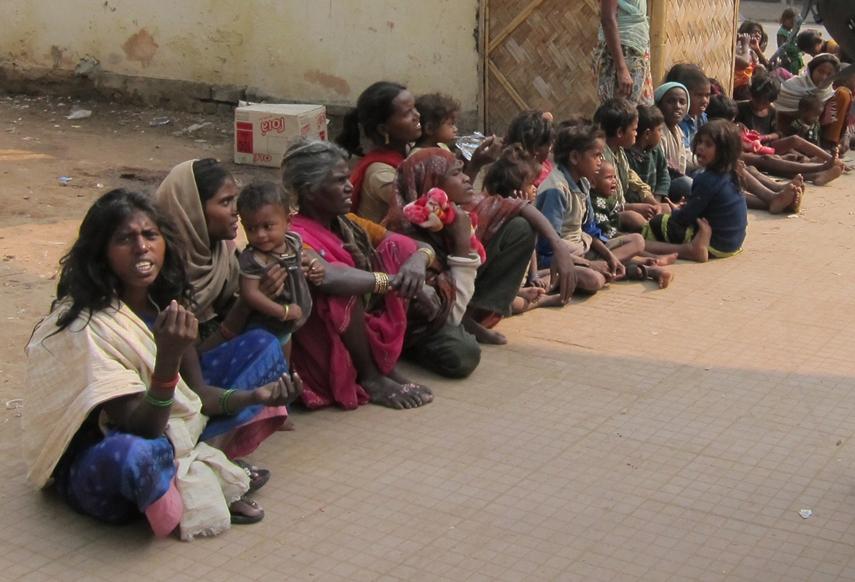
Begging children gather outside the gates and as we are leaving, the tour guide gives us packets of sweets to give to them – intended as a gesture we can make, reflecting on the generosity of Anathapindika (“feeder of the orphans or helpless”), all those centuries ago. But when we start to distribute these small packets, there’s such a fierce clawing and snatching that most of us have to drop the gifts and make a dash for the bus, chased by beggars. Last thing I see is a scuffle amongst them fighting for the ’gifts’. It was a feeling so completely different from the generosity of the historical figure who covered Jeta’s grove with gold coins in order to buy it from Prince Jeta. The Prince was so impressed with the generosity of Anathapindika, he gave the rest of it to him for free and joined with Anathapindika in offering the whole grove as a gift to the Buddha.

Is it possible that the presence of Buddhist tourists has created a generation of beggars at the gates? Anyway, this kind of thing seems to be unavoidable in India; there are beggars in other tourist places also. But the giving of money and gifts is a bit of a shambles and it would be better for everybody if this could be properly organized. What I did see that seemed more positive was a couple of people giving money to the beggars with an honest generosity, joyfully sharing; they were very good at doing it. I learned from this, it seemed to me to have a quality of dignity and mindful generosity and I tried to do it that way afterwards.
So, I wasn’t expecting the presence of beggars to have such an impact during this visit to the Buddhist holy places. Maybe it seems so dominant because what else is there here to see? Only ancient mounds and reconstructed low walls that show the location. I doubt if the bricks are original. There are very old Bodhi trees decorated with prayer flags but not of an age that could be anywhere near to the Buddha’s time. Otherwise there’s the earth and the sky; the air, nothing more than that. What is present is a special kind of sensitivity; visitors are all Buddhists or persons that way inclined, respectful and sincere and what we’re all considering is something that is unseen. If you can focus on being in these places where the Buddha used to be, and allow space for mindful contemplation, just being here becomes part of conscious experience; there’s a reality of that ancient time that comes through, such a fragile thing, barely noticed. It triggers something about these events that happened here all these centuries ago – just knowing it’s possible is enough.

The light and warmth; coolness in shadows in the afternoon, sense impressions, the laughter of a child in the trees and I’m thinking, yes, there would have been this also. I can allow it to be present for a moment and I’m in the 5th Century BC. It’s a simple feeling of just being here. I know how it must be for all other beings to experience this feeling; just like this. Subjectivity; we’re linked like this. The feeling stays for as long as I’m aware of it then it falls away.

————————-
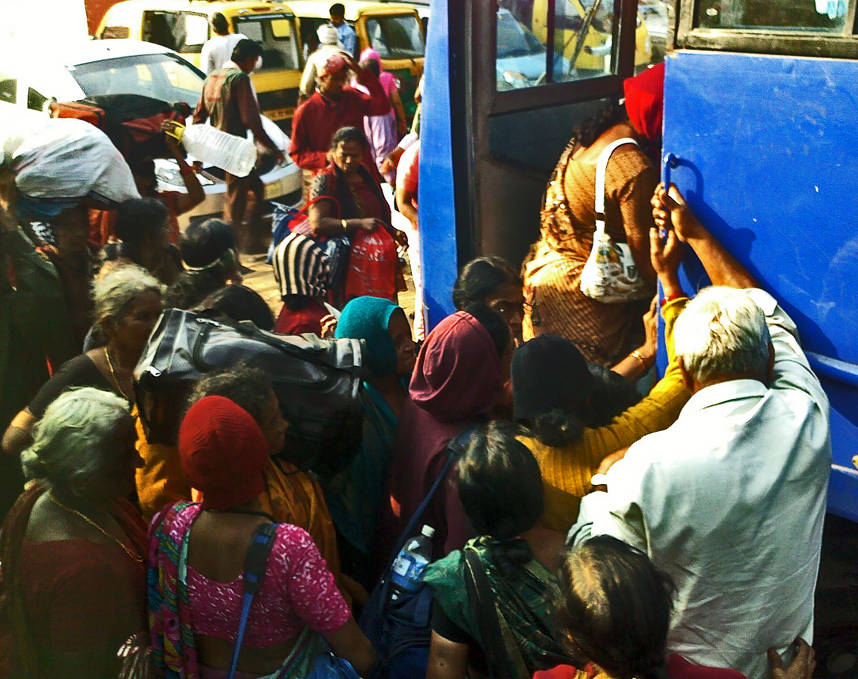
Photos – Upper: Bodhi tree with prayer flags.  Middle: Beggars at the gate [Witit Rachatatanun Collection]

a sense of urgency

India-Nepal highway: more like a simple farmyard road than a highway leading to an international border crossing; rough surface and missing chunks of tarmac create an incredible, bump, crash and rattle in the bus that goes on without end. Too much vibration to be able to sleep and impossible because of the noise the bus driver is making with the horn, a high volume squeak-and-squeal alternating between two notes. Cows and goats wandering around scramble to get out of the way; people on bicycles scatter to make room. If there’s a traffic jam, he gets angry, leans out the window and shouts. There’s a co-driver in the cab and he’s sent out to bully, threaten and persuade the drivers of the vehicles to move to one side. Co-driver gets back in again, then another obstruction. I’m sitting at the front of the bus behind the driver, looking through the large windscreen and it’s like everything is held together in a makeshift, temporary way; no time to do it properly, we have to hurry on – what is it? I’m thinking along the lines of a war-zone or some kind of catastrophic event has taken place and this is an emergency vehicle; there is danger and we are fleeing for our lives. But it’s not that, it’s just normal.

The bus gets seriously stuck behind a buffalo walking slowly, with her calf, down the middle of the road; despite the driver’s trumpeting two-note horn, mother buffalo won’t move from her place in the center of the road. Co-driver is sent out to chase the buffalos to the side so the bus can get through and he whacks mother buffalo hard on the rump, an audible WHACK! I can hear above all the racket. Unfortunately, this sends mother and calf off into a frantic gallop straight down the middle of the road. The bus still can’t overtake and has to follow these galloping buffalos for some distance. The driver is getting worked up into a fury, bus lurches to and fro while he’s yelling like a wild man out of the window, and barely in control of the vehicle. Eventually the buffalos run off to the side of the road, the engine roars into life and we accelerate away. Co-driver climbs back into the cab, breathless from trying to steer the buffalos and for a few minutes he has to defer to the driver’s seething anger directed at him. It’s bizarre and funny, but nobody on the bus is laughing.

I’m with a Thai tour group, reserved, polite, quiet behaviour, small body movements and everyone is sitting straight up, dressed in white top and black trousers or sarong. Could be they’re in a state of shock, never having experienced anything like this before. Somehow they all thought (and I did too) that in India there would be vestiges of the Buddhist loving-kindness and the generosity of letting-go but instead of that the whole thing seems to be about blatant greed, hatred and delusion; a skeletal hell realm of holding on tight and mad with desire. India is discovering it’s identity in the media and advertising. The bus went past a poster showing the actor Riz Khan in an advert for whiskey and the slogan is: ‘I have yet to become me’. I managed to get a slightly blurred photo of it.

What happened to Buddhism in India? There were the Islamic invasions and what little remained was assimilated into Hinduism. It could be that, long before that, King Ashoka considered that one day Buddhism in India would come to an end because it has no built-in mechanism to withstand a forceful take-over; it’s fragile and light and doesn’t attach to anything. For this reason he erected simple stone pillars in places where significant Buddhist events took place; they function like markers on Google maps. The locations are verified and Buddhists coming to India, foreigners like me, visit the sites, Bodh Gaya, Sravasti, Lumbini, see these pillars and take a moment to consider that, yes, it happened here. And if it weren’t for King Ashoka’s sense of urgency that these places could eventually be lost in history, there might be no traces of Buddhism in India at all.

now as it was then

Bodh Gaya: 04.00 hours, this is where the enlightenment took place. I’m in a hotel not far from where it happened, early morning and the window is open, sitting on a cushion with mindfulness, watching the breath. There’s a sense of, it’s just over there, out the window and over to the right a bit; yes, it was there that the event took place. I’m near to the epicenter, ground zero. From here, it spread outwards to the people close by and dispersed among everyone who had a mind to listen. Then, in the course of time, reaching out to all parts of the world, so that visitors from Tibet, China, Japan, Korea, South East Asia and other places eventually came here to see for themselves. Ordinary lay people came, conversions from Hindu castes, bearded sannyasis with matted hair and white marks smeared across the forehead, and monastics came from all over Asia, robes in shades of ochre, maroon and grey; chanting … namo tassa bhagavato arahato samma sambuddhassa … various intonations and melodic rhythms altogether in a pleasant discord.

How much of this is the same now as it was then, 2,600 years ago? The sensation of the breath is the same. The air gently touching the inner surfaces of nasal passages and throat and the consciousness that arises with that feeling. Through my own humanness and in a subjective sense, I can recognize the humanness of the bodhisattva. As well as the same blue sky, brown earth; green foliage, and even though the outer objects I can see may not be the same, changed over the centuries, the process of seeing is the same. The consciousness that recognizes this is the same for me as it was/is for everyone, and the ‘me’ and ‘mine’ I experience is not in any way different from anyone else’s ‘me’ and ‘mine’ who lived at that time, or now, or will live any time in the future.

You could say it’s just a sense of history that’s present whenever you enter a historical site, or a building or museum. It’s possible to know how the people, who lived then, felt and understood the world; the things they looked at and what they heard, smelt, tasted, touched and their mind responses; all of that is the same for me now, here in this place where the bodhisattva walked 2,600 years ago. I’m connected with the outer world by consciousness, in the same way the people at that time were; the conscious experience of what is seen is the same for me as it was for the bodhisattva – simply that function. And the environment I’m in, the outer world, may be different from how it was at that time, but the body/mind organism that receives the experience is universal. All beings are caught in this conscious experience. There’s no need to add anything else. The sense of ‘now’ that’s the same today as it was then could be the sounds I hear, the feeling of sunlight and the gentle wind blowing in my face; an awareness of the ever-present sensory data telling me outer and inner are the same and I’m an inseparable part of it all.

————————-

Where there is the mind, where there are mental phenomena, mind-consciousness, things to be cognized by mind-consciousness, there a being exists or the description of a being. Where there is no mind, no mental phenomena, no mind-consciousness, there a being does not exist nor any description of a being. [SN 1.65]

Photo: prayer flags, Sravasti

Buddhists and Christians

Chiang Mai: A very nice short flight here from Bangkok yesterday, 1 hour 10 minutes. They serve a small meal; it was like going upstairs to have lunch in the clouds, then it’s time to come down again. During the flight I was able to have a discussion with somebody I met there about Christianity and Buddhism – is there ‘something’ there (God) or is there not anything? And ‘not anything’ implies something that cannot be verbalised.

It is a bit like tight-rope walking for me as a Western Buddhist and now 30 years in Asia but still subject to the conditioning of the Church and childhood memories of it in the West. With my Christian companion here, there is agreement on many things. The main thing we agree about is that human beings may experience a certain kind of realization that there is no ‘self’, no identity, nothing there; nothing in the mind/body organism, it’s a construct. There’s a feeling of ‘lack’, and the shock that comes with this discovery causes dismay, distress, etc. Christians say the realization of emptiness is the absence of God, and this knowledge facilitates the entry of God, the creator of everything. This is what fills the emptiness; a significant turning point for all Christians.

Buddhists encounter this feeling of ‘lack’ in the same way but will not ‘fill’ it with anything, rather, they contemplate the emptiness of it in depth; examine the associated emotional reactions with mindfulness and come to see that, this is how it is. Śūnyatā, the emptiness, the lack of ‘self’ is everywhere and in all things. The understanding that everything is without ‘self’ helps Buddhists to contemplate the constructed nature of the mind. It’s possible to see the whole picture; how everything works and where we go from here. It’s an open-ended, investigative approach that may lead to an understanding of the non-duality of the observed world and the observer of it, together as a oneness. What the Christians call God must be inside this, because it is all-inclusive. There cannot be anything outside of it.

Christians will depend on the attachment to a belief in God for guidance and that’s how they see the world; they might say that ‘emptiness’ for the Buddhist is the Buddhist sense of God? And Buddhists could consider it this way, but the Buddha didn’t see any point in going further with that because the important thing is to make sure you are seeing reality correctly; anything else is getting caught in wishful thinking. Necessary because working only with belief and faith and no pragmatic teachings means there are all kinds of things that can go wrong with it. Christians are focused on the experiential aspect; Buddhists say conceptualizing a God leads to attachment, tanha; the desire for, and attachment to, ideas and ideals, views, opinions, theories, conceptions and beliefs. [Dhamma-taṇhā, Walpole Rahula].

If I say the word ‘God’ to myself, something comes into my mind, the word ‘God’ has an immediate emotive effect. Certain assumptions arise and the mind is already closed around it; it’s a ‘special’ thing. When Christians talk about God, what they’re referring to (I think) is the God they are creating in their own minds – their loving devotion to a personal god: a deity who can be related to as a person, but God is beyond everything that is conceived or thought about. There is no adequate analogy, words cannot describe it. It cannot even be imagined because it is beyond space and time. Buddhists stay separate from the God concept because to become involved with it means making assumptions about a kind of consciousness that is totally different from ordinary mind states. This is not to say there is no God, for me, at this time, it is impossible to express in words what God could be.

Then there’s a stewardess announcement, the plane is starting its descent, please put your fold-away table up, arm rest down, and chair forward. I get lost in the directions for a moment; a small clutter of prepositions, then were on firm ground again.

————————-

‘Both Jesus and the Buddha were pointing to something that could not be found in the context of ordinary ‘mind’, the Buddha’s goal was to strive to realise the unconditioned, the unoriginated, the deathless, that which is free from mortality. So did the Buddha find God? Was it this that he called Nibbana? God is not Nibanna, because when we speak about ‘God’ we start getting ideas in our head about what God is and that is very far from the unborn, the unconditioned, the uncreated, the unoriginated, the deathless. All these words tell you nothing. What comes into your mind? Nothing. Anything you might say or try to put into words to describe God is an image in the mind. There are no words for it.’ [Ajahn Jagaro]

‘God is God only in relation to man. God appears in the material world like the reflection of the moon in a pool of water, as part of the illusion that is the context of man searching for God with his mind. What man sees becomes “God” (gender neutral; “He” only for explanatory purposes). He is Omniscient, Omnipresent, Creator of the world. He is both immanent and transcedent, full of love and justice. He may be even regarded to have a personality. He is the subject of worship.’ [Wikipedia Brahman page]

Image: Peter Henderson

Responsibility

Bangkok: We arrived at the Golden Palace in a taxi but at the wrong entrance, unfortunately, and the man there said this is not the entrance, you have to go down that way and he pointed down the road – but, the thing is, and didn’t we know, the Golden Palace is closed in the morning today? So we hesitate and he says, yes there’s some kind of ceremony taking place, so it’s closed to the public but why don’t you go round to some other temples and palaces for an hour or two then come back in the afternoon and it’ll be open at 1pm? So we’re thinking about that and he takes us over to the the tuktuk guys and starts to sell us a deal for going around the area on a tuktuk. That’s when we figure it’s a scam, say to the guy, thank you very much and walk around for a bit to decide what to do, then down to the main entrance where everything is open as usual with a sign saying: ‘Open Every Day’.

It comes as a bit of a shock and makes you wonder, what is it with that guy? How can a Thai have such blatant wrong intention; absolutely contrary to normal cultural behaviour and doing this on the doorstep of one of the most cultularly significant sites in Thailand. Its a bit like someone working a scam on tourists entering the Vatican. He must know he’s creating very bad karma and why would he do that? I asked Jiab afterwards and she didn’t have a lot to say except that the guy was probably in such dire straits he must be in a living hell realm already so let’s not talk about that okay?

I’m not sure how this works, it’s one of those things that everybody just puts up with, so it has space to continue as it is; nothing really comes along to stop it, or give it proper direction. You take responsibility for your own actions here because, up to a point, you can do anything you want in Thailand, except that if it’s wrong action, you have to know that it’ll eventually bring bad results to the wrongdoer and every Thai knows this, fears this and is in awe of this. Why, then, do we have people doing things that’ll create bad karma? Because they are already trapped in pre-existing karma; due to avidyā, a fundamental misunderstanding of the nature of reality and over time have become inseparable from bad actions and have obligations to other unfortunate characters equally lost in the cycle of bad karma. So they have to take on things like this to earn a living – for the guy at the tuktuk stand, it’s not much maybe, but he has to go on creating unpleasant situations for other people as he’s slowly working his way out of his unfortunate karmic situation. He’s just trying to survive and will ask for blessings from the monks, the same as everyone else. If it looks like he’s genuinely trying to do something about his predicament, society tolerates his behaviour – up to a point.

And what, then, if you have some seriously bad guy like a gang boss in the underworld who has such large accummulated wrong action and the bad karma that goes with it? Let’s say he’s at the end of his life, a Buddhist, and clear in the knowledge that he can’t put off having to face the consequences of his actions one day quite soon. What can he do? Assuming he’s not already lost in the cycle of deluded and obscure karmic forces, he may offer to the temple, very large amounts of the money he took from others, in his lifetime or he may even offer to finance the building of a new temple or a monument of religious significance. Whatever; he’ll try to do something to put right the wrong things in his life. Although it will bring benefit to many, it won’t work for the gang boss because he left it too late and is now in the situation of being old and weak and having to face the knowledge of his wrongdoings on the threshold of death; a crash course in learning what remorse is and coping with a fearful mind rapidly moving in the direction towards: ‘the downfall, the woeful way, the sorrowful state, the cycle of birth-and-death.’ There’s just no getting away from it. It’s about samsara and, depending on the particular circumstances, could be unfortunate. We can’t take anything in this life on to the next life; only karma. There’s every reason to feel compassion for the guy standing outside the Golden Palace and hope that eventually he finds the way out.

————————-

‘Like a seed waiting for rain, our karma shadows us, waiting for the opportunity to grow and ripen. Our intentional actions will produce a result at some time. People in their present lives, are experiencing the effects of their past actions or karma.… it is possible to alter or reduce the effects of these past actions through present actions. These will also have effect on future lives. Understanding the law of Karma helps us realise that we are, whatever we make ourselves to be. We are entirely responsible for our own destiny.’ [Hwa Tsang Buddhist Monastery]

Photo Image: Elaine Henderson

30 minutes

Bangkok, Suvarnabhumi: Awake very early and in the car before daylight, through the empty streets and strange yellow sodium street lights on the elevated tollway over the rooftops of the town and out to the airport to meet the Air France flight, ETA: 06.15 hrs. As it turned out, the flight was delayed by one hour, so there was time to sit in the seats at the tour group end of Arrivals, near Gate 10 and open the laptop to write this.

Gate 10 is where the tour groups gather, bleary-eyed and sleepless, having just got off the plane from some distant part of the world. The people around me are speaking Russian and I see from the Arrivals board it must be the flight from Novobirisk (Wikipedia says it’s a large industrial city in Asian Russia). They assemble at Gate 10 and have their names ticked off a list by the Thai representatives of the tour. There’s 30 minutes allowed to have a cup of coffee; children run around, go to the toilets and everyone is ready to get on the coach. When they’re all accounted for, the tour leader gathers them together and they all leave. The mass exodus of the group is dynamic, all following the leader in front who’s holding a coloured flag high in the air so they can see it. Off they go, through the wide passageways and shuffling along with their luggage and running children and moving as one great lake of beings in the direction of the coaches somewhere in another part of the airport. In a short time all the seats at Gate 10 are suddenly empty. Bye-bye the group from Novobirisk.

But before that happens, the Russian tourists spend the time intensely absorbing everything around them; talking with the tour guides and taking pictures of everything; roof structure, walls, illuminated adverts, airport signage, and each other posing in front of vases of purple orchids, dressed up in their best summer frocks and smiling for the camera. It’s as if they’d stepped out of the 1950s, remote from anything I know of and yet there’s a familiarity; it’s possible they could be people I knew in my childhood in the North of Scotland. There are so many photos being taken, it’s like a small press event; digital camera lights flashing like strobe lights in a disco. I’m dazzled by it, blinded for a moment and have to look at the floor to allow normal vision to recover. Look up again and they’re leaving, the whole place captured in pixels and taken away back to Novobirsk, at the end of the holiday, where all the views of it are reassembled to form one composite image of the waiting area at Gate 10. ‘… and here is Aleksandra and Nikolai at Bangkok airport don’t zay looks zo bright and lively?

The seating area is empty for a while, strangely quiet, light slowly coming up and then it’s completely daylight, people again start to assemble in the seating area. It’s another group from Beijing, same thing as last time but the conversations I hear this time are in Chinese.

————————-

‘… it seemed to him that these people were his brothers. Their vanities, appetites and absurd traits had lost their absurdity for him. These traits had become comprehensible, lovable; he even experienced them as worthy of respect. The blind love of a mother for her child, the ignorant pride of a father over his son, the raw hunger of vain young women for jewellry and the admiring looks of men – all these impulses, all these childish qualities, all these simple and foolish but incredibly powerful, incredibly vivid, forcefully dominant impulses and cravings were no longer childishness for Siddhartha. He saw that people live for them, achieve an endless amount for them, travel, wage war, suffer and persevere unendingly for them. And he could love them for that. He saw life, that which is living, the indestructible essence, Brahman, in all of their passions in each of their deeds.’ [Herman Hesse, ‘Siddhartha’ p128]

Photo Image: Peter Henderson

10 million to 1

Bangkok: I’m in a downtown area, standing under an umbrella, trying to hail a taxi; heavy rain here and the traffic is going slow. A taxi pulls up, bright yellow and green, open the door and get in. There’s that strong smell of krating daeng (red bull), and jasmine flower garlands. I see a Buddha rupa and various auspicious objects everywhere. The taxi is old-style, well maintained but at the end of its days. The same could be said of the driver; ‘Loong’, meaning ‘uncle’, a respectful term used with any old man. In fact he’s more like great-grandfather, smiling, childlike and ancient.

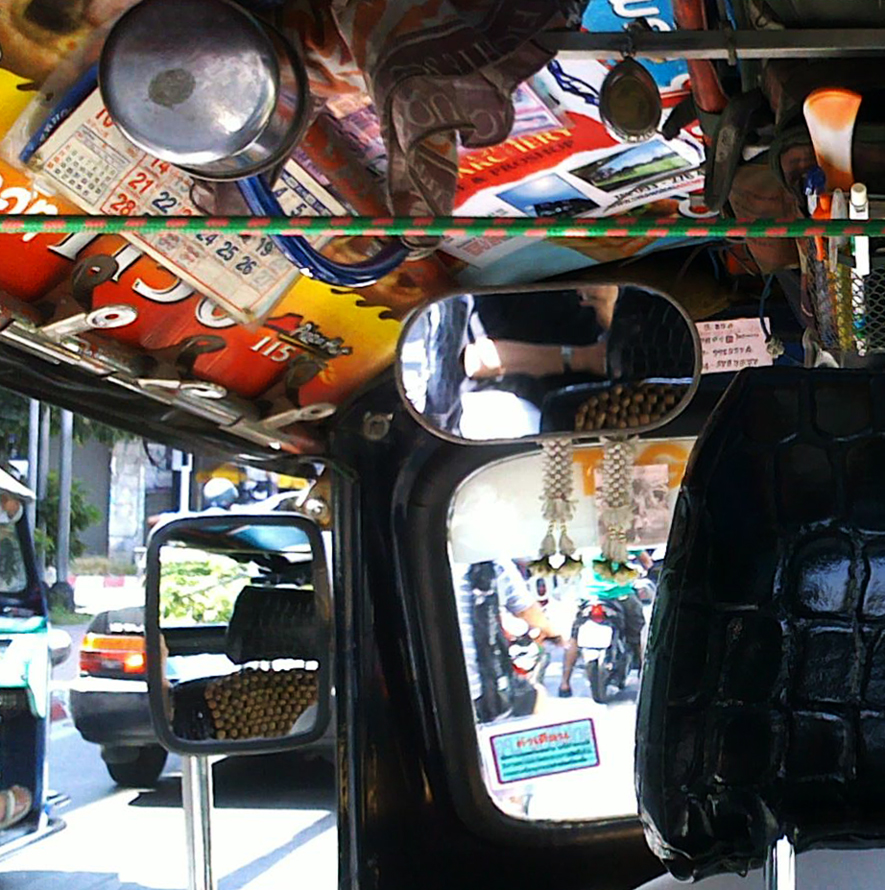
The most noticeable thing about him is he’s got no teeth and insists on grinning all the time. He’s likeable, asks me all the usual questions and it turns out his daughter lives near to where I live in Bangkok and that’s a talking point. He brings his attention to driving the car and I’m wondering how this is going to turn out, but it seems to be good enough. So I settle back and look round the interior of the cab because it is crowded in here. Blessings and charms are painted on the ceiling, a great profusion of strings of beads, amulets and decorative hanging things tinkling and clanking from the rear-view mirror, and it takes me a little while to notice that the dashboard is covered with all kinds of toy objects stuck on with adhesive. The dog with the nodding head, and they all have moving, swinging heads, like this; coiled spring necks and crazy grinning faces that wobble slightly with the vibration of the engine but roll around madly every time his taxi makes a sudden movement, a touch on the brakes, an abrupt acceleration. It’s quite mesmerizing.

I’m just taking it in here, all these wobbly heads and various swinging objects in the middle of the windscreen; a part of the journey I didn’t expect. I get in his taxi simply to travel from point A to point B thinking that he just takes me there – and he does that but feels it necessary to surround his passengers with… something, what is it? I know some Thais who would feel uneasy in here, seeing a connection with phi (superstition). I don’t engage with that stuff and thinking it’s like this because, for him, it’s just boring and pointless; there’s no reason for this journey or any journey, and this is a kind of anchor. Somebody else will get in, after I get out, and that person will tell him to go somewhere else and off he goes. When he gets there it’s the same as the place he just left, and all other places. Traffic in the city is like water in the river; it gets everywhere, into all the corners where there’s space for it.

Every passenger who gets in has a directional goal-orientated intention; this old driver is not part of that, even though he is very much present. For him it may seem incidental in a profound sort of way; just wandering all over the town in randomness and along the way he’s arrived at the concept of all these wobbly heads, I suppose. It’s suitable because it’s meaningless, like everything else. His taxicab is like this because he’s in a place where it’s always ‘now’. Most of the cause/effect, time-bound, goal-directed thinking is just not there. Apart from control of the vehicle, which he must know completely, he is free; he’s not going anywhere because he doesn’t need to go anywhere; there’s nothing he needs. He just takes other people where they want to go and there’s just the emptiness of it.

In the Hermann Hesse novel: ‘Siddhartha’ (chapter 9), Siddhartha speaks to Vasudeva, the ferryman, about a lesson the river teaches, that time does not exist. “The river is everywhere at the same time, at the source and at the mouth…in the ocean and in the mountains, everywhere, and the present only exists for it, not the shadow of the past, nor the shadow of the future… Nothing was, nothing will be, everything has reality and presence.” He talks about listening to the ‘voice of the river’ and I’m wondering if it’s something like this that Loong is experiencing after a lifetime in the timelessness of this huge city.

Loong drops me where I want to go and it’s still raining. I get all the stuff done I was going to do and a few other things too and after a couple of hours I’m in some other part of town in another taxi. We’re stuck at traffic lights and I see this taxi go by with the same wobbly heads on the dashboard; amazing coincidence, considering there are 10 million people in this city – it’s Loong! And he doesn’t have a passenger. Quick decision, I pay off the taxi I’m in, the lights are still at red, jump out and run through the rain to Loong’s taxi. Open the passenger door and jump in – surprise, surprise! There’s wild laughter, and Loong’s great toothless mouth and all of it suddenly feels like a continuation, I was here all the time; I never got out of his cab the first time; the interval that happened in between was a daydream.

So, we set off back to my place and he’s happy about that because he gets to visit his daughter who lives nearby. I hear him explaining things to her on the phone. He’s too old to be driving, really, and as he’s doing that, I have a chance to revisit the strange and interesting timelessness that Loong’s taxi seems to contain.

personifications 1

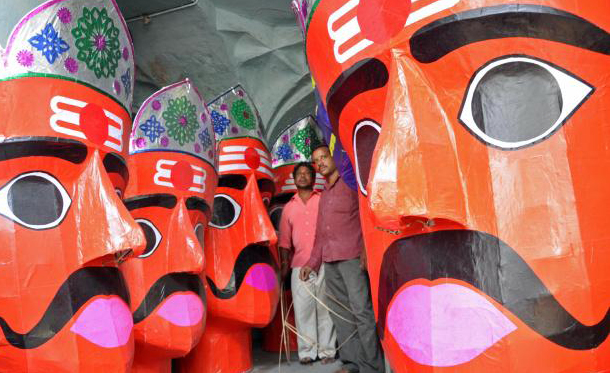
Note about the image: Ravana, huge demon-like effigies, are created for the Dasera festival which was held in India recently. The effigies are packed with straw and the highlight of the event is when they are set alight [Link to: The Hindu newspaper]. What I’m writing about here is the attachment we (Westerners) have to effigies such as teddy bears and the inclination to personify objects as a way of supporting the concept of an individual ‘self’ separate from the world.

Bangkok: I’m in a townhouse in the centre of the city; arranged to meet some people about a school-kids party event. Na Uan is here and the room is full of huge plastic bags containing something… is it teddy bears? Yes, teddy bears. She says, they were donated by an Australian NGO to be given as prizes for the main quiz event. And my first reaction is, how cute! Then that feeling falls away; they’re just teddy bears, a lot of them, packed together in these large plastic bags. I see them all squashed up inside the plastic, upside down, sideways and limbs all tangled together and faces pushed flat against the tight surface of the stretched bag. They’re looking particularly unloved; not cute at all. I ask Na Uan, shouldn’t we take them out of the bag? No, we can’t because they’ll get dusty if we do. Seems like not the kind of thing to do with teddy bears, keep them in plastic bags, they can’t breathe… ? I have to remind myself they’re not living beings.

But the best is yet to come, Na Uan rolls out another plastic bag containing the largest teddy bear I’ve ever seen, it is about 4 feet high in the seated position, squashed up, golden furry body and wide-eyed inquiring alertness about the face, everything flattened tight against the polythene surface, and totally suffocated like the others. Why am I going on so much about teddy bears? It’s because I spent the night there and had to sleep in the same room with all the teddy bears, trapped inside their plastic bags. I got to sleep in the end; woke up in the morning and there they all were again, looking out at me in their appealing way..

It’s this thing about ‘self’, there’s just no getting away from it. We take the mind to be self but it’s a succession of mental elements nāma rising and falling away and seeing, hearing, thinking is the same; the body too, rūpa, one day here, next day gone. The five khandhas – it’s doubtful if they were of any substance in the first place. Sounds like a sad story and I suppose that’s why there are teddy bears we can hold on to – and other things. We try to bring our sense of ‘self’ into reality with these personifications, images of ‘self’, but that falls away too. None of it works, there’s just this great emptiness where the individual self supposedly resides and the great big teddy bear looking at me now from across the room cannot convince me otherwise. It doesn’t work like that.

Interesting to see Na Uan’s attitude about all this; individuality creating existential anxiety; it’s a Western thing. It has no meaning; there are many things like this that happen here in Bangkok that Na Uan doesn’t understand and that’s ok, not important. She is one of eight sisters and brothers, an integral part of a community that takes support from each and every individual present, one way or the other. Yes all kinds of stuff Na Uan didn’t have to learn and get involved with when she was a kid. Good for her. The ‘self’ problem is still there, though, but maybe the Thais are very much less attached to it than we are.

There’s a question about what remains after you see through everything that is not the ‘I’ you take it to be. There’s a quote by Sri Ramana Maharshi: ‘… the one who eliminates the ‘not I’ cannot eliminate the ‘I’… find the source and then all these other ideas will vanish and the pure Self will remain.’ It’s possible to have assumptions about the ‘pure Self’ and about what ‘will remain’. The Buddha’s teaching is that if you can completely deconstruct the ‘I’, nothing is left behind, ‘no remainder’. This must be a teaching about tanha, the natural inclination to hold on to the very end – as we do with teddy bears and everything else. All there can be is the clear-minded investigation of this.

Sometime after that I was having breakfast, pa tong ko, deep fried dough pieces in the shape of an X and soy bean drinks with dried fruits and somebody arrives in a pick-up truck and takes the bags of teddy bears away. It was like they were never here.

————————-

Photo Image: The Hindu Newspaper

A Sea of People

Bangkok: I arrived at Don Mueang aiport, Sunday 28 October, unusually busy; three or more flights arriving at the same time. Through the exit marked TAXIS, out to the street area and about five hundred people are waiting for taxis; wow! Everything in Bangkok is on such a huge scale. It was the last day of the school holidays so families were returning from the provinces to the city. It looked like it was going to be a long wait, but it wasn’t bad, very well handled, airport officials steering this great sea of people into lines, no problem. And lined up on the other side of the crowd barrier was a virtual convoy of waiting taxis, four lanes wide and stretching back as far as the eye could see.

But the initial reaction is frustration, of course. I’d just arrived from Ch’mai and that small town thing where there’s less of the kind of situation that invites you to get engaged, upset about it and thus vent your spleen. I’m saying this because a part of me wasn’t ready to have a frustrating situation like this, but that’s the thing about frustrating situations, they just come along when you least expect it and there you are, same old story. Interesting to see how fast the energy of aversion arises and you’re locked into an immediate response; struggling with ‘self’ among all the other ‘selves’ – ‘me’ first, ‘me’ first, all trying to get a taxi before there are no taxis left and I’m reminded of a Bob Dylan line: ‘… tryin’ to get to Heaven before they close the door…’ Seeing it in this way means thank goodness there’s mindfulness and an opportunity to bring what I know from the Thai othon (patient endurance) to conscious awareness and immediately there’s a small space in the mind and it’s a bit easier to take. These are the teachings I’ve absorbed from the Ajahns; there’s also uppekha (equanimity) in there somewhere and the fact that this is what life is about; the ups and downs of it and the Eight Worldly Dhammas

Deep breaths… and contemplating the value of standing meditation. I’m in one of three very long lines of people with trolleys and pulling wheeled luggage but no jostling, no push-and-shove; well-behaved, and the Thais are calm. So I get calm too. I realize that what the frustration is about is not being able to see what’s going on – the limitations of our human physicality? All I can see are the backs of people’s heads and I’m moving my head from side to side, trying to see past all the other heads down there to the taxi kiosk at the end of the line, very far away. What’s going on down there? But all the other heads are doing the same thing and my line of vision is obscured by somebody else’s head, moving from side to side because the head in front of him is in the way. Moving my head like this probably causes other heads behind me to have to do the same thing. And there’s a consciousness of this.

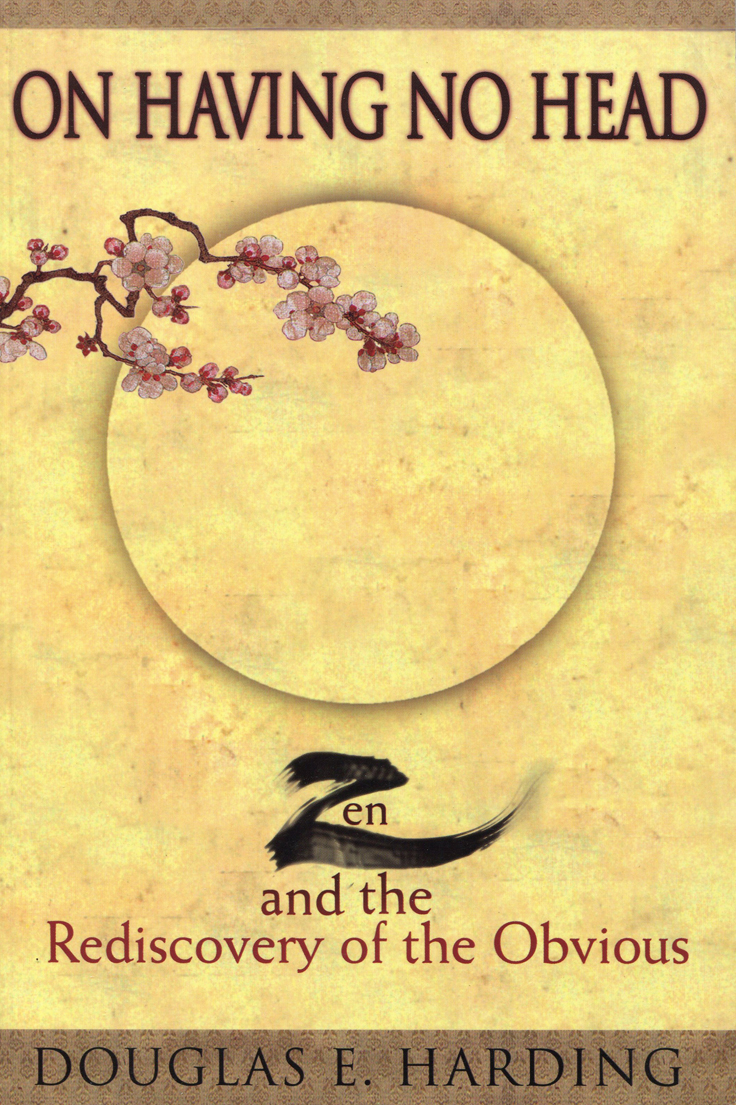
Curious and interesting, hundreds of wobbling heads; the face is on the front and there are no sensory receptors on the back, no rear-view mirror either but it’s a possibility? All sensory data is received in the front and ears on the sides. Seeing the back of someone’s head is like looking at a closed-door, so there is a natural tendency to want to get around to the other side see the face. No, can’t do that kind of thing in a line waiting for taxis; we just have to switch off the ‘search’ function and allow things to happen. There’s an Alan Watts observation about it being like the headlight of a car. ‘The headlight illumines the road in front but does not shine on the wiring that connects it with the battery, and the battery with the engine. And so, we are not ordinarily aware of how we are aware.’ [Zen and the Beat Way, Alan Watts]

I got a taxi okay, no problem, and it was a lady driver, Khun Siripon, which was nice because there’s never any hassle with a lady taxi driver, thank you Khun Siripon! When we got to the house, I paid the fare, gave her quite a large tip and she turned round to look at me, face-to-face and the wai she gave in response was so respectful, I was humbled. Amazing.

I was going to write something else about Douglas Harding, ‘On Having No Head’ but that’ll have to be done some other time.

————————-

world as thought-construct

Chiang Mai: 06.00hrs. Sitting on the cushion before the day actually begins and there’s that colourless light of dawn filling the room, a greyish-green glow. After what seems to be quite a long time, the day gets it’s total act together and the sun rises; things take shape in my vision and colour enters the visual world. The show has started. Sky is blue, sun is yellow, plants and trees are green. That’s how it is here at, 18°47’N, 098°59’E. I notice it because of having only recently returned to this place from the Northern Hemisphere where there are these same colourless dawns; but they’re followed by colourless days – often and unforeseen; the changeability of everything. For the local people there’s no experience of continuity.

I do find it curious here that every day is pretty much the same, some small seasonal differences but not much. For the people in this location it’s always been like this, of course. It’s how it was when they were born; it’s how it was when all known persons in their lineage were born and future generations will go on like this. There’s never any experience of anything being different from this. And for me too; all my sunny days in Asia in the last 30 years could be said to be simply one very long day – the period of night time is a blink of the eye; one huge flow of days, like moments moving along in their sameness, never ending.

In this context it’s easier to get a handle on the teachings of Ādi Śaṅkarācārya, in South India, in the 8th Century (the days were exactly the same then as they are today) and the Advaita truth of timelessness where the endless day, that I am experiencing now, stretches all the way back into the past and out into the future, in one continuous ‘now’ time happening everywhere. There’s no end to it and no beginning. Time and space phenomena are delusions, add-ons. There are, therefore, no causal relationships; cause-leading-to-effect is a temporal process – thought-constructed, and not what I take it to be because the entire objective world is a thought-construct, created by desire-motivated ways of thinking and acting. ‘…Time is generated by the mind’s restlessness, its stretching out to the future, its projects, and its negation of ‘the present state.'[6]’

Knowing this, from the Advaitist perspective, is the whole Truth. Nothing needs to be attained or done; one simply wakes up to the truth of Ātman/Brahman, and anything other than this is māyā, delusion. Where does māyā fit in? No explanation; it cannot be inside or outside Brahman; one doesn’t know where that could be (māyā truly is a delusion). Buddhist practice or any spiritual practice is not a solution to the problem, just another version of the problem itself. Any practice leading to an enlightenment experience maintains the dualism that it strives to escape; projecting a thought-constructed goal like this into the future loses the ‘now’, the place of liberation.

‘… there is absolutely nothing to attain, which is not to deny that that is something to be realized clearly. The difference between attainment and such realization is that only now can I realize I am that which I seek. Since it is always now, the possibility is always there, but that possibility becomes realized only when causal, time-bound, goal-directed ways of thinking and acting evaporate, to expose what I have always been: a formless, qualityless mind which is immutable because it is “nothing,” which is free because it is not going anywhere, and which does not need to go anywhere because it does not lack anything.’ [David Loy]

The colourless dawns, followed by colourless days in the N. Hemisphere did not bring me to this experience of continuity. I stumbled upon it in Asia and found traces of it in this location: ‘Everything – subject, object and the perceiving thereof – is inseparable from this experience-ing-aware-ing-ness … and who can escape this immanence?’ The Buddhist experience tells me there has to be a middle way in here somewhere. I’m looking for some route that allows Sankara’s truth of Ātman/Brahman to be combined with the Buddha’s no-self truth in nibbana. The Buddhists will say I’ll not find anything, the Advaitists will say there’s only One thing to be found: “all of the above”. But there has to be a middle way in here somewhere. The investigating process itself is the Path: ‘the nature of the self and causes and conditions.’ Beyond that is speculation.…

————————-

This post created with excerpts from: ‘The Path of No-path: Śaṅkara and Dogen on the Paradox of Practice’ by David Loy

Quote from: miriam louisa

Quote from: undividedexperience

– g  r  a  t  i  t  u  d  e – 

Photo image: Ch’mai TukTuk