a sense of release

Pindabat 07Chiang Mai: 06.30 hours, sitting on the cushion watching the breath and listening to the monks chanting, some distance away. Soon they will stop just below my window, it’s takbat, people offer food, and there’s a special chanting of thanks anumodana. Suddenly the sound fills the room, that particular pitch of human voice frequencies that brings with it a kind of physical sense, an awareness of the body, heat, air, fluids, and bone, the experiential aspect of simply being alive, here and now. It has a familiarity to it, a resonance in the air triggers consciousness of the chest, drum-like lung cavity, the heart organ and the lower abdomen, limbs extend out from the centre. The soft hot brain organ at the top of the body, cranial cavities behind the face, ear membranes. It’s a discovery to revisit this known experience of the living body. There’s life for a short time. Then there’s death, something every living being is deeply familiar with; a feeling that’s comforting and stable here that says, Yep, this is OK… it’s allright, it’s exactly as it should be. There is no death; there’s only the end of life.

Somebody I know died recently and I’m a bit caught up in it. The memory of that person is all there is; faded like an old sepia tint photo. Where ‘is’ he right now? Do I believe in the idea of a heaven? I don’t know. It’s not an idea; it’s real. I choose to think in terms of reality – not abstraction. The enigma… the empty space where that person used to be. Nothing there now, but that’s just how it seems to be; if it is just ‘nothing’, I’d need to have something else there to confirm it is nothing. So it’s ‘nothing’ in the sense that it’s not ‘something’, not anything? Language tends to identify things, I have to try to see past the concepts the mind creates: ‘nothing’ is more like a feeling of no-thingness. It’s accepting change, aniccan, an easing-away from the tendency to hold on, to adhere, to stick like glue. Releasing that heaviness that doesn’t have a name; welded metal, concrete, brick and iron embedded in stone, it all just fades away. ‘melted into thin air … the baseless fabric of this vision… we are such stuff as dreams are made on…’

Thinking about death is really thinking about life. It’s always an overwhelming wonderful moment; story with a happy ending, details accumulate and appear to have form and direction. But only when the end comes near does it have a context. There’s something about it that’s seen in hindsight. The route by which I arrived at this point becomes somehow … satisfactory, just right – it was the correct way to come here and everything seems to unfold from this place. A curious reversal happens and I’m on the route to getting here and at the same moment I’m looking back on how it happened and how everything happens like this. And time is ordered, in the sequence it is, simply because it would be too confusing if everything was happening at the same moment.

In the end what’s left is the conscious experience of just sitting here in this quiet room with morning coming in through the windows. The monks have gone; nothingness means ‘I’ no longer have the burden of ‘my’ thoughts about ‘me’. There’s something  very normal about it; I let it all in and let it go; a great sense of release, of peace, of rest, of ease and gentleness…

————————
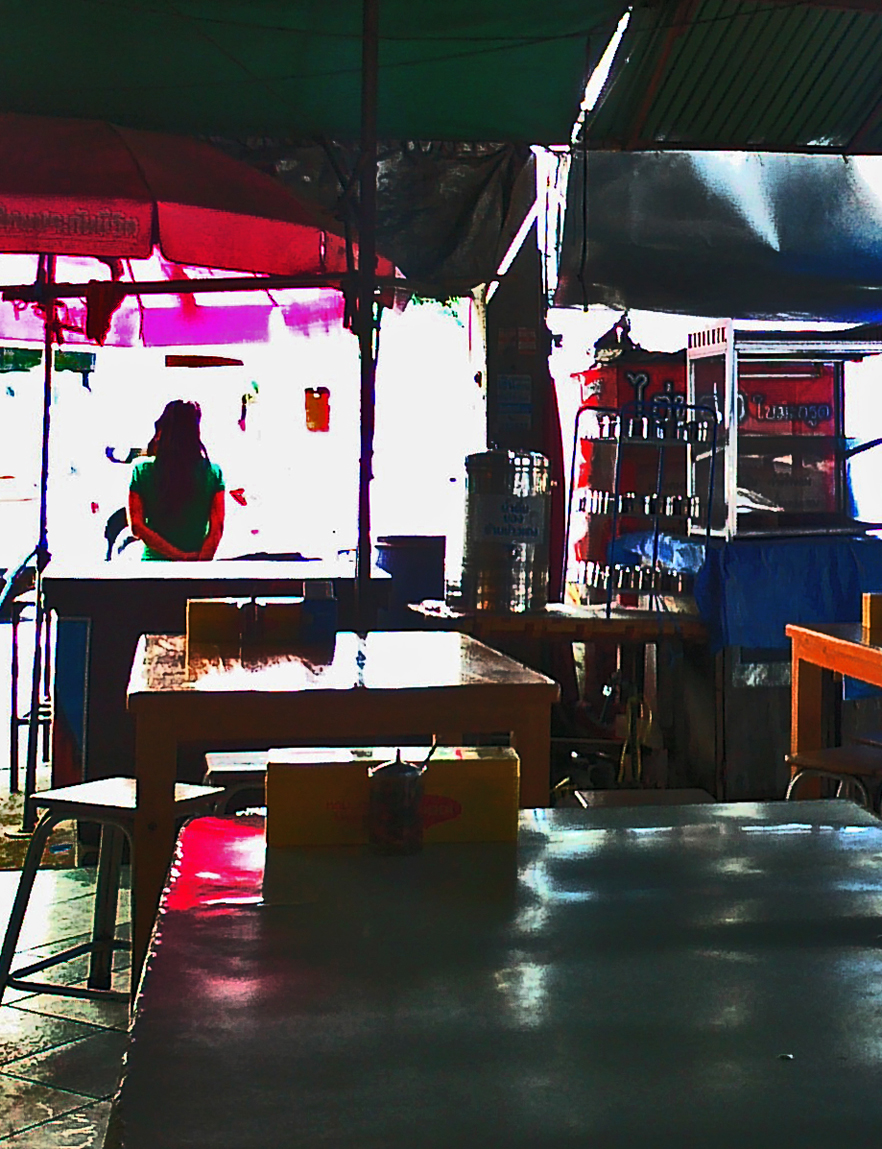
Photo: Monks go to collect food in the morning, from the WPN collection

how it seems (1)

2013-01-09 11.48.37I SEE THE WORLD through a built-in selection process that reflects and supports the default state of mind; it’s like fish cannot see the water they swim in; so obvious, yet… but I can get it to fit, more or less, according to my likes and dislikes and fall deeper into the dream. I make it into something good or bad or whatever and the fact that I can’t see it – well, it just does that. I call it reality. How I perceive the world is dependent on causes and conditions that were here before I was born; you could say it comes with the software. I think I’m an independent being not affected by anything or not affecting or influencing anything else. I can’t see this is a work of fiction and it’s all being monitored by the ongoing needs and requirements of an entity I created; a ‘self’ that has no real substance. I’m dismayed, of course, by how it all gets swept away in randomness; subject to the kamma, unknowingly created at some earlier time.

 ‘… It’s because of not understanding and not penetrating this Dhamma that this generation is like a tangled skein, a knotted ball of string, like matted rushes and reeds, and does not go beyond the cycle of the planes of deprivation, woe, and bad destinations.’ [Tanha Sutta: Craving” (AN 4.199)]

The outer world just rolls along, as it does, in all its diversity, and totally neutral. Whether there’s belief it’s this or that, makes no difference; it’s just how it seems. The devastating emptiness of it all means the population is driven to get and do and attain and protect and defend. It’s a battlefield. To avoid and deny, to have fear and anxiety and be controlled by authority and feel threatened with the flimsy nature of existence, although the absolute fragility anicca, is the beauty of it. But the population can’t see it like that. They are clutching at straws but don’t see it like that; don’t see they are maintained in an unknowingness of the world like penned animals are by the farmer, well intentioned though he may be, in order to cultivate a special kind of hunger, upadana tanha (clinging and craving) – and the economy depends on this. The greater the craving, the faster the turnover of stock and the Western style of God together with governments and the corporations are simply involved in farming the population.

I can understand why the Buddha was thinking the Dhamma was too subtle and there was no point in teaching it because no one would understand. I can see how, in those historical times of feudal hierarchy, it would have seemed impossible to create social change…. and is it any different now? It seems just as impossible for people to understand today. I wonder if I really fully understand it myself. I’m no different from other people, this is our shared suffering. But the Buddha changed his mind about it being too subtle. He said there is a way out and we can find it in the framework of the Four Noble Truths. The teaching has survived 2600 years. Understanding replaces misunderstanding; ignorance is pushed out. There’s a simple curiosity and this quiet state of at-ease knowingness….

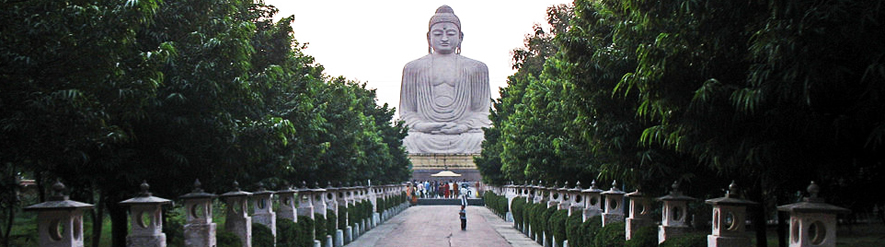
Big_Buddha_statue,_Bodhgaya

————————-

castles made of sand

2013-01-13 09.40.12

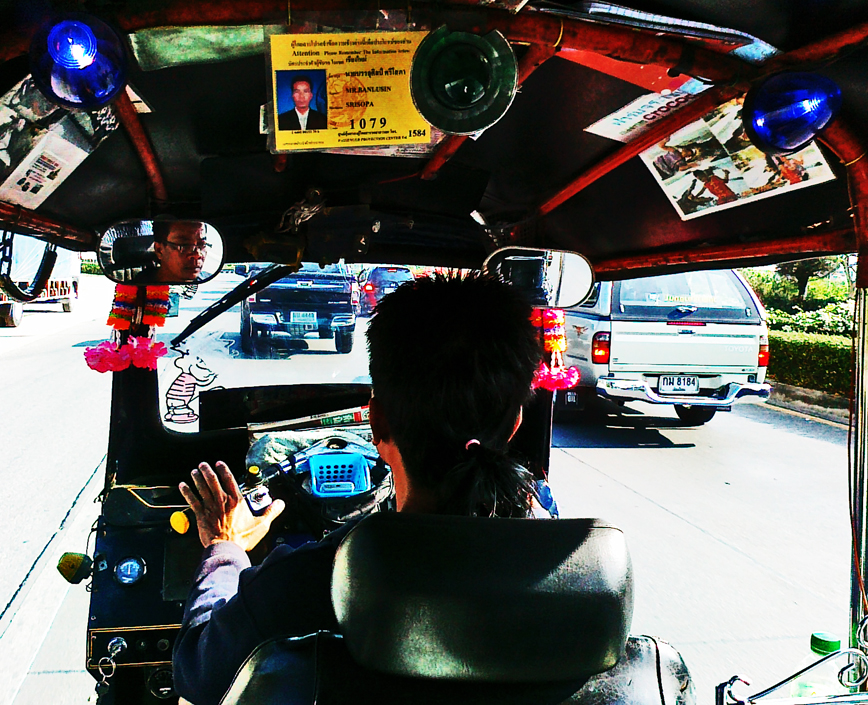
Chiang Mai: Traffic congestion at the intersection and everything comes to a standstill. The tuktuk driver makes some remark, I ask him what he’s saying and out comes a whole string of words I think I can’t understand. Then I start to recognise a few familiar vocabulary items and can reply with the same kind of observation. He laughs and says this thing I’ve never heard before: jai yen-yen (heart stay cool) jai ron mai dai (heart hot – not okay). So what now? He looks around to see if we can do a U-turn; not possible, we have to wait and see, and he switches off the engine. Sit back, relax, silence, it’s strange to be suddenly quiet after the large sound of the 2-stroke engine stops with the flick of a switch. Seems like another world; sitting on a sofa in someone’s living room, decorative chromium bars – an old-fashioned ice-cream parlor on wheels? The driver has photos of his family stuck above the windscreen, and decorative flower garlands swaying in this slight wind. No walls, a canvas roof and the outside world enters my space, like it’s always been here; the inside merged with the outside. Birds could fly through… it’s odd, just metallic creaks and the sound of other engines turning over. The smell of fuel, tarmac; this is somewhere in some part of town. Ah well,  I’m glad it’s not too hot, we might be here for a while.

I could send someone a text message …reach for my phone – then resist the urge. Okay, so, what’s the plan? All things are now directed here: the Plan; an habitual thing from long ago, frequent updates, always in line with current changes. It’s a comfortable space I create in the mind and that’s okay but sometimes I feel compelled to have a plan about the Plan. Then a plan about the plan about the Plan. The Plan is an end in itself, detached from its location in some future time, it’s now placed in present time – more like a plan for the present moment. We’re always only part the way through anything, anywhere, anyway and never at the end – we just don’t know what happens after that. Nobody ever came back from What Happens After That to say what it was like… we just don’t know.

Nothing is permanent, anicca, but the intervals between change may be immense; it doesn’t change for a very, very long time – then it does. I have a vision of it coming to an end one day… there goes the world, collapsing like a dead star, all matter reduced to an atom… all gone in a flash. Or maybe it’ll be slower; bits start to fall off and you hardly notice. And there’ll come a time when the System and all who sail in her will begin to fall in on itself like great empires do that have spanned the centuries; in the end, become too unreal and like castles made of sand and all things subject to collapse, tumble to the sea – nothing is permanently permanent – eventually. But it depends how you choose to see it, of course. In a different kind of temporality, it would just arise again and pick up where it left off; a continuous unfolding transformation and that’s how it is, even as we speak.

Something happening up front, cars beginning to move, the driver switches on the engine and it starts up immediately, a few turns of the throttle and we’re suddenly not there anymore, away in an exhilaration of speed and noise….

————————-

‘For many lives I have wandered, looking for, but not finding the house-builder who caused my suffering. But now you are seen and you shall build no more. Your rafters are dislodged and the ridge-pole is broken. All craving is ended; my heart is as one with the unmade’ [Dhammapada v.153-154]