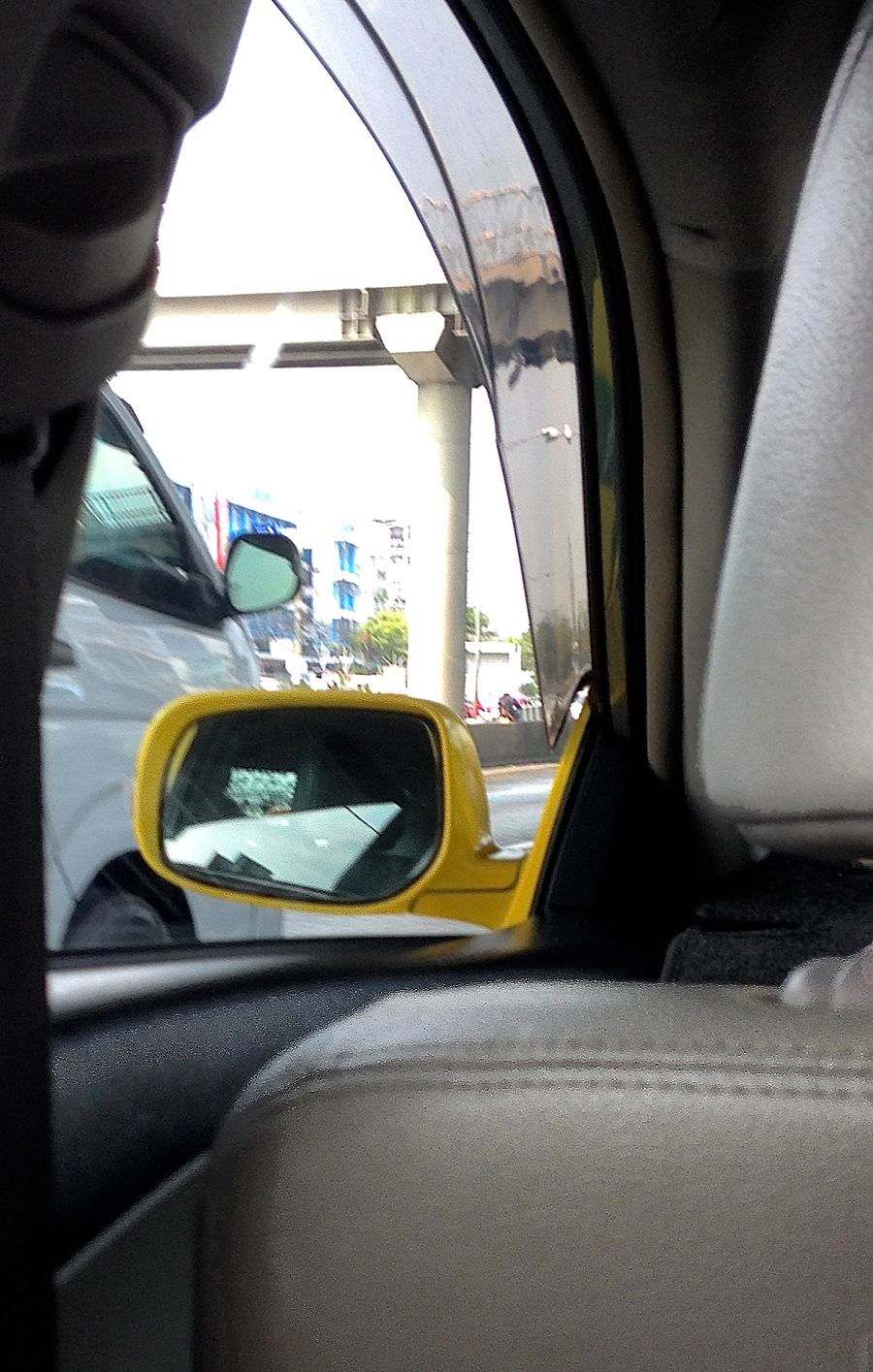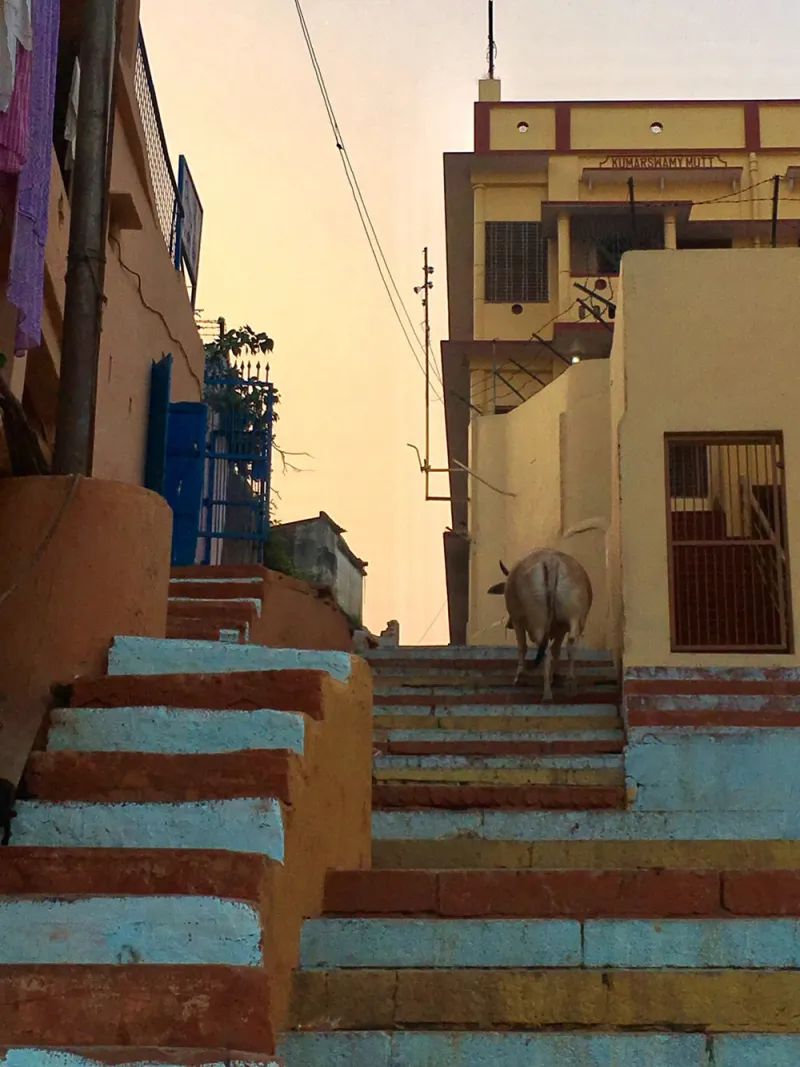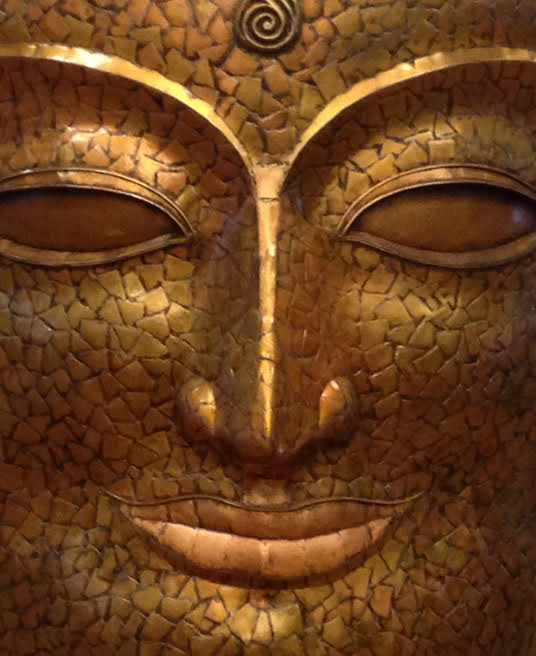
the forever window

Chiang Mai: Early evening, M asks what kind of walls I’d like to have in the house she’s building for me. It’s the Minecraft game, everything created from virtual terrain, mountains, sea, sky and a square sun. She looks up from the iPad window and turns to me with enquiring lift of the eyebrow (a nine-year-old veteran). I say well, how about stone – walls are made of stone, aren’t they? It’s an unimaginative answer lacking in conviction – not paying attention properly. I ask what the choices are. She taps the screen to show me: gold, lapis, and you could have diamonds. Generosity. But I’ll just have the stone, please – keep it simple (thinking to myself is she going to come out soon from this digital dream she’s fallen into? Come out, it’s late and you have to do your homework. Be mindful and attend to things in the real world?) But there’s no ‘real’ world here. M says, what kind of roof you want in your house, Toong-Ting? (It’s her name for me) and I’m drawn into the discussion again. You like floor tiles Toong-Ting? I say what I’d like, and that looks nice (trying to reach her by telepathy, please, please emerge from the iPad window soon and think about the homework always in arrears!) For a moment it seems like she’s going to close the iPad but no, it goes on: why do you want that one? This other one looks nicer, does it look nice to you Toong-Ting?

I find answers that fit each question, but there’s no end to it; I know now the point of the exercise is to indulge expansively in this great wealth of choices. We have to try them all. No such thing as a final choice. The iPad is a forever window, a deep lake of astoundingly rich colours that’s difficult to surface from after you’ve fallen in – everything else in ‘real’ life is sadly dull. M dives into the forever window simply because it’s there. The containment of it is the context. The question answers itself, no need even to ask, cause becomes effect, timelessness without end.

Then for a moment she emerges from the dream, a flicker of alertness in her eye. Quickly, grab the opportunity! Act out a continuation of playfulness and joy, extend the interest to our surroundings and she decides to follow. Good, yes! It’s like guiding someone dismayed by sensory overload. Now let’s close the forever window for a while, shall we? Life is the same as it was but it’s quite nice out here. Fetch the school bag, heavy with stuff, reach inside and pull out a scrumfled homework book from the tangle of scraps of food wrappers in there, bits of tissue, and an overall blueness from a pen that flooded its ink inside the bag, a long time ago. My fingers are always slightly blue after visiting M’s bag; I go wash my hands while she considers her homework.

They have to make a simplified pop-up book page; the double page you open and a whole scene pops up. Wow, we never had fun homework like this when I was a kid! The teacher has given her a model of the folded-out paper mechanism she has to copy. A small spark of interest. Can do by myself now, Toong-Ting, she says, goes over to the sofa and pulls a large cushion over her head: but I have to think it first… stays under the cushion for quite a long time and I’m beginning to think I should ask if she’s okay under there. But next time I look M has cut and formed the folded-out bit with a scissors, glued on the picture that’s supposed to ‘pop up’ and it works – yaay! Well, not brilliant, but homework is not supposed to be a fun thing, it just gets ‘finished’. It’s done, put it away, now where were we? A voice says: may I borrow your iPhone, Toong-Ting? First posted March 25, 2014

‘We have a duty to befriend those aspects of obedience that stand outside of our house and shout to our reason, “O please, O please, come out and play.” For we have not come here to take prisoners or to confine our wondrous spirits. But to explore ever and ever more deeply our divine courage, freedom, and light.’ [Hafiz: We Have Not Come to Take Prisoners]

————————-

alert 2

First posted September 8, 2012: GVA Switzerland: First dawn light and a black crow, last phantom of the night, flies in from the lakeside with louder and louder calls until it passes below our 7th floor balcony and the sound gets fainter as it disappears behind the building, then into the distance … CRAWCRAW. I’m sitting here, alert, and listening to that sound until nothing can be heard at all. No object to activate ear consciousness. It’s the Sunday morning GVA sleep-late feeling; only the zzz zzz zzz ZZZs coming from all the apartment buildings around. Look out the window, nobody about, streets are empty. I listen for the slightest sound but there isn’t anything… only the act of listening. It’s a novelty for me because I’m used to the hub-bub of Asian cities. Awareness poised, waiting for some object to come into range of the receptors. Without an object, awareness goes on forever. I can hear some sounds that are very far away, therefore I have an idea of ‘faraway-ness’. Beyond the range of receptors there is the great empty dome of sky, the void, suññatā1, spreading out around all things and present in all things

Attention drifts away and a series of incidental thought episodes appear; an anthology of short stories, then it’s all gone again in a moment. The empty space returns, the interval; why this pause? What is this still point where there’s no thought?

‘… (the) still point is not in the mind, it’s not in the body; this is where it’s incapable of being expressed in words, ineffable. The still point isn’t a point within the brain. Yet you’re realising that universal silence, stillness, oneness where all the rest is a reflection and seen in perspective…. personality, kamma, the differences, the varieties … are no longer deluding us because we’re no longer grasping at them.’ [‘The Way It Is’, Ajahn Sumedho, page 123]

The period of pause lasts as long as it takes for the next thought to arise and the tendency to create an identity for it, but before that happens there is this state of nothing. A non-event is taking place; everything gradually stops shifting around, settles down; time begins to stretch out and it all moves incredibly slowly. I forget and attention wanders again.

A pigeon flutters in, comes to rest on the balcony rail, folds away its wings, and there’s this small sigh. Quite a deep bird-sized sigh, filling its lungs with air, releasing it and a little ‘bob’ of the fat round body: ah, that’s nice….it looks at me with extended neck curiously then gets involved in preening feathers in strangely revealing postures.

I hear Jiab in the back room, doing things. She arrived from Phnom Penh yesterday. Not jet-lagged, she says, but we do have to do the laundry at this unusually early time in the morning. The laundry room is in the mezzanine of the building, so off we go, very quietly, one step at a time, downstairs, 6:00AM, past all the sleeping doorways of other people’s apartments, carrying the laundry in bags and trying to be really silent because the whole thing is a bit like being in a graveyard.

Then Jiab wants to sneeze… Oh no! It’s held for a moment then escapes. A surprisingly loud short sound like the bark of a small dog. The noise of it echoes around the tiled corridor and staircase, the window glass panels vibrate for a moment; metal rails hum in resonance and there’s the echo of it all through the stairwell. Dynamic. The silence is shocked by it! We spend some time after that trying to control the intense laughter as we go quietly down with our heavy bags.

1suññatā: (Śūnyatā) the absence of inherent existence in all phenomena.

‘Alert to the needs of the journey, those on the path of awareness, like swans, glide on, leaving behind their former resting places.’ [Dhammapada verse 91]

the seen

February 21, 2015 New Delhi: Birds fly low between the buildings, suddenly see me sitting at a desk in the sunshine on the roof terrace and swoop straight up into the sky… not expecting me to be there – usually there’s nobody around on these rooftops, the human domain should be down below. I’m in their flight path and feeling a bit uneasy about that, move my chair out of the way… avoiding collision with bird flying at 30 mph.

But they seem to have communicated with each other about it somehow – is it possible? No birds pass through after that. I’m looking out from the roof terrace level with the treetops, birds flit, zoom, dart, leave no tracks in the sky. Perch on a branch for a moment, flick their head in my direction – aware of my presence, and away without warning in unexpected directions; ‘up’ is not necessarily up and neither is down – ground level is not the reference point.

And these ominous birds of prey circling high above… I’m thinking I want to take a photo if one comes near. Take out phone camera and stand in the middle of the roof, point it at the birds. They’re too far away… no, wait, there’s one coming towards me. Take a few photos as it comes closer. It seems curious, coming over for a look – nearer and nearer; our eyes meet in a strange encounter, it knows it’s being looked at and I’m on the edge of being hypnotised by it watching me here in the centre of this pool of intense vision, like a spotlight moving over the landscape.

Are these smaller birds aware of the predator – is this why they move so quickly? All this and more; an extraordinary alertness, joyful, immediate. They’re in a different kind of temporality. Their world is forever the same moment here-and-now taking place in all other locations and everywhere at the same time. I’m in slow motion, don’t see it, burdened with human mechanisms of sensory perception and lost in thought. I have to consciously look for the way to get back to ‘here’… telescopic sights of mindfulness on crosshairs of past/future that focus on the ‘now’, the point of reference – discovering I don’t have to try to create it because the present moment is already here, always present… it’s the mind that goes away.

Traces of these last thoughts vanish. If I don’t reach out for the next thing to think about, there’s just the stillness of the event itself; a transparent curtain through which there’s a transparent stage in a transparent theatre and all the actors with the illuminated background shining through from behind.
“…sound does not exist, separate from our hearing; sights do not exist, separate from our seeing; tastes do not exist, separate from our tasting; smells do not exist separate from our smelling [….] our projection of an “external world” — of objects “out there” which we then interact with via the sense-organs of a seemingly individual bodymind — is a claim that can never be experientially verified.” [Elizabeth Reninger, “If A Tree Falls In A Forest …” – Bishop Berkeley Meets Laozi]

goodbye the wind

September 2, 2017: Delhi: This is the last whole month in the house, everything now coming to an end at the end of September. Goodbye this room, floor, ceiling, these walls, aperture of window looking out on to small garden, and beyond to the park where these exceptionally tall trees have given us so much shade from direct sunlight. Goodbye trees, goodbye everything deeply green, tree roots and wide leaves in this warm humidity, growing even as we speak.

And always a rustling of the wind, I follow the movement of large branches lowering, rising, and see how the whole mass of foliage shifts in accord with the continuity of movement… the air displacement itself a manifestation of the wind. Where’d it go… have you seen the wind? A wind narrative that never comes to an end, a wind becoming animate intelligence, an unseen form, disconnected from everything. A wind that’s present in all places at the same time, a wind that enters into and out of all things as if it were something autonomous, an invisible entity rising and falling away, form and formlessness in a causality of change and movement.

There’ve been times when it was at its peak and I’d watch from the shelter of this window… sudden velocity of wind strikes the pane of glass against its frame, Bang! I fall back in a moment of shock and fear, as if it were a living thing! The whole garden in a massive transition of wind becoming foliage; metaphor becomes reality, magician, voodooist, witch, wizard of a wind in a nightmare of dancing trees, wild and waving, with a sudden pliability hard to believe.

Everything out there and in here gives form to the insane energy of a wind that enters everywhere and into every single thing. Blows out gusts, sucks in voids, spins it in a vortex and swooping down as if inquisitive about something, filling up all the spaces below there, then suddenly out and up, high in the sky where only birds engage with it.

The sudden sound of it when a huge broken-off bough appears, as if it were something alive, tumbles through the foliage in a rush of leaves whispering in thousands of voices that seems to crash like waves upon a beach, and rises up again in a great sigh of leaf-whispering. Waves upon waves of masses of clustered notes break upon the shore, becoming less and less in an ordered succession of movements.

Goodbye the wind that quietly gusts its way through the mind, my awareness of it rises as it rises, I’m more alert when it’s loud, and when it’s quiet again I feel more at ease. But only for a moment, another small wave of it becomes a parallel thought flow to a story in the mind; it never rests… swooping shadows plunging deep into patterns of foliage over and over.

“Through our eyes, the universe is perceiving itself. Through our ears, the universe is listening to its harmonies. We are the witnesses through which the universe becomes conscious of its glory, of its magnificence.”
[Alan W. Watts]

karma of circumstances

Delhi: Arriving at the breakfast table like a ship docking in the harbor. Sliding in to coffee and bagels. Spread peanut butter on toasted bagel, then slices of banana. A piece of it held between finger and thumb comes into vision for a moment and it disappears somewhere below my nose, as head tilts forward in a teeth/tongue snatch, chewing, chewing and swallow. The world enters my body – gratitude (“give us this day our daily bread…”). Transfiguration of flesh, blood and bones, hair and fingernails grow.

Hands and face wash – hot soapy water dribbling down bare arms, drops off at the elbows in two puddles on the floor… sudden déjà vu, memory of an unreasonable fear. Must have been a childhood scolding. Bend down and dry it all up, headache like a cue ball colliding with the inner walls of the skull. Always like this, in every new instance, reassembling the parts of who I am, and nothing seems to fit; searching for a ‘self’ to be satisfied with – or dissatisfied with, or upset, or angry, confused, depressed, gloomy or sad.

I’m drawn back across the years to how it must have been at birth. Sudden embodiment in a separate physicality, immense sound, trauma of coldness that has no name, the shock of air entering unopened lungs. All the early events from there on that are internalized; unexpected fear, huge sensations – everything happening without language to give it form so it cannot be understood. All the hurt and pain deeply embedded in who I am today.

My life is conditioned by these energy imprints, which are as present now as they were “then” – the past doesn’t exist, ‘clock time’ doesn’t cover it. There is only the karma of circumstances contained in present moment awareness.

I’m so glad to know this, if I didn’t have the PHN headache condition, I wouldn’t feel as motivated to look everywhere for a cure, and thus begin to uncover the mystery. A handful of meds swallowed with a swig of bottled water and in a short while, everything begins to fall into an easing… long sigh of outbreath. I cannot find language that fits the moment.

The melancholia of winter. It takes a while to notice the sun shining through the kitchen extractor fan. Around this time, the shadow cast by the next-door building moves away. I can go up now to the roof terrace and sit in the sunshine… footsteps on concrete steps, flip-flop, flip-flop, flip… disappear up the staircase. [First published January 24, 2017]

“Advaita (nonduality) does not mean “one” in the sense of eliminating all differences. The differences are present in the one in a mysterious way. They are not separated anymore, and yet they are there.” Bede Griffiths (1997)]

passing through

First published March 9, 2014: Chiang Mai: Situated at the top of a column of words (at the time of writing), light and easy, a feeling of no-thingness, the world is here but no serious attachment to anything. Emptiness of space in the place where “I” have not yet arrived and the sensory mechanisms that give the world meaning for me are still offline. Look at the altitude app, it says 1043 ft. above sea level, add 180 feet for the height of a 7 floor building and my location is identified. I am standing with my bag here on the top floor of said building, waiting for the elevator down… everything goes down from here. Doors open, step in with my bag on its little wheels, doors close, and down we go. It’s a small elevator space with large mirror. Is this good or bad; the witchcraft of mirrors. Study my reflection, hmmm… look into my eyes and see my eyes looking back out at me – slightly scary, stop doing that. Elevator stops at the 3rd floor, doors open, nobody there… a volume of 3rd floor air enters, doors close. We go down again, floor numbers on the indicator decrease as we descend further. Look at my reflection like a friend standing next to me. Examine the teeth in a large wide grin; watch myself holding this grimace, weird guy. Try to be normal; this is how I’m seen in public. Elevator reaches the ground level.

The people in the lobby are engaged in a conversational event that started before I got here and there’s a pause in the dialogue as I step into their space. Eyes look… do we know you? Smile, show teeth, no cause for alarm folks, just passing through. Walk out the main door and lift my bag down the steps. Street restaurants, the smell of exotic cooking, noise and clatter, a child cries, bicycles creak, rubber wheels on hot tarmac, a motorbike fills the place with sound. I have the feeling that I’m now situated at the top of a column of bones, ligaments, tissue, fluidity, and looking out of two holes in the skull that bond together into a single screen monitor – just the edges seen and the side of the nose. If I focus on something in the environment, through sight, sound, smell, taste, touch, there’s a curious ‘entering’ takes place… the outside world invades totally, no boundaries, and my whole head disappears* (funny how it does that) and there’s only the world, with me in it, headless. Everything switches back to normal view, when I want it to, and back to watching my feet appear and disappear on the ground below, one at a time: left, right, left, right. My bag following behind, rumbling along on its little wheels, slippers flip-flop on soles of feet…

Looking for a passing tuk-tuk or some means of public transportation that’ll take me to the airport. Reality check: am I at peace with myself? Is there an easefulness or am I busy thinking about things? How am I feeling? Allow the software to do its job; the facility of reflecting on how all this is going so far. Outer noise and heat find a way through the senses and have an effect on the mind/body organism in its ambling walk down the road – that stumbling gait, typical of lanky Western folk. Pleased to know how it feels and I can be aware of the sensation without making it into something I love or hate. Letting the events of the mind go unheld; give it all away, the great generosity of relinquishment. Be kind to myself, the ongoing practice of learning how to live my life. Tuk-tuk arrives, get in, wind in my face…

.‘Human beings have a reflective quality that steps back from experience and says: “I don’t like this. It shouldn’t be this way. Stop it!” The aim of the spiritual path is to fully understand that the main problem of life is not that the government is unfair, that one isn’t getting enough money, that there is hunger, violence, pain or sickness, not even that one isn’t loved – but the feeling in the reflective mind of being bound down by these circumstances. Once we have clearly understood the mind, we can experience patience, equanimity, and release – even in predicaments that can be difficult or unpleasant.’ [Ajahn Sucitto, ‘Making Peace With Despair’, from the volume: ‘Peace and Kindness’]

————————-

*Reference to: ‘On Having No Head’ by Douglas Harding

–  G  R  A  T  I  T  U  D  E  –

a somewhere-else place

First published October 23, 2020: Bangkok: Awake in the darkness before 6 am, sit up in bed and take a meditational posture I invented myself. I can get the body up into the folded legs position, seated on two pillows on top of each other which sink into the mattress. This way I can hold my position comfortably just above the level of the bed, kinda floating there with the knees supported by rolled up edges of quilts pushed into the gaps. It takes a moment or two to get it feeling right… then there is only the breath.

Breath entering the body… feel the impact of incoming air in the nasal passage, “Breathe in slow-ly, breathe out lo-ng”. The breath hurries away, then comes back again as if it has forgotten something – searching all through the body, then it withdraws. Breath enters the body again, this time like a gust of wind, blows everything all over the place. Withdraws in a moment and it’s gone.

Vivid sweeps of colour and a curious light illuminating the space perceived behind the eyes. Mind is aware of the headache that’s always here, otherwise mesmerized by the form and function of the body, only slightly held in this limited temporality; thin skin of eyelid lizard-like slides over surface of smooth eyeball and that strangely seen light entering my darkness; just this…

Birdsong in the trees outside tell me it’s near daybreak, sensory processes perceive the world, aware that it’s an upside-down reflected hologram the brain and optic nerve make sense of – understood but impossible to see it as it is. Or is this how it is… in its as-it-is-ness? Was this world here before I was born? Something wrong with the question, duality. Everything just going on as it is now, without that person called ‘me’ in it. There’s an anonymity about this that’s quite liberating; birds in the trees and all the other random events taking place as they are now, here in this thin slice of time, revisiting the discussion; all that was said, received, held, seen, nurtured.

Then, a window opens. There’s a visitor arriving from somewhere, thousands of miles from here and in a great expanse in time. He appears in the form of a small boy, bowed head, string showing round the neck at the collar; latch-door key kid, scruffy uniform, bleeding at the knee. Teacher in a controlling voice says, ‘You have to think about what you’re doing before you do it, okay?’ Small boy nods, says ‘yes Miss, and shuffles out of the room to go and see the nurse about the knee. Teacher was talking about mindfulness decades before it came to be what it is today. For me, as an adult it remained something unlearned, but bearing a familiarity and intuitively known when it became conscious.

Daylight is here and I’m now lying on the bed, thinking about the small boy as he was in a state of anxious urgency every day and for many years to come. No one at home for support, forgetful and undecided because of the struggle to ‘get it right’ and nobody to reassure him that yes, you can leave book-work and use intelligent guesswork. The built-in reasoning of mind in these circumstances is enough.  

I’m telling myself this of course too late for it to be to be acted upon. I had to take the long way round; wasted years disappeared, searching for motivation in situations that offer comfort, shelter, gratification, everything thrown to the wind. Stumbling and crashing through the successes and failures of many lives, and coming to India more than thirty years ago – there to be suddenly awakened to the whole story”. It took me a very long time to grow up, and even now at the age of 73 years, I feel like an adolescent. Maybe I stayed young and it’s the world that got old…? I continue to return to these windows that open in memory. There must be a larger awareness that includes this, here-and-now… an awareness of one thought that includes awareness of another. There’s something that allows me to consider this, I’m seeing it from a somewhere-else place.

Photo by Sue Douglas

jesus & advaita vedanta

First published July 1, 2012. [Note: The original post attracted a lot of attention, 74 likes and many comments, some of which continued 5 years later. I learned so much from them … it’s worth taking a look, I’ve included some of these at the end of the post.]

I didn’t know about Advaita Vedānta when I was a child and only recently discovered there were people like Alan Watts (and others) writing about non-duality in the Christian context, [link to part of the Alan Watts’ essay: This Is It]. Now I’m convinced it is important to focus on the fact that there is something at the heart of Christianity. The uncomfortable feeling that’s followed me all these years – that somehow, I missed the point of the Jesus Teaching – all this has gone when I think of the Advaitist aspect of the teaching. It’s the missing piece of the puzzle I just stumbled upon, coming from an Asian perspective, an inductive knowing and that’s how it works.

The reason I didn’t see it before is because the Western concept of God, having human attributes (similar to the Advaitist idea of Ishvara), contradicts the rational scientific view. Accepting something that’s scientifically impossible, just because it’s written down in the Bible, doesn’t make sense. It’s like a myth and that’s why Christianity never had any reality in the West. What’s needed is to take it all a bit further.

‘… when human beings think of Brahman, the Supreme Cosmic Spirit is projected upon the limited, finite human mind and appears as Ishvara. Therefore, the mind projects human attributes, such as personality, motherhood, and fatherhood on the Supreme Being. God (as in Brahman) is not thought to have such attributes in the true sense.’

In Western countries, people are wandering around without a map. There’s the shopping mall and that’s all. How to let go of the individual ‘self’ if everything in the system is aimed at getting you to hold on? Looking for the way out by browsing possibilities will take a lifetime. The distractions built-in to window shopping behaviour are designed to keep you ‘shopping’ and prevent you from finding the way out too easily. By the time you get there you’ll have forgotten what it was you were looking for.

‘The Advaita Teachings are pointers, offered at the level of the audience, so to some people Jesus would talk about “a mansion with many rooms” and to other people he would say: “(heaven) is within.” (And) without understanding Advaita and the way pointers are adjusted depending on the audience, (most) Christians haven’t a clue what Jesus was talking about.’

Those who didn’t fall into the shopping mall trap just took the belief ‘thing’ to pieces to see what it was made of. That’s how it was seen that there was/is no substantial “self” in the centre of consciousness. It’s an operating system that keeps all working parts in the state of ‘oneness’. We are, right at this moment, God itself, and we can rejoice in that – if we can break out of our individual identity….’ If someone had been able to explain it to me like this when I was a child, the challenge to find out what it could mean would have been enough motivation for a lifetime.

‘When you fully understand that which you are and cannot not be, there is nothing to do to be

…………..
Check out the comments section in the original pos
t in the link below

something else

First published October 4, 2012: UK: I’m in a rush-hour train coming into London, standing in an integrated mass of human bodies all supporting each other. I’ve got a belt to hold on to above my head which is fortunate because the train is shaking about on uneven tracks, noisy and exhilarating. This really is the whole experience of train travel…. Then it settles down to a smoother pace and I’m focused on the closeness with other people; smell of wet raincoats and a forest of arms reaching up to hold on to roof belts, blocking the view. Somewhere nearby, a voice suddenly shouts out: ‘I’M ON THE TRAIN’ – a man speaking on his phone…

‘I think, therefore I am’ [cogito ergo sum] More than two thousand years before that, the Buddha noted the inherent problems in this kind of thinking: “I am the thinker’ lies at the root of all the categories and labels of conceptual proliferation, the type of thinking that can turn and attack the person employing it… “Do I exist?” – It depends on what you mean by “exist.” “Do I have a self?” – It depends on what you mean by “self.” Thinking driven by definitions like these often falls prey to the hidden motives or agendas behind the definitions, which means that it’s unreliable.’[Thanissaro Bhikkhu]

The man on the phone continues with his loud conversation, surrounded by people with grim faces who don’t speak. He disregards us completely, asserting himself in this space that everybody is squeezed together in, caught in the dis-ease of ‘deadly tedium’. We are struggling over this intrusion of the man and his phone but holding our composure with patient endurance. Folded newspaper in front of the face to avoid eye contact (this was before mobile phones), we are managing to ignore each other completely. Turn the page of the newspaper, fold it back skilfully without untoward touching and have a casual glance all around, as I’m doing it, just in case there’s anything that needs to be noticed, looked at or ‘seen’. No, everything is as it should be; newspaper held like demure fan that masks the face, and doing the crossword: 7 across: Four letters, ‘It may follow something _ _S_. Meanwhile the man talking on his phone is saying the line is breaking up because we are going through a tunnel.

I am committed to a world of consumption of goods and services. I want to have more of what I like and less of what I don’t like. I’m not interested in things that are neutral, they are meaningless (it’s a pity really, because the neutrality of feeling is the Way To Go). I am therefore in a chronic state of dissatisfaction because I never get what I really want. Okay, but as long as we’re mindful, it can be manageable? Well, it’s allright for some, you might say, for those of us who have recently returned from somewhere colourful and bright, light and cheerful, sun shines all the time; smiling Thai faces and their polite behaviour. But isn’t it just that they have a more cheerful kind of dukkha over there?

There’s a passenger announcement: ‘…delays at Croydon and Blackfriars due to congestion’. Then entering Liverpool Street: ‘… this train will not stop at Liverpool Street because of “flooding” at the Eastbound station (flooding?) and will continue on to Aldgate where passengers can take the train back and enter from the Westbound station which is unaffected and we apologize for any inconvenience.’ I have to ask other passengers what the announcement was about and surprised to discover everyone is friendly; the shared burden of these times of hardship and emergency – something conditioned by World War II?

I get there finally, near the end of a long list of Anglo-Saxon place names, and walking along with the South coast tourists in the pleasant harbour area of a town near the sea at Eastbourne. I’m looking for the office of an agent I have to visit and the phone in my pocket is ringing, who can this be… Hello? Jiab, she’s in Peru; hard to believe. She wants to know, can I get some of these wipes that are good for doing polished wood, and get a few packs, please? I have to take them with me when I come to Thailand. I hold up the phone high in the air so she can hear the Eastbourne seagulls all the way over there in Peru; a great swirl and echo of Northern seabirds singing in the wind, like cats mewing in the air.

 ‘It’s because of not understanding and not penetrating this Dhamma that this generation is like a tangled skein, a knotted ball of string, like matted rushes and reeds, and does not go beyond transmigration, beyond the planes of deprivation, woe, and bad destination.’ [DN 15 PTS: D ii 55 Maha-nidana Sutta: The Great Causes Discourse]

Note: This blog is now posting twice a week

the thinking thing

First published December 5, 2012: New Delhi: It’s the middle of the night, it’s cold, I’m in bed and covered with a mountain of bed covers. Can’t sleep, just lying here thinking about things in the darkness. All the stories of my life come and go, click the channel-changer and there’s another one. I remember this, yes… so, he said that… and I said this… and then what happened? Click the channel-changer again and I’m somewhere else. It’s the thinking thing, continually pondering over suppositions, this and that and when I ask myself how to stop thinking the mind starts to look for a solution, drawing conclusions from known facts ad infinitum and I’m thinking again. It’s my Western cultural inheritance – separate from God, we are created by Him – studying the ‘object’ and logical, applied, deductive reasoning. Here in the Eastern context, it’s more like a gradually accumulating lake of inductive reasoning; the ‘whole’ is a pre-existing pattern composed of its parts. I can ‘feel’ my way into it and see where that takes me.

So, I stop thinking. There’s an awareness of the cold air on my face, sensory response vedanā; the mind engaged with the other senses tuned to reception from the outer world like satellite dishes search for a signal. When there’s no thinking, there’s an empty space where the thoughts used to be. I’m aware of the desire to be actively thinking, I see the invitation to be engaged with thinking – same as other forms of ‘wanting’ and mindfulness kicks in. But it occurs to me this is the Buddha’s teaching about the origination of the world: ‘Dependent on the eye & forms there arises eye-consciousness. The meeting of the three is contact….’(phassa) and I’m back into thinking again.

There’s something obvious about this, the mind is one of the six senses and functions like a receptor in the same way as the others do, except that it also has the purpose of ‘guarding’ the entry point; sense object activates the chain of events and mind has an intuitive, cognitive function; it is capable of discerning the object, like a security system. The exact nature of the cognitive mind holds my attention. I experience the absolutely empty space of no-thinking and either there’s not any sensory input the mind needs to be engaged with, or the apparent emptiness is caused by the mind’s awareness of being aware. There’s more of this empty space. Thoughts come in and go out again and the mind is watching the whole process. Sometimes I’m here as an observer, watching from behind the curtain. Other times the observer disappears, and it seems like only the mind itself is left there. That disappears too and, in its place, a sequence of momentary mental events, each one linking with the next as if it were electronic activity. It’s like a small fireworks display, arising and falling away. Some time later sleep comes and the world disappears.
[Note: This blog will be posting twice a week for as long as the review of older posts continues]