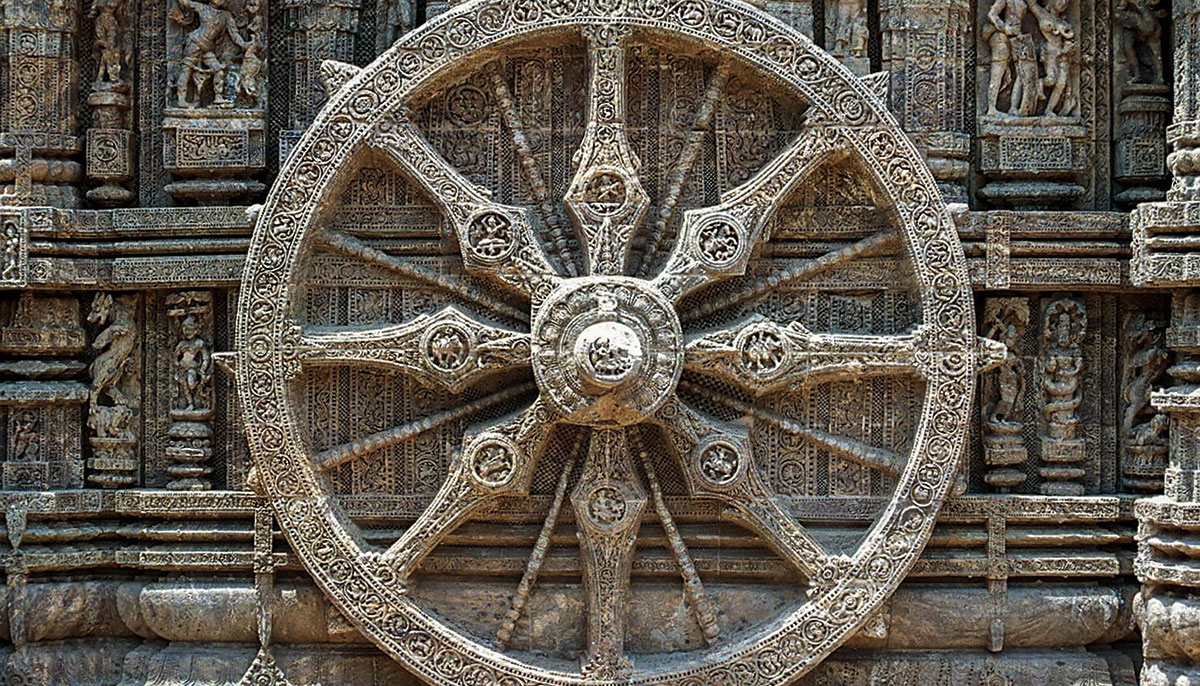
all the myriad things

“The doing is done but there is no doer. The principle of doerless doing must be taken up and utilized in our daily lives. Whether we’re eating, sitting, laying down, walking, using, seeking, whatever we’re doing we must have enough truth-discerning awareness to prevent the arising of ‘I’ – the feeling that ‘I’ am the doer. ‘I’ am the eater, the walker, the sitter, the sleeper, or the user. We must make the mind constantly empty of ego, so that emptiness is the natural state and we abide with the awareness that there is nothing worth having or being.” [Buddhadasa Bhikkhu, “Heartwood from the Bo Tree”]

Emptiness means that there is no feeling of ‘self’ or ‘belonging to self’, there is no feeling of ‘I’ and ‘mine’, which are the creations of craving and grasping. Being void of these things is ‘being empty’. What is it that is empty? It is the mind that is empty, emptied of the feelings of ‘self’, and of ‘belonging to self’, both in their crude and subtle forms. If the mind is empty to the degree of being free of even the most refined sense of self it is said that the mind is itself emptiness. This agrees with the teaching that mind is emptiness, emptiness is mind; emptiness is Buddha, Buddha is emptiness, emptiness is Dhamma, Dhamma is emptiness. There is only one thing… all the myriad things that we are acquainted with are nothing but emptiness.

The characteristic of all things is emptiness. This phrase ‘all things’ must be understood correctly as encompassing every single thing from a speck of dust up to Nibbana. It must be well understood that in a speck of dust there is emptiness or absence of self, absence of a permanent, independent entity. The mind and heart, thoughts and feelings, each thing is characterized by emptiness, absence of a permanent, independent entity.

The Buddhist Teachings, the study and practice of Dhamma have the characteristic of an absence of a permanent, independent entity. All the way through to the final Path Realizations, their Fruits and Nibbana itself, have this same characteristic, it’s just that we don’t see it. Even a sparrow flying to-and-fro has the characteristic of emptiness but we don’t see it. All things display the characteristic of emptiness, it’s just that we don’t see it.

The word ’empty’ also refers to the characteristic of the mind that is free from all grasping and clinging. Although the mind is empty of self, it doesn’t realize that it is empty, because ordinarily, it is constantly enveloped and disturbed by the conceptual thought that feeds on sense contact.

As a result, the mind is neither aware of its own emptiness nor the emptiness in all things. But whenever the mind completely throws off that which is enveloping it, the grasping and clinging of delusion and ignorance, and detaches from it completely, then the mind, through its non-clinging has the characteristic of emptiness.

Because all things do truly have the characteristic of being empty of a self, no permanent, independent entity to be grasped at or clung to, we are able to see the truth of emptiness. Thus, the mind seeing emptiness in all things collapses into itself, leaving only emptiness. It becomes emptiness and sees everything as emptiness. Material objects, people, animals, time and space, every sort of dhamma melts into emptiness through knowing this truth. The word empty is the remainderless extinction of ‘I’ and ‘mine’, the utter destruction of self.

So, how should we practice during those times when the mind is free of association with sense objects? Maybe we are doing some kind of work alone and unconcerned, performing our daily tasks or of practicing formal meditation. There is nothing arising from sense-contact. We may be reading a book or even thinking about something, as long as the mind is undisturbed by sense-contact. At such times our practice must be the study and clarification of the way in which things are empty and the way in which to make the mind empty and free of delusion. Think about it, study it for yourself, enquire from others, and discuss it regularly. Keep doing it.

Excerpts from three talks given by Ajahn Buddhadasa to a Dhamma study group in Siriraj Hospital, Bangkok in 1961 and 1962.

Dhammafootsteps, Postcards# 375,374, 373, 372

Image by Bella White, source: https://www.pexels.com/photo/body-of-water-and-seashore-during-sunset-635426/

awareness: nameless and stopped

Excerpts from Reflections: Ajahn Sucitto
One of the monks asked a renowned Forest Ajahn: ‘What’s it like to see things as they really are?’ There was an understandable air of expectation in the room: to ‘see things as they really are’ (yathābhutam ñānadassanam) is the vision of the Awakened Mind. What mystical insight was about to be revealed?

‘It’s ordinary,’ said the Ajahn in his customary succinct and matter-of-fact way.

Bodhidharma (6th Century CE), the legendary conveyor of the Ch’an Dhamma to China. Ch’an (from Sanskrit Jhāna), a Chinese school of Mahāyāna Buddhism. Bodhidharma had an exchange with the Chinese Emperor that was similar in tone to the Forest Ajahn. The Emperor, who had devotedly built temples and shrines throughout China, implored the Master, ‘What is the essence of the Holy Truth?’

‘Emptiness, no holiness,’ replied the sage.

Awakening is more of a deflation of the mind than a peak experience. That way, it’s difficult to grasp. Actually, ‘emptiness’ – until you understand it as the non-clingable, signless quality of what arises – does give one something a little mystical to cling to… perhaps the Emperor wasn’t ready for the really direct teaching. The point is that the closer you get to the Dhamma, the more you know that appearances aren’t where it’s at. What you are able to see is the Unconstructed, and the end to the conceiving, favouring and proliferations of the mind.

A related example is Bhikkhuni Patacāra’s experience of Awakening. Returning to her dwelling after a period of walking meditation, her realization occurred as she turned down the flame of her lamp: Like the going out of a flame was the release of awareness. (Thig. 5,10)

No blazing light, just the opposite… so, is ‘Awakening’ some kind of coma? Well, this apparent paradox occurs because awareness as consciousness is not fully understood. This kind of consciousness is the six-fold awareness that processes data through eye, ear, nose, tongue, body, and thinking mind. In this context, mind-consciousness is the awareness that is affected by the perceptions and feelings that arise from external sense contact, and also from of the internal (mind-base). The mind is always being affected, it’s either fluttering, on the run, or sliding from this to that. Now, maybe if all that flittering and chattering were to stop… that would be a stilling of an activity rather than an annihilation of anything solid. Which is exactly the point. It also explains why the language of Awakening is distinctly unexciting and doesn’t get one’s pulses racing.

It’s all in the mind. The mind base is the home of the impulses and psychological activities, which stimulate consciousness for good or for bad. On investigation these activities of liking, disliking, of hesitancy or eagerness are seen as arising dependent on our attitudes and subjectively-based perceptions we acquire over the course of time. Whether a taste is ‘delicious’ or music ‘pleasant, etc., all gets learned from paying attention and assessing results through language communication. This is how consciousness is formed, activated and programmed; a perception of ‘what’s out there,’ from moment to moment, defines a ‘me’, as lively, articulate, passionate, even-minded or dull. So, the solidity of our world and our self is based upon activities and formations. And what if they stopped? In that freeing up, in things really being seen as they are, the world and the self neither exist nor don’t exist. They both arise dependently.

One point to emphasize is that the ‘me’ sense is a solidification of the sense of presence that is the resonance of consciousness. It takes form dependent on the perceptions and feelings that consciousness forms, infers and otherwise derives from sense-contact. When an architect looks at a building, he/she becomes an architect (that particular sense of self doesn’t arise as they eat a meal or watch TV). And in that mode, he/she sees something different from that which is seen by a thief. The individual bias, the acquired activity forms an impression both of the subject and the object.

When pain or displeasure touch the heart, ‘I’ get formed as the victim of that. With pleasure, I become the owner. Then I get defensive or acquisitive and act accordingly – instant kamma. Have you seen – or felt – who you become when guilt or fear gets into you? Or when compassion or joy touches your heart? ‘Being touched’ is a formation; contact/impression is an activity that modifies and colours the sense of self. In this respect, I’m referring not so much to direct sensory contact, but the impression that the mind makes of that contact, called ‘designation contact’.

This form of contact is the significant one: owing to the subjective flavouring of designation contact, different people find different sights, sounds, flavours, ideas, remarks and gestures delightful, repugnant, or neutral. Designation contact sets up the familiar pattern of how we experience the world; and the consequent perceptions and impressions guide what we will make impingement contact with in the future. So, this is the key to how we react and create fresh action, or kamma, based on the blueprint of the past.

The sting in this apparently neutral functioning is that when it gets infected with ignorance, the mind takes as real, substantial and potentially acquirable what in fact has been formed by consciousness. So that stirs consciousness into chasing its tail, motivated by either acquisition, aversion or delusion. Of which three, delusion is the one that is most constantly streaming in.

So, how would it be if, instead of creating fantasies and phobias, those streams were to stop? Intellectually, it’s not difficult to repudiate delusion. As far as we can see, in the experienced Cosmos, there’s no such thing as a thing: from the stars and rocks on down to the oscillating cells in our bodies and our flickering thoughts, it’s all dynamic. How could there be a permanent self? But in all this movement, there’s one process that forms the apparent self. It’s the lock of grasping. And that occurs in the mind-base when it’s infected by ignorance. So, trust what arises within when the self-impression passes. Investigate the dukkha of ‘how it should be.’ Because with unerring simplicity, release always comes down to cultivating the Four Noble Truths. Selfless clarity spontaneously arises with their comprehension; what arises by itself after the release is the true guide.

And it’s nobody’s. The awareness that is liberated through such realization is just ‘aññā’ ‘the Knowing.’ It’s a knowing that has no subject, a development based on, but beyond, the mindful knowing and witnessing of what arises. At each stage of Awakening, as places where self-view congregates get freed, there is the Knowing, dispassionate and free from positions. And the Buddha constantly refused to make a self out of that.

Ajahn Sucitto

To read the whole piece, follow this link:
https://ajahnsucitto.org/reflections/awareness-nameless-and-stopped/

Image source: https://unsplash.com/photos/WGVOaJIyMd0

soaring summits of silence

Excerpts from the Introduction to: “Mindfulness, Bliss, and Beyond,” by Ajahn Brahm

During meditation we should not develop a mind that accumulates and holds on to things. Instead, we should develop a mind that is willing to let go, to give up all the burdens we carry like so many heavy suitcases. In meditation unload as much baggage as you can. Think of duties and achievements as heavy weights pressing upon you. Abandon them freely without looking back. This attitude of mind that inclines to giving up will lead you into deep meditation.

Meditators are like birds that soar through the sky and rise to the peaks. It is on such summits of perception that meditators will understand, from their own direct experience, what we call “mind” and the nature of what we call “self,’ “God,” “the world,” “the universe,” the whole lot. It’s there that they become enlightened – not in the realms of thought, but on the soaring summits of silence within their mind.

“Mindfulness, Bliss, and Beyond” is a guided tour through the world of timeless Buddhist rapture. It describes how meditation literally implodes into the supreme bliss of the jhānas and how such states of letting go lift the veil of our fives senses, to reveal the awesome world of the mind, the magic inner garden where enlightenment is reached.

In the Mahāsaccaka sutta (MN 36) the Buddha relates, “I considered:… ‘Could that [jhāna] be the path to enlightenment?’ Then following on that memory, came the realization, ‘That is the path to enlightenment.’”

Image: detail of a photo by Simon Berger (Unsplash)

there’s no need to be busy

Excerpts from “The Path to Peace: A Buddhist Guide to Cultivating Loving-Kindness” by Ayya Khema

There’s no need to be busy. We should of course fulfill our obligations and responsibilities. The Buddha always gave guidelines in that direction. But to be overly busy cannot possibly bring peacefulness. It cannot bring contentment. It cannot bring a heart full of love; it cannot bring a heart that can actually bring the mind to meditation. So, we should check our activities and see which ones are totally unnecessary. And we should see whether, with the activities that we do, we are not only trying to escape our own suffering (dukkha) but also trying to prove something to ourselves and others—that we are somebody. The more we try to prove that we are somebody, the less we have a chance to become nobody. And that’s what nirvana is all about. It doesn’t sound appealing to some people, because they haven’t had enough dukkha yet. When we’ve had enough dukkha with the somebody, we can actually appreciate the fact that there’s only one way to get out of dukkha, and that’s being nobody.

We have the wealth of absolute truth, of immeasurable love and compassion—the whole wealth of the universe within us. It’s just waiting to be discovered. But within the hustle and bustle of morning-to-evening activity, we’ll never manage to find it. It’s like a golden treasure that is lying within us, that we can actually touch upon through the quiet mind. Anyone can do it, but they’ve got to become quiet. And we’ve got to stop trying to be something special. Only then can we get at it, and then, having found it, we can share it. That’s what the Buddha did. He shared it for forty-five years. With a few thousand people. And today we’re sharing it with five hundred million. That’s the value of enlightenment.

So, we have that treasure. But if we really get busy, we have no way of unlocking that treasure chest. Unlocking it takes time, and it takes the quiet mind, the contented mind, the satisfied mind. It needs the mind which knows that there is something to be found far beyond anything at all that we can ever find in the world. And then we will make an attempt at checking out what is really necessary to do.

Whatever we do out of compassion is well done. And this should be our checkpoint: what am I doing out of compassion, and what am I doing in order to assert that I am really here and to let as many people know about it as possible, and what am I doing in order to get out of my dukkha to keep busy? But whatever I do out of compassion, that is what we should pursue.

Ayya Khema (1923–1997) was an international Buddhist teacher, and the first Western woman to become a Theravada Buddhist nun. An advocate of Buddhist women’s rights, in 1987 she helped coordinate the first conference for the Sakyadhita International Association of Buddhist Women in Bodh Gaya, India.

selflessness

Excerpts from “A Path With Heart: A Guide Through the Perils and Promises of Spiritual Life” by Jack Kornfield (1993)

When Buddhists speak of emptiness and of no self, what do they mean? Emptiness does not mean that things don’t exist, nor does “no self” mean that we don’t exist. Emptiness refers to the underlying nonseparation of life and the fertile ground of energy that gives rise to all forms of life. Our world and sense of self is a play of patterns.

Any identity we can grasp is transient, tentative. When we are silent and attentive, we can sense directly how we can never truly possess anything in the world. Clearly, we do not possess outer things. We are in some relationship with our cars, our home, our family, our jobs, but whatever that relationship is, it is “ours” only for a short time. In the end, things, people, or tasks die or change or we lose them. Nothing is exempt.

We encounter another aspect of the emptiness of self when we notice how everything arises out of nothing, comes out of the void, returns to the void, goes back to nothing. All our words of the past day have disappeared. Similarly, where has the past week or the past month or our childhood gone? They arose, did a little dance, and now they’ve vanished, along with the twentieth century, the nineteenth and eighteenth centuries, the ancient Romans and Greeks, the Pharaohs, and so forth. All experience arises in the present, does its dance, and disappears. Experience comes into being only tentatively, for a little time in a certain form; then that form ends and a new form replaces it moment by moment.

As we open and empty ourselves, we come to experience an interconnectedness, the realization that all things are joined and conditioned in an interdependent arising. Each experience and event contains all others. The teacher depends on the student, the airplane depends on the sky.

When a bell rings, is it the bell we hear, the air, the sound on our cars, or is it our brain that rings? It is all of these things. As the Taoists say, “The between is ringing.” The sound of the bell is here to he heard everywhere—in the eyes of every person we meet, in every tree and insect, in every breath we take…

When we truly sense this interconnectedness and the emptiness out of which all beings arise, we find liberation and a spacious joy. Discovering emptiness brings a lightness of heart, flexibility, and an ease that rests in all things. The more solidly we grasp our identity, the more solid our problems become. Once I asked a delightful old Sri Lankan meditation master to teach me the essence of Buddhism. He just laughed and said three times, “No self, no problem.”

Jack Kornfield was trained as a Buddhist monk in Thailand, Burma, and India, and holds a Ph.D. in clinical psychology. He is a psychotherapist and founding teacher of the Insight Meditation Society and the Spirit Rock Center. His books include Seeking the Heart of Wisdom and Still Forest Pool.

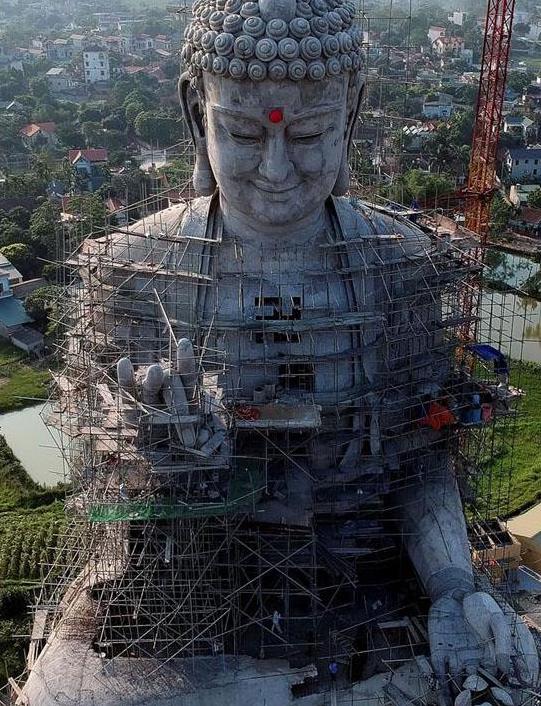
Image: Giant Buddha statue under construction at the Khai Nguyen Pagoda in Son Tay, on the outskirts of Hanoi, Vietnam, on May 18, 2019

perception & reaction

Essentially what counts about our life is our kamma (karma), that is, our actions of body, speech or mind. And kamma means you have a choice: you can act wisely now rather than react compulsively. Reactions are generated by contact – that is something touches the heart. When we notice or are struck by something – it could be something seen, remembered, tasted, imagined – then something vibrates and there’s perception. Perception is the solidification of the immediate impression arising in consciousness; the light goes on, there is meaning, true or false. Then comes the reaction, the volitional quality, or cetanā – and when the mind engages with that, there is kamma.

Training is about putting a micro-pause or attentiveness, between the perception and the reaction, or, between the mental reaction and any engagement with it. And it’s also good to challenge perceptions before they land, or as they arise. So, you establish the perception of impermanence: ‘This is going to change.’ And the perception of the unattractive: ‘This too loses flavour and breaks down.’ Then there are perceptions based on goodwill: ‘Just like me, they are enriched by kindness.’ And when we practice recollection, we establish perceptions based upon awakening: ‘Freedom from suffering is possible.’ In this way, you’re changing your life right now in terms of how and when the mind jumps.

Notice: What are the most habitual jumps? Habitual reactions are about how we repeatedly jump; the ingrained impressions and reactions that become ‘myself’. ‘I’m always like this, I see things this way, I tend to mistrust, or be apprehensive, or urgent, or dismissive, or…’  Then pause; wait a minute. Check. Do you have to jump, right now? Come out of the obsessive rut.

Ajahn Sucitto

Image by Penn B: Coastal view, Phuket Island

neti-neti

Neti-neti is a Sanskrit expression that translates to “neither this, nor that” or “not this, not this.” This expression is used in Hinduism, mainly in Jnana yoga and in Advaita Vedanta (non-dualistic spiritual practice). Neti-neti is a form of analytical meditation that helps the individual understand the nature of brahman (absolute reality) by first understanding what is not brahman.
A “neti-neti search” is one of the key elements of Jnana yoga practice. It is an exercise in negating rationalizations and other distractions from the non-conceptual meditative awareness of reality.
Yogapedia: In Jnana yoga and Advaita Vedanta, “neti-neti” may be a chant or mantra. It is an 8,000-year-old practice that takes the focus away from all disturbances, so the practitioner may find the stillness in every movement and the formless in every form. Neti-neti meditation helps to identify all things of the world which are not the atman (the real), thus negating the anatman (the unreal).
When it’s adapted for the modern world, including neti-neti meditation in one’s yoga practice, neti-neti helps the practitioner realize that they are not actually the things that they normally identify themselves with (personalities, thoughts, feelings or jobs), nor are they merely their roles (parents, partners, friends or siblings) in life. In this way, neti-neti can also be interpreted as “beyond this, beyond that.”
Source: https://www.yogapedia.com/definition/5325/neti-neti

The Fourth Jhāna

POSTCARD#472: As the stillness of the knower calms that which is known, the bliss that was the central feature of the first three jhānas changes again when one enters the fourth jhāna. Only this time it changes more radically. Sukha completely disappears. What remains is an absolute still knower, seeing absolute stillness.

From the perspective of the fourth jhāna, the bliss of the previous jhāna as a residual movement of the mental object, and an affliction obscuring something much greater. When the bliss subsides, all that is left is the profound peace that is the hallmark of the fourth jhāna. Nothing moves in here, nothing glows. Nothing experiences happiness or discomfort. One feels perfect balance in the very center of the mind. As in the center of a cyclone, nothing stirs in the center of the mind’s eye. There is a sense of perfection here, a perfection of stillness and of awareness. The Buddha described it as the purification of mindfulness, just looking on (upekkhā sati pārisuddhi) (DN 9,13).

The peace of the fourth jhāna is like no other peace to be found in the world. It can only be known having passed though the experience of the previous three jhānas. That passage is the only way of later confirming that the unmoving peace that one felt was indeed that of fourth jhāna. Furthermore, the state of fourth jhāna is so very still that one remains on its plateau for many hours. It seems impossible that one could experience the fourth jhāna for any less time.

Though pīti and sukha have both ceased in the fourth jhāna and all that is left is the perfection of peace, such an experience is later recognized, upon reviewing, as supremely delightful. The perfect peace of the fourth jhāna is seen as the best bliss so far. It is the bliss of no more bliss! This is not playing with words, trying to sound clever and mystical. This is how it is.

Summary of the Fourth Jhāna

Thus the fourth jhāna has the following features:

1. The disappearance of sukha;

2. An extremely long-lasting, and unchanging, perception of the perfection of peace, reached only through the lower three jhānas;

3. The same absolute rocklike stillness, and absence of a doer, as in the second and third jhāna;

4. The complete inaccessibility from the world of the five senses and one’s body.

The Buddha’s Similes for the Four Jhānas

The Buddha would often describe the experience within the four jhanas by evocative similes (e.g.; MN 39,15-18;77, 25-28). Before explaining these similes, it is helpful to pause and clarify the meaning of kāya, a key Pāli word used in all the similes. Kāya has the same range of meanings as the English word “body.” Just as “body” can mean things other than the body of a person, such as a “body of evidence,” for example, so too kāya can mean things other than a physical body, such as a body of mental factors, nāma-kāya (DN 15,20). In the jhānas the five senses do not operate, which means that there is no experience of a physical body. The body has been transcended. Therefore, when the Buddha states in these four similes, “so that there is no part of his whole kāya unpervaded (by bliss and so on),” this can be taken to mean “so that there is no part of his whole mental body of experience unpervaded” (MN 39,16). This point is frequently misunderstood.

The Buddha’s simile for the first jhāna is a ball of clay (used as soap) with just the right amount of moisture, neither too dry nor too wet. The ball of clay stands for the unified mind, wherein mindfulness has been restricted to the very small area created by the “wobble.” The moisture stands for the bliss caused by total seclusion from the world of the five senses. The moisture that completely pervades the clay ball indicates the bliss that thoroughly pervades the space and duration of the mental experience. This

is later recognized as bliss followed by bliss, and then more bliss, without interruption. That the moisture is not in excess, and so does not leak out, describes how the bliss is always contained in the space generated by the wobble, never leaking out of this area of mind-space into the world of the five senses, as long as the jhāna persists.

The second jhāna is likened to a lake with no external entry for water but with an internal spring that replenishes it with cool water. The lake represents the mind. The complete absence of any way that water from outside can enter the lake describes the inaccessibility of the mind by any influence from outside. Not even the doer can enter such a mind in this jhāna. Such hermetic inaccessibility is the cause of the rocklike stillness of the second jhāna. The internal spring that supplies the cool water represents ajjhattam sampasādanam, the internal confidence in the bliss of second jhāna. This internal confidence causes complete letting go, cooling the mind into stillness and freeing it from all movement. The coolness stands for the bliss itself, born of samādhi or stillness, which pervades the whole mental experience, unchanging throughout the duration of the jhāna.

The third jhāna is described by the metaphor of a lotus flower that thrives immersed in the cool water of a lake. The lotus represents the mind in the third jhāna. Water can cool the petals and leaves of a lotus but can never penetrate the lotus, since all water rolls off. The coolness stands for sukha, and the wetness stands for pīti. So like the lotus immersed in water, the

mind in the third jhāna is cooled by sukha but is not penetrated by pīti. The mind in the third jhāna experiences only sukha. In the third jhāna, the mind continues to experience a rocklike stillness, never moving outside, just as the lotus in the simile always remains immersed within the water. Just as the cool water causes the lotus to thrive, so the bliss of the third jhāna sustains the mind therein. Once again, just as the cool waters in the simile pervade the lotus with coolness from its roots to its tips, so the unique bliss of the third jhāna pervades the whole mental experience from beginning to end.

The fourth jhāna is likened to a man draped from head to toe in a clean white cloth. The man represents the mind, while the cloth represents the perfect purity of equanimity and mindfulness that is the hallmark of the fourth jhāna. The mind in the fourth jhāna is stainless, spotless as a clean cloth, perfectly still and just looking on, purely and simply. This absolute purity of peacefulness pervades the whole body of mental experience, from the start to the end, just as the white cloth completely covers the man’s body from head to toe.

Such is the meaning of the four similes for jhāna, as I (the author) understands them.

Review of the Five Hindrances

Image Source: Monk Pillars

POSTCARD#456: Bangkok: The suttas say that one practices satipaṭṭhāna “having temporarily abandoned the five hindrances.” That means that a prerequisite for the practice of satipaṭṭhāna is the abandoning of the five hindrances first! MN 68,6:“not attaining a jhāna, the five hindrances invade one’s mind and remain. Attaining a jhāna, the five hindrances do not invade the mind and remain.”) Anyone who has experienced a jhāna knows that after emerging, one’s mindfulness is so powerful and so easy to sustain. This is the result of the five hindrances being absent.

Editors note: Continuing from last week with our review of the Five Hindrance, please note 1. sensory desire kāmma-cchanda was included there, but for convenience’s sake we have included it here also.

1. sensory desire kāmma-cchanda

 The compound kāmma-cchanda means ‘delight, interest, involvement with the world of the five senses. At the start of your meditation, place the mind beyond the reach of the five senses by returning to present-moment awareness [chapter 1, stage one, print copy, page 7]. Most if not all of our past and future is occupied with the affairs of the five senses. Through achieving present-moment awareness, we cut off most of the kāmma-cchanda. [see also: silent present-moment awareness – stage two, print copy, page 11]

 2. ill will (vyāpāda).

The  usual understanding of this second hindrance is anger toward another person. But it is more likely to be toward yourself or even toward the meditation object.

Ill will towards yourself can manifest as not allowing yourself to bliss out. There are many people who have deep guilt complexes. This is mostly a Western trait because of the way most of us have been brought up. Guilt and punishment are inseparable in our culture and in our minds. Punishment may be denying ourselves some kind of pleasure, happiness or freedom. People in the West just keep on seeking punishment. It’s crazy!

Goodwill Toward Yourself

Give  yourself  a  break, do  some  loving-kindness  meditation [Page 34 Print copy. Key in: Loving Kindness in the WordPress search box]. Say  to yourself, “The door to my heart is open to all of me. I allow myself happiness. I allow myself peace. I have goodwill toward myself, enough goodwill to let myself become peaceful and to bliss out on this meditation.”

3. sloth and torpor (thinā-middhā)

I’m sure we know it all too well through our experience of meditation. We sit in meditation and don’t really know what  we  are  watching,  whether  it’s  the  present  moment,  silence,  the  breath,  or  whatever.  This  is because the mind is dull. It’s as if there are no lights turned on inside. It’s all gray and blurry.

Making Peace with Sloth and Torpor

The  most  profound  and  effective  way  of  overcoming  sloth  and  torpor  is  to  make  peace  with  the dullness and stop fighting it! When I was a young monk in the forest monasteries in Thailand and became sleepy during the 3:15 A.M. sitting, I would struggle like hell to overpower the dullness. I would usually fail. But when I did succeed in overcoming my sleepiness, restlessness would replace it. So I would calm down the restlessness and fall back into sloth and torpor.

The Knower and the Doer

It  took  many  years  to understand what was going on. The knower is the passive half of the mind that simply receives information. The doer is the active half that responds with evaluating, thinking, and controlling. The knower and the doer share the same source of mental energy. Thus, when you are doing a lot, when you have a busy lifestyle and are struggling to get on, the doer consumes most of your mental energy, leaving only a pittance for the knower. When the knower is starved of mental energy you experience dullness.

4. Restlessness and Remorse (udhaccha-kukkccha)

The main component of this hindrance is restlessness of mind. But first let me briefly address the matter of remorse. Remorse is the result of hurtful things that you may have done or said. In other words, it is a result of bad conduct. If any remorse comes up in meditation, instead of dwelling on it, you should forgive yourself. Everyone makes mistakes. The wise are not people who never make mistakes, but those who forgive themselves and learn from their mistakes. Some people have so much remorse that they think they can never become enlightened.

Restlessness

Whether we find joy or not depends on the way we train our perception. It’s within our power to change the way we look at things. We can look at a glass of water and perceive it as very beautiful, or we can think of it as ordinary. In meditation, we can see the breath as dull and routine, or we can see it as very beautiful and unique. If we look upon the breath as something of great value, then we won’t get restless. We won’t go around looking for something else.

That’s what restlessness is, going around looking for something else to do, something else to think about, somewhere else to go—anywhere but here and now. Restlessness is one of the major hindrances, along with sensory desire. Restlessness makes it so hard to sit still for very long.

Contentment  is  the  opposite  of  a  fault finding mind. You should  develop  the  perception  of contentment with whatever you have, wherever you are, as much as you can. Beware of finding fault in your meditation, that  thought  is  the  very  cause  of restlessness. It doesn’t matter how the meditation is going, be absolutely content with it and it will go deeper. If you’re dissatisfied with your progress, then you’re only making it worse. So learn to be content with the present moment. Forget about jhānas, just be content to be here and now, in this moment.

Watch the silence and be content to be silent. If you’re truly content, you don’t need to say anything. Don’t most inner conversations take the form of complaining, attempting to change things, or wanting to do something else? Or escaping into the world of thoughts and ideas? Thinking indicates a lack of contentment. If you’re truly contented, then you’re still and quiet. See if you can deepen your contentment, because it is the antidote for restlessness.

5. doubt (vicikiccā)

Doubt can be toward the teaching, about the teacher, or toward yourself.

Doubt can also be directed toward what you are experiencing now: “What
is this? Is this jhāna? Is this present-moment awareness?” Such doubts are hindrances. They are inappropriate during meditation.

If while meditating the thought “Is this jhāna?” arises, then it cannot be jhāna! Thoughts like that can’t come up within these deep states of stillness. Only afterward, when you review those states, can you look back and say, “Ah, that was a jhāna.” If you get into any difficulty in your meditation stop, and rather than think “Is this a jhāna”, ask yourself, “Which of the hindrances is this?”

[Below are the five hindrances in the usual order in which the Buddha lists them:

1. sensory desire (kāmma-cchanda)

2. ill will (vyāpāda)

3. sloth and torpor (thinā-middhā)

4. restlessness and remorse (udhaccha-kukkccha)

5. doubt (vicikiccā)]

Continued next week 4th February 2022

A Softening of the Mind

POSTCARD#445: Mettā meditation softens the mind and turns it toward care, goodwill, and acceptance. You become more selfless, less concerned with your own needs and more willing to peacefully interact with others. The emotion that is mettā feels delightful and pure. As you develop it repeatedly, it soon remains constant in your heart. You become a compassionate person, and your kindness is a source of joy to all beings and to yourself.

Mettā enables you to embrace another being just as they are. Most people find this impossible because of their fault-finding mind. They only see part of the whole, the part that is flawed, and refuse to accept it. Loving-kindness, on the other hand, embraces the wholeness of something and accepts it as it is. Through the practice of mettā meditation, you find yourself becoming less conscious of the faults in yourself and other beings, and more able to embrace them just the way they are. This ability to see the beauty in an object and ignore its flaws is a powerful aid to all types of meditation. To sustain your attention in the present moment, for example, you must accept the way things are now, embracing this moment and not being critical. When you persist in finding faults in the present moment, you will find you cannot remain there.

It is possible to combine mettā meditation with breath meditation. When you begin stage three, awareness of the breath, you observe your breath with loving-kindness. You think something like “breath, the door of my heart is open to you no matter how you feel, no matter what you do.” You will soon be looking at your breathing with compassion, embracing it as it is instead of finding fault. By adding mettā to the process of awareness, you have no expectations, since the breath seems more than good enough. Because of loving-kindness, you soon feel this attractive warmth toward the breath that brings joy to every in-breath and out breath. It becomes so nice to watch your breath that in a very short time you have reached stage five, the beautiful breath.

Taking Mettā into Jhāna

Jhānas are emotional summits and not intellectual heights. You cannot think your way into a jhāna, you can only feel your way in. To succeed you require familiarity with your emotional world, enough to trust in it silently without any controlling. Perhaps this is why female meditators seem to enter jhāna more easily than males. Mettā meditation trains everyone to become more at ease with the power of emotions. Sometimes you may cry during mettā meditation, even weep uncontrollably. If so, let it come. On the path to nibbāna we all have to learn to embrace the intensity of the purest emotions, and the jhānas are the purest of all. Therefore mettā meditation makes jhāna more accessible. You can even take mettā meditation directly into jhāna. When you have reached the stage described above where you are radiating this limitless golden glow of loving-kindness throughout the whole universe, drenching every sentient being with the immense power of your boundless love, then take the next step. Forget about all beings and ignore where the power is coming from. Focus your attention instead on the experience of mettā in itself. This step often happens  automatically with no decision coming from you. The meditation object is being simplified, freed from the perception of separate beings. All that remains in your mind is what I call disembodied mettā, similar to the disembodied grin of the Cheshire Cat in the simile in chapter 2. You experience this as a blissful sphere of gorgeous golden light in your mind’s eye. It is a nimitta. It’s the mettā nimitta.

A nimitta that is generated through mettā meditation is always incredibly beautiful, only sometimes it isn’t so stable. Excitement is the usual problem. However, its nature is so alluring that you cannot resist hanging out with such intense bliss. Thus, in a short time the brilliant golden mettā nimitta becomes still and you fall into jhāna. This is how mettā meditation takes you into jhāna.