springtime in new delhi

First published March 4, 2016: Watering the plants upstairs on the roof terrace and there’s this small one looking so simple and symmetrical, extraordinary. I take a photo of it and zoom into the wonderful experience of a life form in a different kind of temporality. It’s springtime here and the analogy of everything waking up applies, except that there’s no snow in winter, really no winter, and there never was any time before this, or anywhere in the future when things were or will be asleep. Everything is awake, the sense of an eye like a camera aperture so widely open the edges creak with the strain of it trying to open wider. It’s an endless cycle of birth/rebirth, the seed contained in the fruit that falls from the tree and from there another tree grows which creates another seed. No beginning/no end, all forms intertwined with each other to the extent that they are inseparable, bound together in timelessness. The inclination is to think what was it like before this, when things were separate and the mind tries to pull it all apart. What was it like before all this, before the Big Bang?

Another kind of reality. What happened before we came here? We were in another house in New Delhi. It had a roof terrace and seeds were planted in flowerpots there; we carried the pots and everything from there to here and these seeds are now sprouting on this roof terrace. It makes no difference to the plants if they’re moved, so long as they have the same conditions, the cycle continues; seed/ plant/ flower spinning in their own arising and falling away, an enfolding and unfolding sequence of patterns in movement, and I come along, view it from this entry-point in time and space – ‘here-and-now’… but it’s always here-and-now!

There’s the urge to create a highly esteemed object that could fill this perceived space, in this seemingly incomplete world: the sense of a vacant place we need to fill with something held in high holiness, and that will make it whole… what is it? Christians call it God, Hindus call it Brahman and Buddhists have no name for it, because everything is integrated, nothing exists outside of this – really nothing, not even the word ‘nothing’. Subject/object together in a oneness of contemplation, in conscious awareness and the path taken leads us into a realm so fragile and subtle you can never be absolutely sure you’re not just seeing it the way you want it to be, and not really how it actually is. Better not to call it anything, acknowledge its presence, awareness is all-inclusive, mindfulness, take care, and see how that goes.

The sensitivity of the mind, not held by the limitations of the body, always looking for more than what there is, searching beyond the present instance; using one thing as a springboard to get to the next, everything is driven on and on, and present time is not here at all. There’s the sense of a game, an energy, a curiosity – a desire to get involved with ‘it’. The object is the desired state. It belongs to ‘me,’ the act of possessing it requires that there has to be an ‘I’ to whom it belongs. Everything I have, everything I want, all of this is ‘mine.’ Even my enemy is mine. Thus, indirectly creating an identity that is always somehow incomplete unfulfilled, searching for the truth in this and unable to see that it’s the searching that maintains the state of being lost. It’s the seeking that causes it to be formed, reformed and transformed: the world is seen, sounds are heard, food is tasted, words are spoken, things are done, but there is no do-er.

“Imagine if all things that are perishable grew still – for if we listen they are saying, “We did not make ourselves; he made us who abides forever” – imagine, then, that they should say this and fall silent, listening to the very voice of him who made them and not to that of his creation; so that we should hear not his word through the tongues of men, nor the voice of angels, nor the clouds’ thunder, nor any symbol, but the very Self which in these things we love, and go beyond ourselves to attain a flash of that eternal wisdom which abides above all things: And imagine if that moment were to go on and on, leaving behind all other sights and sounds but this one vision which ravishes and absorbs and fixes the beholder in joy; so that the rest of eternal life were like that moment of illumination which leaves us breathless: Would this not be what is bidden in the scripture, Enter thou into the joy of thy Lord?” [Saint Augustine]

————————

goodbye the wind

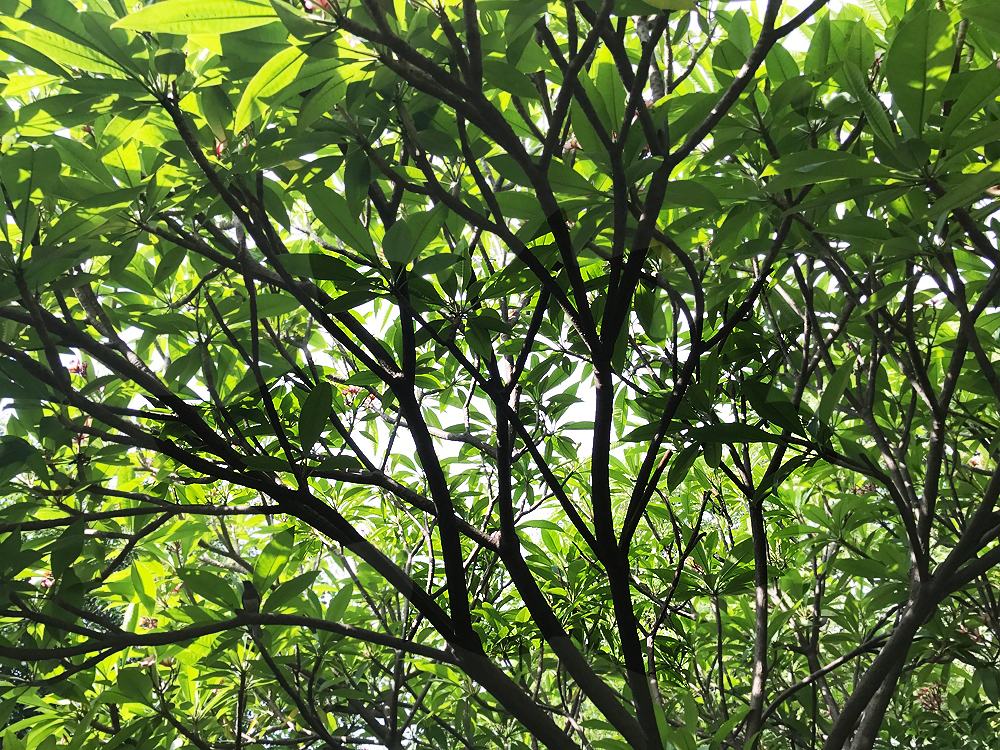
September 2, 2017: Delhi: This is the last whole month in the house, everything now coming to an end at the end of September. Goodbye this room, floor, ceiling, these walls, aperture of window looking out on to small garden, and beyond to the park where these exceptionally tall trees have given us so much shade from direct sunlight. Goodbye trees, goodbye everything deeply green, tree roots and wide leaves in this warm humidity, growing even as we speak.

And always a rustling of the wind, I follow the movement of large branches lowering, rising, and see how the whole mass of foliage shifts in accord with the continuity of movement… the air displacement itself a manifestation of the wind. Where’d it go… have you seen the wind? A wind narrative that never comes to an end, a wind becoming animate intelligence, an unseen form, disconnected from everything. A wind that’s present in all places at the same time, a wind that enters into and out of all things as if it were something autonomous, an invisible entity rising and falling away, form and formlessness in a causality of change and movement.

There’ve been times when it was at its peak and I’d watch from the shelter of this window… sudden velocity of wind strikes the pane of glass against its frame, Bang! I fall back in a moment of shock and fear, as if it were a living thing! The whole garden in a massive transition of wind becoming foliage; metaphor becomes reality, magician, voodooist, witch, wizard of a wind in a nightmare of dancing trees, wild and waving, with a sudden pliability hard to believe.

Everything out there and in here gives form to the insane energy of a wind that enters everywhere and into every single thing. Blows out gusts, sucks in voids, spins it in a vortex and swooping down as if inquisitive about something, filling up all the spaces below there, then suddenly out and up, high in the sky where only birds engage with it.

The sudden sound of it when a huge broken-off bough appears, as if it were something alive, tumbles through the foliage in a rush of leaves whispering in thousands of voices that seems to crash like waves upon a beach, and rises up again in a great sigh of leaf-whispering. Waves upon waves of masses of clustered notes break upon the shore, becoming less and less in an ordered succession of movements.

Goodbye the wind that quietly gusts its way through the mind, my awareness of it rises as it rises, I’m more alert when it’s loud, and when it’s quiet again I feel more at ease. But only for a moment, another small wave of it becomes a parallel thought flow to a story in the mind; it never rests… swooping shadows plunging deep into patterns of foliage over and over.

“Through our eyes, the universe is perceiving itself. Through our ears, the universe is listening to its harmonies. We are the witnesses through which the universe becomes conscious of its glory, of its magnificence.”
[Alan W. Watts]

the forever ‘now’

Fragments of a thought pieced together from associated thoughts, memories of a past time brought into present time, together with things thought about in future time. Words can snatch at things, pin them down and they say what they are. Any ‘new’ experience is assimilated and the actuality of it is filtered, obscured, cloaked.

Then pause for a moment, and everything stops, just the circumstance itself – there is only one moment, only one, going on all the time. I wake up to it every now and then, there and then, here and now in this place and time, but it is always now, the present now, the forever ‘now.’

“Time is in the mind; space is in the mind. The law of cause and effect Is also a way of thinking. In reality, all is here and now and all is one. Multiplicity and diversity are in the mind only.” [Nisargadatta]

I write it in my notebook, in the time taken to do that the thinking sequence seems to have jumped from the thing I’m thinking about, to the next, and then there’s a space … the smallest instant before it becomes something else. In the interval the mind is engaged in ‘thinking it’, everything moves on and I can never seem to catch up. Language is an overlay placed on reality, gives everything an identity, duality, ‘me’ and ‘you.’ Language tells the story, creates a fiction I get lost in. Nothing is what I think it is.

The present moment feels like it’s an immediate event occurring ‘now’, but there’s also a feeling that it comes from some timeless place. What we have is applied time, an agreed-upon measurement that we all apply.  Who‘s to say? Maybe this is something that has not happened yet… it happens later, gets reflected upon and what I think is ‘now’ is actually a moment of hindsight that had its origin in future time.

How can I be sure things are what I think they are when I’ve only just started feeling my way through something not experienced yet? Consciousness, the vast present time – the continuing ‘now’ phenomenon enfolding and unfolding, transforming from the future into past in one continuous surging-through movement that cannot be explained. What a strange mystery it is; future time slides into present time, tomorrow becomes today, ‘now’ falls back into yesterday, something ‘remembered.’

Mind creates a structure to explain time; otherwise, how could we understand the enigma of how the past is ‘gone’ and the future is not here yet? Hovering on the brink of the smallest pause before it gets there, the empty space of not-knowing what it is, and held like this for an instant…

“There exists only the present instant… a Now which always and without end is itself new. There is no yesterday nor any tomorrow, but only Now, as it was a thousand years ago and as it will be a thousand years hence.”
 [Meister Eckhart 1260 – 1328]

[First published, June 17, 2022]

consciousness

Reblogged from March 7, 2024. Selected excerpts from “Intuitive Awareness,” by Ajahn Sumedho, the Chapter titled Consciousness. This is a free Dhamma publication available as PDF EPUB MOBI. Link below:
https://www.abhayagiri.org/media/books/Intuitive_Awareness_web-edition_1.2_2017.pdf

In terms of this moment, right now, this is consciousness. We are reading words on a page – pure consciousness before you start thinking. Just make a note of this: consciousness is like this. I am reading, I am with this present moment, being present, being here now. I’m taking the word consciousness and making a mental note: ‘consciousness is like this.’ It’s where thought, feeling and emotion arise. When we are unconscious, we don’t feel, we don’t think. Consciousness, then, is like the field that allows thought, memory, emotion and feeling to appear and disappear.

Consciousness is not personal. For something to become personal you have to make a claim to it: ‘I am a conscious person.’ But there’s just awareness, this entrance into noting the present, and at this moment consciousness is like this. Then one can notice the sound of silence, the sense of sustaining, being able to rest in a natural state of consciousness that is non-personal and non-attached. Noting this is like informing or educating oneself to the way it is. When we are born, consciousness within this separate form starts operating. A new-born baby is conscious, yet it doesn’t have a concept of itself being male or female or anything like that. Those are conditions we acquire after birth.

This is a conscious realm. We might think of a universal consciousness, and consciousness as it is used in the five khandhas: rūpa (form), vedanā (feeling), saññā (perception), saṅkhārā (mental formations), and viññāṇa sense-consciousness). But there is also this consciousness which is unattached, unlimited, Deathless. In two places in the Tipiṭaka, there is reference to viññāṇaṁ anidassanaṁ anantaṁ sabbato pabhaṁ – a mouthful of words that point to this state of natural consciousness, this reality. For myself, I find it very useful to clearly note: ‘Consciousness is like this.’ If I start thinking about it, then I want to define it: ‘Is there an immortal consciousness?’ Or we want to make it into a metaphysical doctrine or just deny it, saying, ‘Consciousness is anicca, dukkha, anattā.’ We want to pin it down or define it either as impermanent, unsatisfactory and not-self, or raise it up as something we hold to as a metaphysical position. But we are not interested in proclaiming metaphysical doctrines, or in limiting ourselves to an interpretation that we may have acquired through this tradition. Instead, we are trying to explore consciousness in terms of experience. This is Ajahn Chah’s pen paccattaṁ – that is, ‘something that you realize for yourself.’ What I am saying now is an exploration. I’m not trying to convince you or convert you to ‘my viewpoint.’

Consciousness is like this. Right now, there is definitely consciousness. There is alertness and awareness. Then conditions arise and cease. If you sustain and rest in consciousness, unattached, not trying to do anything, find anything or become anything, but just relax and trust, then things arise. Suddenly you may be aware of a physical feeling, a memory or an emotion. That memory or sensation becomes conscious, then it ceases. Consciousness is like a vehicle; it’s the way things are.

Is consciousness something to do with the brain? We tend to think of it as some kind of mental state that depends on the brain. The attitude of Western scientists is that consciousness is in the brain. But the more you explore it with sati-sampajañña, you see that the brain, the nervous system, the whole psychophysical formation arises in this consciousness; it is imbued with this consciousness. That is why we can be aware of the body and reflect on the four postures – sitting, standing, walking and lying down. Being aware of the body’s posture as it is being experienced now, you are not limited to something that is in the brain, but the body is in consciousness. You are aware of the whole body in the position it’s in at this moment.

This consciousness is not personal. It’s not consciousness in my head and then consciousness in your head. Each of us has our own conscious experience going on. But is this consciousness the thing that unites us? Is it our ‘oneness’? I’m just questioning; there are different ways of looking at it. When we let go of the differences – ‘I am Ajahn Sumedho and you are this person’ – when we let go of these identities and attachments, then consciousness is still functioning. It’s pure. It has no quality of being personal, and no condition of being male or female. You can’t put a quality into it. It’s like this.

When we begin to recognize that which binds us together, that our common ground is consciousness, then we see this is universal. When we spread mettā to a billion Chinese over in China, maybe it’s not just sentimentality and nice thoughts, maybe there is power there. I don’t know myself; I am questioning. I am not going to limit myself to a particular viewpoint that has been conditioned by my cultural background, because most of that is pretty flawed anyway. I do not find my cultural conditioning very dependable. Sometimes Theravada Buddhism can come across as annihilationism. You get into this ‘no soul, no God, no self’ fixation, this attachment to a view. Or are the Buddha’s teachings there to be investigated and explored? We are not trying to confirm somebody’s view about the Pali Canon, but rather we use the Pali Canon to explore our own experience. It’s a different way of looking at it. If we investigate this a lot, we begin to see the difference between pure consciousness and when self arises. It’s not hazy or fuzzy, ‘Is there Self now?’ It’s a clear knowing.
So, then the self arises. I start thinking about myself, my feelings, my memories, my past, my fears and desires, and the whole world arises around ‘Ajahn Sumedho.’ It takes off into orbit – my views, my feelings and my opinions. I can get caught into that world, that view of ‘me’ that arises in consciousness. But if I know that, then my refuge is no longer in being a person, I’m not taking refuge in being a personality or my views and opinions. Then I can let go; the world of Ajahn Sumedho ends. When the world ends, what remains is the anidassana viññāṇa – this primal, non-discriminative consciousness. It’s still operating. It doesn’t mean Ajahn Sumedho dies and the world ends, or that I’m unconscious.
Talking about the end of the world, I remember somebody getting very frightened by this, saying, ‘Buddhists are just practising meditation to see the end of the world. They really want to destroy the world. They hate the world and they want to see it end’ – this kind of panic reaction. To us the world is seen in physical terms – this planet, the world of continents and oceans, North Pole and South Pole. But in Buddha-Dhamma, the ‘world’ is the world we create in consciousness. That’s why we can be living in different worlds. The world of Ajahn Sumedho is not going to be the same as the world you create, but that world arises and ceases. That which is aware of the world arising and ceasing transcends the world. It’s lokuttara, transcendent, rather than lokiya, worldly.
When we are born into physical birth, we have consciousness within a separate form. This point of consciousness starts operating, and then we acquire the sense of ourselves through our mothers and fathers and cultural background. We acquire different values or sense of ourself as a person that’s based on avijjā, not on Dhamma – based on views, opinions and preferences that cultures have. That’s why there can be endless problems around different cultural attitudes. As with living in a multicultural community like this monastery is, it’s easy to misunderstand each other because we’re conditioned in different ways of looking at ourselves and the world around us. But remember that cultural conditioning comes out of avijjā, ignorance of Dhamma. So, what we are doing now is informing consciousness with paññā – which is a universal wisdom rather than a cultural philosophy.

Continued same time next week
Editor’s note: I’m away from my desk until 14 August, visiting family in Scotland. I’ve set it up so the posts will continue on the usual dates, hopefully.

uncontracted awareness

Selected excerpts from, “Kamma and the end of Kamma: by Ajahn Sucitto”
Editor’s note: You have reached the end of the text. Please let me know how you feel about reading these words over the weeks and months that have passed. Thank you. All that remains now is Ajahn’s final meditation guidance.

Meditation

Come into embodied awareness, centring on the upright axis of the body as it breathes in and breathes out. By connecting your attention to the rhythm, speed and time span of the breath, come into embodied time.

As awareness gets centred in your bodily presence, widen its span. Extend awareness through the body to its edges. These will be defined by the contact with the ground beneath you, the clothes that wrap you, the space above your head, or the air that meets your skin. Establish that wide focus, referring to these contact points, until the wide focus becomes sustainable. You may also find it helpful to connect to your breathing and imagine that flow extending slowly in all directions as you breathe out, and being drawn in from the space around you as you breathe in. As your embodied awareness gradually unfolds, linger in it and savour it. At some point it will settle into the uncontracted state – the norm of meditation.

Contemplate and be aware of – but not involved with – the changing energies within that field of embodied awareness. From time to time, you might benefit from lingering in the centre of that field, taking in the quality of ease or stability. When awareness does feels settled and full, linger in it and bring it to the felt edge of your body. It will extend beyond those edges, permeating that wide area.

Disturbances will arise. These may be a reaction to a sound, or connected to an unpleasant physical feeling Feel your awareness ripple or contract at the edge of that disturbance. Maybe things start to speed up, or there are pushes to overcome or get away from the source of the disturbance. Acknowledge what is going on, and relax the responses that are attempting to deal with the disturbance. Instead, just be with, but not in, the disturbance – as if you are sitting, standing or walking beside it. Relax the edge of resistance to the disturbance, so that your awareness spreads over it – and while encompassing the disturbance, touches into a space beyond it. Contemplate the effect of that. How, for example, does this affect the sense of your body?

From time to time, mental disturbances will occur. These may be linked to something sensory, such as a sound in the next room. Or they may be purely mental – thoughts about things you have to do, or a happy memory, or a doubt, or a plan, or an intriguing puzzle that seems to ask you to get involved with it. While resisting the urge to go into any of these impressions, acknowledge the rippling or agitating effect, and how its speed and energy contrasts with the more agreeable calm state. But don’t react or be in a hurry to change anything. Instead, soften your attitude to the agitation and its energy. Put aside comparing it with what you’d prefer to be experiencing. Find the edge of the agitation, meet it and widen your awareness over it and beyond. It’s like drawing a blanket over your body and smoothing it out over a very large bed that you’re lying on. Where is the edge of that bed? Can you smooth and spread your awareness until there are no hard edges or boundaries?

If such a practice seems manageable and helpful, you can subsequently bring to mind the notion of your self. That is, the conglomerate of your concerns, plans, duties, ideas and memories. Don’t focus or go into any one of these, but as if you’re listening to a gathering of people conversing, and occasionally laughing or arguing, widen your awareness to include it all. It might be helpful to summarise this totality or field as: ‘a business meeting’; or ‘a critical audience commenting on the show’; or ‘a noisy classroom’; or ‘a city street in the middle of the day’; or ‘a farmyard’; or ‘an open beach with the occasional gull’ – and so on. Extend your awareness over that total field of self and, without losing touch with it, find the quiet place beyond its edges. Contemplate the effect of that. What attitudes, for example, arise in the uncontracted state?

As you find a way of being with, but not in, yourself, ask if there’s anything you wish you would be. Be accurate, and acknowledge it – whether it’s ‘more vigorous’, ‘unburdened’, ‘admired’, ‘effective’ or ‘compassionate’, for example. (Of course, there may be a mixture, but select one that sums them all up, or seems to have the priority.) What ripple or effect does that send across the field of self? There may be a bodily change – such as a flush in the chest or face. The mental aspect may sharpen or unify. How would you name that firmed-up effect? ‘Vibrant?’ ‘Wider?’ ‘Richer?’ ‘Lighter?’ Give attention to that effect – not the details of the wish – and widen as before, until your awareness rests in an extended and inclusive state. Stay with that, letting the details of the wish fade, but attuning to the tone and the breadth of awareness.

As another exercise, imagine what you feel you can’t be. You might, for example, compare your current condition with a better one. Or you might compare yourself with another who you see as ‘better’ or more advantaged than yourself. Once you get the sense of how that affects your field of self in terms of mental or bodily effects, extend your awareness over it and beyond. Regard the field of self with that uncontracted awareness: is there an attitude that arises, by itself? And how does that affect the self?

Eventually the impression of the other and the ripple of your response to them may merge. Extend awareness over that, letting all of this soften –and even fade.

When you feel it’s time to leave the meditation, wait; sense the energy of that intention. Widen your awareness over that arising intention. Contemplate and open to the sense of ‘end of that’ or ‘and now, I’m going to …’ Let those impressions be felt within awareness, so that they don’t dominate it. Then incline to the centre of the embodied state, and the flow of breathing. When you can keep your intention within that uncontracted norm, gradually open to the space around you, the sounds and eventually the visual field.

As a reminder, the exercises around the sense of self may well be the most stirring – so fully establish the practice with reference to the body over a few meditation periods before going further (if you choose to do so). Also bear in mind that the accuracy of how you report on your wishes, your feeling of incapacity, or your responses to another, is not meant to be clinical or an ultimate statement of who you are. That ‘felt sense’ is just an impression in the present; your practice is not about analysing it – or adjusting it. Relate to it (even picture it) as if it were a creature emerging out of the field of awareness – to be given open regard. It will appreciate that – and may respond, or change. Be the awareness of all of that.

As you learn from any of these exercises, you can practise with the self/other comparisons that arise in the day-to-day presence of other people’s appearance or behaviour.

………………………………………………..

Glossary

In the list below, the English words used to render Buddhist terminology are followed by their Pali equivalents and alternative English renditions.

absorption: jhāna

action: kamma – cause; karma

appreciative joy: muditā – sympathetic joy; appreciation

attention: manasikāra

becoming: bhava – being; existence

bodily formation: kāya-saṇkhāra –

body-fabrication; embodied program

body: kāya

bringing to mind: vitakka – directed thought; initial thought; thinking

calming: samatha – tranquillity

cause and effect: kamma-vipāka

compassion: karuṇā

concentration/unification: samādhi

concern: ottappa – fear of blame

conscience: hiri – shame

consciousness: viññāṇa

contact/impression: phassa

deep attention: yoniso manasikāra – wise attention; careful

attention; appropriate attention; systematic attention

discernment/wisdom: paññā – wisdom

designation-contact: adhivacana-phassa

disengagement: viveka – seclusion; withdrawal;

   non-attachment; detachment

dispassion: virāga – fading; detachment

distortions: vipallāsā

disturbance-contact: paṭigha-phassa – resistance impression

divine abidings: brahmavihāra

ease: sukha – happiness; pleasure

effect: vipāka – result; old kamma

empathy: anukampa – compassion; sympathy

ethics/virtue morality: sīla

equanimity: upekkhā

evaluation: vicāra – sustained thought; pondering; considering

exploration of qualities: dhammavicāya –

investigation of phenomena

factors of awakening: bojjhanga – factors of Enlightenment

felt meanings: saññā – perception

full knowing: sampajañña – clear comprehension

gladness: pamojjha

heart/mind/awareness: citta – mind; heart

ignorance: avijjā – unknowing

insight: vipassanā

intention/volition/impulse: cetanā

latent tendencies: anusaya – obsessions

life-force: āyusaṇkhāra

loving-kindness: mettā – kindness; good will; friendliness

mental/emotional formation: citta-saṇkhāra –

mental fabrication; affect-response program

mindfulness: sati

mindfulness of breathing: ānāpānasati

mind/mind-organ: manas – mind; intellect

motivation: chanda – desire; interest

name/interpretation: nāma – mentality; name

outflows: āsavā – influx; taints; effluents; cankers

pattern/s (i.e. acquired or resultant): saṇkhāra/ā – formation/s;

   mental formation/s; volitional formation/s; fabrication/s

passion: rāga – lust

perfections: pāramī/pāramitā

program/s (i.e. active): saṇkhāra/ā – formations;

mental formations; volitional formations; fabrications

proliferate/proliferation: papañca – diffusiveness;

complication; worldliness; objectification

qualities: dhammā – phenomena

rapture: pīti – joy; zest

relinquishment: vossagga – letting go; self-surrender; release

right attitude: sammā-sankappā – right aim; right thought;

   right resolve

right view: sammā-diṭṭhi

speech: vāca

spiritual friendship: kalyāṇamitta

stopping/ceasing: nirodha – ceasing; cessation

suffering/stress: dukkha – dis-ease; unsatisfactoriness

thirst (psychological)/craving: taṇhā – craving

Unprogrammed: asankhata – Unconditioned

verbal program: vaci-saṇkhāra – verbal formation

   innate value/goodness: puñña – merit

wandering on: saṃsāra – endless wandering

This book is offered as a gift of Dhamma. It has been made available through the faith, effort and generosity of people who wish to share the understanding it contains with whomever is interested. This act of freely offering is itself part of what makes this a ‘Dhamma publication,’ a book based on spiritual values. Please do not sell this book in any form, nor otherwise use it for commercial purposes.

You are free to:

    copy and redistribute the material in any medium or format

The licensor cannot revoke these freedoms as long as you

follow the license terms.

   Under the following terms:

Attribution: You must give appropriate credit, provide a link

to the license, and indicate if changes were made. You may do

so in any reasonable manner, but not in any way that suggests

the licensor endorses you or your use.

    Non-Commercial: You may not use this work for commercial purposes.

    No Derivatives: If you remix, transform, or build upon the material,

you may not distribute the modified material.

    No additional restrictions:

You may not apply legal terms or technological measures that legally restrict others from doing anything the license permits.

  Notices:

You do not have to comply with the license for elements of the “material in the public domain or where your use is permitted by

an applicable exception or limitation.

    No warranties are given. The license may not give you all of the

permissions necessary for your intended use. For example,

other rights such as publicity, privacy, or moral rights may

limit how you use the material.

……………………………………..

   Copyright
“Kamma and the end of Kamma

  Amaravati Publications

  Amaravati Buddhist Monastery

  Great Gaddesden, Hertfordshire, HP1 3BZ

  United Kingdom,

  http://www.amaravati.org

whole-life path 2

Selected excerpts from “Kamma and the end of Kamma” by Ajahn Sucitto.
Continued from last week:
…don’t get fazed by the arising of old habits, but reflect on them to remind yourself to avoid old ways: don’t follow outdated maps and false guides. Of these, a good number will also crop up in one’s thinking mind. After all, this too is conditioned in terms of content (education, media) and in the authority we give to it.
In the world in general, thinking is held to be the supreme intelligence, and a guide to truth and fulfilment. Hmm. Really? How many of your thoughts fall into that category? A few meditation sessions will disabuse you of that notion. Many thoughts will be running on autopilot. Some will be planning, some brooding over the past, some playing themes that one has heard many, many times to no good end. All around ‘me’. Then look around at the great unknowables: ‘Why do things, even our own minds, occur? Am I or am I not? Is there a purpose to life? What happens when we die? Is there a soul, an afterlife, or what?’ What good would it do you if you could have all these worked out in your head anyway? Thinking can’t take you to where you know enough to not need more thinking.

But mindfulness opens another kind of intelligence. It surveys the process of thinking, cleans it, prunes it, trains it to report accurately on presently arising phenomena – and with dispassion turns down its voltage. When mindfulness is combined with other factors of awakening, the relative and changeable nature of experience becomes clear. You can notice the moment when a thought has ended; or acknowledge that a particular obsession isn’t running like it used to. This full knowing reduces suffering. You get to glimpse non-clinging, and with some calming and steadying you can consolidate awareness of that area where the mind isn’t seeking stimulation through thoughts or memories. That basis, where manas ceases and perceptions based on any ideas fade out, can yet be ‘sensed’.[**]

These resources and insights make it possible to bear with unpleasant feeling, as one recollects: ‘Unpleasant feeling sits on the life path; it is to be met, understood and handled with awareness.’ For example, when there is physical pain, can you cultivate the attention that notices where the pain isn’t? If you have pain in your legs, can you notice the ease in your neck? The habit of perception is to generate global felt meanings out of local feelings; and from that comes the experience ‘I’m in pain.’ To shift from that to ‘there is pain; it draws attention to the leg,’ is a good start. It checks the saṇkhāra program that is attracted to feeling, gathers around it and generates ‘I am’. To go against that trend, you widen awareness: you include your entire body, and you consider that all bodies experience painful feeling. But by referring to the relativity of the discomfort – that only a part of the body, and only a fraction of potential awareness, are occupied by any one feeling – and by not fighting the dukkha, a piece of the suffering of ‘I am’ can be abandoned. That dispassion allows a shift to a more manageable standpoint regarding the pain. This view of how stress lessens has to be realized, kept alive, and expanded. With this, you get a window into the domain of the mind which isn’t about feeling and interpreting and reacting.

This is significant when it comes down to psychological and emotional pain – because that is based on perceptions, meanings, assumptions and self-view, and could cease more completely than bodily pain.[56] Perceptions of being blamed, being overlooked or not treated sympathetically; impressions of betrayal and being a failure – they all cut deeply and engender painful feeling for a long time. Understandably, we don’t want or support such actions – but they happen. So, we have to cultivate an awareness that can be steady and spacious enough to feel unpleasant feeling without tightening, collapsing or reacting. That’s a part of anyone’s awakening process. And if the factors of awakening are strong, they can do the job. To them, feeling is just feeling. Mental feeling is generated through the manas activity of interpreting and hitting the sore spots of the citta in its programmed ways. This kind of feeling arises dependent on favouring or opposing what the mind itself has created. But when feelings and reactions have already arisen, or are associated with memory, getting upset about them is of no use. If we can mindfully widen around our reactions (‘what to do?’), then around our perceptions and patterns (‘I am this’), until we just feel the feeling – the feeling can pass. Then, although it may be the case that one has done something wrong or been treated unfairly, there’s no suffering.

For example: shifting the mind from irritation to patience can be brought around through noting the unpleasant quality of irritation, and any non-irritating aspect of the person or the event that is bothering us. ‘Waiting for an hour for someone isn’t much fun, but I’m safe here; I can practise with this and waiting won’t kill me.’ So, maybe we recollect patience, deliberately evoke it and attend to that quality. As another example: if we’re impassioned with a body or some consumer item, we might bring to mind the unattractive or the undesirable feature of it. In other words, to move from suffering to non-suffering we can substitute one image or mind-state for another.

However, the mind can eventually learn to move from the perceptions and programs that condition suffering without having an alternative image or thought to go to. It does this through penetrating that convincing mesh of ‘me and them and what I want to do’, and expanding awareness of a heart-impression – such as (in the above example) ‘I’m being treated like an idiot’ – until it is no longer ‘me’ and ‘mine’ but an impression (‘contracted, frustrated’). Then, by steadying and suffusing the citta with Dhamma resources, the perception, impression and feeling can dissolve. Suffering can cease whenever the factors of awakening gather round, remove the ‘person’ from the negative scenario, and attend to the citta directly. Then there’s no further kamma created: you don’t have to prove, contend, or defend; as the saṇkhāra releases, the hurt fades.

Through humble everyday practice such as this, the experience of the Third Noble Truth deepens. The mind steps back from the outflows, and as citta senses that, the flow of mental energy quietens. That is, if the mind is steadied, opened and dispassionate, an intrinsic and clear stillness can be experienced. It has no intention, and it doesn’t support becoming and self-view. It’s a kind of weightlessness which at the same time is the most grounded and steady thing you can know.

This has a long-term effect in terms of understanding: I don’t have to be something, simply because I never have been able to be anything in the first place – all that happened was a tangle of confused activity. The apparently trapped owner of the mind is exposed as a phantom, a confusion of consciousness. And as that confusion and that person abate, so also does the drive of intention; there is a sense of lightness and freedom.

As long as there’s the view that a real self is the owner, perpetrator and inheritor of kamma, that view supports pleasing or displeasing impressions and patterns, and a need to do something about it. When that view is relinquished, there is peace, because there’s nothing nagging away at the heart.[57] But it’s not that there’s now a view of being a self who is independent of kamma, or a view that there’s no need to do anything. In the domain of kamma, of cause and effect, skills around kamma have to be exercised – so it’s helpful to inquire into how to act co-operatively, and to mutually address our assumptions and programs. The Buddha demonstrated and encouraged such action throughout his life; it’s just that for an awakened being, there’s no outflow, no craving, no becoming to have to deal with. For the awakened, these are the actions that have utterly ceased.

Continued next week: 26 June 2025

the kamma of relationship

Selected excerpts from “Kamma and the end of Kamma” by Ajahn Sucitto

‘And how is it, bhikkhus, that by protecting oneself one protects others? By the pursuit, development, and cultivation [of the four establishments of mindfulness]. It is in such a way that by protecting oneself one protects others. …

‘And how is it, bhikkhus, that by protecting others one protects oneself? By patience, harmlessness, lovingkindness, and sympathy. It is in such a way that by protecting others one protects oneself.’

S.47:19 – ‘At Sedaka’

Even when meditating on your own seems fine, you may notice that social contact stirs you up. Opinions about others, concern, attraction, irritation: how to resolve all that? How do we establish guidelines to help form healthy relationships? Is skill in relating to others even necessary for liberation?

The Community of Value

Well, we exist due to relationship; we all needed several people to even get born, let alone to survive infancy and learn about being human. We model ourselves on other people, from whom we learn a language and any kind of moral behaviour. A life without good friends is narrow and bleak; and families, friendships and communities thrive or splinter dependent on how skilful the relationships are. Our lives as individuals are blessed by good people: we can’t see our own blind spots, so it takes wise and compassionate companions to point these out in a way that is supportive rather than judgemental. For this reason, the Buddha greatly valued spiritual friendship (kalyāṇamitta), and considered association with wise people to be one of the requirements for ‘stream-entry’, the first level of awakening. [43]

Given the variable nature of social relationships, the most reliable thing to belong to is a field of value such as this. To belong to the group no matter what it’s doing, or to follow a leader because they make promises is unwise: we enter a relationship of infantile dependence or of being dumbed down. Not only is such false association personally unreliable – given the power that comes with group belief and action – it can be a danger to humanity. We can all attest to the destructive ideologies that masses of people have adopted – often incited by promises of wealth, or by the power of a charismatic leader. So, we need to personally connect with a Way, a Dhamma, that is free from contaminations and offers clarity and integrity. When this freedom is accessed by anyone who cultivates that Way, the community of value arises as a collective that enriches and is for the welfare of all.

Kalyāṇamitta is therefore not just a matter of friendship; it’s about a shared commitment to values that don’t harm or exploit others. It grows through cultivating relationships that steadily bring integrity, compassion and inquiry into a living focus. Such aspiration, effort and benefit from the spiritual communion that has involved millions of people throughout history. This living and ongoing legacy of skilful actions, aspiration and understanding is a ‘field of value’ (puññākhettaṃ) that can keep extending its boundaries. To belong to such a community entails steady practice. It means that rather than compete, compare and focus on each other’s personal idiosyncrasies, we attune to the bright kamma in ourselves and others, and develop through acting and interacting in its light. To see and respect the good in ourselves and to be keen to live that out – this is conscience (hiri); then to see and respect the good in others, and to be keen to live in accordance with that – this is concern (ottappa).

Conscience and concern are called ‘the guardians of the world’ – and as long as we listen to their advice, our personal world is aligned to the integrity and empathy that support awakening.

We can lose touch with that integrity and empathy if we neglect valuing our own actions and those of others. This devaluing occurs when we see each other, not as fellow subjects, but as objects compounded of wishful fantasy or anxiety. This seeing of another through one’s own tinted lens is the ‘self and other’ program. In this, we might expect other people to embody our ideals – and consequently get critical when they don’t live up to them. We might also project our fears onto others; or imagine that everyone else is enlightened or near it, and we are the laggards of the group. Or that people expect us to be something we’re not. All of these are negative mental kamma: the mind has adopted a view that divides ‘us’ into ‘self and other’ rather than directly relating to another with respect, appreciation and compassion: just as we would like to be related to.

Of course, it’s not that all aspects of anyone’s behaviour are flawless, or that we ourselves always see things from an undistorted perspective – but how else can good qualities arise if we don’t acknowledge our potential for them? It’s not as if we can make goodness appear where there isn’t a basis. So, the field of value offers the common ground in any misunderstanding. That common ground is remembered and brought into play whenever we touch into the qualities of integrity and empathy in ourselves, and ask another to do the same. Then there can be a dispassionate expression of how we see things, and a similar listening.[44]

 Mutual respect and equanimity can show us where we’re mistaken, or where ignorance has taken over the heart – and at the same time present trust and friendship.

So, when there is deep attention in the relational experience, the heart also finds access to the inspiration and compassion that give it strength. We all have a measure of good-heartedness, and as we tune in to that capacity in ourselves and others, it grows. Then we can enjoy the nourishment of kindness, or the protective care of compassion, or the joy of appreciation, and the equanimity to hold the space that allows emotions to arise and pass. These measureless qualities soften and even eradicate notions about self and others; they are even called ‘doors to the Deathless’.[45]

To be continued

knowledge and action

Selected excerpts from “Kamma and the end of Kamma” by Ajahn Sucitto

[Note: This part of the text is the conclusion of the section on latent tendencies, leading to disturbing states of mind, and their release through guided meditation.]

There are dependently-arisen states that lead to suffering, solidification of world and self; and there are dependently-arisen states that lead to release. The former depend on ignorance; the latter arise in accord with Dhamma (dhammatā). [42] Dependent on factors of awakening, the biases are removed from the mind that gave rise to a sense of inadequacy, feeling hard done by, frustration, worry, uncertainty about what one is or should be, and the planning that is supposed to make one’s world comfortable. And so on. With the fruition of Dhamma, one’s world doesn’t arise: there is an end to that kamma.

But to integrate that relinquishment of self-view in terms of action, the ongoing path of our lives is to maintain the spiritual values that benefit the shared domain. As you clear the layers of assumptions about life in the world – that it should always feel good, make sense and provide you with fulfilment – you place your trust in good heart and association with good people as being the foundation for engaged life. To see and bring forth the good in others, you cultivate good heart; to cultivate good heart, you associate with good people. We acknowledge the parents who kept us alive and psychologically intact for years; we acknowledge the great gift of receiving teachings, and of having a teacher. And without having taken precepts, having committed to a convention and a practice, would the crucible for liberation have been set up? Without training the mind in meditation, would the chemistry that transmutes kamma into liberation have taken place?

What arises from such inquiry is the wish to serve; to follow what calls forth good heart. To have regard for the world and for healing its suffering: this is compassion. To regard it steadily: this is dispassion. Regarding the world takes a bright, still mind.

Meditation: Meeting Your World

Establish a supportive bodily presence: a sense of uprightness, with an axis that centres around the spine. Connect to the ground beneath and the space above and around the body. Acknowledge sitting within a space, taking the time that you need to settle in. As you settle, let your eyes gently close. Attune to the bodily sense in any way that encourages stability and ease.

If you feel unsettled – by thoughts, stirred-up moods or sagging energy – draw attention down your back to the ground, allowing the front of the body to flex freely with the breathing. Refer to the ‘descending breath’ – down through the abdomen – if you feel bustling or uptight. Attune to the ‘rising breath’ – up through the chest and throat – if you feel sunk or flat.  As you come to a sense of balance, bring to mind a current situation in your life. It may well be the case that if you ask yourself: ‘What’s important for me now?’ or ‘What am I dealing with now?’ a meaningful scenario will come to mind. It could be about something at work, or to do with your close friends or family, or your well-being or your future. Just get the overall impression of that, without going into the full story. It could trigger a flurry of expected possibilities, or a heavy sense of having no choice; it could be the ‘so much to do…’ or the ‘I really need this…,’ or ‘he she/they think this about me and it’s not true.’ Try to catch and distil the emotive sense: burdened, eager, agitated – or whatever. As it becomes distinct, feel the energy, the movement of that (even if you can’t quite put it into words). For example, is it a racing sense, a buoyant one, or giddy, or locked? Keep triggering that sense by bringing the scenario to mind until you feel you have the tone of that.

Then contemplate that sense in terms of the body. Notice whether, for example, you feel a flush in your face or around your heart, or a tightening in your abdomen, or a subtle tension in your hands or jaw or around your eyes. If the topic is very evocative, you may feel a flurry and then be filled with such a flood of thoughts and emotions that you lose awareness of your body.

If so, open your eyes, breathe out and in slowly and wait for things to become steady again. Then as you re-connect to, or sustain, your embodied awareness, sense that emotive affect again … which area of the body is affected? And as you focus on the bodily effect, what mood does that bring up? Is it positive, something that there is an eagerness for, so that the body sense seems to rise up and open? Or is it negative, accompanied by a sinking or tightening in the body? Whatever it is, create an attentive space around the experience: can you be with this for a little while?

Let the awareness of, the ‘being with’, fully feel the tone of that experience. It may settle into an image – such as a bright stream, or something dark and heavy, or something twisted and stuck. Ask yourself: ‘What does this look (or feel) like, right now?’ Then, as you settle with it for a few seconds, bring up the question: ‘What does this need?’, or ‘What does this want to do?’ Follow with attention anything that happens to that sense of reaching out, or sinking back, or tension. There may have been an emotional shift – of relief or compassion. Perhaps parts of your body were affected: say you experienced a tightness in the abdomen and when you attended to your topic, lines of energy were experienced in your chest. Be with the enlarged experience, noticing any changes in the emotive sense. When things feel freer, ask yourself, with curiosity: ‘What is this response?’ Does something now seem obvious to you?

Carefully repeat this with that aspect of your world until you feel that something has shifted in your response, or that it has given you a key to deeper understanding. You may sense a letting go, or a firming up of your intentions.

Return through the body: to the central structure and the softer tissues wrapped around that, the skin around that, the space around all that. Slowly open your eyes, attuning to the space, and the sense of the place that you’re sitting in.

To be continued

four bases of clinging

Selected excepts from Kamma and the End of Kamma’ by Ajahn Sucitto

This world, Kaccāna, for the most part depends upon a duality – upon the notion of existence and the notion of nonexistence. But for one who sees the origin of the world as it really is with correct wisdom, there is no notion of nonexistence in regard to the world. And for one who sees the cessation of the world as it really is with correct wisdom, there is no notion of existence in regard to the world.

‘“All exists”: Kaccāna, this is one extreme. “All does not exist”: this is the second extreme. Without veering towards either of these extremes, the Tathagata teaches the Dhamma by the middle: With ignorance as condition, volitional formations [saṇkhārā] come to be; with volitional formations as a condition, “consciousness. … Such is the origin of this whole mass of suffering. But with the remainderless fading away and cessation of ignorance comes cessation of volitional formations; with the cessation of volitional formations, cessation of consciousness. … Such is the cessation of this whole mass of suffering.”’

(S.12:15; B. Bodhi, Trans.)

……………………………………..

One thing led to another, and after three years of practising in solitude, I returned to England for a visit. I stopped off in London, where Ajahn Sumedho was leading a small group of monks. In that community, there was more emphasis on action and interaction, “on a detailed training in terms of ethics and frugality, and on mindfulness with regard to using requisites. There was a lot of that kind of attention given to daily life; no competition, and no achievement. It demanded energy: all-night group meditation was a weekly practice, with its too brief highs and too long lows. ‘Patient resolve’ was the watchword. All this broadened equanimity and deepened awareness. And we were all in it together, so that generated friendship – even when people got stirred up and argumentative at times. That was understood and accepted, and we were encouraged to explore the cause of conflict and stress. The overall theme was to be mindful of whatever the mind brought up and investigate where the suffering was. It made life into a practice of pāramī; I made a resolution to stay with it – even though that meant getting stirred up pretty often. It was easy to see and feel where the challenge lay: clinging to my way and wishes. Holding on goes deep.

…………………………………..

The Buddha spoke of clinging as having four successively deeper levels: 1) clinging to sense objects, 2) to rules and customs, 3) to views, and 4) to impressions of what we are.

The first is fairly obvious – it’s about hanging on to possessions, and feeding on sights, sounds and the rest of it. In the monastery, with the limitation on sense-input, and with a good amount of physical work going on, most of this intensity would gather around the one meal of the day, or the hot drink and occasional sweets at tea-time. The very energy of clinging to the felt meaning of getting fed would sometimes send so much energy through the system that to patiently wait for everyone to gather, patiently file through to receive the food, patiently wait for everyone to get back … then, after chanting the meal-time blessings, to patiently wait for the senior person to begin eating – was quite an achievement! The food itself was nothing special – sometimes I hardly noticed what it was. Moreover, the degree of satisfaction derived from eating was nothing fantastic and was offset by feeling dull afterwards. The passion was all around the idea, the felt meaning, of eating. But that impression of gratification, and the appealing nature of the food could shift within minutes. On contemplating the whole issue, it was apparent that the intensity was just around the set of feelings and drives that clinging made solid and real – for a while. Clinging was just clinging to its own interpretations.

I could experience the same clinging occurring in terms of the second level of clinging – with reference to the rules and customs of the monastery. Everyone uses rules and customs to regulate their lives or occupations: forms of etiquette, customs around what food to eat at what time on what day of the week, or around how I like my office to be arranged, as well as religious observances and social taboos. But there’s a tendency to go into automatic, or to get dogmatic about one’s own system. One feeling I had about committing to Buddhist practice was to get out of this – to be more spontaneous, to live in the here and now. But after about three years with nothing to do, nothing to belong to, and therefore nothing to be spontaneous about, I really appreciated things like morning chanting every day, observances around handling and washing your alms-bowl, and a training in conventions that helped to keep me focused in daily life in a way that wasn’t about me achieving or being rewarded. The training just kept placing awareness ‘here’ in what I was doing.

It was the same with the system of meditation that I was using; even if I wasn’t always good at it, it defined where I was. I got to feel solid. But then there’d be a hunger to get even more solid; to be part of a highly-disciplined outfit and be someone who could sit like a rock with unwavering mindfulness of breathing. So, the snag that I hit was that a subtle condescension crept in for people who weren’t so solid, or couldn’t keep up; and an outright dismissal of those ‘here and now’ types who were sloppy and clearly had no sense for resolution.

However, Ajahn Sumedho, the leader of what was supposed to be the crack troop, did from time to time cancel routines, either if he thought people were struggling, or just for a break. Or maybe it was just for us to see what our minds did. He also lessened the intensity of some of the observances, allowing an early-morning mug of porridge because some people weren’t so well … And as for a system of meditation, although he sat in meditation a lot, he didn’t use much more of a technique than a basic focus on breathing for starters. The main theme was one of letting go.

It was a complete turn-around from how I had been practising, so it was very confusing for a few years, but it was to the point, and very direct. Let go of clinging. Yes, you do get to recognize that taking hold of a system, firming up and getting righteous about it, carries the same feel and passion that you can get around a bar of chocolate. It’s clinging … and it means you’re about to suffer. And probably to inflict some suffering on someone else.

Much the same thing occurs with the next layer of clinging to views, typified as views of ‘becoming and not-becoming’. These are the ways we extend out of direct experience to conjure up a future. That is, we either add continuity, purpose and a trajectory in life, or deny that there is any purpose; we either get involved with action or development, or declare that nothing can really be done – that everything’s impermanent so there’s no point. This is the underlying view of ‘becoming/not-becoming’ (bhava-vibhava) that makes us unable to relate to the ongoing and uncertain nature of conditions. Those views solidify and spin, sometimes with great conviction. They carry the passion and thirst that initiate kamma, so you don’t get out of cause and effect by following their signals.[38] The harder you work at getting things finished and solid, the more that craving for becoming sets up new goals. But saying that there’s no goal, that it’s all an illusion and let’s not bother with the future – also has its negative effects. Failure to consider cause and effect has definitely affected and continues to affect our environment. Results inevitably proceed from action. So, the more immediate goal is to find balance; and act from there.

Our attempts at getting enlightened can follow the becoming/not-becoming bias. Is it about having the Ultimate Experience of Deathlessness; or is it about the Final Cessation of Nibbāna? Either way, the clinging to these ideas comes from views that configure either some Timeless Ground of Being or a Blissful Oblivion as the goal. And these depend on whether the self-view inclines towards becoming or towards not-becoming. We probably switch from one to the other “dependent on whether we’re feeling upbeat or fed-up, or just as our energies fluctuate. Of course, it doesn’t make sense because the underlying bias varies: one moment we want an experience, and the next we want to get away from experiencing anything. A good question to ask dispassionately is: ‘Who’s doing that?’  and that takes us to the fourth layer of clinging – clinging to self. Clinging to the tendency of becoming or not-becoming generates the self who will be, or who will be eliminated. But any idea of self arises within awareness. And it changes all the time, such as from confident and relaxed to anxious and tense. Notice the itch and the thirst to be successful – or even a failure – a s long as you’re being something. “As this urge affects the mind with regard to any form, any thought and any scenario, so feelings and impressions get clung to and become solidified into a self who is the agent or victim of the world. And that world, whether it be a sublime, immaterial ‘Ultimate Reality’, or the ‘authentic, pure Buddhist tradition’, or the benighted and unjust world of geopolitics, is then regarded as a foundation for a view and inclination with regard to the world it’s created. Essentially, ‘self’ and ‘world’ arise interdependently as two ends of the same designation process; my self is embedded in my world. With this, skills and advantages get tainted with conceit and the urge for more, and negative conditions arouse despond or irritation. There’s plenty of room for suffering, and no end to the goings-on that occur around identification.  So, the four bases give us windows through which to contemplate clinging. In themselves, material food and the rest of it are useful. Rules and customs are useful guides, and in order to do anything well, you have to have a point of view and take into account your own energies, inclinations and skills. But there is also a need to witness and contain the passion and clinging around all this. This is the purpose of cultivating pāramī: to check, witness and move through the mind’s assumptions and resistances. Then, if you stay focused at the place where the mind lets go, there is a sense of ease and spaciousness. You get a glimpse of non – clinging.

However, you don’t resolve and clear these programs with pāramī alone. Cultivating pāramī develops one’s intent to the point where one can have a choice over whether to act upon them or not; but the tendencies remain as potentials in the mind, ready to engender more problems. To clear the tendencies of ignorance and becoming takes the factors of awakening (bojjhanga.)

To be continued

clearing results from the past

Excerpts from Kamma and the end of Kamma by Ajahn Sucitto

Unless we cultivate letting go, unless we can stop accepting heart-patterns as unbiased truth and ‘my self’, the issues of the past will be the basis for further kamma. The difficulty is that letting go requires the presence of an awareness that can receive these impressions, their tracks and residues. This takes a lot of grounded good-will, clarity, and spaciousness – qualities that can remind the citta of ‘safe and comfortable’.

In life-scenarios of chronic abuse, or sustained performance-driven stress, the heart-pattern of ‘safe and comfortable’ may in fact be rare. So, when we go to the Buddha, Dhamma and Sangha for Refuge, this isn’t just a catch-phrase; it’s a practice of sensing the felt meaning of the Triple Gem, attuning one’s heart to it, and opening one’s embodied presence to the quality of Refuge.[26] A true Refuge is that which remains when your world goes upside down; this is why people with great faith can survive disasters and tyrannies.

The felt meaning, the perception, of being in Refuge, may be evoked by attending to what is not urgent or threatening right now – even if that is just the space of an open sky. Even a visual sign such as this can evoke the tone of ‘being safe in this’, a tone that allows your body to breathe freely. However, the tone of Refuge can more skilfully occur through reflections on bright kamma, that of others or one’s own. Its underlying theme is that you don’t create it; it arrives by being receptive to a supportive pattern, whether that is a memory or a presence. A Refuge that we feel welcomed into can then provide the container wherein distressing memories can arise and pass, and thus assist in ‘de-conditioning’ the mind.

Clearing Results from the Past: An Outline

With regard to what we can do to clear our inner world, the process of clearing the past as outlined by the Buddha is twofold: first, to acknowledge the results of action, and to determine “not to act in such ways again; and secondly, to spread inclinations of goodwill through the whole system and towards anyone else connected to the action.[27]

What needs to be cleared occurs on three levels: there are active programs – actions we keep doing; there are involuntary tendencies – patterns that lie dormant but come to the surface under stress, or as the mind unfolds in meditation; and finally there’s the self-view – the aspect of self-construction that refers to how we habitually regard ourselves. In all cases, the method entails accessing the patterns and programs in the mind, and revealing their tracks with deep attention. And then being mindful of and fully sensing how these conditions manifest. Then we need to meet them skilfully so that a response arises from the intelligence that begins to return through not following the old track.

In brief, we establish and firm up a reference to a healthy pattern, and then expand awareness so that that bright quality receives, meets and smoothes out residues of fear, rage, self-hatred, grief – or whatever the citta hasn’t been able to discharge. This may sound like a lot, but because many impulses and programs move along a few basic tracks, clearing the past is not a matter of focusing on every wild pig that’s charged through the heart – it’s more a case of straightening, uprooting, or leaving its tracks.

At the most obvious level, that of acknowledging actions and of changing how you’re going to act in the future, you own up to any unskilful deed you feel you’ve done, and with deep attention, discern the underlying pattern. (Remember, it’s a pattern, not a self.) Widen attention so that the citta can step back from that pattern. At the same time, stabilize the mind in the energetic“feel of resolve, so that awareness is strengthened – then a resolution that’s made will stick. In this way, you block off access and nourishment for that bad habit, and its track begins to fade.

Following on from that, the general theme of practice is to spread kindness (mettā), compassion (karuṇā), appreciative joy (muditā), and equanimity (upekkhā) into the citta’s field. Collectively, they’re called ‘the measureless’ (appamāno) or a ‘celestial abiding’ (brahmavihāra). In more down-to-earth terms, accessing them means touching into the felt sense and tone of these empathetic qualities, then lingering in and strengthening the citta with them. When the heart feels full, it’s natural and easy to steadily extend its awareness towards beings you feel you may have affected – and towards your own heart if it has become infected in some way or another.

So: you recollect an unskilful deed you’ve done towards another, considering how you would feel if you were them – or towards the person you may have been at that time. And when you remember being the object of others’ abuse or lack of empathy, you do much the same. You take the impression of who you feel you’ve been, and who you feel the other has been, and suffuse the entirety with goodwill; or at least with non-aversion.

The practice covers both ourselves and others, because in the heart, ‘self and other’ are just forms that arise from saññā-saṇkhāra. They are also interdependent. That is, our personalities are established and moulded dependent on who we’ve customarily interacted with: such as parents, peers and colleagues. And it is through the eyes of our personality that we regard and define others. When the personality has an embedded mistrust or hostility pattern, it projects that onto others. Granted, many people can exhibit forceful or intimidating mannerisms, but when your buttons get pushed by a few words, or a glance, or even just by their status, then you know that you have stuff to clear – otherwise you’ll keep that track of inferred hostility open and well-trodden.

The process of clearing entails our capacity to suffuse (or ‘pervade’) the citta with healthy ripples and waves. This entails a soft and slow expansion of awareness through body and heart. It’s a meditative training based on the understanding that where awareness goes, energy goes; awareness is the primary intelligence of citta. It’s through this that ignorance is removed.

In terms of practice, you don’t go into the tangling energies of ill-will, craving or despond, but stay wide and steady around them. With reference to the bodily aspect of patterning, you can slowly extend awareness through the entire body, so that the refined energy of breathing and the uncontracted quality of awareness clear hindrances. This generates the bright states of rapture and ease; and the mind settles in samādhi. In terms of heart, the suffusion is of the intentions of kindness, or compassion, or appreciative joy, or equanimity – so that the contracted or sour heart-energy unfolds into a beautiful abiding: ‘abundant, exalted, immeasurable, free from hostility and ill-will.’[28] Although they have different approaches, their combined cultivation is the kamma that generates the ‘great heart’.[29]

In referring to the brahmavihāra states, the Buddha uses the simile of someone blowing on a conch to evoke the way that these radiate and suffuse the atmosphere.[30]

 Exactly what ‘tune’ one plays depends on the distortion one is healing. There is the bleak ‘have to do it on my own’ hardness that needs the nourishing quality of kindness; at other times, it’s the heart’s irritability or vulnerability that calls for compassion, the protective energy. Sometimes it’s the case whereby we recognize the harm that comes from neglecting what is good in ourselves and others, or even through taking others for granted. Then the intent to appreciate goodness can arise. It’s important to not neglect this: the stream of good deeds that you did do, the kind words that just seemed natural, but were the right thing at the right time, the acts of courtesy or generosity that other people manifest. It’s important not to overlook appreciation – because we often do.

Equanimity holds the empathetic space and allows things to unfold. It doesn’t ask for results, but attunes to how things are right now. It is where the issue of self comes to an end as we understand kamma. With this, we realize that ultimately no-one did anything: it’s just that patterns and programs get established based on reckless actions, and on what each person has had done to them.

In the world in general, there’s a huge inheritance of psychological programs based upon violence and deprivation – and who knows where all that began. Under the pressure of desperate need and hopelessness, in a context that is starved of goodwill, or is abusive, citta can get so distorted and compressed that it only experiences relief in the blaze of rage and brutality. For example, say your father got brutalized by being in a war; this led to his bouts of depression, explosive rage and drunkenness. You picked up the results of that, were insecure and became abusive towards yourself and insensitive to others. Where and when do these cycles of violence and punishment and revenge end? Only when we can regard our own and other people’s actions empathetically in terms of cause and effect. That regard is equanimity, the most reliable base for action.

The End of Grief: The Nun’s Story

‘Overwhelmed with grief for my son –
naked, demented,
my hair disheveled
my mind deranged –
I went about here & there,
living along the side of the road,
in cemeteries & heaps of trash,
for three full years,
afflicted with hunger & thirst’

‘Then I saw
the One Well-Gone,
gone to the city of Mithilā:
tamer of those untamed,
Self-Awakened,
with nothing to fear
from anything, anywhere.’

‘Regaining my mind,
paying him homage,
I sat myself down.
He, Gotama, from sympathy
taught me the Dhamma.
Hearing his Dhamma,

I went forth into homelessness.
Applying myself to the Teacher’s words,’

‘I realized the state of auspicious bliss.
All griefs have been cut off,
abandoned,
brought to this end,
for I’ve comprehended
the grounds from which grief
come into play.’
(Therīgathā 6:2; Thanissaro, trans.)

Continued next week, 14 November 2024