bright kamma: pūja

By Ajahn Sucitto

(From last week): Thus, the old perception shapes me; in this case, as a fearful or confident person. And I act from that basis. This is why it is said: ‘Contact is the cause of kamma.’

To summarize: contact touches the citta, attention focuses it, and intention launches its response. This dynamic and formative process and the ‘track’ or ‘formation’ that it leaves in the citta is a saṇkhāra – the formative aspect of mental kamma, and what it forms. Saṇkhārā are crucial because they shape both action and actor – following their tracks, I become the tracker.

Now you could say that all meaning is factual: in the above instance, maybe a dog did bite me when I was four. That’s why I see dogs like that, and it’s quite reasonable. And it may well be the case that men in uniforms/red-headed women/people who talk fast (etc., etc.) have frightened me or let me down at some time or another. And it may also be the case that my fear or suspicion is based purely on somebody else’s opinion. But what the Buddha is pointing to is not historical circumstance or the attitudes of others – over which we have no say – but how fresh action arises when the felt sense that comes with designation-contact pushes a button on the citta and the established meaning jumps up.

What we might be encouraged to do then, is not to run away from, poison, slander, or get paranoid about dogs or people, but to handle the felt meaning and assess its validity in the here and now. Because to base one’s responses on one piece of data alone, even though it touches a sensitive spot, is only going to intensify the impression and bind you to it. Yes, as that’s a sensitive spot, that felt meaning should be responded to – but with skilful attention both to the actual dog, now (‘Is this dog, here and now, growling or baring its teeth? Or just sniffing around?’), and to your state of mind (feel the fear and pause on reacting to it). This is the kamma of handling and reviewing contact, attention and impulse – the kamma that leads to the end of further kamma (from that historical bias, at any rate).

Otherwise, it can be the case that even when there are no dogs (and so on) around, one can still be anxious that one might come by soon. Sounds ridiculous? No, paranoia is part of social life, even encouraged: look out for ‘suspicious’ people, Communists, radicals, atheists, men wearing hoodies, etc. … and when the citta collapses under all this, it’s chronic anxiety and medication. However, if we at least get the idea that these felt meanings are established in the citta, not in the object, we might also acknowledge the possibility that these historically-based perceptions could be reset or disbanded; also that positive ones – such as those associated with goodwill, generosity, integrity, and the many qualities perfected by the Buddha, proclaimed in his Dhamma teachings, and practised by his disciples – could be established. These perceptions can help the heart settle and bring forth the truth of its own goodness. This is the rationale behind devotion and recollection.
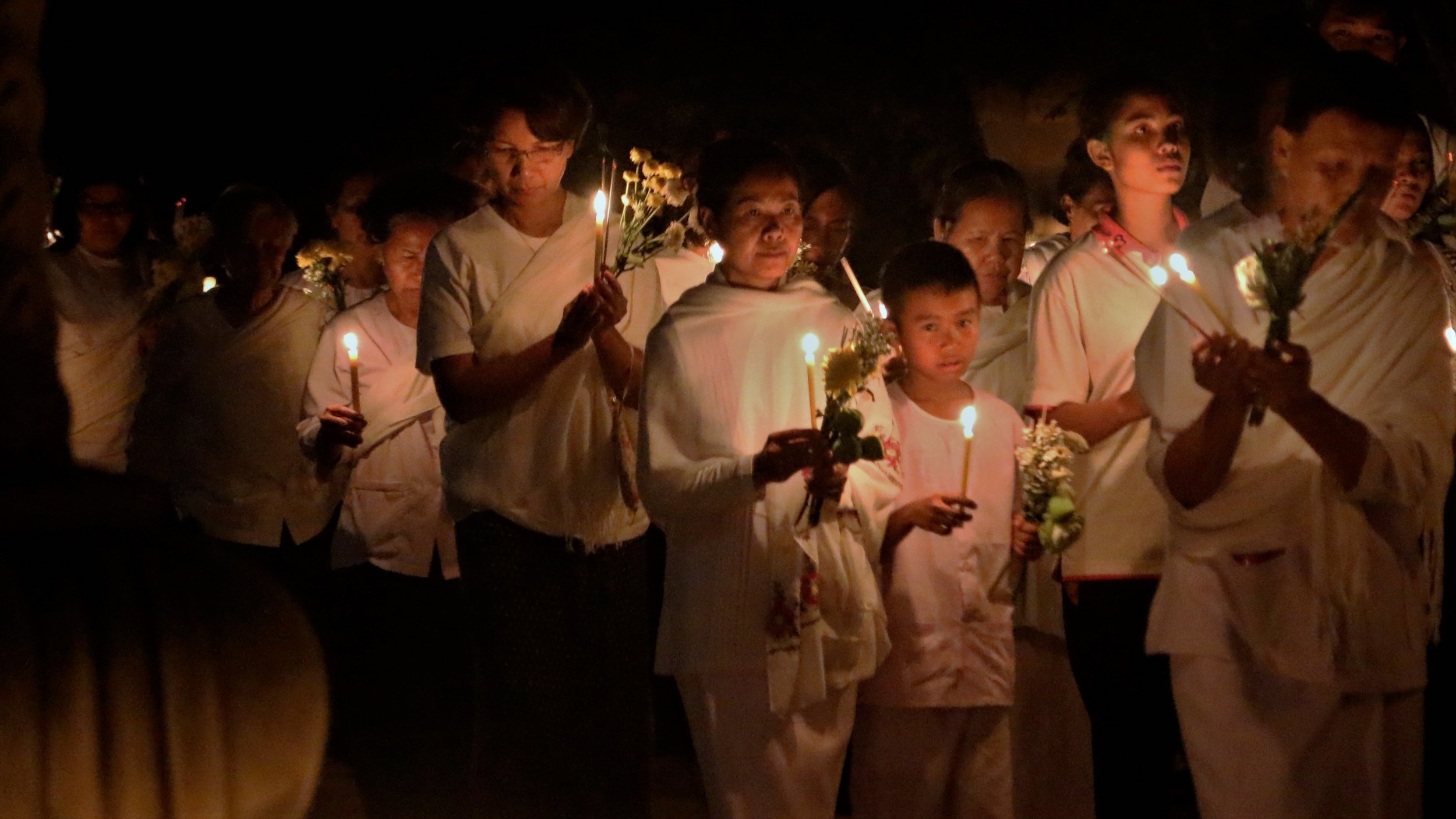
Pūja’: Ritual that Brightens the Heart

In Buddhism, and in other religions, access to and dwelling in the heart-tone of bright kamma is occasioned by devotion and recollection. In Buddhism, this is called ‘pūja’ – an act of raising up, and honouring that which is worthy of our respect. The very fact that there are human models and actions that one can feel deep respect for is itself a blessing to take note of: honouring opens and uplifts the heart. With pūja, we attend to a skilful felt meaning, linger there and allow the effects to nourish the citta. From this basis, it’s likely that inclinations or even specific ideas in line with bright kamma will arise. Either that, or the mind easily settles into a state that supports meditation. This is how and why one should linger in any bright kamma.

So, in the act of honouring the Buddha, one first opens the heart in respect and brings to mind the meaning of an Awakened One: someone of deep clarity; a speaker of truths that penetrate and bring healing to the human condition; one accomplished in understanding and action – a sage whose teachings can still be tested and put into action. If one has a Buddha-image, it’s something that should be held with respect – one cleans it, illuminates it with light, and offers flowers and incense to it. We place it on an altar, bow to it and chant recollections and teachings.

This is not a mindless activity; we use ritual means and resound words and phrases because this full engagement embodies and strengthens the quality of respect in a way that thinking can’t. With the openness of heart that these attitudes bring, any aspect of the teaching that’s brought to mind goes deeper. The act of offering that begins a pūja is a case in point: offering flowers “symbolizes bringing forth virtue, offering light is about bringing forth clarity, and incense does the same for meditative concentration. In this way, pūja introduces the heart to important Dhamma themes.

Pūja is especially helpful when people perform it as a group. Then we are participating in the Dhamma as both the expression and the Way of awakening, as well as in the collective commitment to, and engagement with, that Dhamma. This collective engagement ritualizes the ‘Sangha’, that is, the assembly of disciples. Chanting in a group has a harmonizing, settling effect: sonorous and unhurried, it steadies bodily and mental energies and supports an atmosphere of harmony with fellow practitioners. Tuning in and participating brings us out of ourselves and into a deep resonance with heart-impressions of the sacred. We can be touched by a sense of timeless stability, purpose and beauty. If these intentions, felt senses and recollections are established regularly, we know where to find good heart, how to attend to it, and how to allow ourselves to be uplifted. Such kamma feels bright.

The Benefits of Recollection

‘At any time when a disciple of the noble ones is recollecting the Tathāgata … the Dhamma … the Sangha … their own virtues: “[They are] untorn, unbroken, unspotted, unsplattered, liberating, praised by the wise, untarnished, conducive to concentration.” At any time when a disciple of the noble ones is recollecting virtue, his mind is not overcome with passion, not overcome with aversion, not overcome with delusion. His mind heads straight, based on virtue. And when the mind is headed straight, the disciple of the noble “ones gains a sense of the goal, gains a sense of the Dhamma, gains joy connected with the Dhamma. In one who is joyful, rapture arises. In one who is rapturous, the body grows calm. One whose body is calmed experiences ease. In one at ease, the mind becomes concentrated.

‘Mahānāma, you should develop this recollection of virtue while you are walking, while you are standing, while you are sitting, while you are lying down, while you are busy at work, while you are resting in your home crowded with children.’

(A.11:12; B. BODHI, TRANS.)

The expressions that are used in recollecting Dhamma are that it is experienced directly (not just as a theory), is of timeless significance, and is accessible and furthering for those who practise it. So that gives us an encouragement to look into what the Buddha taught and modelled: the way to the end of suffering and stress. With this, we recollect aspiration, learning and commitment as our common touchstone, and suffering and ignorance as our common challenge. Then we no longer feel so alone with our difficult mind-states, and we can handle them in a more open and aware way. Recollection of Sangha reminds us that although there is greed, anger and confusion in the human world, there are also people who cultivate a way out of that.

If you use pūja on a regular basis, it aligns you to the ‘Triple Gem’ – Buddha, Dhamma and Sangha – by presenting content in terms of images, ideas and themes, and values and practices that guide the heart. It also occasions acts of steering and composing attention. So pūja works both on what the mind is dealing with, and how it operates [Continued next week 22 August 2024].

Link to the original:

https://www.abhayagiri.org/books/458-kamma-and-the-end-of-kamma
bright kamma

Ajahn Sucitto

The Blessing of Skilful Attention

Whoever cultivates goodness is made glad,

right now and in the future – such a one is

gladdened in both instances.

The purity of one’s deeds, if carefully recollected,

is a cause for gladness and joy.

Dhammapada: ‘The Pairs’, 16

In the last few weeks, a Buddha-image has been created in this monastery by Ajahn Nonti. He’s a renowned sculptor in Thailand, and he came to Cittaviveka to fashion this image as an act of generosity. It’s been a lovely occasion because the Buddha-image is being made in a friendly and enjoyable way. Many people have been able to join in and help with it. Yesterday there were nine people at work sanding the Buddha-image. It’s not that big, yet nine people were scrubbing away on it, and enjoying doing that together.

Bright and Dark Kamma Arise from the Heart

Nine people working together in a friendly way is a good thing to have happening. Moreover, the work was all voluntary, and came about with no prior arrangement: people got interested in the project and gathered around it. It’s because of what the Buddha represents, and because people love to participate in good causes. That’s the magic of bright kamma. It arises around doing something which will have long-term significance, and also from acting in a way that feels ‘bright’ rather than intense or compulsive. Kamma – intentional or volitional action – always has a result or residue, and here it’s obvious that the bright kamma is having good results. There’s an immediate result – people are feeling happy through working together. And there’s a long-term result – they are doing something that will bring benefit to others.

In a few days we hope to install the Buddha-image in the meditation hall. It’s an image that makes me feel good when I look at it. It has a soft, inviting quality that brings up a sense of feeling welcome and relaxed. This is a very good reminder for meditation. Sometimes people can get tense about ‘enlightenment’, and that brings up worries, pressure, and all kinds of views; but often what we really need is to feel welcomed and blessed. This is quite a turnaround from our normal mind-set; but when we are sitting somewhere where we feel trusted, where there’s benevolence around us, we can let ourselves open up. And as we open our hearts, we can sense a clarity of presence, and firm up around that. This firmness arising from gentleness is what the Buddha-image stands for. It reminds us that there was an historical Buddha whose awakening is still glowing through the ages – but when this is also presented as a heart-impression in the here and now, rather than as a piece of history, it carries more resonance. Then the image serves as a direct impression of what bright kamma feels like.

‘Bright’ kamma is the term used in the scriptures to denote good action, or that which leads to positive results. This is not a theory or a legal judgement; if you linger in the heart behind skilful actions, you can feel a bright, uplifting tone. Bright kamma is steady and imparts clarity; it has an energy that’s conducive to meditation. Dark kamma, on the other hand, lacks clarity and feels corrosive. As it makes the heart feel so unpleasant, mostly attention doesn’t want to go there; the heart gets jittery and distracts instead. So, this is something to check inwardly: can we rest and comfortably bear witness to the heart behind our actions? Do our thoughts and impulses come from a bright or dark state? Even in the case of owning up to some painful truth about our actions, isn’t there a brightness, a certain dignity, when we do that willingly? Look for brightness in occasions when your heart comes forth rather than in times of superficial ease or of being dutifully good. That bright, steady tone rather “than casualness or pressurized obedience, indicates the best basis for action.

Sense and Meaning: The Perceptual Process

The energy of kamma originates in the heart, citta. It can move out through body (kāya) and speech (vāca – which includes the ‘internal speech’ of thinking) and mind (manas). Both manas and citta can be translated as ‘mind’, but the terms refer to different mental functions. ‘Manas’ refers to the mental organ that focuses on the input of any of the senses. This action is called ‘attention’ (manasikāra). So manas defines and articulates; it scans the other senses and translates them into perceptions and concepts (saññā). Tonally, it’s quite neutral. It’s not happy or sad; in itself, it just defines, ‘That’s that.’

Citta, on the other hand, is the awareness that receives the impressions that attention has brought to it, is affected and responds. It adds pleasure and pain to the perceptions that manas delivers, and these effects generate mind-states of varying degrees of happiness and unhappiness. Owing to this emotional aspect, I refer to citta as ‘heart’. Note that citta doesn’t access the senses directly. Instead, it adds feeling to the perceptions that attention has brought it; but with that, the initial moment of perception gets intensified to give a ‘felt sense’. This is a simple note such as ‘smooth’, ‘glowing’, ‘foggy’, ‘intense’. Then as attention rapidly gathers around that sense, a felt meaning crystallizes. For example, manas may decide that an orange-coloured globe of a certain size is probably an orange. From that meaning, further felt senses such as ‘tasty, healthy’ may arise and resonate in the heart. So, a mind-state based on desire arises. And even though all this originates in mere interpretations, intention springs up – and citta moves attention, intention and body towards the orange with an interest in eating it.

In this way, impulse/intention occurs as a response to a felt meaning that itself has been conjured up by a graduated and felt perceptual process. This is how mental kamma arises. And the result of citta being affected in this way is that the meaning is established as a reference point. Then the next time I see or think of an orange, that established perception that ‘Oranges are tasty; they’re good for me’ becomes the starting point for action. But is that interpretation always correct? Ever bitten into a rotten orange, or been fooled by a plastic replica? More significantly, don’t perceptions of people need a good amount of adjustment over time? How true is perception?

Perception is initiated when attention turns towards a particular sense-object. So, all contact depends on attention. Take the case of when you’re intensely focused on reading a book or watching a movie: awareness of your body, of the pressure of the chair, and maybe even a minor ache or pain, disappears. The mind’s attention is absorbed in seeing and processing the seen, so other impressions don’t get registered. Contact with the chair has disappeared because one’s attention was elsewhere. How real then is contact?

Contact is actually of two kinds. The contact that occurs when the mind registers something touching the senses is called ‘disturbance-contact’ (paṭigha-phassa). But when manas ‘touches’ the citta at a sensitive point, ‘designation-contact’ (adhivacana-phassa) is evoked – along with a felt sense. Disturbance-contact occurs in the mind-organ, and designation-contact occurs in the heart; and it is designation-contact, the heart’s impression, rather than contact with something external, that both moves us and stays with us as a meaning. For example, ‘dog’ is tonally a neutral perception that we would agree upon as a definition of a certain kind of animal. But in terms of citta, that ‘dog’ could mean ‘savage creature that can bite or has bitten me’ or ‘loyal, cuddly friend that will protect me.’ Such contact is therefore formed by previous action, but present-day impulses and actions are based on it. Thus, the old perception shapes me; in this case, as a fearful or confident person. And I act from that basis. This is why it is said: ‘Contact is the cause of kamma.’

Continued next week 15 August 2024

Link to the original text. Download a few pages, or the whole book free of charge. It’s a Dhamma publication:

https://www.abhayagiri.org/books/458-kamma-and-the-end-of-kamma

vipāka, ‘old kamma’ being born

Ajahn Sucitto

Excerpts from: “Kamma and the end of Kamma”, Chapter 1: “Action that Leads to Liberation” (continued from last week) “These impressions and interpretations begin with the external mind, but get settled in the heart through the agreeable or disagreeable feeling (vedanā) or the prior association it evokes. In other words, citta doesn’t receive sights, sounds, smells and tastes; it receives the perceptions that mind-consciousness brings in.”

Consequently, the pairing of the objective mind and subjective heart builds meaning. The spiritual quest is based on the understanding that there is ageing, sickness and death; and with that the experience of separation from the loved, and being disagreeably affected by these facts of life – while at the same time being powerless to do much about it. Even on the level of daily life, what we think about, and how we conceive of people and things, washes over the heart with pleasant or unpleasant feeling, arouses gladness or disappointment, and may lead us into action. This is how the world of sights and sounds and people and events gets into us and gets us going (even when the event happened long ago). The inheritance, the vipāka or ‘old kamma’ of being born, is that whether the mind interprets things accurately or not, the heart stores its interpretations. And it bases intentions, responses and reactions – kamma – on those stored-up meanings. It’s a questionable basis.

The basis is as much psychological as sensorial. We need to, and do, seek to understand and otherwise manage our circumstances. Therefore, one of our most continual mental actions is that of interpreting and filing away experience to derive meaning and purpose. And, as with other creatures, part of that meaning and purpose has to do with getting support from, or participating within, a group. In our case, this ‘belonging’ also entails participation in a complex weave of social programs, customs and attitudes. “that tell us how to operate in order to be accepted. This also affects our kamma, because although some advice is wise, we may also act upon socially-derived prejudices that cause us to contribute to hurting others – so we become arrogant or insensitive. Some social customs are about bypassing uncomfortable truths (such as mortality), or not giving deep attention to the heart: a life of golf and parties fails to come to terms with the facts of life. Another big effect comes from the views and opinions of others: being praised or blamed, valued or neglected, lingers as perceptions by which we sense ourselves. This self-reference then becomes an identity. As a general principle then, how we have been (and are being) affected by others solidifies into who we are.

This psychological program of being affected and responding is called the ‘mental (or heart) formation’ (citta-saṇkhāra). Installed at birth, at any given moment this ‘master program’ responds to present experience in terms of what it has learnt that experience is like. It is informed through a library of perceptions, or ‘felt meanings’, that the manas aspect has encoded, even though these perceptions are all only representations of an object, an event, or of course a person. And also, saññā adds subjective tints to any object-definition, such as: ‘Will she like me?’, ‘He looks threatening’ – and so on. These tinted perceptions become the basis of many spur-of-the-moment responses in our lives.

Meanwhile, the mind has responded on many fronts: we may be involved with business, but are challenged by the result of hearing of a relative’s death an hour ago. Even as we struggle with this, other long-term aims or social obligations apply their pressure. Bodily health and energy also have their effects. In addition to this, our attention span fluctuates, particularly if we’re tired – so we can be running on automatic, attending in a habitual or blurred way, and acting on outdated or biased programs. Rather like the tides of an ocean that can lift us up, engulf us, or sweep us in any direction, this kammic process is then a dynamic field of the interplay between established aims, former or current input, and responses to any of these. The mind-sets, attitudes and interpretations that have become established in our hearts carry the potential to shape our present actions; and the future will arise according to whichever mixture of these effects we act upon.

Steering Through the Causal Field

From the above, you’ll see that kamma is potent and multi-dimensional. Steering through its causal field is possible, but it does require a reliable and trained mind; training is then an imperative. Dark kamma weakens the mind and destroys people; bright kamma is a source of strength and nourishment. On account of bright kamma, such as ethical integrity and goodwill, we can establish the calm and clarity that supports training manas and citta. Together, these two aspects of mind can then handle, understand and release the causal tangle.

Look after yourself!

‘And for the sake of what benefit should a woman or a man, a householder or one gone forth, often reflect thus: “I am the owner of my kamma, the heir of my kamma; I have kamma as my origin, kamma as my relative, kamma as my resort; I will be the heir of whatever kamma, good or bad, that I do”? People engage in misconduct by body, speech, and mind. But when one often reflects upon this theme, such misconduct is either completely abandoned or diminished.’

(A.5:57; B. Bodhi, Trans.)

So kamma is not an imprisonment, but a matter to be mastered. Firstly, if we must generate kamma, we can at least determine whether it will be bright or dark. Remember, there’s a choice: kamma depends on impulse or intention – but ‘intention’ is not just a deliberate plan; in fact, we’re not always that clear about what we’re doing and why. Many of our troubles come from just being preoccupied, or getting stuck in habits, or from inattention or misunderstanding; then intention is not guided by clarity. “Complacency or, on the other hand, pessimistic fatalism may also weaken the clarity and firmness of intention.

We might wonder why we are who we are and what made us like this, but such speculation just activates the mind to no good end. The details of kamma are too complex to understand – it would be like trying to figure out which river or rain-cloud gave rise to which drop of water in the ocean.[4]

 The most direct and helpful way to steer kamma begins with ‘right view’ (sammā-diṭṭhi). Right view is the view that there is the bad and it can be steered away from, and there is the good and it can be cultivated. And cultivation entails training one’s attention. An attention that’s firm, clear and not flustered by moods and sensations can enter the underlying currents of the mind and turn a tide of heedlessness and self-obsession that would otherwise steer intention. In this way, right view leads into ‘right attitude’ (sammā-saṇkappā), which is the aim to set one’s attention on a skilful footing. With these two steps, the Eightfold Path out of suffering and stress gets established.[5]

The first responsible and accessible action on this Path is to pause on an emotional response and ask yourself whether this response is reliable and aims in a wholesome direction. Even this brief breaking of the reactive link that engages fresh intention with an old habit, if done repeatedly, can dissolve that link and cause that mental habit to cease. You find that you don’t have to retort, that you don’t have to rush to the deadline, and you don’t have to binge. Then different responses can arise – such as patience, forgiveness and tolerance. In ways like this, you can get out of the gridlock of ‘I’m stuck in this habit; I am this’, and make meaningful choices in your life. The “basis of any such choices is gaining the capacity to choose. And this heedfulness (appamāda) is what pausing and considering offers: I can pause, come out of a mind-state, give it due consideration, and decide to act on it – or let its accompanying impulse pass. I don’t have to be compulsive or reactive. Just taking this step, that of disengagement (viveka), opens the possibility for the fourth type of kamma, the kamma that leads to the end of kamma.

 This is what ‘liberation’ and ‘awakening’ refer to.

[Please find the last part of this chapter in the original, (see the link below), under the subhead: ‘Liberation Begins with Mindfulness,’ which can be found in the Contents listing. I decided not to continue with it here because it is of interest to a limited readership, in my opinion, and it’s best to move on to another aspect of this subject.]

https://www.abhayagiri.org/books/458-kamma-and-the-end-of-kamma

internal speech

Ajahn Sucitto

[Excerpts from Kamma and the end of Kamma, Chapter 1: “Action that Leads to Liberation” by Ajahn Sucitto]

If with an impure mind a person speaks or acts,
suffering follows them like the cart-wheel
that follows the ox’s hoof …
If with a pure mind a person speaks or acts,
happiness follows them like
their never-departing shadow.
Dhammapada: ‘The Pairs’, 1 & 2

What is ‘kamma’, and what does it have to do with liberation? Well, as a word, ‘kamma’ is the Pali language version of the Sanskrit term ‘karma’, which has slipped into colloquial English as meaning something like a person’s fate or destiny. The problem with this interpretation is that it supports a passive acceptance of circumstances: if something goes wrong, one can say: ‘It was my karma’ – meaning that it had to happen, perhaps because of what one had done in a previous life. That’s not a very liberating notion. Where the idea really goes astray is when it is used to condone actions, as in ‘it’s my karma to be a thief (or to be abused).’ If kamma meant this, it would rob us of responsibility and self-respect. Furthermore, there would be no way in which we could guide ourselves out of our circumstances, habits or past history: and that’s a dismal prospect. However, kamma, in the way the Buddha taught it, means skilful or unskilful action – in terms of body, speech or mind – that we can exercise choice over. Making good use of this potential is what liberation, or ‘awakening’, is about.

Also, not everything that we experience is because of what we’ve done anyway. If you’re sick or caught up in an earthquake, it’s not necessarily because you’ve done bad things. If that were the case, considering the number of reckless human beings there have been, the Earth would never stop quaking! Instead, kamma centres on your current intention, inclination, or impulse (cetanā) – and it has a result (vipāka), either fortunate or unfortunate. This is the case even if why or how you acted was influenced by other people. So the Buddha’s encouragement was to know what you’re doing and why. One simple guideline is that acting towards others in a way that you wouldn’t want them to act towards you can’t give good results for yourself or others. Liberation is about getting free of tendencies such as self-centeredness or abusiveness.

Seen in this light, the teachings on kamma encourage a sense of responsibility for how you direct yourself in general, and for the many conscious and half-conscious choices you make throughout a day. Whether you feel at ease with yourself, or anxious and depressed; whether you’re easily led astray or whether you set a good example – all this rests on your clarity and integrity.

The Four Kinds of Kamma

Kamma means ‘action’ in a more than physical sense: it also includes verbal action, such as whether we insult and yell at people or say truthful and reliable things – and that action includes the ‘internal speech’ of thinking. But just as the body does neither good nor evil – these ethical qualities being rooted in the mind that initiates the physical deed – it’s the same with speech and thought. Language is neutral – it’s the kindness or the malice of the mind that’s creating the concepts and using the language that brings fortunate or unfortunate results. So, of the three bases of action – body, speech or mind – the kamma of our mental responses is therefore the most crucial in terms of living a wholesome life.

The Buddha spoke of four kinds of kamma. There is bad or ‘dark’ kamma – actions such as murder, theft, falsehood and sexual abuse that lead to harmful results. Avoid this, definitely. There is good or ‘bright’ kamma – actions such as kindness, generosity and honesty that have beneficial effects and enhance integrity and wisdom. This kind of kamma is to be thoroughly understood, cultivated and enjoyed. It’s not difficult: even refraining from dark kamma is bright in that it offers freedom from regret and supports clarity.

The third kind of kamma is a mixture of bright and dark kamma – actions which have some good intentions in them, but are carried out unskilfully. An example of this would be having the aim to protect and care for one’s family but carrying that out in a way that negatively impacts one’s neighbours. And the fourth? It’s the actions that lead to liberation – which I’ll get to later.

Kamma has consequences – vipaka. Now take the case of dark kamma: if I speak harshly or abusively to someone, one effect of that is that they get hurt – and that means that they’re probably going to be unpleasant towards me in the future. It’s also likely that that action will have immediate effects in terms of my own mind: I get agitated. At this point habitual psychological programs get going. I may shrug off scruples, say that they deserved it, or that I was having a bad day, etc. – but the results still remain. I may even get accustomed to acting in that way because it relieves my emotional tension or makes me feel I’m on top – but my mind will become insensitive, and I will lose friends. On the other hand, if I think about my actions, I may feel stricken with guilt and hate myself.

Effects therefore accrue in terms of states of mind – such as insensitivity or guilt – and also in terms of behaviour: in this example, I either become loud-mouthed or intensely self-critical. Then there are results in the wider social sphere: I get isolated or only associate with shallow, insensitive people. All of this can lead on to substance abuse and other self-destructive patterns.

All kamma rolls out in terms of behaviour patterns, psychological programs and strategies – saṇkhārā – of which intention (or impulse) is the prime agent. And if there is no clarity around kamma, even negative and uncomfortable programs – such as justification, blaming, distracting and switching off – can define how I operate and how I’m seen. Tendencies to be a compulsive do-er, a busy and over-responsible one who doesn’t take care of themselves, or defensive or somehow unworthy – are programs that become part of my identity. And as these programs become familiar, they bind the mind into ongoing habitual action – psychological, verbal and physical. The identity that they thus create is like a ball bouncing on a trampoline. Bouncing and being bounced: ‘saṃsāra’, ‘the wandering on’, is what it’s called. Liberation is about not being bounced; and the fourth kind of kamma is the mental action that brings that around.

So, if we want to get free, we have to get a hold on how saṃsāra works. We have to pause and approach our saṇkhārā from a different mind-set than the one they jumped out of: getting defensive about the tendency for denial, for example, is just a continuation of the same program. However, a different approach is possible – because the mind is not completely bonded to its programs. We can experience the results of unskilful actions, and with the support of our own trained attention and/or that of reliable friends, learn to do better. We can change our ways. We can also realize the awareness that makes that possible, and that stands apart from kamma. Liberation from the feedback loop of action and result (kamma-vipaka) is therefore possible; it all comes down to training the mind.

Bodily, Verbal and Mental Kamma: The Causal Field

Mind mediates within our multi-faceted experience of ‘external’ and ‘internal’ realms. What I’m referring to as ‘external’ is the range of sense-data that provides details of where we are; whereas the ‘internal’ consists of our inclinations, moods, memories and attitudes. Similarly, mind has an external aspect, manas, that scans the senses and through its focus shapes experience into discrete objects; and it also has as an internal, or subjective, aspect, citta (pronounced ‘chitta’), that adds how we are affected by these objects. For the sake of clarity, I’ll call citta the ‘heart’ of the mental process.

Citta isn’t rational; it’s an affective-responsive awareness that is attuned to respond to its environment – physical or psychological – at a gut and heart level, with ‘fight-flight-freeze ‘drives that can kick in at a moment’s notice. Basically, it’s attracted to pleasure and tries to get away from pain – and those impulses, along with the thoughts that they stimulate, make experience very dynamic. Indeed: dealing with the changing state of the world around us – and the ‘world’ within us – keeps us pretty busy.

Taken as a whole, these external and internal realms make up a causal field. This field is the sum total of experience that’s caused by our living context of sensory life, society and family; and it also causes – that is, it’s sensitive and responsive to that context. Consciousness acts as the one-moment-at-a time link between these two realms, with mental consciousness (mano-viññāṇa) adding its interpretations to sights and sounds and the rest. That is, this mental activity tags input from the external senses with perceptions (saññā) that affect the heart, such as: ‘tastes good’; ‘this carpet smells like an old dog’; ‘she looks irritated.’ These impressions and interpretations begin with the external mind, but get settled in the heart through the agreeable or disagreeable feeling (vedanā) or the prior association it evokes. In other words, citta doesn’t receive sights, sounds, smells and tastes; it receives the perceptions that mind-consciousness brings in.

Continued next week 1 August 2024   

                     Click on the link below to download the original:  

https://www.abhayagiri.org/books/458-kamma-and-the-end-of-kamma
   Photo images in this post source: unsplash.com: Pedestrian crossing, Shinjuku, Tokyo

‘world’

Ajahn Sucitto

[Excerpts from “Kamma and the End of Kamma,” by Ajahn Sucitto, Chapter 5: “Regarding the World.” Note: The book is available as a free Dhamma publication. Look for the link at the end of this post.]

Regarding the World
Having directly known all the world –
all in the world just as it is –
he is detached from all the world,
disengaged from all the world.
He is the vanquisher of all,
the wise one who has untied all knots.
He has reached the supreme peace,
nibbāna, inaccessible to fear.
A.4:23 – ‘The World’

When I visited a monastery in China recently, I met an old monk who presented me with a treasured piece of his own calligraphy, a piece that summed up the view of Dhamma as he understood it. It comprised two ideograms on a scroll: one meaning ‘still’ and the other meaning ‘bright reflection’. The translator interpreted the overall sense to mean something like: ‘the quiet, reflective mind that regards the world.’ ‘Regards the world’: there’s attention there, but non-involvement – dispassion. Yet that mind keeps regarding the world, not ignoring it: that implies compassion.

Interdependence

What is this world anyway? Socially, psychologically and environmentally, it’s a web in which different forces, energies and beings support and condition each other’s existence. It’s both caused and causative. In ecological terms, this interdependence calls for balance. The Buddha’s understanding was that our psychological balance and ethical integrity are essential for a climate that sustains life.

 Hence his deep commitment to harmlessness and frugality. However, in referring to ‘the world’, the Buddha was generally focusing on the personal ‘internal’ world: the web of causes and conditions which arises dependent on the consciousness that participates in bodily life. This world is experienced as a series of shifting forms (rūpa) that arise dependent on seeing, hearing, smelling, tasting and touching – moment-by-moment data which are tacked together by our minds to form a solid three-dimensional realm. To the casual observer, this reality persists through time.

 But when it’s more deeply and directly known, this world is not experienced as a fixed and stable entity, but as arising a moment at a time.

Furthermore, it is dependently arisen. That is, form becomes present for us dependent on consciousness; and consciousness arises dependent on some form to be conscious of. In detail: mind-consciousness arises as the interpreter and organizer of sense-data and heart-impressions. Without that input, mind-consciousness does not arise. It makes contact, thus generating perceptions that evoke feeling. Feeling and perception arise with contact, and with contact comes more heart-impressions and patterns – as well as programs involved with interpreting, organizing and responding to the impressions that mind has placed in the heart. And so, our world rolls on.

All this interpreting and organizing and feeling is summarized as ‘name’ (nāma), although ‘interpretation’ might give you a better handle on it.

 It is through the linking of ‘name’ to ‘form’ that an apparently ‘outer world’ and an ‘inner world’ co-dependently arise in the dynamic experience of consciousness, name and form.

To illustrate this: in the act of seeing, a visual object is first detected, then lingered over as the mind recognizes it, and designates it with an impression, perception or felt sense, such as ‘friend’ or ‘stranger’. Dependent on that and the current mood or intent, a response arises. One can then linger further and develop possibilities and plans. Regarding all this, we may feel uplifted, overwhelmed or bored by all the saṇkhārā – the energies and emotions that come up. Accordingly, ‘the world’ may seem exciting, dreadful or hum-drum. But it is conditioned, created and creative. And like the ever-changing design of the Mandelbrot set, it can keep going on and on: as the Buddha observed, you don’t get to the end of the personal upheavals until you have got to the end of your world.

Moreover, this doesn’t happen through moving around the world, running away from it or creating another world, but through contemplating the causal field, and penetrating the basis on which your world arises.[35]

Regarding the world this way leaves open the possibility that each of us, through purifying our ‘naming’ processes, can affect how the world seems and how we respond to it. Some responses feel balanced; others more compulsive. How are my attitudes colouring what arises? Is some fixed mind-set creating my world and myself as someone embedded in it? We train to acknowledge this so that we can see what needs to be cleared in order to get free. Therefore the Buddha taught where the world arises and where it stops, and the way to that.

To this end, many of the Buddha’s teachings are based on generating bright kamma in daily life. He taught the Eightfold Path to establish purity of intent. If you work with this with regard to people, duties and events, you can live with self-respect, gladness and equanimity. You don’t get caught up in the judgements of success/failure, praise/blame; instead, you establish your Path, linger in and savour the good, and work with what arises.

As long as one hasn’t developed such skill, the success/failure assessment gets internalized and craving keeps the mind driving on: ‘How long is it going to take me to achieve my goals?’ That’s the world arising, right there; it’s a race that can never be won, because the thirst to achieve creates the goal and the self who hasn’t achieved it. You climb one mountain, then you need to climb a higher or more risky one. What’s driving you? This process will always create stress. Stress can end, however, in accordance with the degree with which one can relinquish that thirst, that goal-orientation, that self. This is what is meant by purifying the intent. It means letting go of the search for fulfilment in terms of ‘world’.

Kamma should be known. The cause of kamma should be known. The diversity in kamma should be known. The result of kamma should be known. The cessation of kamma should be known. The path of practice for the cessation of kamma should be known.’ Thus, it has been said. In reference to what was it said?

‘Intention, I tell you, is kamma. Intending, one does kamma by way of body, speech, and intellect.’

‘And what is the cause of kamma? Contact is the cause of kamma.’

‘And what is the diversity in kamma? There is kamma to be experienced in hell, kamma to be experienced in the realm of common animals, kamma to be experienced in the realm of the hungry shades, kamma to be experienced in the human world, kamma to be experienced in the world of the devas. This is called the diversity in kamma.’

‘And what is the result of kamma? The result of kamma is of three sorts, I tell you: that which arises right here & now, that which arises later [in this lifetime], and that which arises following that. This is called the result of kamma.’

‘And what is the cessation of kamma? From the cessation of contact is the cessation of kamma; and just this noble eightfold path – right view, right resolve, right speech, right action, right livelihood, right effort, right mindfulness, right concentration – is the path of practice leading to the cessation of kamma.’

“A.6:63 (Thanissaro, trans.)

Click on the link below to get your free copy:

https://www.abhayagiri.org/books/458-kamma-and-the-end-of-kamma

transcendental dependent origination

Leigh Brassington

Editorial note: I was surprised to discover there are so many words in the Pali language that mean Joy or are related in some way: Somanassā, Pīti, Sukha, Mudita, Sumanā, Nandi, Ananda, and there are others. If you want to know more about Joy, you need to check out the video “Joy as Path” by Ajahn Kovilo in the context of Transcendental Dependent Origination (Before you view the video, please return the counter to zero. My mistake, apologies)

https://youtu.be/CR1myaKIOSk

Now we turn to Leigh Brassington’s text, a follow-up on last week’s post, “Moment-to-Moment Consciousness.”  

The sutta on Transcendental Dependent Origination is one of the more interesting ways that dependent origination is used to teach more than just the moment-to-moment activity we experience with our sense-contacts.

“And what is the result of dukkha? Here, someone overcome by dukkha, with a mind obsessed by it, sorrows, languishes, and laments; they weep beating their breast and become confused. Or else, overcome by dukkha, with a mind obsessed by it, they embark upon a search outside, saying: ‘Who knows one or two words for putting an end to this dukkha?’ Dukkha, I say, results either in confusion or in a search. This is called the result of dukkha.” AN 6.63

Once we acknowledge the seeming all-pervasiveness of dukkha, we begin searching for a solution to this problem. When we find a promising path, we try it out and if it seems like it just might work, we gain confidence in that path [Upanisa sutta, Samyutta 12.23.1]. The sequence is, Dukkha (Suffering) is a necessary condition for the arising of Saddha. Saddha is often translated as “faith” but I think a better translation is “confidence.” This confidence is not self-confidence, rather it’s confidence in a proposed method for overcoming Dukkha.

From Saddha as a necessary condition, Pāmojja arises. Pāmojja is usually translated as “worldly joy.” This joy arises because the path that one now has confidence in is starting to work. In particular, the Buddha frequently teaches that Pāmojja arises during meditation when one overcomes the five hindrances: sensual desire, ill will & hatred, sloth & torpor, restless & remorse, and doubt. [See below for an analysis of the five hindrances]

Having generated this Worldly Joy, one can now generate Pīti. Pīti gets variously translated as “rapture” or “euphoria” or “ecstasy” or “delight.” My favorite translation is “glee.” Pīti is primarily a physical sensation that sweeps you powerfully into an altered state. But Pīti is not solely physical; as the suttas say, “on account of the presence of Pīti there is mental exhilaration.”

When the Pīti calms down, Passaddhi – tranquility – arises. Then because of that tranquility, Sukha – joy, happiness – arises. Upon letting go of the pleasure of the Sukha, Samādhi – deep concentration – manifests. These five – Pāmojja, Pīti, Passaddhi, Sukha, and Samādhi – are the mind’s movement into and through the four jhānas, the purpose of which is to generate the deep concentration “that turbo-charges one’s insight practice. Arising dependent on a mind that is “thus concentrated, pure and bright, unblemished, free from defects, malleable, wieldy, steady and attained to imperturbability” is Yathābhūtañāṇadassana – knowing and seeing things as they are. These are the insights into the nature of reality that begin the process of freeing one from dukkha. [First, let’s look at the five hindrances.]

The five hindrances (nīvaraṇa)

Whether we find ourselves in a storm of emotions or sleepy, anxious, bored, or daydreaming, meditation shines a light on all the ways the heart and mind can be uncomfortable and resist settling down. These difficult energies we encounter in both meditation and ordinary life are known as the five hindrances (nīvaraṇa), and engaging with them skillfully can change our practice time from a frustrating chore to the nourishing and insightful experience we know is possible.

The concentrated mind is focused and relaxed, and the cultivation of samādhi depends more on being able to let go into calm, easeful presence than focusing the attention relentlessly on one thing. The hindrances obstruct concentration because they all are active in a way that’s not helpful for calm and clarity.

The hindrances can be thought of as symptoms of an underlying disconnection or dissatisfaction (dukkha). They are habits of the heart and mind that, like many of our unconscious tendencies, are rooted in the heart’s attempt to stay safe in an unsafe world. They are reactive, judgmental, and above all, not under our conscious control.

The instructions for bringing mindfulness to the hindrances start with recognizing when a hindrance is present and when it is not. These are habitual energies, and can be so familiar that they feel like part of our personality, but in our practice, we begin to see that they are sometimes present and sometimes not, depending on the conditions we find ourselves in. We are then encouraged to actively set up the conditions for the hindrances to diminish. [Click on the link below to the original Spirit Rock Practice Guide for detailed analyses on the five hindrances]

https://www.spiritrock.org/practice-guides/the-five-hindrances

Transcendental dependent origination continued:

The Remaining Steps

When the insights are deep enough, when one knows and sees what’s actually happening, this can lead to Nibbidā. The best translation of nibbidā is “disenchantment.” We are currently under the spell that we will find relief from dukkha via the things of this world. But when we can see deeply enough the way things really are, we become dis-enchanted; the spell is broken.

Being disenchanted, we can become Virāga. The usual translation of Virāga is “dispassion;” but this dispassion doesn’t mean a flat affect. It means one’s mind is not colored by the things of the world that one has become disenchanted with and which have been seen to no longer be an exit from Dukkha.

Dependent on dispassion, Vimutti arises – release/deliverance/emancipation. Finally with emancipation, Āsavakkhaye ñāṇa is gained – the knowledge of the destruction of the āsavas. The āsavas are the intoxicants – we are intoxicated with sense pleasures, we are intoxicated with becoming, and we are intoxicated by ignorance. The overcoming of these intoxicants is the goal of practice; and with emancipation, one knows one has done what needed to be done, one has become an arahant.

Now we can build the following chart of Transcendental Dependent Origination – in the reverse order:

Knowledge of destruction of the āsavas (āsavakkhaye ñāṇa) arises dependent upon
Emancipation (vimutti) arises dependent upon
Dispassion (virāga) arises dependent upon
Disenchantment (nibbida) arises dependent upon
Knowledge and vision of things as they are (yathābhūtañāṇadassana) arises dependent upon
Concentration (samādhi) arises dependent upon
Happiness (sukha) arises dependent upon
Tranquility (passaddhi) arises dependent upon
Rapture (pīti) arises dependent upon
Worldly Joy (pāmojja) arises dependent upon
Confidence (saddha) arises dependent upon
Dukkha arises dependent upon the other eleven mundane links.

This text is a composite of excerpts from “Dependent Origination and Emptiness” by Leigh Brassington, whicjh is a free Dhamma publication. Click on the link to see how to download:

https://leighb.com/sodapi/index.html

‘whereness’ does not apply

Excerpts from “The Island” by Ajahn Pasanno & Ajahn Amaro, chapter titled “The Unconditioned and Non-locality.” This week I’d like to go back to a subject that’s been done before on Dhamma Footsteps, namely: ‘Unsupported consciousness,’ I wrote a number of posts on this subject, back in the day when I was able to write my own posts. Take a look at ‘Unblinking gaze.’ Just key in the title in the Search box here on the front page. On the subject of ‘Atammayatā,’ see the text by Ajahn Amaro from “Small Boat, Great Mountain”, dated January 18 2024 and titled: ‘The place of non-abiding.’ Also, the post, dated January 25 2024: ‘Overlooking this to get to that.’

Consciousness of Nibbāna, although real, is best described as being unlocated — here we begin to say good-bye to the world of geography. Interesting that only what we call physical existence is dependent upon three-dimensional space – all the factors of the mental realm (the nāma-khandhas) are ‘unlocated’; that is to say, the concepts of place and space do not in any true sense apply there. Our thoughts and perceptions are so geared to operate in terms of three-dimensional space as the basic reality, and that view of things seems so obvious to common sense, that it is hard for us to conceive of any other possibility. It is only through meditative insight that we can develop the uncommon sense required to see things differently. A couple of everyday examples might serve to lead us into the subject. Firstly, the word ‘cyber-space’ is used frequently these days; one talks of “visiting such and such a website” and “my e-mail address” but where are these? Abhayagiri Monastery has a web-site but it does not exist anywhere. It has no geographical location. The words ‘visit,’ ‘homepage,’ ‘address’ and suchlike are the easy jargon of Cyberia, and we can be very comfortable using such terms, but the fact is – that just like a thought and, indeed, the mind itself – although they exist, they cannot be said to truly be anywhere. Three-dimensional space does not apply in their context.

The second example comes from a (purportedly) true incident. An American tourist, in Oxford, England, approached a tweed-jacketed and bespectacled professorial type and said: “Excuse me, but I wonder if you could tell me where exactly is the University?”

 “Madam,” the professorial type responded, “‘the University’ is not, in reality, anywhere – the University possesses only metaphysical rather than actual existence.”

What he meant, of course, was that ‘the University’ – being comprised of separate, independent colleges and not having a campus – is just a concept agreed upon by a number of humans to have some validity. It might have financial dealings, it might set exams and issue degrees, but physically it does not exist. There are the different colleges that one may attend or visit, but ‘the University’– no. Like a website or a virtual garden in a computer program, or indeed like a mythical country such as Erewhon – all can be said to exist, but whereness does not apply; they are unlocated.

As we cross the border into the realm of the Unconditioned (if such a metaphor is valid), there needs to be a relinquishing of such habitual concepts as self and time and place. The apprehension of Ultimate Truth (paramattha sacca) necessarily involves a radical letting go of all these familiar structures. Here, as a present-day example and to illustrate the centrality of such relinquishment, is the insight which arose for Ajahn Mahā Boowa “in the period of intense practice immediately following Ajahn Mun’s final passing away. It was this thought, which he describes as having arisen on its own (and more that it was heard rather than thought) which led to Ajahn Mahā Boowa’s full enlightenment shortly thereafter.

9.1) “If there is a point or a center of the knower anywhere, that is the essence of a level of being.” ~ Ajahn Mahā Boowa, ‘Straight from the Heart,’ p 171

Secondly, we can take up the Buddha’s own words on the nature of Nibbāna or asaṅkhata-dhamma, the Unconditioned Reality.

9.2) “There is that sphere where there is no earth, no water, no fire nor wind; no sphere of infinity of space, of infinity of consciousness, of nothingness or even of neither-perception-nor-non-perception; there, there is neither this world nor the other world, neither moon nor sun; this sphere I call neither a coming nor a going nor a staying still, neither a dying nor a reappearance; it has no basis, no evolution and no support: this, just this, is the end of dukkha.” ~ Ud 8.1

9.3) “There is the Unborn, Uncreated, Unconditioned and Unformed. If there were not, there would be no escape discerned from that which is born, created, conditioned and formed. But, since there is this Unborn, Uncreated, Unconditioned and Unformed, escape is therefore discerned from that which is born, created, conditioned and formed.” ~ Ud 8.3, Iti 43

It is significant that, when the Buddha makes such statements as these, he uses a different Pali verb ‘to be’ than the usual one. The vast majority of uses of the verb employ the Pali ‘hoti’; this is the ordinary type of being, implying existence in time and space: I am happy; she is a fine horse; the house is small; the days are long. In these passages just quoted, when the Buddha makes his rare but emphatic metaphysical statements, he uses the verb ‘atthi’ instead. It still means ‘to be’ but some Buddhist scholars (notably Peter Harvey) insist that there is a different order of being implied: that it points to a reality which transcends the customary bounds of time, space, duality and individuality.

Some similar areas of Dhamma are examined in ‘The Questions of King Milinda, (100 BC. – 200 AD) It is significant, in the following exchange between the Buddhist monk, Nagasena, and the King, how the element of sīla (morality/integrity) and its role in the realization of Nibbāna, are brought firmly into prominence.

9.7) Nibbāna is neither past nor future nor present; It is neither produced nor not produced nor to be produced, Yet, it exists, and may be realized. ~ Miln 323, (E.W. Burlingame trans.)

9.8) Nibbāna Is Not a Place

“Reverend Nāgasena, is this region in the East, or in the South, or in the West, or in the North, or above or below or across – this region where Nibbāna is located?”

“Great king, the region does not exist, either in the East, or in the South, or in the West, or in the North, or above or below or across, where Nibbāna is located.” 

“If, Reverend Nāgasena, there is no place where Nibbāna is located, then there is no Nibbāna; and as for those who have realized Nibbāna, their realization also is vain…” (The King goes on to tell Nāgasena why he thinks this is so.)

Nāgasena replies: “Great king, there is no place where Nibbāna is located. Nevertheless, this Nibbāna really exists; and a man, by ordering his walk aright [practising wisely], by diligent mental effort, realizes Nibbāna… Just as there is such a thing as fire, but no place where it is located – the fact being that a man, by rubbing two sticks together, produces fire – so also, great king, there is such a thing as Nibbāna, but no place where it is located – the fact being that a man, by ordering his walk aright [practising wisely], by diligent mental effort, realizes Nibbāna…”

“But what, Reverend Sir, is the place where a man must stand to order his walk aright [practise wisely] and realize Nibbāna?” 

Sīla, great king, is the place! Abiding steadfast in Sīla, putting forth diligent mental effort – whether … on a mountain-top or in the highest heaven – no matter where a man may stand, by ordering his walk aright [practising wisely], he realizes Nibbāna.”

“Good, Reverend Nāgasena! You have made it plain what Nibbāna is, you have made it plain what the realization of Nibbāna is, you have well-described the Power of Sīla, you have made it plain how a man orders his walk aright [practises wisely], you have demonstrated that Right Effort on the part of those who put forth diligent effort is not barren. It is just as you say most excellent of excellent teachers! I agree absolutely!” ~ Miln 326-328, (E.W. Burlingame trans)

To underscore the quality of placelessness, the non-locality of Dhamma, here we have Ajahn Chah’s final message to Ajahn Sumedho, which was sent by letter (a rare if not unique occurrence) in the summer of 1981. Shortly after this was received at Chithurst Forest Monastery in England, Ajahn Chah suffered the “stroke that left him paralysed and mute for the last ten years of his life.

9.9) “Whenever you have feelings of love or hate for anything whatsoever, these will be your aides and partners in building pāramitā. The Buddha-Dhamma is not to be found in moving forwards, nor in moving backwards, nor in standing still. This, Sumedho, is your place of non-abiding.” ~ Ajahn Chah

This was by no means the first time that Ajahn Chah had used this expression – on neither moving forwards, backwards nor standing still (e.g. see ‘Food for the Heart – collected teachings of Ajahn Chah,’ p 339) – but it is perhaps significant that these were the words he chose to write as final instructions to one of his closest and most influential disciples.

Another analogy that might be useful when investigating these areas where habitual approaches and language no longer apply is in the nature of the subatomic realm. Scientists have found that “conventional notions of space and time cease to have much relevance below the Planck scale (i.e. distances less than 10-35 m). Such ultramicroscopic examinations of the world leave us, similarly, in a vastly different conceptual landscape, for they too describe an arena of the universe in which the conventional notions of left and right, back and forth, up and down, and even before and after, lose their meaning.

In sum, the mind cannot be said to be truly anywhere. Furthermore, material things, ultimately, cannot be said to be anywhere either. “There is no ‘there’ there,” as Gertrude Stein famously put it. The world of our perceptions is a realm of convenient fictions – there is nothing solid or separate to be found in either the domain of the subject or that of the object, whether it be an act of cognition, an emotion, the song of a bird or this book that you hold in your hands. However, even though all attributes of subject and object might be unlocated and thus ungraspable, with wisdom they can be truly known.

Link to the source of this post:

https://www.abhayagiri.org/media/books/The-Island-Web-2020%20ed..pdf

the way it is

Ajahn Sumedho
For each one of us, the way it is right now is going to be different: with our own moods, memories, thoughts, expectations or whatever. When we try to compare one person with another, we get confused because we’re all different. On the level of saṅkhāras, or conditioned phenomena, everything is different. Nothing can stabilize into a permanent quality or condition; it’s beyond the ability of saṅkhāras which by their very nature are changing. The Buddha taught, ‘Sabbe saṅkhārā aniccā – all conditions are impermanent. This is the way it is. They change. Saṅkhāras are like this. They can be of any quality: low or high, good or bad, right or wrong, material or mental or emotional, and their nature is anicca (impermanent), dukkha (unsatisfactory) and anattā (non-self).
The Buddha laid down this teaching very clearly; it’s very simple and you can reflect on it. It’s not a teaching you grasp or a Buddhist doctrine that you must believe in, because belief just stops you from reflecting. You don’t just say, ‘The Buddha said that, so it’s true.’ Rather, you take what the Buddha said and use it to look in the direction that it’s pointing… it’s like this. This may sound very prosaic and boring, ‘It’s like this’, but it’s using words to open up the mind to the way it is, rather than try to determine whether the way it is right now is right or wrong, good or bad, true or false.
What we call meditation is really mindfulness. There are so many meditation techniques that are available now on the Internet, and various teachers teach different styles because that’s the way teaching is; it depends on words. It isn’t about whether what I’m saying is right or wrong, or about you trying to believe what I’m saying is right, or prove I’m wrong. It’s an invitation, an encouragement to reflect on the reaction that you’re having as individuals at this present moment. Whatever the emotional state or mood that arises – it’s like this. Whether it is right, wrong or a mixture, is not the issue. It is the way it is. When I talk about Dhamma, it’s the reality of the way it is.
Religion is a kind of outer surface of everything. Some people prefer one over another, but that doesn’t make one better than the other. It’s just the way things are. Nobody’s going to demand that we feel the same and agree on the one. That’s what tyranny is: ‘You have to believe what I believe, what I say.’ So much of religious teaching gets blocked off by doctrines, things you have to believe in order to be a functioning member of a particular group. Belief is grasping concepts that you are attracted to, or that you are interested in. Or maybe you’re not interested in it but you’re told that if you don’t believe in a certain way, you’re a sinner, there’s something wrong with you, that you’re an apostate and have to leave the group.
But that’s not reflecting on the way it is; that’s just a form of tyranny where one person determines what a group has to believe in without question. That’s one reason why Christianity broke up into so many different kinds of groups, because people had different takes on the basic teachings and history of the Christian religion. Buddhism also can be caught in just believing in Tibetan Buddhism, Zen Buddhism, Korean Buddhism, Thai Buddhism or Theravada Buddhism. We can all feel that the particular form we’ve chosen is better than the rest. Reflect on that. This feeling of ‘What I have is better than what you have’ is a feeling; words and feelings that arise and cease. That’s the very nature of all languages – it’s all words.
No matter how high-minded or beautiful the word may be, or how mean, low or nasty it might be, the one thing in common that all words have is that they are saṅkhāras, they’re conditioned phenomena. And that’s why I always encourage you to listen to the words that enter your mind without judging them, because if you learn to just sit still in a quiet place for a while, then various thoughts, memories and concepts arise and cease. You’re not trying to control them, reasoning everything out logically or judging if they’re right or wrong, true or false. But it’s like this.

This is reflecting on the nature of words – thoughts as they arise and cease – rather than trying to figure out what kind of thoughts you should think, or are wrong and bad and shouldn’t arise. If you have bad thoughts, you easily assume there’s some evil source in you, some devil trying to tempt you, or that you’re a bad person because a good person wouldn’t have evil thoughts. That’s conceptual proliferation. The mind goes around and around about right and wrong, good and bad.
I assume everybody here wants to be good. In the whole monastic form – in all religious forms – the ambition to be a good person is a common bond we share. But we can’t always have good thoughts. We are living in a community that has a structure to it that we all agree to: to surrender and live within the structure of the vinaya, the precepts. That’s an agreement that’s required to join the community of monks and nuns. All the Vinaya precepts are about right action and right speech, but not about right thought. Thought can be wrong, can be bad, can be evil, as well as good, the best, the highest possible thought you can think of at any moment. But you can’t sustain them. If you observe them, they arise and they cease. When you resist or try to suppress them, then you proliferate around them and blame somebody. Either you blame external sources – some kind of evil force in the universe is tempting you, is one way of expressing that – or think that someone in the sangha is trying to influence you in a negative way, or that you are just a bad person. But whatever take you have in regard to these bad or evil thoughts, it’s still the use of words, proliferating concepts that arise in your consciousness.
Many of the thoughts, emotional reactions and experiences that we have are still coming from the time we were little children, teenagers, young adults and onward. But what or who is it that is aware of thoughts as thoughts? Not the critic. The critic is not who you are. Your position in life isn’t to be stuck in a critical mind – caught always in seeing everything as what’s right and wrong about every condition, every situation – because all conditions, all saṅkhāras, are changing. You can’t sustain them.
Many of us have had insights through various forms of meditation, and then we remember them. For example, you think, ‘Yesterday I sat in the Temple and had the most profound insight into Dhamma.’ That’s a memory. It arises in the present moment. That’s the way memories are: impermanent. The next day you come back and sit in the same place in the Temple, and do the same things that you remember doing the previous day when you had this profound insight, and what happens? Your mind goes all restless, negative. You’re struggling with it; you feel disappointed and want to get up and leave. You’d hoped that the bliss that you experienced on a previous day could be sustained for your whole life. We would like to live in a state of what we call ‘bliss’ forever and ever because we don’t like to suffer.
The very nature of saṅkhāras is dukkha or suffering – unsatisfactoriness – because that’s the way they are. They’re not satisfying. No matter how good or beautiful or right, or the best that you can possibly have, they’re going to change because saṅkhāras are impermanent. That’s the way it is. Whose fault is that? You think, ‘Is it God’s fault? Why didn’t God create permanently blissful saṅkhāras for us, so that once we have this insight, we can stay in that peaceful state forever and ever, beyond death?’ We can imagine bliss as a permanent state. But the thoughts about bliss are still words and concepts that we create in the present moment. So, trying to remember previous insights is suffering.
Fifty-five years ago, before I met Luang Por Chah, I spent the first year as a sāmaṇera (novice monk) in a monastery in Nong Khai, in northeast Thailand. The head monk sent me off to a meditation monastery outside the town, where I spent a year meditating, at first using methods I found blocked me; I just couldn’t get beyond them. Then I’d feel if I wasn’t doing this method then I wasn’t meditating, and feel guilty and try to force myself to do this technique all day. And when you’re with yourself, you have no distractions. I didn’t take any books except one that I was given, The Word of the Buddha, the basic teachings from the suttas and the Tipitaka. That was the only book I allowed myself to read.

In the first three months, after desperately trying to perform this technique and I couldn’t do it), I just gave up. I was in a hut by myself and the people at the monastery were very good to me. The nuns and sāmaṇeras would provide me with food every day, and I also had good support from the lay community. The difficulty that I was experiencing wasn’t due to anything untoward that was happening around me in the monastery. But I was 31 or 32-years-old at the time, and I’d spent a lifetime repressing negative state. My self-image was that I was basically a very good-natured person, because at that time you had to get along in life and be friendly and open, and I considered myself a well-adjusted adult male. But then living alone with nothing to do for 24/7, except this technique, I couldn’t sustain it. The teacher who taught it to me said I had to keep doing this over and over until I got enlightened. Well, it wasn’t working.
There was nothing I could do, so I just learned to sit and watch. So much anger, resentment and fear started arising in consciousness. I looked at it – 32 years of repressed anger and resentment. In anyone’s life, there’s a lot to resent. Life has its qualities of fairness and goodness and also its opposite. But I was told anger was a sin. When I felt angry, I wasn’t angry at anyone in the monastery; it was just old resentment that I would remember from the time I was a child, the time when I was a student, when I was in the military. I decided I wasn’t going to try to stop this anger. I would just let it go, and I did. Anger is also a saṅkhāra. It isn’t permanent, it’s not self, it’s anattā. Resisting anger was a lifetime habit at that time – 30 years of resisting and repressing negative feelings, fear.
I started reviewing this book, The Word of the Buddha, and the Four Noble Truths, the first sermon of the Buddha. I started to contemplate suffering, the First Noble Truth. And I got it: the cause of suffering is trying to get something you can’t have. I began to have an insight into the fact that I didn’t have the bliss that I wanted. This is bhava-taṇhā, this is the desire to get something you remember or conceive of that you don’t have right now. So I started awakening to Dhamma, to the way things are. Bhava-taṇhā is like this. Wanting to get rid of things is vibhava-taṇhā; the desire to get rid of bad thoughts, of what you don’t like, what you don’t want, to kill the defilements. This is resistance, repression.
The teaching on the Four Noble Truths – that there are three kinds of desire, kāma-taṇhā (desire for sense pleasures), bhava-taṇhā, vibhava-taṇhā really awakened me to reflect on desire. In terms of Dhamma, desire can be divided into these three categories, which are very helpful. See how much of your life here at Amaravati is about vibhava-taṇhā, the desire to get rid of things, or bhava-taṇhā, desiring to get something you want, to become enlightened, to become an arahant. Now, there’s nothing wrong with wanting to become an arahant or get enlightened. It’s not about good and bad anymore. But it is a desire, and desires are saṅkhāras and are impermanent and not self.

Continued next week: June 6 2024

intuitive awareness part 3

Ajahn Sumedho

Excerpts from “Intuitive Awareness,” by Ajahn Sumedho. This is the third and last part of the first chapter. The book is a free Dhamma publication available as PDF, EPUB, MOBI. Look for the link at the end of this post.

We live on a planet that is quite beautiful. Nature is quite beautiful to the eye. Seeing it from sati-sampajañña, I experience joy from that. When we speak from personal habits, then it can get complicated with wanting and not wanting, with guilt or just not even noticing. If you get too involved with what’s in your head, after a while you don’t even notice anything outside. You can be in the most beautiful place in the world and not see it, not notice it. Seeing beauty or sense-pleasures just as experience is seeing something for what it is. It is pleasurable; good food does taste good, and tasting a good, delicious flavour is like this; it’s purely enjoyable. That’s the way it is. You may contemplate, ‘Oh, I shouldn’t’ – then you’re adding more to it. But from sati-sampajañña, it is what it is. It’s experiencing the flow of life from this centre point, from the still point that includes rather than from the point that excludes – the extreme where we want only the beautiful and the good, just to have one banquet after another. When we can’t sustain that delusion, we get depressed. We go to the opposite, wanting to kill or annihilate ourselves in some way.

Just like this weather we’ve been having – it’s the kind that people think England has all the time: cold, wet, damp, drizzly and grey. This is the worldwide perception of England. I decided to open to these conditions with sati-sampajañña. It is what it is, but I’m not creating aversion to it. It’s all right, and isn’t like this very often. I’ve lived in this country for twenty-four years. Some of the most beautiful weather I ever experienced has been here in this country. Perfect days, so beautiful: the greenness, the beautiful flowers and hills. Sati-sampajañña includes the cold, wet, drizzly and grey weather. There’s no aversion created in it. In fact, I find I like it in a way, because I don’t feel compelled to go out in it. I can sit in my kuti (small monastic dwelling) and keep warm. I quite enjoy feeling that I don’t have to go out anywhere just because the weather is so good. I can stay in my room, which I quite like; it has a nice feeling to it. When the weather gets good, I always feel I should be out. These are ways of just noticing that, even with sensory experiences that can be physically unpleasant, like cold and dampness, the suffering is really in the aversion. ‘I don’t like this. I don’t want life to be like this. I want to be where there are blue skies and sunshine all the time.’

With the body-sweeping practice, I found paying attention to neutral sensation very helpful because it was so easily ignored. Years ago, when I first started doing this, I found it difficult because I’d never paid attention to neutral sensations, even though they’re quite obvious. My experience of sensation was always through the extremes of either pleasure or pain. But you can notice how the robe touches the skin, just one hand touching the other, the tongue in the mouth touching the palate or the teeth, or the upper lip resting on the lower – investigate little details of sensation that are there when you open to them. They are there but you don’t notice them unless you’re determined to. If your lips are painful you notice. If you’re getting a lot of pleasure from your lips, you notice. But when it’s neither pleasure nor pain, there’s still sensation but it’s neutral. So, you’re allowing neutrality to be conscious.

Consciousness is like a mirror; it reflects. A mirror reflects but it doesn’t just reflect the beautiful or the ugly. If you really look into a mirror, it’s reflecting whatever: the space, the neutrality, everything that is in front of it. Usually, you can only notice the outstanding things, the extremes of beauty or ugliness. But to awaken to the way it is, you’re not looking at the obvious but recognizing the subtlety behind the extremes of beauty and ugliness. The sound of silence is like a subtlety behind everything that you awaken to, because you usually don’t notice it if you’re seeking the extremes.

When you’re seeking happiness and trying to get away from pain and misery, then you’re caught in always trying to get something or hold on to happiness, like tranquillity. We want samatha and jhānas – steady and absorbed states of mind – because we like tranquillity. We don’t want confusion, chaos or cacophony, abrasive sensory experiences or human contacts. We come into the Temple and sit down, close our eyes and give off the signs: ‘Don’t bother me. Leave me alone. I’m going to get my samādhi.’ That can be the very basis for our practice, ‘Getting my samādhi so I can feel good, because I want that.’ That leads to an extreme again – wanting, always grasping after the ideal of some refined conscious experience. Then there are others who say, ‘You don’t need to do that. Daily life is good enough. Just in-the-marketplace practice, that’s where it’s at – where you’re not doing anything extreme like sitting, closing your eyes, but living life as an ordinary person and being mindful of everything.’ That can be another ideal that we attach to.

These are ideals – positions that we might take. They are the ‘true but not right; right but not true’ predicament that we create with our dualistic mind – not that they’re wrong. In George Orwell’s novel Animal Farm there is a slogan: ‘Everyone is equal but some are more equal than others.’ In the conditioned realm, this is how we think. We think all human beings are equal, ideally. All human beings are equal, but with the practicalities of life, some are more equal than others. You won’t find the affluent Western world willing to give up much for the sake of equality in the Third World.

Reflect on the monastic form. It’s a convention and its aim is connected to the world through its alms-mendicancy. We need society, we need the world around us, we need the lay community for our survival. They are a part. Monasticism is not an attack on or a rejection of lay life. If we’re living in the right way, then the lay community bring forth their good qualities: generosity, gratitude and things like this. We can also move towards silence, meditation and reflection – this is encouraged. We can combine both samatha and vipassanā, tranquillity and insight – and the life of solitude with the life in the world. It’s not to reject one and hold on to the other as the ideal, but to recognize this is the way it is; it’s like this. The world we live in, the society we live in – we’re not rejecting it, turning against it or away from it, but including it. We can include it in the silence and the solitude.

Link to the original:

https://media.amaravati.org/dhamma-books?title=Intuitive+Awareness

intuitive awareness part 2

Ajahn Sumedho

Excerpts from “Intuitive Awareness,” by Ajahn Sumedho. This is the second part of the first chapter. The book is a free Dhamma publication available as PDF, EPUB, MOBI. Look for the link at the end of this post.

When you try to conceive of mettā as ‘love’, loving something in terms of liking it, it makes it impossible to sustain when you get to things you can’t stand, people you hate and things like that. Metta is very hard to come to terms with on a conceptual level. To love your enemies, to love people you hate or can’t stand, is an impossible dilemma on the conceptual level. But in terms of sati-sampajañña, it involves acceptance – because it’s about including everything you like and dislike. Mettā is not analytical; it’s not dwelling on why you hate somebody. It’s not trying to figure out why I hate this person, but it includes the whole thing – the feeling, the person, myself – all in the same moment. So, it’s an embracing, a focus that includes and is non-critical. You’re not trying to figure out anything, but just being open, accepting and patient with it.

With food, for instance, we eat here in the dhutaṅga tradition – that is, eating from alms-bowls. I, at least, can no longer convince myself that I’m only eating one meal a day, because of this breakfast we are offered. But, however many meals a day we eat, we are encouraged to use restraint: not because there’s anything wrong with enjoying a meal; it’s not that food is dangerous and that any kind of pleasure you receive from eating will bind you to rebirth again in the saṁsāra-vaṭṭa (the cycle of birth and death) – that’s another view and opinion. It’s a matter of recognizing the simplicity of the life that we have. It simplifies everything. This is why I like this way.

Just notice your attitude towards food. The greed, the aversion or the guilt about eating or enjoying good food – include it all. There’s no attitude that you must have towards food other than an attitude of sati-sampajañña. It’s not making eating into any hassle. When I used to go on fasts, Ajahn Chah would point out that I was making a hassle out of my food. I couldn’t just eat; I was making it more difficult than it needed to be. Then there is the guilt that comes up if you eat too much or you find yourself trying to get the good bits. It gets complicated. I couldn’t just be greedy and shameless, I also had to have a strong sense of guilt around it and hope that nobody would notice. I had to keep it a secret, because I didn’t want to look greedy, I wanted to look as if I weren’t.

I remember that whilst staying with Luang Por Jun, I was trying to be a strict vegetarian, really strict. At his monastery, Wat Bung Khao Luang, they had certain kinds of dishes that didn’t have any fish sauce in them, or any kind of meat or fish. But, as most of you know, in Thailand most of the food has fish sauce or some kind of animal mixtures in it. So, it was difficult because I had very little choice, and people would always have to make special things for me. I always had to be special. It had to be Phra Sumedho’s food and then the rest. That was hard to deal with – to be a foreigner, a phra farang, and then to have a special diet and special privileges. That was hard for me to impose on the group. As I was helping to pass out the food, I’d get very possessive. I felt I had a right to have a lot of the vegetable dishes they did have, because the other monks were eating all the fish, chicken and things like that. I found myself aiming for the vegetarian dishes first so that I could pass them out according to my own needs. It brought up a really childish tendency in me. Then one day another monk saw me doing this, so he grabbed the vegetarian dish first and only gave me a little spoonful. I was so angry when I saw that. I took this fermented fish sauce, this really strong stuff, and when I went past his bowl, I splattered it all over his food! Fortunately, we were forbidden to hit each other. This is an absolute necessity for men – to have rules against physical violence!

“I was trying to live up to an ideal of vegetarian purity, and yet in the process having violent feelings towards other monks. What’s this about? It was a vindictive act to splatter all that strong chilli sauce with rotten fish in it over some monk’s food. It was a violent act in order for me to keep a sense that I’m a pure vegetarian. So, I began to question whether I wanted to make food into such a big deal in my life. Was I wanting to live my life as a vegetarian or what? Was that the main focus that I was aiming at? Just contemplating this, I began to see the suffering I created around my idealism. I noticed Ajahn Chah certainly enjoyed his food and he had a joyful presence. It wasn’t like an ascetic trip where you’re eating nettle soup and rejecting the good bits; that’s the other extreme.

Sati-sampajañña includes, and that’s the attitude of a samaṇa, a contemplative, rather than the ascetic who says, ‘Sensual temptations, the sensual world, sensual pleasures are bad and dangerous. You’ve got to fight against them and resist them at all costs in order to become pure. Once you get rid of sexual desire, greed for food, all these other kinds of greedy sense things – these coarse, gross things – you don’t have any more bad thoughts, you don’t have any more greed, hatred and delusion in your mind. You’re absolutely sterilized from any of those things. They’re eradicated, totally wiped out like toilet cleansers that kill every germ in sight – then you’re pure.’ Then you’ve managed to kill everything – including yourself. Is that the aim? That’s taking asceticism to the position of annihilation, attakilamathānuyoga or self-torture.

Or there is the opposite extreme of kāmasukhallikānuyoga, sensual indulgence, ‘Eat, drink and be merry, for tomorrow you may die. Enjoy life. Life is a banquet and most of the suckers are starving to death.’ This is a quote from a fifty’s movie called Auntie Mame. Auntie Mame managed to really enjoy life, in the movie anyway. She’s not a real woman but a kind of icon of intelligence and beauty, one who just lives life to the hilt and enjoys everything. That’s a very attractive idol: one who thinks this life is meant to be full of pleasure, happiness and love. Grasping that is kāmasukhallikānuyoga.

For the samaṇa, it’s a matter of awakening to these extremes; awareness includes both. It’s not like taking sides – that we’re rejecting or condemning Auntie Mame and ‘Life is a banquet,’ or the extreme ascetic, the life-denying annihilator. But we can see that these are conditions we create in our minds. Always wanting life to be at its best, a party, a banquet, one pleasure after another, or thinking to have any pleasure or enjoyment is wrong and bad, that it’s lesser and dangerous; these are the conditions we create. But the samaṇa life is right now, it’s like this. It’s opening to what we tend not to notice when we’re seeking these two extremes as our goal.

Life is like this. You can’t say it’s a banquet all the time. Breath going in … I wouldn’t describe it as a banquet, or that the sound of silence is life at its best, where it’s just one laugh after another. Most of our experience is neither one extreme nor another; it’s like this. Most of one’s life is not peak moments, either in the heights or the depths, but it’s neither-nor, it’s that which we don’t notice if we’re primed to extremes.

In terms of beauty, for example, I find it helpful to come from sati-sampajañña rather than from personal attachment. With beautiful objects, beautiful things, beautiful people or whatever – coming from personal habits is dangerous because of the desire to possess them, to have them for yourself, or be attracted and get overwhelmed by the desires that arise from seeing beauty through ignorance. With experiencing beauty from sati-sampajañña, one can just be aware of the beauty as beauty. It also includes one’s own tendencies to want to own it, take it, touch it or fear it; it includes that. When you’re letting go of that, then beauty itself is joy.

Part 3, continued next week 23rd May 2024

Link to the original:

https://amaravati.org/dhamma-books/intuitive-awareness/