assumed identity

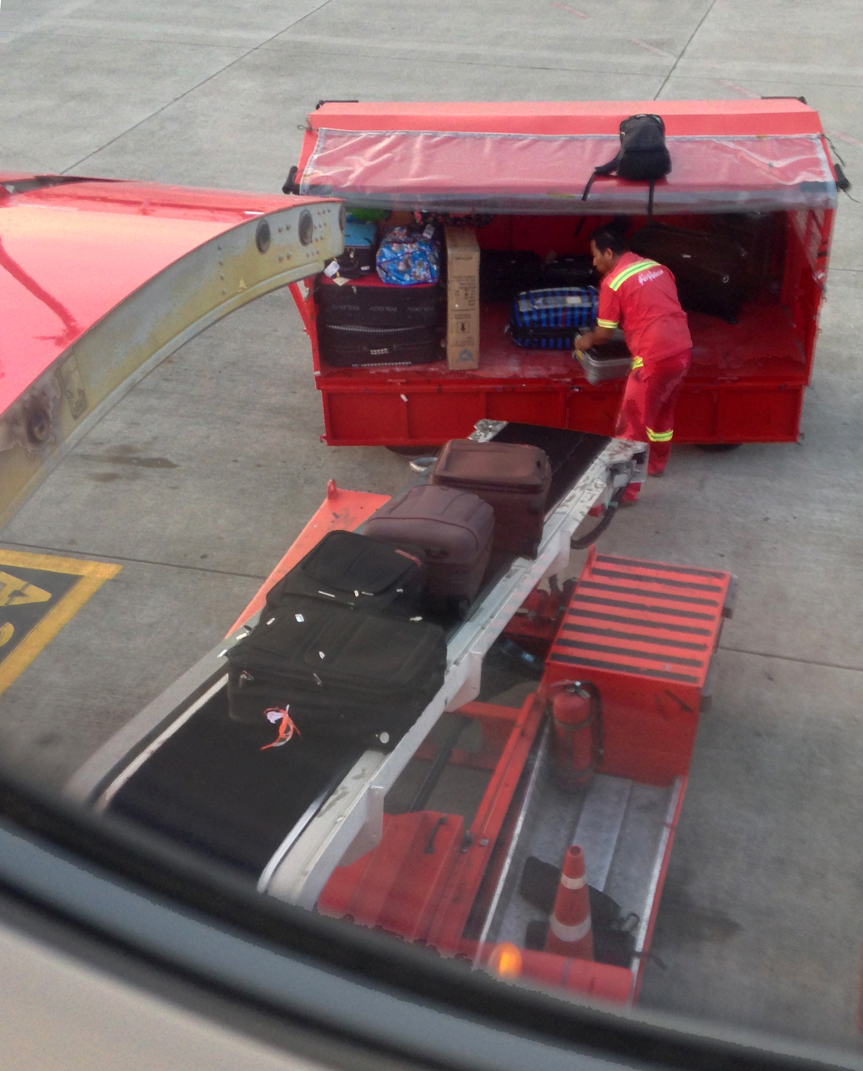
Chiang Mai: Arrived in the early evening and out through the exit tunnel into the airport corridors. Turn the first corner and we’re looking back through a large window at our plane with passenger bridge attached. M says, in her 9-year-old voice: take a photo of it… put in your blog Toong-Ting (she calls me that). There’ll be a time when M takes a direct editorial role in this blog… so I take the photo and here it is now. A passenger aircraft that has a painted face, while a large reptilian mouth is sucking out the contents of the plane.

M is silent for a moment as she considers the elasticity of this strange stretched metaphor. Then we continue along the corridors to get our bags from the luggage belt. I put everything on the trolley with M sitting on top, push the wheels through the glass doors, opening as we approach and we’re in Arrivals. Her mum is waiting for us, pleased to have M back.

Bags in the car and we’re off. Heavy traffic on the way into town and M, still silent, looking out at it all considering, maybe, how one thing can become another, tells me that cars have gender: boy-car and girl-car. It’s the look of the ‘face’ of the car – that kind of ‘grin’ created by the front bumper and radiator grille. She sees it as the face of a boy or a girl or, if she can’t decide which it is, it must be a katoey, effeminate gay male, trans-gender, or whatever – she giggles a bit, it’s okay to talk about that in Thailand. I ask her to identify a boy-car for me, just to see if I can recognise its ‘maleness’ – although I’ve always thought of a car as male being male. She points at one: that’s a boy-car Toong-Ting. I want to say… how d’you know that? But this kind of challenge to her reasoning might be too much, so I’m just going along with it.

She asks if I can identify the gender: you tell me, Toong-Ting, it’s a boy-car or girl-car, okay? I have a feeling I’m going to get this wrong… let’s see, there’s one that’s got really male characteristics, I point to it and say that one is a boy-car. No, Toong-Ting it’s a girl-car… looking at me like, how come you can’t see something as obvious as that, hmm?

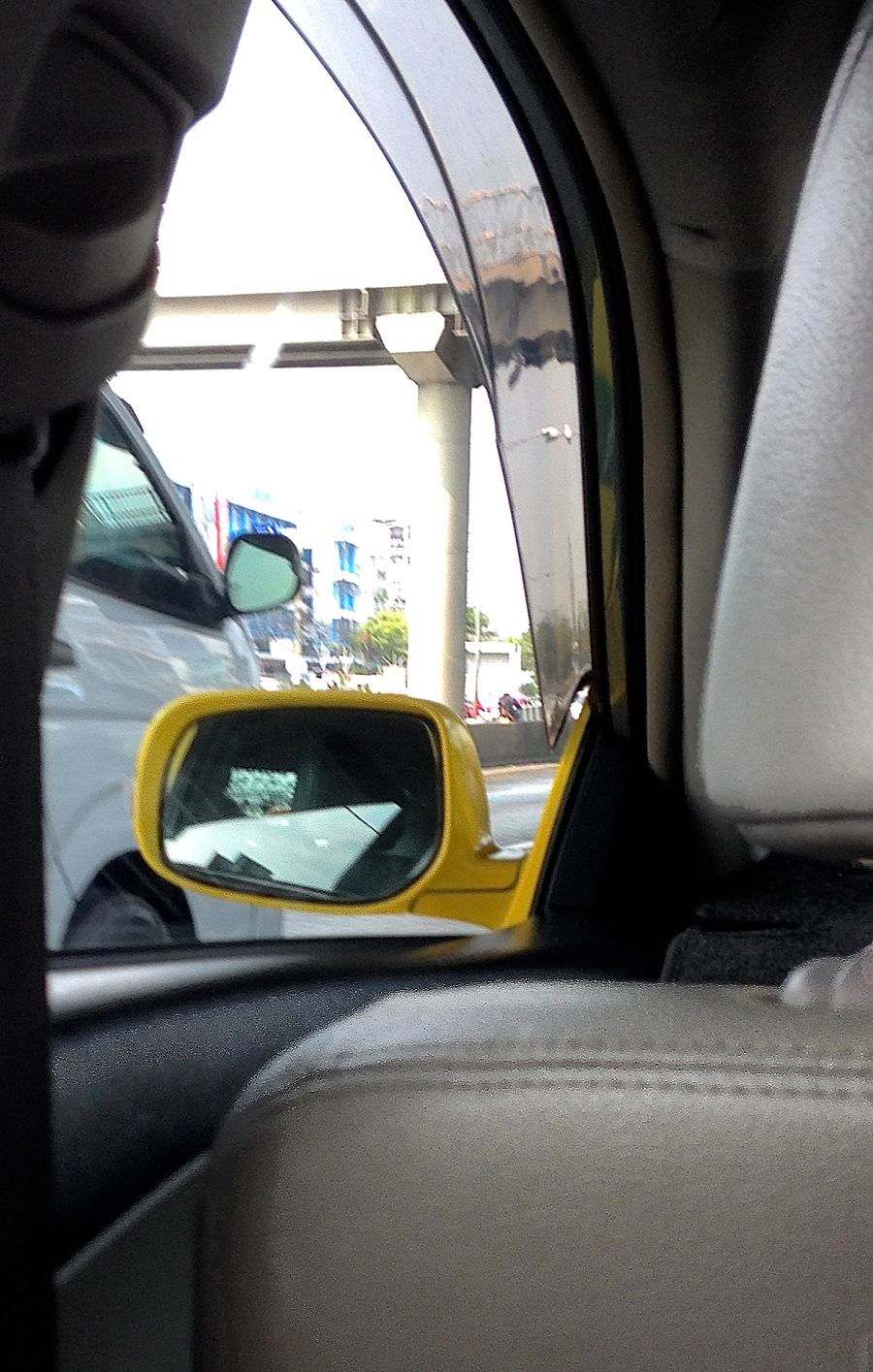
M spends a lot of time on the road, going to and from her school, a long way from her house. I think she probably knows the brands of all kinds of cars now, maybe not the names, just a familiarity with their appearance and long ago decided some were boy-cars, some were girl-cars, and those in-betweens were katoeys. As we’re going along, I take a photo of the back of a car and show it to her so she can study it in detail: boy or girl?  She says she can’t really tell looking at the back of it, can’t see its face, but thinks maybe it’s a girl-car, because she remembers that she decided at some earlier time, that particular make of car was a girl. It’s a case of remembering which is what (or what is which?) or what she had already decided it was when she first saw that make of car.

There’s intelligence in her playfulness, a reality in her personifications that challenges my usual insisting there is no ‘self’, the Buddha’s Teaching on anatta: ‘self’ is an illusion arising from the 5 Khandas. I feel I’m holding on to something I should let go of, with M going around happily applying the attributes of ‘self’ and gender to all kinds of things. She can create an identity and let it go, because it’s one among many. She can escape the entanglements of ‘self’ because she plays with a multitude of ‘selves’, like waves in the ocean and an ocean in all the oceans of the world. Everything in the universe is Self. The ‘self’ I believe to be ‘me’ is an assumed identity – there is no ‘self’, everything I see is ‘me’. First posted March 29. 2014. Check it out for additional gender photos taken by M.

‘Brahman is full of all perfections. And to say that Brahman has some purpose in creating the world will mean that it wants to attain through the process of creation something which it has not. And that is impossible. Hence, there can be no purpose of Brahman in creating the world. The world is a mere spontaneous creation of Brahman. It is a Lila, or sport, of Brahman. It is created out of Bliss, by Bliss and for Bliss. Lila indicates a spontaneous sportive activity of Brahman as distinguished from a self-conscious volitional effort. The concept of Lila signifies freedom as distinguished from necessity.’ [Ram Shanker Misra, The Integral Advaitism of Sri Aurobindo]

now here & nowhere

Chiang Mai:Going home in a tuk-tuk with M, nine years old, sitting beside me, small body-mass pressed against my side. The urgency of speed, kinda scary, canvas roof, no walls and immense sound of 2-stroke engine fills our space. Impossible to hear what she’s saying, M indicates that she wants to borrow my phone. I pull it out of my pocket, hesitate. Is it okay to play with a slippery glass-like instrument like this in a speeding tuk-tuk?  It might fly away into the great-rushing-past-outside world, anicca, necessity of mindfulness – she should hold it tight. Small face looks at me silently… don’t make a thing out of this Toong-Ting. I press it into her small hands. Hot, prehensile fingers grab, grasp and clasp the phone. Go to settings, clear away unwanted windows with the swipe of a tiny finger and launch multiplayer Minecraft.

So fast! I’m kinda surprised she’s managing to get Internet, 5G signal reaching us here in a tuk-tuk racing through the streets of Chiang Mai – more like we’re in it in the same way fish are in an ocean of water. Everything out-there passing by in a blur, feels like a totally crazy speed, why all this rush? I can see over the driver’s shoulder, through his windscreen and it’s like travelling through a wormhole in space-time; the actual here-and-now – everything outside of this is in a different reality. Everything on the ‘in’ side of it locked down tight, my arm around the slight presence of M, taking up such a small amount of the space on the seat, legs sticking out, and Minecraft’s digitally created landscapes of mountains and seascapes appear in the little window of the phone in her hands. She’s now in player-hosted servers with visiting players from all countries in the world. How do you say this Toong-Ting? She spells out: G-A-V-I-N. I tell her it’s a boy’s name, ‘Gavin’, probably English (who’s this Gavin guy, I wonder). I see name labels moving around the landscapes, Japanese and Italian names; Spanish, German, Norwegian – players I assume are about the same age as M. I see boy’s names and girl’s names, all here at this very moment – and, where is ‘here’? Good question: now here and nowhere (anagram), depends on the context… spatial and temporal qualities. Space and time are not separate; I read in a post recently. This is (always) where we are at.

Looking down at the top of her head, hair combed from a parting in the middle, pulled out in two separate directions, woven into tight plaits on either side, and it’s as if she knows I’m looking at her: Remember this number Toong-Ting: 19122, she says. I consciously remember the number, repeating it to myself… In a moment she asks me what the number was. I tell her, 19122 and ask what it was for, by the way, but she doesn’t answer… having to have things explained to me by a 9-year-old girl who speaks English as a second language – must be a password or username. Sad really, these days there’s not the dialogue there used to be, ‘I’ am not here, anatta, a suspended state, waiting for the next question. What’s this mean, Toong-Ting? M spells out: B-R-O-S and I tell her, Brothers it’s a boy’s server, he’s American probably, he’s black and I think she knew the word ’bro’ already. Obviously interested in this and next thing she’s in with the BROS, their mountains and volcanic lava, burning fires.

Then there’s a little wail – she gets disconnected. It feels to me like a catastrophe, but for M it’s no big deal, she changes to a different player-hosted server with new players – or maybe some of them are the same ones who just got here from the same sites we were all in earlier. And while that’s loading, a quick glance at the blur of what’s out there rushing by us, then she starts to sing a song from the movie: Frozen: ‘Let it go, let it go….’ I join her in the song. We sing together, Tuk-tuk driver laughing with his eyes in the rear-view mirror…. First posted April 25. 2015

“As wave is driven by wave
And each, pursued, pursues the wave ahead,
So time flies on and follows, flies, and follows,
Always, for ever and new. What was before
Is left behind; what never was is now;
And every passing moment is renewed.”
[Ovid, Metamorphoses]

blessings fill the room

Chiang Mai: 07.00 hours: The alarm rings…. it takes a moment to recognize I’m in Chiang Mai, arrived last night. Heavy curtains over the window; a darkness I’m not used to. It’s quiet here, the sound of monks chanting anumodana on the edge of hearing. A motorbike whizzes by in the distance, nothing else. Senses are alert, listening, feeling, searching for a way to ‘become’ something that will establish ‘me’ in this place and time but I can’t, I’m distracted by these new surroundings and keep returning to the narrative associated with interesting objects.

Walking across the room, bare feet on cool floor tiles, flip flop, flip flop, a sense of empty rooms, as yet uninhabited; space/time occupied with the moving of its integral parts – chapters from a book about furniture being moved into a new apartment, the ending hasn’t been written yet and the beginning is a continuation of what happened before that. Future time slides into present time, tomorrow becomes today, and ‘now’ becomes yesterday – here we are in the awareness of this moment, the means by which we arrive at this point in time is forever the mystery.

I go over to the window, slide open the curtain. A blaze of colour, five monks in varying shades of orange robes and a group of kneeling Thai tourists from the hotel opposite. (The original post is dated Christmas Day 2012.) In Thailand, 25th December is just an ordinary day, kids go to school, people go to work, government offices are open, mail gets delivered, transport systems are normal, it’s all open for business, same as usual. Yet there are Christmas decorations everywhere downtown, Christmas carols playing in all the malls and the season of goodwill has a place here even though the population are 95% Buddhist, 4% Moslem and only 1.2% Christian. It’s because Thai society is joyful; they like to share everything. They like playfulness – the word in Thai is sanuk (fun), everything has to be sanuk and if it’s not, it’s mai sanuk (seriously boring) and that’s very bad style.

 And there’s a lot I could say about consumerist schemes embedded in our lives in the West that has resulted in our losing so much of our inherited cultural traditions. The Christmas festival is layered over with the maya (illusion)of santaclausisms and it’s as if the essential part of our spiritual truth got forgotten along the way and consumerism came along in its place.

But this is getting too serious, not in accord with the principle of sanuk, so no more about that. Another important part of Thai culture is tamboon. It t refers to the act of giving. This is a core Buddhist practice involving good deeds like offering food to the monks, donating to temples, chanting, meditating.

So, Christmas Day fits perfectly with the Thai love gift-giving and festivals making any event fun. [Adapted from an original dated December 25, 2012]
Merry Christmas friends and fellow bloggers ~ December 25, 2025

“Through our eyes, the universe is perceiving itself. Through our ears, the universe is listening to its harmonies. We are the witnesses through which the universe becomes conscious of its glory, of its magnificence.” [Allan Watts]

“The vastness created these human circuitries in order to have an experience of itself out of itself that it couldn’t have without them.” [Suzanne Segal, Collision with the Infinite]

the forever window

Chiang Mai: Early evening, M asks what kind of walls I’d like to have in the house she’s building for me. It’s the Minecraft game, everything created from virtual terrain, mountains, sea, sky and a square sun. She looks up from the iPad window and turns to me with enquiring lift of the eyebrow (a nine-year-old veteran). I say well, how about stone – walls are made of stone, aren’t they? It’s an unimaginative answer lacking in conviction – not paying attention properly. I ask what the choices are. She taps the screen to show me: gold, lapis, and you could have diamonds. Generosity. But I’ll just have the stone, please – keep it simple (thinking to myself is she going to come out soon from this digital dream she’s fallen into? Come out, it’s late and you have to do your homework. Be mindful and attend to things in the real world?) But there’s no ‘real’ world here. M says, what kind of roof you want in your house, Toong-Ting? (It’s her name for me) and I’m drawn into the discussion again. You like floor tiles Toong-Ting? I say what I’d like, and that looks nice (trying to reach her by telepathy, please, please emerge from the iPad window soon and think about the homework always in arrears!) For a moment it seems like she’s going to close the iPad but no, it goes on: why do you want that one? This other one looks nicer, does it look nice to you Toong-Ting?

I find answers that fit each question, but there’s no end to it; I know now the point of the exercise is to indulge expansively in this great wealth of choices. We have to try them all. No such thing as a final choice. The iPad is a forever window, a deep lake of astoundingly rich colours that’s difficult to surface from after you’ve fallen in – everything else in ‘real’ life is sadly dull. M dives into the forever window simply because it’s there. The containment of it is the context. The question answers itself, no need even to ask, cause becomes effect, timelessness without end.

Then for a moment she emerges from the dream, a flicker of alertness in her eye. Quickly, grab the opportunity! Act out a continuation of playfulness and joy, extend the interest to our surroundings and she decides to follow. Good, yes! It’s like guiding someone dismayed by sensory overload. Now let’s close the forever window for a while, shall we? Life is the same as it was but it’s quite nice out here. Fetch the school bag, heavy with stuff, reach inside and pull out a scrumfled homework book from the tangle of scraps of food wrappers in there, bits of tissue, and an overall blueness from a pen that flooded its ink inside the bag, a long time ago. My fingers are always slightly blue after visiting M’s bag; I go wash my hands while she considers her homework.

They have to make a simplified pop-up book page; the double page you open and a whole scene pops up. Wow, we never had fun homework like this when I was a kid! The teacher has given her a model of the folded-out paper mechanism she has to copy. A small spark of interest. Can do by myself now, Toong-Ting, she says, goes over to the sofa and pulls a large cushion over her head: but I have to think it first… stays under the cushion for quite a long time and I’m beginning to think I should ask if she’s okay under there. But next time I look M has cut and formed the folded-out bit with a scissors, glued on the picture that’s supposed to ‘pop up’ and it works – yaay! Well, not brilliant, but homework is not supposed to be a fun thing, it just gets ‘finished’. It’s done, put it away, now where were we? A voice says: may I borrow your iPhone, Toong-Ting? First posted March 25, 2014

‘We have a duty to befriend those aspects of obedience that stand outside of our house and shout to our reason, “O please, O please, come out and play.” For we have not come here to take prisoners or to confine our wondrous spirits. But to explore ever and ever more deeply our divine courage, freedom, and light.’ [Hafiz: We Have Not Come to Take Prisoners]

————————-

‘return to go’

Chiang Mai: I have an appointment with the doc about my general state of health, being a ‘senior person’. It goes all right, a small mark on my inner arm where the needle went in, get blood pills and come back in 6 months. Downstairs and out; we have a slightly complex schedule today and I have to say there’s a small anxiety in me that’s saying maybe we can’t get it all done; M’s mommy is coming to pick me up in the car outside the clinic, then we’re going to the airport to meet Jiab coming from India. I get a call from M: How are you feeling Toong Ting? And I say yes, I’m fine, where are you now? There’s a silence then M says: I’m in the car. I keep forgetting she doesn’t know about explaining what her location is at this moment… I ask, are you near me? There’s a dialogue with mommy in Thai then: about 10 minutes from where you are. Okay I’m waiting outside the clinic bye-bye! Anxiety again about waiting there for an unknown period

Car arrives and I get into the back seat with M, mommy in the front, driving. I always have to get in the back with M – she insists. Jumps past the large arm rest in the ‘down’ position that divides the back seat to make space for my large body mass. A small smile as if to say welcome to my space, then the shuffling of play objects out of the way and debris of food wrappers on the floor and lately, careful about ‘the book’ she’s reading placed on the armrest. It’s her world, it’s where she spends a number of hours of every day going to and from school, and then stopping at restaurants to get fast food because Mommy has to work every day – there’s nobody at home to cook. I get in the back seat and there’s a sense that this is where M lives.

We get to the airport and have to drive around and around because there’s just nowhere to park. Anxiety returns. When it’s near the time I get out and meet Jiab, help her with her bags, car comes by and we’re in. Jiab has to sit in the front with mommy because M doesn’t allow her in the back – in fact there’s an immediate small resentment when Jiab speaks to me. Same thing when we stop at a Japanese restaurant Oishi Shabushi, I have to sit next to M. This is the kind of restaurant where there’s a moving belt of small plates of food and you have about an hour to eat as much as you want for a set price. The haste and urgency of it encourages M to eat a lot. The rest of us are required to show enthusiasm. So, once again I eat too much and we stagger out to the car park and drive back to the condo.

It’s obvious to me, being now a senior person with expanding waistline I have to be mindful of how things are and try to get back to normality, the middle way, the Path; ‘return to go’ as they say in the monopoly game. Get back there, to start again. First posted April 25, 2015

To be able to be unhurried when hurried;
To be able not to slack off when relaxed;
To be able not to be frightened
And at a loss for what to do,
When frightened and at a loss;
This is the learning that returns us
To our natural state and transforms our lives.
[Liu Wemin, 16th Century]

————————-

mindfulness and the sound of rain

First posted August 2, 2015: New Delhi: 6.30am, wake up, turn over and watch the ceiling fan spinning… waves of air movement and coolness on the surface of wet eyes blinking. There’s this rhythmical creak. The fan needs to have oil. A familiarity with the small sound; it’s been going on all night as I was sleeping – half-awake, I’ve been singing a song in my head around the rhythm of it. A curious rising tone, it’s as if it were a question: creak? And, occasionally but not always, there’s a lesser sound, in offbeat syncopation, a small ‘quack’ sound, like a duck, a flat tone, not complying with the question; quack, a response that’s sort of dismissive: quack… creak? quack… creak? creak? … quack. Sometimes the rhythm alters and the ‘quack’ comes before the ‘creak?’ – as if the creak? is asking the quack to confirm what it just said, quack… creak? (What did you say?) creak?

There’s a limit to this kind of entertainment, even in a house where there’s no TV. Time to get up, the air seems different, humid, what is it? Upright position, legs swing over the bed; mindfulness of bare feet on cold floor… switch off the fan and the creak-quack-creak? slows down, stops. I hear rain on the roof window. Go through to the front room and look out; yes, it’s raining. An unusual darkness, heavy grey clouds up there form a kind of low-ceilinged sky. Pixel-filtered light has the quality of mother-of-pearl. Jiab’s slippers are outside, small puddles of rainwater beginning to form in the hollows where her feet have shaped the rubber – we live in a house where you leave your shoes by the door, step inside and walk around barefoot… I should have taken them in.

I bring my chair to sit by the open door and look out at the rain, open the glass doors, take in the slippers, warm air enters. It’s always hot… when I first experienced monsoon weather, I thought the rain would make it cool, but it just makes the ‘hot’ wet.

So, I sit there and listen for a while. The rain is a vast sea of tiny finger-snapping sounds. Individual collisions with the concrete seem to jump out of context with a sharpness – noticeable against a background of random pitter-patter sounds that are always just on the edge of hearing – as if the listening process itself chooses the sound. Mindful of the mechanisms of focusing, receiving the ‘world’ in this unknowing pre-selected form.

Somehow it answers a question I’ve been pondering over for a while, but can’t quite remember what it was… what was it? Maybe I haven’t gotten round to seeing it as a question yet… answer arrives before the question? Mindful about the fact that I can’t get to where I want to get to, but seem to be trying anyway – mindfulness of mindlessness. Mindfulness of the times when I forget to be mindful – the tendency to fall into the dream, into the fiction I’ve created; the unaware habituality. Mindfulness as a lightness, an alertness surrounding thoughts. Intermittent rain continues for the rest of the morning.

“Everything is created twice, first in the mind and then in reality.” [Robin S. Sharma]
note: the phrase ‘low-ceilinged sky’ comes from the title of an album by Stefan Andersson: Under a Low-Ceilinged Sky
: https://www.youtube.com/watch?v=MS7J7APu6lQ

alert 2

First posted September 8, 2012: GVA Switzerland: First dawn light and a black crow, last phantom of the night, flies in from the lakeside with louder and louder calls until it passes below our 7th floor balcony and the sound gets fainter as it disappears behind the building, then into the distance … CRAWCRAW. I’m sitting here, alert, and listening to that sound until nothing can be heard at all. No object to activate ear consciousness. It’s the Sunday morning GVA sleep-late feeling; only the zzz zzz zzz ZZZs coming from all the apartment buildings around. Look out the window, nobody about, streets are empty. I listen for the slightest sound but there isn’t anything… only the act of listening. It’s a novelty for me because I’m used to the hub-bub of Asian cities. Awareness poised, waiting for some object to come into range of the receptors. Without an object, awareness goes on forever. I can hear some sounds that are very far away, therefore I have an idea of ‘faraway-ness’. Beyond the range of receptors there is the great empty dome of sky, the void, suññatā1, spreading out around all things and present in all things

Attention drifts away and a series of incidental thought episodes appear; an anthology of short stories, then it’s all gone again in a moment. The empty space returns, the interval; why this pause? What is this still point where there’s no thought?

‘… (the) still point is not in the mind, it’s not in the body; this is where it’s incapable of being expressed in words, ineffable. The still point isn’t a point within the brain. Yet you’re realising that universal silence, stillness, oneness where all the rest is a reflection and seen in perspective…. personality, kamma, the differences, the varieties … are no longer deluding us because we’re no longer grasping at them.’ [‘The Way It Is’, Ajahn Sumedho, page 123]

The period of pause lasts as long as it takes for the next thought to arise and the tendency to create an identity for it, but before that happens there is this state of nothing. A non-event is taking place; everything gradually stops shifting around, settles down; time begins to stretch out and it all moves incredibly slowly. I forget and attention wanders again.

A pigeon flutters in, comes to rest on the balcony rail, folds away its wings, and there’s this small sigh. Quite a deep bird-sized sigh, filling its lungs with air, releasing it and a little ‘bob’ of the fat round body: ah, that’s nice….it looks at me with extended neck curiously then gets involved in preening feathers in strangely revealing postures.

I hear Jiab in the back room, doing things. She arrived from Phnom Penh yesterday. Not jet-lagged, she says, but we do have to do the laundry at this unusually early time in the morning. The laundry room is in the mezzanine of the building, so off we go, very quietly, one step at a time, downstairs, 6:00AM, past all the sleeping doorways of other people’s apartments, carrying the laundry in bags and trying to be really silent because the whole thing is a bit like being in a graveyard.

Then Jiab wants to sneeze… Oh no! It’s held for a moment then escapes. A surprisingly loud short sound like the bark of a small dog. The noise of it echoes around the tiled corridor and staircase, the window glass panels vibrate for a moment; metal rails hum in resonance and there’s the echo of it all through the stairwell. Dynamic. The silence is shocked by it! We spend some time after that trying to control the intense laughter as we go quietly down with our heavy bags.

1suññatā: (Śūnyatā) the absence of inherent existence in all phenomena.

‘Alert to the needs of the journey, those on the path of awareness, like swans, glide on, leaving behind their former resting places.’ [Dhammapada verse 91]

buddhists and christians

First published November 9, 2012: Chiang Mai: A very nice short flight here to Chiang Mai from Bangkok yesterday, 1 hour 10 minutes. They serve a small meal; it was like going upstairs to have lunch in the clouds, then it’s time to come down again. During the flight I was able to have a discussion with somebody I met there about Christianity and Buddhism – is there ‘something’ there (God) or is there not anything? And ‘not anything’ implies something that cannot be verbalised.

It is a bit like tight-rope walking for me as a Western Buddhist and now 30 years in Asia but still subject to the conditioning of the Church and childhood memories of it in the West. With my Christian companion here, there is agreement on many things. The main thing we agree about is that human beings may experience a certain kind of realization that there is no ‘self’, no identity, nothing there; nothing in the mind/body organism, it’s a construct. There’s a feeling of ‘lack’, and the shock that comes with this discovery causes dismay, distress, etc. Christians say the realization of emptiness is the absence of God, and this knowledge facilitates the entry of God, the creator of everything. This is what fills the emptiness; a significant turning point for all Christians.

Buddhists encounter this feeling of ‘lack’ in the same way but will not ‘fill’ it with anything, rather, they contemplate the emptiness of it in depth; examine the associated emotional reactions with mindfulness and come to see that, this  is how it is. Śūnyatā, the emptiness, the lack of ‘self’ is everywhere and in all things. The understanding that everything is without ‘self’ helps Buddhists to contemplate the constructed nature of the mind. It’s possible to see the whole picture; how everything works and where we go from here. It’s an open-ended, investigative approach that may lead to an understanding of the non-duality of the observed world and the observer of it, together as a oneness. What the Christians call God must be inside this, because it is all-inclusive. There cannot be anything outside of it.

Christians will depend on the attachment to a belief in God for guidance and that’s how they see the world; they might say that ‘emptiness’ for the Buddhist is the Buddhist sense of God? And Buddhists could consider it this way, but the Buddha didn’t see any point in going further with that because the important thing is to make sure you are seeing reality correctly; not caught in wishful thinking. Necessary because working only with belief and faith and no pragmatic teachings means there are all kinds of things that can go wrong with it. Christians are focused on this, what it is believed to be; Buddhists say conceptualizing a God leads to attachment, tanha; the desire for, and attachment to, ideas and ideals, views, opinions, theories, conceptions and beliefs. [Dhamma-tahā, Walpole Rahula].

If I say the word ‘God’ to myself, something comes into my mind, the word ‘God’ has an immediate emotive effect. Certain assumptions arise and the mind is already closed around it; it’s a ‘special’ thing [Ajahn Jagaro]. When Christians talk about God, what they’re referring to (I think) is the God they are creating in their own minds – their loving devotion to a personal god: a deity who can be related to as a person, but God is beyond everything that is conceived or thought about. There is no adequate analogy, words cannot describe it. It cannot even be imagined because it is beyond space and time. Buddhists stay separate from the God concept because to become involved with it means making assumptions about a kind of consciousness that is totally different from ordinary mind states. This is not to say there is no God, for me, at this time, it is impossible to express in words what God could be. Then there’s a stewardess announcement: The plane is starting its descent, please put your fold-away table up, arm rest down, and chair forward. A small clutter of prepositions, and I get lost in the directions for a moment. Then we’re on firm ground again.

the forever turning

First published May 3, 2017: New Delhi: House agent came to the door, saying they are going to demolish the building, and when would be a good time for the architect to come to see the house – it was said like how we decide to delete a message on the phone. We knew about the plan and are prepared, but the emphatic bluntness of it… what’s gone is gone, the forever turning wheel. “Don’t let the sun go down on me.” My world is tipping over, mind driven by some kind of energy, a curiosity and desire to get involved with it. Words come out grouped in chunks, searching for a connection as if they had a volition of their own.

The characteristic mind reaction when confronted with an immutable truth; when I understood that my PHN headache is a permanent condition. As Jude says, the mind is creative no matter what the stimuli. Imagination let loose like a racehorse, goes careering off then is yanked back unwillingly and all kinds of fearful things arise, created by the struggle. How to have mindfulness so I can catch that creative awareness before I get hijacked by how bad it seems.

World-wide monitoring of events, immediate media coverage, on the spot reporting in a here-and-now performance starring ‘he’ who is about to be demolished: boom, crash, bang! It’s finished before it began, the whole scene gets folded into itself and packed away, gone – like it never happened, no evidence remains. Grab the bags and let’s get out of here. ‘I’ become ‘him’ over there, third person singular, object pronoun, making an escape out the window into the garden before the walls cave in. Away in the car through a swirling cloud of masonry brick dust, and onto the long straight road to the airport.

Check-in for the overnight flight to Bangkok, thinking of tomorrow and the day after tomorrow … I’d like it if the whole thing could be put on fast-forward so I can get it over and done with, but it hasn’t even started yet. I’m here on the plane and in my mind, are pictures of a house falling down around my ears.

The flight is a directionless experience. Look out the window, total darkness, no sense of moving forward, we could be flying sideways. When I try to think of it, there’s the image of a journey that leads from here to there, the route we take is an elevated highway in the sky, we’re in a long silver night coach with the moon and stars and stewardesses with the drinks trolley. Occasional air turbulence suggests small bumps on an otherwise very smooth road surface – sufficient to tip me over and fall asleep, with not even the sense that we’re going anywhere… just the noise of the engines and hiss of the air.

The present moment is not an absolute. It’s something that we’re [unconsciously] fabricating, and the goal of the practice is to learn how to fabricate it in a new [nirvanic] direction…. The present is here to be used, and the teachings are here to teach us how to use it wisely” [Thanissaro Bhikkhu, “The Use of the Present,” 2016-11-28]

the bird is the messenger

First published August 19, 2017: Delhi: It’s as if a note was tied around its tiny leg bringing us the news; we’re moving from here at the end of September. After that, three months in temporary accommodation, then we’re leaving India for good.

There it is again, the tiny bird in the bush outside, and I’m inside the room, trying to get a clear photo of it through the window glass. There were three of them there, the other two out of sight right now. They move so fast, quicker than thinking. It’s the Purple Sunbird, olive green as youngsters and these are so small, almost not there at all. I blink my eyes and they disappear… the quickening. See one for an instant then it’s gone – takes my breath away.

Even now, it all seems to be coming an end – a cancellation of everything that remains, no time to settle, before we’re gone. The disappearance of the past, a new direction, and return to Bangkok – return to “GO”… time is just slippin’ away.

It doesn’t seem so long ago that we came to this house, characteristics of the shift from house A to house B. At the edge of my vision, household items look at me as I pass… poised in a choreography of dance steps, ready for their next move. The great leap… percussive landing, clatter, scrape, bump and hastily take up their positions in new rooms and the packaging is tidied away

In the morning, we wake up in somebody else’s house… a familiarity of objects out of context in these new surroundings. I’m in someone else’s life – stepped out of my own life, into theirs. Same world, just a different angle on how it’s seen, felt and understood– same sensory awareness mechanism creates the kaleidoscope of different coloured lights.

Where am I? Maybe I’ll find myself in the Lost and Found Department. Searching among the ghosts there, for a Self gone missing – but if it can’t be found, any one will do. I can bear with the tendency for “self” to think it’s different from all the other “selves” going around thinking they’re different too.

Who am I? The world is how I/you perceive it, he/she, perceives it. We/you and they see and look into each other’s eyes. A window opens into another realm inhabited by him, her and them. The sense of their presence inter-lacing with the presence of others before them and as yet nothing of our own. Generations and generations of karma in an arrangement of cause and conditions and interconnected lives

I remember coming here with the house agent. Walking up the path, open the door… ghosts of previous tenants rush away to their hiding places in a whisper of movement. For me there’s only the dust of empty houses I’ve viewed everywhere in the city – looking for somewhere to sit in a room with no furniture. Leaning thus, in a doorframe, and maybe this will do. Maybe here we can invent a life we’ll be happy with. Awareness takes it all in, puts it away in a new folder. A new reference point: ‘this’ is where the heart is, home is where I hang my hat.

Death is drawn to sound
like a slipper without a foot, a suit without its wearer,
comes to knock with a ring, stoneless and fingerless,
comes to shout without a mouth, a tongue, without a throat.
Nevertheless its footsteps sound
and its clothes echo, hushed like a tree.
[Excerpt from Pablo Neruda, “Death Alone”]