a somewhere-else place

First published October 23, 2020: Bangkok: Awake in the darkness before 6 am, sit up in bed and take a meditational posture I invented myself. I can get the body up into the folded legs position, seated on two pillows on top of each other which sink into the mattress. This way I can hold my position comfortably just above the level of the bed, kinda floating there with the knees supported by rolled up edges of quilts pushed into the gaps. It takes a moment or two to get it feeling right… then there is only the breath.

Breath entering the body… feel the impact of incoming air in the nasal passage, “Breathe in slow-ly, breathe out lo-ng”. The breath hurries away, then comes back again as if it has forgotten something – searching all through the body, then it withdraws. Breath enters the body again, this time like a gust of wind, blows everything all over the place. Withdraws in a moment and it’s gone.

Vivid sweeps of colour and a curious light illuminating the space perceived behind the eyes. Mind is aware of the headache that’s always here, otherwise mesmerized by the form and function of the body, only slightly held in this limited temporality; thin skin of eyelid lizard-like slides over surface of smooth eyeball and that strangely seen light entering my darkness; just this…

Birdsong in the trees outside tell me it’s near daybreak, sensory processes perceive the world, aware that it’s an upside-down reflected hologram the brain and optic nerve make sense of – understood but impossible to see it as it is. Or is this how it is… in its as-it-is-ness? Was this world here before I was born? Something wrong with the question, duality. Everything just going on as it is now, without that person called ‘me’ in it. There’s an anonymity about this that’s quite liberating; birds in the trees and all the other random events taking place as they are now, here in this thin slice of time, revisiting the discussion; all that was said, received, held, seen, nurtured.

Then, a window opens. There’s a visitor arriving from somewhere, thousands of miles from here and in a great expanse in time. He appears in the form of a small boy, bowed head, string showing round the neck at the collar; latch-door key kid, scruffy uniform, bleeding at the knee. Teacher in a controlling voice says, ‘You have to think about what you’re doing before you do it, okay?’ Small boy nods, says ‘yes Miss, and shuffles out of the room to go and see the nurse about the knee. Teacher was talking about mindfulness decades before it came to be what it is today. For me, as an adult it remained something unlearned, but bearing a familiarity and intuitively known when it became conscious.

Daylight is here and I’m now lying on the bed, thinking about the small boy as he was in a state of anxious urgency every day and for many years to come. No one at home for support, forgetful and undecided because of the struggle to ‘get it right’ and nobody to reassure him that yes, you can leave book-work and use intelligent guesswork. The built-in reasoning of mind in these circumstances is enough.  

I’m telling myself this of course too late for it to be to be acted upon. I had to take the long way round; wasted years disappeared, searching for motivation in situations that offer comfort, shelter, gratification, everything thrown to the wind. Stumbling and crashing through the successes and failures of many lives, and coming to India more than thirty years ago – there to be suddenly awakened to the whole story”. It took me a very long time to grow up, and even now at the age of 73 years, I feel like an adolescent. Maybe I stayed young and it’s the world that got old…? I continue to return to these windows that open in memory. There must be a larger awareness that includes this, here-and-now… an awareness of one thought that includes awareness of another. There’s something that allows me to consider this, I’m seeing it from a somewhere-else place.

Photo by Sue Douglas

jesus & advaita vedanta

First published July 1, 2012. [Note: The original post attracted a lot of attention, 74 likes and many comments, some of which continued 5 years later. I learned so much from them … it’s worth taking a look, I’ve included some of these at the end of the post.]

I didn’t know about Advaita Vedānta when I was a child and only recently discovered there were people like Alan Watts (and others) writing about non-duality in the Christian context, [link to part of the Alan Watts’ essay: This Is It]. Now I’m convinced it is important to focus on the fact that there is something at the heart of Christianity. The uncomfortable feeling that’s followed me all these years – that somehow, I missed the point of the Jesus Teaching – all this has gone when I think of the Advaitist aspect of the teaching. It’s the missing piece of the puzzle I just stumbled upon, coming from an Asian perspective, an inductive knowing and that’s how it works.

The reason I didn’t see it before is because the Western concept of God, having human attributes (similar to the Advaitist idea of Ishvara), contradicts the rational scientific view. Accepting something that’s scientifically impossible, just because it’s written down in the Bible, doesn’t make sense. It’s like a myth and that’s why Christianity never had any reality in the West. What’s needed is to take it all a bit further.

‘… when human beings think of Brahman, the Supreme Cosmic Spirit is projected upon the limited, finite human mind and appears as Ishvara. Therefore, the mind projects human attributes, such as personality, motherhood, and fatherhood on the Supreme Being. God (as in Brahman) is not thought to have such attributes in the true sense.’

In Western countries, people are wandering around without a map. There’s the shopping mall and that’s all. How to let go of the individual ‘self’ if everything in the system is aimed at getting you to hold on? Looking for the way out by browsing possibilities will take a lifetime. The distractions built-in to window shopping behaviour are designed to keep you ‘shopping’ and prevent you from finding the way out too easily. By the time you get there you’ll have forgotten what it was you were looking for.

‘The Advaita Teachings are pointers, offered at the level of the audience, so to some people Jesus would talk about “a mansion with many rooms” and to other people he would say: “(heaven) is within.” (And) without understanding Advaita and the way pointers are adjusted depending on the audience, (most) Christians haven’t a clue what Jesus was talking about.’

Those who didn’t fall into the shopping mall trap just took the belief ‘thing’ to pieces to see what it was made of. That’s how it was seen that there was/is no substantial “self” in the centre of consciousness. It’s an operating system that keeps all working parts in the state of ‘oneness’. We are, right at this moment, God itself, and we can rejoice in that – if we can break out of our individual identity….’ If someone had been able to explain it to me like this when I was a child, the challenge to find out what it could mean would have been enough motivation for a lifetime.

‘When you fully understand that which you are and cannot not be, there is nothing to do to be

…………..
Check out the comments section in the original pos
t in the link below

something else

First published October 4, 2012: UK: I’m in a rush-hour train coming into London, standing in an integrated mass of human bodies all supporting each other. I’ve got a belt to hold on to above my head which is fortunate because the train is shaking about on uneven tracks, noisy and exhilarating. This really is the whole experience of train travel…. Then it settles down to a smoother pace and I’m focused on the closeness with other people; smell of wet raincoats and a forest of arms reaching up to hold on to roof belts, blocking the view. Somewhere nearby, a voice suddenly shouts out: ‘I’M ON THE TRAIN’ – a man speaking on his phone…

‘I think, therefore I am’ [cogito ergo sum] More than two thousand years before that, the Buddha noted the inherent problems in this kind of thinking: “I am the thinker’ lies at the root of all the categories and labels of conceptual proliferation, the type of thinking that can turn and attack the person employing it… “Do I exist?” – It depends on what you mean by “exist.” “Do I have a self?” – It depends on what you mean by “self.” Thinking driven by definitions like these often falls prey to the hidden motives or agendas behind the definitions, which means that it’s unreliable.’[Thanissaro Bhikkhu]

The man on the phone continues with his loud conversation, surrounded by people with grim faces who don’t speak. He disregards us completely, asserting himself in this space that everybody is squeezed together in, caught in the dis-ease of ‘deadly tedium’. We are struggling over this intrusion of the man and his phone but holding our composure with patient endurance. Folded newspaper in front of the face to avoid eye contact (this was before mobile phones), we are managing to ignore each other completely. Turn the page of the newspaper, fold it back skilfully without untoward touching and have a casual glance all around, as I’m doing it, just in case there’s anything that needs to be noticed, looked at or ‘seen’. No, everything is as it should be; newspaper held like demure fan that masks the face, and doing the crossword: 7 across: Four letters, ‘It may follow something _ _S_. Meanwhile the man talking on his phone is saying the line is breaking up because we are going through a tunnel.

I am committed to a world of consumption of goods and services. I want to have more of what I like and less of what I don’t like. I’m not interested in things that are neutral, they are meaningless (it’s a pity really, because the neutrality of feeling is the Way To Go). I am therefore in a chronic state of dissatisfaction because I never get what I really want. Okay, but as long as we’re mindful, it can be manageable? Well, it’s allright for some, you might say, for those of us who have recently returned from somewhere colourful and bright, light and cheerful, sun shines all the time; smiling Thai faces and their polite behaviour. But isn’t it just that they have a more cheerful kind of dukkha over there?

There’s a passenger announcement: ‘…delays at Croydon and Blackfriars due to congestion’. Then entering Liverpool Street: ‘… this train will not stop at Liverpool Street because of “flooding” at the Eastbound station (flooding?) and will continue on to Aldgate where passengers can take the train back and enter from the Westbound station which is unaffected and we apologize for any inconvenience.’ I have to ask other passengers what the announcement was about and surprised to discover everyone is friendly; the shared burden of these times of hardship and emergency – something conditioned by World War II?

I get there finally, near the end of a long list of Anglo-Saxon place names, and walking along with the South coast tourists in the pleasant harbour area of a town near the sea at Eastbourne. I’m looking for the office of an agent I have to visit and the phone in my pocket is ringing, who can this be… Hello? Jiab, she’s in Peru; hard to believe. She wants to know, can I get some of these wipes that are good for doing polished wood, and get a few packs, please? I have to take them with me when I come to Thailand. I hold up the phone high in the air so she can hear the Eastbourne seagulls all the way over there in Peru; a great swirl and echo of Northern seabirds singing in the wind, like cats mewing in the air.

 ‘It’s because of not understanding and not penetrating this Dhamma that this generation is like a tangled skein, a knotted ball of string, like matted rushes and reeds, and does not go beyond transmigration, beyond the planes of deprivation, woe, and bad destination.’ [DN 15 PTS: D ii 55 Maha-nidana Sutta: The Great Causes Discourse]

Note: This blog is now posting twice a week

endeavour

May 24, 2015: Delhi: I’ve had this photo in my files for a long time. All kinds of stuff comes to mind, studying it, but if you look closely, there’s an orderliness about it. These people are not fighting with each other to get on the roof of the train. This is Dhaka, Bangladesh, the massive exit from the city for Eid celebrations (end of fasting during the month of Ramadan). At the lower left you can see a hand extended to help someone climb on a window ledge. Others on the lower right are calmly waiting to see what’s going to happen because it looks like they can’t all get on this train. Maybe they’re waiting for the next one to arrive. Another thing that’s obvious for those on the roof is the fearlessness, the strength, the belief in each other, a kinship; the closeness of the group that you find everywhere in Asia, also I’ve noticed it in Thailand. These folk are from the ‘old world’. In the ‘new world’ (the West) the closeness is not so obvious. Could be we have been more war-like, the hunter-gatherers in ancient times, but within each clan there would still have been this unity, this bonding in the face of adversity. I feel it’s possible to recognize something of this affinity with each other.

I’m thinking of what it must be like to be one of these individuals with a place on the roof of the train, doing this trip annually; quite used to the sheer vastness of it all. Perhaps taking some comfort from the fact that there could be hundreds of human beings there at that very moment – also aware that the totality of this annual migration in Bangladesh is in the millions, certainly. Holding on to each other up there on the roof on the rough and bumpy ride. A journey maybe a day and part of a night, for some of them, and jumping off the train in groups, then probably another long journey to get home.

It reminds me of another event long ago, South India maybe 30 years ago. I was stuck in this provincial Bus Stand (bus terminal) because of a mix-up in routing on the way from Pondicherry to Bangalore. So just sitting on the pavement like all the rest do and waiting for my bus to turn up. Terrific noise and people everywhere, food vendors, everything. Other buses careering past and clouds of dust, black exhaust fumes and dangerous speeds – overloaded with people on the roof so much, the vehicle was leaning precariously to one side. It was quite a thing to see.

Then I noticed this boy running to catch his bus, 12 or 13yrs maybe, he looked at me, maybe the first foreigner he’d ever seen. There I was just sitting with everybody else. He hesitated then carried on running with a quick look back at me. Then running flat out to get his bus, speeding away very quickly. There was a moment when it looked like he wasn’t going to make it, then a hand reached out from somebody on the bus and he got pulled near enough to grab the ladder at the back that leads up to the roof. A wild leap and with both feet safely on the bottom rung, and held by others’ arms so both hands were tightly holding on, his head swiveled back, black eyes staring at me. The bus racing further and further away. I held the gaze like that, thinking there’s no way I’d have the strength and endeavor to do that. It seemed like this, held by watching his golden face turned towards me until the bus went out of sight.

“Right now you are Consciousness, appearing as a character in your play.  Maybe you think you need confirmation.  Forget it.  Relax.  You already are That.” [Nathan Gill]

Note: This blog is now posting twice a week, Thursday and Monday around 7pm Thai time

the thinking thing

First published December 5, 2012: New Delhi: It’s the middle of the night, it’s cold, I’m in bed and covered with a mountain of bed covers. Can’t sleep, just lying here thinking about things in the darkness. All the stories of my life come and go, click the channel-changer and there’s another one. I remember this, yes… so, he said that… and I said this… and then what happened? Click the channel-changer again and I’m somewhere else. It’s the thinking thing, continually pondering over suppositions, this and that and when I ask myself how to stop thinking the mind starts to look for a solution, drawing conclusions from known facts ad infinitum and I’m thinking again. It’s my Western cultural inheritance – separate from God, we are created by Him – studying the ‘object’ and logical, applied, deductive reasoning. Here in the Eastern context, it’s more like a gradually accumulating lake of inductive reasoning; the ‘whole’ is a pre-existing pattern composed of its parts. I can ‘feel’ my way into it and see where that takes me.

So, I stop thinking. There’s an awareness of the cold air on my face, sensory response vedanā; the mind engaged with the other senses tuned to reception from the outer world like satellite dishes search for a signal. When there’s no thinking, there’s an empty space where the thoughts used to be. I’m aware of the desire to be actively thinking, I see the invitation to be engaged with thinking – same as other forms of ‘wanting’ and mindfulness kicks in. But it occurs to me this is the Buddha’s teaching about the origination of the world: ‘Dependent on the eye & forms there arises eye-consciousness. The meeting of the three is contact….’(phassa) and I’m back into thinking again.

There’s something obvious about this, the mind is one of the six senses and functions like a receptor in the same way as the others do, except that it also has the purpose of ‘guarding’ the entry point; sense object activates the chain of events and mind has an intuitive, cognitive function; it is capable of discerning the object, like a security system. The exact nature of the cognitive mind holds my attention. I experience the absolutely empty space of no-thinking and either there’s not any sensory input the mind needs to be engaged with, or the apparent emptiness is caused by the mind’s awareness of being aware. There’s more of this empty space. Thoughts come in and go out again and the mind is watching the whole process. Sometimes I’m here as an observer, watching from behind the curtain. Other times the observer disappears, and it seems like only the mind itself is left there. That disappears too and, in its place, a sequence of momentary mental events, each one linking with the next as if it were electronic activity. It’s like a small fireworks display, arising and falling away. Some time later sleep comes and the world disappears.
[Note: This blog will be posting twice a week for as long as the review of older posts continues]

ten million to one

November 3, 2012: Bangkok: [Note: Continuing the series of early posts on the beginning of a sense of what Buddhism is. There is no direct reference here, this is one of the very early posts, the blog was barely one year old]
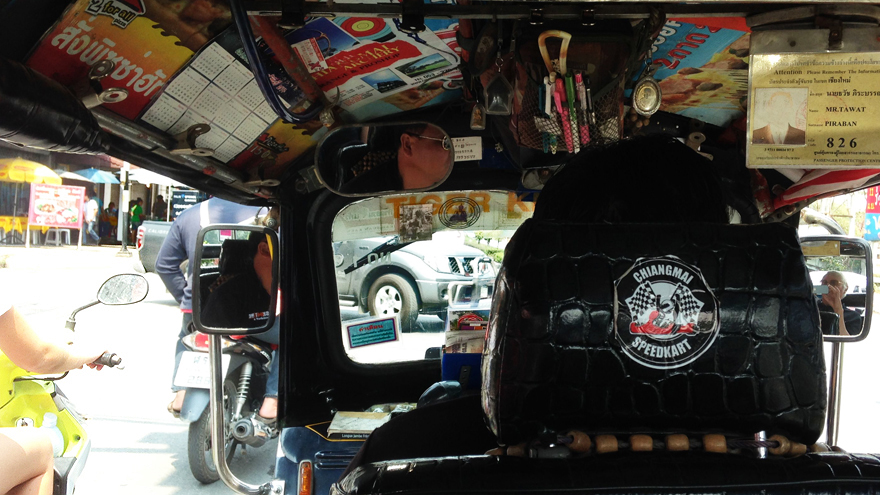
I’m in a downtown area, standing under an umbrella, trying to hail a taxi; heavy rain here and the traffic is going slow. A taxi pulls up, bright yellow and green, open the door and get in. There’s that strong smell of krating daeng (red bull), and jasmine flower garlands. I see a Buddha rupa and various auspicious objects everywhere. The taxi is old-style, well maintained but at the end of its days. The same could be said of the driver; ‘Loong’, meaning ‘uncle’, a respectful term used with any old man. In fact, he’s more like great-grandfather, smiling, childlike and ancient.

The most noticeable thing about him is he’s got no teeth and insists on grinning all the time. He’s likeable, asks me all the usual questions and it turns out his daughter lives near to where I live in Bangkok and that’s a talking point. He brings his attention to driving the car and I’m wondering how this is going to turn out, but it seems to be good enough. So, I settle back and look round the interior of the cab because it is crowded in here. Blessings and charms are painted on the ceiling, a great profusion of strings of beads, amulets and decorative hanging things tinkling and clanking from the rear-view mirror, and it takes me a little while to notice that the dashboard is covered with all kinds of toy objects stuck on with adhesive. The dog with the nodding head, and they all have moving, swinging heads, like this; coiled spring necks and crazy grinning faces that wobble slightly with the vibration of the engine but roll around madly every time his taxi makes a sudden movement, a touch on the brakes, an abrupt acceleration. It’s quite mesmerizing.

I’m just taking it in here, all these wobbly heads and various swinging objects in the middle of the windscreen; a part of the journey I didn’t expect. I get in his taxi simply to travel from point A to point B thinking that he just takes me there – and he does that but feels it necessary to surround his passengers with… something, what is it? I know some Thais who would feel uneasy in here, seeing a connection with phi (superstition). I don’t engage with that stuff and thinking it’s like this because, for him, it’s just boring and pointless; there’s no reason for this journey or any journey, and this is a kind of anchor. Somebody else will get in, after I get out, and that person will tell him to go somewhere else and off he goes. When he gets there it’s the same as the place he just left, and all other places. Traffic in the city is like water in the river; it gets everywhere, into all the corners where there’s space for it.

Every passenger who gets in has a directional goal-orientated intention; this old driver is not part of that, even though he is very much present. For him it may seem incidental in a profound sort of way; just wandering all over the town in randomness and along the way he’s arrived at the concept of all these wobbly heads, I suppose. It’s suitable because it’s meaningless, like everything else. His taxicab is like this because he’s in a place where it’s always ‘now’. Most of the cause/effect, time-bound, goal-directed thinking is just not there. Apart from control of the vehicle, which he must know completely, he is free; he’s not going anywhere because he doesn’t need to go anywhere; there’s nothing he needs. He just takes other people where they want to go and there’s just the emptiness of it.

In the Hermann Hesse novel: ‘Siddhartha’ (chapter 9), Siddhartha speaks to Vasudeva, the ferryman, about a lesson the river teaches, that time does not exist. “The river is everywhere at the same time, at the source and at the mouth…in the ocean and in the mountains, everywhere, and the present only exists for it, not the shadow of the past, nor the shadow of the future… Nothing was, nothing will be, everything has reality and presence.” He talks about listening to the ‘voice of the river’ and I’m wondering if it’s something like this that Loong is experiencing after a lifetime in the timelessness of this huge city.

Loong drops me where I want to go and it’s still raining. I get all the stuff done I was going to do and a few other things too and after a couple of hours I’m in some other part of town in another taxi. We’re stuck at traffic lights and I see this taxi go by with the same wobbly heads on the dashboard; amazing coincidence, considering there are 10 million people in this city – it’s Loong! And he doesn’t have a passenger. Quick decision, I pay off the taxi I’m in, the lights are still at red, jump out and run through the rain to Loong’s taxi. Open the passenger door and jump in – surprise, surprise! There’s wild laughter, and Loong’s great toothless mouth and all of it suddenly feels like a continuation, I was here all the time; I never got out of his cab the first time; the interval that happened in between was a daydream.

So, we set off back to my place and he’s happy about that because he gets to visit his daughter who lives nearby. I hear him explaining things to her on the phone. He’s too old to be driving, really, and as he’s doing that, I have a chance to revisit the strange and interesting timelessness that Loong’s taxi seems to contain.

all that remains

DELHI AIRPORT [First published in February 9, 2016]: Early morning in a coffee shop space while Jiab is checking-in for her flight to Mumbai. Me looking around and up above this steel glass and tiled environment to the old vaulted ceiling structure. Sometimes all I can do is find a quiet place and just sit. Looking at things from an oblique angle… it’s an unreal world. There’s this pain in my head, but I have a magic medicine pill that sends the pain away… then it’s gone… and a part of my mental functioning gone with it. Where’d it go? I think it went into another room where there’s a dance party going on all the time day and night. I can hear the music beat through the wall throbbing constantly… don’t recognize the music being played, no worries, the main thing is I can’t feel the pain; besides, it’s more like stress than pain. Sometimes I have no stress at all; sitting alert and mindful, vipassana. Other times I feel the energy of that stress so strongly it brings attention to the thin membrane separating me from the pain – it could rupture any moment now. Wait and see if it’s gonna happen?

Allow all things to pass, continue to sit, mindful, quiet and alert to everything that’s going on. A few tables next to me there’s a teen-aged girl with head and body hunched over her phone device, all I see is the reflected color glow from the screen on her face. The colour of her eyes sparkles with light that’s continually changing; flashes of blue, pink, and then, everything goes orange. She is having a conversation with her friend on speaker-phone, so she has her hands free to work on the keyboard and smoke her cigarette secretly, and here’s the thing, she’s writing messages on her phone and speaking with her friend and smoking a cigarette, all at the same time. Multi-tasking with a keyboard, speakerphone and the sound of very noisy texting: poo, paw, poo, paw, pee, pay, pay, poo; auditory stabs pierce my being, on the frequency that all phone-ring-tones and unfriendly digital sounds seem to inhabit.

The voice of her friend at the other end is really LOUD. Must be she’s calling from another party environment similar to the one going on in my head, all kinds of party noises – in fact I can’t tell the difference… what’s happening to me? Is she calling from inside my head? Disregard that thought. She has to shout to be heard: “Yeh, I know her, an I got natheen to say to her, that back-stabbin sawn offa beech!”

The girl here says something I can’t make out really loud in agreement. Maybe I can seek some peace from this noise, up in the ceiling structure, the bigger picture, the larger space within which all this is contained, and already the sound of the girl’s phone is like small harmless sparks from a loose electric wire.

But again, the intrusive lunge of the girlfriend’s voice into my space, razor-sharp blade of steel brings me back to the way things are. Language syllables, smack-your-head-around in shrill sound waves that slice my head and upper body into pieces fall to the ground, scattered around. The sense of bien-être quivers and gasps in a kind of death… such are the battles fought in the mind.

Jiab comes with her cabin luggage running on wheels behind; she is a small oriental with a large heart, we say goodbye at the security line and I make my way back. Out through the crowds and into the car, squeezing through traffic cacophony of car-horn noise and wondering why then realizing we are doing a U- turn, back to the way we came in.

The whole landscape is familiar but unfamiliar, pieces and parts of what is remembered, digital sound-and-vision recognizable from faraway events in history when huge towers in slow motion tumbled to the ground, as if all the concrete and steel had turned to dust. The population just can’t figure it out… please no, it’s too huge, time to move on from there. Only clouds of pollution now, the effect it has on everyone is the metaphor; devastation is all that remains.

You hide me in your cloak of Nothingness
Reflect my ghost in your glass of Being
I am nothing, yet appear: transparent dream
Where your eternity briefly trembles [Rumi]

attachment becomes generosity

Delhi: Packing household objects for the move is simple enough, there are two categories: a) things to Give Away, b) things to Keep. There is, also, c) things I have to give away, but want to keep. Still some reluctance there, gazing fondly at these possessions, do I really need this? In the end it all gets caught up in the momentum of leaving. I begin to see how it belongs in the ‘Give Away’ group, except there’s this tenacity of attachment; fingertips adhere to surfaces of the object – it would have to be pulled from my grasp.

The urgency of having to pack up and leave, sweeps the attachment into another place where it becomes generosity. Much-loved objects become gifts, rather than possessions. Generosity is letting-go, and the Buddha’s teaching on self/no self reveals the suffering inherent in the human condition caused by holding on, when we should be letting go. Compassion for those of us caught in the suffering of possession and ownership; the system creates the predicament – across the board consumerism stimulates a hunger that doesn’t lead to satisfaction but to a sharper edge to appetite.

A change in acoustics, the rooms are emptying fast, the sound of a single handclap creates an echo: “clap!” Household objects are disappearing at the same rate as large sealed boxes are appearing – rooms starting to vanish, space enters through the windows, floor gives way, and for a moment, everything turns inside out. Then seeing it the way it was before this, is impossible… memory gives way and it’s gone.

Parts of the interior are deleted; a blank space appears where something large used to be – the place where a thought used to be but it got forgotten; what was I thinking about there? Can’t remember. More of these blank spaces, objects wrapped in bubble wrap lose their identity. Everything packed away in boxes, cubed, diced up on the chopping board. I can’t remember what it was before this… there’s a world of things, and then there’s not.

This is a difficult time, earthquakes, hurricanes, and natural disasters of the Trump kind. The world is watching, not sure, uncertain. The urgency of thought seeks the safest place to be, the midway point and holding the balance; a place of equanimity in the midst of uncertainty, find a calm abiding there and cultivate the disposition to be free of bonds of ownership – attachment becomes generosity, relinquishment, letting go metta, loving kindness

In Asian languages, the word for ‘mind’ and the word for ‘heart’ are the same. So, if you’re not hearing mindfulness in some deep way as heartfulness, you’re not really understanding it. Compassion and kindness towards oneself are intrinsically woven into it. You could think of mindfulness as wise and affectionate attention. [Jon Kabat-Zinn]

First published September 22, 2017

the forever ‘now’

Fragments of a thought pieced together from associated thoughts, memories of a past time brought into present time, together with things thought about in future time. Words can snatch at things, pin them down and they say what they are. Any ‘new’ experience is assimilated and the actuality of it is filtered, obscured, cloaked.

Then pause for a moment, and everything stops, just the circumstance itself – there is only one moment, only one, going on all the time. I wake up to it every now and then, there and then, here and now in this place and time, but it is always now, the present now, the forever ‘now.’

“Time is in the mind; space is in the mind. The law of cause and effect Is also a way of thinking. In reality, all is here and now and all is one. Multiplicity and diversity are in the mind only.” [Nisargadatta]

I write it in my notebook, in the time taken to do that the thinking sequence seems to have jumped from the thing I’m thinking about, to the next, and then there’s a space … the smallest instant before it becomes something else. In the interval the mind is engaged in ‘thinking it’, everything moves on and I can never seem to catch up. Language is an overlay placed on reality, gives everything an identity, duality, ‘me’ and ‘you.’ Language tells the story, creates a fiction I get lost in. Nothing is what I think it is.

The present moment feels like it’s an immediate event occurring ‘now’, but there’s also a feeling that it comes from some timeless place. What we have is applied time, an agreed-upon measurement that we all apply.  Who‘s to say? Maybe this is something that has not happened yet… it happens later, gets reflected upon and what I think is ‘now’ is actually a moment of hindsight that had its origin in future time.

How can I be sure things are what I think they are when I’ve only just started feeling my way through something not experienced yet? Consciousness, the vast present time – the continuing ‘now’ phenomenon enfolding and unfolding, transforming from the future into past in one continuous surging-through movement that cannot be explained. What a strange mystery it is; future time slides into present time, tomorrow becomes today, ‘now’ falls back into yesterday, something ‘remembered.’

Mind creates a structure to explain time; otherwise, how could we understand the enigma of how the past is ‘gone’ and the future is not here yet? Hovering on the brink of the smallest pause before it gets there, the empty space of not-knowing what it is, and held like this for an instant…

“There exists only the present instant… a Now which always and without end is itself new. There is no yesterday nor any tomorrow, but only Now, as it was a thousand years ago and as it will be a thousand years hence.”
 [Meister Eckhart 1260 – 1328]

[First published, June 17, 2022]

unsung song

April 2, 2014: Chiang Mai: I’m awake before it’s light, start the computer and there’s a link to a music file of Gregorian Chant. Click on that…mystical voices and rustle of ecclesiastical robes of 10th Century Christianity. The darkness of the room here and glow of the screen suit the dramatic nature of the performance. It’s the breathlessness of the chant, itself, Wow! Exhaled air pushing through partly closed vocal cords, then an opening for the next breath then closing, and it does it again and again. The absolute physiological miracle of it. Forget the applied ‘meaning’ of Christianity or Islam or Hindu – it’s just the phenomenon of ‘voice. ’ Tone quality created in volume of throat, in void of mouth, intricate cranial cavities generate high frequencies, and the whole bone of skull is resonating like a fantastical musical horn, or a trumpet-like whistling wind-instrument, or acoustic device fixed at the top of the vocalist’s body. The performing ‘harmonic’ of human voice (and gasp of inbreath that follows it), echoing in stone walls of old Europe and holy places a thousand years old – listening to it blows me away…

After a while, there’s some light in the sky and the birds have started their dawn chorus all around me here in tropical South East Asia, third floor, level with the treetops – open all the windows and let the sound in. Switch the digital file to speaker, allow the intermingling Gregorian Chant to overlay on the flow of random exotic birdsong. An extraordinary mix. Birdsong is unstructured, uncreated, unmade – a song ‘unsung’ as is the sound that water makes rushing over the pebbles in a stream, a myriad of small collisions, the incidental harmony of it. I have to go and hear this birdsong performance in natural surroundings. Out of the door, down three floors to street level and there’s an old tree with large root formation noearby. Streets are quiet as dawn light illuminates the sky above the buildings… I stand under the tree and listen. [see image above].

Birdsong is on-going – a story told in a multitude of voices about something that’s always there. It is an event presented for its own sake. The sky is full of it, an abundance floods everything, devastates the scarcity of small mindedness. There is one bird nearby, it pauses to take a bird-size breath of air… a small interval of silence, then it continues. The regular pace of all these incidental pauses sprinkled through the pattern of groupings of sound, forms an almost discernible construct but not really a melody. There’s no beginning or middle, and no end. It’s more like a huge chord played on an instrument with a great number of strings. A phenomenon that’s there all the time, as the planet spins towards the sun, daylight invading national boundaries, mountains and lakes, the narrow line between night and day moves out of darkness into light, the constant herald of birdsong always and forever on the edge of global night.

Chuang Tzu and Hui Tzu were crossing the Hao River by the dam. Chuang said: “See how free the fishes leap and dart: that is their happiness.” Hui replied: “Since you are not a fish, how do you know what makes fishes happy?” Chuang said: “Since you are not I, how can you possibly know that I do not know what makes fishes happy?” Hui argued: “If I, not being you, cannot know what you know, it follows that you, not being a fish, cannot know what they know.” Chuang said: “Wait a minute! Let us get back to the original question. What you asked me was ‘How do you know what makes fishes happy?’ from the terms of your question you evidently know I know what makes fishes happy. “I know the joy of fishes in the river through my own joy as I go walking along the same river.” [xvii. 13] [The Way of Chuang Tzu, page 97, ‘The Joy of Fishes’, Thomas Merton]

Note: I’m interested in these old posts and planning to continue republishing edited forms of some of them for the time being.