being

IMG_0086b

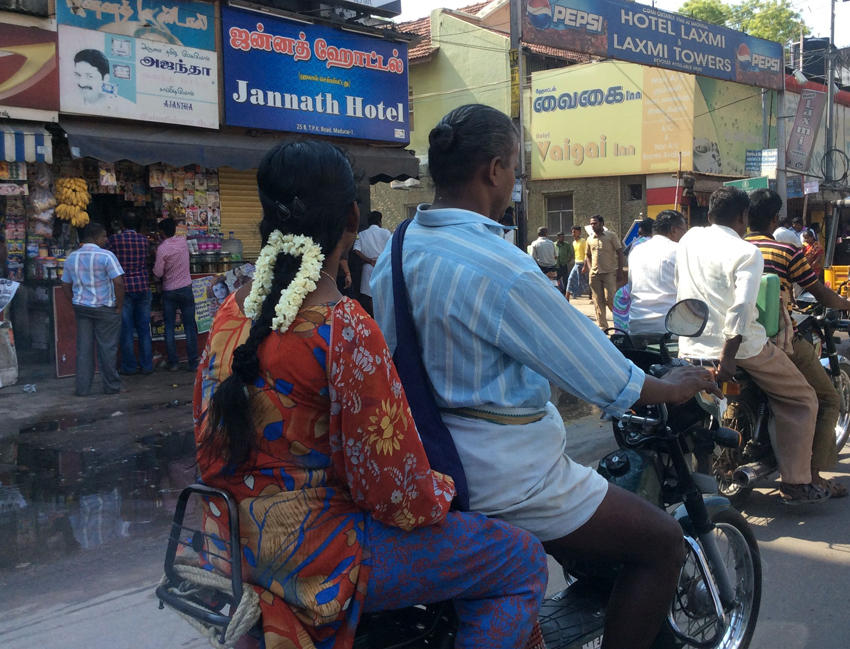
POSTCARD #119: Bangkok: The Thai new year came and went and it happened I had to go for a medical, nothing important I thought, but the doc said I had high blood pressure and gave me all kinds of pills to take. Anyway, when M got to hear about it, I became her patient and she’d arranged something on the porch, a comfortable chair and low table for my laptop, thermos and books. There’s also a ceiling fan out there so it was nice to just sit in the garden and simply ‘be’  there with the birds and the squirrels and ‘be’ a human (‘being’ as a verb), just being human.

Trying to focus on the infinitive form of the verb ‘to be’, the strange thing is, when I catch up to the present tense: ‘I am,’ it immediately becomes the past tense: ‘I was,’ (a moment ago). Chasing the elusive present time, a mind function identifying a miniscule speck of familiarity in a vast universe of an expanded present moment stretched beyond belief. And in the time taken to process it, the present moment immediately moves back into the past. It feels like everything happens after the event. Impossible to comprehend, words cannot reach…

Birds fly in all directions; the numberless beings in the world, and M enters my line of vision, carefully carrying a small plate of fruit, places it on my table and asks me how I’m feeling. Looks at me with her small oriental face, her eyes shine – consciousness is limitless so it can take this form. She does a spontaneous twirl and runs off with a hop and a skip … still partly a child. M isn’t the individual ‘I’, she’s the ‘I’ of everything that ever was – no particular self, she has a great number of selves, spends her days multitasking identities. A fictional character dressed in a costume that lasts a lifetime, playing a part in a narrative contained in an anthology of short stories. And the book is shelved in a vast library categorized by subject and author, most of which we have all read at some point in former lives.

Can’t help thinking somehow I missed the point of it all in my own childhood. A shadow of regret; life was only attraction, aversion, indifference: I don’t want that, I want this – something thought to be deservedly earned because I’ve been having such a hard time trying to obtain it… always, always, out of reach. Believing in the user illusion; the things we cling to (the clings we thing to). And the Church days; pray for peace and experience struggle. Pray for understanding and discover confusion. Pray for patience and encounter unbearable endurance. I never thought there could be something wrong with the question. Belief in the impossible and denial of the obvious. ‘God’ is not an object, ‘God’ is the subject…

The entry point is time evolving, developing, mushrooming out in all dimensions; the effect becomes the cause of the next effect and next cause in events that seemingly merge from a ‘before’ to an ‘after’. The bigger picture is that of a great river enfolding/unfolding and the presence of a sense that all of it remains to be seen.

“…we do not experience a succession of nows. This present now is the only now there is. The now in which the body was born is the very same now in which these words are appearing. It is the only now there ever truly is. [Rupert Spira]

too much

IMG_2110bPOSTCARD #117: Chiang Mai: Walking to school with M and we pass this 30 foot high sculpture of a cat with a moustache and a small handbag… too much. That’s how it looks to me, thinking of the many poets who died for love of the metaphor – and is this a monument to their too-muchness? But that’s only how I see it, a European living in Thailand. I ask M if she knows what it’s supposed to be? And look down at this small person walking beside me, backpack bouncing slightly always out of sync with the motion of her walk. She tells me something at length, but I can’t hear properly, so acknowledge with hmmm, really? Wait to see if there’s a follow-up response, but we’re focused on going to school and besides, we’re in this public place.

It’s too much – me being here, walking with this eleven-year-old Thai child holding my hand, and she with her Thai cultural behavior. When I ask M if I’m walking too fast, because she’s so small maybe I should slow down? She says, no Toong Ting, is okay and places her cheek against my forearm as we’re walking along in the heavy traffic, no pavement … it’s that too-much thing again. She’s on the inside all the way until we get to the main road and turn right. Then I need to change hands so I’m on the outside shielding her against the traffic and little M is on the inside. Three people on a small motorbike go past us, looks dangerous – but I’d be wrong to say that’s too much; it’s ordinary low budget. For them, it’s just right. What’s too much is that I think it’s too much, and my views and opinions are not relevant here.

A few people recognize us, smile; night shift security guards salute… too much; I’m not sure how to react when I’m being saluted at. We get to the school; other kids are there, the familiarity of it. M takes her shoes off, waves bye-bye and enters the building. I set off back the way we came, my too-much reaction is unavoidable and have to struggle to see it just as a reaction. For the Thais it’s different, there’s this built-in sense of ‘too much’; food is too spicy; too many colours in a room interior… that’s what they call ‘too much’. The word is bprung dtàeng, ปรุงแต่ง. There’s the mind form of it too; thinking too much, ‘conceptual proliferation’ the Buddhist term papañca. Human beings are like this; the reaction to follow thought is as automatic as the eyes see, nose smells… thoughts proliferate.

“It is quite amazing to watch as the mind takes the simplest thought, jumps on it, and runs off in all directions. Just as the ear hears without any effort (and in fact it takes a lot of effort to make the ear not hear), the mind proliferates effortlessly, and it takes a lot of effort and/or training to hold this tendency in check. It’s the unbidden “going” of the mind to so many different subsequent thoughts that is important, rather than the diverse places it goes […] By becoming masters of the directions in which our thoughts proliferate, we can achieve freedom. The Buddha recognizes that the mind’s tendency towards Papañca is unavoidable, and instead of fighting the inevitable, he teaches us how to ride (and tame) the tiger.” [Leigh Brasington]

————————-

transit

IMG_1812POSTCARD #116: Bangkok: We got here yesterday, flight from Chiang Mai, one night’s sleep and in the darkness of five o’clock in the morning next day there’s a voice in M’s room. It’s her mom saying, time to wake up. I can’t hear exactly because I’m at the desk, listening to a YouTube music video with the ear buds in. There’s the glow of the video in the dark room and mom’s voice is a mumble going on and on… a sound that cannot be switched off – the option of going back to sleep is ruled out. I hear M’s voice, a baby bird calling, tiny high-pitched utterance; small resentment enclosed in a whimper.

Just as I start to forget, she creeps up behind me – gives me a fright… I turn round, see her sleepy face lit up in the illumination of the screen; what you listen to Toong Ting? I pull out the left earbud and give it to her, it’s Liquid Mind – Awakening (Cosmic Sea), click the link: here, extended peaceful music with nice visuals of stars and galaxies. She stands next to me, level with my shoulder, ear bud in her left ear and my ear bud in my right ear – we watch and listen together. Somewhere outside of the sound cloud we’re in, I hear ‘the voice’… this time it’s an urgent questioning pitch. I should tell M to go see what mommy wants but this music is so nice and we’re transfixed by the visuals. There’s a stirring beside me, then the curious sensation of M gently placing the earbud back into my ear – and she’s gone.

I am given the last hug, she’s out the door, into the car and off to the airport with Mom for the early morning flight to the South. M will have her 11th birthday there in the house in the trees. It’s the clan thing, the elders will study her face, her posture and see in her the ancestors. Those who are long gone will come alive again. She will be taken from house to house, she will anjali, show respect sawat di kha and it’ll be very boring because there’s no internet.

I sympathise with her why-do-I-have-to-do-this? feeling, I’ve had to do the clan thing too – more of an idle curiosity on the elders’ part, since I come from a different planet… but they’ve gotten used to my visits over the last 30 years of births, deaths and marriages. I arrive at the house in the trees and it’s a déjà vu moment, the ever-present now. The place is always associated with the last time I was here, no difference between time and space. Conscious experience is only ever happening in this body/mind organism, always here-and-now, the event is forever in present time. Usually it’s when somebody respected and venerable is approaching the end of their life. Last thing is, they may raise up slightly from the deathbed, hold my forearms in both hands and look into my eyes. A blessing given with this frail touch, held with their last ounce of energy. Next time I see them, they’re lying in a flimsy coffin as if asleep, hair looking nice and wearing reading glasses. After that, there’s the smoke rising from the crematorium chimney… those not busy being born are busy dying.

We’re all in transit, small children and old folks. I miss M, her laughter tinkling like a fragment of a Mozart piano concerto; her unbearable lightness of being….

‘I was not ‘there’ then, just as I am not ‘here’ now. I was not, am not, and will not be a separate being. If I am something, I am flow, I am experience, I am perspective.’ [Tashi Nyima]

————————-

leaving

IMG_0500POSTCARD#44: Chiang Mai: Time to close this chapter of the story. I’m leaving soon for New Delhi, transit in Bangkok for some days. The flight departs at 16.20 and before that there are things to do in the apartment: a basket of laundry to iron; ironing table set up and I’m standing there. Pointed end of the iron smoothens its way among the creases, sailing through mountains and valleys of fragrant laundered cloth, leaving a warm, flat plain of patterned textile in its wake. Place the heavy iron on its metal stand and there’s that pleasing little sound: clink-clink… then pick it up again to do another part of the garment. Doing the front, the back, the shoulders, the collar – place it on its stand again: clink-clink. Ironing is such a peaceful thing, the hot smoothness of it, all these landscapes of wrinkled cotton eased away.

Pictures unfold in the mind, a memory appears, the story begins. It’s wintertime, I’m in Kamakura, Japan, snow everywhere and the colourless luminosity of reflected light inside the dark interior of my cute little house (everything is small in Japan) high up on the slope of a hill, in the precincts of Zuisenji temple. The ironing table set up by the window; just enough room if I move carefully, laundry basket placed at hand and on the corner of a small table, a pile of folded ironed things. The brightness of reflected light outside illuminates what I’m doing. A time of sleepy afternoon days, the clink-clink sound of the iron at intervals intrudes gently into this comfortable silence.

There’s a small slooshing sound of someone walking through the snow – look out the window; a blinding whiteness, a photographic negative. Black tracks of footsteps on the path leading to the steps to the temple. It’s a lady walking with great care, taking smaller steps than Japanese ladies usually take. She is dressed in a long dark maroon coat and indigo coloured costume down to the ankles, feet in wooden geta slippers secured by a small V-shaped thong passing between the first and second toe over tabi, white stockings specially stitched for the purpose, and the entire foot encased in transparent galoshes with pretty floral designs. Holding her hand is a little girl about 8 years old, and it just happens that as I’m looking at the girl and her small white face, alert eyes, she turns to look at me… a faint smile, a moment of intelligent understanding; she sees me, a gaijin, framed in my window at eye level with the street: a foreigner lives there, in a house the same as ours… or maybe there are no words for it, just some kind of recognition, an enigma suddenly cleared away and knowing this.

How did life turn out for her? I feel sad that we only had the shared experience for that instant. Maybe it’s the remembering of events like these, returning many years later; a moment recalled, a thing that was puzzling for a long time suddenly understood, somehow – beyond words. These small moments of understanding, overlapping each other and it could be the more I’m aware of it, the more conscious experience includes the possibility of revelation. And this is the reason why there’s always a fascination with the remembered moment; an event or an accumulation of events that make sense… somehow. Language doesn’t stretch that far; the whole thing just carries meaning.

Ironing along the seams, the waistband, how good these garments look, just as they are, stitched art objects – clink-clink goes the iron. Pictures unfolding in the mind, a memory of an event is a story with a beginning, a middle, an end – although I might arrive in the middle and have to work it out from that entry point; searching for the ending of it so that I have some idea of what the beginning could have been – then re-order it so the story starts as it should (“… once upon a time….”). Language insists on a structure, I have to ‘story’ it (verb: to story), think about how to get it to work; what happened after that? Create a sequence of events. Listening to a story I’m telling myself as if it were being told to me by someone else.

Getting this place cleared up and ready now so that it can enfold itself quietly in hibernation while I’m away living in another world. Soon it’ll be time to jump into the taxi and off…

‘We are forever telling stories about ourselves. In telling these self-stories to others we may, for most purposes, be said to be performing straightforward narrative actions. In saying that we also tell them to ourselves, however, we are enclosing one story within another. This is the story that there is a self to tell something to, a someone else serving as an audience who is oneself or one’s self…. On this view the self is a telling.’ [Roy Schafer]

————————-

now as it was then

Bodh Gaya: 04.00 hours, this is where the enlightenment took place. I’m in a hotel not far from where it happened, early morning and the window is open, sitting on a cushion with mindfulness, watching the breath. There’s a sense of, it’s just over there, out the window and over to the right a bit; yes, it was there that the event took place. I’m near to the epicenter, ground zero. From here, it spread outwards to the people close by and dispersed among everyone who had a mind to listen. Then, in the course of time, reaching out to all parts of the world, so that visitors from Tibet, China, Japan, Korea, South East Asia and other places eventually came here to see for themselves. Ordinary lay people came, conversions from Hindu castes, bearded sannyasis with matted hair and white marks smeared across the forehead, and monastics came from all over Asia, robes in shades of ochre, maroon and grey; chanting … namo tassa bhagavato arahato samma sambuddhassa … various intonations and melodic rhythms altogether in a pleasant discord.

How much of this is the same now as it was then, 2,600 years ago? The sensation of the breath is the same. The air gently touching the inner surfaces of nasal passages and throat and the consciousness that arises with that feeling. Through my own humanness and in a subjective sense, I can recognize the humanness of the bodhisattva. As well as the same blue sky, brown earth; green foliage, and even though the outer objects I can see may not be the same, changed over the centuries, the process of seeing is the same. The consciousness that recognizes this is the same for me as it was/is for everyone, and the ‘me’ and ‘mine’ I experience is not in any way different from anyone else’s ‘me’ and ‘mine’ who lived at that time, or now, or will live any time in the future.

You could say it’s just a sense of history that’s present whenever you enter a historical site, or a building or museum. It’s possible to know how the people, who lived then, felt and understood the world; the things they looked at and what they heard, smelt, tasted, touched and their mind responses; all of that is the same for me now, here in this place where the bodhisattva walked 2,600 years ago. I’m connected with the outer world by consciousness, in the same way the people at that time were; the conscious experience of what is seen is the same for me as it was for the bodhisattva – simply that function. And the environment I’m in, the outer world, may be different from how it was at that time, but the body/mind organism that receives the experience is universal. All beings are caught in this conscious experience. There’s no need to add anything else. The sense of ‘now’ that’s the same today as it was then could be the sounds I hear, the feeling of sunlight and the gentle wind blowing in my face; an awareness of the ever-present sensory data telling me outer and inner are the same and I’m an inseparable part of it all.

————————-

Where there is the mind, where there are mental phenomena, mind-consciousness, things to be cognized by mind-consciousness, there a being exists or the description of a being. Where there is no mind, no mental phenomena, no mind-consciousness, there a being does not exist nor any description of a being. [SN 1.65]

Photo: prayer flags, Sravasti