awareness: nameless and stopped

Excerpts from Reflections: Ajahn Sucitto
One of the monks asked a renowned Forest Ajahn: ‘What’s it like to see things as they really are?’ There was an understandable air of expectation in the room: to ‘see things as they really are’ (yathābhutam ñānadassanam) is the vision of the Awakened Mind. What mystical insight was about to be revealed?

‘It’s ordinary,’ said the Ajahn in his customary succinct and matter-of-fact way.

Bodhidharma (6th Century CE), the legendary conveyor of the Ch’an Dhamma to China. Ch’an (from Sanskrit Jhāna), a Chinese school of Mahāyāna Buddhism. Bodhidharma had an exchange with the Chinese Emperor that was similar in tone to the Forest Ajahn. The Emperor, who had devotedly built temples and shrines throughout China, implored the Master, ‘What is the essence of the Holy Truth?’

‘Emptiness, no holiness,’ replied the sage.

Awakening is more of a deflation of the mind than a peak experience. That way, it’s difficult to grasp. Actually, ‘emptiness’ – until you understand it as the non-clingable, signless quality of what arises – does give one something a little mystical to cling to… perhaps the Emperor wasn’t ready for the really direct teaching. The point is that the closer you get to the Dhamma, the more you know that appearances aren’t where it’s at. What you are able to see is the Unconstructed, and the end to the conceiving, favouring and proliferations of the mind.

A related example is Bhikkhuni Patacāra’s experience of Awakening. Returning to her dwelling after a period of walking meditation, her realization occurred as she turned down the flame of her lamp: Like the going out of a flame was the release of awareness. (Thig. 5,10)

No blazing light, just the opposite… so, is ‘Awakening’ some kind of coma? Well, this apparent paradox occurs because awareness as consciousness is not fully understood. This kind of consciousness is the six-fold awareness that processes data through eye, ear, nose, tongue, body, and thinking mind. In this context, mind-consciousness is the awareness that is affected by the perceptions and feelings that arise from external sense contact, and also from of the internal (mind-base). The mind is always being affected, it’s either fluttering, on the run, or sliding from this to that. Now, maybe if all that flittering and chattering were to stop… that would be a stilling of an activity rather than an annihilation of anything solid. Which is exactly the point. It also explains why the language of Awakening is distinctly unexciting and doesn’t get one’s pulses racing.

It’s all in the mind. The mind base is the home of the impulses and psychological activities, which stimulate consciousness for good or for bad. On investigation these activities of liking, disliking, of hesitancy or eagerness are seen as arising dependent on our attitudes and subjectively-based perceptions we acquire over the course of time. Whether a taste is ‘delicious’ or music ‘pleasant, etc., all gets learned from paying attention and assessing results through language communication. This is how consciousness is formed, activated and programmed; a perception of ‘what’s out there,’ from moment to moment, defines a ‘me’, as lively, articulate, passionate, even-minded or dull. So, the solidity of our world and our self is based upon activities and formations. And what if they stopped? In that freeing up, in things really being seen as they are, the world and the self neither exist nor don’t exist. They both arise dependently.

One point to emphasize is that the ‘me’ sense is a solidification of the sense of presence that is the resonance of consciousness. It takes form dependent on the perceptions and feelings that consciousness forms, infers and otherwise derives from sense-contact. When an architect looks at a building, he/she becomes an architect (that particular sense of self doesn’t arise as they eat a meal or watch TV). And in that mode, he/she sees something different from that which is seen by a thief. The individual bias, the acquired activity forms an impression both of the subject and the object.

When pain or displeasure touch the heart, ‘I’ get formed as the victim of that. With pleasure, I become the owner. Then I get defensive or acquisitive and act accordingly – instant kamma. Have you seen – or felt – who you become when guilt or fear gets into you? Or when compassion or joy touches your heart? ‘Being touched’ is a formation; contact/impression is an activity that modifies and colours the sense of self. In this respect, I’m referring not so much to direct sensory contact, but the impression that the mind makes of that contact, called ‘designation contact’.

This form of contact is the significant one: owing to the subjective flavouring of designation contact, different people find different sights, sounds, flavours, ideas, remarks and gestures delightful, repugnant, or neutral. Designation contact sets up the familiar pattern of how we experience the world; and the consequent perceptions and impressions guide what we will make impingement contact with in the future. So, this is the key to how we react and create fresh action, or kamma, based on the blueprint of the past.

The sting in this apparently neutral functioning is that when it gets infected with ignorance, the mind takes as real, substantial and potentially acquirable what in fact has been formed by consciousness. So that stirs consciousness into chasing its tail, motivated by either acquisition, aversion or delusion. Of which three, delusion is the one that is most constantly streaming in.

So, how would it be if, instead of creating fantasies and phobias, those streams were to stop? Intellectually, it’s not difficult to repudiate delusion. As far as we can see, in the experienced Cosmos, there’s no such thing as a thing: from the stars and rocks on down to the oscillating cells in our bodies and our flickering thoughts, it’s all dynamic. How could there be a permanent self? But in all this movement, there’s one process that forms the apparent self. It’s the lock of grasping. And that occurs in the mind-base when it’s infected by ignorance. So, trust what arises within when the self-impression passes. Investigate the dukkha of ‘how it should be.’ Because with unerring simplicity, release always comes down to cultivating the Four Noble Truths. Selfless clarity spontaneously arises with their comprehension; what arises by itself after the release is the true guide.

And it’s nobody’s. The awareness that is liberated through such realization is just ‘aññā’ ‘the Knowing.’ It’s a knowing that has no subject, a development based on, but beyond, the mindful knowing and witnessing of what arises. At each stage of Awakening, as places where self-view congregates get freed, there is the Knowing, dispassionate and free from positions. And the Buddha constantly refused to make a self out of that.

Ajahn Sucitto

To read the whole piece, follow this link:
https://ajahnsucitto.org/reflections/awareness-nameless-and-stopped/

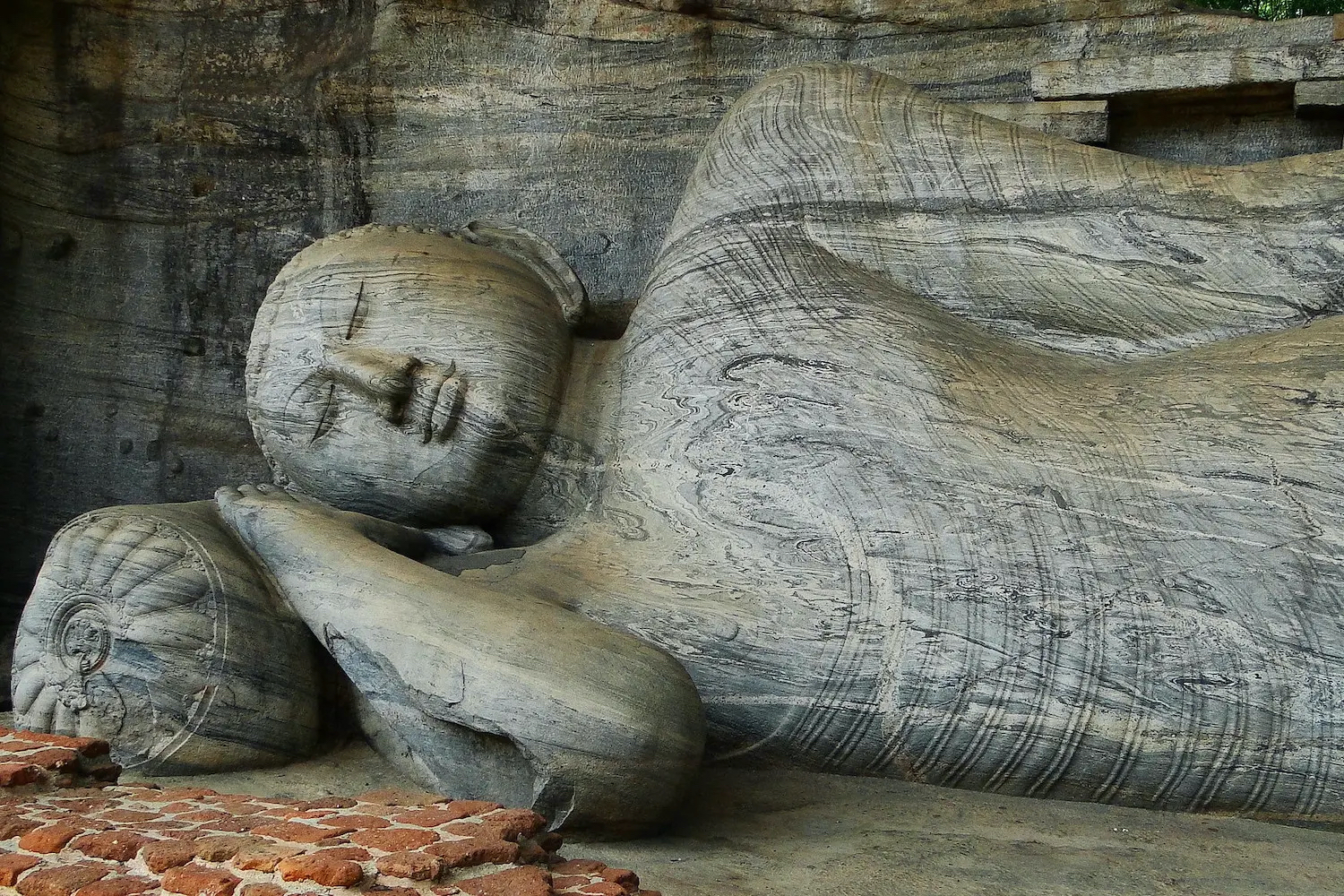
Image source: https://unsplash.com/photos/WGVOaJIyMd0

soaring summits of silence

Excerpts from the Introduction to: “Mindfulness, Bliss, and Beyond,” by Ajahn Brahm

During meditation we should not develop a mind that accumulates and holds on to things. Instead, we should develop a mind that is willing to let go, to give up all the burdens we carry like so many heavy suitcases. In meditation unload as much baggage as you can. Think of duties and achievements as heavy weights pressing upon you. Abandon them freely without looking back. This attitude of mind that inclines to giving up will lead you into deep meditation.

Meditators are like birds that soar through the sky and rise to the peaks. It is on such summits of perception that meditators will understand, from their own direct experience, what we call “mind” and the nature of what we call “self,’ “God,” “the world,” “the universe,” the whole lot. It’s there that they become enlightened – not in the realms of thought, but on the soaring summits of silence within their mind.

“Mindfulness, Bliss, and Beyond” is a guided tour through the world of timeless Buddhist rapture. It describes how meditation literally implodes into the supreme bliss of the jhānas and how such states of letting go lift the veil of our fives senses, to reveal the awesome world of the mind, the magic inner garden where enlightenment is reached.

In the Mahāsaccaka sutta (MN 36) the Buddha relates, “I considered:… ‘Could that [jhāna] be the path to enlightenment?’ Then following on that memory, came the realization, ‘That is the path to enlightenment.’”

Image: detail of a photo by Simon Berger (Unsplash)

disembodied beauty

Excerpts from Mindfulness, Bliss, and Beyond: A Meditator’s Handbook by Ajahn Brahm.

[Note: The following is the beginning of the meditational guide that takes the reader to the jhānas, the higher states of bliss. Ajahn Brahm explains that even though the jhānas may seem distant and unreachable, for some meditators, discussing such sublime states can create inspiration, as well as map out the territory ahead. Some readers may have already gotten close enough to be able to understand this discussion from their own experience, and it may help them to make that last leap into the jhānas – eventually the seeds that are planted in this kind of discussion will someday bear fruit.]

It would be marvellous for each one of us if we could abandon all inner speech and abide in silent awareness of the present moment long enough to realize how delightful it is. Silence is so much more productive of wisdom and clarity than thinking. When one realizes that, silence becomes more attractive and important. The mind inclines toward it, seeks it out constantly, to the point where it engages in the thinking process only if it is really necessary, only if there is some point to it.

Once we have realized that most of our thinking gets us nowhere, we gladly and easily spend much time in inner quiet. Turn the awareness onto the breath and follow that breath from moment to moment without interruption. Notice the arising of inner speech and the mind’s tendency to go off into the past or future. Come back to the breath, and see how your attention expands to take in every single moment of the breath.

You know the inbreath at the very first moment, when the first sensation of inbreathing arises. Then you observe as those sensations develop gradually through the whole course of one inbreath, not missing even a moment of the in-breath. When that in-breath finishes, you know that moment. You see in your mind that last movement of the in-breath. You then see the next moment as a pause between breaths, and then many more moments of pause until the out-breath begins. You see the first moment of out-breathing and each subsequent sensation as the out-breath evolves, until the out-breath disappears when its function is complete. All this is done in silence and in the present moment.

You can attain this degree of stillness by letting go of everything in the entire universe except for this momentary experience of the breath happening silently. Actually “you” do not reach this stage, the mind does. This is where the doer, the major part of one’s ego, starts to disappear. One finds that progress happens effortlessly at this stage of meditation. We just have to get out of the way, let go, and watch it all happen. The mind will automatically incline toward this very simple, peaceful, and delicious unity of being alone with one thing, just being with the breath in each and every moment. This is the unity of mind, the unity in the moment, the unity in stillness.

The Beautiful Breath

This is what I call the “springboard” of meditation, because from it one may dive into the blissful states. When we simply maintain this unity of consciousness by not interfering, the breath will begin to disappear. The breath appears to fade away as the mind focuses instead on what is at the center of the experience of breath, which is awesome peace, freedom, and bliss.

When the breath disappears, all that is left is “the beautiful.” Disembodied beauty becomes the sole object of the mind. The mind is now taking the mind as its own object of contemplation. We are no longer aware of the breath, body, thought, sound, or outside world. All that we are aware of is beauty, peace, bliss, light, or whatever our perception will later call it. We are experiencing only beauty, continuously, effortlessly, with nothing being beautiful! We have long ago let go of chatter, let go of descriptions and assessments. Here the mind is so still that it cannot say anything. One is just beginning to experience the first flowering of bliss in the mind. That bliss will develop, grow, and become very firm and strong. And then one may enter into the jhānas.

The book has been extensively discussed in dhammafootsteps, Click on the link below for a more detailed presentation

Photo by Simon Berger

there’s no need to be busy

Excerpts from “The Path to Peace: A Buddhist Guide to Cultivating Loving-Kindness” by Ayya Khema

There’s no need to be busy. We should of course fulfill our obligations and responsibilities. The Buddha always gave guidelines in that direction. But to be overly busy cannot possibly bring peacefulness. It cannot bring contentment. It cannot bring a heart full of love; it cannot bring a heart that can actually bring the mind to meditation. So, we should check our activities and see which ones are totally unnecessary. And we should see whether, with the activities that we do, we are not only trying to escape our own suffering (dukkha) but also trying to prove something to ourselves and others—that we are somebody. The more we try to prove that we are somebody, the less we have a chance to become nobody. And that’s what nirvana is all about. It doesn’t sound appealing to some people, because they haven’t had enough dukkha yet. When we’ve had enough dukkha with the somebody, we can actually appreciate the fact that there’s only one way to get out of dukkha, and that’s being nobody.

We have the wealth of absolute truth, of immeasurable love and compassion—the whole wealth of the universe within us. It’s just waiting to be discovered. But within the hustle and bustle of morning-to-evening activity, we’ll never manage to find it. It’s like a golden treasure that is lying within us, that we can actually touch upon through the quiet mind. Anyone can do it, but they’ve got to become quiet. And we’ve got to stop trying to be something special. Only then can we get at it, and then, having found it, we can share it. That’s what the Buddha did. He shared it for forty-five years. With a few thousand people. And today we’re sharing it with five hundred million. That’s the value of enlightenment.

So, we have that treasure. But if we really get busy, we have no way of unlocking that treasure chest. Unlocking it takes time, and it takes the quiet mind, the contented mind, the satisfied mind. It needs the mind which knows that there is something to be found far beyond anything at all that we can ever find in the world. And then we will make an attempt at checking out what is really necessary to do.

Whatever we do out of compassion is well done. And this should be our checkpoint: what am I doing out of compassion, and what am I doing in order to assert that I am really here and to let as many people know about it as possible, and what am I doing in order to get out of my dukkha to keep busy? But whatever I do out of compassion, that is what we should pursue.

Ayya Khema (1923–1997) was an international Buddhist teacher, and the first Western woman to become a Theravada Buddhist nun. An advocate of Buddhist women’s rights, in 1987 she helped coordinate the first conference for the Sakyadhita International Association of Buddhist Women in Bodh Gaya, India.

selflessness

Excerpts from “A Path With Heart: A Guide Through the Perils and Promises of Spiritual Life” by Jack Kornfield (1993)

When Buddhists speak of emptiness and of no self, what do they mean? Emptiness does not mean that things don’t exist, nor does “no self” mean that we don’t exist. Emptiness refers to the underlying nonseparation of life and the fertile ground of energy that gives rise to all forms of life. Our world and sense of self is a play of patterns.

Any identity we can grasp is transient, tentative. When we are silent and attentive, we can sense directly how we can never truly possess anything in the world. Clearly, we do not possess outer things. We are in some relationship with our cars, our home, our family, our jobs, but whatever that relationship is, it is “ours” only for a short time. In the end, things, people, or tasks die or change or we lose them. Nothing is exempt.

We encounter another aspect of the emptiness of self when we notice how everything arises out of nothing, comes out of the void, returns to the void, goes back to nothing. All our words of the past day have disappeared. Similarly, where has the past week or the past month or our childhood gone? They arose, did a little dance, and now they’ve vanished, along with the twentieth century, the nineteenth and eighteenth centuries, the ancient Romans and Greeks, the Pharaohs, and so forth. All experience arises in the present, does its dance, and disappears. Experience comes into being only tentatively, for a little time in a certain form; then that form ends and a new form replaces it moment by moment.

As we open and empty ourselves, we come to experience an interconnectedness, the realization that all things are joined and conditioned in an interdependent arising. Each experience and event contains all others. The teacher depends on the student, the airplane depends on the sky.

When a bell rings, is it the bell we hear, the air, the sound on our cars, or is it our brain that rings? It is all of these things. As the Taoists say, “The between is ringing.” The sound of the bell is here to he heard everywhere—in the eyes of every person we meet, in every tree and insect, in every breath we take…

When we truly sense this interconnectedness and the emptiness out of which all beings arise, we find liberation and a spacious joy. Discovering emptiness brings a lightness of heart, flexibility, and an ease that rests in all things. The more solidly we grasp our identity, the more solid our problems become. Once I asked a delightful old Sri Lankan meditation master to teach me the essence of Buddhism. He just laughed and said three times, “No self, no problem.”

Jack Kornfield was trained as a Buddhist monk in Thailand, Burma, and India, and holds a Ph.D. in clinical psychology. He is a psychotherapist and founding teacher of the Insight Meditation Society and the Spirit Rock Center. His books include Seeking the Heart of Wisdom and Still Forest Pool.

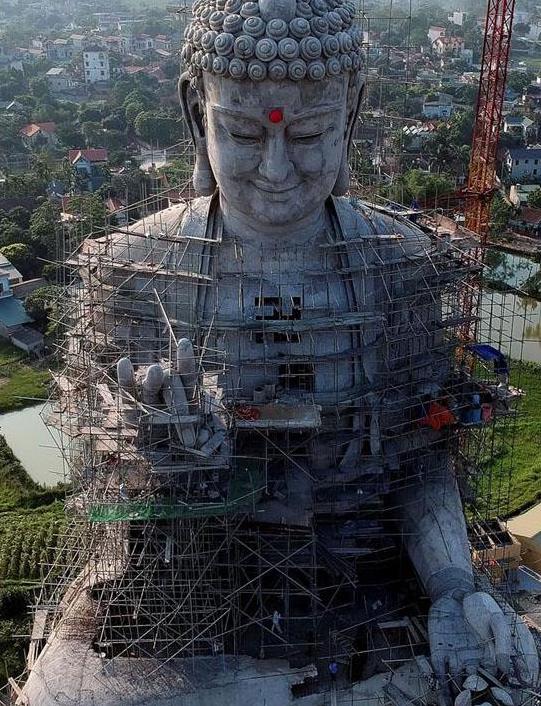
Image: Giant Buddha statue under construction at the Khai Nguyen Pagoda in Son Tay, on the outskirts of Hanoi, Vietnam, on May 18, 2019

perception & reaction

Essentially what counts about our life is our kamma (karma), that is, our actions of body, speech or mind. And kamma means you have a choice: you can act wisely now rather than react compulsively. Reactions are generated by contact – that is something touches the heart. When we notice or are struck by something – it could be something seen, remembered, tasted, imagined – then something vibrates and there’s perception. Perception is the solidification of the immediate impression arising in consciousness; the light goes on, there is meaning, true or false. Then comes the reaction, the volitional quality, or cetanā – and when the mind engages with that, there is kamma.

Training is about putting a micro-pause or attentiveness, between the perception and the reaction, or, between the mental reaction and any engagement with it. And it’s also good to challenge perceptions before they land, or as they arise. So, you establish the perception of impermanence: ‘This is going to change.’ And the perception of the unattractive: ‘This too loses flavour and breaks down.’ Then there are perceptions based on goodwill: ‘Just like me, they are enriched by kindness.’ And when we practice recollection, we establish perceptions based upon awakening: ‘Freedom from suffering is possible.’ In this way, you’re changing your life right now in terms of how and when the mind jumps.

Notice: What are the most habitual jumps? Habitual reactions are about how we repeatedly jump; the ingrained impressions and reactions that become ‘myself’. ‘I’m always like this, I see things this way, I tend to mistrust, or be apprehensive, or urgent, or dismissive, or…’  Then pause; wait a minute. Check. Do you have to jump, right now? Come out of the obsessive rut.

Ajahn Sucitto

Image by Penn B: Coastal view, Phuket Island

neti-neti

Neti-neti is a Sanskrit expression that translates to “neither this, nor that” or “not this, not this.” This expression is used in Hinduism, mainly in Jnana yoga and in Advaita Vedanta (non-dualistic spiritual practice). Neti-neti is a form of analytical meditation that helps the individual understand the nature of brahman (absolute reality) by first understanding what is not brahman.
A “neti-neti search” is one of the key elements of Jnana yoga practice. It is an exercise in negating rationalizations and other distractions from the non-conceptual meditative awareness of reality.
Yogapedia: In Jnana yoga and Advaita Vedanta, “neti-neti” may be a chant or mantra. It is an 8,000-year-old practice that takes the focus away from all disturbances, so the practitioner may find the stillness in every movement and the formless in every form. Neti-neti meditation helps to identify all things of the world which are not the atman (the real), thus negating the anatman (the unreal).
When it’s adapted for the modern world, including neti-neti meditation in one’s yoga practice, neti-neti helps the practitioner realize that they are not actually the things that they normally identify themselves with (personalities, thoughts, feelings or jobs), nor are they merely their roles (parents, partners, friends or siblings) in life. In this way, neti-neti can also be interpreted as “beyond this, beyond that.”
Source: https://www.yogapedia.com/definition/5325/neti-neti

the timeless time

[Excerpts from an article by Loch Kelly in “When am I?” : Tricycle : September 08, 2015. The writer explains something about the present moment that’s held my attention for a long time, vis-à-vis the concept of present moment awareness as in “Postcards from the Present Moment” : dhammafootsteps.com]

In Tibetan Buddhism, the Now is considered the “timeless time” that includes the three relative times of past, present, and future. We know not to get caught in the past or the future, but in order to be in the Now, we also have to let go of the present. The Now is not confined by relative clock time, yet it is also not pure timelessness. The Now is the meeting place of timeless spacious awareness with the relative world and its conventional time. The Now does not come and go, but includes everything all at once. When we’re aware of being in the Now, present moments come and go, like ripples and waves in the ocean of awake awareness.

We cannot enter present moments because they move too fast and change continuously. Contemporary Tibetan Buddhist teacher Mingyur Rinpoche says, “If you examine even the present moment carefully, you find that it also is made up of earlier and later moments. In the end, if you keep examining the present moment, you find that there is no present moment that exists either.”

One of the great insights we can get from mindfulness meditation practice is that each moment of experience arises and passes. Having a direct experience of this impermanence, from observing awareness, helps us let go of the attempt to calcify any single moment of time, to try to make something stable that is not. When we really get a feeling for the coming and going of moments, it helps us break the illusion of a solid, separate self, which gives us relief from suffering.

The present time is not the Now. When Gampopa, an 11th-century Buddhist teacher, said, “Don’t invite the future. Don’t pursue the past. Let go of the present. Relax right now,” he was pointing to the fact that trying to locate yourself in any of the three relative times, including the present, can cause suffering – it’s not always a benefit to strive to be in the present. While working as a psychotherapist, I saw that the distinguishing feature of clinical depression is feeling stuck in the present. As one client said, “It feels like there is only this present, unbearable pain and no hope of it changing.”

The most important thing to know is that we are always already in the Now—however, we are not always aware of being in the Now. You can only know the Now from awake awareness. Many of us have experienced being in the Now when we were “in the zone” or in a panoramic flow state, but we can’t be aware of being in the Now from our everyday, ego-identified state of mind. We can shift through the door of the Now into awake awareness, or when abiding in awake awareness, we can begin to notice the feeling of being in the Now. The purpose of clarifying and distinguishing the Now from the present and present moment is for us to be able to shift into being in the Now and know we are here.

From Shift Into Freedom: The Science and Practice of Open-hearted Awareness, by Loch Kelly.

(Photo: Phuket coastal palms by Penn B.)

Mind Object Contemplation

POSTCARD#460: Objects of the mind are the last of the four focuses of mindfulness. The mind objects listed in the Satipaṭṭhāna Sutta are the five hindrances, the five aggregates, the six senses, the seven enlightenment factors, and the four noble truths. I understand this list to represent examples of mind objects, and therefore other mind objects not mentioned in the Satipaṭṭhāna Sutta, such as thought and emotions, may also be included.

Contemplating the Five Hindrances

As I’ve explained regarding contemplation of feeling (vedanā), the five hindrances must be abandoned before you can effectively contemplate anything. But how can you contemplate the five hindrances after you have abandoned them? As I stated above mindfulness can take as its object an experience that has already passed. Mindfulness includes memory. So superpower mindfulness can take up, for example, a previous example of sloth and torpor and hold that past experience still in its strong light long enough to see into its true nature. What you apprehend with superpower mindfulness is that these five hindrances are mere instances of images on the screen, that they are not yours or anything to do with you, as the following simile demonstrates.

An old school friend visited Jamaica many years ago. He went to see a movie in a drive-in theatre in a remote town well known for its violence. He was surprised to see that the screen was a two-foot thick reinforced concrete wall. It must have cost a fortune. People of that town, it turns out, were very fond of Westerns. However, when the story came to the inevitable gunfight, many members of the audience took out their own guns and joined in the action! If they didn’t like the sheriff, they shot at his image on the screen, or they blasted away at the Indians, or whomever else upset them. The owner of the theatre could not stop them from joining in the gunfights, and he had replaced so many bullet-riddled canvas screens that he built this indestructible concrete screen. Then his audience could join in the gunfights without ruin.

If, like these moviegoers, you identify images on the screen as real, you will want to shoot them. With mindfulness, however, you will see them as having nothing to do with you. When you see the hindrances merely as images on the screen of consciousness, you will not bother you ever again. You will be free.

Contemplating thought

Thought, the inner conversation, is an object of the mind that can generate immense suffering. It can manifest as restlessness, remorse, doubt, desire or ill will. As such, remorse is at the heart of the five hindrances. Persistent pessimistic thoughts lead to depression, even suicide. Obsessive fearful thoughts lead to paranoia. It should be obvious that there are great benefits to be won through contemplating thought according to this fourth satipaṭṭhāna.

Again, only superpower mindfulness can see through the con game that is thought. With ordinary mindfulness you tend to believe in the thinking, get caught up in it, even worship it as more truthful than reality. A hungry man goes to dine at an expensive restaurant and is handed the menu. He eats the menu, pays, and leaves. He is still hungry. The menu is not the food any more than thoughts are reality.

Superpower mindfulness sees that thought, at best, is one step removed from reality, and at worst it is completely removed. Ill will bends thought into anger, sensory desire inflates thoughts into lust, and restlessness twists thoughts into frustration. When seen clearly, thoughts can’t be trusted. Not even this one!

When satipaṭṭhāna sees thinking for what it truly is, a makeshift approximation,  then  we  experience  dispassion  with  regard  to  our  thinking.  The  sign  of  such dispassion and wisdom is that you can let go of thoughts at any time. The proof of such insight is your ability to be silent. In the suttas, a term for an enlightened one is santamuni, “silent sage.”

Contemplating Will

Another important mind object that I wish to discuss here is “will” (cetanā), which comes under the contemplation of the five aggregates (khandha) in this fourth satipaṭṭhāna. Will is “that which does” or the doer. As I mentioned above the will is one of the two last resorts of the illusion of self, along with the knower (citta). Contemplating the will, the doer, and seeing it as anattā is therefore crucial to the experience of enlightenment.

Years ago I was an active member of the Psychic Research Society at Cambridge University. Every year we would hire a professional hypnotist to demonstrate his craft, often to the great amusement of us students. Once the hypnotist put a receptive volunteer student into a deep state of hypnosis. In front of all the students the hypnotists told him that later in the evening when the hypnotist touch his left ear the student was to stand up and sing the British national anthem. And later after coming out from the hypnotic trance, when the hypnotist touched his left ear the poor student arose and sang “God Save the Queen”! He sang alone accompanied by great laughter. The most fascinating part of this demonstration was that, when questioned, the student was of the firm opinion that he had freely decided to sing the national anthem and gave some convoluted reason for it. It showed that even brainwashing appears to the brainwashed as free will.

You are deluded to think you are reading this of your own free will. My friend, you had no choice but to read this! Will is not the action of a being, it is the end product of a process,

When superpower mindfulness takes a recent experience of jhāna as its object it sees that will, the “doer” has completely ceased within that state. It has vanished for long periods of time. Contemplating a fully mindful state that is free of will allows you to see that “will”, “choice”, and the “doer” are not me or mine, not a self. Whatever you do is just a result of complex programming.

When I talk like this people get frightened. Such fear is a symptom that something you are so attached to, your will, is about to be taken away. We in the West are so attached to the delusion of free will, in fact, that we enshrine the illusion in our constitutions and declaration of human rights. You may raise objection that if there is no free will, why bother to generate the great effort needed for enlightenment? The answer should be obvious. You put forth great effort because you have no choice. It is only superpower mindfulness that has the strength to penetrate the barrier of fear erected by attachment and observe the process of will as it truly is. Like the thousand-petaled lotus, when the layer of petals that represent the “the doer” fully opens up, you see the unexpected, that there is no one in here doing all this. The will is anattā. Craving begins to unravel at this point.

Contemplating Emotions

The last of the mind objects that I want to discuss here is emotion. Emotion is that texture of mind categorized as depressed or inspired, guilty or forgiving, worried or serene, angry or compassionate, and so on. Emotions toss us around, and this often hurts. Emotions are mind objects, things that appear on the screen of consciousness, and are part of this fourth satipaṭṭhāna.

When I was already a young Buddhist I went to see the movie West Side Story. There is a heartbreaking scene at the end when the hero, Tony, runs to his lover, Maria, under a New York City streetlight, is shot, and dies in Maria’s arms. As their doomed relationship is tragically rent, they sing, “There’s a place for us. Somewhere a place for us.” Many in the audience began sobbing uncontrollably. Why did they cry? It was only a movie after all, just the play of light on a cloth screen.

When you are deluded by emotions you take them to be important, real, “mine”. You get so sucked in that you seek even unpleasant emotions like sadness repeatedly. Why is it that so many people go to a movie with a box of tissues knowing, from the reviews that it is a tearjerker? It is because they are attached to emotions, delight in them and identify with them. They don’t want to be free.

Superpower mindfulness focused on the emotions uncovers the reality of whether you want to be free or not. It pushes aside your preferences. You recognize that the emotions are seductive sirens beckoning you to their treacherous rocks. But in their essence they are but mind objects, causally conditioned like weather fronts passing overhead, having nothing to do with you. When you see the truth, you are detached from emotions and free from their tyranny.

Whatever is an object of the mind, whatever appears on the screen of consciousness – whether it be the five hindrances, thought, will, or emotions – can be put under the unremitting and penetrating beam of superpower mindfulness. There you will realise the completely unexpected. You will see what the Buddha saw under the Bodhi tree. The realization will dawn that all these events on the screen of consciousness, are just the play of nature not the play of God, not the play of a soul. There is nothing here. There is “nobody at home”. These mind objects are empty. They are no-self (anattā). The illusion has been seen through. You are now free, unaffected by any mind object.

The Buddha promised that anyone who practices the four satipaṭṭhānas diligently will reach the  state  of  either  the  non-returner  or  full enlightenment  in  seven  days.  Perhaps  you  now understand why many meditators have  been  disappointed  that  after  many  more  than  seven days  they’re  still  not  enlightened.  As  I  said  earlier,  the  reason  is  that  they  have  not  been practicing   satipaṭṭhāna   following   the   Buddha’s   instructions.   Try   it   and   see.   Develop superpower mindfulness generated by jhāna so you know for yourself how impotent ordinary mindfulness is. Put the citta (the knower) or cetanā (the will) under the spotlight of superpower mindfulness,  courageously  going  beyond  the  comfort  of  your  views.  Await  the  unexpected. Don’t second-guess truth. Wait with patience until the thousandth petal of the lotus fully opens to  reveal  the  heart.  That  will  be  the  end  of  delusion,  the  end  of  saṃsāra,  and  the  end  of satipaṭṭhāna.

Image: Buddha statue under construction at Khai Nguyen Pagoda, Vietnam, 2019, Photo credit MANAN VATSYAYANA/AFP/Getty Images)

Continued next week 4 March 2022 with “The Jhānas I: Bliss”

Mind Contemplation

POSTCARD#459: Bangkok: Editor’s note, continuing with our text “Mindfulness, Bliss, and Beyond” by Ajahn Brahm. This section is the study of the Four Foundations Of Mindfulness, which Ajahn refers to as the Four Focuses of Mindfulness.

This  third  focus  of  mindfulness,  observing  the  citta  or  mind  consciousness,  is  one  of  the  most difficult  to  practice.  Most  people’s  meditation  is  not  developed  sufficiently  to  even  see  mind consciousness.  Mind  consciousness  is  like  an  emperor  covered  from  head  to  toe  in  five  thick garments: his boots go up to his knees; his trousers go from his waist to his calves; a tunic stretches from his neck to his thighs and along his arms to his wrists; gloves cover his hands and forearms; and a helmet covers all of his head. Being so completely covered, the emperor cannot be seen. In the same way, mind consciousness is so completely clothed by the five senses of sight, hearing, smell, taste, and touch that you cannot see it underneath.

To see the emperor, you have to remove his clothes. In the same way, to see the citta, you have to remove the five external senses. It is the task of the jhāna to remove the five senses and reveal the citta. Thus you cannot even start to practice this third focus of mindfulness until you have experienced a jhāna. For how can you contemplate citta when you haven’t really experienced it? It would be like contemplating the emperor when all you can see are his (or her?) clothes.

Investigating the nature of citta is also like investigating the nature of gold. Before chemists even begin to test the material, they must ensure that the sample of gold is purified of all other elements and that what they have is 100 percent pure gold. Similarly before you begin to investigate the nature of citta you have to ensure that this mind consciousness if purified from all other types of consciousness, i.e., that the five external sense-consciousnesses have been abandoned. Again, this can only be done after emerging from a jhāna. Then superpower mindfulness takes the jhāna experience just past, a sustained experience of the citta set apart from the five sense, as its object of investigation. Only in this way will the truth be seen, that the citta is anatta, that mind consciousness is subject to arising and passing, that is it “me’, or “mine”, nor a self, that it is neither God nor cosmic-consciousness – that is just citta, a flame burning because of fuel.

Where the Citta Goes After Enlightenment

A flame depends on fuel. The word for “fuel” in Pali is upādāna. A candle flame depends on heat, wax, and a wick. If any one of those three “fuels” disappears, then the flame ceases. If a wind takes away the heat, the flame ceases. And if the wax is used up, the flame ceases. Once the flame ceases, it doesn’t go anywhere. There is no heaven where all good flames go to flicker for eternity. Nor does the flame merge with a comic transcendent Flame. It just ceases, that’s all. In Pali the word for a flame “going out” is nibbāna.

The citta too depends on fuel. The suttas say that citta depends on nama-rupa (body and objects of mind) and when nāma-rūpa ceases, the citta completely ceases (SN 47.42). It goes out. It “nibbānas”. It doesn’t go anywhere, it just cease to exist. Interestingly, the two famous bhikkhunīs Kisāgotamī and Pațācārā became fully enlightened when they saw the flame of a lamp go out (Dhp 275; Thig116).

The Nature of Citta

When you sustain superpower mindfulness on the pure citta, the nature of all types of consciousness reveals itself. You see consciousness not as a smoothly flowing process, but as a series of discrete, isolated events. Consciousness may be compared to a stretch of sand on a beach. Superficially, the sand looks continuous over several hundred metres. But after you investigate it closely, you discover it is made up of discrete, isolated particles of silicate. There are empty spaces between each particle of sand, with no essential sandiness flowing in the gap between any two particles. In the same way, that which we take to be the flow of consciousness is clearly seen to be a series of discrete events with nothing flowing in between.

Another analogy is the fruit salad analogy. Suppose on a plate there is an apple. You clearly see this apple completely disappear and in its place appears a coconut. Then the coconut vanishes and in its place appears another apple. Then the second apple vanishes and another coconut is there. That vanishes and a banana appears, only to vanish when another coconut manifests on the plate, then another banana, coconut, apple, coconut mango, coconut, lemon, coconut and so on. As soon as one fruit vanishes then a moment later a completely new fruit appears. They are all fruits but completely different varieties, with no two fruits the same. Moreover, no connecting fruit-essence flows from one fruit to the next. In this analogy the apple stands for an event in eye-consciousness, the banana for an incident of nose-consciousness, the mango for taste consciousness, the lemon for body consciousness, and the coconut for mind consciousness. Each moment  of consciousness is discrete, with nothing flowing from one moment to the next.

Mind consciousness, the “coconut,” appears after every other species of consciousness and thereby gives the illusion of sameness to every conscious experience. To the average person, there is a quality in seeing that is also found in hearing, smelling, tasting, and touching. We can call that quality “knowing.” However, with superpower mindfulness, you will discern that this knowing is not part of seeing, hearing, and so on, but arises a moment after each type of sense consciousness. Moreover, this knowing has vanished when, for example, eye consciousness is occurring. And eye consciousness has vanished when knowing (mind consciousness) is occurring. In the simile of the fruit salad, there can’t be an apple and a coconut on the plate at the same time.

That Which Knows Is Not Self

Contemplating consciousness in this way—seeing it as a series of discrete, isolated events with no thing  continuing  from  one  moment  to  the  next—undermines  the  illusion  that  there  is  a  knower, constantly present, which is always there to receive the experience of the world. You are unravelling the last refuge of the illusion of a self. Previously, it may have seemed so obvious to you that “I am the one who knows.” But what seems obvious is often wrong. Now you see it as just a “knowing,” as mind  consciousness,  like  the  coconut  that  is  sometimes  there  and  sometimes  not.  Citta  is  just  a natural phenomenon, subject to ceasing. It cannot be me, mine, or a self. That which knows, citta, is finally understood as anattā.

Satipaṭṭhāna, as noted above, is practiced for the purpose of realizing anattā—no-self. The two last resorts of the illusion of a self or soul are the knower and the doer. If you identify with anything as the essential “you,” it will be one or both of these. You assume that you are that which does or that which  knows.  These  two  deep-seated,  long-held  delusions  are  what  stand  between  you  and enlightenment.  See  through  these  illusions  once,  and  you  are  a  stream  winner.  See  through  these illusions every time, and you are an arahant.

Continued next week 25 February 2022 with “Mind Object contemplation”