consciousness and non-duality

Excerpts from a talk by Rupert Spira, titled, “Non-duality and the Nature of Consciousness.” [YouTube: starts at 28.32]

When we dream at night, our mind imagines a whole world within itself. However, it cannot perceive the dream world directly – in order to do this, the dreamer’s mind must localise itself within its own dream as a separate subject of experience. From the perspective of the character in the dream, the dreamed world is outside of her own mind. The name that she gives to the stuff out of which this world outside of herself is made, is ‘matter’. Everything inside herself, her thoughts, images, feelings, perceptions and so on, she refers to as ‘mind’. Everything in her experience seems to corroborate this view. When she closes her eyes the world she sees, that is, the dreamed world – although, she doesn’t know that it is a dreamed world – disappears and when she opens them again, it reappears. She reasonably concludes from this that whatever it is that is seeing or knowing the world, is located behind her eyes, in her brain. From this basic assumption she builds a model of consciousness located in, limited to, and derived from the brain.

The dreamed character would never question her model of reality, but for two experiences; suffering on the inside and conflict on the outside. Little does she realise that both experiences, the suffering and the conflict, are the inevitable consequence of her belief that the consciousness she essentially is, is limited by the body contained within it. Of course, when the dreamer wakes up, she realises that the dreamed world was simply how the content of her own mind appeared to itself from the localised perspective of the dreamed character that she seemed to be within her own dream.

Now, consider the possibility that what appears to us as our environment in the waking state is in fact a dream state for universal consciousness – it is how universal consciousness appears to us from our limited and localised perspectives. You could say, the same pattern we observe in dreams is taking place in the waking state one level up, so to speak, where universal consciousness is dreaming or imagining the universe within itself and simultaneously localising itself in the form of each of our minds. From this perspective it perceives its own activity as the universe as we know it. In other words, the universe as we know it results from the interaction of two segments of reality; the universal and the individual, just as the dreamed world comes into apparent existence when the dreamer’s mind interacts with a part of itself, namely the dreamed character.

Why is it necessary for the universal consciousness to overlook or forget, or ignore itself in order to bring forth manifestation within it? Why cannot universal consciousness simply perceive the world directly? Because to do so would require viewing the world, indeed viewing the universe from every possible point of view within it, which would result in innumerable images superimposed one on top of the other. To see an object, it is necessary to do so from the localised perspective of a single subject. As such, consciousness localises itself in order to actualise what lies in potential within it, in form. It gives birth to existence within itself in the form of the subject-object relationship. However, this comes at a price, consciousness brings forth manifestation within itself by overlooking or forgetting itself by collapsing or contracting into an apparently separate subject of experience and in doing so it loses touch with its innate peace and joy. It sacrifices itself for the sake of its creation.

Just as a mother sacrifices herself to bring forth her child, consciousness pays for itself with its own innate peace and happiness. It is for this reason the longing for happiness, peace and love, burns in the heart of all people. What we really seek is not an experience to be added to us, what we really seek is to be divested of all that makes us feel we are temporary, finite selves, separate from one another, separate from nature, separate from God and returned to our natural condition.

Does a tree in the forest exist if no-one is perceiving it? This question cannot be satisfactorily answered because it is founded on a false premise, namely that the tree exists as such when it is being perceived. Suspend the idea that the tree has its own stand-alone existence and consider the possibility that what we perceive as a tree is simply the way a particular segment of the activity of universal consciousness appears when it interacts with another segment of itself, namely the finite mind. In other words, the world as we see it is the result of an interaction between infinite consciousness and the finite mind.

We half-create the world in the sense that we impose the limitations of perception on its reality. We half-perceive it in the sense that its reality exists independently of each of our minds and precedes its being perceived by us. So, what we see when we look at the world is its pre-existing reality, infinite consciousness modulated by our finite mind. The world as such owes its reality to infinite consciousness. It borrows its appearance from the finite mind.

It is what William Blake, in the 19th Century meant when he said: “… ev’ry Bird that cuts the airy way, is an immense world of delight, clos’d by your senses five…” (71) Every object is an immense world of delight that is of the nature of pure consciousness, which is peace and joy itself, filtered through, or enclosed by our faculties of perception. It is perception that reduces the infinite to the finite, or more accurately, makes what is truly infinite from the localised perspective of each of our minds appear as the finite.

William Blake, on another occasion said: “If the doors of perception were cleansed every thing would appear to man as it is, infinite. For man has closed himself up, till he sees all things thro’ narrow chinks of his cavern.” The narrow chinks of our cavern are the limited faculties of our senses. Our senses as such, are not a clear window on to reality, they mediate reality through their own limitations, conferring on to reality the limitations that properly belong to the human mind, rendering reality in a way that is consistent with the limitations of that mind, divested of the limits that sense perception confers on reality. Reality shines as it is, infinite and in human experience the infinite shines in the form of peace, joy, love and beauty.
[YouTube: ends at 40:00]

“… And I have felt
A presence that disturbs me with the joy
Of elevated thoughts; a sense sublime
Of something far more deeply interfused,
Whose dwelling is the light of setting suns,
And the round ocean and the living air,
And the blue sky, and in the mind of man;
A motion and a spirit, that impels
All thinking things, all objects of all thought,
And rolls through all things.”

:[Lines Composed a Few Miles above Tintern Abbey, William Wordsworth, July 13, 1798]

Image source: https://unsplash.com/@jeremybishop

infinite consciousness and the finite mind

Excerpts from a talk by Rupert Spira, titled “What is Reality?”

As a person, you have emerged from the universe, your body has been born from the earth so whatever you are as a person essentially must be the same as the universe from which you emerged. For the same reason… what a wave essentially is must be the same as what the ocean essentially is, because it is an emergence of that ocean. The reality of yourself and the reality of the world must be the same, the question then is what is that reality?

That reality is that which truly is. An illusion is not something that does not exist, it is something that does exist, but is not what it appears to be. Unlike, or instance, a square circle – not only does a square circle not exist, it doesn’t even appear as an illusion. What, then is an illusion? A landscape in a movie is an illusion, it does exist as something that is obviously there, but it is obviously not a real landscape. All illusions have a realty to them, and there must be something about the landscape in the movie that is real.

ln order to find out what is real we need to somehow penetrate through the illusion and touch its reality. We go up to the landscape in the movie, touch its reality, and we find the screen. We do exactly the same with this experience we are having, sitting together in this room. It is undoubtedly real, all experience is real, there is no such thing as an unreal experience. So, what is real about our current experience of the world? It could be an illusion, which doesn’t mean to say it’s not real, and doesn’t mean to say it doesn’t exist. It just means it may not be what it appears to be.

The way the world appears to be is directly correlated with our sense perceptions, our minds have the capacity of seeing, hearing, touching, tasting, and smelling and reality appears to us in the form of sights, sounds, tastes, textures and smells. There is a direct correlation between the perceiving apparatus and the world as it appears to be in accordance with the limitations of the apparatus through which it is perceived. So, do these sights, sounds, etc., we see out there, do they have their own standalone reality or do our minds confer upon them their appearance? For instance, what would the thing in itself be if we were to remove everything from it that our minds project on to it; the sights, sounds, tastes, textures, smells and concepts, perceiving and thinking, what would be left of reality? There would be no forms because these forms are what we see, hear, touch, taste, and smell. What would remain would be undoubtedly present, without any form it would be being itself – some would say, God’s being. When you go directly to that being in yourself you find the awareness that shines in each of us, the knowledge that ‘I am.’

The experience that I am is not mediated through thought or perception; I know that I am, I am not imagining it. So, is the ‘I’ that knows that I am, the same ‘I’ that knows I am, or is your being known by something other than itself? Are there two ‘I’s in you, one that is and the other that knows you are? It’s the same ‘I’, there is only one ‘I’ in you. Your being knows itself; it is self-aware. Here you could say that the Ultimate Reality of the universe is aware being, which is consciousness, and what we perceive as the world is the activity of reality, called Reality Consciousness, that moves or vibrates within itself, and that movement or vibration of consciousness, appears when viewed through our sense faculties as the physical world. When you fall asleep at night the activity of your own mind appears as a physical world from the perspective of a separate subject of experience in that world. So, what appears to us as a physical world is the activity of a universal mind or consciousness, whose nature is consciousness, not matter. It only appears as physical matter when perceived through the sense perceptions of a separate subject of experience within that world. There’s a beautiful line from Wordsworth’s “Lines Composed a Few Miles above Tintern Abbey,” dated July 13, 1798

“ [from line 106]…all that we behold from this green earth; of all the mighty world of eye, and ear,—both what they half create, and what perceive; well pleased to recognise in nature and the language of the sense, the anchor of my purest thoughts…”

This stunning realisation that, of this green earth, what we perceive is half created by us, half perceived by us. What he’s saying is that the reality of the world precedes the finite mind and is independent of it., and the mind creates its appearance but perceives its reality.  Our sense faculties, seeing, hearing, touching, tasting, and smelling create the way the word appears, the way reality appears to us. We perceive the reality of the world, we don’t create it, it’s already there.

To put it into more contemporary language, the world as we experience it is very close to quantum physics and I don’t want to go too far in this direction because I’m not a scientist. The world as we perceive it results from an interaction of infinite consciousness and a finite mind – a finite mind being a localization of infinite consciousness.

When we conceptualize independently existing selves and things, there is a separating-out… but it’s not what it seems. There’s something about this in Ian McGilchrist’s book “The Matter with Things.” He says: “Relationship precedes relata.” By this, he means relationship precedes things. What it means is that normally we think there are things – things come first, and then there are relationships between things. He’s suggesting it’s the other way round, there is relationship between the whole infinite consciousness and the finite mind and it is the interaction between these two that creates the appearance of things. So, things come about as a result of this interaction, rather than the relationship being created by the things. But don’t think Reality is just a dead, inert being or consciousness, it moves, it is moved but the whole cannot see itself … let me try to demonstrate first why the whole cannot see itself.

Look at this glass I’m holding, you see this glass from a single point of view and therefore see it as a single glass. If you were to take a snapshot of your view of the glass, then change your seat and go to the other side of the room, take another snapshot of the glass and superimpose the two images, like transparencies, one on top of the other, you’d now have two glasses looking roughly the same but it would begin to look blurred. Now, say you did that four times, eight times, 16 times, 32 times and you superimposed all the images on top of each other, it would begin to look like a Cubist painting, the integrity of the glass would begin to disintegrate, you’d see all different angles of the glass. Now keep on doing that, 64 times, 128 times, 200, 400, and so on from different points of view in space. The image would get darker and darker until it would be utter darkness and that’s why the whole cannot perceive reality, it cannot perceive the world directly – there’s no form.

From the point of view of the whole, consciousness has no view of the world directly, it cannot perceive itself directly, it just knows its own being but that being doesn’t appear in any form. In order for its movement to be perceived or known, it must be perceived or known through a localised perspective. That’s what each of our minds are; a localized point of view within consciousness, from which it is able to perceive its own movement, its own activity as an apparently physical world. The activity of consciousness is there prior to the finite mind but the finite mind lends the world its appearance. Hence the world that we experience is an interaction between these two segments of reality. It’s the same realty; infinite consciousness and the finite mind but they have to seem to separate in order to bring something into existence.

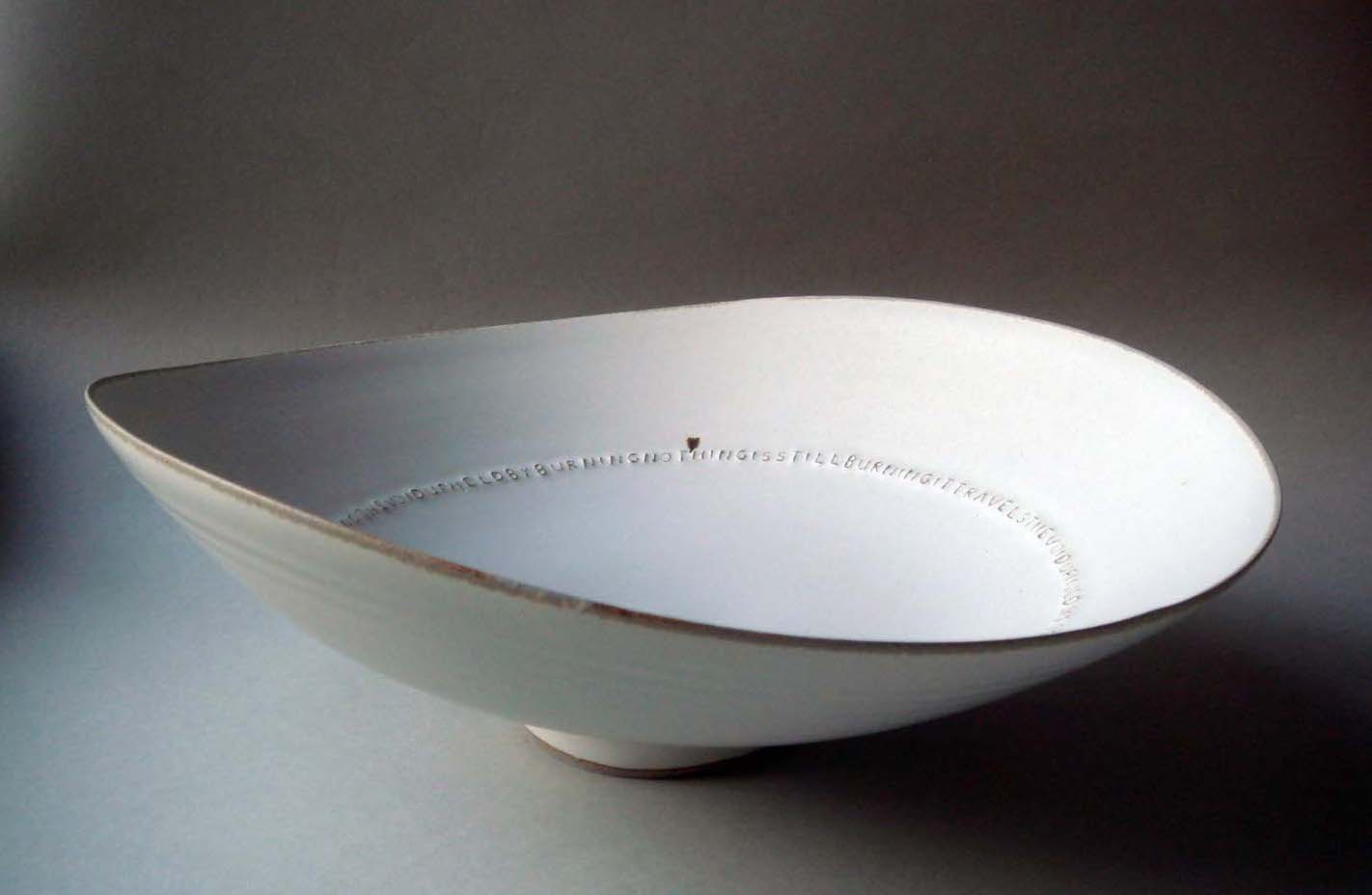
Image: Rupert Spira’s Open Bowl, 2007, a stoneware piece with embossed text under white titanium glaze. Acquired by Friends of the V&A in 2013.

Link to the Rupert Spira talk:https://www.youtube.com/watch?v=LyyojKcGDNY&t=1417s

About Rupert Spira, Wikipedia:https://en.wikipedia.org/wiki/Rupert_Spira

death and life in buddhism

Excerpts from: Care of the Dying – Buddhism HSE: Samye Ling, “Buddhism and Death” by Ken Holmes: “Kusala and Akusala” by Buddhistdoor Global BDG and: Abhidhamma in daily life, Chapter 10, “The First Citta in Life” by Nina Van Gorkom.

Buddhist teaching views life and death as a continuum, believing that consciousness (the spirit) continues after death and may be reborn. Death can be an opportunity for liberation from the cycle of life, death and rebirth.

Since Buddhism’s earliest days, Buddhist monks have gone to funeral grounds to meditate and contemplate death. This may seem macabre, to a modern Western mind, but for monks it is an invaluable and time-saving device. Most people have to wait decades – until parents or spouses die – to go through the unique learning cycle afforded by observing death at close hand; to see the biological shell as a guest-house in which the travelling consciousness sojourns but briefly, soon to go on to another place. This almost endless, age-old journey will involve staying in hundreds, thousands, of such temporary residences until liberating truths finally release the weary traveller.
Observing this ephemeral fragility of life can lead to an awakened appreciation of every precious moment of life. Each hour, each day, becomes a fresh opportunity for working for the long-term spiritual well-being rather than inconsequential material pleasure. On a deeper level, death is not only a physical reality but also a powerful metaphor for the psychological death of ego which must occur before the mind is liberated into limitless wisdom.

We are born in planes of existence where we can experience objects through the sense-organs. During previous lives as well as the present life we experienced colour, sound and other sense-objects. We were clinging to these objects in the past and we are clinging to them at present again and again, so that attachment has become a deep-rooted tendency. Attachment does not arise with each moment of consciousness, citta, but the tendency to attachment is “carried on” from one moment to the next moment, from life to life.

Cittas (moments of consciousness) arise and fall away and succeed one another, thus each citta conditions the next one. The last citta of the previous life (dying-consciousness) was succeeded by the first citta of this life. That is why tendencies one had in the past can continue by way of accumulation from one citta to the next one and from past lives to the present life. Since people accumulated different tendencies in past lives they are born with different tendencies and inclinations.

Since the first citta of a lifespan performs the function of rebirth there is only one patisandhi-citta in a life. There is no self which transmigrates from one life to the next life; there is only nama (mind) and rupa (body) rising and falling away. The present life is different from the past life but there is continuity in so far as the present life is conditioned by the past. Since the patisandhi-citta succeeds the last citta of the previous life the accumulated tendencies of past lives go on to the patisandhi-citta. Thus, inclinations one has in the present life are conditioned by the past.

There are many different types of citta and they can be classified by way of four groups: kusala cittas (wholesome cittas) akusala cittas (unwholesome cittas) vipakacittas (cittas which are result) kiriyacittas (cittas which are neither cause nor result). We may not know that both in a sense-door process (body) and in a mind-door process (mind) there are akusala cittas or kusala cittas arising. Because of our accumulated ignorance we do not clearly know our akusala cittas and kusala cittas and we do not recognize our more subtle defilements.

In Buddhism, all moral good and moral evil can be traced to six radical roots. All moral evil spring from the three radical roots of lobha (greed, covetousness), dosa (hatred, aversion) and moha (ignorance, delusion, mental confusion). All defilements and all unwholesome mental dispositions that manifest themselves either mentally, vocally or physically come into being. On the contrary, all moral good can be traced to three radical roots of alobha (non-greed, non-covetousness), adosa (non-hatred, non-aversion) and amoha (non-delusion, absence of ignorance). In other words, generosity, compassionate love and wisdom.

A mind obsessed with greed, malice and delusion is in bondage. It fails to see things in their proper pespective, and prevents one from acting properly. Thus it is called akusla or unskillful.

When kusala qualities are dominant, we experience mental health (arogya), mental purity (anavajjata), dexterity (cheka), mental felicity (sukha-vipaka). Such a mind is healthy and skillful.

It is said that kusala leads to Nibbana, the ultimate goal in Buddhism for nibbana means the complete elimination of all traces of self-eccentricity and ego-centric impulses. The more selfless acts (kusala) are done, the more selfless we become, and the closer we come to the realization of nibbana.

Hence, we must be mindful at all times for kusala and akusala thoughts and actions take us to opposite directions. We are the architects of our own fate. We are our own creators and destroyers.  We build our own heavens and hells.

https://www.wildmind.org/blogs/on-practice/parinirvana-day-authors

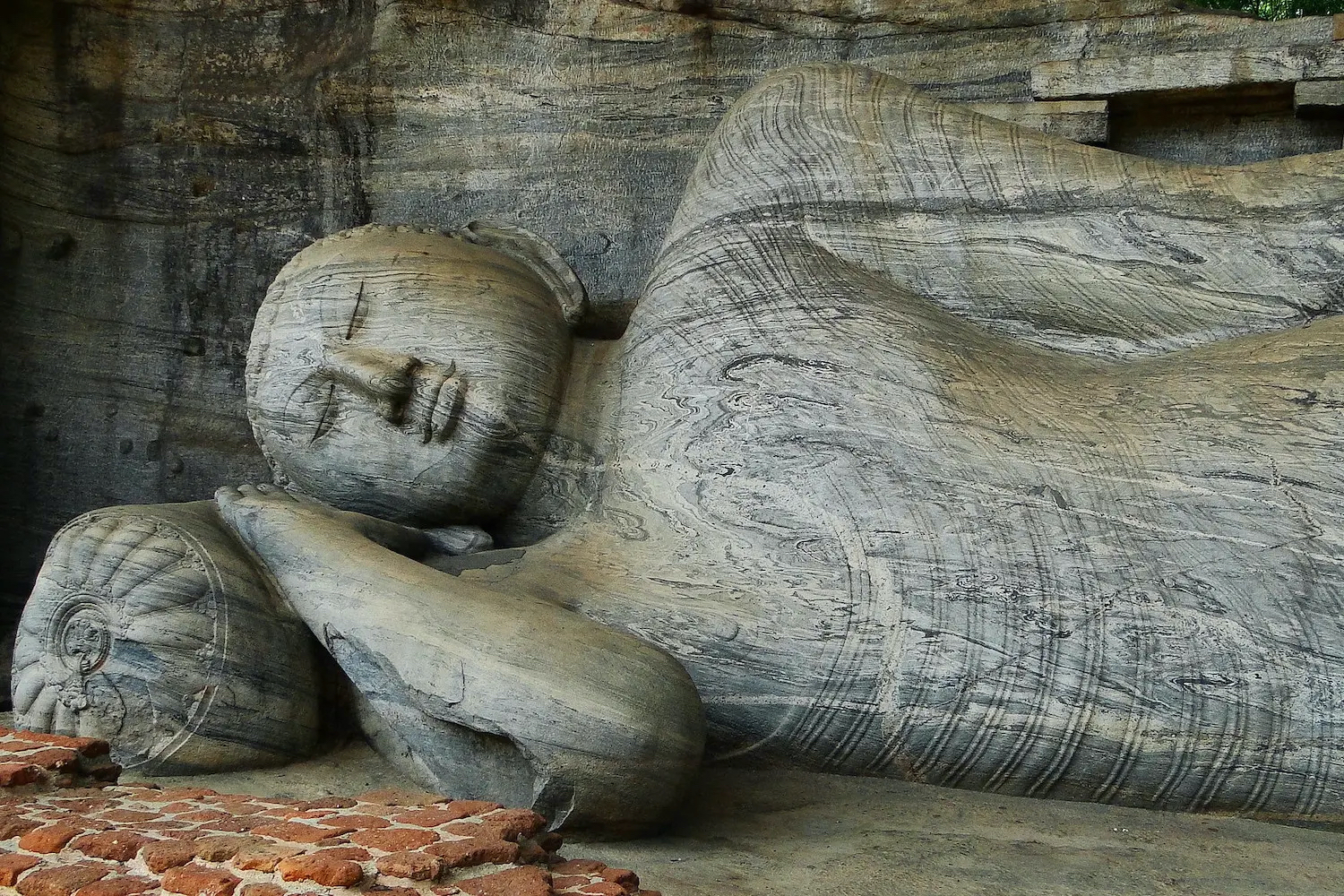
Image source: Parinirvana Buddha

the paradoxical dance

[Editor’s note: I came to be a follower of the Buddha by way of the Theravadin path, so the Mahayana direction remained a mystery to me, for many years. Likewise, the Zen Koan: “A koan is a question or answer posed by a Zen master that is difficult to answer and challenging to those seeking solutions. It directly challenges one’s fundamental concept of self, acting like a sharp weapon that pierces through the self to reveal the Buddha nature within.” It’s only recently that my curiosity has turned in that direction. The following article answers the question, what is a koan?]

The paradoxical dance of seeking and finding wears different costumes in different traditions. In Zen it’s usually known as the gateless gate: Until you crack the combination and pass through, you can’t fully understand the meaning of the great Zen teachings—but then all your mental effort inevitably proves fruitless before this enigmatic and impenetrable barrier. You need to bring your whole being, not just your mind, to the process and allow the paradox to transform you from the inside. Many Zen koans pose some version of this paradox, disorienting the mind and evoking an answer from another dimension of knowing.

Consider the well-known Mahayana teaching: All beings are inherently enlightened, but because of their attachments and distorted views they can’t realize this fact. I can still remember how these words short-circuited my mind the first time I heard them. Hmm, I mused, if we can’t realize it, then how can we possibly say we’re enlightened? But if we’re really enlightened, why can’t we realize it?

As a neophyte practitioner, I understood these words to mean that deep down inside me there was this enlightened nature that I somehow needed to discover and meditation was a kind of excavation project designed to unearth it. For years I kept digging, sitting intensive retreats, contemplating koans, emptying my mind to make room for the influx of awakening. I was spurred on in this archaeological exploration by my teachers, who offered encouragement in private interviews and lavished authority and cachet on those who passed koans quickly. Eventually I just wore myself out with the digging, so I set aside my shovel (and my monk’s robes) and went back to living a more ordinary life. Yet the paradox continued to gnaw at me, silently, from the inside.

The fact is, once you’re gripped by the core paradox and recognize that consensus—that everyday reality is merely a reflection of some deeper truth that’s close at hand but hidden from view—you’ve embarked on a search that you can never really abandon, no matter how far you seem to stray. The Zen masters say that encountering the paradox is like swallowing a red-hot iron ball you can neither disgorge nor pass through. Until you digest this ball, you can never be completely at peace.

Throughout the centuries zealous Zen students have meditated long hours struggling to resolve this paradox, only to return home and discover their “original face.” In the Rinzai Zen tradition, practitioners bellow mu (the key word from one of the most important koans) for hours in their fervor to break through the gate, and the tradition’s stories are filled with notable examples of those who took their practice to even greater extremes, standing in the snow for hours, sitting at the edge of a precipice, walking on foot from master to master. “Monasteries are places for desperate people,” my first Zen teacher used to say, by which he meant people whose suffering, urgency, or intensity drives them forward on their long and often lonely search.

Many centuries ago, the Persian mystic poet Rumi described his own divine desperation in these words:

I have lived on the lip of insanity, wanting to know reasons, knocking on a door. It opens.I’ve been knocking from the inside!

Judging from this poem, Rumi struggled for a long time to penetrate the paradox with his mind, but the door eventually opens by itself, almost in spite of his efforts, and reveals that he’s been living in the secret chamber all along. Rumi’s epiphany when he discovers that he’s been looking from the inside out mirrors the surprise, relief, and delight of those seekers who wear themselves out attempting to unravel the paradox and drop to the ground, exhausted—only to discover that they’ve never strayed from home, even in their most desperate moments. “No creature ever falls short of its own completeness,” says Zen master Dogen. “Wherever it stands it does not fail to cover the ground.”

Needless to say, this intense longing to crack the code and reveal the truth at the heart of reality is as ancient and universal as humankind itself. You could say that it’s in our DNA. According to the Sufis, God said to the Prophet Muhammad, “I am a hidden treasure, and I want to be known.” In His yearning to be loved and experienced, God set in motion an evolutionary pattern that reached its pinnacle in the human capacity for spiritual awakening. God, or Truth, in other words, is seeking to awaken to itself through you, to see itself everywhere through your eyes and taste itself everywhere through your lips. “That which you are seeking,” wrote an anonymous sage, “is always seeking you.”

Taken from an article in Tricycle: Encountering the Gateless Gate

From Wake Up Now: A Guide to the Journey of Spiritual Awakening, © 2007 by Stephan Bodian. Reprinted with permission from McGraw-Hill Professional.

all the myriad things

“The doing is done but there is no doer. The principle of doerless doing must be taken up and utilized in our daily lives. Whether we’re eating, sitting, laying down, walking, using, seeking, whatever we’re doing we must have enough truth-discerning awareness to prevent the arising of ‘I’ – the feeling that ‘I’ am the doer. ‘I’ am the eater, the walker, the sitter, the sleeper, or the user. We must make the mind constantly empty of ego, so that emptiness is the natural state and we abide with the awareness that there is nothing worth having or being.” [Buddhadasa Bhikkhu, “Heartwood from the Bo Tree”]

Emptiness means that there is no feeling of ‘self’ or ‘belonging to self’, there is no feeling of ‘I’ and ‘mine’, which are the creations of craving and grasping. Being void of these things is ‘being empty’. What is it that is empty? It is the mind that is empty, emptied of the feelings of ‘self’, and of ‘belonging to self’, both in their crude and subtle forms. If the mind is empty to the degree of being free of even the most refined sense of self it is said that the mind is itself emptiness. This agrees with the teaching that mind is emptiness, emptiness is mind; emptiness is Buddha, Buddha is emptiness, emptiness is Dhamma, Dhamma is emptiness. There is only one thing… all the myriad things that we are acquainted with are nothing but emptiness.

The characteristic of all things is emptiness. This phrase ‘all things’ must be understood correctly as encompassing every single thing from a speck of dust up to Nibbana. It must be well understood that in a speck of dust there is emptiness or absence of self, absence of a permanent, independent entity. The mind and heart, thoughts and feelings, each thing is characterized by emptiness, absence of a permanent, independent entity.

The Buddhist Teachings, the study and practice of Dhamma have the characteristic of an absence of a permanent, independent entity. All the way through to the final Path Realizations, their Fruits and Nibbana itself, have this same characteristic, it’s just that we don’t see it. Even a sparrow flying to-and-fro has the characteristic of emptiness but we don’t see it. All things display the characteristic of emptiness, it’s just that we don’t see it.

The word ’empty’ also refers to the characteristic of the mind that is free from all grasping and clinging. Although the mind is empty of self, it doesn’t realize that it is empty, because ordinarily, it is constantly enveloped and disturbed by the conceptual thought that feeds on sense contact.

As a result, the mind is neither aware of its own emptiness nor the emptiness in all things. But whenever the mind completely throws off that which is enveloping it, the grasping and clinging of delusion and ignorance, and detaches from it completely, then the mind, through its non-clinging has the characteristic of emptiness.

Because all things do truly have the characteristic of being empty of a self, no permanent, independent entity to be grasped at or clung to, we are able to see the truth of emptiness. Thus, the mind seeing emptiness in all things collapses into itself, leaving only emptiness. It becomes emptiness and sees everything as emptiness. Material objects, people, animals, time and space, every sort of dhamma melts into emptiness through knowing this truth. The word empty is the remainderless extinction of ‘I’ and ‘mine’, the utter destruction of self.

So, how should we practice during those times when the mind is free of association with sense objects? Maybe we are doing some kind of work alone and unconcerned, performing our daily tasks or of practicing formal meditation. There is nothing arising from sense-contact. We may be reading a book or even thinking about something, as long as the mind is undisturbed by sense-contact. At such times our practice must be the study and clarification of the way in which things are empty and the way in which to make the mind empty and free of delusion. Think about it, study it for yourself, enquire from others, and discuss it regularly. Keep doing it.

Excerpts from three talks given by Ajahn Buddhadasa to a Dhamma study group in Siriraj Hospital, Bangkok in 1961 and 1962.

Dhammafootsteps, Postcards# 375,374, 373, 372

Image by Bella White, source: https://www.pexels.com/photo/body-of-water-and-seashore-during-sunset-635426/

awareness: nameless and stopped

Excerpts from Reflections: Ajahn Sucitto
One of the monks asked a renowned Forest Ajahn: ‘What’s it like to see things as they really are?’ There was an understandable air of expectation in the room: to ‘see things as they really are’ (yathābhutam ñānadassanam) is the vision of the Awakened Mind. What mystical insight was about to be revealed?

‘It’s ordinary,’ said the Ajahn in his customary succinct and matter-of-fact way.

Bodhidharma (6th Century CE), the legendary conveyor of the Ch’an Dhamma to China. Ch’an (from Sanskrit Jhāna), a Chinese school of Mahāyāna Buddhism. Bodhidharma had an exchange with the Chinese Emperor that was similar in tone to the Forest Ajahn. The Emperor, who had devotedly built temples and shrines throughout China, implored the Master, ‘What is the essence of the Holy Truth?’

‘Emptiness, no holiness,’ replied the sage.

Awakening is more of a deflation of the mind than a peak experience. That way, it’s difficult to grasp. Actually, ‘emptiness’ – until you understand it as the non-clingable, signless quality of what arises – does give one something a little mystical to cling to… perhaps the Emperor wasn’t ready for the really direct teaching. The point is that the closer you get to the Dhamma, the more you know that appearances aren’t where it’s at. What you are able to see is the Unconstructed, and the end to the conceiving, favouring and proliferations of the mind.

A related example is Bhikkhuni Patacāra’s experience of Awakening. Returning to her dwelling after a period of walking meditation, her realization occurred as she turned down the flame of her lamp: Like the going out of a flame was the release of awareness. (Thig. 5,10)

No blazing light, just the opposite… so, is ‘Awakening’ some kind of coma? Well, this apparent paradox occurs because awareness as consciousness is not fully understood. This kind of consciousness is the six-fold awareness that processes data through eye, ear, nose, tongue, body, and thinking mind. In this context, mind-consciousness is the awareness that is affected by the perceptions and feelings that arise from external sense contact, and also from of the internal (mind-base). The mind is always being affected, it’s either fluttering, on the run, or sliding from this to that. Now, maybe if all that flittering and chattering were to stop… that would be a stilling of an activity rather than an annihilation of anything solid. Which is exactly the point. It also explains why the language of Awakening is distinctly unexciting and doesn’t get one’s pulses racing.

It’s all in the mind. The mind base is the home of the impulses and psychological activities, which stimulate consciousness for good or for bad. On investigation these activities of liking, disliking, of hesitancy or eagerness are seen as arising dependent on our attitudes and subjectively-based perceptions we acquire over the course of time. Whether a taste is ‘delicious’ or music ‘pleasant, etc., all gets learned from paying attention and assessing results through language communication. This is how consciousness is formed, activated and programmed; a perception of ‘what’s out there,’ from moment to moment, defines a ‘me’, as lively, articulate, passionate, even-minded or dull. So, the solidity of our world and our self is based upon activities and formations. And what if they stopped? In that freeing up, in things really being seen as they are, the world and the self neither exist nor don’t exist. They both arise dependently.

One point to emphasize is that the ‘me’ sense is a solidification of the sense of presence that is the resonance of consciousness. It takes form dependent on the perceptions and feelings that consciousness forms, infers and otherwise derives from sense-contact. When an architect looks at a building, he/she becomes an architect (that particular sense of self doesn’t arise as they eat a meal or watch TV). And in that mode, he/she sees something different from that which is seen by a thief. The individual bias, the acquired activity forms an impression both of the subject and the object.

When pain or displeasure touch the heart, ‘I’ get formed as the victim of that. With pleasure, I become the owner. Then I get defensive or acquisitive and act accordingly – instant kamma. Have you seen – or felt – who you become when guilt or fear gets into you? Or when compassion or joy touches your heart? ‘Being touched’ is a formation; contact/impression is an activity that modifies and colours the sense of self. In this respect, I’m referring not so much to direct sensory contact, but the impression that the mind makes of that contact, called ‘designation contact’.

This form of contact is the significant one: owing to the subjective flavouring of designation contact, different people find different sights, sounds, flavours, ideas, remarks and gestures delightful, repugnant, or neutral. Designation contact sets up the familiar pattern of how we experience the world; and the consequent perceptions and impressions guide what we will make impingement contact with in the future. So, this is the key to how we react and create fresh action, or kamma, based on the blueprint of the past.

The sting in this apparently neutral functioning is that when it gets infected with ignorance, the mind takes as real, substantial and potentially acquirable what in fact has been formed by consciousness. So that stirs consciousness into chasing its tail, motivated by either acquisition, aversion or delusion. Of which three, delusion is the one that is most constantly streaming in.

So, how would it be if, instead of creating fantasies and phobias, those streams were to stop? Intellectually, it’s not difficult to repudiate delusion. As far as we can see, in the experienced Cosmos, there’s no such thing as a thing: from the stars and rocks on down to the oscillating cells in our bodies and our flickering thoughts, it’s all dynamic. How could there be a permanent self? But in all this movement, there’s one process that forms the apparent self. It’s the lock of grasping. And that occurs in the mind-base when it’s infected by ignorance. So, trust what arises within when the self-impression passes. Investigate the dukkha of ‘how it should be.’ Because with unerring simplicity, release always comes down to cultivating the Four Noble Truths. Selfless clarity spontaneously arises with their comprehension; what arises by itself after the release is the true guide.

And it’s nobody’s. The awareness that is liberated through such realization is just ‘aññā’ ‘the Knowing.’ It’s a knowing that has no subject, a development based on, but beyond, the mindful knowing and witnessing of what arises. At each stage of Awakening, as places where self-view congregates get freed, there is the Knowing, dispassionate and free from positions. And the Buddha constantly refused to make a self out of that.

Ajahn Sucitto

To read the whole piece, follow this link:
https://ajahnsucitto.org/reflections/awareness-nameless-and-stopped/

Image source: https://unsplash.com/photos/WGVOaJIyMd0

soaring summits of silence

Excerpts from the Introduction to: “Mindfulness, Bliss, and Beyond,” by Ajahn Brahm

During meditation we should not develop a mind that accumulates and holds on to things. Instead, we should develop a mind that is willing to let go, to give up all the burdens we carry like so many heavy suitcases. In meditation unload as much baggage as you can. Think of duties and achievements as heavy weights pressing upon you. Abandon them freely without looking back. This attitude of mind that inclines to giving up will lead you into deep meditation.

Meditators are like birds that soar through the sky and rise to the peaks. It is on such summits of perception that meditators will understand, from their own direct experience, what we call “mind” and the nature of what we call “self,’ “God,” “the world,” “the universe,” the whole lot. It’s there that they become enlightened – not in the realms of thought, but on the soaring summits of silence within their mind.

“Mindfulness, Bliss, and Beyond” is a guided tour through the world of timeless Buddhist rapture. It describes how meditation literally implodes into the supreme bliss of the jhānas and how such states of letting go lift the veil of our fives senses, to reveal the awesome world of the mind, the magic inner garden where enlightenment is reached.

In the Mahāsaccaka sutta (MN 36) the Buddha relates, “I considered:… ‘Could that [jhāna] be the path to enlightenment?’ Then following on that memory, came the realization, ‘That is the path to enlightenment.’”

Image: detail of a photo by Simon Berger (Unsplash)

Letting Be

POSTCARD#446: Bangkok: Continuing with Ajahn Brahm’s text: “Mindfulness, Bliss and Beyond

Sometimes the best thing my mind needs at the moment is just to let things be. Basically, letting-be meditation is simply this second stage of breath meditation, just silent awareness of the present moment. It has to be silent, because to really let things be means you give no orders and have no complaints; you’ve got nothing to talk about. Letting be happens in the present moment. You’re aware of things as they appear right now, and you allow them to come in or stay or go, whenever they want. Letting-be meditation is like sitting in a room, and whoever comes in the door, you let in. They can stay as long as they like. Even if they are terrible demons, you allow them to come in and sit down. You are not at all fazed. If the Buddha himself enters in all his glory, you just sit here just the same, completely equanimous. “Come in if you want.” “You can go whenever.” Whatever comes into your mind, the beautiful or the gross, you stand back and let it be, with no reactions at all—quietly observing and practicing silent awareness in the present moment. This is letting-be meditation.

The Garden Simile

Many English men and women have gardens in their homes where they often spend many hours working. But a garden is to be enjoyed, not just to be worked in. So I advise my students that they should frequently go sit in their own garden and enjoy its great beauty.

The least adept of my students believe that they must mow the grass, prune the bushes, water the flower bed, rake the leaves, and get the garden perfect before they can sit down to enjoy it. Of course, the garden never is perfect, no matter how hard they work. So they never get to rest.

Mediocre students, on the other hand, refrain from work. Instead they sit in their garden and begin to think. “The grass needs mowing and the bushes should be pruned. The flowers are looking dry and the leaves really need raking, and a native bush would look better over there,” and so on. They spend their time pondering how to make their garden perfect rather than simply enjoying it. They too find no peace.

The third type of student is the wise meditator. They have done a lot of work in their garden, but now is their time for rest. They say, “The lawn could be mown, the bushes could be pruned, the flowers could be watered and the leaves raked—but not now! The garden is good enough as it is.” And they can rest a while, not feeling guilty about unfinished business.

Letting-be meditation is just the same. Don’t try to make everything perfect or tie up all those loose ends before you let things be. Life is never perfect and duties are never finished. Letting be is having the courage to sit quietly and rest the mind in the midst of imperfection.

Letting Be Can Become Quite Powerful

If your breath meditation or mettā meditation or any other type of meditation isn’t working, very often it’s because the foundation is incorrect. So just do the letting-be meditation. You can “sit out in the garden” and just let things be. Whatever is happening, that’s OK. Whatever you’re experiencing is fine—no preference, no choice, no good or bad, no argument, and no commentary. Just let things be. You can have a little bit of a inner speech, but only a commentary about “letting be.” Just be with what is. Just be with thoughts concerned with the meditation subject, but not about anything else. That way the meditation comes close to complete silent awareness of the present moment.

If I’m in pain, if I have a headache, stomachache, or some other ache, or if the mosquitoes are biting, I say, “Just let it be.” I don’t argue with it, don’t get upset about it. I just watch the feelings in my body as the mosquito pushes its nose into my flesh and itching sensations follow. “Just let things be.” If you’re lying in bed at night and you can’t go to sleep: “Let it be.” Or if there’s a pain that won’t go away: “Just let it be.” Just be with it. Don’t try running away. If demons have come into your room, you’re not going to push them out, but you’re not going to invite them to stay either. You’re just going to let them be. Letting be is the practice of equanimity.

Continued next week 26th November 2021

A Softening of the Mind

POSTCARD#445: Mettā meditation softens the mind and turns it toward care, goodwill, and acceptance. You become more selfless, less concerned with your own needs and more willing to peacefully interact with others. The emotion that is mettā feels delightful and pure. As you develop it repeatedly, it soon remains constant in your heart. You become a compassionate person, and your kindness is a source of joy to all beings and to yourself.

Mettā enables you to embrace another being just as they are. Most people find this impossible because of their fault-finding mind. They only see part of the whole, the part that is flawed, and refuse to accept it. Loving-kindness, on the other hand, embraces the wholeness of something and accepts it as it is. Through the practice of mettā meditation, you find yourself becoming less conscious of the faults in yourself and other beings, and more able to embrace them just the way they are. This ability to see the beauty in an object and ignore its flaws is a powerful aid to all types of meditation. To sustain your attention in the present moment, for example, you must accept the way things are now, embracing this moment and not being critical. When you persist in finding faults in the present moment, you will find you cannot remain there.

It is possible to combine mettā meditation with breath meditation. When you begin stage three, awareness of the breath, you observe your breath with loving-kindness. You think something like “breath, the door of my heart is open to you no matter how you feel, no matter what you do.” You will soon be looking at your breathing with compassion, embracing it as it is instead of finding fault. By adding mettā to the process of awareness, you have no expectations, since the breath seems more than good enough. Because of loving-kindness, you soon feel this attractive warmth toward the breath that brings joy to every in-breath and out breath. It becomes so nice to watch your breath that in a very short time you have reached stage five, the beautiful breath.

Taking Mettā into Jhāna

Jhānas are emotional summits and not intellectual heights. You cannot think your way into a jhāna, you can only feel your way in. To succeed you require familiarity with your emotional world, enough to trust in it silently without any controlling. Perhaps this is why female meditators seem to enter jhāna more easily than males. Mettā meditation trains everyone to become more at ease with the power of emotions. Sometimes you may cry during mettā meditation, even weep uncontrollably. If so, let it come. On the path to nibbāna we all have to learn to embrace the intensity of the purest emotions, and the jhānas are the purest of all. Therefore mettā meditation makes jhāna more accessible. You can even take mettā meditation directly into jhāna. When you have reached the stage described above where you are radiating this limitless golden glow of loving-kindness throughout the whole universe, drenching every sentient being with the immense power of your boundless love, then take the next step. Forget about all beings and ignore where the power is coming from. Focus your attention instead on the experience of mettā in itself. This step often happens  automatically with no decision coming from you. The meditation object is being simplified, freed from the perception of separate beings. All that remains in your mind is what I call disembodied mettā, similar to the disembodied grin of the Cheshire Cat in the simile in chapter 2. You experience this as a blissful sphere of gorgeous golden light in your mind’s eye. It is a nimitta. It’s the mettā nimitta.

A nimitta that is generated through mettā meditation is always incredibly beautiful, only sometimes it isn’t so stable. Excitement is the usual problem. However, its nature is so alluring that you cannot resist hanging out with such intense bliss. Thus, in a short time the brilliant golden mettā nimitta becomes still and you fall into jhāna. This is how mettā meditation takes you into jhāna.

the fifth hindrance – doubt

POSTCARD#438: Bangkok: Doubt can be toward the teaching, about the teacher, or toward yourself. Regarding doubt toward the teaching, you should have enough confidence by now to know that some beautiful results come from practicing meditation. You may have experienced many of them already. Allow those positive experiences to strengthen your confidence that meditation is worthwhile. Sitting in meditation, developing the mind in stillness, and especially developing the mind in jhānas are all tremendously worthwhile and will give you clarity, happiness, and understanding of the Buddha’s teachings.

With regard to teachers, they are often like coaches of sports teams. Their job is to teach from their own experience and, more important, to inspire students with words and deeds. But before you put your confidence in a teacher, check them out. Observe their behavior and see for yourself if they are practicing what they preach. If they really know what they are talking about, then they will be ethical, restrained, and inspiring. Only if teachers lead by example—a good example, that is—should you place your confidence in them.

Self-doubt—which thinks, “I’m hopeless, I can’t do this, I’m useless, I’m sure everyone else who practices meditation, except me, has got jhānas and is already enlightened”—is often overcome with the help of a teacher who inspires and encourages you. It’s the teacher’s job to say, “Yes, you can achieve all of these things. Many other people have achieved them, so why not you?” Give yourself encouragement. Have confidence that you can achieve whatever you want. In fact, if you have sufficient determination and confidence, then it’s only a matter of time before you succeed. The only people who fail are those who give up.

Doubt can also be directed toward what you are experiencing now: “What is this? Is this jhāna? Is this present-moment awareness?” Such doubts are hindrances. They are inappropriate during meditation. Just make the mind as peaceful as you can. Let go and enjoy the peace and happiness. Afterward, you can review the meditation and ask, “What was that? That was really interesting. What was happening there?” That’s when you’ll find out whether or not it was a jhāna. If while meditating the thought “Is this jhāna?” arises, then it cannot be jhāna! Thoughts like that can’t come up within these deep states of stillness. Only afterward, when you review those states, can you look back and say, “Ah, that was a jhāna.”

If you get into any difficulty in your meditation, stop and ask yourself, “Which of the hindrances is this?” Find out what the cause is. Once you know the cause, then you can remember the solution and apply it. If it’s sensory desire, just take the attention away from the five senses little by little and apply it to the breath or the mind. If it’s ill will, do some loving-kindness. For sloth and torpor, remember “give value to awareness.” If it’s restlessness and remorse, remember “contentment, contentment, contentment” or practice forgiveness. And if it’s doubt, be confident and be inspired by the teachings. Whenever you meditate, apply the solutions methodically. That way, the obstacles you experience won’t create long-term barriers. They’re things that you can recognize, overcome, and move beyond.

Preview of next week’s text:

“All the Hindrances emanate from a single source. They are generated by the control freak inside of you that refuses to let things go. Meditators fail to overcome the hindrances because they look for them in the wrong place. It is crucial to success in meditation to understand that the hindrances are to be seen at work in the space between the knower and the known. The hindrances’ source is the doer, their result is lack of progress, but their workshop is the space between the mind and its meditation object. Essentially, the five hindrances are a relationship problem.”

More next week Saturday 02 October 2021