Storm

Switzerland: Just before the storm started I was having this problem with the internet upload speed; trying to get a post into Publish but Mbps too low; let’s see, okay try again; waiting for it to come up with the WordPress site to click on the upload button, maybe it’ll do it this time. Nope…  stuck again and I start to take it personally, caught in thinking this is ‘bad.’ And, pretty soon, it gets blown out of proportion, turns into a small crisis, like a fire burning down the house. The intensity of feeling is incredible. This is what a very low internet speed can do.

Am I in withdrawl? Focus for a moment, just there at the desk, feet flat on floor, watch the breath, stop the mind, and suddenly I’m in an empty space, surprised to discover it was that quick! And without the wandering thoughts, there is just silence! Just the physical awareness of the body, comfortably seated with this inactive thought process… I could hear the storm really loud around this time; lightning and thunderous bangs and crashes across the sky – a perception of vast distance.

It’s like someone in the floor above has gone berserk, pushing over huge pressed steel cabinets and metal desks, metal oil drums, BOOOOM, BADAAANG, and a small silence in between, then the echo of it returning from a long way away in the immense space of night sky. Still sitting at the desk in the violence of the heavens and the room is brightly illuminated by a flash of lightning very close, followed immediately by another overwhelming CRASH. The lights go out, and for a moment I’m thinking the sound is the bricks and masonry of the building tumbling down.

I fall to the floor in a crouched position to protect the head and then up from there quickly out to the front room, and exit by jumping over the balcony from our place on the seventh floor? No, can’t do that, look here and there, no damage I can see. The flap of wings as birds roosting on the balcony rail are stirring a bit, but they’re not really getting in a tizz about this. If the buildings were to fall to the ground, no problem, they’ve got wings and can just fly away.

Back into the room, waken up the computer and I get a connection right away, loading completed immediately. And that’s the story of how I got this post done in a room full of flashing lights like a Press event taking place and uploaded no problem – harvesting ambient electricity? The sounds of war and bombing raids; the noise of it was colossal, somebody said later it’s because of the Jura mountains reflecting the sound and the lake resonating like a huge sheet of metal; an area of about 500 square kilometres.

The first noble truth says simply that it’s part of being human to feel discomfort. We don’t even have to call it suffering anymore; we don’t even have to call it discomfort. It’s simply coming to know the fieriness of fire, the wildness of wind, the turbulence of water, the upheaval of earth, as well as the warmth of fire, the coolness and smoothness of water, the gentleness of the breezes, and the goodness, solidness, and dependability of the earth. Nothing in its essence is one way or the other. [Pema Chodron]

Link to: Weather and the Four Noble Truths, Pema Chödrön

————————-

Homer & the 1st Noble Truth

Switzerland: An old Simpsons episode appears out of nowhere, just as I’m beginning to despair here in the long journey through Central European TV channels; one end to the other, then back again. The samsara of television. So I do find something I can identify with in Homer’s world view, but afterwards, I notice, there’s this strange, unreal quality; the Simpsons effect. Everything else on TV seems changed and it takes some time for this altered perception to pass. The way I find to emerge from the ennui mind is through recognition of the Noble Truth of Suffering: dukkha, the characteristic ruminations of thought, same old thing, and I can just say: oh, that’s what it is, let it go and be done with it. But, how about poor old Homer? I wonder if the creators of the Simpsons ever properly considered that Homer might have a basic understanding of the Noble Truth of Suffering? It seems unkind if they didn’t. He’s so close to it but never quite gets there.

Whether it’s intended or not, Homer is at the very beginning of the spiritual search. He is pre-first Noble Truth, doesn’t know this is dukkha; he doesn’t know what it is. He hates it, he loves it, he’s indifferent to it, he is in denial. He’s so totally immersed in the experience of it, there’s just a dull glow of obscured awareness – enough to see that this is the fundamental human condition? Probably not, Homer is so busy ‘wanting’ things to be different from what they are, he doesn’t realise that this involvement with tanha craving/desire is exactly the reason he’s in the unpleasant situation he’s in.

He tries to see beyond desire and sees only more desire. The idea of ’giving up desire’ triggers the conditioning that desire is ‘bad’. It does stuff to Homer’s head. That’s why he got the idea inverted somehow and managed to explain it to himself that giving up desire is ‘bad’. This means he’s not able to see that (even if he did get it the right way round) we don’t give up desire because it’s ‘bad’, we give it up because it’s what’s causing the pain.

The possibility of release: 3. nirodha [there is a way out], and: 4. magga [this is how you do it], these things are not on his to-do list. Homer has the wrong idea, completely, but I have to remember he is a cartoon character – and I have to consciously remind myself about this. There is no ‘Homer’, there is no ‘self’, there is only the driving mechanism of craving and attachment. Homer can’t see it in this way because he’s conditioned to believe that if there’s desire, it must be happening to ‘somebody’ and that’s Homer. So, it looks like the way to go is to gratify that desire immediately, rather than stop and look at how it came to be like this.

Everyone would be very happy if the creators of Homer could get around to thinking about Homer’s predicament: what does it take for him to get closer to his desire urge and look at what’s really going on there? Without responding to the tugs and pulls, just observing, he’d see that the desire is there because it’s in the nature of desire to be like that. Homer’s curiosity, a dim glimmer of wisdom, is all it needs to clear away the ignorance – there is understanding and desire loosens the tenacity of its hold on him.

Accepting the Noble Truth of Suffering means he can let it go. He’s not confused by it or perplexed by the fact that he doesn’t know what’s wrong. He knows what it is. Knowledge displaces ignorance, so he can let it go. The difficulty of being bound up in difficulty is suddenly not there anymore. Instead there’s the familiar feeling that things are fine just as they are and something about this says to him there can be a profound awakening to the allrightness of just being in the moment.

This small glimpse of the innate quality of peace all beings share might be enough for Homer to seek the Path to Liberation.

————————-

‘The first of the four noble truths of Buddhism, that there is suffering in life, was enormously important to me. No one had ever said it out loud. That had been my experience, of course, but no one had ever talked about it. I didn’t know what to do with all the fear and emotions within, and here was the Buddha saying this truth right out loud. I wasn’t alone, I wasn’t weird, and I didn’t have to feel isolated. For the first time I didn’t feel so utterly alone, like I had a shameful secret…. Then I learned the next three noble truths – I could do something about the suffering. I could change how I dealt with it. I could approach my pain with compassion instead of bitterness, in community rather than isolation. I could change my relationship to pleasure. The Buddha offered a very simple, pragmatic tool — meditation – to transform one’s relationship to everything.’ [Sharon Salzberg, except from an interview in Huffington Post Aug 30 2012]

Birds on the Balcony 3

Switzerland, August: Awake at 4:00 AM this morning, came through and switched on the kitchen light: neon tube fluorescent, flicker-flicker flick. Light everywhere, through the windows illuminating the outdoor furniture on the balcony of this 7th floor apartment and the pigeons sleeping there wake up: croo-croo, croo-croo! Had to switch off the light again and they were quiet as soon as I did that. Now I’m sitting in the darkness, held back in my domestic activities by the wildlife on the balcony. What to do now? It takes me a while to get round to noticing this silence the pigeons are in. I get my meditation cushion and place it on the sofa with other cushions to stop it from sinking into the softness and get up on that, a little unsteady but balanced at this slightly higher elevation so I’m able to see the round shapes of the sleeping birds through the window. I’m in their quiet space, we share the peace of this Sunday morning – so silent here, high above street level. There’s a presence around these sleeping birds; there’s an immediate focus on metta loving-kindness to all beings:

‘All people, all animals, all creatures, all those in existence, near and far, known to us and unknown to us. All beings on the earth, in the air, in the water. Those being born, those dying. May all beings everywhere live in safety, be happy, be healthy, live with ease…’

Attention wanders and the mind enters into the story of it all: the bird out on the balcony, nesting in the Christmas tree bucket then there were two eggs, they hatched out and there were two babies and Ajahn V even did a little blessing for them when he came to visit [Link to: Birds on the Balcony1 and Birds on the Balcony2]. The young birds became adults and now we have a small family group inhabiting the balcony. Two adults and two young birds and there’s another one – the mysterious ‘other’ … the alpha male has taken a second wife? I’m saying this because there’s often some upset out there; some extended flapping of wings in the evening as they get their places in the hierarchy settled for the night – it’s like who gets to perch next to whom. I can’t imagine… return to mindfulness mode:

Let them not do the slightest thing that the wise would later reprove. Wishing: in gladness and in safety, may all beings be at ease. Whatever living beings there may be; whether they are weak or strong, omitting none, the great or the mighty, medium, short or small, the seen and the unseen, those living near and far away, those born and to-be-born — may all beings be at ease.’

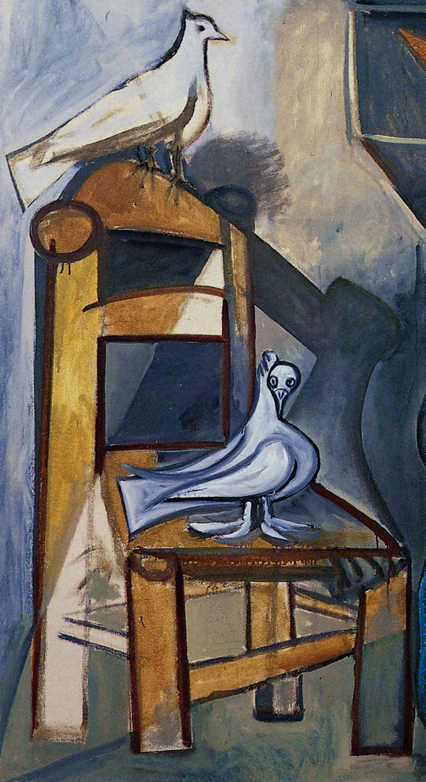
Eyes open slightly in the half-darkness. I’m perched on my high cushion like one of the birds. Morning light is coming up. I see them more clearly now. They’re sitting on different parts of the old artist’s easel that I left out there because it’s too big to have inside the apartment. It looks strangely like a work of art, some kind of out-of-context aesthetic event, but can’t think what that might be…. Picasso did some paintings of pigeons and doves that had moved into his studio in the South of France. I look at these pictures and I just know what that must have been like.

One bird begins to waken up, wing stretch, flutter, flap. They’re here with us, sharing the same worldview. Without us, the birds wouldn’t be on this balcony – they’d be on someone else’s balcony, okay, but the whole thing is about inter-dependency. We all need each other. I am one part in the vast body of life, distinct yet intimately bound up with all living beings. Eyes close again, return to meditation mode:

‘… so with a boundless heart should one cherish all living beings; radiating kindness over the entire world: spreading upwards to the skies, and downwards to the depths; outwards and unbounded, freed from hatred and ill-will. Whether standing or walking, seated or lying down free from drowsiness, one should sustain this recollection.’

After a while, in the light of early morning, I notice an odd silence in the bird group out there; no wing-flap. Get up and go over to see. They’re poised on the balcony handrail; all looking out, little necks stretched out and eyes focused on the space outside; the great swimming-pool of sky. Still no movement. Then simultaneously they burst into flight, and gone. As one unit they drop over the balcony and down. A moment later I see them swoop and swirl in a great arc in the sky then on eye level with this 7th floor and in a direct line away from me, they vanish in the distance.

————————-

[Excerpts from: Karaniya Metta Sutta also excerpts from loving-kindness meditation by Jack Kornfield, Susan Salzberg]


Choosing Liberation

Van Gogh 'Miners' 1880 (detail)

I’M ON THE BUS, going to an early morning class in zone industrielle. As we get near, the bus is stopping at every stop to pick up people employed in the factories. Migrant workers from East Europe; men and women speaking a language unknown to me. Thin, sad, serious faces; reminds me of Van Gogh’s drawings of the miners in 19th Century. He was there as a clergyman and convinced that he could help them find ‘liberation’. But he wasn’t successful, poor old Vincent….

Bus is getting crowded, I have a book to read: ‘The Noble Eightfold Path’ by Bhikkhu Bodhi and I’m looking at this partly because there’s nowhere else to look without encountering another pair of eyes looking back at me. ‘The search for a spiritual path is born of suffering. It does not start with lights and ecstasy but with the hard tacks of pain, disappointment and confusion… for suffering to give birth to a genuine spiritual search, it must amount to more than something passively received…’ 

Urgent circumstances; this is about a level of suffering hard to endure and there’s just no getting away from it. In the past, my first reaction would have been to look for a way of easing the suffering, and I’d have gone for that straight away. And when it became obvious that such a thing is only a temporary solution I’d have continued with it anyway for as long as it took to find some other similar easing. The real way out, the way to the end of suffering is more deeply embedded.

More stops, more migrant workers get on the bus. Maybe they’re looking at me and thinking I shouldn’t be here, with my shirt and tie, polished shoes. What they don’t realise is that I’m a foreign worker too. I know how it feels to live in someone else’s country – I’ve been doing this for about 25 years. Okay, guys! I’m a teacher of English, and I’m on my way to teach your bosses, yes – but, as far as I’m concerned, we’re all the same here. And that’s how it is now, squashed up against the window glass; thin shoulders and arms pressing against me.

‘It has to trigger an inner realization, a perception which pierces through the facile complacency of our usual encounter with the world to glimpse the insecurity perpetually gaping underfoot. When this insight dawns, even if only momentarily, it can precipitate a profound personal crisis. It overturns accustomed goals and values, mocks our routine preoccupations, leaves old enjoyments stubbornly unsatisfying.’

It’s about being right out there; on the edge. And there was a time for me when it was like that; a confrontation with the obstruction. I had to give in to it. As soon as I did, there was something unseen that tipped the balance. There was the easing, but different this time – I got a little preview of the Way; nirodha: 3rd Noble Truth. Then the question of what to do next and this led to the Noble Eightfold Path magga. It was at Wat Pahnanchat and Ajahn J. explained all this to me later because at the time I didn’t know much about the Buddha’s teachings. What I’d experienced was a knee-jerk reaction; an ordinary human response. Same as it would be for anybody on this bus.

What would it take for the kind of insight described here by Bhikkhu Bodhi to be meaningful to these migrant workers? The endurance threshold would need to be lower than it is. As long as they have the ability to withstand hardship, it will go on like this because, for them, it’s about holding on, not letting go; they’re putting their small amounts of money together to send back home to support the family. So they choose to pursue this endeavour, I choose liberation. Does this mean I’ve taken the ‘soft’ way out?

Buddhism has always attracted the elite of whatever society it has traveled to, partly because you need to have traveled through a certain experience of materialism in order to arrive at the sense that there is something problematic about desire and longing, how they don’t lead to happiness, and more often than not lead to unhappiness. If you are still struggling to fulfil your fantasies of wealth, power, status, Buddhism is less likely to appeal to you.’ [‘An End to Suffering’ Pankaj Mishra]

The Buddha’s Teachings offer an opportunity for liberation that really only comes about if you already have a certain distance from economic concerns. In Thailand there’s always the option of living in the monastery for a period of time and following a spiritual path. This kind of choice is held in high regard. In the West, people have to structure their lives around employment. Their innate ability to be happy is exploited by commercial strategies and a fleeting, temporary happiness has come to be built-in to the system. People can’t escape from that unless they step out of the social status momentum they’re in and this means there’s the risk of losing everything.

The bus gets to the terminus, stops, air suspension lets out in one long last gasp, and the bus lowers itself on to its structure. I get out with everyone else in this strangely remote place with factory smells and set off walking along the path to the industrial buildings in the distance. Behind me the bus starts up, a worrying moment, no wish to be stranded in this particular reality. I look back at it as it rumbles off on its little round wheels.

 ————————-

(Link to: The Noble Eightfold Path: Way to the End of Suffering’ by Bhikkhu Bodhi)

[Image: Vincent van Gogh 
Drawing, “Miners”, Pencil on Paper,
Cuesmes: September, 1880, Kröller-Müller Museum]