doing and being

POSTCARD # 489: Dated 12th September 2022: Aruna Ratanagiri Buddhist Monastery, Northumberland: I arrived at the monastery in a taxi from Newcastle, after an absence of seven years. First things you see are the stone walls and rundown farm buildings repaired and rebuilt. Grass, hedges, small gardens and trees grown up and all filled out. The monastery looks like it’s nestled into the landscape and everything has made room for it. The guest accommodation is down the hill, two dormitories, male and female and a few individual rooms. I have one of these rooms. There is a Dhamma hall where we sit in meditation, early morning and evening.

My first thoughts about the place were that even though there were these outer transformations, it had hardly changed in the seven years I’d been away – check out an earlier post about this monastery: [‘The thingness of things,’ POSTCARD # 81, dated: July 19th 2014]. I met the senior monk again and he didn’t look a day older. Some of the passageways were repaired and painted but basically it was just the same. It’s as if I’ve been away to the town to get a few things, in the car and coming back only now.

The monks, in brown/faded tangerine colour robes of ancient times, chanting together the historical Pali suttas: Nammo Tassa Bhagavato, Arahato SammasamBuddhassa [Homage to the Blessed] Noble and Perfectly Enlightened One]. Seeing this, and lifted in spirit by the sound of the chanting, I felt well prepared at the end of my UK trip, to step into the Buddha’s Teaching at the start of my return to Thailand.

The bell signals the beginning of a forty-five-minute meditation period. So, I’m getting comfortable on a chair nowadays, because my knees complain if I sit on the floor, and on the chair, the body/mind can get settled into the meditative state. The Theravada practice is not so much about the blissful experience, it’s more to do with the observation and analysis of the mind; the nature of thoughts leading to associated thoughts, headed for some kind of conclusion but never getting there. I’ve learned that this is ‘the doer’ compulsively doing things and we need this ‘doing’ to stop, and make way for ‘being.’ Drop the active driving force and allow the passive form, ‘to be.’

It’s hard to do this, the thinking process is being compulsively driven. You discover that it is after all, the doer, still busy with this and that. It’s possible then, to identify the Self behind it all, and ask that Self to leave the stage. The performance starts to quieten down after that, although the world ‘out there’ is still seen as Self, the doer, the ‘me’ in here, in the realm of ‘doing’, the metaphorical self, ‘I think therefore I am.’  Descartes and his unfortunate self-view – and that’s not the way to go.

Then it all starts to disperse and I’m inside a curious extended freeze-frame moment, vestiges of thoughts dissolve and the whole thing comes to a stop – a sense of immensely distant things and the ‘unthinking’ state arises. The compulsive ‘doer’ is seen in the shadows, but we are not having anything to do with that today, thank you.  Then there is only the space and a curious light illuminates everything.

Incidental thinking episodes float by looking for a place to settle, but there’s nowhere that’s not occupied right now. The spaces between thoughts are being kept empty, those intervals that start and finish before the next thought arises. There’s the awareness of how one thought includes an awareness of another thought; awareness can be in two places at the same time. I contemplate something, and contemplate the mind contemplating that but I can’t go any further with this because the bell rings and we have to get up and put our cushions and things away.
Now it’s later, I’m in my room writing this and it’s uncomfortably cold here, fingertips touch the laptop tentatively, unwilling to make contact with its cold surface. I’m feeling chilled, can’t seem to get warm. There’s this uncertainty, all this moving from place to place, every second day. I came from Thailand only seven days ago, and I’ve been in four places – all over the place. Here in the monastery has been the longest stay, nice people, good conversations in Kusala House, and time to consider how the trip has worked out… it has gone well, I think. Everything is still uncertain, like the weather in UK.  They were saying that things changed the day before yesterday… Summer became Autumn all of a sudden and the nearness to winter is not a pleasing thought for me. Yet I feel a connection with this kind of climate and this monastery, unfortunately, I’ll be away when the snowy weather comes. Thank you everyone, thank you Ajahn. Sorry to leave but looking forward to being back in the land of blue sky and summer all the time, departure on 13 September, 2 days remaining…

“… I went to Ajahn Chah once, totally beside myself with doubt and worry. After we talked awhile, he looked at me and said, ‘If something is uncertain and you want to make it certain, you are going to suffer.’ Well, that’s obvious. But he really knew what he was talking about, he really knew. If it’s uncertain, you’ve got to see it as uncertain – why try and make it certain? It’s only because of our attachment to certainty that we can’t learn from uncertainty; yet it’s only when we’re uncertain that we learn. When we’re uncertain, we can wake up, and look around and say, ‘What’s going on, what’s happening?’ We can be alert and attentive when we’re uncertain; when we’re sure, we just sit back and get fat and lazy. People who are really certain don’t have this sense of openness and vitality and investigation of life, everything’s very closed and sure.” [Ajahn Munindo, Forest Sangha Newsletter, Number 16, April 1991, “In Doubt We Trust.”]

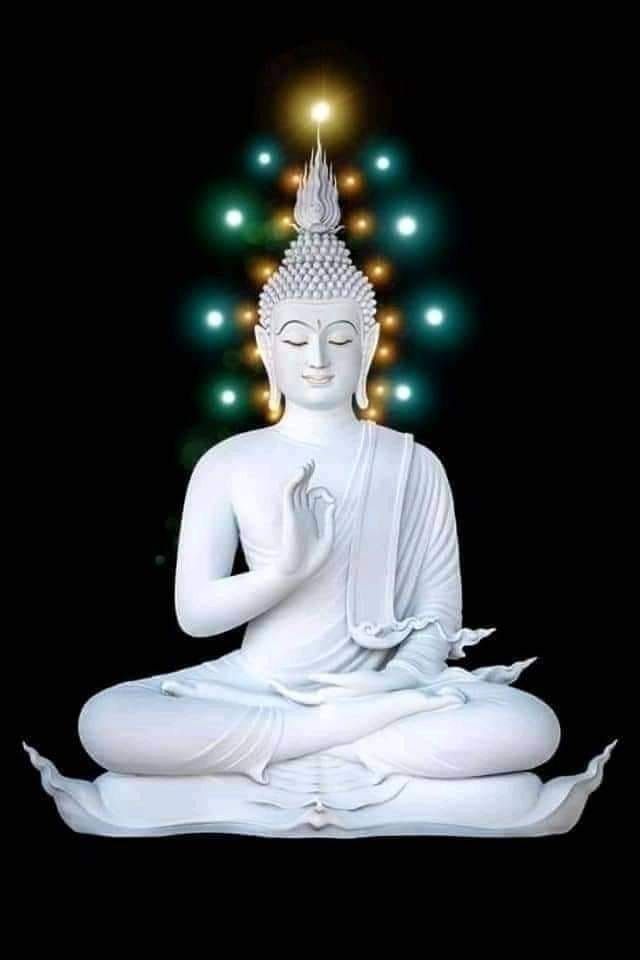
Image by Herman Ettema: Buddha Rupa by the lake at Aruna Ratanagiri Monastery
one day I woke up from the dream

POSTCARD 488# : Glasgow Queen Street Station: Dated 7th September 2022: Sitting on a bench with hundreds of people going here and there, some sitting like me, but they’re occupied with their phones, while I’m writing notes on pieces of paper, hoping I’ll remember when time comes to key in the gist of what I’m seeing here. Meanwhile, raggedy pigeons walking around my feet looking for scraps, they peck at this and that, maybe trying to give me a hint but I don’t have anything edible to give.

Everywhere there is the picture of a particular place in space and time presented before our eyes, a series of events tell the story, and this is how it happens: a child stumbles into the parameters of my vision, corrects herself, then loses balance again, falls over, and sits up on the floor, slightly shocked by the fall. For a moment I think she’s going to cry, arms held out, wanting to be picked up, but mum is carrying all the luggage and pulling a large case on wheels and there is no dad in the picture. Instead, mum stands there, looking back at her daughter and calls out, in a Scottish dialect, a little harshly, I thought. Daughter remains sitting looking at her options, shouts a one syllable utterance and mother replies with a short encouraging sound but I can’t bear to be in this picture any more.

If you’ve lived in the East for any length of time, or any Third World country, you’ll know that when people have to travel, they go as a family unit, able-bodied grannies, aunties, older sisters, cousins or paid helpers – there would always be someone to pick the child up from the dirty floor. It goes without saying, but here in Northern Europe they have more or less lost that kindness.

For the sake of the economy, the authorities disbanded the clans, ‘every man for himself,’ and we were each reduced to a single unit of consumable human energy, or left to survive by whatever means. (We mustn’t dwell on unhelpful thinking, nor chase after a fleeting happiness, to the extent we forget what we’re doing.) It happened like that because of a misguided belief in Self – there is no enduring Self [anatta]. “The self exists conceptually, dependent on mind and body, not an entity in itself.” [Dalai Lama].

Getting back to reality, I’m waiting for a train to Newcastle via Edinburgh. Meanwhile, situated here in Glasgow Rail Station. There’s a familiarity about this city, although so much has changed. I was at the Glasgow School of Art for four years. The constant sweeping along of things brings me back to the place where I started off from. It was here I had a belief in Self, as we all did, then one day I woke up from the dream but three decades had passed – why didn’t I get here sooner? It’s an adherence that looks more difficult to unstick from than it really is. There is no Self, nobody at home, Elvis has left the building. The concept of no-self can be applied here and now – see the nothingness at the centre of everything. The entire thing is a construct.

We call it a grain of sand,

but it calls itself neither grain nor sand.

It does just fine without a name,

whether general, particular,

permanent, passing,

incorrect or apt.
The window has a wonderful view of a lake,

but the view doesn’t view itself.

It exists in this world,

colorless, shapeless,

soundless, odorless, and painless.
The lake’s floor exists floorlessly,

and its shore exists shorelessly.

The water feels itself neither wet nor dry,

and its waves to themselves are neither singular or plural.

They splash deaf to their own noise

on pebbles neither large nor small.
And all this beneath a sky by nature skyless

in which the sun sets without setting at all

and hides without hiding behind an unminding cloud.

The wind ruffles it, its only reason being

that it blows.”

[Wislawa Szymborska]

the present moment as it was then

POSTCARD 487# : Bangkok, Suvarnabhumi Airport: Dated, Near Midnight, 1st September 2022: We were in the car and nearing the airport when Jiab suddenly realised I had left my jacket in the wardrobe – I never wear it, too hot, in fact it’s been hanging in the wardrobe since the last time I went to Europe seven years ago. But now I needed it, September is usually quite cold in the North of Scotland. No time to go back and get it, what to do? I’ll have to buy one as soon as I get there. So, we reach the airport, bye-bye, and I was off through the endless passageways, security zones and portals that lead to the plane. No worries, still warm in the airport and on the plane, it was a night flight, warm enough with a blanket and a place to put your feet up, not bad, got some sleep, twelve hours later, arrival in Amsterdam was a different story, darkness, got the shivers, every now and then, a huge blast of North Sea air, enormously cold.

Then on the plane to Scotland we were up above the clouds and a brilliant sun in the vastness of blue sky, shining straight on to the right side of head and shoulders (the side where the headache strikes), wonderful to feel that warming, and felt a sunbeam warming all the way through to the ear drum itself. How strange, but I recall this happening previously in Scotland – the sun must be shining from a different angle in this part of the world, than how it is in Thailand.

At the airport my cousin was waiting in arrivals and he swiftly took me away to a discount shop where I got a light-weight jacket with a zip and a hood. Just right for September weather. So, we couldn’t believe it was seven years since I last visited Scotland (also our own ageing, that face that looks at you in the mirror) and later with my sister the thought of it being seven years was just ‘too much’ and we preferred to see it as a time somewhere out there in the past. Then I met her daughter again and two grandchildren who had grown so much, they were visible proof of that span of time.

How to understand the concept of time? There is the ‘now,’ a point in time. The present moment as it was then, when I was last here, is the same present moment I experience today, seven years later in linear time. Therefore, you could say that chunk of time is one long stretched-out present moment. And, on the larger scale of things, the Whole History of the World is just one entire present moment… beyond comprehension, wow! Cannot be thought of in terms of Self, better to think of it as no-self (anatta), and emptiness (sunyata). But so much has been said in this blog about no-self. My cousin who is a Church-goer visibly flinched when I first brought it up in conversation. I need to pay more attention to what this means and how it is best expressed.

But maybe there is no best way of expressing or explaining no-self. Just let them get on with it and not have to think about the whole picture as it is. Meister Eckhart in the 14th Century paid a heavy price when he expressed some radical ideas in the context of the Christian belief at that time. There were two distinct factions; the Cataphatic division (Franciscan) whose spirituality was entirely devotional, and the Apophatic division (Dominican), which included Eckhart, whose spirituality was almost entirely analytical. In a few words we can say Eckhart wanted there to be a complete rejection of everything learned and cherished in a person, until there was only the empty ‘soul’, then Christ should be ‘born’ in us spiritually. From a Buddhist point of view, this resembles some aspects of the Theravada practice, which culminates in emptiness (sunyata) and no-self (anatta). Of course, there is no Jesus and no soul in the Theravadin Buddhism. Rather we allow the emptiness to be as it is, without any Christian intervention.

Needless to say, there was outright disagreement from the Devotional division, who were the Franciscans (Eckhart was Dominican). The Pope and other Church authorities created a huge upheaval concerning Eckhart’s sermons and teachings, calling him a heretic.

I spent some time with my cousin’s Church group (Devotional) and in the past, I’ve dropped into their discussions and surprised to see their reaction to the concept of no-self (anatta), I shall not bring it up again.

Returning to my journey, I left for Glasgow on the 6th September to see a friend you may know from the blog, Manish Jain, who is a follower of Ishwar Puri Ji and I’d like to write more in the blog in the near future, about the devotional aspect of Ishwar Ji’s teaching. I spent one night there and, on the 7th, left Glasgow for Edinburgh and Newcastle and through to Hartridge Buddhist monastery. By the end of this trip, I’ll have experienced both the analytical and devotional aspects of spirituality.

“When the sensation that I am in control of my life and must make it happen ends, then life is simply lived and relaxation takes place. There is a sense of ease with whatever is the case and an end to grasping for what might be.” [Richard Sylvester]

remembering M

POSTCARD # 486: Bangkok: There’s really nothing left to do, just waiting for the hours to pass before it’s getting-on-the-plane time – everything else seems kinda irrelevant. If you’re reading this on the day of publication, 02.09.22, I’ll be gone… hop, skip, jump, up and over to Northern Europe, where it’s around seven in the morning, local time, I’m still in Airplane Mode, but near to where I get off the bus. A significant moment in my childhood in Scotland; the bus would stop in the middle of nowhere and my mother, my sister and I would step down with all our bags, to the quiet of the countryside, watch the bus go rumbling off and it was the start of the summer holidays spent in my grandfather’s farm. A happy time, and I like to think of this trip back ‘home’ in the same way, remembering how it was in those childhood days.
We re-live our childhood through our children and although I never had any of my own, there was M our Thai niece. Some readers will know about M through reading the early posts – the first time she makes an appearance is in a post titled: “No more than this,” dated: May 10, 2013. I think she must have been 7 at that time and even then, there was a ‘conversational’ style about her English, skipping over vocabulary items she couldn’t reach with that spontaneity that seeks/finds creative solutions to problems in the here-and-now, and moving on.

The last time M appears in the blog is in a post titled ‘2021 looking forward,’ when she was 16 and had dyed her hair a yellow-blond colour. By this time, she was racing ahead in her ‘free-flow’ English style, disregarding errors. It was a direct result of the daily confrontation with English-speaking kids when she went to New Zealand for a few months on an exchange student program – liked it so much she went back a second year.

After NZ, she went to international school in Chiang Mai for a year, then she came to stay with us in Bangkok, just as the Covid lock-down happened and there was nothing to do, other than take on-line classes, and work on her GED and SAT scores. She’s on a ‘Gap’ year now, studying Japanese and planning to go to Waseda University, Japan next year. Maybe she has an affinity with the Japanese language because her grandfather was Japanese.

Nowadays, she is completely fluent in English and chooses to spend her time with my wife Jiab, who speaks English well. It amazes me that even though they are both Thai, their conversation is in English all the time. She speaks Thai with her mother (Jiab’s younger sister) and other members of the family, but she’s out there on her own in the English speaking world – not necessarily native English speakers but those in the South East Asia region who use English as a link-language.


Mostly she is quietly being her own self and surprisingly communicative at times – other times the earphones cable disappears in curtains of hair – sorry, she’s not available at the moment, plugged into two phones, watching YouTube videos while checking for messages at the same time… our questions addressed to her remain unanswered. She is becoming a person, a lengthy process. The whole thing dependent on the time needed to grow, of course – sometimes sleeps til noon then phones a food delivery from her room and appears downstairs to get it from the motorbike guy, goes back to her room to eat it there. Some of us might think this is a bit, well, antisocial? But here, nobody gets upset, it’s included in the Thai way, let it go…


I’ve included part of a post here ‘A kind of subjectivity’ March 30, 2014, that highlights M as an eight-year-old:

…being the only foreigner in the family, I’ve learned to go along with the preferences of others when it comes to food. As it was this morning, for example, faced with Korean kimchi at 10.30 AM because somebody thought it was a good idea to go to the Korean food buffet downtown, and if it were up to me, I’d have chosen something less exotic so early in the day, but Jiab thinks M, needs to eat something substantial so maybe she’ll like this. Okay go for it.  


We get there, M tries the kimchi and tells me: not spicy, Toong-Ting, her name for me (key in Toong-Ting in the Search Box for all the M posts). She’s waiting for a response… I taste it, blood red and trailing strands of human skin and tissue –  a vampire thing? But there’s nothing wrong with kimchi really, I’ve had things far more out-of-this-world than that. I nod with approval and give her a smile I think is convincing. But M can see kimchi doesn’t quite hit the spot.
She comes over and tells me quietly they have ice-cream here. I’m thinking, yeh… well, do I need ice-cream? But if I said I didn’t want ice cream, I’d lose all credibility; so, I say, Nice! I’ll have chocolate chip. M goes off to tell the waitress, who comes with the ice creams… 30 years further on in the journey and I’m eating ice-cream with a nine-year-old.

I’m amazed that she seems to like me and her English language is as it is, without any corrections from me or being told she got it wrong. The kind of thing Western people remember in their own childhood and may suffer from. Maybe M responds to this quality of improvised simplicity I’ve developed partly because I want to avoid the systems of thought I grew up with, besides M thinks differently from kids her age in the UK.

It’s fun to have M in the world with all her made-up statements and short-cut questions. Besides, she corrects my Thai pronunciation (the tones), has a continuous chattering bird-like dialogue with me and discovers useful-to-know things about my phone I never knew were there. M has a kind of subjectivity she shares with me, she is an empath – no words for it, maybe because she’s a child in a bilingual situation and has to find the easiest route to understanding what I’m saying, and composing what she’s going to say in her head, or maybe all children are like this to an extent, and because I never had any children of my own, it seems special to me.


Being part of her world means there’s less of me holding on to my Western ‘self.’ I am the odd-man-out here in Thailand, a largely Buddhist population and unique in Asia, in that it was never colonized by a Western power. I learned early on, the importance of listening to the local people. It’s not appropriate to be imposing my Western ‘standards’ here, creating supporting statements to prove what I’ve already decided is the correct way of going about things, and convinced about this simply because my continuing engagement with it somehow seems to confirm it has objective reality. In the East, the starting point and the answer are revealed in the interaction with the context of the question – inductive reasoning, it takes longer, it’s more revelatory, exploratory, open-ended.


It reminds me of M’s intuitive way of figuring things out, there is no structure to hold things together if it all falls apart – but all nine year-olds must have this inductive way of expressing their reflection on ‘the world,’ more so for bi-lingual kids who have to invent a bridge from one set of behaviours to another – it’s all part of the game.


To close, I’ve included part of another post at the end of one of our Bangkok/Chiang Mai flights titled: ‘Windows,’ and dated: March 14, 2014. We come in from the airport in a taxi to the Nontaburi house, put the key in the door and get inside. Nobody at home, M runs around discovering the familiarity of the last time we were here… her energy is noticeable and my attempts to keep up with it:


We’re in a corner of the room where she has her playthings scattered around. Everything lying in disarray after a particularly large creative frenzy of cutting out and the sticking of things with glue, scotch tape, adhesive coloured paper and bits of old Christmas decorations, recycled. And when every additional use these items might be put to is thoroughly exhausted, M moves to Minecraft videos on my iPad: “Look Toong-Ting, look…” she says.


I position myself so I can see the screen, participate when I’m needed, and otherwise pleasantly distracted by the surroundings; the world suddenly thrust into a clear, enhanced three-dimensional presence. Objects become somehow… known? All our bags and things just lying where they got dropped, extensions and extrapolations of the environment of rooms, the furniture, the plants and trees outside. A momentary happiness, bien-être, no words for it…