
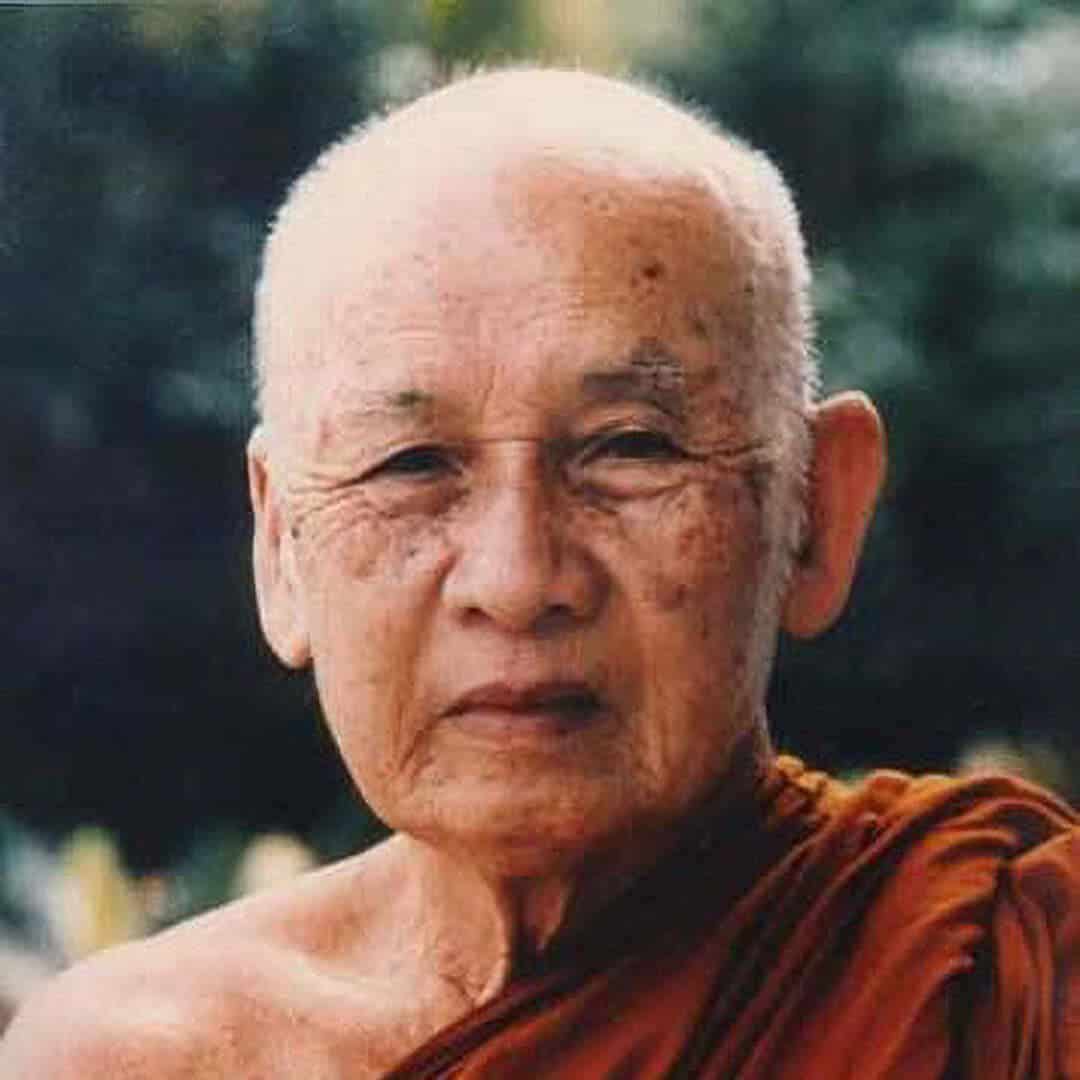
[Editorial Note: I’ve been re-reading “Autobiography of a Forest Monk” by Venerable Ajahn Thate 1902-1994 [The book is available online, look for the link at the end of this text]. Ajahn Thate’s autobiography was originally published in 1974, on his seventy-second birthday. He was involved in monastic life from an early age, through his family, and it interests me to read that he studied “indigenous Dhamma and Korm scripts” at the age of nine.]
I asked my wife Jiab about this and she recognised the word ‘korm,’ saying that when she was a child, she had seen these Buddhist texts, inscribed in Indo-Cambodia characters. So, for the first time I found a direct reference to the extent of Buddhist Teaching coming from Northern India into Thailand.
Wikipedia tells me that Buddhism was introduced into Southeast Asia [“the golden peninsula”], in the 3rd century BC, by way of monks sent by King Ashoka in India. This resulted in a mixture of Mahayana Buddhism, Brahmanism and indigenous animistic religion in the region and that continued until the 13th century CE when Theravada Buddhism became the state religion of Cambodia. One of the kings had sent his son to Sri Lanka to be ordained as a Buddhist monk and study Theravada Buddhism according to the Pali scriptural traditions.
After 10 years the prince returned to Cambodia and promoted Buddhist traditions according to the Theravada training, he had received, galvanizing and energizing the long-standing Theravada presence that had existed throughout the Angkor empire for centuries. More than 900 temples were built in Cambodia and Thailand, Mahayana Buddhism and Hindu Khmer Empire dominated much of the Southeast Asian peninsula. After the slow diminishing of Buddhism in India, Buddhist monks came from Sri Lanka and slowly converted the Buddhism in Burma to Theravada tradition. This was followed by the introduction of Theravada Buddhism in Thailand, Laos and Cambodia. Theravada tradition later replaced the previous forms of Buddhism and was made the official state religion in Thailand with the establishment of the Thai Kingdom of Sukothai in the 13th century AD.
Returning now to Ajahn Thate’s autobiography, his monastic life began at the age of eighteen with novice ordination and at twenty-two he became a monk; however, the young Ajahn Thate had already been on tudong in the forests with older monks and was quick to learn the hazards. At the time, they monks were following the trails and narrow footpaths deep in the forest asking hill tribe people if they had seen their teacher, Ajahn Mun.… and I’d like to pick up the narrative this time at 22.2:
“There had been no news of Ven. Ajahn Mun for two years. That left the two of us, Ven. Ornsee and myself, to seek him out and our wanderings through the forests and mountains were all aimed at this… about half way along the trail we heard the roar of a tiger not far away from us. I was almost frightened to death by the idea of a tiger being so close but I didn’t let on to my friend — he had been born and raised in an agriculturally developed area and so didn’t know the sound of a tiger. If I had told him, I knew I would instantly draw him into my state of trepidation. Going beyond the range of the tiger’s roar we lost the trail and so were forced to find a place to spend the night in the jungle. I was so afraid of the tiger that I lay sleepless throughout the night. There was a heavy dew and it was extremely cold yet my friend lay there snoring loudly all night. While I was terrified with the thought that the tiger might hear him and we would be killed — he blissfully slept through it all.
On another occasion I had left Ven. Ornsee and went off to stay alone. One day I heard a tiger roar and became so terrified by its noise that I began to tremble and shake so much that I couldn’t sleep and my meditation wouldn’t settle down at all. Some local people helped to chase it away by firing threatening shots with their guns and by hurling firebrands at it. It fled for a moment but then came back again. In the early morning, when the villagers were going out to work in the fields, they would sometimes spot the tiger crouching in the jungle ahead of them. They would then run away — although I never heard that it had done any harm to anyone.
No matter how I tried to sit in meditation, it just didn’t seem to come together. At that point I was still unaware that it was all to do with my fear of the tiger. My whole body would be soaked in sweat. “Hey!”, I thought, “what’s all this about then? I’m cold and yet I’m still sweating”. I tried removing the blanket wrapped around me and saw that I was still trembling. I felt exhausted with not being able to progress with my meditation. Then I thought of lying down to rest a little and refresh myself, ready for future efforts. At that very moment, I heard the tiger roar out and my whole body started shivering and shaking, as if I had a malarial fever. It was then I realized that this was all due to my fear of the tiger’s roar.
I sat up and established mindfulness, settling the mind in stillness on a single object and ready to sacrifice my life. Hadn’t I already accepted death? Wasn’t that the reason for my coming to live here? Aren’t tiger and human both a fabrication of the same four elements? After death, won’t both end in the same condition? Who eats whom — who is the one who dies and who is the one that doesn’t die? When I was willing to relinquish and investigate in this dauntless, single-minded way, I could no longer hear the noise of the tiger.
Whenever I afterwards heard the tiger’s roar, my mind remained quite unconcerned. I now saw it just as air reverberating from a material form, causing sound. Ever since childhood, I had had a natural tendency to be easily upset, being of a rather nervous disposition. The sound of the tiger had brought up some past conditioning that had caused my unconscious fear. During that night I again heard the tiger roar from a nearby mountain top and this helped to concentrate my mind in seclusion. I called up the virtues and qualities of the Lord Buddha as my meditation object and from this arose knowledge of a strange and marvellous nature, in different ways never imagined or experienced before.
 dhamma footsteps
Such wisdom here T. Let us always be open to the different ways and how we experience them. 🙏🏻
This is it… words don’t reach that far