I have this eyesight difficulty (AMD) that’s here to stay it seems. When I browse through my old books from before it got to be like this, I’m looking for something that has a slightly larger font, and a wider space between lines (US publications are best), and if a particular book gets my attention, but the readability of it is not good, I can sometimes find it in the right format online and read the part that I need on screen, with enlarged font and spacing. There is the likelihood of headaches peering closely at text on a backlit screen but I can take some precautions.
So, I found what I was looking for: ‘Chakra Therapy’ by Keith Sherwood, printed in 2011. I’d decided to finally get round to learning about the Chakras but it stayed mostly unread because there were some Christian references in the contents list that at a glance put me off. It was this that caused me to put the book aside all those years ago. The fact is, I’m an isolated lapsed Christian living with the Thais for 30 years as a Buddhist in a Buddhist country, and no actual contact with Western people.
Since I decided to follow the Buddha’s Teaching, long ago, the “Thou Shallt Not” shadow of the Church of Scotland, I experienced as an adolescent, still conditions my thought. I forget that this book was written for people living in a Western culture looking out from there into the same universal field we are all part of. There’s a familiarity about this that pulls me out from my contained reality status, living in someone else’s country and into a kind of recognition I can’t find words for yet.
The book is about interacting energy fields and “the universal field,” the atman, meaning “pure consciousness,” or “self,” since the unified field is the true identity of everything in nature. A flicker of attention here because, for me, the sense of Self is illusory in the anthropocentric sense of the word. However, I’ve come round to seeing it another way; if I think of it as Brahma/Atman, devoid of any individualizing influence, no problem because I can wear my Advaita Vedanta hat to blend in with the surroundings.
‘You are an energy being. Each individual is composed of a system of energy fields which interact with each other and the environment they interpenetrate. The universe is permeated by these fields and a human being can be thought of as a localization or concentration in the universal field.’
I understand this immediately and there are these bursts of energy as I read the text. For a moment there’s a sense of joyful déjà vu… I know this fundamentally! But then there’s confusion; all those years ago I chose not to pursue it, unwilling to engage with something I knew nothing about, embedded in my Western separationism and now I’m stuck with age-related eyesight difficulty and headaches (PHN). It’s the Judeo-Christian Tradition I was born into: “The notion that humans are incomplete and that they can become separated from the universal field is held as an objective reality in the Judeo-Christian world.” That’s what it is! The book straightens out tangled thoughts about Christianity I’ve been burdened with for years
“The doctrine of separation, which is at the root of orthodox theology and is the cause of so much misunderstanding and unnecessary suffering, is the foundation of orthodox psychology as well. Orthodox psychology built its towers on the shoulders of Newtonian and Cartesian thought which saw separation as the natural condition.”
There are so many worthwhile sections on separation and duality here but I need to paraphrase this text to get it to completion. Man faced a continual striving between what was base in his nature and what was noble. He chooses to identify with what is noble in his character and reject what is base which includes the inevitable repression of those elements in his character which he considers ignoble. They are rejected, and rather than being integrated, they are judged, sentenced and become the “others” within himself.
The writer describes how he learned the principles of psycho-spiritual integration a little at a time and thus remembered those hitherto lost and unwanted parts of himself and could recollect “the others” buried within himself. The energy imprisoned within began to be released and the system by which this was developed is presented here in this text, out of necessity in order to understand and integrate the seemingly contradictory parts of how he managed to do it. (More about this later)
Inherently
Ultimate bodhicitta is basically Buddha Nature. We all have Buddha Nature. Every being, every sentient being has Buddha Nature. Every being IS Buddha Nature; not has, but IS Buddha Nature. We are all Buddha Nature; we all are Buddha. […]
Buddha Nature can never be defiled; it can never be polluted. No matter how much darkness, how much evil we might do, or think, or say, for however long, never, ever, ever can contaminate the nature of the mind. The nature of the mind is beyond all that. Inherently we are completely pure. Inherently we are completely light, no worries. [Jetsunma Tenzin Palmo]
[Editor’s note: I was reading about Fa Xian, the Sixth Century Chinee Buddhist monk who, at the age of sixty, walked overland to India and I thought what is it that drives a person to do something extraordinary like that? Then I listened to Ajahn Sucitto’s Dhamma talk given at the ordination of a young monk and he was talking about the ‘call’ or the whisper that doesn’t have a sound and it doesn’t come from thought. It’s the citta, a special quality you could call faith – except that it doesn’t come from a belief in anything. It seemed to me that the ‘call’ in Ajahn Sucitto’s talk is what Fa Xian heard or became aware of. So, I transcribed some parts of Ajahn’s talk and that is attached at the end of the Fa Xian story for you to decide.]
FAXIAN
Faxian, also referred to as Fa-Hien, Fa-hsien and Sehi, was a Chinese Buddhist monk and translator who traveled by foot from China to India to acquire Buddhist texts. Faxian’s visit to India occurred during the reign of Chandragupta II. He entered the Indian subcontinent through the northwest. His memoirs describe his 10 year stay in India. He visited the major sites associated with the Buddha, as well the renowned centers of education and Buddhist monasteries. He visited Kapilvastu (Lumbini), Bodh Gaya, Benares (Varanasi), Shravasti, and Kushinagar, all linked to events in Buddha’s life. Faxian learned Sanskrit, and collected Indian literature from Pataliputra (Patna), Oddiyana, and Taxila in Gandhara. His memoirs mention the Hinayana (Theravada) and emerging Mahayana traditions, as well as the splintering and dissenting Theravada sub-traditions in 5th-century Indian Buddhism. Before he had begun his journey back to China, he had amassed a large number of Sanskrit texts of his times.
On Faxian’s way back to China, after a two-year stay in Sri Lanka, a violent storm drove his ship onto an island, probably Java. After five months there, Faxian took another ship for southern China, but again it was blown off course and he ended up landing at Mount Lao in what is now Shandong in northern China, 30 kilometres (19 mi) east of the city of Qingdao. He spent the rest of his life translating and editing the scriptures he had collected. These were influential to the history of Chinese Buddhism that followed. Faxian wrote a book on his travels, filled with accounts of early Buddhism and the geography and history of numerous countries along the Silk Road, as they were, at the turn of the 5th century CE. He wrote about cities like Taxila, Pataliputra, Mathura, and Kannauj in Madhyadesha. He also wrote that inhabitants of Madhyadesha eat and dress like Chinese people. He declared Patliputra to be a prosperous city. He returned in 412 and settled in what is now Nanjing. In 414, he wrote (or dictated) Foguoji (A Record of Buddhistic Kingdoms; also known as Faxian’s Account). He spent the next decade, until his death, translating the Buddhist sutras he had brought with him from India.
[Excerpts from a Dhamma talk by Ajahn Sucitto showing on You Tube, link at the end of this text.]
This ordination ceremony is the beginning, the entry point, and we can all perhaps resonate with the sense that there’s an occasion here. Someone is making a declaration to put aside the normal, the ‘knowns,’ the familiar forms of the domestic situation, the job, the family. Put aside having things my own way, we come to serve.
All these opportunities, we gave them up. We gave them up because they weren’t taking us far enough. Something else started to call; a sense of the ‘call; it’s something that’s not about what normally shapes our lives. Something else begins to whisper, or call in a louder voice than all that. It’s Faith – doesn’t mean a belief in anything. The way I understand it is, my home is in the world of sense consciousness; sight, sound, touch, hearing, odours, fragrance and the measuring mind, the thinking, planning, opinionizing, dogmatic, believing, mind. It moves around the other senses, deciding, judging, comparing, contrasting and reflects upon itself, thinks about its thoughts, thinks about its ideas, thinks about its psychologies. It’s very engrossing, gets very dense and becomes a territory called ‘Mine.’
Other people are in their world. It’s Her world or it’s His world – not My world. There’s conflict, disappointment, frustration. Everything is flooded with dogma media, chat shop, chat shows, chat rooms. People chat, chat, chat, opinions about this, opinions about that; this-that, this-that, Right-wing, left-wing, middle wing, going up, going down and the whole thing blabbing away and you’re thinking about your own opinions about yourself.
Then there is the ‘Call’ – not necessarily a sound, it’s some sense of, ‘I want to get out of this, even though I’m looked after, well fed. I’m not being brutalized. I’ve got a car or a flat or a partner’. Even though I’ve got a reasonable deal in life, compared with some people, I’m still not satisfied and this isn’t taking me anywhere that really makes my life feel bright, clear, confident. And that something begins to dawn, a sign of Faith.
The Buddha said its root condition is actually not a belief in anything but the realization that things don’t work, nothing fits… there’s got to be something better than this (dukkha). Maybe this is the point where we begin to recognize some sense of ‘I am,” a sense of being that’s not a thought, it’s not a possession, it’s a sense that’s not associated with sight, sound or all the other senses. This is the citta, it’s a kind of an immaterial quality whereby we’re able to review and get a perspective on what the six senses are bringing in.
That’s what enables us to recognize this is not my true home, this is the building, these are the clothes, that is my name on the passport but it’s is not my true home. My home is something more fundamental. We begin to recognize as soon as we step back from just adopting what’s seen or heard or thought, that it’s enough to just barely notice it. This is hearing, this is a sound, this is a sight, or this is a thought. This is feeling stirred-up, this is feeling disappointed, this is feeling irritated, this is feeling glad. We step back from it and notice there’s an awareness of it, and there’s something else here that could support you – not easily revealed without quite a considerable amount of cultivation, purification, and clearing away and firming up of this experience, this, citta, the awareness; firming it up till it becomes a refuge and the Buddha said this is the refuge, there is no other refuge.
Early on, in my own situation, my own life, I had the certainty that something wasn’t working, even though I was ticking all the boxes and I was in Thailand and that was supposed to be interesting and fun and so on. But, no… it wasn’t working, what do I do next? So, I stumble into one of these meditation sessions, meditate for Fifteen minutes. I thought well… it’s worth a try. Just sit and be with your breathing for Fifteen minutes, but…‘Whoa!’ The mind was going all over the place and I couldn’t watch one breath. But I was able to recognize there was something there that was able to see my mind going like a crazy monkey. This is, of course, the citta (awareness). ‘Okay I don’t know about that right now, what I need to have, is the encouragement and support to get that measuring mind, with all its wishes and wills, tethered down. So, I’ll go to a monastery. When I go there, I won’t have so much sense impact and so many choices.’
So, I got there, and thought well, it’s testing to just unplug, but I could do this for a couple of weeks. I could sense something stirring, something awakening because when I left Thailand to get a new visa, things were different. I had decided to spend a couple of months travelling around in Malaysia and Indonesia, but all I wanted to do was sit and meditate. So, I went back to the monastery and decided to stay there for a while. They didn’t have anagārika in the place I was, so I became a sāmaṇera. After six months I decided to stop thinking about how long I was planning to stay there because the measuring mind cannot comprehend what’s going on or where this is coming from, you just have to trust the process.
And that’s what it is, essentially; something wants to do this, something wants to wake up. This is special, this is sacred, and it comes from that Call. There’s the mind, then there’s the body. So what does the body reveal by itself? The body is not seen or heard, by itself. It has a sensitivity to it that is twofold. There is a tactile sense; it’s always being touched by furniture and clothes. Other times there’s just space all around except for say the sensation of feet touching the ground.
The body also has an inner sense which deals with things like being intense, relaxed, excited, angry, sick and in this very body is the beginning of my world. My world begins right here, and this is where you travel, right through to the end. It’s here that we practice breathing, sensing the energy of the body moving within the body. How the body brightens up when we breathe in and gets calm when you breathe out – basic meditation, and that quality of brightening and subsiding is not a physical sense it’s an energetic sense. In this you’ve got something that will never leave you as long as you’re alive. It acts as an inner refuge. where we can contemplate our emotions and thoughts and yet not get caught up in them. When we feel things like worry, anger the body reacts. Anger flushes into our face, fear cramps around our belly, excitement thumps into our heart.
As for thinking, there are all these forms of contact that stir, arouse, disappoint, excite and present possibilities of grasping. Thinking is the king and leader. At the drop of a hat, the thinking mind will proliferate immense scenarios of ‘my’ world and immense pantomimes of other people and their world. A major part of our training, is how to notice the tendency to proliferate and to realize this is what we need to get free from.
There is a way, and this way is supported by the presence of the body which doesn’t proliferate, has no future, no past, does not establish me and mine. It establishes life, and we take refuge in life itself, as long as this life lasts. It’s an extremely helpful tool where the citta gets support gets stabilized by that presence of body. It keeps you grounded. You tune into that and you can sense thoughts, sights, sounds moving around. Their nature is to come and go, they’re interchangeable they’re insecure. And you’ve got this (body and mind). And this practice is centred on meditation,
This is an enormous practice, really when it comes down to it, your cultivation, your meditation is meeting in these places we would normally grasp, normally rush, normally tighten. Meeting these places where reflexes start firing and at that very point, come into awareness and presence and let’s see what we can do.
That’s practice… practice is about driving to the airport… leaving you think, a good two hours to get to the airport but you hit a traffic jam. Watching the clock go tick, tick, tick, and here we are, insecurity, uncertainty… I can’t make what should happen, happen! Ah practice, practice is about cultivating that point where we start to learn about situations that we would normally find infuriating, difficult and we begin to rephrase it… a chance for equanimity to be developed. A chance for patience to be developed, good. These tremendous strengths, patience, equanimity, resolutions mean you keep returning time and time again to your ground which is steady which will always look after you, which will carry you through life and into death and beyond.
This solemnizes our occasion; this makes it all worthwhile. I wish you all the best.
The Silk Road opened around 139 BCE when China was unified under the Han dynasty. It is thought however, that significant trade occurred for about 1,000 years beforehand. In terms of the development of Buddhism, these early times were notable because of King Ashoka (reigned 322-185 BCE in North India), best known for his renunciation of war, after the conquest of the Kalinga in 261 BCE, and subsequent conversion to Buddhism. He carved Dhamma lessons into cliff rock, onto pillars, and in caves throughout India (some are still visible today), in the hope that he could provide inspiration and guidance to the people of his extensive kingdom. Three languages were used, Prakrit, Greek and Aramaic. The Prakrit inscriptions were written in scripts which a commoner could read and understand; the practice of honesty, truthfulness, compassion, benevolence, nonviolence, and considerate behaviour toward all.
After the death of King Ashoka, Buddhism in India went into decline. There was a large-scale reform in Hinduism led by Adi Sankaracharya and the Buddha became a part of Hindu history as an avatar of Vishnu. Another factor for the decline was the Muslim invasion of India and Islamic destruction of Buddhist temples, shrines, and institutions, at Taxila and Nalanda universities. Buddhist monks sought refuge in Nepal and Tibet.
By this time however, the Buddha’s Teachings had found their way to Central and East Asia by way of the Old Silk Road. The “silk road” itself was an interconnected network of Eurasian trails followed by caravans transporting Chinese silk and other goods to and from China, through Central Asia to the Middle East and Mediterranean countries (distance 6,400 kilometres, 4,000 miles). Few individuals crossed the entirety of the Silk Road, instead relying on a succession of middlemen based at various stopping points along the way. In addition to goods, the network facilitated an exchange of ideas, religions, especially Buddhism.
Buddhism is associated with the rise of the Kushan Empire, present-day Uzbekistan, Afghanistan, Pakistan and Northern India. Kushan coins show that all along the Silk Road kings and rulers had built monasteries and temples. This combination of patronage, the founding of monasteries, and the rise of Buddhist scholarship all contributed to make Buddhism a very significant presence all over Central Asia.
The greatest success in the spreading of Buddhism came with its introduction to China, where it reinvigorated the existing philosophy, culture, and literature. The Silk Road also reached Korea and Japan. Its encounter with Daoism and Confucianism helped establish deep roots among the peoples of East Asia. Here Buddhism became a religious and spiritual presence as well as the catalyst for greater links with Eurasia.
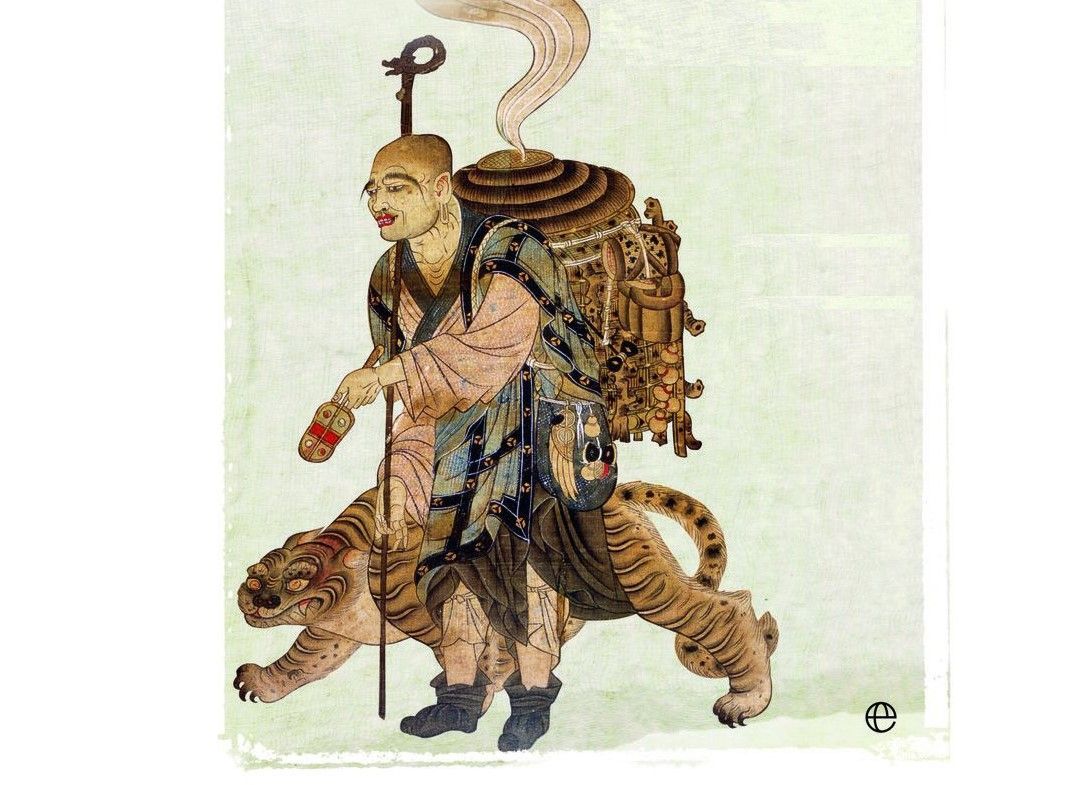
From the 4th century onward, Chinese pilgrims also started to travel on the Silk Road to India, the origin of Buddhism, in order to get improved access to the original scriptures, the most famous of these is Xuanzang. At age 27, he began his seventeen-year overland journey to India, making his way through various central Asian cities, and through to Northern India. He also spent some time at Nalanda Buddhist monastic university (mahavihara) in ancient Magadha in modern day Bihar, India where he studied with the monk, Śīlabhadra.
On his return to China in 645 CE, Xuanzang was greeted with much honor but he refused all high civil appointments offered by the still-reigning emperor, Emperor Taizong of Tang. Instead, he retired to a monastery and devoted his energy to translating Buddhist texts until his death in 664 CE. According to his biography, he returned with “over six hundred Mahayana and Hinayana texts, seven statues of the Buddha and more than a hundred śarīra relics (pearl or crystal-like bead-shaped objects that are apparently found among the cremated ashes of Buddhist spiritual masters).
During the fifth and sixth centuries C.E., merchants played a large role in the spread of Buddhism. The moral and ethical teachings of Buddhism were found to be an appealing alternative to previous religions. As a result, merchants supported Buddhist monasteries along the Silk Roads. In return, the Buddhists gave the merchants somewhere to stopover. Merchants then spread Buddhism to foreign encounters as they travelled. Merchants also helped to establish diaspora within the communities they encountered and over time, their cultures were based on Buddhism. Because of this, these communities became centers of literacy and culture with well-organized marketplaces, lodging, and storage.
At the Mediterranean end of the Silk Road, the Greeks were the first Europeans to embrace Buddhism, centuries before the advent of Christianity, and there is evidence that the first sculptors to depict the Buddha in the form of statues were of Greek descent. These were the first anthropomorphic representations of the Buddha himself. Before this innovation, the Buddha was only represented through his symbols (an empty throne, the Bodhi Tree, Buddha footprints, the Dharmachakra, the Dharma Wheel).
Buddhism flourished under the Indo-Greeks, the Milindapañha (English publication: available: ‘Questions of Milinda’) dated between 100 BC and 200 AD, is a dialogue between the Indian Buddhist sage Nāgasena, and the 2nd century BC Indo-Greek King Menander I of Bactria, in Sāgalā, present-day Sialkot. The book speaks of the encounter of two civilizations — Hellenistic Greece and Buddhist India — and is of continuing relevance as the wisdom of the East meets the modern Western world. King Milinda poses questions about dilemmas raised by Buddhist philosophy that we might ask today. And Nagasena’s responses are full of wisdom, wit, and helpful analogies.
Great Buddhist scholars always looked at the Silk Road as a connecting thread with what they regarded as the founding values of Buddhism. With the 7th Century invasion of Islam in Central Asia, the transmission of Buddhism started to disappear. An increasing Muslim dominance all along the route made it difficult for Buddhist monks and pilgrims to travel between India and China, and the Silk Road transmission between Eastern Buddhism and Indian Buddhism eventually came to an end.
Buddhism recovered in China during the Song Dynasty (960–1279), the “golden age” of Chan (known today as Zen). Chan Buddhism spread south to Vietnam as Thiền and north to Korea as Seon, and, in the 13th century, east to Japan as Japanese Zen. Pure Land Buddhism also became popular during this period and was often practiced together with Chan.
(More next week)
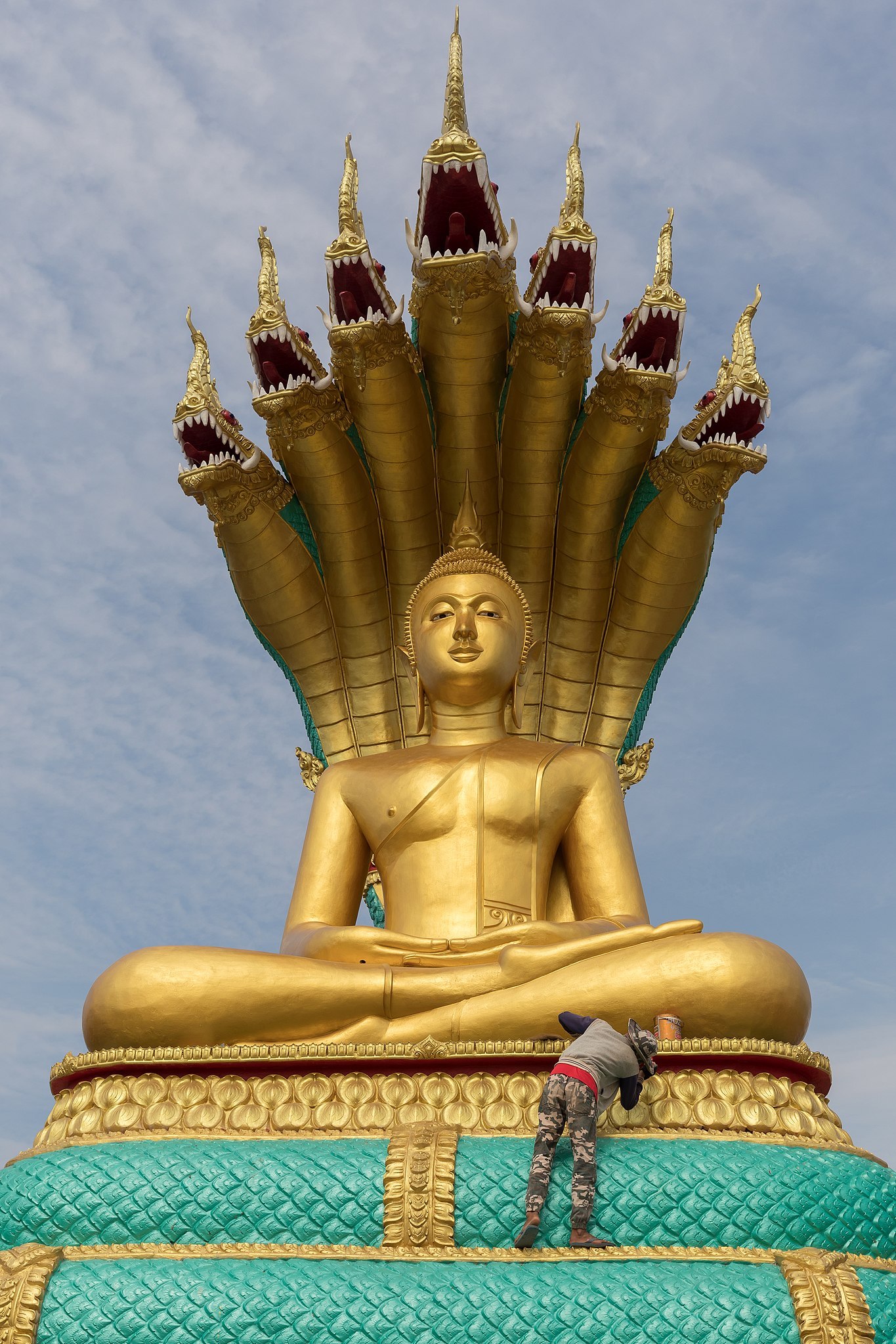
Buddha Daibutsu, Kamakura
Header Image: 4th Century Chinese pilgrim monk, Xuanzang
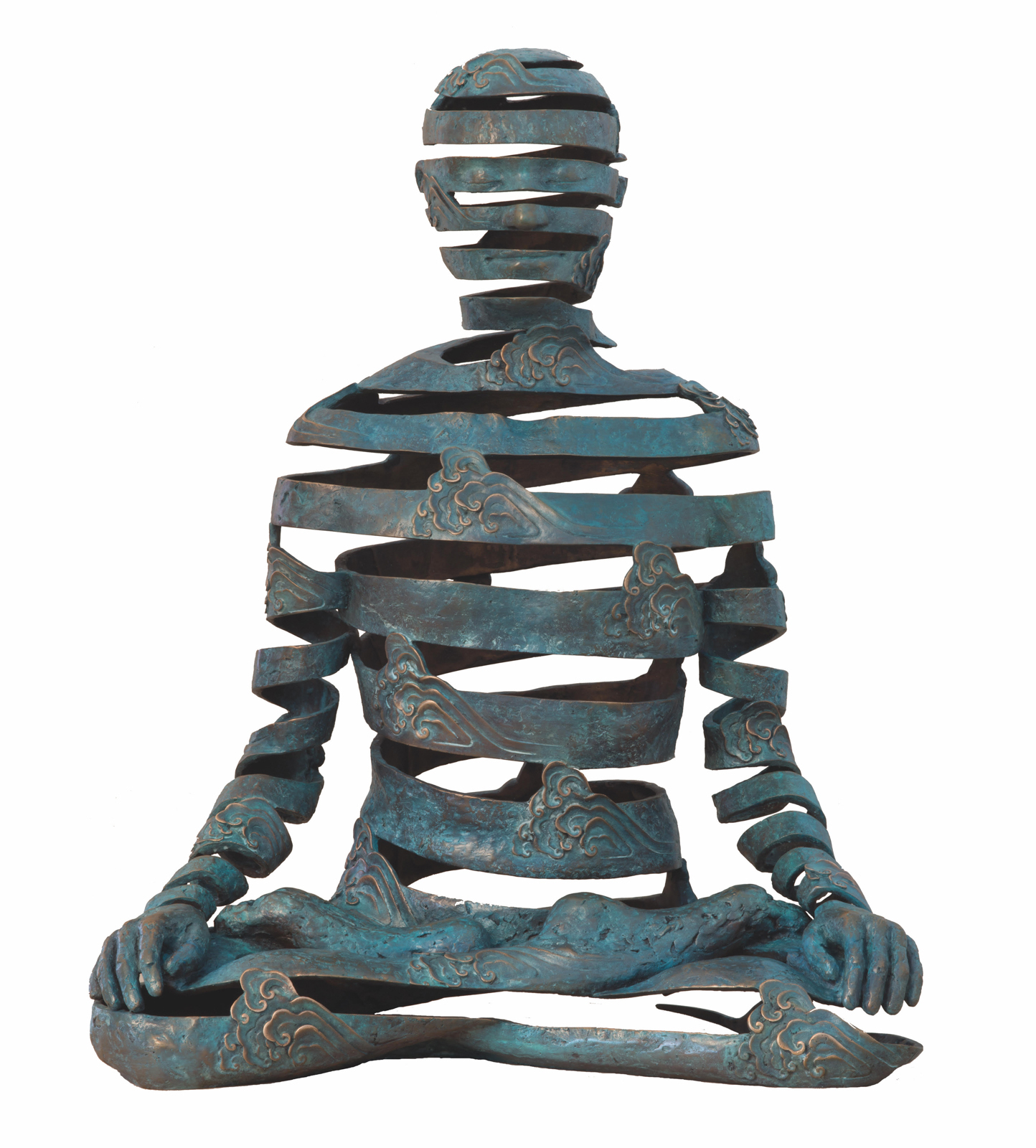
The Buddhist concept of anattā appears in a thought window: “non-self” – no unchanging, permanent self or essence can be found in any phenomenon. And to begin with, there is the story of Vajira, a Buddhist nun (bhikkhuni), one of the earliest women adepts in Buddhist history. While Vajira was meditating, she was confronted by Mara, a malignant celestial demon king, and he asked about the origin and creator of her “Being”, i.e., her soul. She responded by comparing one’s “Being” to a chariot, showing that it had no permanent existence but was made up of constituent parts: Is it the wheels, the framework, the ropes, the spokes of the wheel?’ None of these things are the chariot but the aggregate of such physical parts composed in certain ways is conventionally understood as a chariot. Just as, with an assemblage of parts, the word ‘chariot’ is used, when the 5 aggregates (khandas) are present in a human, there’s the convention ‘a being.’
Returning to present-times, the following is a transcript of parts of a dougsdharma video by onlinedharma.org: “As the chariot is being taken apart, at what point in the dis-assembly does the chariot cease to be a chariot? Consider the assertion of non-self: What we are is a complex process, a causally inter-related set of parts essentially that creates a sense of self over a period of time. This radically displaces our ordinary everyday sense of self, replacing it with a much wiser and deeper understanding of the way things really are. I would assert that a similar kind of thing happens when we contemplate the complexity of artificial intelligence because, after all, it’s got to have these incredibly complex trained neural networks behind it. In the same way we might say human utterances come out of a very complex network of neurons – literal neurons rather than artificial neurons in a computer.
Let’s look again at how a person is like a chariot made up of parts, in particular five parts which are known as the Five Aggregates. [1. form (the body) 2. sensations (vedana) 3. perceptions (sañña) 4. mental activity or formations (sankhara) 5. consciousness (viññāna)]
All of these five groups of processes are causally interrelated and causally interacting. That causal interrelation among these five different parts is what creates our idea of a self, a person. Then, it’s important to remember that each of these parts can be broken down into further parts.
Form, the human body, can be broken down into the elements and each of the four mental parts can be broken down into subparts. It’s a complex interrelation of many different parts that are basically coming into being and going out of existence over a period of time.
A lot of this I think, mirrors and reflects what we are seeing now in artificial intelligence; that the self is no different from a very complex causally interreacting machine except for the biology part of it. Now, certainly we can’t see a computer’s mental parts just as we can’t see the mental parts of another human being that is standing in front of us – we infer them based on the behaviour of the object in front of us.
If we see the person in front of us behaving in the way a normal person does, we assume that they have a mind, they have mental parts. Now we may think that the artificial intelligence programs around us are too simple, that they don’t quite meet the criteria of sentience or intelligence. It’s possible we believe that, maybe we’re right, that’s true. But if it is, I would submit that we only need to wait because these programs are getting exponentially more complex, more powerful over time, new versions of these programs will be coming out in the next few years and so these points we’re going to have to meet in the future and probably in the near future.
I think nothing displaces our literal sense of self more than the contemplation of these kinds of artificial intelligences. And the idea that we can now create something that is in certain very deep respects indistinguishable from a human in the way that it interacts with the world. Following that line of thought, I decided to ask one of these programs, the most famous publicly available one which is ChatGPT a question about this about what it made of this relationship between contemporary advances in artificial intelligence and the Buddhist concept of non-self and it had an interesting response.”
Some experts have suggested that the development of advanced AI could challenge our conventional notions of self and identity, raising questions about what it means to be conscious and self-aware. For example, if we were to create an AI system that was capable of learning and evolving in ways that resembled human cognition, would we consider that system to have a ‘self’ or a sense of identity?
In this sense the Buddhist concept of non-self could be seen as a helpful framework for understanding the relationship between consciousness and self in the context of AL. By recognizing that the self is not a fixed unchanging entity, bt rather a dynamic and ever-evolving process, we may be better equipped to grapple with the challenges and opportunities presented by advances in AI and related technologies,
So, I’ll just leave that response there and say that we ae living now in pretty amazing times.”
"To me, photography is an art of observation. It’s about finding something interesting in an ordinary place. . . I’ve found it has little to do with the things you see and everything to do with the way you see them." – Elliott Erwin (Documentary photographer)







 dhamma footsteps
You must be logged in to post a comment.