unsupported consciousness

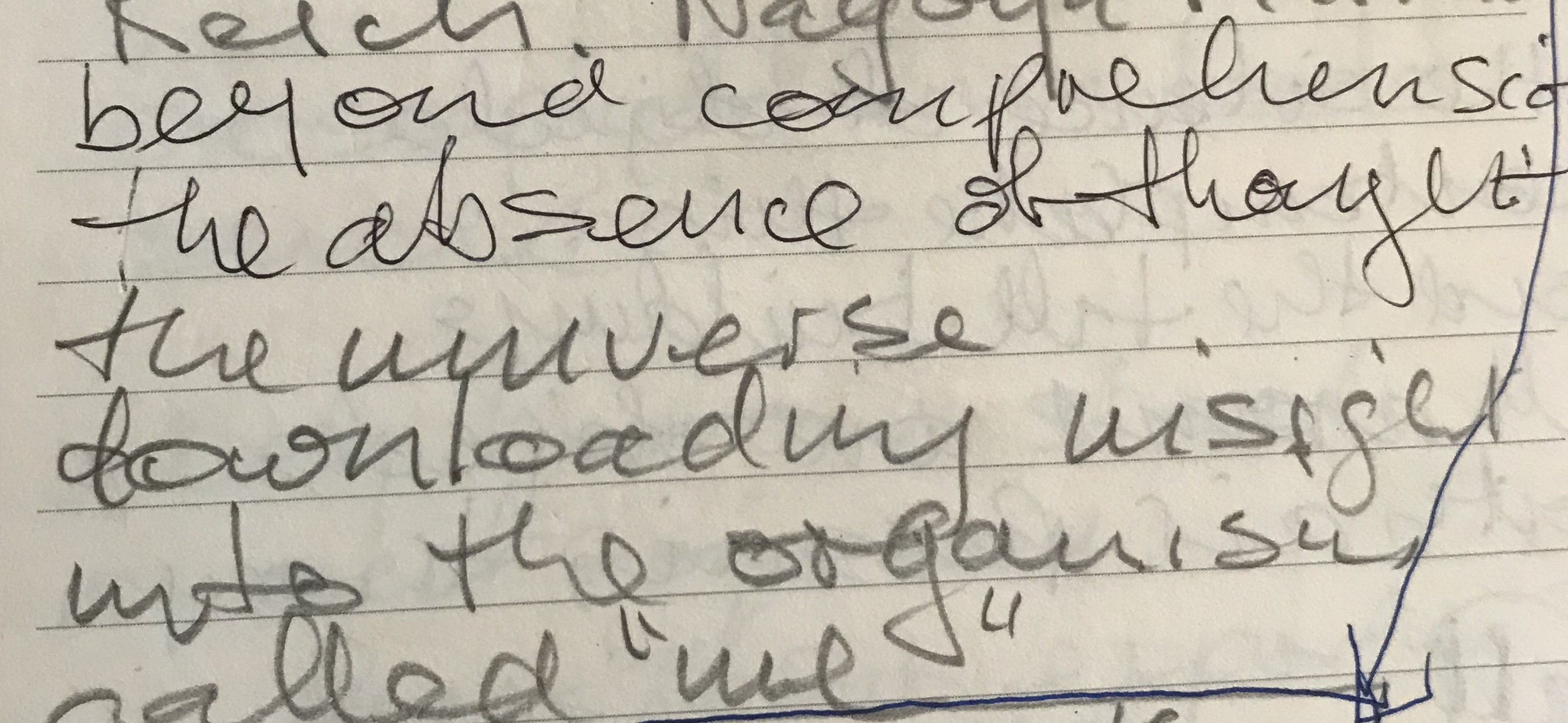
POSTCARD#474: I’ve been looking through my old notebooks, hard-to-read handwriting, scribbled in urgency many years ago – the stream of consciousness, where everything seemed to carry meaning. Not enough space to outline the vast wholeness. This was before our days of phone cameras and scanners. No internet, only books in the library, photocopies for a charge per page. It was all heavy and slow but this was normal for us, we didn’t know anything different. No email, no text-messaging, etc. Only letters folded into an envelope, lick-stick-on stamp… thump, and post in the mail box, then wait for days for a reply…

I left the West in 1982 and that’s how things were then, very different from the East. I used to like to select a postcard to send, a picture on one side; blue sky, a beach, palm trees and on the other side; space for the address, exotic stamps, and not much room left to write. Minimalist choice of words to express what you want to say to the other person, to read and reflect on the present moment and how it is there and then, compared with how it is here and now, in this different place and time. Then stamp… thump, post in the mail box, and there was no reply, usually. The postcard message is a statement… this is how things are. The present moment stretching out into the future and back into the past.

A prevailing sense of Self, of course, running through every part of the configuration – leading to unwholesome attachment to all kinds of unhappy mental states. That’s how it was in Northern Europe, the belief in the self was encouraged. We were not taught about meditation, and structuring the mind in order to see the ‘self’ is a fiction the mind creates. Instead we just muddled along and I could see something was not quite right, but most of the time I was living in a dream; the deluded not-knowing state and random karma: ‘a tangled skein of thread, a woven nest of birds, a thicket of bamboo and reeds…’ The thinking thing gets a hold, loves it, hates it; tries to control it, tries to figure it out.

But I found the way out, I was lucky enough to have a friend and got a few books that helped me understand. Also, meditation where the self is seen for what it is; it appears sometimes, holding on to Mind and Body and if  you don’t let it get attached, then it’s gone: “… the ‘I’ exists conceptually, dependent on mind and body, not an entity in itself (Dalai Lama).  So the Buddha, the Dalai Lama and other enlightened beings are saying, there is no self. That’s how it is if you’ve reached “… the remainderless fading & cessation, renunciation, relinquishment, release, & letting go of that very craving. (the noble truth of the cessation of dukkha) “— SN 56.11 (dukkha nirodho ariya sacca).

For the rest of us still engaged in unhelpful attachment, it’s hard to let go of our years of conditioning. My difficulty with practising ‘no-self’ had been extricating myself from the Judeo-Christian conditioning that assumes the existence of an eternal soul. It still haunts me some nights but I’m okay about that now. I understand everything that arises, ceases. “All dharmas (phenomena) arise in dependence upon other dharmas: ‘if this exists, that exists; if this ceases to exist, that also ceases to exist.’” In other words; if you can accurately remove the cause, then the suffering falls away.

Often it takes place in an unexpected way, the problem is gone and in its place an empty space – the strangeness of it, a luminosity and awareness of immensity. Sometimes it happens if I’m in a dangerous situation say, fast moving traffic behaving in a wild sort of way, I look into the mind and there is this stretched-out present moment! I’m excited and watchful. A trembling awakenedness, it’s like that place,” the zone,” that athletes refer to – not always reachable but I’ve been there, and understand better now, the meaning of the word, ‘śūnyatā,’ when the little sense of ‘me’ is gone and there is only consciousness.

There are different ways of understanding the word ‘consciousness’ and  describing the experience, Ajahn Sumedho calls it ‘unsupported consciousness, an awareness that’s different from the basic functions of consciousness,’ when you are interacting with the world; distant from the usual state of simply being aware of what’s going on in the body/mind.

And beyond all of that is the unsupported consciousness. It’s there that my curiosity is drawn. The thinking mind disappears, no boundaries, a non-conceptual experience… an omnipresent consciousness all through the centuries of present ‘moment-ness’ and there’s so much more to be said about this.

Listening 1

[Editorial Note] This is another in the series of selected posts from 2012  reblogged and considered again, here in 2022.

I was in Pondicherry at the time, stayed there for one year then moved on to Bangalore. Looking at the post now, there’s nothing I would change, and it is refreshing to read it again. I notice that the mind is on automatic pilot when it comes to interpreting a wave of random sounds, as well as random notes – one has the beauty of birdsong, the other, an interpretation of known sounds and the nearest match for unknown sounds. There is no ‘self’ involved other than being the uncomplaining recipient of the end product.

The ‘collected’ random sounds has beauty too, ten years ago, most people had no ACs running only fans and the windows open, so you could hear the kitchen sounds for some way away. Also aluminum cooking pots or ‘vessels’ as they were known and the characteristic ‘ding’ sound, different from the stainless steel kitchenware of today. Susan Blackmore is still around, this was an early study and it has developed since then. I am still here and thinking not much has changed, in fact I could easily be learning from the past. These are postcards from the present moment, the ‘here and now’ as it was there and then.

(Reblog POSTCARD# 104/): South India: Birdsong. A small wave of tiny notes. Sitting on the cushion under a thatched structure built on the roof. Focus on breathing, soft warm air, it’s the end of the night. Dawn light coming up. The birds near to me are surprisingly loud, so much energy from such a small body, such a tiny breathing system. There are these silent intervals, to take a bird-size breath of air, I think, then a long musical ‘verse’, and another silent interval for breath; the ‘song’ moves on to the next verse and so on. The regular pace of these silent intervals contributes to the pattern of the verses. Birdsong is a ballad, a story about something that goes on and on; more than enough; an abundance. It blows away the scarcity of my small mindedness. I can see why they call it ‘The Dawn Chorus.’ Sky is full of sound, a huge chord played on an instrument with a great number of strings

Listening consciousness and sound object are one and the same thing, there’s an affinity with birdsong. Maybe it’s about acoustic resonances of the bird cranium being all of a oneness as far as we other living creatures in the world are able to perceive it. And, part of it too, are the echoes in the spaces between things: reflective surfaces, tree trunks, branches, walls, the air, clouds. Sympathetic resonances create multiple frequencies like the echo it makes on the underside of my thatched roof. And now it’s gradually diminishing; no grande finale, just a musical occurrence that takes place every day and gets forgotten about as soon as the sun rises in the dramatic way it does, expanding into our lives and everything becomes secondary to that main event.

Other sounds become heard; ordinary household noises, miscellaneous gentle ‘clatter’ from houses through open windows. Dishes clink, aluminium pots make that dull ‘ding’ sound. A shout, partial sound of a goat. child cries, cock crows, dog barks, a bicycle bell, street trader’s call, a car horn honks. Something clinks, and it goes on, individual recognisable sounds all appear in consciousness exactly as they occur, no end to it. Each has its own space, situated in its place in a clear sequence, one after the other.

I’m thinking there’s something about it that suggests a composer could create an orchestral symphony out of this? But it doesn’t work that way, I realise. It’s not the ‘actual’ sound I’m listening to, it’s the ear consciousness function that is set to rationalise the flow into an orderly pattern of ‘virtual’ sound. Each unit of sound has a place, according to how the consciousness function selected it, unknown partial sounds are replaced by known sounds, ear consciousness triggers a process so the object is placed according to the ‘closest match’ that can be found in the filing system.

The actual sound space I’m surrounded by may well be a tremendous complexity of pieces of things; an ocean of permutations. There’s some insight into what this amounts to but I know I’m not even taking on anything resembling the scale of it. I seek stability from this chaos: the ‘self’ shapes the randomness of the universe into a manageable chunk and I can settle with that thought.

‘In the normal way, attention shifts from one thing to another. Surprising events grab the attention: other chains of thought wait to be finished as soon as there is a gap. So there is never any peace. This is efficient in using all available processing capacity, but what does it feel like to be … in such a system? I suppose it feels like most of us do feel – pretty confusing. The only thing that gives it any stability is the constant presence of a stable self model. No wonder we cling to it.’ Dr. Susan Blackmore [Check out: Science tackles the self ]

Jesus and ‘Churchianity’

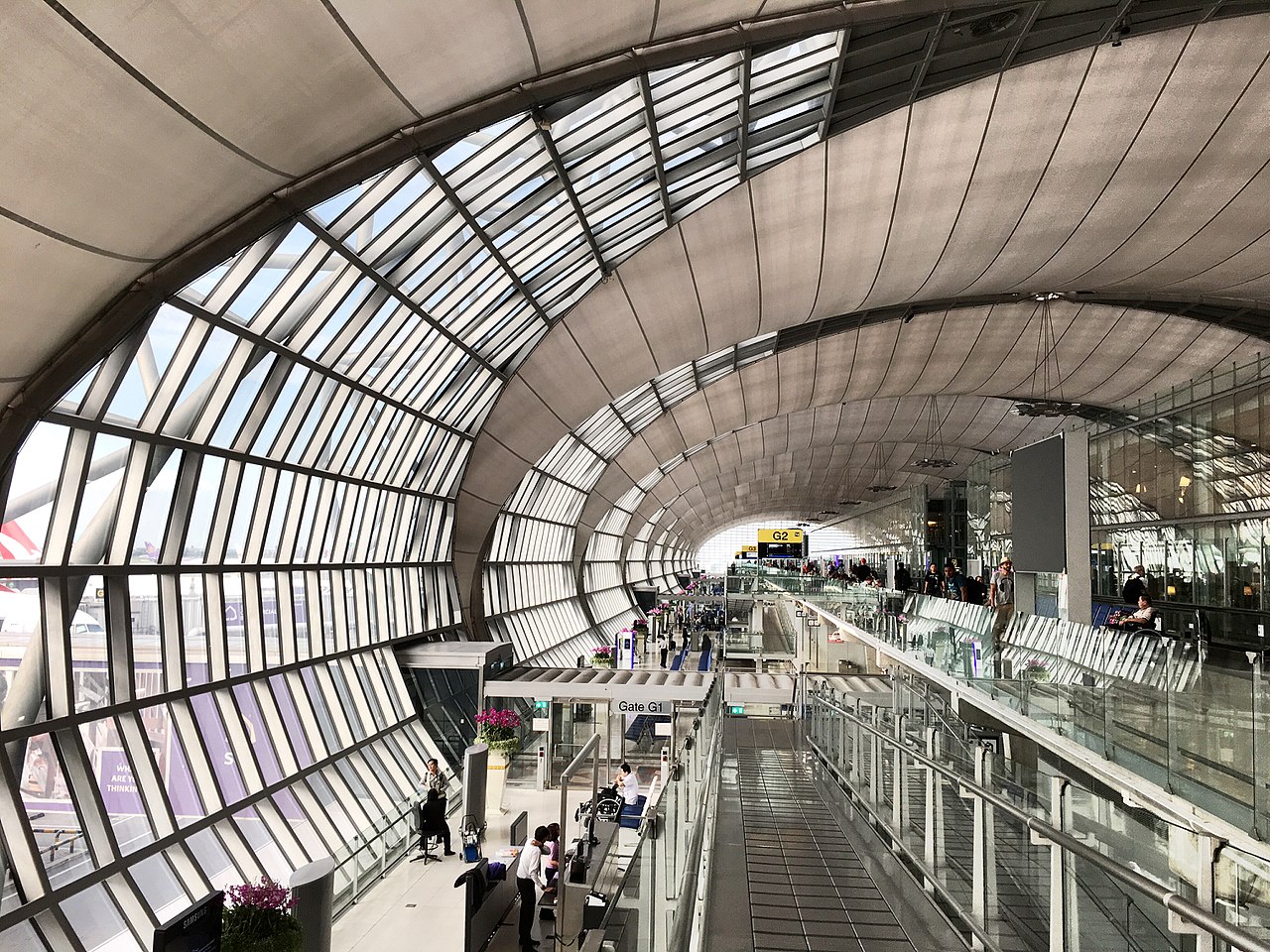
(Reblog POSTCARD# 001/): Christmas 2011, Bangkok Airport: Bags packed, got passport and ticket – taxi to the airport. Checked in, immigration, security and step through into the glitzy duty-free with people and music circulating. Compelling christmas carols with full orchestral backing and we are swept away to a tinsellated heaven realm. The next music track is a syncopated, off-beat, acoustic guitar melody support for: ‘… the ho-lee bible says, mary’s boy-child, jee-sus christ, was born on christ-mas daaay…’ Enter coffee shop area as we reach the main chorus at full volume: ‘Hark Now, Hear The Angels Sing…’ waiters have that look: dulled minds, christmas carol track loop playing in their dreams.

When I was a kid, I’d ask people about Jesus and didn’t ever get a satisfactory answer: ‘Jesus was the Son of God’. I accepted it, but didn’t understand. That’s how it was and maybe it’s why, in later life, I started to search for a real spiritual path. And eventually I became a Buddhist; all’s well that ends well. And it’s only recently I’ve been able to see links between the Jesus Teachings and Eastern religious experience (Advaita Vedanta) so that brings the Jesus story very much closer to me.

I open the laptop in the middle of: ‘… the cattle are lowing, the baby awakes…’, internet connection, Google, Wikipedia, I find Brahman/Atman and substitute the word ‘God’ for Brahman and Jesus for Atman then edit out all Advaita Vedānta references, now try that and see. “… away in a manger, no crib for a bed…” Flip through all kinds of pages then discover this very interesting paper about Neo-Vedantic Christology given by an Indian clergyman: Rev. Dr. K.P. Aleaz in 1994.

It’s a series of short contributions from members of the Ramakrishna Mission Order; including S. Radhakrishnan (President of India 1962-1967), and I find something here that is pretty critical but reflects the feeling about the Church I had in school days. And it’s reassuring to read about it now and know I was probably not alone in having the thoughts I did, back in those days:

 ‘Christianity considered the human person (Man), to be a sinner, a worm and that is why it could not understand the message of potential divinity implied in his (Jesus’) saying, ‘I and my father are one’. (Swami Vivekananda)

I’m reading about how Jesus’ pure religion of heart (was converted into) ‘Churchianity’. It goes on to talk about ‘renunciation’, interesting, I find I don’t feel comfortable with the word: ‘renunciation’ in this context, associations with guilt, Christian conditioning. In the Buddhist sense: ‘renunciation’ means joyfully giving things up, letting-go. That helped me leave these old associations behind. It goes on to say:

 ‘The West has distorted the religion of renunciation and realization of Jesus into a ‘shop-keeping religion’ of luxury and intolerant superstitious doctrines.’ [Swami Vivekananda]

That was in 1994, we’d say rampant consumerism today. And I see it all around me here in the shopping area, Jesus as purchasing initiative. Where did it all go wrong? When I was a child, nobody really studied Jesus’ Teachings, it was the domain of the clergy. The general public, believing it on a superficial level just muddled along and no questions were asked. And it occurs to me that the Christian clergy today, vicars and priests, those who are thinking about this realistically, must have uncomfortable feelings of guilt about this to assimilate from time to time?

‘… the universal message of Jesus which comprises the ideas of the indwelling divinity, of divine grace, universal ethics and spiritual realization was distorted by the Christian Church through fettering it in cast-iron dogmas of innate vileness of human nature, ‘the scape-goat’ and ‘the atonement’, physical resurrection and the second advent, earthly kingdom and the imminence of the Day of Judgment which are purely tribal in their scope.’ [Swami Ranganathananda]

Towards the end of the paper Rev. Dr. K.P. Aleaz reassures us: ‘Today, the lost universal message of Jesus can be regained with the help of Advaita Vedanta; the Christian dogmatic assertions no more need distort the meaning of the gospel.’

Interesting how the word ‘salvation’ has an odd heaviness about it – my Christian conditioning again. The dictionary says: Salvation: preservation or deliverance from harm, ruin, or loss. I think it’s about having Wisdom. If you have Wisdom you won’t fall into the deep hole. If you do fall in, Wisdom will get you out. Trust in that. Swami Abhedananda points out that, from the Church point of view:

‘Salvation is the redemption from sin through faith in the atoning sacrifice of Christ, the Son of God. But Jesus did not teach the idea of vicarious atonement; what he taught was ‘the kingdom of Heaven is within you’.

As I see it, Jesus is saying: Heaven is within you. Simple, and that’s all there is, we aspire towards that Truth. On the other hand, the Church is adding something extra, something manipulative about atonement. It’s easy to see it now and, I guess, it must have been something they just went along with in those days. Another thing is, you will notice I will put a strikethrough in the next piece of text, in ‘the kingdom’ so instead of: ‘the kingdom of Heaven” and we can just say “Heaven” instead. Here’s a very nice Advaita quote that I like a lot:

 ‘God is pure knowing itself. God is beyond everything that can be conceived or thought about. Words cannot describe it. God is beyond space and time. God is infinite Being, infinite Consciousness, and infinite Bliss.’

The Rev. Dr. K.P. Aleaz is saying the non-dual relation that Jesus had with God the Father is something all of us can have, ‘through the renunciation of the lower self.’ (giving up the illusion of ‘self’ emerging from the Five Khandas.) It means humans can become ‘God’-conscious. Each soul has this latent potential and ‘… the resources of God which were available to Jesus are open to everyone. Christ’s statement, “behold the kingdom of God is within you” refers to the divinity within the human person.’  The important word here is ‘divinity’, Jesus was teaching the subjective realization of human divinity and therefore subject/object unity: ‘… “I and my Father are one’, ‘God is within you’ and in declaring himself as the son of God (Jesus is) inviting others to be sons of God too….” (Bhawani Sankar Chowdhury)

The Advaita view is that the self of the human person (Atman) is ever united with the Supreme Self (Brahman); God always shines as our Inmost self and we can realize it here and now. Christians can understand this, Buddhists can too but Theravadins have a problem with the ‘anatta’ and ‘atman’ issue – but not insurmountable.

The Christmas carol tracks have moved on to ‘Sti-ill, the night, Holee the night, Shepherds watched their flocks by night…’ I get up to leave, laptop in carry-on bag and head for the Gate. It’s a 12 hour flight to Zurich, hopefully I’ll get some sleep; economy class, not much legroom. Let’s see, conditioned experience, same old thing. Cold and snow at the other end. Goodbye everyone in this restaurant and this place, blessings and, ‘jingle bells, jingle bells …’ follows me all the way until I don’t notice it, it’s gone, and I’m on the way to the Departure lounge. Original source: Rev. K. P. Aleaz Neo-Vedantic Christologies

end of the book study, and looking back

Dear Readers. I propose bringing our study of “Mindfulness, Bliss, and Beyond,” to a close now. The text from here on, in my opinion, is intended for those who have a functioning knowledge of the Jhānas. I’m thinking of senior monks who have been practicing for a few decades, or more – those to whom I show respect including, of course, the author of the book, Ajahn Brahm.

So what has been going on here these last few months? We are working on the book versions of the posts, some of them soon to be published, in time for our 10th Anniversary: 2012/ 2022!

There was one ground-breaking post in December 2011 and the actual starting date was January 2012. Special thanks to WordPress for hosting the site and to all our readers, those who have looked, liked and made a comment – those too, who engaged in lengthy dialogue on this humble platform. I’m very grateful.

To celebrate our 10th year, I think we have to re-publish a few posts from that year, beginning with “Jesus and Advaita Vedānta,” posted on July 1 2012

Jesus and Advaita Vedānta

POSTCARD#473: I didn’t know about Advaita Vedānta when I was a child and only recently discovered there were people like Alan Watts (and others) writing about non-duality in the Christian context, Now I’m convinced it is important to focus on the fact that there is something at the heart of Christianity. The uncomfortable feeling that’s followed me all these years – that somehow I missed the point of the Jesus Teaching – all this has gone when I think of the Advaitist aspect of the teaching. It’s the missing piece of the puzzle I just stumbled upon, coming from an Asian perspective, an inductive knowing and that’s how it works.

The reason I didn’t see it before is because the Western concept of God, having human attributes (similar to the Advaitist idea of Ishvara), contradicts the rational scientific view. Accepting something that’s scientifically impossible, just because it’s written down in the Bible, doesn’t make sense. It’s like a myth and that’s why Christianity never had any reality in the West. What’s needed is to take it all a bit further.

“… when human beings think of Brahman, the Supreme Cosmic Spirit is projected upon the limited, finite human mind and appears as Ishvara. Therefore, the mind projects human attributes, such as personality, motherhood, and fatherhood on the Supreme Being. God (as in Brahman) is not thought to have such attributes in the true sense.”

In Western countries, people are wandering around without a map. There’s the shopping mall and that’s all. How to let go of the individual ‘self’ if everything in the system is aimed at getting you to hold on? Looking for the way out by browsing possibilities will take a lifetime. The distractions built-in to window shopping behaviour are designed to keep you ‘shopping’ and prevent you from finding the way out too easily. By the time you get there you’ll have forgotten what it was you were looking for.

“The Advaita Teachings are pointers, offered at the level of the audience, so to some people Jesus would talk about “a mansion with many rooms” and to other people he would say: “(heaven) is within.” (And) without understanding Advaita and the way pointers are adjusted depending on the audience, (most) Christians haven’t a clue what Jesus was talking about ….” 

Those who didn’t fall into the shopping mall trap just took the belief ‘thing’ to pieces to see what it was made of. That’s how it was seen that there was/is no substantial “self” in the centre of consciousness. It’s an operating system that keeps all working parts in the state of  ‘oneness’. “We are, right at this moment, God itself, and we can rejoice in that – if we can break out of our individual identity…” If someone had been able to explain it to me like this when I was a child, the challenge to find out what it could mean would have been enough motivation for a lifetime.

——————————–

Note: I’m including the Jesus Teaching in a oneness of spiritual teaching centred in that geographical region where the three Abrahamic religions arose: Christianity, Judaism, Islam and the connection with Brahmanic religions, Buddhism and Jainism. That region, from North India through to Israel and the Mediterranean, a distance of about 3000 miles, say from New York to San Francisco? I see it like a highway of knowledge, wisdom and information. All of it coming and going along the route many centuries before Jesus was born and many centuries after. All the world’s religions arose here.

The Fourth Jhāna

POSTCARD#472: As the stillness of the knower calms that which is known, the bliss that was the central feature of the first three jhānas changes again when one enters the fourth jhāna. Only this time it changes more radically. Sukha completely disappears. What remains is an absolute still knower, seeing absolute stillness.

From the perspective of the fourth jhāna, the bliss of the previous jhāna as a residual movement of the mental object, and an affliction obscuring something much greater. When the bliss subsides, all that is left is the profound peace that is the hallmark of the fourth jhāna. Nothing moves in here, nothing glows. Nothing experiences happiness or discomfort. One feels perfect balance in the very center of the mind. As in the center of a cyclone, nothing stirs in the center of the mind’s eye. There is a sense of perfection here, a perfection of stillness and of awareness. The Buddha described it as the purification of mindfulness, just looking on (upekkhā sati pārisuddhi) (DN 9,13).

The peace of the fourth jhāna is like no other peace to be found in the world. It can only be known having passed though the experience of the previous three jhānas. That passage is the only way of later confirming that the unmoving peace that one felt was indeed that of fourth jhāna. Furthermore, the state of fourth jhāna is so very still that one remains on its plateau for many hours. It seems impossible that one could experience the fourth jhāna for any less time.

Though pīti and sukha have both ceased in the fourth jhāna and all that is left is the perfection of peace, such an experience is later recognized, upon reviewing, as supremely delightful. The perfect peace of the fourth jhāna is seen as the best bliss so far. It is the bliss of no more bliss! This is not playing with words, trying to sound clever and mystical. This is how it is.

Summary of the Fourth Jhāna

Thus the fourth jhāna has the following features:

1. The disappearance of sukha;

2. An extremely long-lasting, and unchanging, perception of the perfection of peace, reached only through the lower three jhānas;

3. The same absolute rocklike stillness, and absence of a doer, as in the second and third jhāna;

4. The complete inaccessibility from the world of the five senses and one’s body.

The Buddha’s Similes for the Four Jhānas

The Buddha would often describe the experience within the four jhanas by evocative similes (e.g.; MN 39,15-18;77, 25-28). Before explaining these similes, it is helpful to pause and clarify the meaning of kāya, a key Pāli word used in all the similes. Kāya has the same range of meanings as the English word “body.” Just as “body” can mean things other than the body of a person, such as a “body of evidence,” for example, so too kāya can mean things other than a physical body, such as a body of mental factors, nāma-kāya (DN 15,20). In the jhānas the five senses do not operate, which means that there is no experience of a physical body. The body has been transcended. Therefore, when the Buddha states in these four similes, “so that there is no part of his whole kāya unpervaded (by bliss and so on),” this can be taken to mean “so that there is no part of his whole mental body of experience unpervaded” (MN 39,16). This point is frequently misunderstood.

The Buddha’s simile for the first jhāna is a ball of clay (used as soap) with just the right amount of moisture, neither too dry nor too wet. The ball of clay stands for the unified mind, wherein mindfulness has been restricted to the very small area created by the “wobble.” The moisture stands for the bliss caused by total seclusion from the world of the five senses. The moisture that completely pervades the clay ball indicates the bliss that thoroughly pervades the space and duration of the mental experience. This

is later recognized as bliss followed by bliss, and then more bliss, without interruption. That the moisture is not in excess, and so does not leak out, describes how the bliss is always contained in the space generated by the wobble, never leaking out of this area of mind-space into the world of the five senses, as long as the jhāna persists.

The second jhāna is likened to a lake with no external entry for water but with an internal spring that replenishes it with cool water. The lake represents the mind. The complete absence of any way that water from outside can enter the lake describes the inaccessibility of the mind by any influence from outside. Not even the doer can enter such a mind in this jhāna. Such hermetic inaccessibility is the cause of the rocklike stillness of the second jhāna. The internal spring that supplies the cool water represents ajjhattam sampasādanam, the internal confidence in the bliss of second jhāna. This internal confidence causes complete letting go, cooling the mind into stillness and freeing it from all movement. The coolness stands for the bliss itself, born of samādhi or stillness, which pervades the whole mental experience, unchanging throughout the duration of the jhāna.

The third jhāna is described by the metaphor of a lotus flower that thrives immersed in the cool water of a lake. The lotus represents the mind in the third jhāna. Water can cool the petals and leaves of a lotus but can never penetrate the lotus, since all water rolls off. The coolness stands for sukha, and the wetness stands for pīti. So like the lotus immersed in water, the

mind in the third jhāna is cooled by sukha but is not penetrated by pīti. The mind in the third jhāna experiences only sukha. In the third jhāna, the mind continues to experience a rocklike stillness, never moving outside, just as the lotus in the simile always remains immersed within the water. Just as the cool water causes the lotus to thrive, so the bliss of the third jhāna sustains the mind therein. Once again, just as the cool waters in the simile pervade the lotus with coolness from its roots to its tips, so the unique bliss of the third jhāna pervades the whole mental experience from beginning to end.

The fourth jhāna is likened to a man draped from head to toe in a clean white cloth. The man represents the mind, while the cloth represents the perfect purity of equanimity and mindfulness that is the hallmark of the fourth jhāna. The mind in the fourth jhāna is stainless, spotless as a clean cloth, perfectly still and just looking on, purely and simply. This absolute purity of peacefulness pervades the whole body of mental experience, from the start to the end, just as the white cloth completely covers the man’s body from head to toe.

Such is the meaning of the four similes for jhāna, as I (the author) understands them.

Truthful Words to Pacify the Fear of War

Editor’s Note: I’m here with Jiab and M on holiday in Phuket. Some rain and sunshine, Thinking of those less fortunate than I, and the terrible situation in Ukraine. Just this morning I found a beautiful, apt Dharma message from The Great Middle Way blog, and re-blogged it here:

Truthful Words to Pacify the Fear of War

oṃ maṇi peme hum

POSTCARD#471: Victorious Maitreya, sublime and noble Chenrezi, ferocious king Hayagrīva, Jetsün Tārā, and all Holy Buddhas, the mere sound of whose names dispels all fear —compassionate sources of refuge, please hear my prayer!

In this time when individuals experience an oceanic surge of negative karma and jealousy –the age of fivefold decadence and strife– as intense suffering, fighting and quarrelling oppress us, please burn it all in the fires of your compassionate wisdom.

Shower the nectar of love upon those who fan the flames of hatred. Bless them to recognize one another as parents, and thereby usher in auspiciousness and happiness.

May the mischievous unwholesome thoughts that enter the minds of beings and instantaneously transform their hosts into warring demons never hold sway again.

May all who have died in battles, combat, conflicts, and wars immediately give up their indulgence in destructive action, cause and effect, and, having taken birth in the pure realm of Dewachen, lead all to that same Buddha realm.

May all beings have long and healthy lives, be free of quarrels and strife, practice the ten virtues, experience timely rains and bountiful harvests, and may the auspiciousness of the environment and beings increase exponentially.

May these pure, vast prayers be accomplished through the compassion of the Lama, Yidam, and Three Rare and Sublime Ones, Suchness, which by its very nature is utterly pure, and the appearance of things, the undeceiving nature of cause and effect.

—Thangtong Gyalpo

The Second and Third Jhānas

The Second Jhāna

Subsiding of the Wobble

POSTCARD#470: As the first jhāna deepens, the wobble lessens and the bliss consolidates. One comes to a state where vicāra is still holding on to the bliss with the most subtle of grasping, but this is not enough to cause any instability in the bliss. The bliss doesn’t decrease as a result of vicāra nor does mindfulness seem to move away from the source. The bliss is so strong that vicāra cannot disturb it. Although vicāra is still active there is no longer any vitakka,  no movement of mind back to the source of the bliss. The wobble has gone. this is a jhāna state described in the suttas as without vitakka but with a small measure of vicāra. (MN 128,31; AN VIII,63). It is so close to the second  jhāna that it is usually included in that jhāna.

As the bliss strengthens into immutable stability, there is no purpose for vicāra to hold on anymore. At this point the mind becomes fully confident, enough to let go absolutely. With this final letting go, born of inner confidence in the stability of the bliss, vicāra disappears and one enters the second jhāna proper.

The first feature, then, of the second jhāna described in the suttas is avitakka and avicāra meaning “without vitakka and without vicāra.” In experience, this means that there is no more wobble in the mind. The second feature is ajjhattam sampasādanam meaning “internal confidence.” In experience, this describes the full confidence in the stability of the bliss which is the cause for vicāra to cease.

Perfect One-pointedness of Mind

The third and most recognizable feature of the second jhāna is cetaso ekodibhāvanam or perfect one-pointedness of mind. When there is no longer any wobble, then the mind is like an unwavering rock, more immovable than a mountain and harder than a diamond. Such perfection in unyielding stillness is incredible. The mind stays in the bliss without vibration. This is later recognized as the perfection of the quality called samādhi.

Samādhi is the faculty of attentive silence, and in the second jhāna this attention is sustained on the object without any movement  at all. There is not even the finest oscillation at all. One is fixed, frozen solid fixed with “super glue,” unable even to tremble. All stirrings of mind are gone. There is no greater stillness of mind than this. It is called perfect samādhi , and it remains as a feature not only of this second jhāna but of the higher jhānas as well.

The Bliss Born of Samādhi and the End of All Doing

It is this perfection of samādhi the gives the bliss of the second jhāna its unique taste. The burden that affected the first jhāna, the affliction of movement, has been abandoned, everything stands perfectly still, even the knower. Such absolute stillness transcends the mental pain born of the mind moving, and it reveals the great bliss fuelled by pure samādhi. In the suttas, the bliss of the second jhāna is called the pīti-sukkha born of samādhi (samadhija pīti-sukkha) (DN 9.11). Such bliss is even more pleasurable, hugely so, than the bliss resulting from transcending the world of the five senses. One could not have anticipated such bliss. It is of a totally separate order. After experiencing the second jhāna, having realized two rare “species” of bliss that are extreme, one ponders what other levels of bliss may lie ahead.

Another salient feature of the second jhāna is that all doing, has totally ceased, even the involuntary activity that caused the wobbling has completely vanished, the doer has died. Only when one has experience of the second jhāha can one fully appreciate what is meant by the term “doer” – just as a tadpole can fully appreciate what is meant by the tern “water” only when water disappears during the frog’s first experience on dry land. Not only is the doer gone, it seems as if this apparently essential part of one’s eternal identity has been deleted from experience, What was seemingly obvious turns out to be a mirage, a delusion. One penetrates the illusion of free will using the data from raw experience. The philosopher (Sarte) who proposed “to be is to do” could not have known the second jhāna, where “being” is without any “doing.” These jhānas are weird, and they defy normal experience. But they are real, more real than the world.

Summary of the Second Jhāna

Thus the second jhāna is distinguished by another four collections of factors:

1 + 2. Avitakka-avicāra, ajjhattam sampasadanam:  experienced as the subsiding of the “wobble” from the first jhāna due to internal confidence in the stability of the bliss;

3. Cetaso ekodibhāvam: perfect one-pointedness of mind due to full confidence in the bliss. This is usually experienced as rocklike stillness or the perfection of samādhi;

4. Samādija-pītisukha: being the focus of this jhāna, the supramundane bliss generated by the end of all movement of the mind;

5. The end of all doing: seen as the first time the “doer” has completely gone.

The Third Jhāna

As the stillness of the knower continues, the stillness of the known grows ever more profound. Remember that in jhāna what is known is the image of the mind, and the mind is the knower. First the knower becomes still, then the image, the known, gradually becomes still.

In the first two jhānas this image of the mind is recognizes as a bliss that up until now has been called pīti-sukkha. In the third jhāna, the image of the mind has gone to the next level of stillness, to a very different kind of bliss.

Pīti Has Vanished

Prior to the third jhāna, all bliss had something in common, although it differed in its taste due to the distinguishing causes. That something in common was the combination of pīti plus sukha. Because they were always together, as inseparable as Siamese twins, it was not only pointless, but even impossible to tell them apart. 

It is only after the experience of the third jhāna that one can know what sukha is, and by inference what pīti was. The pīti of the second jhāna seemed more euphoric than anything else. Yet it is now seen as the lesser part of the bliss. Sukha is the more refined part.

Great Mindfulness, Clear Knowing, and Equanimity

With all jhānas, the experiences are next to impossible to describe. The higher the jhāna, however, the more profound the experience and the more difficult it becomes to describe, These states and their language are remote from the world. At a stretch, one may say that the bliss of the third jhāna, the sukha, has a greater sense of ease, is quieter, and is more serene. In the suttas it is accompanied by the features of mindfulness (sati), clear knowing (sampajañña), and equanimity (upekkhā), although these are said in the Anupada Sutta (MN III) to be present in all jhānas. Perhaps these features are emphasized  as qualities of the third jhāna in order to point out that in this very deep jhāna, one is exceptionally mindful, very clear in the knowing, and so still that one looks on without moving which is the root meaning of equanimity (upekkhā).

The Same Rocklike Stillness and Absence of a Doer

The third jhāna retains the perfect samādhi, the rocklike stillness, the absence of a doer, and the inaccessibility from the world of the five sensesaIt is distinguished from the second jhāna by the nature of the bliss, which has soared up to another level and appears as another species of bliss altogether. So much so that the suttas quote the enlightened one’s description of the third jhāna as “abiding in bliss, mindful, just looking on” (DN 9,12).

Summary of the Third Jhāna

Thus the third jhāna has the following features:    

1. The bliss has separated, losing the coarse part that was pīti;

2. The bliss that remains, sukha, exhibits the qualities of great mindfulness, clear knowing, and the sense of just looking on;

3. The same absolute rocklike stillness, and absence of a doer, as in the second jhāna.

Continued next week: 13th May 2022

The First Jhāna

The Wobble (Vitakka and Vicāra)

POSTCARD#469: All jhānas are states of unmoving bliss, almost. However in the first jhāna, there is some discernable movement. I call this movement the “wobble” of first jhāna. One is aware of great bliss, so powerful it has subdued completely the part of the ego that wills and does. In jhāna one is on automatic pilot, as it were, with no sense of being in control. However, the bliss is so delicious  that it can generate a small residue of attachment. The mind instinctively grasps at the bliss. Because the bliss of the first jhāna is fuelled by letting-go, such involuntary grasping weakens the bliss. Seeing the bliss weaken, the mind automatically lets go of its grasping, and the bliss increases its power again. The mind then grasps again, then lets go again, Such subtle involuntary movement gives rise to the wobble of the first jhāna.

This process can be perceived in another way. As the bliss weakens because of the involuntary grasping, it seems as if mindfulness moves a small distance away from the bliss. Then the mindfulness gets pulled back into the bliss as the mind automatically lets go. This back-and-forth movement is a second way of describing the wobble.

The wobble is, in fact, the pair of first jhāna factors called vitakka and vicāra. Vitakka is the automatic movement back into the bliss; vicārra is the involuntary grasping of the bliss. Some commentators explain vitakka and vicāra as “initial thought” and ”sustained thought” While in other contexts this pair can refer to thought, in jhāna they certainly mean something else. It is impossible that such a gross activity as thinking can exist in such a refined state as jhāna. In fact thinking ceases a long time prior to jhāna. In jhāna vitakka and vicāra are both subverbal and so do not qualify as thought. Vitakka is the subverbal movement of mind back into bliss. Vicāra is the subverbal movement of mind that holds on to the bliss. Outside of jhāna such movements of mind will often generate thought and sometimes speech. But in jhāna vitakka and vicāra are too subtle to create any thought. All they are capable of doing is moving mindfulness back into bliss and holding mindfulness there.

One-Pointedness (Ekaggatā)

The third factor of the first jhāna is one-pointedness, ekaggatā. One-pointedness is mindfulness that is sharply focused on a minute area of existence. It is one-pointed in space because it sees only the point-source of bliss, together with a small area surrounding the bliss caused by the first jhāna wobble. It is one-pointed in time because it perceives only the present moment, so exclusively and precisely that all notion of time completely disappears. And it is one-pointed in phenomena because it knows only one object – the mental object of pīti-sukha – and is totally oblivious to the world of the five senses and one’s physical body.

Such one-pointedness in space produces the peculiar experience, only found in jhāna, of non-dual consciousness, where one is fully aware but only of one thing, and from one angle, for timeless periods. Consciousness is so focused on the one thing that the faculty of comprehension is suspended a while. Only after the one-pointedness is dissipated, and one has emerged from the jhāna, will one be able to recognize these features of the first jhāna and comprehend them all.

The one-pointedness in time produces the extraordinary stability of the first jhāna, allowing it to last effortlessly for such a long period of time. The concept of time relies on measuring intervals from past to present or present to future of from past to future. When all that is perceived within the first jhāna is the precise moment of now, then there is no room for measuring time. All intervals have closed. It is replaced with timelessness unmoving.

One-pointedness of phenomena produces the exceptional occurrence of bliss upon bliss, unchanging throughout the duration of the jhāna. This makes the first jhāna such restful abode.

In academic terms, ekaggatā is a Pali compound meaning “one-peakness.” The middle term agga (Sanskrit agra ) refers to the peak of a mountain, the summit of an experience, or even the capital of a country (as in Agra the old Moghul capital of India). Thus ekaggatā is not just any old one-pointedness, it is a singleness of something soaring and sublime. The single exalted summit  that is the focus of ekaggatā in the first jhāna is the supreme bliss of pīti-sukha.

Joy Happiness (Pīti-sukha)

Indeed the last two factors of the first jhāna are pīti and sukkah, which I will discuss together since they are such a close-knit pair. In fact they only separate out in the third jhāna, where pīti cease and leaves sukha “widowed.” Therefore only after the third jhāna, can one know from experience what sukha is and what pīti was, Here it is sufficient to explain the pair as one thing.

These two factors of the first jhāna refer to the bliss that is the focus of mindfulness, and which forms the central experience of the first jhāna. Bliss is the dominant feature of the first jhāna, so much so that it is the first thing that one recognizes when reviewing after emerging from the jhāna. Indeed, mystic traditions more recent than Buddhism have been so overwhelmed by the sheer immensity, egolessness, stillness, ecstasy, ultimateness, and pure otherworldliness of the first jhāna thsy they have understood the experience as ‘union with God.’ However, the Buddha explained that this is but one form of supramundane bliss. The first jhāna is the first  level. Even though after emerging from the first jhāna, one cannot conceive of an experience more blissful. There is much more!  

Each level of bliss has a different “taste,” a quality that sets it apart. These different qualities can be explained by the diverse causes of the bliss. Just as heat generated by sunlight has a different quality than heat caused by a wood fire, which in turn is different from heat generated by a furnace, so bliss fueled by different causes exhibits distinguishing features.

The distinguishing feature of the bliss of first jhāna is that it is fueled by the complete absence of all five senses activities. When the five senses have shut down, including all echoes of the five senses manifesting as thoughts, then one has left the world of the body and material things (kāmaloka) and has entered the world of pure mind (rūpaloka). It is as if a huge burden has dropped away. Or, as Ajahn Chah used to describe it, it is as if you have had a rope tied tightly around your neck for as long as you can remember. So long, in fact, that you have become used to it and no longer recognize the pain. Then somehow the tension is suddenly released and the rope is removed. The bliss you then feel is the result of that noose disappearing. In much the same way, the bliss of the first jhāna is caused by the complete fading away of a heavy burden, of all that you took to be the world. Such  insight into the cause of the bliss of the first jhāna is fundamental to understanding the Buddha’s four noble truths about suffering.

Summary of the First Jhāna

In summary then, the first jhāna is distinguished by the five factors, here compressed into three.

1 + 2. vitakka-vicāra: experienced the “wobble,” being the fine subtle movement in and out of the bliss.

3. ekaggatā: experienced as nonduality, timelessness, and stillness.

4 + 5. pīti-sukha: experienced as a bliss surpassing anything in the material world, and fuelled by the complete transcendence of the world of the five senses.

Continued next week: 6th May 2022

The Jhānas III: Bliss upon Bliss upon Bliss

The Landmark of all Jhānas

POSTCARD#468: From the moment of entering a jhāna, one will have no control. One will be unable to give orders as one normally does. When the will that is controlling vanishes, then the “I will” that fashions one’s concept of future also disappears. Since the concept of time ceases in jhāna, the very question “What should I do next?” cannot arise. One cannot even decide when to come out. It is this absolute absence of will, and of its offspring, time, that gives the jhānas their timeless stability and allows them to last sometimes for many blissful hours.

Because of the perfect one-pointedness and fixed attention, one loses the faculty of perspective within jhāna. Comprehension relies on comparison –relating this to that, here to there, now with then. In jhāna, all that is perceived is an unmoving, enveloping, nondual bliss that allows no space for the arising of perspective. It is like that puzzle where one is shown a photograph of a well-known object from an unusual angle, and one has to guess what it is. It is very difficult to identify some objects  without  looking  at  them  from  different  angles.  When  perspective  is  removed,  so  is comprehension. Thus in jhāna not only is there no sense of time but also there is no comprehension of what is going on. At the time, one will not even know which jhāna one is in. All one knows is great bliss, unmoving, unchanging, for unknown lengths of time.

Afterward,  when one has emerged from the jhāna, such consummate one-pointedness of consciousness  falls  apart.  With  the  weakening  of  one-pointedness,  perspective  reemerges,  and  the mind  has  the  ability  to  move  again.  The  mind  has  regained  the  space  needed  to  compare  and comprehend. Ordinary consciousness has returned. Having just emerged from a jhāna, it is the usual practice to look back at what has happened and review the jhāna experience. The jhānas are such powerful events that they leave an indelible record in one’s memory store. In fact, one will never forget them as long as one lives. They are easy to recall with perfect retention. One comprehends the details of what happened in the jhāna, and one knows which of the jhānas it was. Moreover, data obtained from reviewing a jhāna form the basis of the insight that leads to enlightenment.

Another strange quality that distinguishes jhāna from all other experience is that within jhāna, all the five senses are totally shut down. One cannot see, hear, smell, taste or feel touch. One cannot hear a crow cawing or a person coughing. Even if there were a thunderclap nearby, it wouldn’t be heard in a jhāna. If someone tapped you on the shoulder or picked you up and let you down, in jhāna you cannot know this. The mind in jhāna is so completely shut off from these five senses that they cannot break in.

A lay disciple once told me how, completely by chance, he had fallen into a deep jhāna while meditating at home. His wife thought he had died and sent for an ambulance. He was rushed to hospital in a loud wail of sirens. In the emergency room, no heartbeat registered on the ECG and no brain activity was seen by the ECG . So the doctor on duty put defibrillators on his chest to reactivate his heart. Even though he was being bounced up an down on the hospital bed throughout the force of the electrical shocks, he didn’t feel a thing. When he emerged from the jhāna in the emergency room, perfectly all right, he had no knowledge of how he had got there, nothing of ambulances, and sirens, nothing of body-jerking defibrillators. All that long time he was in jhāna, he was filly aware, but only of bliss. This is an example of what is meant by the five senses shutting down within the experience of jhāna.

Summary of the Landmarks of All Jhānas

It is helpful to know, then, that within a jhāna:

1. There is no possibility of thought;

2. No decision- making process is available;

3. There is no perception of time;

4. Consciousness is nondual, making comprehension inaccessible;

5. Yet one is very, very aware but only of bliss that doesn’t move;

6. The five senses are fully shut off, and only the sixth sense, mind, is in operation.

These are the features of jhāna. So during a deep meditation, if one wonders if it is jhāna or not, one can be certain it is not. No such thinking can exist within the stillness of jhāna. These features will only be recognized upon emergence from a jhāna, using reviewing mindfulness once the mind can move again.

Continued next week 29 April 2022

Entering the Jhāna

POSTCARD#467: When the nimitta is stable and radiant, then one is at the entrance to jhāna. One must train oneself to wait patiently here, maintaining the stillness and non-doing until the causes or conditions are ready for the transition into jhāna. At this stage, however, some meditators make the mistake of disturbing the process by peeking at the edge of the nimitta.

Once the nimitta is stable and bright, one might become interested in its shape or size. Is it circular or oblong? Are the edges precise or ill-defined?

Is it small or is it big? When one looks at the edge, mindfulness loses its one-pointedness. The edge is the place of duality, of inside and outside. And duality is the opposite of one-pointedness. If one looks at the edge, the nimitta will become unsettled and may even disappear. One should keep mindfulness on the very center of the nimitta, away from the edge, until any perception of edge vanishes into the nonduality of one-pointedness.

Similarly, if one attempts to expand or contract the nimitta, then one will also be sacrificing the essential one-pointedness. Expansion and contraction involve the perception of size, and that involves awareness of the edge of the nimitta and the space that lies beyond. Again one is falling back into the trap of duality and loss of one-pointedness through this unprofitable expanding and contracting.

So when the nimitta is stable and bright, you must be patient. Don’t move. One is building up the jhāna factors of pīti-sukha and one-pointedness. When they are built to sufficient power, they will unfold into jhāna by themselves. An oft-quoted passage from the suttas, often erroneously translated to imply the existence of an original mind, is relevant here. The passage is from the Aṅguttara Nikāya 8.

This mind, O monks, is luminous, but it is defiled by adventitious defilements. The uninstructed worldling does not understand this as it really is; therefore for him there is no mental development.

This mind, O monks, is luminous, and it is freed from adventitious defilements. The instructed noble disciple understands this as it really is; therefore for him there is mental development. (AN I,6,1-2)

At the stage of the beautiful and stable nimitta, it is the nimitta that is radiant and incredibly luminous. And the nimitta, as already explained, is an image of the mind. When one experiences such a nimitta, one recognizes it as the luminous (or radiant) mind of the Aṅguttara passage above. This nimitta is radiant because the mind has been freed from the “adventitious defilements,” which mean the five hindrances. Then one understands that this nimitta—this luminous mind freed of the five hindrances—is the doorway into jhāna, then one truly understands what is meant by “mental development.”

When the nimitta is radiant and stable, then its energy builds up moment by moment. It is like adding peace upon peace upon peace, until the peace becomes huge! As the peace becomes huge, the pītisukha becomes huge, and the nimitta grows in luminosity. If one can maintain the one- pointedness here by keeping one’s focus on the very center of the nimitta, the power will reach a critical level. One will feel as if the knower is being drawn into the nimitta, that one is falling into the most glorious bliss. Alternatively, one may feel that the nimitta approaches until it envelops the knower, swallowing one up in cosmic ecstasy. One is entering jhāna.

Yo-Yo Jhāna

It sometimes happens that when inexperienced meditators fall into a nimitta, they immediately bounce back to where they began. I call this a “yo-yo jhāna,” after the children’s toy. It isn’t a real jhāna because it doesn’t last long enough, but it is so close. It is the enemy I identified above, excitement, that causes mindfulness to bounce back from jhāna. Such a reaction is quite understandable since the bliss that one experiences when falling into the nimitta is greater joy than one can ever imagine. One may have thought that the best sexual orgasm was something nice, but now one discovers that it is trivial compared to the bliss of these jhānas. Even after a yo-yo jhāna, one often bursts into tears of happiness, crying at the most wonderful experience by far of one’s whole life. So it is understandable that novice meditators first experience yo-yo jhānas. After all, it takes a lot of training to be able to handle such immensely strong bliss. And it takes a lot of wisdom to let go of excitement when one of the great prizes of spiritual life is theirs for the taking.

For those who are old enough to remember the game of snakes and ladders, the simple children’s board game played with dice, they will remember the most dangerous square to land on is the square just before the goal. The ninety-ninth square holds the head of the longest of snakes. If you land on the hundredth square you win. But if you land on the ninety-ninth square, you fall down the snake to its tail, right back at the beginning. A yo-yo jhāna is like landing on the ninety-ninth square. You are very close to winning the game and entering a jhāna, but you fall just a little short, land on the snake head of excitement, and slide, or rather bounce, right back to the start.

Even so, yo-yo jhānas are so close to the real thing that they are not to be sneered at. In the yo-yo jhāna one experiences incredible bliss and transports of joy. It makes one feel as high as a weather balloon for hours, without a care in the world and with so much energy that one can hardly sleep. The experience is the greatest in one’s life. It will change you. Through a little more training and wise reflection on one’s experiences, you will be able to fall into the nimitta, or be enveloped by it, without bouncing out. Then you have entered the amazing world of jhāna.

Continued next week: April 22, 2022

Image details:

810px-Gandhara,_periodo_kushan,_buddha_in_meditazione,_I-IV_sec.JPG

Refers to the Buddhist culture of ancient Gandhāra which was a major center of Buddhism in the Indian subcontinent from the 3rd century BCE to approximately 1200 CE. Ancient Gandhāra corresponds to modern day north Pakistan, mainly the Peshawar valley and Potohar plateau as well as Afghanistan’s Jalalabad.