camouflage

IMG_2555POSTCARD #185: Bangkok: It might look like a small heap of dirt stuck in a ceiling fan, but it’s a bird’s nest and the tiny bird, hatched out, is just sitting there, not moving… camouflaged, trying to look like a small heap of dirt stuck in a ceiling fan.

Almost impossible to see, but there’s a shape of a head there, and a small body. I can see it sometimes when it appears from under the wing of the parent bird but whenever I lift the camera, parent bird glares at me with this slightly fierce stare.

As soon as the parent bird leaves the nest, the other one gets in… unless I’m standing on top of a chair wobbling around with a phone camera and not getting anywhere. So I’m looking for an opportunity to get a better pic but that’s the best I can do without disturbing things too much.

Yep, some familiarity with this kind of situation because this is the second time around. We used to have doves on the balcony in an apartment on the seventh floor, 70-80 feet up, well above street level, above the treetops, just clouds and sky. I was surprised the birds would fly as high as seven floors. They’d come in the evening, stay the night and fly away each day at dawn – I should say they flew down each day because there really wasn’t any up. Following is a section of notes made at that time:

old notebooks: The birds have decided to roost on that big old artist’s easel on the balcony we have no room for in the apartment; somehow sculptural, artistic in a puzzling conceptual way, birds perched on the cross-piece and silhouetted against the evening sky. I’ll have to try to get them not to roost there; the smears of paint on the easel are becoming more of an ochre/white/grey smearing and dropping off onto the floor.

I spent the whole day today building a structure of bird perches made from bamboo canes bound with string, glue, duct tape and screwed to the wall. Then I waited until evening when the birds came back… but they didn’t seem to notice it at all and continued to perch on the artist’s easel. It must be about having your own place and your own identity, ‘self’, this is ‘my’ territory; this is me, myself, and this is where I am. None of the birds moved from where they were, and my elaborate new perch remains unoccupied.

Two days later: new birds have arrived and assembled on it, checking out the situation with this nearly 360 degrees sweep of vision they have, and thinking, well, it looks like this fine perch must be for us! But the old birds on the easel don’t like the new ones on the perch. There’s some upset-wing-flap and the deliberate pushy invasion of each other’s space with puffed-out, chest and assertive walk thus forcing the unwanted bird off its perch. Gained some understanding of the term: “the pecking order”.

About 15 birds now on the balcony, too much noise every night, small feathers blowing around and coming into the house. My wife Jiab really doesn’t like the idea of it and has spoken wise words about how it is getting quite crowded out there and how this is getting to be a problem. So I have to persuade the birds, I invited to stay, to go away… that’s a whole story in itself and I’ll write about it later.

LATE NEWS: I managed to get a very blurred pic of the nest and I think there are two hatchlings, not one.

IMG_2568

————————-

every picture tells a story

IMG_2530POSTCARD #182: Bangkok: Some kind of cute little long-tailed dove-like bird has built a tiny nest in the ceiling fan we never use that’s outside on the porch; formerly the porch was where compulsive smokers would sit and flick ash into their ashtrays. Then smokers became less and less, dwindled away, became non-smokers like everyone else or joined la résistance, an underground movement. The fan hasn’t been switched on in years, the ashtrays were removed and everything was renewed, painted and no one ever went out there again.

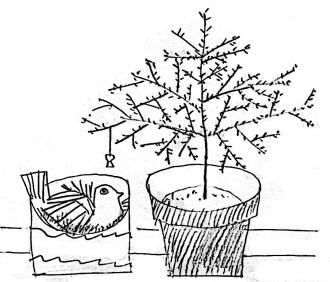
So the birds decided it must be for them. We’re now standing behind glass doors, watching a bird arriving with small twigs held in the beak and squeezing through the bars with the structure of twigs to create a small nest base inside the metal guard. The process strikes a memory of another post in this blog from our time in Switzerland [Birds on the Balcony 1] about pigeons nesting on our balcony up there on the 7th floor. I had no camera and made a sketch of it.

pigeon-sketch-imageThe nest was in the old Christmas tree bucket we’d just put out on the balcony after Christmas had been and gone. Some of the bells and everything still dangling from the branches, the faded coloured paper of Christmas-Past… a forgotten thing. So the bird(s) just went ahead and built a nest in the abandoned tub. Strange really because the wrappings were intact, it was as if it were a continuation of a pagan rite. After a while two eggs appeared, which became two living beings with wings – and I saw the whole thing; their getting fed from the beak of the parent bird and the flapping of little downy wings. The birds on the balcony were the main focus of my attention for a long time. I feel I know such a lot about rearing birds, I’ve been through the whole thing.

Early on I realized they build their nests near human habitation because the proximity to humans is a good thing; humans chase away crows. And it was then I knew I had a part to play in this little family situation, patron and benefactor, and sure enough, security system… I had no time to prepare.

One day, I was looking out at the two cute little baby birds all huddled up in there, parent bird off to get food leaving me in charge, and suddenly I become aware of a black shape in the centre of my vision. It didn’t immediately click in my brain that it was a huge crow because maybe it’s so black, mysterious and a peculiar invisibility, a photographic negative, something that’s not supposed to be there, glinting a kind of deep purple and blue… a being materialised out of the unknown. And I’m kinda, speechless; hypnotized by it’s presence.

It slants its head with long pointed beak in the direction of the baby birds and makes a hop in their direction. I fall out of my chair, knocking over a few things in the scramble to get to the balcony door; collisions with the furniture: then a primal roar: ‘AAAAAHHHHHH!’ and wild flailing of arms, fling open the sliding glass door and the crow was gone, two little birds happy and safe, barely aware of the interruption.

My relationship with the birds became quite bonded since the visit of the crow and I felt a certain sadness when they both got their flying sense and left the balcony. Now another opportunity arises to see the beginning, and not the end….

Beauty is not caused, it is.
Chase it and it ceases,
Chase it not and it abides.
[Emily Dickinson]

————————-

pain/resistance

fishing netsPOSTCARD #133: Scotland: Overnight flight from Delhi to Heathrow, train from Euston station and I’m in Glasgow. Can’t recognize anything, it’s been years. I feel like a foreigner… then later having breakfast at the hotel, 7am and sitting by the front window, watching everybody on the street going to work. Hats and coats and it’s cold out there; the happiness of the people in Thailand, sunny and bright… just not here. Reminds me of the following post, written when I had a part time job teaching English in Geneva, Switzerland – migrant workers employed in the factories and light industry going to work by bus in the early morning:

(originally dated August 22, 2012) I’m on the bus, going to an early morning class in the industrial zone. As we get near, the bus is stopping at every stop to pick up people employed in the factories. Migrant workers from East Europe; men and women speaking a language unknown to me. Thin, sad, serious faces; reminds me of Van Gogh’s drawings of the miners in 19th Century.

Van Gogh 'Miners' 1880 (detail)Bus is getting crowded, I have a book to read: ‘The Noble Eightfold Path’ by Bhikkhu Bodhi: ‘The search for a spiritual path is born of suffering. It does not start with lights and ecstasy but with the hard tacks of pain, disappointment and confusion… for suffering to give birth to a genuine spiritual search, it must amount to more than something passively received…’ 

More stops, more migrant workers get on the bus. It feels like I’ve got to have my head down reading my book because there’s nowhere else in this bus to look without encountering another pair of eyes looking straight back at me; my shirt and tie, polished shoes. What they don’t realise is that I’m a foreign worker too: UK citizen resident in Switzerland. I know how it feels to live in someone else’s country. Okay, guys! I’m a teacher of English, and I’m on my way to teach your bosses, yes – but, as far as I’m concerned, we’re all the same here. And that’s how it is now, squashed up against the window glass; thin shoulders and arms pressing against me. Continue reading:

‘It has to trigger an inner realization, a perception which pierces through the facile complacency of our usual encounter with the world to glimpse the insecurity perpetually gaping underfoot. When this insight dawns, even if only momentarily, it can precipitate a profound personal crisis. It overturns accustomed goals and values, mocks our routine preoccupations, leaves old enjoyments stubbornly unsatisfying.’

Urgent circumstances; this is about a level of suffering hard to endure and there’s just no getting away from it. A long time ago, I had an operation for colonic cancer and there were a number of confrontations with pain… unbearable, I had to give in to it. As soon as that happened, something unseen tipped the balance… for a moment there was the easing –  I discover it’s the resistance to it that causes most of the discomfort.

What would it take for Bhikkhu Bodhi’s insight described here to be meaningful for these migrant workers? For them, it’s about holding on, not letting go; as long as they can withstand hardship, it will go on like this. They’re putting their small amounts of money together to send back home to support the family. They structure their lives around employment and the innate ability to be happy becomes a fleeting, temporary happiness found in consumerism, built-in to the system. People can’t escape from it unless they step out of the earning momentum they’re stuck in, and risk losing everything.

The bus gets to the terminus, stops, air suspension lets out in one long last gasp, and the bus lowers itself on to its structure. I get out with everyone else in this strangely remote place with factory smells and set off walking along the path to the industrial buildings in the distance. Behind me the bus starts up, a worrying moment, no wish to be stranded in this particular reality. I look back at it as it rumbles off on its little round wheels.

————————-

Image: Vincent van Gogh 
Drawing, “Miners”, Pencil on Paper,
 Cuesmes: September, 1880, Kröller-Müller Museum.
Note excerpts here from an earlier post: ‘Choosing Liberation

something, anything, nothing

16x20_webOLD NOTEBOOKS: Geneva, Switzerland: (originally dated September 29, 2012) I get on the Airport bus crowded with people and all their baggage, but I’m not going to catch a plane, I have to teach a new English class in the airport building, and feeling a bit nervous about that. Staff entrance, visitors’ ID, then I’m led along corridors to an elevator and down two or three floors into a network of underground rooms. Door opens and I’m in this claustrophobic space. No windows of course, a large white board, the smell of whiteboard markers, harsh penetrating fluorescent tube lighting. Find the air vents, adjust the air flow by remote and I can breathe better.

Three large athletic men enter; customs officers and senior security people, I see from my notes; shake hands with everyone. There’s a relaxed informal locker-room awareness of each other; deference among them, recognition of something about one individual I guess must be the most senior. Anyway I’m the foreigner in the group, and I have to give an account of myself.

Introductions over and we get started with the class. Pretty soon, something comes up, one of them stands, as if to attention, asks me a question about the use of ‘anything’ rather than ‘something’. After he’s asked the question there’s a hesitation, as if he’s going to say something else, then I notice he’s just observing my body behavior, the professional investigator…

So we’re looking at each other like this, and after I realize he’s finished talking in fact, I’m giving an answer to his question while gradually realizing I’m having a kind of out-of-body experience. I can hear my voice saying the words; the echo in the concrete room, feel the moisture and movement of the mouth but everything else is somehow unfamiliar.

It seems to work ok, I manage to articulate properly and tell him that ‘anything’ is usually used either in a negative context: “I don’t have anything”, and it’s also used in the interrogative form; you might ask a person: “Do you have anything to declare?” Me saying this with a smile, thinking of the Customs Declaration, and hoping to get the intensity to lighten up a bit.

No reaction (maybe he didn’t understand). So I continue with the example: “If you thought that person did have something to declare you could say: “Do you have something to declare?” Still no reaction from this hypnotic look and I’m feeling really weird. He sits down and discusses with the other two in French and they seem to agree about this. I’m still kinda not ‘here’… maybe it’s the underground room, the intensity of the officer’s stare

Somebody else in the group asks a follow-up question and an interesting discussion follows on from this. I sit down with them and can feel myself get back to ‘normal’ – learn not to pay attention to ‘the look’. Class time, comes to an end, shake hands (everybody shakes hands in the French culture), and I’m up in the elevator out along the corridors to the exit and the fresh air.

Wait at the Airport bus stop, it comes, and we’re off into town. The bus is full of wide-eyed people just arrived from distant parts of the world, large suitcases blocking the passageway. How can I say that there is no self, because, if there is no self, who/what is it that realizes this? There’s this feeling that I’m not here – clearly in the public eye but vanished away, invisible. Bus speeds off to town with passengers all speaking loudly in different languages.

Are you an object being watched by another Presence? Or are you the Presence in whose view an idea of yourself is watched? [Mooji]

————————

Notes also from David Loy: Enlightenment in Buddhism and Advaita Vedanta: 
Are Nirvana and Moksha the Same?) Image source

the construct

IMG_1192OLD NOTEBOOKS: East Anglia: [post written in New Delhi] A group arrives at the mall coffee shop sorts out the chairs, a few remarks, laughter; look at the menu the waitress comes over. Give their order, then there’s nothing left to say. Silence. Each one pulls out a mobile device, phone or iPad, stares at screens whose reflected glow illuminates the face of the user. Heads tucked in to examine the picture, body crouched over in fetal position; hypnotized, fascinated with the object, unlearned, never thinking of the question ‘WHY?”

Dominated by thoughts of, who am I? How do I relate to everybody else: you, he, she or it – we, you they? “Me’ as an individual doesn’t seem to be anything more than just a member of a particular socio-economic group. From this way of thinking, I can see (my) self situated favorably – or it could be unfavorably if I’m caught in being the victim; subject to the karma of former circumstances – product marketing gently nudging at the elbow. I need to be thinking about the next option – expectations, responsibilities, things I ought to be doing. Thoughts thinking thoughts, thinking more thoughts and thinking about things to the extent that it all becomes habitual – embedded in the self-construct I recognize as ‘me,’ subject to causes, conditions in the world, which is also a construct, I am some kind of imaginary character in a fictional landscape.

There is so much that we cannot know, limitations of the senses, including the cognitive sense. But everything arises due to thought, the duration between one thought and another is non existent – thought knows nothing of it because thought only knows an object; all objects appear only in thought – no object, no thought. STOP THINKING and there’s the enigma… the empty space where that thought used to be. Nothing there now, if it is just ‘nothing’, I’d need to have ‘something’ there to confirm it is nothing. I can’t find the ‘something’. So it’s not ‘anything’, it’s ‘not something’ – it’s a feeling of no-thingness. But then I’m thinking about it again… it’s an easing-away from that heaviness of thought, that which built the construct; buildings, welded metal, concrete, brick and iron embedded in stone. All of it can be demolished in a day. It all just fades away. ‘Melted into thin air… the baseless fabric of this vision… we are such stuff as dreams are made on…’

“After having thus successively taken each member of the community in its powerful grasp and fashioned him at will, the supreme power then extends its arm over the whole community. It covers the surface of society with a network of small-complicated rules, minute and uniform, through which the most original minds and the most energetic characters cannot penetrate, to rise above the crowd. The will of man is not shattered, but softened, bent, and guided; men are seldom forced by it to act, but they are constantly restrained from acting. Such a power does not destroy, but it prevents existence; it does not tyrannize, but it compresses, enervates, extinguishes, and stupefies a people, till each nation is reduced to nothing better than a flock of timid and industrious animals, of which the government is the shepherd.” [Alexis de Tocqueville, 1805-1859]

a world of things

sycamore 1“Those who float away their lives on ships or who grow old leading horses are forever journeying, and their homes are wherever their travels take them.” [Matsuo Bashō 1644 –1694]

OLD NOTEBOOKS: East Anglia: It’s the last day, I’m leaving, this is it… the end – no more departures and arrivals I’m leaving now for the very last time. The house is to be sold, the rooms are empty, all remaining things ready to be put into boxes for the recycling people to collect after I’m gone. Right now it’s all arranged in two groups: a) stuff to be given away and, b) ‘stuff that I can’t let go of YET’… still some reluctance, lingering over things I want to keep. Gazing fondly at a pile of books, a framed picture, pondering, hesitation, attachment… but how will I get all this into checked-in luggage for the flight to Thailand? Some time spent considering this but, impossible, let’s face it. In the end it’s a decision pushed along by the momentum of leaving; there’s a car coming for me in the afternoon. Out of time, ok, pack up and leave… and I move everything into a), the stuff-I’m-giving-away group. That settles it.

But I’m tugged back… did I just do that? Hands reach out to take the stuff back again. Pause for a moment to think about it and everything stops, emptiness, there’s nothing there… thought is an elaborated construct built in a landscape of no-thingness. An awareness event turns up out of nowhere, the kind of thing that couldn’t happen in any other circumstance: let someone else have these things. It’s the letting-go thing, the generosity of easing, the release of all that tight energy – giving it all away, giving it all back to the world, returning to the context of how it all arose in the first place. I stop for a moment to think about how that feels, but there’s no thought, everything is still wonderfully clear and completely empty. There’s a world of things, then there’s not.

Suddenly it feels like everything I’ve been holding on to doesn’t matter anymore, and that’s okay. The loss is only there if I ‘think’ it into being. Sit down, close my eyes and everything  becomes invisible. Feel the pressure points, lower back, seat in chair, feet on floor, elbows on the arm rests – but no body, no head – it occurs to me that sometimes the universe doesn’t exist… takes my breath away. Only a curious intensity in the place where the thought used to be contained; something that really never happened… years and years of nurturing a dream about something that wasn’t there.

Last thing to do is bless the rooms, hands held in anjali in that small dwelling: Wishing in gladness and in safety, may all beings be at ease… There’s a clear sense of closure. Going through the door… I’ve been in this house 36 years and it’s gone in a flash. Standing outside, blinking in the bright daylight, surprised to discover it’s a just a day like any other day. A last look inside, sunlight extends in from the doorway… goodbye little house! Pull the door closed, lock. Get in taxi, door slam. We’re off across the landscape…

‘When this exists, that comes to be. With the arising of this, that arises. When this does not exist, that does not come to be. With the cessation of this, that ceases.’ Samyutta Nikaya 12.6

————————-

Many thanks to Jeff for: ‘stuff that I can’t let go of YET’ – source: Leaving Lexington. Photo: a stand-alone Sycamore tree at the top of the hill

the light of memory

12052011016eOLD NOTEBOOKS: East Anglia: [post written in New Delhi] The old house is sold. A printout of the email from the lawyer signed, enveloped, stamped and sent by DHL to England, 4000 miles away. A small packet of A4 paper folded once, bearing all the correct documentation, tucked away in a bundle, squeezed into an aircraft for a night and a day. At the other end, registered, signed-for and unlocked, unpacked, seals broken, it’s confirmed by officials, checked, stamped and placed in a folder and delivered by a guy on a motorbike to an office in East Anglia. Smoothened out in the bright white electric light of a cold January morning (by a mature female hand probably, cosmetics, manicured nails and a silver ring), and there’s my signature, exposed for all to see; idiosyncratic squiggle recognised by law as being ‘me’ saying ‘yes’ I agree to the foregoing; I relinquish, renounce, I have read and understood the above-mentioned; box ticked, it’s all yours… sayonara, goodbye little house that sheltered me for 36 years, my small cave, hollow, burrow in the side of a hill. Everything there that was ‘me’ is fading away, even as we speak, already feels like I was never there. It’s like a death… all that remains is a memory of so many comings and goings, arrivals/departures, and in the 36 years I was there I never stayed longer than 3 months. There are only the journals left; words written in old notebooks, hard-to-read writing in ball-point pen etched into the surface of old yellowed paper:

OCTOBER 10, 2012: Today is the last day. Getting ready for the flight to Thailand… that familiar feeling of departures is in the air. This time tomorrow I will not be here. I’ll not be in a room that has split floor boards stacked in a cupboard next to the fireplace in the sharp coldness before the fire is lit. Yes, at least I’ll be away from this stunningly cold house where I have to wear a coat indoors, going around with kindling, paper and matches first thing in the morning, rushing to get the fire lit, the flames going and some heat started up. I notice a certain… vigour in everything that seems to be necessary to keep warm. Words come out in steamy puffs of breath, and a kind of gasping breathlessness: haaaaah! It’s cold.

There’s a fragrance of cleaning products around the house. Yesterday was a day of hoover and broom and the place is clean now, pity I’ll not be here to appreciate it. Everything gets a major clean-up a couple of days before I go. It’s always like this; then, on the last morning, I have breakfast, wash out my coffee cup, place it on the edge of the sink; wash my breakfast plate and leave it to dry in the dish-rack – it’ll have plenty time to dry…. The house is locked up, sealed like a time capsule until I return; into the taxi and I’m gone. The house remains as I left it, exactly like this, for countless days and nights and afternoons and early mornings, sun peeps in the window, nobody at home; all through winter, all through Spring and then one day I come back, open the door, break through the spider webs, trip over the mountain of junk mail and enter into this same moment enclosed here now. Same cup sitting on the edge of the sink, same plate in the dish-rack. And the whole house says: Hello, how’ve you been?

And now I know I’ll never be back there again. Stirring the ashes of a fire gone out, a life I think I wanted but never had – maybe I should have tried harder… maybe it was meant to be the way it is. Maybe I’ll go there one day with my Thai niece M – we’ll drive down that road and I’ll show her the house where Toong-Ting used to live. Slow down and stop, look at the old place for a moment and drive on. It’ll all be ancient history by then …

“The light of memory, or rather the light that memory lends to things, is the palest light of all…. I am not quite sure whether I am dreaming or remembering, whether I have lived my life or dreamed it. Just as dreams do, memory makes me profoundly aware of the unreality, the evanescence of the world, a fleeting image in the moving water.” [Eugène Ionesco]

————————

nostalgia for winter

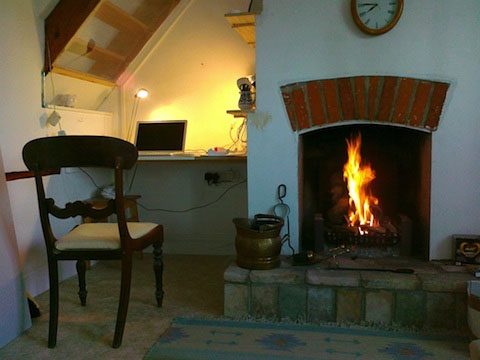
back of shedOLD NOTEBOOKS: East Anglia: Writing this in New Delhi, the winter chill has a familiarity; the cold-nose-sniffing days of UK winters long ago at the old house in East Anglia, before I had proper heating installed. A massive quantity of firewood; they cut down some Elms that had fallen over and all I had to do was chop it up with a long-handled axe. Thus, entire days were spent swinging axe, volumes of breathy vapour air then sitting by the fire. Everything that had to be done indoors was done there, next to the fire. A cup of Oolong tea placed for convenience on the edge of the hearth… cold fingers on warm porcelain.

And one day in particular, here in this low ceilinged house, staring at the flames, thinking I’ll have to go to the woodshed with the wheelbarrow again to get more logs. Walk through to the back door, not focused on anything but the task ahead, then for some reason there’s a joyful little skip at the wrong moment and I whack my head on the oak crossbeam protruding dangerously from the kitchen ceiling – the karma of wood fighting back… more like a sound than a feeling; an audible BONK! Fall to the floor, wow! Hands rise up and hold the head. It’s not an immediate pain; it’s an investigatory, how bad is it this time?

Stay there for a moment, inward searching directionalised towards the perceived centre where ‘self’ resides; awareness of the vulnerability of ‘head’ situated at the top of the body; eyes looking out, a world seen as if through a window at the front of the skull. Pause for a moment and consider the phenomenon of ‘me’ and the body I inhabit as a curious plurality; it’s not an ‘I’, it’s a ‘we’. I’m issuing commands and body just does what I tell it; addressing oneself as if ‘I’ were someone else: hmmm, the blunt-force trauma and brutality of the present moment… let it pass – get busy with something. Go upstairs and see if there’s a pair of gloves I can wear. The body obediently goes there because I’ve just told it do that.

Stumbles along, gets to the staircase then up, step by step, plod, plod, plod. Get the gloves and stand there for a moment, looking through this ‘window’ as if from a position inside the skull, seeing things at eye-level, then down the length of the body to my feet standing on the step, and the steps below that, leading down, and down to the ground floor… plod, plod, plod, downstairs again; it seems like a long way.

shed with logsOut along the garden to the wood shed and, instead of just gathering a few logs and going back, I decide to cut up some more. WHACK, axe cuts through wood in a pleasing way. WHACK… so what’s to be done about this low headroom situation? WHACK… again and again I’m caught by it, even though I know it’s there. WHACK… return to ‘the plan’: excavate the floor and lower the level by one step to create more headroom. WHACK… isn’t it satisfying how the wood splits and falls to either side of the axe blade, forming two piles of equal number. WHACK… everything comes in twos, and there’s this feeling of companionship; that good friend, the body. It has a familiar feel to it; the aches, pains, grumbles and squeaks. The wheelbarrow filled, I push it back to the fireside and the rest of the afternoon is spent planning how to dig up the floor…

“I am and the ‘I’ that I am, is aware that I am. This knowing of our own being – its knowing of itself – is the most familiar, intimate and obvious fact of experience and is shared by all.” [Rupert Spira]

————————-

Third post in the series about the house in East Anglia I had for 36 years. Click on the links to follow the thread: house on a hill, and presence.

presence

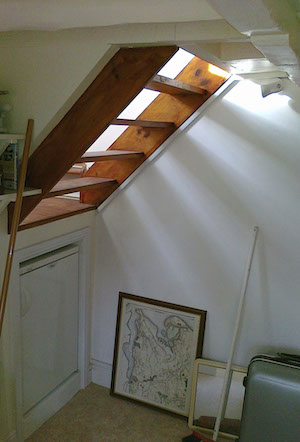
back stairsOLD NOTEBOOKS: East Anglia: Aunt Liz was an unusual person because she didn’t speak much, lived like a recluse and it’s only recently I realized she may have been Bipolar – it was so long ago, nobody knew about it then. I was often away and when I came back, she wouldn’t speak to me. The neighbours would tell me she was sometimes socially active, then after a few days she’d go back to her silence and not speak to anyone at all for months. Aunt Liz lived in that house for 23 years. She was alone, preferred to be alone and at the age of 85, she died alone. Bottles of milk left on her doorstep for two days, the police forced the back door and found her sitting on the sofa. It was 1989, I was in Japan, didn’t know it had happened until a relative called me on the phone (no emails in those days) and in a screeching, long-distance voice told me about it; said she’d inherited Aunt Liz’s house and was going to sell it – or did I want to buy it? Yes I did, so we got the paperwork done, I had the contractor go in and do renovations, but it was more than a year by the time I got back to the house.

Everything had changed of course, fresh paint, new plaster; the emptiness of a newly renovated house and nothing left to remind me of Aunt Liz. She was just not there any more – something about it strangely familiar; she was never ‘there’. So many times in the past I’d ring her bell, but no answer. Then I’d be in my house next door, listening for sounds, holding my breath and maybe I’d hear the clink of a cup or plate, and know she was there. Mostly she was simply a presence, so silent sometimes I’d forget about her completely.

That time I came back from Japan, the first thing I did was look for something to use as a floor cushion and sit for a few minutes of meditation in the place where her sofa used to be. This is where she would read her newspaper, do her knitting, watch the six o’clock news … this is where she died. Maybe it was on a day like this; the quietness, the sound of the birds in the trees all around, an ordinary day, and she paused in a quiet moment and listened to the birds; the same birds I’m listening to now, some of them their descendants. Maybe she contemplated this sound as I’m doing now, and had the same awareness of the hearing mechanism that carries the sound.

Get up and open all the windows, landscape reaching out to the horizon; hazy blue sky, the smell of the sea. The sound of birds enters the room, tiny fragments of a hundred melodies merged together in a flow of incidental harmony; no beginning, no middle, no end; blackbirds, thrushes, sparrows and in the quiet intervals, the distant mewing of gulls flying in from the sea.

Whatever living beings there may be;
whether they are weak or strong,
omitting none,
the great or the mighty,
medium, short or small,
the seen and the unseen,
those living near and far away,
those born and to-be-born —
may all beings be at ease.

[Karaniya Metta Sutta: The Buddha’s Words on Loving-Kindness]

————————-

The second post on the house on a hill – click the link for the first post.
Photo shows the back staircase built during the renovation and a new window in the wall opposite so the light can enter the otherwise dark kitchen.

house on a hill

23-05-2010 09-13-22OLD NOTEBOOKS: Chiang Mai: I used to have a house on a hill in England, so far away from here – it’s just a memory now. I had it for 36 years and it was sold just a few days ago… feels like a part of me has become extinct. Another part of me says, what’s gone is gone, let it go because I never really lived there. I’d stay there for a while, go away to Asia for a year, then come back; very long grass in the garden and generations of spiders.

Curiouser and curiouser it was part of a larger building owned by my Great Aunt Liz, a spinster, a recluse and she could read fortune-telling cards. Aunt Liz gave me the house by Deed of Gift in 1978, then became a bit distant and elderly and quite stubborn about allowing me to help.

I’d send Aunt Liz postcards from the places I’d been and bring back gifts but she became more and more remote. Our communication dwindled and in the end she hardly spoke to me. When I knocked on her door, she would open it on the chain, smile and say: ah, so you’re back. You’re looking well… then close the door. I’d hear the lock go: click, and I was left outside.

This is how it was, a kind of companionship, no more than that. She was probably disappointed that I wasn’t going to just come and settle down in that place and be what she’d imagined I’d be. But what could I do? Her decision to create a situation for me to have a ‘home’ next door to her was just so kind. There I was in the centre of rural life and the simple rumbling-along of things, but… never for very long, always moving on to somewhere else.

Image001

She died in 1989… I was in Japan and it was impossible to return. I negotiated with a relative who inherited Aunt Liz’s part of the house and to cut a long story short, eventually I owned the whole building. Contractors were hired to renovate the place, but it was two or three years before I managed to get back. The house on the hill had long since become a dream… years and years spent thinking and planning how I could go live there in the end, and just get old sitting by the fireside. These last few days I have revisited that same place in the midst of these rememberings, knowing that sometime soon I have to disengage from it – it’s not my house anymore it’s somebody else’s. People I don’t know walk around in these rooms where I used to be, sit by the fireside stare into the flames.

02062011038How long do memories remain? One time I was sitting there burning some old floorboards removed during the renovation of Aunt Liz’s bedroom. The wood was dry and old and good for kindling. They were also painted along the ends – she had a carpet in the middle and painted floor boards all round the edge. It all came back to me when I found it… stuck in the paint on a piece of the floorboard, a human hair – a single strand of hair, quite long. It got stuck there as she was applying the paint. I kept it for a while; would hold it between thumb and forefinger for a moment and pull the tension of it gently… still attached to the painted wood. Then one day I placed the wood piece in the flames and watched it burn away.

Everything is always in the process of ceasing to be, turning into ash. There’s a reluctance to leave, drawn towards the extinguished fire; something peaceful about the absence of everything…

As fire, through loss of fuel grows still [extinguished] in its own source, so thought by loss of activeness grows still in its own source… For by tranquility of thought one destroys good & evil karma. With tranquil soul, stayed on the Soul, one enjoys unending ease. [Maitri Upanishad 6.34]

————————-