plasticity

190320131769Chiang Mai: Holding the inverted eye-dropper bottle close to the eye, head back and squeeze a drop… it goes in, blink, and overflows, trickles out of the corner of the eye down the cheek like a tear drop and falls into the ear. I wipe it away with a tissue – the action triggers a memory, something emotional. I have new vision now, eye surgery for cataracts. The left eye is done, the right eye will be operated on next month. I’m seeing everything with such clarity; hard to believe the natural process of seeing that I’ve taken for granted all these years now involves a plastic lens. I see the world refracted through a man-made device and it doesn’t make any difference – well it does make a difference, of course, it’s very much better. My glasses don’t do anything any more; in the good eye the lens distorts vision, in the bad eye it enhances some things but it’s dull, blurred and yellowish in colour. I’ve had an overhaul – like taking the car to the garage to have new parts fitted. Or it’s how the system gets updated, the latest version is now installed. I feel renewed.

There’s this plasticity about the human body (and mind) that allows all kinds of changes to take place. I’m a Buddhist and I’m inspired by the thought that things can adapt, evolve, move on. It feels like there’s no such thing as getting stuck with anything or any state of mind, because we can learn to ‘unstick’ from it. In the same way, we can study a new subject; we put our minds to it, get interested in it and learn how it works. If I’m stuck with something, I’m attached to that thing in a strange kind of way; a locked-in response to adversity – more of a driven, unaware action than something done knowingly, mindfully. It’s a deluded attachment to habituality and I’m inspired by the very real possibility of working towards being free of this; acting always in awareness, seeing clearly.

Metaphors like ‘clouded vision’ describe tanha, habitual craving for something thought to be deservedly earned because of the endured hardship seemingly required to get there, unaware that one gets lost in the getting-there and there’s no end to it. Because I don’t normally understand things as they truly are, usually it’s how they’re seen habitually, I choose to see everything according to what’s already known; apperception, understanding newly observed data in terms of past experience. Before I get stuck in the delusion that it’s unavoidably like this, an opportunity arises to escape the cycle at Step 7 vedana in the paticcasamuppada (Cycle of Dependent Origination). Interrupt the causality sequence, go to the door leading to the emergency exit, aware that in the Buddhist sense of ‘no-self’, the habituality of mind’s perception of itself as the central actor in its own world, personality-view (sakkaya-ditthi), is the root of the problem. Step out of the cycle and I’m free…

Then later that night, walking to 7-eleven to get a few grocery items and I leave my glasses at home because they don’t help – I’ve worn glasses for most of my adult life and this is the first time I’m going out without them and at night time too. It’s been raining, there’s the glare of car headlights, and street lights reflected in large puddles. Only a short walk and arriving there, I notice some of the tiles on the floor of the lobby forecourt at the supermarket are shiny, glossy, and these must be new ones, replacements for the ones that were damaged? Why am I seeing this? I cover the good eye and look at the tiles with the old eye, no it can’t be seen, but I can see them with the good eye. It’s a repair I’d not have noticed before. People must think I’m acting strangely, better move along. So many discoveries about the world, and I’m stumbling around like this, seeing everything for the first time…
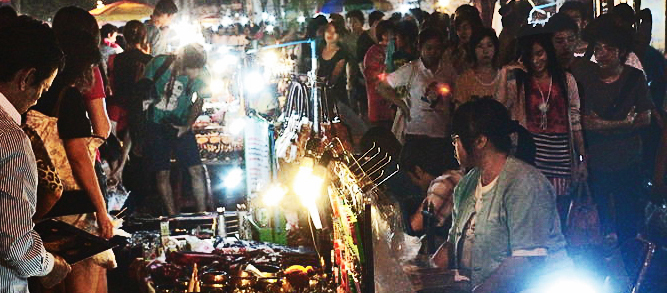
800px-ChiangMaiNightMarket————————-

‘Instead of starting with a perception or a conception of anything, the Buddha established a way based on awareness, or awakened attention. This is an immanent act in the present. It is sati-sampajañña, an intuitive awareness that allows the consciousness to be with the present moment. With this attention, you begin to explore personality-view (sakkaya-ditthi) in terms of the perceptions you attach to as yourself.’ [Ajahn Sumedho, The Problem of Personality]

Upper photo: Interior of Chiang Mai songteaw (public transport vehicle). Lower photo: Night Market, Chiang Mai
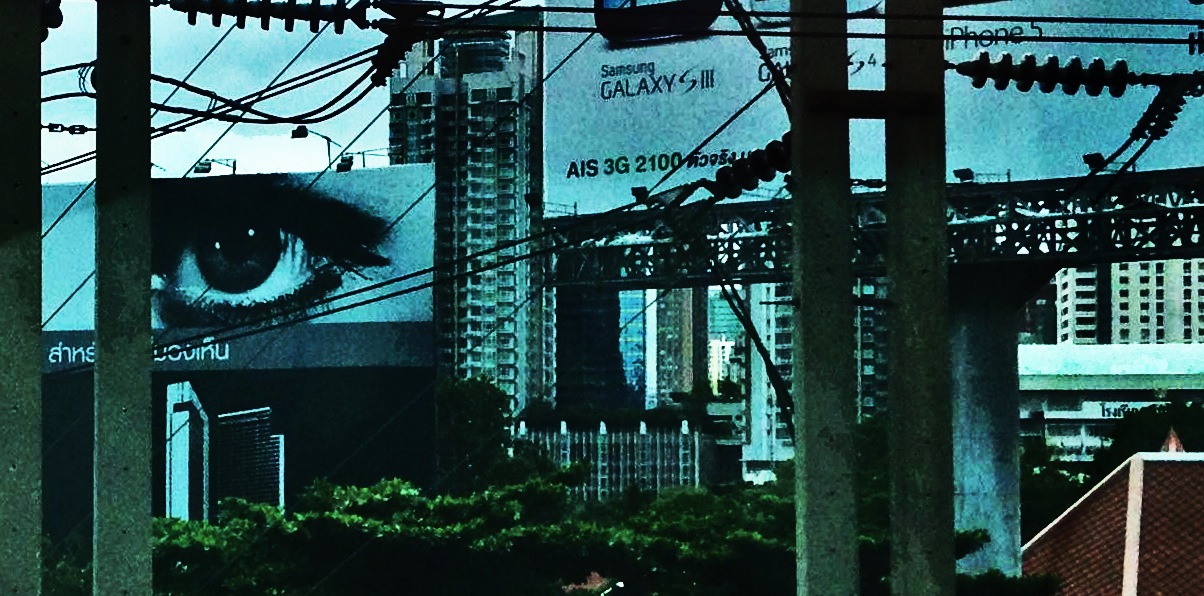
 

the beholder

ploenchitBKK3

Bangkok: The world seems different, everything suddenly seen in clear three-dimensionality. Reflected light, rich, deep colours and a strange familiarity, objects in the environment become somehow known. I’ve seen these things so often before but now seeing them with an expanded awareness. It sounds visionary, you could say revelatory but it’s the result of eye surgery, rather than insight… nonetheless quite astonishing. I have this clarity in one eye only, vision in the other eye is like an old yellowed photo, dull and indistinct. The operation on that eye will be in October, back to the Rutnin Eye Hospital in Bangkok. The surgeon makes a hole in the eye and puts in a tool that uses ultrasound to emulsify the lens. The lens becomes liquid and is sucked away, then a plastic foldable lens is inserted in the place where the natural lens used to be. That’s it, done. Local anaesthetic is enough, or general if you feel claustrophobic about the covers over the face. After the op there are different kinds of eye-drops that go on for about three weeks and it feels a bit itchy but that’s all.

I’m amazed that it’s possible to do this; the plasticity of the human body, parts can be taken out, replaced; systems are deconstructed, reconstructed, subject to change. It all supports the idea of anatta: no abiding self. There’s an underlying flexibility about the mind/body organism namarupa. One example of this is that I have a very refined piece of plastic in my eye instead of a natural lens. And, looking at the world, I find an affinity with clear-wrap, cling-film, transparent plastic food packaging – the way the plastic surface refracts the light. In this strong sunlight in Thailand, I notice the reflections on chrome and glass – the clarity is sparkling and beautiful. Also these enhanced colours, reds mostly, and an overall bright clear blueness in the white areas. It has the quality of an iPad screen, retina display, high density pixels merge into one – an extraordinary brightness.

Faces of friends and family are seen as if for the first time. I notice small expressions now I didn’t know were there, maybe because everybody is looking at my new eye, intense Thai faces examine my new eye, and I’m looking back at them looking at me, seeing subtleties in their features that I’ve never seen before. It’s all quite new, a curious reality.

So, I’ll be going around for the next few weeks, looking at my surroundings and considering the phenomenon that I am experiencing this. Can it really be so? ‘Beauty is in the eye of the beholder’ (Margaret Wolfe Hungerford). The expression always seemed a bit mean and divisive to me, ‘I’ think it’s beautiful but ‘you’ might think it’s not; beauty becomes a matter of opinion… In Buddhism, the ‘beholder’ sees the world and identifies the self, ‘me’. If ‘I’ am inside the body, in ‘here’, I must be separate from everything else out ‘there’, isolated, alone, anxious – wrong view a fundamental error. The attachment to a perceived self and craving for it to become real, creates suffering. Language has a naming function, creating an apparent identity. Anything that is stated is always missing the point because of these characteristics of language. Better to think of it in terms of what it is not, rather than what it is: ‘… the remainderless fading & cessation, renunciation, relinquishment, release, & letting go of that very craving. (the noble truth of the cessation of dukkha)’ [SN 56.11 (dukkha nirodho ariya sacca)]

————————-

Photo image: Skyline at Ploenchit Bangkok.

layers

IMG_0041Bangkok: Falling out of the sky, jet-lagged and inert. A 12-hour flight from London; they gave me an upgrade to business class, nice. More space, better everything and a larger seat. Able to stretch out in the prone position, yes but also a huge selection of videos so I watched movies for 12 hours and no sleep. Now in a state of hypnosis here at the house, lying on the sofa in another time zone. Early morning in Bangkok and I’m watching the FOX channel. There’s only one English language channel on TV in this place so it simplifies things: NCIS, Bones, The Bridge and others. The stories merge into one all-inclusive narrative, a complex and improbable plot. Good-looking actors in expensive cosmetics play characters that migrate from other crime series into this one, the central story, all roads lead to one end, catching the bad guy, variations on a crime scene theme. The pace of it is intense, camera shots hold for about 3 seconds then change. Background audio has a percussive, mechanical sound then it’ll switch to something calm; a picture of domestic reality, beautiful interior, elegant lighting, lovely fabrics – I wish I had a room like that. Slow piano notes played meaningfully, like steps taken through the memory of something that happened once. I’m lulled into acceptance; the way it unfolds is the way it is. I become the story.

I could switch off the TV but there’s a reluctance; a pleasing attachment, something that appears more difficult to let go of than it is. Resisting the emptiness, the deep knowing there’s nothing there that triggers the reaction to fill the empty space with a self-construct, or an image, a movie celebrity, a child’s doll, the sphinx, the totem pole, dependency on a perceived creator. I mute the sound, allow the engagement with it, following the story as it transforms, watching the present moment until it changes – how did that happen? I didn’t notice it take place, only after it occurred. There’s the sense of something applied. Consciousness seems like an unconnected series of screenshots, a random sequence of events; things without substance appear and fade away. Rest in this fictional state… it’s just the way things are. Mindfulness is at the base of it all, in every way. Sleep shuts off the system; down through the layers, comfort, familiar surroundings. Crash out on the sofa in flickering TV light…

————————-

‘Like fish that cannot see the water they swim in, we do not notice the medium we dwell within. Unaware that our stories are stories, we experience them as the world.’ [David Loy, The World is Made of Stories]

just this

Sunrise (1)WPNChiang Mai: 05.30 hrs., ‘… down the long and silent street, the dawn, with silver-sandalled feet…’ daylight creeps into the rooms and it’s my birthday today! I suppose one’s birthday is something to be possessive about: ‘my’ birthday. I was born on this day quite a long time ago in the North of Scotland and now I’m here in the silence of a Chiang Mai morning in the North of Thailand. Open all the windows and a breeze blows through in all directions, curtains and fabrics that haven’t moved for a month in the stillness of this interior, flutter and flap against the walls – a sheet of paper flies off my desk, lands on the smooth floor tiles and slides away. It feels like the world outside is inside; all of a one-ness and this mind/body awareness (that is ‘me’) spreads out from here, through the trees, up and into the dome of the sky as far as the eye can see.

Skype call from Jiab in Delhi, happy birthday, and in the video window I can see our room, the place I usually inhabit. Jiab is at the desk where I normally sit. It’s still dark there, daylight here. Two people talking with each other but often occupied with the tiny image of themselves that appears in the Skype window, lower right. Eyes are sometimes directed away, how does my hair look? Jiab tells me the story about how she was born on the night of the full moon and so her actual birthday is not always on the same day. The family lived in an old forest area in the South of Thailand. Jiab remembers her father saying it was the light of the full moon that guided him through the trees to bring the midwife to their house. And a phone-call from M, happy birthday Toong Ting! She calls me that because she’s my 9 year-old niece. Toong Ting, when you go to Inkland? She asks me this, meaning ‘England’ but I like ‘Inkland’ (the place that makes ink?), so I tell her I’m going to Inkland on Saturday 13th, but it’ll be Sunday 14th by the time I get there. We have a discussion about the time difference thing and M knows about this, having visited Japan earlier this year. Only 9 years old, but she has an understanding of the world and systems that’s so much in the present moment it takes my breath away.

http://www.dreamstime.com/-image17433969Children teach us about birth and the great mystery. About 10 years ago, there was an episode from a BBC series on the human body that showed a woman giving birth – so vivid, I suddenly felt this immediacy of it happening to me: the blinding light, echoing sounds; the coldness, the impact of air entering the nasal passages? Revisiting the birth experience. Emerging into the world,  the first total sensory consciousness sweeps through and the body/mind organism is turned inside-out. That TV film left me quite transformed… Now it’s later, many years later, and there’s ‘me’ and this old body, getting settled on the cushion for a 30 minute meditation sit on ‘my’ birthday. These are the same body parts, regenerated, expanded in a lifetime, worn a bit smooth, puckered up at the edges. Skin, muscle, flesh; soft rubberoid plasticity, and these mysterious organs held by ligaments bonded into solid bone. The whole thing maintaned by the tremendous heat and energy processed from food, the fuel for the engine. And there’s the fluidity enclosed in bubble-like spaces, gurgling away all the time. The breath enters the body as a kind of wind, gusting in and out. It comes back and blows everything all over the place, withdraws in a moment and it’s gone again. Mind mesmerized by the form and function of the body, seemingly trapped in this limited temporality; cause/effect – then for an instant, seeing the truth of the Five Khandas. Thin skin of eyelid slides over surface of smooth eyeball and the dimly seen light entering my darkness; just this…

‘Each and every mental and physical process (namarupa) must be observed as it really occurs so that we can rightly understand it in its true nature. That right understanding will lead us to remove ignorance (avijja). When ignorance has been removed, then we do not take these mind-body processes to be a person, a being, a soul or a self. If we take these mind-body processes to be just natural processes, then there will not arise any attachment. When attachment has been destroyed, we are free from all kinds of suffering and have attained the cessation of suffering.’ [Venerable Mahasi Sayadaw]

————————-
‘…down the long and silent street, the dawn, with silver-sandalled feet…’ taken from ‘The Harlot’s House’ by Oscar Wilde. Upper photo image taken from the WPN archive. Lower photo image: dreamstime. Gratitude to Rory and his post for the inspiration: http://beyondthedream.co.uk/2013/07/05/tao-te-ching-28-keep-to-the-feminine/

seeing things backwards

010720131926

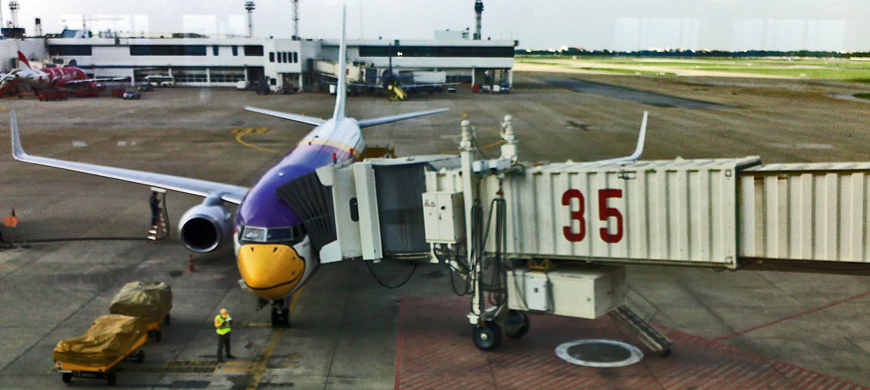
Bangkok/Chiang Mai flight: Stone cold in Departures, AC has me chilled to the bone. I walk around the shopping area, just to be doing something, and go to the magazine and newspaper shop. They have packs of Thai alphabet cards – just what I was looking for! I can find the vowel set, but not the consonant set and I ask the lady at the desk if she has it. Stress on her face as I’m asking the question; she thinks she will not be able to understand… then she realizes I’m speaking Thai – a small jump in the air, joyful surprise. Wow! Okay, so… but she’s forgotten the question. I ask again if she has the consonant cards. She starts looking but can’t find them: oh, no have, solee! (sorry) Disappointed. I get the vowel cards anyway and ask her how much it is. She says 47 baht but when she rings up my money at the cash desk, she says 74 baht – checking my change afterwards, she was right first time, 47 baht – just said it round the wrong way (47 or 74?) seeing things backwards is a problem for her sometimes. No worries, everything moves along; flight is called and we are boarded. Stewardesses in lemon yellow costume, it’s all doll-like, pretty and cute – the plane has a bird’s face painted on the nose. You can buy gifts from a trolley coming along the aisle; do I need a vinyl blow-up inflatable airplane? Nothing to get heavy about, overly serious about; no need to get stuck thinking about anything hopelessly imponderable.

eu-ahEven so, it’s noticeable how the mind will attach to an object and hold on to it with the intensity of a velcro fastener bonding with its surface; the desire for adherence. The thinking mind presents a range of options; I can choose to ‘be’ something, contained in an acted-out scene from a movie I’m watching about ‘my’ life. It’s birth in the Buddhist sense jati: the I-am-here thing. It’s sometimes an uncomfortable, driven, locked-in state that arises through examining an event, and returning to it again and again, simply because I’m so used to seeing the situation from this perspective of holding on to it, I expect it to be the same starting point of my meanderings every time.

Mindfulness of this unaware habituality. Knowing it’s like this means ignorance (not knowing) is gone, vanish’d into thin air. I enter the space knowingly, intervention in the probability sequence. Instead of the intensity of mind, there’s just the intensity… a tightness of posture – maybe that’s how it started – relax the neck, the forehead. No thought associated with it. No goals to which I’m compelled to strive for; what the eye doesn’t see, the heart doesn’t grieve for. Undoing all the knots tied in memory, letting the mind untangle itself from the problem: good, bad, whatever. Letting it all go, giving it room.

Reminded of Ajahn Pasanno’s reflection on Ajahn Chah’s teaching: ‘A coconut tree draws nutriments from the planet; it draws elements good and bad, clean and dirty, up through the roots and into the top of the tree and then produces fruit that gives both sweet water and delicious coconut.’ And Ajahn Pasanno describes how we don’t need to be concerned about the different experiences that we have of the world, everything is drawn up through the ‘roots’ by way of the three-fold practice: sila (virtue), samadhi (concentration), paññā (wisdom). All experiences, good, bad, whatever, are transformed into insight, understanding, balance and sense of peace.

In-flight announcement: … we are now making our descent… please ensure your window shutters are up, arm rests down, seat backs forward and tables folded away – a small cluster of prepositions. Plane lands and luggage collected, out into the clean Chiang Mai mountain air. Shortly after that I’m in a tuk-tuk headed down to the supermarket to get supplies.

tt05July13

————————-

Photo image upper: My plane to Chiang mai
Middle:  Thai vowel/dipthong ‘eu-ah’
Lower: Chiang mai tuk-tuk

necessity of mindfulness

2012-03-31 12.35.44Bangkok: Getting into town from the airport is okay to start with, gliding along the elevated highway in a huge open landscape, and all the good-looking 21st Century buildings pointing up into the evening sky like some futuristic sci-fi heaven realm. Then, as we get near the exit, the traffic slowly starts to fuse together in a mass of end-to-end steel/chrome-plated metal units, creaking along like the glacier I visited a long time ago in Switzerland moving so slowly, the end of its 133 kilometer length is four hundred years older than its beginning. Struggling with the thought that I don’t want it to be like this, causes and conditions, the traffic is like nature, the ocean, the weather. Reminded of the Ajahn Chah image of leaves in the trees blowing in the wind in a rising and falling motion for as long as the winds last. And how it’s the moods of the mind blowing like the wind that cause the restless, uneasy feeling. In its original state, the mind is still and calm.

300620131923_crop

The next day I have to go to the eye hospital, blurred vision in the left eye, and procrastinating about that for a long time. Sometimes stumbling into things and I’m gently squeezing through the crowds at the skytrain entrance to get the ticket in the turnstile, remembering how it all works. There’s an alertness, awake and mindful, I am a foreigner living in someone else’s country. Getting off the train is complicated, it’s a place I’ve not been to before. Not finding the correct exit because the signs are unclear, I can read Thai but I choose to go with the North/South orientation of the map, knowing that if I face the way the train is travelling as I get off, in this case North, and as I go down the staircases and escalators to street level, I’m always orientated in that same Northerly direction and the traffic will be going North. All this because doing a U-turn can be a lengthy process here; somebody said the whole of Bangkok is one large, U-turn…. A pink and white cab is waiting and I tell the driver where I’d like to go – will he take me? He thinks for a bit (doing U-turns in his head), yes, ok. So we’re off.

At the hospital, it’s a long session. They put some drops in my eyes to enlarge the pupils so their equipment can see inside the eyeball. The doctor asks me if there’s anybody to take me home because the drops in the eyes will make things a bit indistinct for a few hours. Understatement. When I step outside the world is a blur, a smear, a sea of colour, yellow, green and pink taxis, red tail lights of vehicles in vivid splashes. No form or definition anywhere; I’ve lost my North/South orientation, having come in by a different door. Get on the first motorbike taxi that comes along and allow him to sort it out. We get up to a surprising speed going along what I believe to be the wrong side of the road, dodging oncoming traffic, weaving in and out of the other lane, wherever there’s a space. A great whoosh of hot wind, noise and get to the Skytrain station so fast it’s like we arrived before we set off. Give the guy a good tip and then it’s just a case of getting the North/South thing sorted out, following the crowds up the escalator, on to the train, and into the coolness of the AC carriage, with this wild wind blowing through the mind; papañca, proliferations arising from the single thought that I have an eye operation on August 9th. Necessity of mindfulness…

300620131924

————————-

‘To be mindful means to have metta towards the fear in your mind, or the anger, or the jealousy. Metta means not creating problems around existing conditions, allowing them to fade away, to cease. For example, when fear comes up in your mind, you can have metta for the fear — meaning that you don’t build up aversion to it, you can just accept its presence and allow it to cease. You can also minimise the fear by recognising that it is the same kind of fear that everyone has, that animals have. It’s not my fear, it’s not a person’s, it’s an impersonal fear.’ [“Mindfulness: The Path to Deathlessness: The Meditation Teaching of  Venerable Ajahn Sumedho.”]

loving-kindness to animals 2

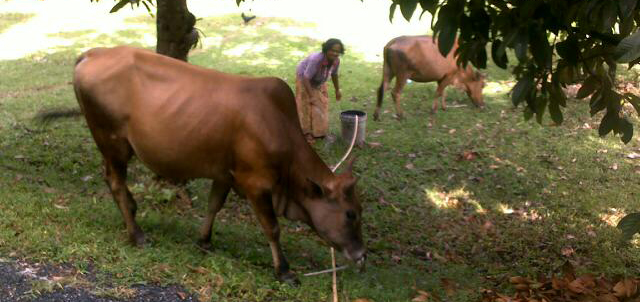
cows2A village near Hat Yai:  Going to see the cows with M and we meet the first one. I ask M about pulling on the rope tied through it’s nose and if she thinks that would be painful? M tells me it’s like pulling your hand and she pulls me along by holding on to my finger: ‘Like this Toong-Ting’ – laughing, Toong-Ting as a reluctant cow… I can hear the voice of (her auntie) Pa K, who lives here, a down-to-earth farming person; and I guess M must have asked Pa K the same question and she’d shown her, as M shows me now. I’m also aware that M sees me a bit like a grown-up child, because I’m a foreigner and have such naïve views about things. For us Westerners, the simplicity of rural life is attractive, but we’re not able to see it in the long term, or accept the hard work that’s necessary to be able to live like that. Also having to accept basic truths like killing animals for food and all that… yes, well, I don’t discuss this with M. We just go on through all the wet ground towards the other cows in the distance.

There was another time I came here to visit the cows, and met the little cow with the bamboo bell around its neck: clacka-clacka sound when it’s eating grass – strange grass-eating rhythms. We stop and look at it, and it looks at us. Such a miniature creature, it looks like a calf, and comes towards me with cautious movements, swinging head in motion with the way it walks. It raises it’s head and points a snuffling, sniffing wet snout in my direction; bits of grass and green stained mouth. Large snorts. Then it extends a long tongue and sticks it in it’s nostril (how do they do that?), comes a bit closer and there’s quite a bit of sniffing of the air around me. This cute little cow is curious about me due to a certain familiar milky smell coming through the pores of my skin? It’s not smelling the others who are with me like this… Thais don’t drink much milk so I’m thinking, hmmm, here’s proof that the Western body releases a noticeable odour of milk. I know this little cow has never been near to a Western person before in its life. The recognition of this milky smell, a familiarity: I am an upright, standing-on-it’s-hind-legs member of the species – a cow person? A bit disturbing… I’m conscious, all of a sudden, that humans are carnivores and there’s this unpleasant conceit about being at the top of the food chain that’s bothering me right now.

Scan-130523-Cow1

Later, reflecting on this while eating a breakfast of grains, nuts, fruit and cow’s milk – jaws move in a slightly circular motion, down up, down, up, down, grind, grind, and swallow. I’m an animal too. I consume the environment, whether it’s other animals, fish, vegetables, eggs, milk and – we are the cow’s babies! I notice cutting up vegetables is a bit of a sacrifice too; every time I start to cook food there is the opportunity for this kind of contemplation. Vegetables and fruit may not have the obvious characteristics of sentient beings but we may eat their reproductive organs along with everything else and that’s kinda weird…

There’s a couple of lines of text somewhere in an essay by Tan Ajahn Buddhadassa, that I cannot find at the moment; it’s about consciousness of all the things we eat, bits of animals, poultry and fish and how all their ghosts will come back to haunt us in the end. Pretty scary, nowhere to run, everything we are: mental, physiological, flesh, blood, and bones is a composite of what we have eaten, internalized. And it extends back through the generations to the beginning of time. The cellular substance of what we are is a genetic composite of all kinds of animal fats and enzymes and there’s just no getting away from it.

Contemplating the eating of meat helps me to see the true extent of my delusion driven by a voracious appetite for all consumables. Things I feel drawn to consume surround me – non-food items; ideas, concepts, ‘mind’ hungers for mind object. Consciousness is clouded over by habitual ‘mind’. Remove habitual ‘mind’ and there may be something like a deluge of reality comes in and with it comes a satisfactory understanding of the mystery that people eat animals.

Scan-130523-cows3

When Acharn Mun was at the end of his life, weak and lying in a village in NE Thailand, a very large number of his followers began to assemble. He asked the bhikkhus to take him away from the village because the villagers would have to kill many animals to feed those people. They took him to a nearby town where there were market places and various kinds of prepared food could be easily obtained. Shortly after that Ajahn Mun passed away.

‘From the day of my ordination I have never thought of harming (animals), let alone killing them. I have always extended my loving-kindness to them, never neglecting to share with them all the fruits of my merit. It would be ironic if my death were to be the cause of their deaths (‘The Venerable Phra Acharn Mun Bhuridatta Thera, Meditation Master’, page 201 – 202).

————————-

Sections originally posted in loving-kindness to animals 1 and re-posted here.


the holding-on habit

2012-06-01 17.46.31A village near Hat Yai: Sitting in the house with M, it’s been raining and the farmyard is a plethora of muddy things. M is inclined to stay indoors and that’s how it is today, a day of uncertainty, the catastrophe of failed projects, unfinished paper structures, and fooling around with the camera phone. M is tired with the stories in her 9 year-old world. Some excitement and interest when: clacka-clacka, the sound of the cow with the bamboo bell around its neck, energetically chomping the grass that grows around the house – all this thick lush grass in the wetness. The other cows, four altogether, have been brought home because it’s the end of the day and soon they’ll be herded into the cowshed and closed in for the night. I ask M if she’d like to go out? We can get the big umbrella and go look at the cows? But this is not a good question to ask right now.

Complex emotions, M is suffering a disappointment. We took her to the bookshop in town. There was a book about science with a ‘SUPER SCIENCE KIT’ in a large box that went with it. The thing is, it was really too advanced for M but she became convinced she had to have it. So we got it, came back to the house and I started to look at the instructions. Opening the box and assembling the pieces of the kit, test tubes and small pieces of plastic equipment – all that goes okay, but following the instructions to carry out the experiments, has no meaning for her. She simply doesn’t know where to begin and I can’t explain because of our limited communication. She tries to enter a created story with a ‘pretend’ thing but science doesn’t work like that. Somebody thoughtfully removes the difficult SUPER SCIENCE KIT and all that can be done now is damage repair. M is quiet. I ask her if there’s anything I can do, and she says, ‘… no, is OK, Toong-Ting.’ (Toong-Ting is M’s pet name for me.) I suggest we read a book or play with the iPad… then I remember there’s no Internet and some of her apps don’t work. That’s part of the problem. ‘No, Toong-Ting, is OK,’ she says.

So I sit with her, everything is dull and meaningless – I can feel it too. M makes small, whimpering sounds like her digital kittens on the iPad. She’s holding my arm, cuddled up in a small ball next to me, eyes closed and face hidden away, struggling with the uncertainty of her world. Thai children are taught othon [khanti] patient endurance – or it could be an inherited character trait. I don’t have any children of my own, so no experience; having M in my world is an opportunity for me to learn. What I notice is, there are no tears or tantrums that I’d expect (from Western children). Here, it’s more like a locked-in holding. I’m available, ready to support, but I can’t do much to divert her attention. It’s the holding-on habit and what this is about is just allowing for these moments of not knowing that we’ve all got to get through, somehow, and the uncomfortable feelings that go with it. Just letting them go…

I’m affected by the mood, it’s really tense, but can sit quietly without making a ‘thing’ out of it. The self is a sensory experience. The experiencer is itself an experience. Consciousness is the sensory organ of the void. There can be nothing separate from this, except the ability to think about things. The question, then, is: what is thought? And thinking about thought, itself, leads only to the empty space where the question used to be…

Some time after that somebody finds a small bottle of food colouring in the kitchen and I show M what happens when you put a tiny drop of it into a test tube of clear water. The violet colour is like a tendril of descending smoke curling around the inside of the test tube and her whole attention is focused on this extraordinary event; the world is opening up again… wow! how to develop this? The uncertainty of the moment has vanished and suddenly everything seems full of wonderful choices….

Cowscrop

————————-

‘What effort should I make? Should I do something about this situation or simply watch my mind?’ Such moments of not-knowing are precious. Uncertainty does not have to be seen as failing. In fact we might lose something important if we are in a hurry to push past it. The actuality is I don’t know what to do and there is not necessarily any fault in that. If, however, I’m completely caught in the momentum of wanting to escape suffering, I may miss the truth of the situation, as it is, and learn from it. With the confidence that comes from our commitment to precepts we can afford to trust in being patient and aware of ‘not-knowing’, and the uncomfortable feelings that come with it. Feel the force of the momentum of wanting to get away from it, to ‘solve it’; stubbornly refuse to be drawn along. We can experiment with waiting until the feeling of being driven subsides and quietly listen to what intuition suggests we could do.’ [Ajahn Munindo, Dhammapada v. 276]

 [Note: There are references here to, ‘the experiencer is itself an experience’, taken from an Internet source I can no longer find. If anyone knows the origin of it, please let me know, thank you!]
Upper Photo: My pic of M taking a photo of me. Lower photo: The cows coming home

persistence of the dream

Mpic2A village near Hat Yai: Here in a house surrounded by trees, it’s nearly one year since I was last in this place [Link to earlier post: ‘nothing in itself’]. Birdsong and mostly quietness; only a faint noise from the road reaches us here, drifting in according to wind direction. And the sound of two puppy dogs yap-yap tied up on long leads, getting bathed by being dragged along the concrete path, pulled under the garden tap and held there as long as possible (they’re so small you can do that), then untangling the leads is the difficult part. They soon dry off in the hot sun. The chicken population chirp-chirp of last year has disappeared from this world, some eaten by carnivorous nocturnal creatures that watch from the edge of the clearing. Most are eaten by carnivores who live in the house – thus the truth of farmyard life is revealed. A new population of chickens pecks the ground chirp-chirp where the others once pecked, and who’s to say they’re not the same ones reborn? A piebald kitten miaow goes around seeking attention, miaow. Four cows; three have bells tingaling, tingaling, tingaling around the neck and there’s one with a bamboo bell that goes clacka-clacka. Three of the animals are dignified and silent; there’s one that goes moo-aaaah, feeling a bit hard-done-by, maybe. I don’t know if it’s the one with the bamboo bell; that’s just the way it is, no obvious connection; no reason for it – or for anything. There’s just this multiplicity of loosely related phenomena that has the characteristics of a farmyard scene. It’s like this right now because it’s nearly evening, and everything’s going: chirp-chirp, yap-yap, miaow-miaow, tingaling-tingaling, clacka-clacka and moo-aaaah. Sun turns orangey, pinkish purple, sinks rapidly below the horizon – no twilight. Approaching darksome night mystery, and wild nocturnal carnivores wait in stealth at the edge of shadow. Insects zzzzzling and large moths surround the porch light that’s left on till morning.

28052010010Upstairs in the half-dark of the guest bedroom, M can’t go to sleep. ‘I not go to sleep yet, Toong-Ting. You have to tell me a story’, she says, addressing me as Toong-Ting, in her 9 year old way of giving people and things in the World different names. It’s my responsibility, I’m the fictionist. Too late now to go find a story book from downstairs, and I try telling her that…‘Then you tell me your story, your own’, M says. This means I have to invent something… there’s just no getting away from it. So, in an inspired moment, I start telling her about all the birds here around the house and, when we leave next week, all the chickens and the rooster and the ducks and birds in the trees and the owls will come with us to the airport. They’ll have to take a taxi by themselves because there are so many of them but the driver can follow us in our car. They don’t have to check in any bags because they don’t have any bags, of course. They just get on the plane with us, perch on the seat backs and arm rests and fold-away tables and go: chirp-chirp, cockadoodledoo, quack-quack, woo-woo, tweet-tweet as the plane rushes along the runway, up into the air, flies away into the clouds, far far away until nobody on the ground can see it anymore. There’s a short pause and M asks me, ‘Leally (really) Toong-Ting? Why the birds go in a plane, they can fly by themselves?’ And, yes, there’s this unforseen logistical problem about the story, I realize – so, I begin my explanation for these circumstances then notice that M has fallen into the dream and is already asleep…

————————-

‘If in this way I see one of these creatures withdraw from my sight without my ever knowing where it goes to, and another appear without my ever knowing where it comes from…; then of course the assumption that what vanishes and what appears in its place are one and the same thing, which has experienced only a slight change, a renewal of the form of its existence, and consequently that death is for the species what sleep is for the individual…’  [Schopenhauer, The World As Will and Representation, Supplements to the Fourth Book, Chapter XLI: On Death and Its Relation to the Indestructability of Our Inner nature]

no more than this

161120121610Chiang Mai/Bangkok flight: Sitting on the plane with M beside me, my Thai niece, and her coloured Tshirt, funny hat; her iPad mini and her 9 year old vision of the world. I’ve been watching her use these kiddy’s applications; cute kittens with large eyes and she shows me how they respond to your voice; all kinds of stuff. We can make fruity ice-cream drinks, waffles and cup cakes with different kinds of toppings and M insists I have an opinion about what kind of toppings to have – lemon or strawberry? It’s important! M asks me in basic English; only the key words: What you like, Toong-Ting? So I choose a lemon topping. When it’s finished we eat the cup cake by tapping a finger on the screen. The name Toong-Ting is part of her former baby language she doesn’t use any more but, somehow, M decided to keep it as my name. She selects things in this unique way because English is a second language. Maybe it’s easier to say Toong-Ting than my actual name, or she likes the idea of being cute (I think it’s this).

And so the time is taken up with M asking me about various things like this. I engage with her on these points and in the intervals, when she’s busy with the iPad, I’m simply aware of our physical presence. There’s really not anything left to think about… mindfulness, waiting for the next question. In the silence there’s a curious emptiness, just a quiet awareness, bhavanga, the space in-between; not reacting to stimuli, there’s nothing happening. Just being here; the knowingness of it. My responsibility is to take care of M; to respond to her small requests in a way that’s in tune with her way of thinking and her use of English. That’s all. We are linked in our present-time mutuality and there’s nothing else coming into consciousness from the outside world unless it’s something very interesting or something we need to be careful about. Right now, here in the aircraft seats, it’s all very bland and neutral. Somehow I seem to have sidestepped my own mental activity; the usual state of affairs of the mind, the way the ‘self’ attempts to perpetuate itself is seen; there’s only this, being here…

Then the cup of coffee is served and M says I should have the powdered creamer in the packet that comes with it: ‘Why you not put that in your coffee, Toong-Ting?’ and she looks at me with these almond shaped eyes and little face… so I put the powdered milk in, even though I normally take black coffee. She watches me open the paper packet and pour it in, her eye level is much nearer to the brim of the cup than from where I’m seeing it. I lean over, we watch this together, powder dissolving in the cup in small clouds and imploding movements. I never really noticed it before… children are here to teach adults (I read in a blog recently?). M tells me to try it and see if it tastes nice. I try it and say yes.

Looking out the window, down on the land below, there’s the surface of the planet; swirling movements of rivers and patterns of vegetation, land shaped by many hundreds of years of the wind and climate, and it looks like the powdered milk dissolving in the coffee. Liquid in a small plastic cup 38,000 feet above what’s seen on the surface of planet below; macro/micro, the oneness, all things have the same characteristics. ‘Look, look at this, Toong-Ting!’ and I have to look again at something else M is doing and make a comment about that. We discuss it for a while, then back to considering the powdered milk in the coffee and I’m feeling this same continuing state that’s empty of thought. I know that M is going to ask another question soon so part of my attention is occupied with being ready for that with a clear mind; metta, loving kindness. I’m a passive passenger transported on an aircraft, aware of the immediate surroundings; a gentle bumping of the plane, the hiss and hum of the engines. Just a sort of space I am occupying right now, no more than this…

————————-

‘Bhavanga literally means “factor of life”; bhavanga is usually translated into English as “life-continuum”. The bhavanga-citta keeps the continuity in a lifespan, so that what we call a “being” goes on to live from moment to moment. That is the function of the bhavanga-citta.’ [Introduction to the Abhidhamma]

Photo Image: Flowers growing in a Thai temple in Buddhist India