plasticity

190320131769Chiang Mai: Holding the inverted eye-dropper bottle close to the eye, head back and squeeze a drop… it goes in, blink, and overflows, trickles out of the corner of the eye down the cheek like a tear drop and falls into the ear. I wipe it away with a tissue – the action triggers a memory, something emotional. I have new vision now, eye surgery for cataracts. The left eye is done, the right eye will be operated on next month. I’m seeing everything with such clarity; hard to believe the natural process of seeing that I’ve taken for granted all these years now involves a plastic lens. I see the world refracted through a man-made device and it doesn’t make any difference – well it does make a difference, of course, it’s very much better. My glasses don’t do anything any more; in the good eye the lens distorts vision, in the bad eye it enhances some things but it’s dull, blurred and yellowish in colour. I’ve had an overhaul – like taking the car to the garage to have new parts fitted. Or it’s how the system gets updated, the latest version is now installed. I feel renewed.

There’s this plasticity about the human body (and mind) that allows all kinds of changes to take place. I’m a Buddhist and I’m inspired by the thought that things can adapt, evolve, move on. It feels like there’s no such thing as getting stuck with anything or any state of mind, because we can learn to ‘unstick’ from it. In the same way, we can study a new subject; we put our minds to it, get interested in it and learn how it works. If I’m stuck with something, I’m attached to that thing in a strange kind of way; a locked-in response to adversity – more of a driven, unaware action than something done knowingly, mindfully. It’s a deluded attachment to habituality and I’m inspired by the very real possibility of working towards being free of this; acting always in awareness, seeing clearly.

Metaphors like ‘clouded vision’ describe tanha, habitual craving for something thought to be deservedly earned because of the endured hardship seemingly required to get there, unaware that one gets lost in the getting-there and there’s no end to it. Because I don’t normally understand things as they truly are, usually it’s how they’re seen habitually, I choose to see everything according to what’s already known; apperception, understanding newly observed data in terms of past experience. Before I get stuck in the delusion that it’s unavoidably like this, an opportunity arises to escape the cycle at Step 7 vedana in the paticcasamuppada (Cycle of Dependent Origination). Interrupt the causality sequence, go to the door leading to the emergency exit, aware that in the Buddhist sense of ‘no-self’, the habituality of mind’s perception of itself as the central actor in its own world, personality-view (sakkaya-ditthi), is the root of the problem. Step out of the cycle and I’m free…

Then later that night, walking to 7-eleven to get a few grocery items and I leave my glasses at home because they don’t help – I’ve worn glasses for most of my adult life and this is the first time I’m going out without them and at night time too. It’s been raining, there’s the glare of car headlights, and street lights reflected in large puddles. Only a short walk and arriving there, I notice some of the tiles on the floor of the lobby forecourt at the supermarket are shiny, glossy, and these must be new ones, replacements for the ones that were damaged? Why am I seeing this? I cover the good eye and look at the tiles with the old eye, no it can’t be seen, but I can see them with the good eye. It’s a repair I’d not have noticed before. People must think I’m acting strangely, better move along. So many discoveries about the world, and I’m stumbling around like this, seeing everything for the first time…
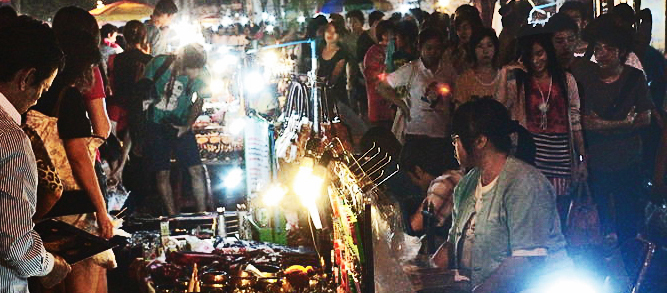
800px-ChiangMaiNightMarket————————-

‘Instead of starting with a perception or a conception of anything, the Buddha established a way based on awareness, or awakened attention. This is an immanent act in the present. It is sati-sampajañña, an intuitive awareness that allows the consciousness to be with the present moment. With this attention, you begin to explore personality-view (sakkaya-ditthi) in terms of the perceptions you attach to as yourself.’ [Ajahn Sumedho, The Problem of Personality]

Upper photo: Interior of Chiang Mai songteaw (public transport vehicle). Lower photo: Night Market, Chiang Mai
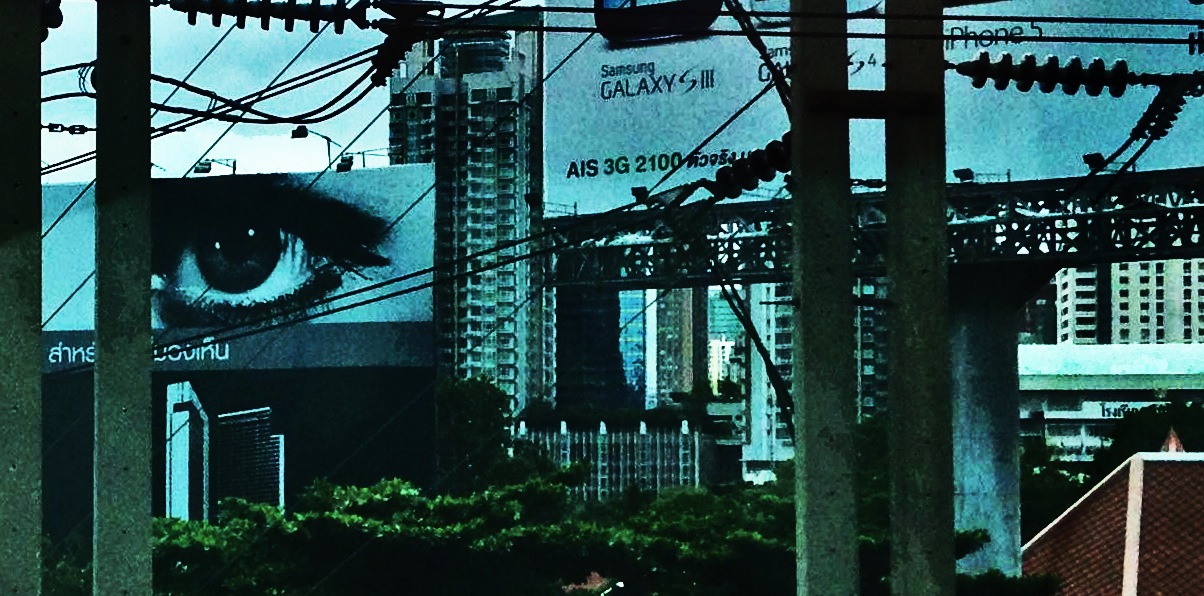
 

the beholder

ploenchitBKK3

Bangkok: The world seems different, everything suddenly seen in clear three-dimensionality. Reflected light, rich, deep colours and a strange familiarity, objects in the environment become somehow known. I’ve seen these things so often before but now seeing them with an expanded awareness. It sounds visionary, you could say revelatory but it’s the result of eye surgery, rather than insight… nonetheless quite astonishing. I have this clarity in one eye only, vision in the other eye is like an old yellowed photo, dull and indistinct. The operation on that eye will be in October, back to the Rutnin Eye Hospital in Bangkok. The surgeon makes a hole in the eye and puts in a tool that uses ultrasound to emulsify the lens. The lens becomes liquid and is sucked away, then a plastic foldable lens is inserted in the place where the natural lens used to be. That’s it, done. Local anaesthetic is enough, or general if you feel claustrophobic about the covers over the face. After the op there are different kinds of eye-drops that go on for about three weeks and it feels a bit itchy but that’s all.

I’m amazed that it’s possible to do this; the plasticity of the human body, parts can be taken out, replaced; systems are deconstructed, reconstructed, subject to change. It all supports the idea of anatta: no abiding self. There’s an underlying flexibility about the mind/body organism namarupa. One example of this is that I have a very refined piece of plastic in my eye instead of a natural lens. And, looking at the world, I find an affinity with clear-wrap, cling-film, transparent plastic food packaging – the way the plastic surface refracts the light. In this strong sunlight in Thailand, I notice the reflections on chrome and glass – the clarity is sparkling and beautiful. Also these enhanced colours, reds mostly, and an overall bright clear blueness in the white areas. It has the quality of an iPad screen, retina display, high density pixels merge into one – an extraordinary brightness.

Faces of friends and family are seen as if for the first time. I notice small expressions now I didn’t know were there, maybe because everybody is looking at my new eye, intense Thai faces examine my new eye, and I’m looking back at them looking at me, seeing subtleties in their features that I’ve never seen before. It’s all quite new, a curious reality.

So, I’ll be going around for the next few weeks, looking at my surroundings and considering the phenomenon that I am experiencing this. Can it really be so? ‘Beauty is in the eye of the beholder’ (Margaret Wolfe Hungerford). The expression always seemed a bit mean and divisive to me, ‘I’ think it’s beautiful but ‘you’ might think it’s not; beauty becomes a matter of opinion… In Buddhism, the ‘beholder’ sees the world and identifies the self, ‘me’. If ‘I’ am inside the body, in ‘here’, I must be separate from everything else out ‘there’, isolated, alone, anxious – wrong view a fundamental error. The attachment to a perceived self and craving for it to become real, creates suffering. Language has a naming function, creating an apparent identity. Anything that is stated is always missing the point because of these characteristics of language. Better to think of it in terms of what it is not, rather than what it is: ‘… the remainderless fading & cessation, renunciation, relinquishment, release, & letting go of that very craving. (the noble truth of the cessation of dukkha)’ [SN 56.11 (dukkha nirodho ariya sacca)]

————————-

Photo image: Skyline at Ploenchit Bangkok.

layers

IMG_0041Bangkok: Falling out of the sky, jet-lagged and inert. A 12-hour flight from London; they gave me an upgrade to business class, nice. More space, better everything and a larger seat. Able to stretch out in the prone position, yes but also a huge selection of videos so I watched movies for 12 hours and no sleep. Now in a state of hypnosis here at the house, lying on the sofa in another time zone. Early morning in Bangkok and I’m watching the FOX channel. There’s only one English language channel on TV in this place so it simplifies things: NCIS, Bones, The Bridge and others. The stories merge into one all-inclusive narrative, a complex and improbable plot. Good-looking actors in expensive cosmetics play characters that migrate from other crime series into this one, the central story, all roads lead to one end, catching the bad guy, variations on a crime scene theme. The pace of it is intense, camera shots hold for about 3 seconds then change. Background audio has a percussive, mechanical sound then it’ll switch to something calm; a picture of domestic reality, beautiful interior, elegant lighting, lovely fabrics – I wish I had a room like that. Slow piano notes played meaningfully, like steps taken through the memory of something that happened once. I’m lulled into acceptance; the way it unfolds is the way it is. I become the story.

I could switch off the TV but there’s a reluctance; a pleasing attachment, something that appears more difficult to let go of than it is. Resisting the emptiness, the deep knowing there’s nothing there that triggers the reaction to fill the empty space with a self-construct, or an image, a movie celebrity, a child’s doll, the sphinx, the totem pole, dependency on a perceived creator. I mute the sound, allow the engagement with it, following the story as it transforms, watching the present moment until it changes – how did that happen? I didn’t notice it take place, only after it occurred. There’s the sense of something applied. Consciousness seems like an unconnected series of screenshots, a random sequence of events; things without substance appear and fade away. Rest in this fictional state… it’s just the way things are. Mindfulness is at the base of it all, in every way. Sleep shuts off the system; down through the layers, comfort, familiar surroundings. Crash out on the sofa in flickering TV light…

————————-

‘Like fish that cannot see the water they swim in, we do not notice the medium we dwell within. Unaware that our stories are stories, we experience them as the world.’ [David Loy, The World is Made of Stories]

recognition

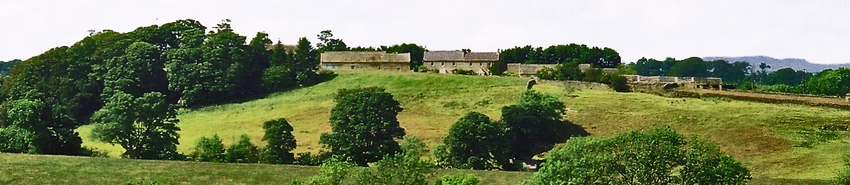
HarnhamLakePOSTCARD ♯05: Harnham Monastery, Northumberland: The monastery is situated on top of a small hill; guest accommodation is down the road a bit. I walk up to the main building for the one meal of the day; sunshine, a cloudless sky, and I meet one of the monks at the door. How long has it been, more than two years? He looks different. Faded brown/tangerine robe, shaved head, exposed face, features looking at me. The whole presence of a person, eyes in the centre of a field of vision – it seems like an immense identity just living here quietly… my perception of how things are, looking back at me. Recognition is a selective thing, matching moments of experience with what’s in the files inside the folder marked: THE MEMORY OF OTHER THINGS SIMILAR TO THIS – select/match, the mind-body organism default. It’s not what it is, it’s only what it appears to be.

Chanting, food, wash dishes and walk back down to the guest accommodation again. Huge daisies on the edge of path, everything is swelling up in blossom on top of this solitary hill and the panorama of Northumberland landscape all around. Unknowingly, I’m manipulating my perception of things to see the world as I want to see it without any real understanding of why I’m attracted – a huge habit of indulgence that I think is simply normal. I don’t understand desire, I just respond to the experience of it. Now on top of this hill, looking at a lifetime of seeking after what I want and rejecting what I don’t want without really knowing why. There’s this experience of dissatisfaction at the base of it all… normally I’m pretending it’s not there. It’s a hunger – a hunger for what? Caused by what? Is there a way of ending this hunger? There’s a name for it. It can be identified. Dukkha, (suffering), the First Noble Truth. Knowledge enters and ignorance is pushed out. I couldn’t see it before; too much thinking about how much I dislike the idea of suffering, an obstacle is created by my aversion to it; the desire for it to not be there. Strategies of avoidance, and lost in experience, agreeable/disagreeable. Caught in the momentum of seeking gratification or holding on to unhappy states of mind believing that this is my reality. The deluded self, ‘me’ and ‘mine’. This is the obstacle – the only reason it’s there is that I linger with the idea of it….

KHouse daisiesReturning again and again to the same starting point means these unhappy states of mind are reinforced more and more. Recognition is not informed by ‘clear knowing’, it’s seen through the clouded prism of unawareness, avidyā not-knowing (ignorance). What’s required is mindfulness, applied recognition, Right View, and the undoing of all the little knots tied in memory, habitual reactions over many lifetimes. Bit by bit, letting it all go…

View_harnham_hill————————-

‘If we have faith in the Buddha’s teaching and are inspired by the great teachers, we can direct our interest into not just avoiding suffering, something we have spent a long time doing, but finding a skilful way of directing our attention towards recognising it, here and now. What is this ‘self’? How is this ‘me’ and ‘mine’ manifesting itself here and now?’ [Ajahn Munindo, Entering the Monastery, 22 July 2013]

– G  R  A  T  I  T  U  D  E –

suspended disbelief

StACaPOSTCARD #04: St Andrews, Scotland: It’s a sharp bright light, different from the sunshine of South East Asia, comes at a lower angle; the sunbeam seems to shine straight into my eyes. Quite blinding in the early morning, I’m dazzled and have to shade my eyes to look up at the ruins of the nave of St. Andrews Cathedral, against the Northern sky. A great emptiness, 12th century mediaeval folk saw it as the ‘Glory of God’, projecting a ‘self’ onto empty space and if there was an intuitive sense – a normal inquiring mind – that something about this is not quite right; the sense of lack, unconvinced, doubting – could it really be God? If it was like this, they were living in fear of their own natural thinking processes and reasoned that it must be because ‘we are all sinners’ and the Church is there to ‘save’ us. Religion was/is power; the Church of Rome, then the Scottish Reformation claimed all the wealth of the Cathedral of St Andrews. Not much in history about the spiritual life of those who lived in that place, studied, prayed, meditated; their compassion, or loving kindness…

I see the door arches and passageways, people walked through here and lived their lives, breathed this air. How was it then; the existential reality of these 12th Century Britains? Conscious experience was the same in mediaeval times as it is today: outer object triggers inner recognition/desire. Example found in the Old Testament: Adam sees the apple: I want that… Dependent origination (paticcisammupadda) in an Old Testament format: there’s an apple out there and I want it but there’s conflict in the mind, associating a fictional self with a normal response; sorry this apple belongs to someone else and you can’t have it. How to resolve this? The response to the apple is normal, the process of human consciousness must be universal – there was never any time when people didn’t react/respond like this. Today we can apply understanding; how does the process work? In those days, no other way to understand it, you have desire for the apple, you are a born sinner, believe in God, and have your sins forgiven… and that was it – no other instruction. Thank goodness I discovered Buddhism.

It’s daylight until very late at night here, a long twilight going through to dawn the next day – really no darkness at all. The morning gathers momentum and we’re flooded with sunshine, day after day, everybody stumbling around in a state of astonishment, suspended disbelief. The sense of being on an island doesn’t seem to be here in Scotland, we are not held, contained, more like we are dispersed, all the way to the Northern region; Orkney, Shetland, Faroe Islands, the Arctic Circle and beyond…

————————-

Ignorant of their ignorance, yet wise in their own esteem, these deluded men, proud of their vain learning, go round and round like the blind led by the blind [Mundaka Upanishad 18]

a small island

050POSTCARD #03: London: Writing this on the new iPhone I bought in Apple Store, Covent Garden. Takes some getting used to. The keyboard is tiny; index finger placed on the letter key blocks out the whole letter – fingers too thick. The letters ‘O’ and ‘P’ are difficult, and when I type ‘M’, I hit the backspace instead. Jiab can do it okay, she has fingers as thin as flower stalks. Maybe I’ll give it to her…? A friend fixed me up with a blue-tooth keyboard and small projector (Optima). I’m using the image on the wall like a screen. Uploading the post to WordPress is possible with wordpress mobile but only with a good Wi-Fi connection. Interesting to work in miniature like this – there’s something about the smallness of it that suits things here in UK.

We’re in a tiny hotel room, just enough space for everything. The streets outside accommodate pedestrians on the pavement, and a narrow road allows the big black taxicabs to rush by. Could be a claustrophobic feeling if you think about it too much, compressed, economy of space provision. Don’t think about it. Japan is the same, squeezed into a little country. It is a small island, travel across from East to West and you come to the sea again – I am marooned. Geographical aloneness. The world is out ‘there’. I remember the separateness; the belief in a ‘self’ but seeing only the lack of it, and nearly a lifetime is taken up with looking for the answer to this conundrum – seeking. Now coming back from Thailand where I’m living in somebody else’s country, an outsider, and finding that it’s been so long since I was in the UK, where I was born, I’ve become an outsider here too. Can’t relate to this culture; holding on to a UK identity and there’s really not anything to support it, just my attachment. Most people I knew then are gone, I’m a homeless person, staying in hotels, staying with people I met in Buddhist groups, friends, and at Buddhist monasteries on the way.

Pretty nearly everyone here is an outsider, a visitor. So many different languages: Italian, Japanese, French, South American and others – where are the English people? It’s the holiday season, maybe they’re in someone else’s country too, being outsiders there? All the staff in hotels, restaurants and shops are East Europeans. Visitors come here and what they see is a system run by other visitors to England. A picture of England; a picture of reality – when was it not like this? Buildings and statues of eminent Victorians, a solitary man standing alone, high up there on a plinth, pigeons sit on his head. Splendid isolation, tourists take pictures of each other standing next to the man’s name carved in the stone of the base of the statue’s plinth and up above he’s there, looking out at other statues. I feel I should know who he is, I’m British, I should know… but you’d have to have studied history to know that. I can’t remember, it couldn’t have been important to me. All I see here is a monument to ‘self’, the grandeur of it escapes me. But it was important to the people of that time; statues, ornate buildings, the opulence and wealth of the Empire recorded in history. Such a great achievement, such a small country. This was. Can’t help reflecting on the fact that it’s all a fiction created by the storytellers of the day about a reality somewhere else, far away – samsara, stories from a small island.

‘There is a path to walk on, walking is being done but there is no traveller. There are deeds but there is no doer. There is no self. The thought of a self is an error and all existences are as empty as whirling water bubbles, as hollow as the plantain tree. There’s a blowing of the air but no wind that does the blowing. There is no self, there is no transmigration of a self; there are deeds and the continued effect of deeds…’ [Ramesh S. Balsekar, ‘Advaita, the Buddha and the Unbroken Whole’]

————————-

250720131971


Optoma projector on gorilla tripod keyboard and iPhone

nothing extraordinary

photo-1POSTCARD #02: London: There’s a crowd standing around the entrance to the Underground Station. It looks like an emergency, police cars pulled up on the pavement, and an area is cordoned off with white tape stretched across entry points to the station entrance. All traffic is redirected and pedestrians can’t get through either. A policeman gives me directions to the Underground station entrance on the other side; so reassuringly calm, I’m made to feel convinced there’s nothing unusual about this situation of flashing lights, bulletproof vests and loud crackling voices on the police audio system. Pay no attention if there’s a slight urgency in the air and the world seems like it’s falling apart, it’s all being taken care of…

Strange circumstances, we all think, realising what we are expected to do is adjust to it, stay within the familiarity of ‘self’ mode, conventional reality. Mesmerised by strategies to keep the population from mass hysteria. No, really, everything is perfectly allright sir… and I feel a hesitation; it wouldn’t be polite to ask the policeman what’s actually going on here, to take up any more of his time with awkward questions – no, and thank you, you’ve been so nice about this, thank you very much – very English. You hear the word ‘thank you’ constantly; THANKYOUs are everywhere, staying with how it appears to be; nothing extraordinary here, no, no… but I sense something catastrophic; a great yawning chasm opening up beneath my feet. Things are clearly not allright and there’s this sudden desire to be absent, distance myself from this location ASAP.

tube pic1Depending on a self that’s seemingly in ‘here’ creates the objective state – I am inside looking out through the eyes; seeing what’s going on out ‘there’ – a world separate from where ‘I am’. Duality. It’s an illusion, and part of this illusion is that the mind is maintaining the illusion. The policeman is maintaining the illusion, media, culture, everybody I meet reinforces the illusion because we’re all doing it. Even when I can see there’s no self to speak of – nobody at home – the mind is always telling itself there is a ‘self’ in here. And this is the situation; seeing past the ordinary self where there’s a ‘me’, a GPS locator: YOU ARE HERE. This is how it is that I arrive at the Underground entrance by way of the small backstreets, following the crowd. Then down two long escalators, deep under the ground, down and down to the depth of what feels like a ten storey building. At the very bottom of this is the tunnel and the track. Heavy old metal train careering in with a great whoosh of tunnel air, I get into the carriage and we’re off clattering through the blackness of the underground network, rattle-bang-clink, rattle-bang-clink, rattle-bang-clink….

————————-

‘… the distinction between an ever-changing experiential response to the environment, and the concept of a reified continuous self living in an objective world,’ [Gay Watson, ‘I, Mine and Views of the Self’]

Upper photo: Newcastle Rail Station, lower photo: London Underground train

a kind of alertness

100720131952POSTCARD #01: Chiang Mai: A slight breeze disturbs the wind chimes, tinga-tingaling… ting. An unfinished sequence of musical notes. It diverts my attention from these rememberings, one by one, rushing towards me like a single wave quickly covers the smooth beach sand for a moment then recedes. The wind chimes again: tingaling-ting… ting, a sense of something suspended, isolated, uneasy – butterflies in the tummy – why should it be like this? The fact that I don’t know why it’s like this, causes the uneasy feeling to be there, ‘a riddle, wrapped in an enigma.’ Uncertainty, impermanence, the Ajahn Chah teaching, ‘Not Sure’ [mai nae]; poised on the edge of something – a kind of alertness. I’m going to UK, it’s to do with that; leaving Chiang Mai tonight, only a few hours left. Flight to Bangkok, change planes and I’ll be in London on Sunday morning – 5½ hours in the past. Thinking about Inkland (England, as M calls it), a great flood of memories and the revisiting of these times. I’m not feeling sure about it; Inkland is such a ’proper’ place (compared with Thailand), not sure about being not sure and remembering other times when I was not sure.

Only two weeks in the UK and too many things to do; a sequence of events planned; connecting with trains often delayed, sometimes cancelled, and meeting people in places I don’t know. So many things dependent on so many other things. And so much of it is unresolved until it unfolds, piece by piece and fits together in the right order. A handful of printouts of train tickets and hotel reservations, it’s hard to keep it all in my head. I feel cramped, it’s time to finish off planning for this event – the event is already here, it’s happening now! Time to get ready to go to the airport. Tidy up this placet; the Zen of housekeeping, inner peace, do the ironing…

Hot iron on freshly laundered fabrics, comforting, homely, perfumed smells. It has a soothing effect. Ironing out all these little wrinkles, the silvery nose of the hot iron smoothens them all away, warm to the touch. Place the folded packets of clothing in the suitcase. Peace and flatness. Being mindful of the ‘not sure’ thing, it’s caused by my being not sure about it. As long as the uncertainty is out there somewhere, neither in nor out, it’s uncertain. So I know I have to embrace it, give it a hug, be open to it and allow the uncertainty to enter – there’s nowhere else for it to go. The willingness to let it in, leads to an immediate sense of release, inside and outside. Wind chimes go: tingaling again, joyful sound. Passport, ticket, wallet, I’m on my way. Goodbye house, anjali…

————————-

just this

Sunrise (1)WPNChiang Mai: 05.30 hrs., ‘… down the long and silent street, the dawn, with silver-sandalled feet…’ daylight creeps into the rooms and it’s my birthday today! I suppose one’s birthday is something to be possessive about: ‘my’ birthday. I was born on this day quite a long time ago in the North of Scotland and now I’m here in the silence of a Chiang Mai morning in the North of Thailand. Open all the windows and a breeze blows through in all directions, curtains and fabrics that haven’t moved for a month in the stillness of this interior, flutter and flap against the walls – a sheet of paper flies off my desk, lands on the smooth floor tiles and slides away. It feels like the world outside is inside; all of a one-ness and this mind/body awareness (that is ‘me’) spreads out from here, through the trees, up and into the dome of the sky as far as the eye can see.

Skype call from Jiab in Delhi, happy birthday, and in the video window I can see our room, the place I usually inhabit. Jiab is at the desk where I normally sit. It’s still dark there, daylight here. Two people talking with each other but often occupied with the tiny image of themselves that appears in the Skype window, lower right. Eyes are sometimes directed away, how does my hair look? Jiab tells me the story about how she was born on the night of the full moon and so her actual birthday is not always on the same day. The family lived in an old forest area in the South of Thailand. Jiab remembers her father saying it was the light of the full moon that guided him through the trees to bring the midwife to their house. And a phone-call from M, happy birthday Toong Ting! She calls me that because she’s my 9 year-old niece. Toong Ting, when you go to Inkland? She asks me this, meaning ‘England’ but I like ‘Inkland’ (the place that makes ink?), so I tell her I’m going to Inkland on Saturday 13th, but it’ll be Sunday 14th by the time I get there. We have a discussion about the time difference thing and M knows about this, having visited Japan earlier this year. Only 9 years old, but she has an understanding of the world and systems that’s so much in the present moment it takes my breath away.

http://www.dreamstime.com/-image17433969Children teach us about birth and the great mystery. About 10 years ago, there was an episode from a BBC series on the human body that showed a woman giving birth – so vivid, I suddenly felt this immediacy of it happening to me: the blinding light, echoing sounds; the coldness, the impact of air entering the nasal passages? Revisiting the birth experience. Emerging into the world,  the first total sensory consciousness sweeps through and the body/mind organism is turned inside-out. That TV film left me quite transformed… Now it’s later, many years later, and there’s ‘me’ and this old body, getting settled on the cushion for a 30 minute meditation sit on ‘my’ birthday. These are the same body parts, regenerated, expanded in a lifetime, worn a bit smooth, puckered up at the edges. Skin, muscle, flesh; soft rubberoid plasticity, and these mysterious organs held by ligaments bonded into solid bone. The whole thing maintaned by the tremendous heat and energy processed from food, the fuel for the engine. And there’s the fluidity enclosed in bubble-like spaces, gurgling away all the time. The breath enters the body as a kind of wind, gusting in and out. It comes back and blows everything all over the place, withdraws in a moment and it’s gone again. Mind mesmerized by the form and function of the body, seemingly trapped in this limited temporality; cause/effect – then for an instant, seeing the truth of the Five Khandas. Thin skin of eyelid slides over surface of smooth eyeball and the dimly seen light entering my darkness; just this…

‘Each and every mental and physical process (namarupa) must be observed as it really occurs so that we can rightly understand it in its true nature. That right understanding will lead us to remove ignorance (avijja). When ignorance has been removed, then we do not take these mind-body processes to be a person, a being, a soul or a self. If we take these mind-body processes to be just natural processes, then there will not arise any attachment. When attachment has been destroyed, we are free from all kinds of suffering and have attained the cessation of suffering.’ [Venerable Mahasi Sayadaw]

————————-
‘…down the long and silent street, the dawn, with silver-sandalled feet…’ taken from ‘The Harlot’s House’ by Oscar Wilde. Upper photo image taken from the WPN archive. Lower photo image: dreamstime. Gratitude to Rory and his post for the inspiration: http://beyondthedream.co.uk/2013/07/05/tao-te-ching-28-keep-to-the-feminine/

seeing things backwards

010720131926

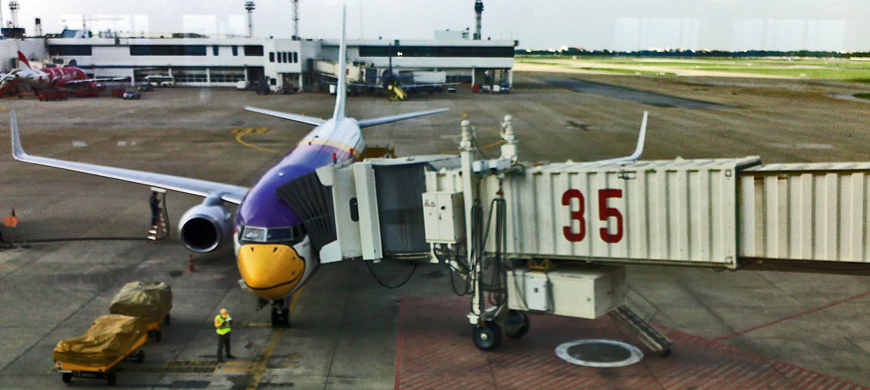
Bangkok/Chiang Mai flight: Stone cold in Departures, AC has me chilled to the bone. I walk around the shopping area, just to be doing something, and go to the magazine and newspaper shop. They have packs of Thai alphabet cards – just what I was looking for! I can find the vowel set, but not the consonant set and I ask the lady at the desk if she has it. Stress on her face as I’m asking the question; she thinks she will not be able to understand… then she realizes I’m speaking Thai – a small jump in the air, joyful surprise. Wow! Okay, so… but she’s forgotten the question. I ask again if she has the consonant cards. She starts looking but can’t find them: oh, no have, solee! (sorry) Disappointed. I get the vowel cards anyway and ask her how much it is. She says 47 baht but when she rings up my money at the cash desk, she says 74 baht – checking my change afterwards, she was right first time, 47 baht – just said it round the wrong way (47 or 74?) seeing things backwards is a problem for her sometimes. No worries, everything moves along; flight is called and we are boarded. Stewardesses in lemon yellow costume, it’s all doll-like, pretty and cute – the plane has a bird’s face painted on the nose. You can buy gifts from a trolley coming along the aisle; do I need a vinyl blow-up inflatable airplane? Nothing to get heavy about, overly serious about; no need to get stuck thinking about anything hopelessly imponderable.

eu-ahEven so, it’s noticeable how the mind will attach to an object and hold on to it with the intensity of a velcro fastener bonding with its surface; the desire for adherence. The thinking mind presents a range of options; I can choose to ‘be’ something, contained in an acted-out scene from a movie I’m watching about ‘my’ life. It’s birth in the Buddhist sense jati: the I-am-here thing. It’s sometimes an uncomfortable, driven, locked-in state that arises through examining an event, and returning to it again and again, simply because I’m so used to seeing the situation from this perspective of holding on to it, I expect it to be the same starting point of my meanderings every time.

Mindfulness of this unaware habituality. Knowing it’s like this means ignorance (not knowing) is gone, vanish’d into thin air. I enter the space knowingly, intervention in the probability sequence. Instead of the intensity of mind, there’s just the intensity… a tightness of posture – maybe that’s how it started – relax the neck, the forehead. No thought associated with it. No goals to which I’m compelled to strive for; what the eye doesn’t see, the heart doesn’t grieve for. Undoing all the knots tied in memory, letting the mind untangle itself from the problem: good, bad, whatever. Letting it all go, giving it room.

Reminded of Ajahn Pasanno’s reflection on Ajahn Chah’s teaching: ‘A coconut tree draws nutriments from the planet; it draws elements good and bad, clean and dirty, up through the roots and into the top of the tree and then produces fruit that gives both sweet water and delicious coconut.’ And Ajahn Pasanno describes how we don’t need to be concerned about the different experiences that we have of the world, everything is drawn up through the ‘roots’ by way of the three-fold practice: sila (virtue), samadhi (concentration), paññā (wisdom). All experiences, good, bad, whatever, are transformed into insight, understanding, balance and sense of peace.

In-flight announcement: … we are now making our descent… please ensure your window shutters are up, arm rests down, seat backs forward and tables folded away – a small cluster of prepositions. Plane lands and luggage collected, out into the clean Chiang Mai mountain air. Shortly after that I’m in a tuk-tuk headed down to the supermarket to get supplies.

tt05July13

————————-

Photo image upper: My plane to Chiang mai
Middle:  Thai vowel/dipthong ‘eu-ah’
Lower: Chiang mai tuk-tuk