

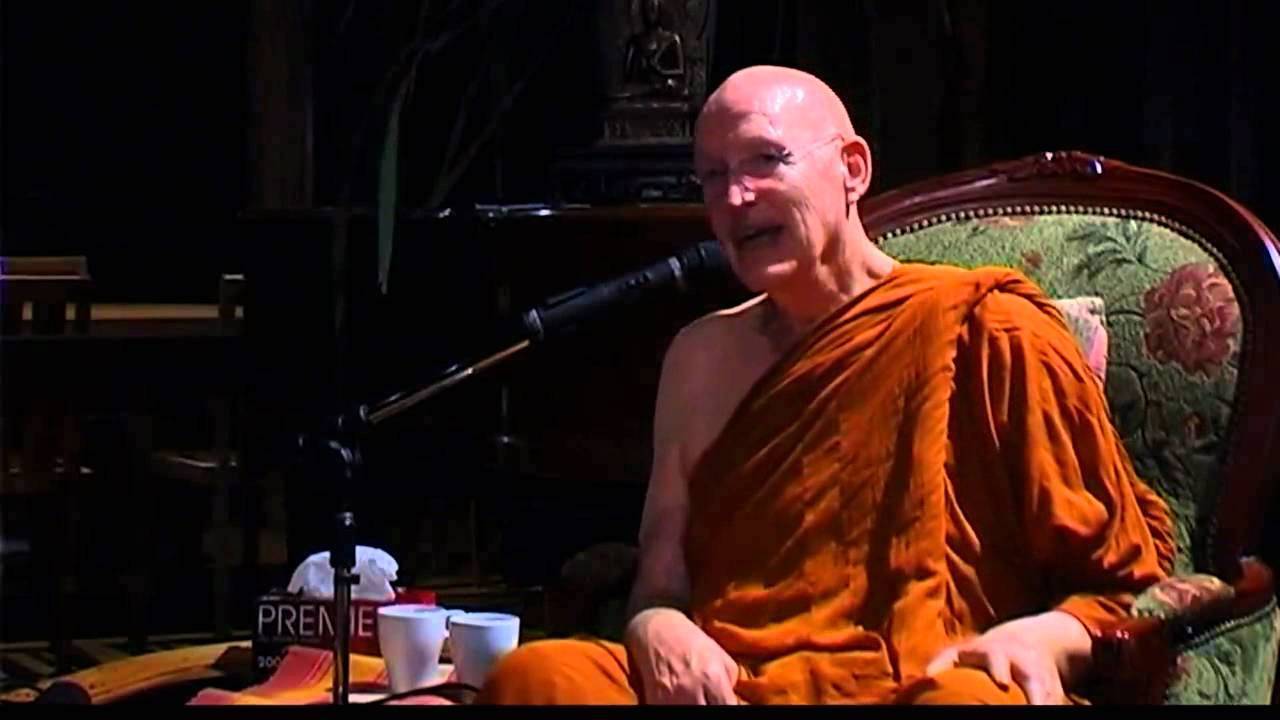
Excerpts from “Intuitive Awareness,” by Ajahn Sumedho, the Chapter titled Identity. This is a free Dhamma publication available as PDF EPUB MOBI. Look for the link at the end of this post.
As soon as we identify with a negative thought, it hooks us: ‘Oh, here I go again, being critical and negative about somebody and I shouldn’t do that. I’ve been a monk all these years and how can I stop doing that?’ I’ve identified with a negative thought and it triggers off all kinds of feelings of despair. Or, ‘I shouldn’t be like this, I shouldn’t think like this. A good monk should love everybody.’ With awareness, you suddenly stop that, and you’re back in the centre again.
So just recognize, no matter how many times you go out on the wheel, it’s just a very simple act of attention to be back in the centre. It’s not that difficult, remote or precious; we’re simply not used to it. We’re used to being on the turning wheel. We’re used to going around and around and becoming all kinds of things. We’re used to delusions, fantasies, dreams. We’re used to extremes. What we’re used to we are inclined to do if we’re not attentive, if we’re not vigilant. Then we easily fall back onto the turning wheel because we’re used to that, even though we suffer. When we aren’t aware, when we aren’t vigilant and attentive, then we easily fall back into the realm of suffering. The good side of it is the more we develop awareness, cultivate awareness, we then start de-programming those habits. We’re not feeding these illusions anymore. We’re not believing, we’re not following, we’re not resisting. We’re not making any problem about the body as it is, the memories, the thoughts, the habits or the personality that we have. We’re not judging or condemning, praising, adulating or exaggerating anything. It is what it is. As we do that, our identification with the personal condition begins to slip away. We no longer seek identity with our illusions; we’ve broken through that. When we’ve seen through that illusion of self, what we think we are, then our inclination is towards this centre point, this Buddho position.

This is something you can really trust. That’s why I keep saying this, just as a way of encouraging you. If you think about it, you don’t trust it. You can get very confused because other people will say other things and you’ll hear all kinds of views and opinions about meditation, Buddhism and so on. Within this sangha there are so many monks and nuns, so many views and opinions. It’s a matter of learning to trust yourself, the ability to be aware rather than think, ‘I’m not good enough to trust myself. I’ve got to develop the jhānas first. I’ve got to purify my sīla first, my ethical conduct. I’ve got to get rid of my neurotic problems and traumas first before I can meditate.’ If you believe that, then it’s what you’ll have to do. But if you begin to see what you’re doing, that very illusion, then you can trust in that simple recognition. It’s not even condemning the illusion. It’s not saying you shouldn’t do those things. I’m not saying you shouldn’t purify your sīla or resolve your emotional problems, go to therapy or develop the jhānas. I’m not making any statement about ‘should’ or ‘shouldn’t’, but rather I’m pointing to something that you can trust – this awareness, sati-sampajañña, here and now.
If one of you should come to me and say, ‘Ajahn Sumedho, I’ve got so many neurotic problems and fears. I really need to go to therapy and get these things straightened up in some way because I can’t meditate the way I am,’ and I say, ‘Well, that self-view might even be right on a worldly level – I’m not saying you shouldn’t go to a therapist. What’s best is to not say you are this way or that way – to not give you some kind of identity to attach to – but to empower or encourage you to trust in your own ability to wake up, to pay attention. I don’t know what the result of that will be. I hope it will be good. But what’s true is that your true identity isn’t dependent upon any condition.
Pointing to the present, the paccuppanna-dhamma, we can grasp that idea and then think we don’t need to do all those things. ‘We don’t need to be monks or nuns; we don’t need therapy. We can just meditate. Pure meditation will solve all our problems.’ Then we grasp that and become anti-religious: ‘All religion is a waste of time; it’s all a bunch of rubbish. Psychotherapy is a waste of time. You don’t need that. All you need to do is be mindful and meditate.’ That’s another viewpoint. Those kinds of opinions are not pointing to the centre, they’re judging the conditions or the conventions. And even though you can say that it is true, that ultimately all you need to do is to wake up – simple as that – that in itself is a convention of language. This empowerment or encouragement is pointing to an immanent act of awakening. It’s not telling you that you are some kind of person who is asleep and should wake up, or that you should grasp that idea. It is pointing to that sense of actually being awake, aware.
In the Western world we get very complicated because we don’t usually have a lot of faith, or saddhā. Asian Buddhists tend to be more culturally attuned to this. They have a lot of faith in Buddha, Dhamma, Sangha or a teacher. Most of us come to Buddhism or become monks or nuns when we’re adults, and we’re sceptical. Usually, we’ve gone through a lot of sceptical doubts and have strong self-images, and a hard, strong sense of individuality. Speaking for myself, my personality was a doubting, sceptical one. This doubt, or vicikicchā, was one of my greatest obstructions. That’s why I couldn’t be Christian: it was totally impossible for me to believe in the kinds of doctrines that you have to believe in to be one. I was a sceptical, doubting character. At the age of thirty-two I was quite cynical. I’d been through a lot, and had quite a lot of bitterness about life. I was not pleased with my life at thirty-two. I was disappointed with myself and a lot of others. There was a kind of despair, bitterness and doubt, and yet the faint light at the end of the tunnel was Buddhism. That was one thing I still had some hope for, my interest in Buddhism. It was a sign to me, something that drew me into this life.
The good thing about being highly individualistic, sceptical and doubtful is that you do tend to question everything. One thing I appreciated with Ajahn Chah was that everything was up for questioning. That which is sacred and oftentimes never questioned in religions, was allowed to be questioned. He was never one for a peremptory approach of ‘you have to believe in this and you have to believe in that.’ There was never that hard, heavy-handed, dictatorial style; it was much more this reflective questioning and inquiry. One of the problems with Westerners is that we’re complicated because of the lack of faith. Our identities get complicated in so many ways, and are highly personal; we take everything personally. Sexual desire and the sexual forces in the body are regarded as very personal. The same is true with how we identify with hunger and thirst. We judge the basic forces that are natural and take them personally, thinking we shouldn’t be cowardly and weak, pusillanimous. We get complicated because we judge ourselves endlessly, criticize ourselves according to very high, ideal standards – noble standards we can never live up to. We get self-disparaging, neurotic and depressed because we’re not in touch with nature. We’ve come from the world of ideas rather than from realizing the natural law.
In meditation it’s a matter of recognizing the way it is – the Dhamma or the natural law, the way things are – that sexual desire is like this, it’s not mine. The body is like this; it has sexual organs so it’s going to have these energies. This is the way it is. It’s not personal. I didn’t create it. We begin to look at the most obvious things, the basics, the human body, in terms of ‘the way it is’ rather than identifying with it personally. We investigate the instinctual energies. We have strong survival and procreative instincts: hunger and thirst, the urge to protect ourselves, the need for safety. We all need to feel some kind of physical safety, which is a survival instinct; these are basic to the animal kingdom, not just humans. It gets more complicated because we identify with it, and judge it according to high standards and ideals. Then we become neurotic. It gets all over the place; we can’t do anything right. This is the complicated mess that we create in our lives and it’s very confusing.
Now is the time to understand that it needn’t be seen in this way. No matter how complicated things are, the practice is very simple. This is where we need a lot of patience, because when we’re complicated, we oftentimes lack patience with ourselves. We’ve got clever minds. We think very quickly and have strong passions, and it’s easy to get lost in all of this. It’s confusing for us because we don’t have any way out of it, we don’t know a way to transcend or to see it in perspective. In pointing to this centre point, to this still point, to the here-and-now, I’m pointing to the way of transcendence or the escape. Not escape by running away out of fear, but by means of the escape hatch that allows us to get perspective on the mess, on the confusion, on the complicated self that we have created and identify with.
It’s simple and uncomplicated. But if you start thinking about it, then you can make it very complicated with such thoughts as, ‘Oh, I don’t know. I don’t think I could ever realize nibbāna.’ But this is where trust comes in. If you’re aware that ‘Oh, I don’t know’ is a perception in the present, trust in that awareness. That’s all you need to know. It is what it is. We’re not even judging that perception. We’re not saying, ‘What a stupid perception.’ We’re not adding anything. The awareness of it, that’s what I’m pointing to.

Learn to trust in that awareness rather than in what the perception is saying. The perception might even be common sense in a way, but the attachment to it is where you get lost. ‘We should practise meditation. We should not be selfish and we should learn to be more disciplined and more responsible for our lives.’ That’s very good advice, but if I attach to that, what happens? I go back to thinking, ‘I’m not responsible enough, I’ve got to become more responsible and I shouldn’t be selfish. I’m too selfish and I shouldn’t be,’ and I’m back onto the turning wheel again. One gets intimidated even by the best advice. What to do? Trust in the awareness of it. The thought ‘I should be responsible’ is seen, and one’s relationship to it is no longer that of grasping. Maybe if that thought resonates as something to do, then be more responsible. It’s not a matter of denying, blotting out, condemning or believing, but of trusting in the attitude of attention and awareness rather than endlessly trying to sort it out on the turning wheel with all its complicated thoughts and habits, where you just get dizzy and totally confused.
The still point gives you perspective on the conditions, on the turning wheel, on the confusion, on the mess. It puts you into a relationship to it that is one of knowing it for what it is, rather than making a personal identity out of it. Then you can see that this knowing is your true nature – your real home – this pure state, pure consciousness, pure awareness. You are learning to remember that, to be that. It’s what you really are, rather than what you think you are according to the conditioning of your mind.
Link to the source of this article:
https://forestsangha.org/teachings/books/intuitive-awareness?language=English






 dhamma footsteps
You must be logged in to post a comment.