ending kamma through insight

Continued excerpts from, “Kamma and the end of Kamma,” by Ajahn Sucitto

Samādhi is generated through skilful intentions in the present. It also relies upon already having a mind-set that settles easily, and it naturally sets up programs for the future: one inclines to simpler, and more peaceful ways of living. Samādhi provides us with a temporary liberation from some kammic themes – such as sense-desire, ill-will, worry, or despond – and it gives us a firm, grounded mind which feels bright. But samādhi itself is still bound up in time and cause and effect; it is kamma, bright and refined, but still formulated.

Also, it takes time to develop samādhi. And meanwhile, the very notion of ‘getting samādhi’ can trigger stressful formulations such as: ‘Got to get there’, ‘Can’t do it’ and so on. Accordingly, the learning point for both one who does, and for one who doesn’t, develop much samādhi, is to handle and review the programming. ‘How much craving is in this? How much “me holding on” is there?’ That’s the process of insight. It’s always relevant.

The results of holding on can be discerned in our most obvious and continual form of kamma: thinking. Thinking plays a big part in our lives, governing how we relate to circumstances and other people, determining what potentials we want to bring forth and where interesting opportunities might lie – and just reflecting, musing and daydreaming. So moderating and contemplating thought is an all-day practice. This practice offers understanding – and therefore a means of purifying one’s kamma, and even getting beyond it.

To do this, notice the tone or speed or raggedness that thinking has. By doing this, there is a disengagement from the topic or purpose of thinking; and your mind settles and connects to how the thought feels in the heart. When your heart is grounded in the body, you don’t get captured by the drive or emotional underpinning of thinking. Whether you have a great idea, or are eager to get your idea acted upon, or you don’t have a clue and feel ashamed of that – all that can be sensed and allowed to change into something more balanced. So this hinges on referring to the interconnected system of body, thought and heart. Ideally we want to direct our lives with the full set, so that we’re not just acting on whims and reactions, and our thoughts and ideas are supported by good and steady heart. That heart is where kamma arises, so you want to make sure it’s in good shape and is on board with what you’re proposing. Get it grounded in the body before you let the tide of thought rush in.

Once you settle the heart, you can evaluate the current of thought in terms of its effect. Sometimes it feels really pleasant in itself (like when people agree with me), but when I refer to how it sits in my heart and body, thinking can seem overdramatic, self-important, petty or unbalanced. Too often thinking closes the opportunity for the miraculous to occur, or for a fresh point of view to arise. And as the after-effect of all kamma is that a self-image gets created, do my thoughts make me into a fault-finder; a compulsive do-er; a habitual procrastinator; a feverish complicator; or a slightly grandiose attention-seeker? Does thinking keep my heart very busy being ‘me’, or could it be just a balanced response to what a situation needs – something that can dissolve without trace?

And as self-images do arise, can they be evaluated and witnessed with steady awareness? Can openness and goodwill arise in that awareness to know: ‘this is an image, this is old kamma, don’t act on this but let it pass?’ In this way, we can avoid making assumptions, established attitudes, and directed intentions into fixed identities. These are the blades of the spinning fan – stored up as citta-saṇkhārā. If you train in samādhi and paññā, those self-programs can be un-plugged. True actions don’t need an actor.

What underpins the automatic plugging-in is ignorance, the programming that is most fundamental to our suffering and stress. Ignorance is easy: pre-fabricated attitudes cut out the awkward process of being with things afresh. Ignorance gets seeded in the familiar and blossoms into the compulsive – which feels really solid and ‘me’. That’s how it is. But as the sense of self centres around people’s most compulsive behaviour, the personal self is so often experienced as the victim of habit, a being who’s locked into patterns and programs.

This is why it’s always remedial to attend to the kinds of kamma that are about not doing. The not-doing of harm, for example, is an absolutely vital intention to carry out – if enough of us followed this, it would change the world. And what about the other precepts? We can fulfil these, day after day and not notice it because our hearts and minds were elsewhere, believing we should do more and not noticing the not-doing mind. But the crucial Dhamma actions are just this: to disengage from the compulsive, and mindfully engage with the steady openness of your own interconnected intelligence.

For example, when a verbal exchange is getting overheated, you can attune to what’s happening in the body – the palms of the hands, the temples and the eyes are accessible indicators of energy. Does this energy need to be more carefully held? Sometimes I find that just acknowledging and adjusting the speed of speaking or walking shifts attitudes and moods; softening the gaze is also helpful. Say you’re feeling dull or depressed: is your body fully present …? Giving some attention there with a kindly attitude helps the energy to brighten up, and shifts the mind-state.

Holding on, gaining, succeeding, losing: the programs that saṇkhārā concoct – deliberate or instinctive, driving or drifting – can be witnessed. We can notice the surge of glee or despond, the lure of achievement, and the itch to get more. But we can focus on these impressions, heart-patterns and programs just as they are, rather than believing ‘this is me’; ‘this is mine’; ‘I take my stand on this’; or even ‘I am different from all this stuff.’ This is the focus of insight. It’s about witnessing programs: how they depend on self-views, how they arise based on feeling, attract a grasping, lead to the creation of ideas and notions, create a self – and so keep saṃsāra rolling on. With insight, you contemplate the rigmarole of success and failure, of what I am and what I will be: it’s all more kamma, more self-view, more stuff to get busy with. But if you see the endlessness of all that, you work with the self-patterning and cut off stressful programs. And that’s the only way to get free of kamma.

When that point becomes clear, deepening liberation depends on staying attentive and learning from what arises and passes through your awareness. Because when one relates to bodily, conceptual and emotional energies as programs, that doesn’t support the view ‘I am’. Being unsupported by that view, the basis of feeling is exposed; with disengagement and dispassion, that feeling doesn’t catch hold. But it’s like scratching an itch, or smoking a cigarette: even though you get the idea that it might be good to stop, your system won’t do it unless it gets an agreeable feel for the benefits of stopping, and you develop the resolve and skills to do so.

To this end, ethics place discernment where it most often needs to dwell; meditation blends body, thought and heart together into firmness, clarity and ease; and wise insight disbands the defective programs. Then we can handle life without getting thrown up and down by it. We don’t have to keep on proving ourselves, defending ourselves, creating ourselves as obligated, hopeless, misunderstood and so on. Kamma, and a heap of suffering, can cease.

Continued next week October 17, 2024

the work of not-working

Ajahn Sucitto

Let’s get on with the practice. Since how you attend as well as what you attend to affect the heart – and that’s where our self-impression (and its kamma) arises – it’s important to begin right there. Recollections of the Triple Gem, and of one’s ethical standards and good kamma, steadily applied, dispel worry and distraction and encourage the heart, so that you approach your experience in a peaceful but decisive way.

For this, you have to exercise authority over thinking. Because the mind is geared to this verbal activity, it easily picks up and follows trains of thought that take you away from your bodily presence, and from a cool place where they could be witnessed. So, one of the skills of meditation is to lightly apply thoughtful attention – without thinking of anything. It’s as if you’re about to think, and then, feeling the energy of your thinking, you steady it so that you can use it to lightly label an experience. Walking, you simply notice ‘walking’; breathing, you notice ‘this is breathing in … this is breathing out.’ Then, as you place your attention on these simple themes, you’re receptive, as in: ‘How is this?’

Any kind of thinking operates through this two-fold process. Firstly, the rational mind scans for a sensory impression or a heart-impression and names it: ‘cow’, ‘bell’. This is ‘bringing to mind’ or ‘placing thoughtfulness’, vitakka. In tandem with that, there is a momentary review to check out if the concept really fits, or to evaluate what attention has been placed on, as in: ‘the cow is speckled, and seems agitated.’ This evaluation is the more receptive aspect of thinking, vicāra. Evaluation connects to the citta by listening deeply. In meditation, you use it to listen out for the felt sense of bodily experience, such as ‘this sensation feels sharp’ or ‘this breath feels long and fades gently.’ These felt senses aren’t simply feeling (= pleasant or painful), nor are they full-blown meanings – such as ‘I’m being stabbed’ or ‘my body is dissolving.’ Many felt senses are quite neutral and don’t evoke much, but they provide an ongoing reference to direct experience – and that is grounding. As with the body: ‘Right now my body is just a sense of warmth, of solidity and rhythmic energies.’ That’s a lot less stressful than ‘I look a mess. I’m too fat.’ So, in meditation, you use the simple felt senses of groundedness, spaciousness and natural rhythm to elicit the felt meaning ‘I am really here, there is no pressure around me, I feel safe.’  Just to be able to let a breath go all the way out, and have the time to wait and let the inhalation come in at its own rate and fill you, can give you an assurance that isn’t always there in social contact. When your heart gets that, you can think, speak and act from that safe and fully present place.

So, as you bring your heart and thought into line, turn them to whatever is the most stable pattern of physical sensations that occur as your body is sitting still: the pressure of your body against what it’s sitting on, the sense of the upright posture, etc. Learn to steady the body in the sitting position, and to set the body upright and relax what muscles aren’t needed (such as in the face or hands). That means applying thought and heart to find out how best to sit in order to maintain alertness without stress. It can take some time to find an even balance because of habitual bad posture or residual tension in the body.

Also practise finding that balance when you are standing and walking. Keep referring to two bases: the spine, and the space around it. So, try to sit, stand or walk in a way that brings the whole spine into alignment, from the top of the head to the tail, as if you were hanging upside down. Aim for a balance whereby the skeletal structure is carrying the majority of the weight, rather than the muscles: that lessens stress. Secondly, let your “body sense the openness around it. This helps to get the front of the body to relax.

Stay alert to nervous energy. A high-pressure, fast-paced lifestyle can turn the entire nervous system into a mass of jangling wires. These energy patterns can shift from relaxed to tense, or receptive to aroused with one sight, sound or thought.  And it takes a lot longer to calm down than it does to get stirred up. This sensitive, impulsive and receptive experience of body is the area of kāya-saṇkhāra. Referring to the body as a system of energies helps you to be aware of how the body is affected, how to guard this sensitivity against being triggered, and how to then turn its energies to good use. Because, if it is steadied, embodied energy can be strengthening and bright.

So, if you get agitated or feel uncomfortable, or get lost in thought, keep coming back to these two reference points. The training is to keep your thinking minimal. This channels its energy and thereby brings around a more balanced state. This is necessary because although the verbal program is powered by an impulse to define and plan, it acquires distortions when out of anxiety we get lost in planning. So, thinking can carry an emotional bias, and can hastily prejudge an experience – ‘seeing’ the cow as threatening because we are nervous around cows.
[Continued next week: 26 September 2024]

body, thought, heat: interconnection

Ajahn Sucitto

There are two processes that steer the kamma of meditation. The first process is one of strengthening and healing the heart through calming (samatha). Samatha practices use a steadying focus and a soothing attitude. The second process is ‘insight’ (vipassanā) – which is about seeing how things really are. The two processes work together: as you get settled and at ease, your attention gets clearer, and as you see things more clearly, liberating wisdom arises.

 In this way, calm and insight guide the mind to an alert, knowing stillness.

To enter a period of meditation, you put aside personal issues and circumstances in order to attend to the basis of your body-mind system. With even a cursory review, it’s clear how dynamic this system is: the body’s sensations throb and change, and its energies tingle and flow. Meanwhile, the mental domain has its own dynamic: moods swing, thoughts race and spark of memories; then there are plans and decisions and all kinds of options popping up – it can be such a flood that we’re often not completely with what we’re doing right now. So, the first step in meditation is to refrain from jumping into that flood, and instead familiarize yourself with how it happens. Then you’re doing one unusual but important thing – establishing a way of witnessing, and therefore learning about, your conscious system.

Notice that you get messages from three aspects of this system: bodily intelligence gives you a sense of being here; emotional intelligence is meanwhile telling you how you are while the rational faculty is suggesting what you should do about this – and many other things. All very lively; these three intelligences run on energy. And they interact: the energies of moods and thoughts trigger resonances in the body’s nervous system, and vice versa. Sometimes a burst of irritation or fear will cause a contraction in this somatic domain; or the notion of having lots of things to do generates an emotional spin in which you lose awareness of your body.

What you might not notice at first is that the three intelligences affect each other – so check that out for a while. If your mind is racing, is it possible to have a calm, aware bodily sense? Can you feel bright and assured if your body is slumped or tense? This interconnectedness is important in meditation, in which we use a steady, upright body to calm the mind. And calm gives rise to wisdom: you realize that although the sum total of this body-thought-heart interplay seems to be ‘me’, you can witness that ‘me’ – and the witnessing is equally ‘mine’, but it’s a lot steadier and more spacious. It isn’t coloured by the urgencies, discomforts and glitches of the personal world, and by referring to it, you lessen the spin of that world.

The personal world is kamma: old habits and concerns and reactions that get added to by fresh actions and responses. The mind is busy being, or creating, ‘me’. The dynamic that keeps recycling kamma is carried out by programs – coded instructions that we associate with computer software – which in this case are organic. The capacity to form concepts and articulate them is the ‘verbal program’ (vaci-saṇkhāra). The heart’s nature to be affected by feelings and impressions, and to formulate impulses and responses, is another program – citta-saṇkhāra. The body (kāya) also operates according to its program, which most crucially is geared to generating and circulating energy around breathing in and out. This program is called ‘kāya-saṇkhāra’. All these programs are established by another one: the life-force (āyusaṇkhāra).

On these universal foundations, more personal programs get built. That is: the ability to conceive and articulate is adjusted to operate in terms of specific languages, attitudes and ways of thinking. Our emotional program of liking and disliking also gets fine-tuned to a range of individual-specific responses. As these programs get fixed and made familiar, they become ‘mine’ and then ‘me’. ‘I am a Swedish woman’, ‘I am a rational humanist’, etc. This is the ‘self-construction program’ (ahaṃkāra); it collects these subjective attributes, inclinations and psychological patterns; that collection becomes ‘me’ and ‘mine’ – and that becomes the basis for actions and speech.

These inclinations and programs are active saṇkhārā – in which intention, the urge to do, gets the process going; and they result in baseline saṇkhārā, that is, the patterns of thinking, emotional response, and bodily energy that form the baseline for each individual’s fresh kamma. Hence saṇkhārā are also referred to as ‘formations’ or ‘kamma-formations’. The pattern of acquired attitudes, energies and behaviours becomes the old ‘me’; and that becomes the basis for further action.

But with regard to that ‘me’, as you witness it, its seeming substantiality is created by the interweaving of thought and emotion with nervous energy backing it up – just as the spinning blades of a fan create the appearance of a solid disk. As to why this feels so ‘me’ and ‘mine’: it’s the familiarity and specific form of these interplays that give rise to that. The person-specific nature of that form is old kamma; the interplay is new kamma. But do we have to keep chewing over and being chewed by kamma, and creating a spinning self out of it? Or is there something better to be?

Well, the aim of meditation, in fact of all Dhamma practice, is to get free from defective programs and even from encoding new ones – that’s the program of meditation! As the paradox suggests, practice entails using the mind in particular ways to counteract negative programs, generate more skilful ones, and not have to create a self out of any of it. To this end, samatha works on the energy of saṇkhārā so that we can still the activity of our habitual programs; then their biases and distortions can be witnessed and cleared through insight. Working together, these meditative processes bring mind and heart to rest.

[Continued next week 19 September 2024]

dhamma values become strengths

Ajahn Sucitto

To establish mindfulness and full knowing in daily life relies on filtering the input of stuff coming at us from all directions, because the sheer deluge can overwhelm us. Because we build up saṇkhāra tracks and programs based on contact, we need to be responsible about what we give attention to. Part of cultivation therefore is about turning away from input and actions that pull the mind into craving or aversion or distraction. Hence the function of deep attention is to be discriminative. Rather than have the mind absorb into whatever is being pumped out by the media, we cultivate sense-restraint so that the citta doesn’t compulsively go out into the sense-fields without a filter. As in cases like the following: you’re walking down the street, or browsing the internet – do you need to gaze into the shop windows and advertisements? Does that hand you over to the consumer demon? Do you need to immediately switch on your phone as soon as you get up in the morning – get busy, get out there before you fully know where you are? With wise reflection, you can recognize a habitual saṇkhāra, and give attention to one or two long in-breaths and out-breaths to balance its impetus.

Recollecting Dhamma themes adds further support to the mind and heart. As in the case of the Triple Gem, recollection entails bringing up a concept and dwelling on it steadily and repeatedly until it touches the citta. Then a felt sense is established that can steady, rein in or gladden the heart. This process goes deeper than merely thinking: people can think about anything without necessarily reflecting on how the heart has been affected. And we can forget to think deeply about what would serve us best – like attuning to integrity. So, when you have the five precepts, you can make a daily practice of checking in with the harmlessness, honesty, reliability and clarity that they signify, and what heart-tones they give rise to. You may have wavered from these, but with recollection, you repeatedly bring them to mind, gain their meaning and settle into that. From there you can review your actions and attitudes towards other people, other creatures, and material resources: am I living with an attitude of respect towards the world I inhabit? Can I bring forth bright kamma – or at least turn away from dark kamma?

Once you’ve established values, you can recollect them, and linger on them until you feel the tonal qualities of non-violence, integrity, honesty, modesty, generosity and so on. These tones carry the energy of the value, and as you linger on them, you can discern a bodily effect: you feel cleaner, lighter and firmer. Worry, anger, passion and despair, on the other hand, have negative bodily effects. In simple instances like these you learn a useful truth: heart and body share the same energy, and the purity of the energy of bright intentions clears and strengthens them. This consolidated effect is called ‘goodness’, ‘merit’, or ‘value’ (puñña). Puñña steadies and supports you, not only when it comes to meditation, but also with resilience in the face of crisis. So, the advice is to recollect bright intentions that you’ve sustained in the course of each day; linger on the goodness and let the puñña sustain you. Shifts can then happen – if you let them.

Beware of idealism though. With that attitude the mind grabs hold of the ideas, proliferates around them, and creates a self who does or doesn’t have those qualities. All this contracts the heart and cuts off the body – until you lose touch with the body altogether. So, when people are not in touch with the embodied feel of the good heart, there are quarrels over truth, peace, love and freedom and the like. Passions or fears get mixed up with those ideals; and as the heart contracts and clinging to a view occurs, a righteous self is born.

I remember an incident in the accommodation block of a centre during a silent meditation retreat when one night two people started arguing over the relative importance given to compassion in Tibetan or Theravada Buddhism, and which was more compassionate. They were talking so loudly that the person in the next room started beating on the wall to get them to be quiet! Obviously, they missed the point: if you really get the feel of a value, you can’t quarrel over who’s more compassionate – because the grabbing, the contraction of the citta that accompanies attachment to a view, doesn’t support a heart-opening quality like compassion. Needing to be right is a source of suffering!

Another heart-opening recollection is of mortality. This is because the perception of mortality causes some of the sticky stuff the mind contracts around to lose its grip. Where’s the pressure to get, consume, or even be, something when everything you get, you lose? What is really worth giving time and attention to? If you are to die this very night, why hold grudges? Such recollection supports the quality of dispassion (virāga). With dispassion, we get a clear perspective: better centre attention in your values and your puñña. The recollection of mortality also reminds us that our energy, mental agility and health are finite and dwindling. We must use such resources in a way that will enhance or free our lives, or we will waste the time in fantasies and frustrations. Used wisely then, the recollection of death keeps the heart attuned to the good, the clear and the present.

One of the greatest sources of affliction and negative kamma is a loss of empathy with others. In modern urban life, we may experience many people through media stereotypes, or in the no man’s land of busy streets and public places. People then become ‘other’ – other nationalities, other customs, etc. – and we may feel either nothing, or mistrust, for them. In a relational field with such a bias, indifference and brutality find room to breed. But if we consider the common ground – that, like us, others have to endure stress, illness, bereavement and death – this generates empathy (anukampa), the basis of all forms of goodwill. For example, a friend of mine recounted having a picture of famine victims and people with terrible afflictions, and whenever he was starting to feel irritable or lose perspective, he would look at these individuals. Then he’d experience a sense of compassion for the human realm, as well as gratitude for the blessing of being healthy, free from punishment and well-fed.

Can we see the actions of others in a more tolerant or reflective way? ‘Other people’ are experiences that can teach you a lot. We can get good advice from wise people – and also learn from how they act and speak. Confused or misguided people can strengthen our patience and wisdom: ‘She’s showing me how “not to act! Thank you!’ And we can broaden empathy to recollect that ‘others too have joy and despair, humour and fear, birth, families, and their kamma – then why don’t I relate to others in the way that I’d like them to relate to me?’ Morality is empathy in terms of behaviour.

Another classic recollection feels disturbing at first. It’s the recollection of the unattractive aspects of the body (asubha); that is, the organs and fluids that lie under the skin: in fact, most of what makes up a body and keeps it going. The aim of this recollection is not to make us morbid, but to relieve the heart from obsession with the current notion of beauty. How much effort, time and money goes into glamourizing the most superficial aspect of our inheritance? How much anxiety, vanity, jealousy and passion does this give rise to? How much deep happiness or contentment can the outward appearance of the body bring? “And as you can’t see much of your own body, the outward appearance is for other people; it’s not even ‘your’ body.

After the initial shock of recognizing what anyone’s body consists of, what can arise is a cooling effect. This is the tone of dispassion. Then we associate with others, not through outward appearance but through the heart, and our perspective opens accordingly.

All these recollections, if lingered on with mindfulness, will evoke a steadying tone. This tone affects the body’s nervous energies; we feel stable, cool and open to a degree that exceeds a purely emotional effect. Such heart-opening qualities, if you give them deep attention and linger on them with mindfulness, lead into a place of stillness. Furthermore, even when the heart gets shaken with fear or grief or other forms of suffering, the puñña of repeated recollection is that its embodied effect can still be accessed. Then the reactive saṇkhāra that would otherwise rush out as ‘I’m this, it’s not fair, I can’t stand it’ (and so on) doesn’t arise, or having arisen, ceases quickly. It also leads into the place of stillness that is unoccupied, yet without boundaries – this is where intention and impulse come to rest and kamma ends.

[Continued next week 5 September 2024]

Link to the original, download:

https://www.abhayagiri.org/books/458-kamma-and-the-end-of-kamma

bright kamma: pūja

By Ajahn Sucitto

(From last week): Thus, the old perception shapes me; in this case, as a fearful or confident person. And I act from that basis. This is why it is said: ‘Contact is the cause of kamma.’

To summarize: contact touches the citta, attention focuses it, and intention launches its response. This dynamic and formative process and the ‘track’ or ‘formation’ that it leaves in the citta is a saṇkhāra – the formative aspect of mental kamma, and what it forms. Saṇkhārā are crucial because they shape both action and actor – following their tracks, I become the tracker.

Now you could say that all meaning is factual: in the above instance, maybe a dog did bite me when I was four. That’s why I see dogs like that, and it’s quite reasonable. And it may well be the case that men in uniforms/red-headed women/people who talk fast (etc., etc.) have frightened me or let me down at some time or another. And it may also be the case that my fear or suspicion is based purely on somebody else’s opinion. But what the Buddha is pointing to is not historical circumstance or the attitudes of others – over which we have no say – but how fresh action arises when the felt sense that comes with designation-contact pushes a button on the citta and the established meaning jumps up.

What we might be encouraged to do then, is not to run away from, poison, slander, or get paranoid about dogs or people, but to handle the felt meaning and assess its validity in the here and now. Because to base one’s responses on one piece of data alone, even though it touches a sensitive spot, is only going to intensify the impression and bind you to it. Yes, as that’s a sensitive spot, that felt meaning should be responded to – but with skilful attention both to the actual dog, now (‘Is this dog, here and now, growling or baring its teeth? Or just sniffing around?’), and to your state of mind (feel the fear and pause on reacting to it). This is the kamma of handling and reviewing contact, attention and impulse – the kamma that leads to the end of further kamma (from that historical bias, at any rate).

Otherwise, it can be the case that even when there are no dogs (and so on) around, one can still be anxious that one might come by soon. Sounds ridiculous? No, paranoia is part of social life, even encouraged: look out for ‘suspicious’ people, Communists, radicals, atheists, men wearing hoodies, etc. … and when the citta collapses under all this, it’s chronic anxiety and medication. However, if we at least get the idea that these felt meanings are established in the citta, not in the object, we might also acknowledge the possibility that these historically-based perceptions could be reset or disbanded; also that positive ones – such as those associated with goodwill, generosity, integrity, and the many qualities perfected by the Buddha, proclaimed in his Dhamma teachings, and practised by his disciples – could be established. These perceptions can help the heart settle and bring forth the truth of its own goodness. This is the rationale behind devotion and recollection.

Pūja’: Ritual that Brightens the Heart

In Buddhism, and in other religions, access to and dwelling in the heart-tone of bright kamma is occasioned by devotion and recollection. In Buddhism, this is called ‘pūja’ – an act of raising up, and honouring that which is worthy of our respect. The very fact that there are human models and actions that one can feel deep respect for is itself a blessing to take note of: honouring opens and uplifts the heart. With pūja, we attend to a skilful felt meaning, linger there and allow the effects to nourish the citta. From this basis, it’s likely that inclinations or even specific ideas in line with bright kamma will arise. Either that, or the mind easily settles into a state that supports meditation. This is how and why one should linger in any bright kamma.

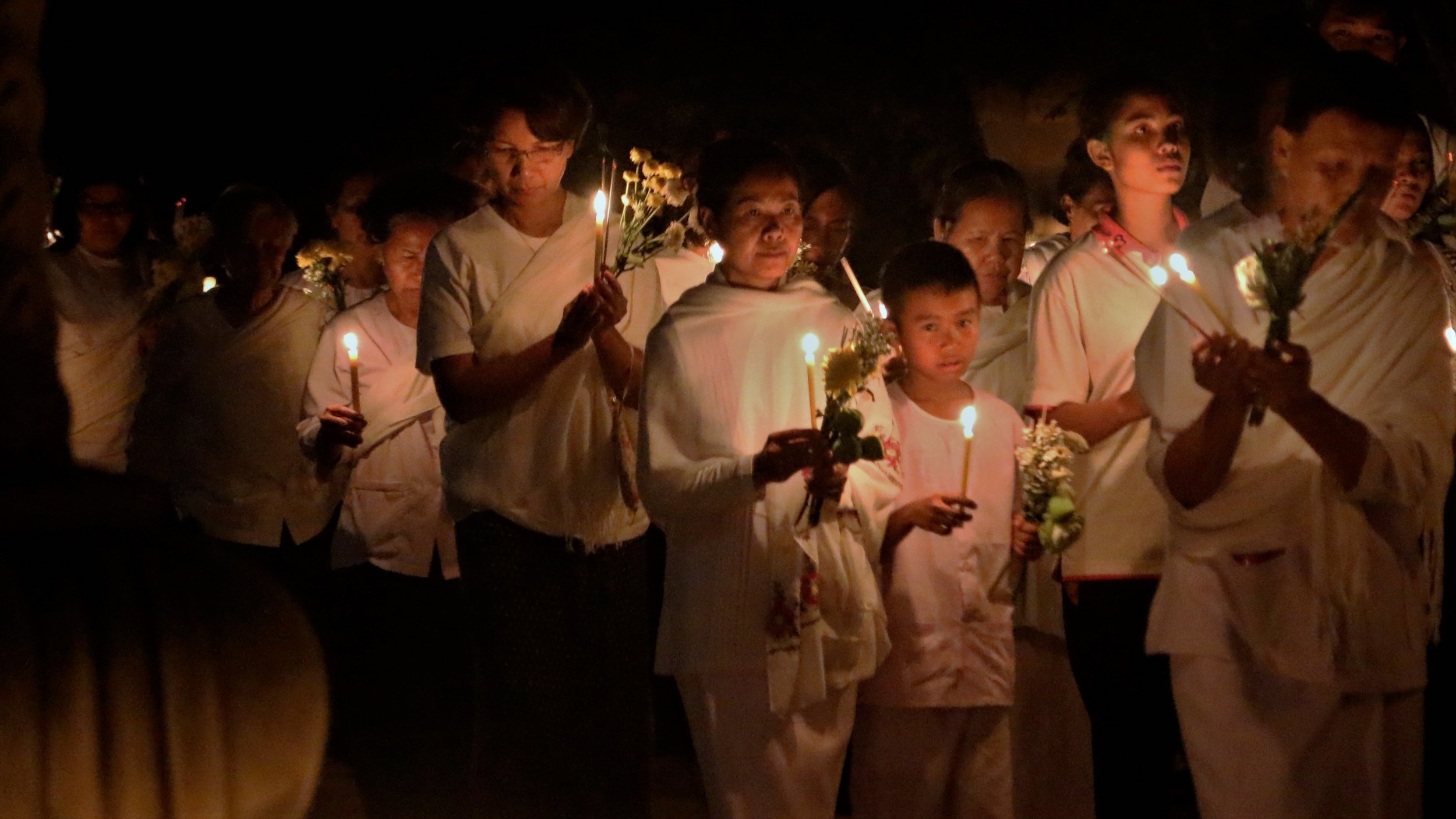
So, in the act of honouring the Buddha, one first opens the heart in respect and brings to mind the meaning of an Awakened One: someone of deep clarity; a speaker of truths that penetrate and bring healing to the human condition; one accomplished in understanding and action – a sage whose teachings can still be tested and put into action. If one has a Buddha-image, it’s something that should be held with respect – one cleans it, illuminates it with light, and offers flowers and incense to it. We place it on an altar, bow to it and chant recollections and teachings.

This is not a mindless activity; we use ritual means and resound words and phrases because this full engagement embodies and strengthens the quality of respect in a way that thinking can’t. With the openness of heart that these attitudes bring, any aspect of the teaching that’s brought to mind goes deeper. The act of offering that begins a pūja is a case in point: offering flowers “symbolizes bringing forth virtue, offering light is about bringing forth clarity, and incense does the same for meditative concentration. In this way, pūja introduces the heart to important Dhamma themes.

Pūja is especially helpful when people perform it as a group. Then we are participating in the Dhamma as both the expression and the Way of awakening, as well as in the collective commitment to, and engagement with, that Dhamma. This collective engagement ritualizes the ‘Sangha’, that is, the assembly of disciples. Chanting in a group has a harmonizing, settling effect: sonorous and unhurried, it steadies bodily and mental energies and supports an atmosphere of harmony with fellow practitioners. Tuning in and participating brings us out of ourselves and into a deep resonance with heart-impressions of the sacred. We can be touched by a sense of timeless stability, purpose and beauty. If these intentions, felt senses and recollections are established regularly, we know where to find good heart, how to attend to it, and how to allow ourselves to be uplifted. Such kamma feels bright.

The Benefits of Recollection

‘At any time when a disciple of the noble ones is recollecting the Tathāgata … the Dhamma … the Sangha … their own virtues: “[They are] untorn, unbroken, unspotted, unsplattered, liberating, praised by the wise, untarnished, conducive to concentration.” At any time when a disciple of the noble ones is recollecting virtue, his mind is not overcome with passion, not overcome with aversion, not overcome with delusion. His mind heads straight, based on virtue. And when the mind is headed straight, the disciple of the noble “ones gains a sense of the goal, gains a sense of the Dhamma, gains joy connected with the Dhamma. In one who is joyful, rapture arises. In one who is rapturous, the body grows calm. One whose body is calmed experiences ease. In one at ease, the mind becomes concentrated.

‘Mahānāma, you should develop this recollection of virtue while you are walking, while you are standing, while you are sitting, while you are lying down, while you are busy at work, while you are resting in your home crowded with children.’

(A.11:12; B. BODHI, TRANS.)

The expressions that are used in recollecting Dhamma are that it is experienced directly (not just as a theory), is of timeless significance, and is accessible and furthering for those who practise it. So that gives us an encouragement to look into what the Buddha taught and modelled: the way to the end of suffering and stress. With this, we recollect aspiration, learning and commitment as our common touchstone, and suffering and ignorance as our common challenge. Then we no longer feel so alone with our difficult mind-states, and we can handle them in a more open and aware way. Recollection of Sangha reminds us that although there is greed, anger and confusion in the human world, there are also people who cultivate a way out of that.

If you use pūja on a regular basis, it aligns you to the ‘Triple Gem’ – Buddha, Dhamma and Sangha – by presenting content in terms of images, ideas and themes, and values and practices that guide the heart. It also occasions acts of steering and composing attention. So pūja works both on what the mind is dealing with, and how it operates [Continued next week 22 August 2024].

Link to the original:

https://www.abhayagiri.org/books/458-kamma-and-the-end-of-kamma

bright kamma

Ajahn Sucitto

The Blessing of Skilful Attention

Whoever cultivates goodness is made glad,

right now and in the future – such a one is

gladdened in both instances.

The purity of one’s deeds, if carefully recollected,

is a cause for gladness and joy.

Dhammapada: ‘The Pairs’, 16

In the last few weeks, a Buddha-image has been created in this monastery by Ajahn Nonti. He’s a renowned sculptor in Thailand, and he came to Cittaviveka to fashion this image as an act of generosity. It’s been a lovely occasion because the Buddha-image is being made in a friendly and enjoyable way. Many people have been able to join in and help with it. Yesterday there were nine people at work sanding the Buddha-image. It’s not that big, yet nine people were scrubbing away on it, and enjoying doing that together.

Bright and Dark Kamma Arise from the Heart

Nine people working together in a friendly way is a good thing to have happening. Moreover, the work was all voluntary, and came about with no prior arrangement: people got interested in the project and gathered around it. It’s because of what the Buddha represents, and because people love to participate in good causes. That’s the magic of bright kamma. It arises around doing something which will have long-term significance, and also from acting in a way that feels ‘bright’ rather than intense or compulsive. Kamma – intentional or volitional action – always has a result or residue, and here it’s obvious that the bright kamma is having good results. There’s an immediate result – people are feeling happy through working together. And there’s a long-term result – they are doing something that will bring benefit to others.

In a few days we hope to install the Buddha-image in the meditation hall. It’s an image that makes me feel good when I look at it. It has a soft, inviting quality that brings up a sense of feeling welcome and relaxed. This is a very good reminder for meditation. Sometimes people can get tense about ‘enlightenment’, and that brings up worries, pressure, and all kinds of views; but often what we really need is to feel welcomed and blessed. This is quite a turnaround from our normal mind-set; but when we are sitting somewhere where we feel trusted, where there’s benevolence around us, we can let ourselves open up. And as we open our hearts, we can sense a clarity of presence, and firm up around that. This firmness arising from gentleness is what the Buddha-image stands for. It reminds us that there was an historical Buddha whose awakening is still glowing through the ages – but when this is also presented as a heart-impression in the here and now, rather than as a piece of history, it carries more resonance. Then the image serves as a direct impression of what bright kamma feels like.

‘Bright’ kamma is the term used in the scriptures to denote good action, or that which leads to positive results. This is not a theory or a legal judgement; if you linger in the heart behind skilful actions, you can feel a bright, uplifting tone. Bright kamma is steady and imparts clarity; it has an energy that’s conducive to meditation. Dark kamma, on the other hand, lacks clarity and feels corrosive. As it makes the heart feel so unpleasant, mostly attention doesn’t want to go there; the heart gets jittery and distracts instead. So, this is something to check inwardly: can we rest and comfortably bear witness to the heart behind our actions? Do our thoughts and impulses come from a bright or dark state? Even in the case of owning up to some painful truth about our actions, isn’t there a brightness, a certain dignity, when we do that willingly? Look for brightness in occasions when your heart comes forth rather than in times of superficial ease or of being dutifully good. That bright, steady tone rather “than casualness or pressurized obedience, indicates the best basis for action.

Sense and Meaning: The Perceptual Process

The energy of kamma originates in the heart, citta. It can move out through body (kāya) and speech (vāca – which includes the ‘internal speech’ of thinking) and mind (manas). Both manas and citta can be translated as ‘mind’, but the terms refer to different mental functions. ‘Manas’ refers to the mental organ that focuses on the input of any of the senses. This action is called ‘attention’ (manasikāra). So manas defines and articulates; it scans the other senses and translates them into perceptions and concepts (saññā). Tonally, it’s quite neutral. It’s not happy or sad; in itself, it just defines, ‘That’s that.’

Citta, on the other hand, is the awareness that receives the impressions that attention has brought to it, is affected and responds. It adds pleasure and pain to the perceptions that manas delivers, and these effects generate mind-states of varying degrees of happiness and unhappiness. Owing to this emotional aspect, I refer to citta as ‘heart’. Note that citta doesn’t access the senses directly. Instead, it adds feeling to the perceptions that attention has brought it; but with that, the initial moment of perception gets intensified to give a ‘felt sense’. This is a simple note such as ‘smooth’, ‘glowing’, ‘foggy’, ‘intense’. Then as attention rapidly gathers around that sense, a felt meaning crystallizes. For example, manas may decide that an orange-coloured globe of a certain size is probably an orange. From that meaning, further felt senses such as ‘tasty, healthy’ may arise and resonate in the heart. So, a mind-state based on desire arises. And even though all this originates in mere interpretations, intention springs up – and citta moves attention, intention and body towards the orange with an interest in eating it.

In this way, impulse/intention occurs as a response to a felt meaning that itself has been conjured up by a graduated and felt perceptual process. This is how mental kamma arises. And the result of citta being affected in this way is that the meaning is established as a reference point. Then the next time I see or think of an orange, that established perception that ‘Oranges are tasty; they’re good for me’ becomes the starting point for action. But is that interpretation always correct? Ever bitten into a rotten orange, or been fooled by a plastic replica? More significantly, don’t perceptions of people need a good amount of adjustment over time? How true is perception?

Perception is initiated when attention turns towards a particular sense-object. So, all contact depends on attention. Take the case of when you’re intensely focused on reading a book or watching a movie: awareness of your body, of the pressure of the chair, and maybe even a minor ache or pain, disappears. The mind’s attention is absorbed in seeing and processing the seen, so other impressions don’t get registered. Contact with the chair has disappeared because one’s attention was elsewhere. How real then is contact?

Contact is actually of two kinds. The contact that occurs when the mind registers something touching the senses is called ‘disturbance-contact’ (paṭigha-phassa). But when manas ‘touches’ the citta at a sensitive point, ‘designation-contact’ (adhivacana-phassa) is evoked – along with a felt sense. Disturbance-contact occurs in the mind-organ, and designation-contact occurs in the heart; and it is designation-contact, the heart’s impression, rather than contact with something external, that both moves us and stays with us as a meaning. For example, ‘dog’ is tonally a neutral perception that we would agree upon as a definition of a certain kind of animal. But in terms of citta, that ‘dog’ could mean ‘savage creature that can bite or has bitten me’ or ‘loyal, cuddly friend that will protect me.’ Such contact is therefore formed by previous action, but present-day impulses and actions are based on it. Thus, the old perception shapes me; in this case, as a fearful or confident person. And I act from that basis. This is why it is said: ‘Contact is the cause of kamma.’

Continued next week 15 August 2024

Link to the original text. Download a few pages, or the whole book free of charge. It’s a Dhamma publication:

https://www.abhayagiri.org/books/458-kamma-and-the-end-of-kamma

moment-to-moment consciousness

Leigh Brasington

Editorial Note: Some of you may have noticed that last week I placed the name Leigh Brassington as the author of Christina Feldman’s piece on Dependent Origination. Sorry about that, in fact, I corrected it a day later. Increasing difficulty with my vision (AMD macular degeneration in the right eye) has made it impossible to write my own material,

https://dhammafootsteps.com/2012/10/04/neverending/

(click on the link to read an early post that refers to Dependent Origination). For the time being I’m focused on republishing sections from Dhamma publications which I find particularly worthwhile. So, what follows is Leigh Brassington’s clearly stated piece on Dependent Origination [Image: close-up of a sunflower seed by Mathew Schwartz, unsplash]

Here’s an example of what’s meant by moment-to-moment Dependent Origination: let’s say you’ve never had a mango. You’ve heard about mangos, and one day you go to the grocery store, and in the produce section there’s a sign that says “Mangos.” You’re like “Oh, I’ve heard about mangos, they’re supposed to be good.” There’s this funny looking fruit and you think, “I’ll buy a mango.” So, you buy a mango and you take it home. You figure out you’ve got to peel it; and of course, you make a big mess because that’s what happens the first time you attack a mango. Then you cut off a piece, and now you’ve got a piece of mango in your sticky fingers. You are conscious, you’ve got a mind and body, you’ve got working senses. The mango hits the tongue – contact, vedanā, pleasant vedanā, craving; “I’ll have another bite” and another bite. “This is good; I’m going to get me some more mangos. In fact, my friends Bob and Carol and Ted and Alice, they’ve never had a mango. I’m going to turn them on to mangos.” You have just given birth to the mango bringer. You go see your friends and you turn them on to mangos and they’re like “Great, this is wonderful, thank you!” And the next time you go see your friends you bring a mango, and they’re like “Great, thank you for the mango.” And the next time you bring a mango, they’re like “Oh, another mango.” And the next time you bring a mango, they’re like “What’s with all the mangos?” Oh, dear! death of the mango bringer.

What’s happening is that based on your sensory input and your cravings and clingings, you’re creating a sense of self. It’s not your physical birth that’s happening with every sense-contact; it’s the birth of the self. When you crave, there’s a sense of the craver. When you cling, there’s an even stronger sense of the clinger – me, I own it, mine. At first, at the craving stage, it’s “I want it”. At the clinging stage, it’s “I’ve got it and I’m going to keep it.” And this results in “bhava,” which I’ve been translating as “becoming,” and which could also mean “being and having.” Now you have this thing you’re craving. You have become the one who owns it, and you just gave birth to yourself as this owner. But because your sense of self is rather fragile – notice how we’re always seeking self-validation – it keeps dying on you and you’ve got to think it or emote it up again.

Examining the twelve links of dependent origination from a moment-to-moment perspective is probably the deepest and most important way to look at them. This spinning of the wheel of dependent origination leads to old age, sickness, death, pain, sorrow, grief, lamentation, and all the rest of the dukkha. The Buddha’s teaching is about the end of dukkha, and there are two ways to work on this. One is when there’s a sense-contact, and it produces vedanā – Stop! don’t go any further. Don’t go into the craving. There’s not much you can do before that. You’re conscious, you have a mind and body, your senses are engaged with the environment. You’re inevitably going to get contacts, and the contacts are going to produce the vedanā which are not under your control. The vedanā are happening in the old brain, the so-called reptilian structure, and that’s not under your control. It’s only after the vedanā that you have some opportunity to control what happens next.

Thankfully, the craving isn’t inevitable. Some of these links are inevitable. In other words, if you get born, it’s inevitable you’re going to die. But if you get a pleasant vedanā, it’s not inevitable that you’re going to fall into craving. What comes after vedanā is perception – the naming or conceptualizing of that sense-contact – and that’s not even mentioned in the twelve links of dependent origination. After perception, mental activity arises – saṅkhāra again, the thinking and emoting about the sense-contact that produced this vedanā. Some of the thinking and emoting is no problem. It’s only when it gets into the “I gotta have it, I gotta keep it” that the craving and clinging set in. Or “I gotta get rid of it, I gotta keep it away.” That’s where it gets to be a problem.

This is why the Second Foundation of Mindfulness is to pay attention to your vedanā. This is so that when you experience a pleasant vedanā, you know it, and you’re right there in that gap after the vedanā and before the onset of craving – and you can actually deal with the experience wisely. You can enjoy the pleasant vedanā, and just leave it at enjoying the pleasant vedanā. You can experience the unpleasant vedanā, and act, if necessary, based on the unpleasant vedanā without falling into craving and clinging. This is the strategy on a sense-contact by sense-contact basis. It’s a lot of work because we get a lot of sense-contacts. However, you need to be in there every time checking because the craving is liable to come up; and when it comes up, it’s a setup for dukkha. We don’t really seem to be able to pull this off all the time. Sometimes, yes, good, diminish your dukkha, you experience the sense-contact with its vedanā, enjoy it, let it go. But sometimes, you get lost and fall into craving and clinging.

But a long-term strategy is to go back to the very beginning of the list of the twelve links, and uproot the ignorance. Because without the ignorance, there are not the saṅkhāras, and without the saṅkhāras there’s no consciousness, mind-and-body, etc. That sounds a bit like annihilation, but really what it’s saying is that without the ignorance this whole tendency to wind up in craving and clinging just isn’t there. The key thing is to uproot that sense of self that is the craver and the clinger, to gain the unshakable deep understanding, based on experience, that this feeling of self is simply an illusion. You want to penetrate that illusion to such an extent that you don’t conceive of a self. Similarly, when you go to the beach and look out and see a ship sail over the horizon, you know it didn’t fall off the edge of the world. That sensory input does not lead to conceiving any “the edge of the world” as part of the experience. Can you get to the same place about all of the stuff that normally generates the sense of “I”, the sense of me, the most important creature in the universe? This is the uprooting of ignorance, and when that’s done, then the whole edifice of self/craver/clinger falls apart. Furthermore, it’s taken care of forever.

You can read the est of this chapter (chapter 3) in the original, which is a free Dhamma book, as PDF, Epub, Mobi. Look for the link in Leigh’s Website:

https://leighb.com/index2.html#RightCon

https://www.youtube.com/watch?v=1pZQdBy3u84

Another link from the Website, a helpful video on emptiness. At the beginning of this video, you will see he uses the acronym: SODAPI (Note: the sound of the ending of the word rhymes with ‘eye’) Streams Of Dependently Arising Processes Interacting, SODAPI

dependent origination part two

Christina Feldman

[Editorial Note: It was 1982, I was in South India for the first time, fresh off the plane from London. None of this would have been possible without the help of friends in the NGOs and charitable organizations there. In the days that followed, I was taken on the back of a motorbike over the rough rural roads, to a small NGO in a village of impoverished fishermen. Culture shock as well as jetlag, led to a a confusion of random mind stuff looking for a context, a framework, somewhere for it all to fit, and not finding anywhere.

It’s easy to sum it up like that now, with the benefit of hindsight. One good thing that happened was that somebody gave me a book; “What the Buddha Taught” by Walpole Rahula, an outline of paṭicca-samuppāda: dependent origination. This was my introduction to how the Eastern mind works. Difficult to grasp at first, but a strange familiarity, as if I knew the text from somewhere but I’d never come across it before… perhaps in a previous life? So, I can’t explain it except that this must be a partly obscured universality. It all made as much sense to me, the Western mind, as it does the Eastern mind and as it would to any way of thinking in any context.]

Over the years, I’ve gathered references and examples of the paṭicca-samuppāda mostly in the Thai Theravada branch of Buddhist thought, particularly Buddhadassa Bhikkhu, and there are some recent articles by Ajahn Amaro who describes how Ajahn Buddhadassa presents this teaching. The central question to us, is how can we be free of the Western addiction to becoming?

“The cycle of becoming bhavacakka is our drug of choice to which we are all habituated, whether it is ‘becoming’ based on sense-pleasure, or becoming born of noble aspirations or caring for our family. The objects of becoming can vary from those which are reasonably wholesome to those which are downright destructive, but the process works in exactly the same way irrespective of the object, and if we don’t understand how it works, we are inevitably trapped in that endless cycle of addiction. The Buddha’s teaching helps us to recognize that trap and to break free from it.”

To read the whole post, click on the link below, and from there you can make your way to other related material:

https://dhammafootsteps.com/2023/12/07/off-the-wheel-part-two/

Other links, you’ll find at the end of this article: Dependent Origination by Christina Feldman.

In the Buddha’s teachings, the second noble truth is is a process which is going on over and over again in our own lives—through all our days, and countless times every single day. This process in Pali is called paṭicca-samuppāda, sometimes translated as “dependent origination” or “co-dependent origination” or “causal interdependence.”

The process of dependent origination is sometimes said to be the heart or the essence of all Buddhist teaching. What is described in the process is the way in which suffering can arise in our lives, and the way in which it can end. That second part is actually quite important.

Paṭicca-samuppāda is said to be the heart of right view or right understanding. It is an understanding that is also the beginning of the eight-fold path, or an understanding that gives rise to a life of wisdom and freedom. The Buddha went on to say that when a noble disciple fully sees the arising and cessation of the world, he or she is said to be endowed with perfect view, with perfect vision—to have attained the true dharma, to possess the knowledge and skill, to have entered the stream of the dharma, to be a noble disciple replete with purifying understanding—one who is at the very door of the deathless. So, this is a challenge for us.

What the paṭicca-samuppāda actually describes is a vision of life or an un­derstanding in which we see the way everything is interconnected—that there is nothing separate, nothing standing alone. Everything affects everything else. We are part of this system. We are part of this process of dependent origination—causal relationships affected by everything that happens around us and, in turn, affecting the kind of world that we all live in inwardly and outwardly.

It is also important to understand that freedom is not found separate from this process. It is not a question of transcending this process to find some other dimension; freedom is found in this very process of which we are a part. And part of that process of understanding what it means to be free depends on understanding inter-connectedness, and using this very process, this very grist of our life, for awakening.

Doctrinally, there are two ways in which this process of paṭicca-samuppāda is approached. In one view it is held to be something taking place over three lifetimes, and this view goes into the issues of rebirth and karma. My own approach today is the second view, which I think is really very vital and alive, which looks at paṭicca-samuppāda as a way of understanding what happens in our own world, inwardly and outwardly, on a moment-to-moment level. It’s about what happens in our heart, what happens in our consciousness, and how the kind of world we experience and live in is actually created every moment.

To me, the significance of this whole description is that if we understand the way our world is created, we also then become a conscious participant in that creation. It describes a process that is occurring over and over again very rapidly within our consciousness: I like this; I don’t like this; the world is like this; this is how it happened; I feel this; I think that.

Right now, we could track down countless cycles of this process of paṭicca-samuppāda—when we’ve been elated, when we’ve been sad, when we’ve been self-conscious, fearful—we’ve been spinning the wheel. And, it is important to understand this as a wheel, as a process. It is not something static or fixed, not something that stays the same. You need to visualize this as something alive and moving, and we’ll get into how that happens.The basic principle of dependent origination is simplicity itself. The Buddha described it by saying:
When there is this, that is. 
With the arising of this, that arises. 
When this is not, neither is that. 
With the cessation of this, that ceases.

When all of these cycles of feeling, thought, bodily sensation, all of these cycles of mind and body, action, and movement, are taking place upon a foundation of ignorance—that’s called saṃsāra. That sense of wandering in confusion or blindly from one state of experience to another, one state of reaction to another, one state of contraction to another, without knowing what’s going on, is called saṃsāra.

It’s also helpful, I think, to see that this process of dependent origination happens not only within our individual consciousness, but also on a much big­ger scale and on more collective levels—social, political, cultural. Through shared opinions, shared views, shared perceptions or reactions, groups or communities of people can spin the same wheel over extended periods of time. Examples of collective wheel spinning are racism or sexism, or the hierarchy between humans and nature, political systems that conflict, wars—the whole thing where communities or groups of people share in the same delusions. So, understanding dependent origination can be transforming not only at an individual level, but it’s an understanding about inter-connectedness that can be truly transforming on a global or universal level. It helps to undo delusion, and it helps to undo the sense of contractedness and the sense of separateness.

In classical presentations, this process of dependent origination is comprised of twelve links. It is important to understand that this is not a linear, progressive, or sequential presentation. It’s a process always in motion and not static at all. It’s also not deterministic. I also don’t think that one link determines the arising of the next link. But rather that the presence of certain factors or certain of these links together provide the conditions in which the other links can manifest, and this is going to become clearer as we use some analogies to describe how this interaction works.

It’s a little bit like a snowstorm—the coming together of a certain temperature, a certain amount of precipitation, a certain amount of wind co-creating a snow storm. Or it’s like the writing of a book: one needs an idea, one needs pen, one needs paper, one needs the ability to write. It’s not necessarily true that first I must have this and then I must have this in a certain sequential order, but rather that the coming together of certain causes and conditions allows this particular phenomenon or this particular experience to be born.

It is also helpful to consider some of the effects of understanding paṭicca-samuppāda. One of the effects is that it helps us to understand that neither our inner world, nor our outer world is a series of aimless accidents. Things don’t just happen. There is a combination of causes and conditions that is necessary for things to happen. This is really important in terms of our inner experience. It is not unusual to have the experience of ending up somewhere, and not knowing how we got there. And feeling quite powerless because of the confusion present in that situation. Understanding how things come together, how they interact, actually removes that sense of powerlessness or that sense of being a victim of life or helplessness. Because if we understand how things come together, we can also begin to understand the way out, how to find another way of being, and realize that life is not random chaos.

Another effect of understanding causes and conditions means accepting the possibility of change. And with acceptance comes another understanding—that with wisdom, we have the capacity to create beneficial and wholesome conditions for beneficial and wholesome results. And that’s the path—an understanding that we have the capacity to make choices in our lives that lead toward happiness, that lead toward freedom and well-being, rather than feeling we’re just pushed by the power of confusion or by the power of our own misunderstanding. This understanding helps to ease a sense of separateness and isolation, and it reduces delusion.

A convenient place to start in order to gain some familiarity with the process of dependent origination is often with the first link of ignorance. This is not necessarily to say that ignorance is the first cause of everything but it’s a convenient starting place:

With ignorance as a causal condition, there are formations of volitional impulses. With the formations as a causal condition, there is the arising of consciousness. With consciousness as a condition, there is the arising of body and mind (nāma-rūpa). With body and mind as a condition, there is the arising of the six sense doors. (In Buddhist teaching, the mind is also one of the sense doors as well as seeing, hearing, smelling, tasting and touching.) With the six sense doors as a condition, there is the arising of contact. With contact as a condition, there is the arising of feeling. With feeling as a condition, there is the arising of craving. With craving as a condition, there’s the arising of clinging. With clinging as a condition, there’s the arising of becoming. With becoming as a condition, there’s the arising of birth. And, with birth as a condition, there’s the arising of aging and death. That describes the links. To read the author’s commentary on the twelve steps of dependent origination see last week’s post,

This process, when reversed, is also described as a process of release or freedom. With the abandonment of ignorance, there is the cessation of karmic formations. With the cessation of karmic formations, there is the falling away of consciousness, and so on.

The second noble truth of dependent origination describes a process that happens every single moment of our lives. But clearly there is a distinction between a process and a path, and it is an absolutely critical distinction. One doesn’t actually want to continue in life just as a spectator, watching the same process happening over and over and over again—a spectator of our own disasters. Awareness is actually something a bit more than simply seeing a process take place. In choosing to be aware, we make a leap which is really about an application of a path in our lives, otherwise mere seeing of the process becomes circular and we continue to circle around. The path is what ac­tually takes us out into a different process.

Now, the third noble truth [the cessation of suffering] is not a value judgment in itself; it is simply a portrayal of the way in which it is possible to step off a sense of being bound to this wheel of saṃsāra or to the links of dependent origination. It is significant to remember that it doesn’t have to be any one link that we step off or that there is only one place where we can get out of this maze. In fact, we can step out of the maze and into something else at any of the links.

The well-known Thai meditation master Buddhādasa Bhikkhu describes the path out of suffering as “the radiant wheel.” It is also called the wheel of understanding or the wheel of awakening, in which the fuel of greed, anger, and delusion which give us the feeling of being bound to the wheel of saṃsāra, is replaced by the fuel of wise reflection, ethics, and faith.

One portrayal of the alternate wheel is that wise reflection, ethics, and faith lead to gladness of heart and mind, the absence of dwelling in contractedness and proliferation. The gladness is in itself a condition for rapture, a falling in love with awareness. The rapture is a condition for calmness and calmness is a condition for happiness. Happiness is a condition for concentration; concentration is a condition for insight; insight is a condition for disenchantment or letting go, and letting go is a condition for equanimity, the capacity to separate the sense of self from states of experience so that an experience can be just an experience rather than be flavored by an “I am”-ness of a self. And equanimity in itself is a condition for liberation and the end of suffering.

Link to the original document by Christina Feldman:

https://www.buddhistinquiry.org/article/dependent-origination/

Link to a post about Dependent Origination by Buddhadasa Bhikkhu, with some biographical details by the editor:

https://dhammafootsteps.com/2020/07/24/doerless-doing-part-6b-editors-notes/

Link to Ajahn Amaro’s post about further exit points from the cycle:

https://dhammafootsteps.com/2023/12/14/off-the-wheel-follow-up/

dependent origination part one

Christina Feldman

Dependent Origination (paṭicca-samuppāda) is a way of understanding what happens in our world on a moment-to-moment level. It’s about what happens in our heart, what happens in our consciousness, and how the kind of world we experience and live in is actually created every instant. If we understand the way our world is created, we also then become a conscious participant in that creation. It describes a process that is occurring over and over again very rapidly within our consciousness. If we pause here and think for a moment, we have probably all gone throughout countless cycles of dependent origination since we first woke up. Perhaps it was a moment of despair about what you had for breakfast or what happened on the way to where you are right now, a mind-storm about something that happened yesterday, some sort of anticipation about what might happen today—countless moments that you have gone through where you have experienced an inner world arising: I like this; I don’t like this; the world is like this; this is how it happened; I feel this; I think that.

Ignorance (avijjā)

Ignorance is used in Buddhist teachings in a very different way than it is used in our culture. It’s not an insult, or an absence of knowledge—it doesn’t mean we’re dumb. Nonetheless ignorance can be deeply rooted in the consciousness. It may be very invisible to us, and yet it can be exerting its influence in all the ways we think, perceive, and respond. Ignorance is often described as a kind of blindness, of not being conscious in our lives of what is moving us on a moment-to-moment level. Sometimes it is described as perceiving the unsatisfactory to be satisfactory, or as believing the impermanent to be permanent—this is not an unusual experience. Ig­norance is sometimes taking that which is not beautiful to be beautiful, as a cause of attachment. Sometimes it is defined as believing in an idea of self to be an enduring and solid entity in our lives when there is no such thing to be found. Or as not seeing things as they actually are, but seeing life, seeing ourselves, seeing other people through a veil of beliefs, opinions, likes, dislikes, projections, clinging, attachments, et cetera, et cetera. Ignorance flavors what kind of speech, thoughts, or actions we actually engage in.

Formations (sankhāra)

Ignorance is the causal condition or climate which allows for the arising of certain kinds of sankhāras—volitional impulses or karmic formations. In a general sense we’re all formations; we’re all sankhāras. Everything that is born and created out of conditions is a formation. Dependent origination gets a little more specific: it talks about intentional actions as body formations, intentional speech as both body and mind formations, and thoughts or states of mind as mental formations. As such it is describing the organization or shaping of our thinking process in accordance with accumulated habits, preferences, opinions. Sankhāras lend a certain fuel to the spinning of the wheel. Within a given cycle, they interact and form more and more of themselves. There is also a constant interaction of the inner and outer, through which the whole cycle keeps getting perpetuated. Some of the formations arise spontaneously in the moment, and some are ways of seeing or ways of reacting that have been built up throughout our whole life. Due to their repetitive use, these sankhāras become somewhat locked or invested in our personality structures and stay close to the surface as more automatic or habitual ways of response. However, it is important to understand that each sankhāra is actually new in every moment. They arise through contact, through certain kinds of stimulation. We tend to think of them as habitual or ever-present because of how we grasp them as something solid. But in our encounter with them in the present moment they are not presented to us as history or as something that is there forever.

Consciousness (viññāṇa)

Formations condition the arising of consciousness. Consciousness is used in the sense of the awareness of all the sensations that enter through the sense doors. So, there is the consciousness of seeing, hearing, smelling, tasting, touching and thinking. At any given time, one or the other of these sense door consciousnesses dominates our experience. Consciousness also describes the basic climate of the mind at any particular moment—the way it is actually shaped or flavored. So, any particular moment might be aversive or dull or greedy, for example, though without interest or intention some of these flavorings of consciousness may not be noticed. Consciousness is also interactive: not only is it shaped by formations and by ignorance, it is also shaping everything going on around us—regardless of whether we pay attention to it or not.

Name and Form (nāma-rūpa)

Consciousness gives rise to nāma-rūpa, which is sometimes translated as mind and body, but that’s a little too simplistic. Rūpa, or body, describes not only our own body but all other bodies and all forms of materiality. Nāma, or mind, describes the feelings, the perceptions, the intentions, the contact, and the kind of attention we give to what appears in the field of our awareness. So nāma describes the whole movement of mind in all its components in relationship to materiality. This is how it works: there’s an arising of rūpa, and then nāma creates concepts or attitudes about it. The kind of relationship we have with any material form, including our own body, is shaped by what’s going on in the mind, whether we are consciously aware of it or not. So, the shape of the mind and our body, this nāma-rūpa, is always changing, always moving, never staying the same. Consciousness, body, and mind are always interdependent, with consciousness leading the body and the mind to function in a certain way. If a consciousness has arisen flavored by anger or by greed, by depression, by anxiety—or whatever—it provides the conditions for the body and mind to organize itself in a particular way.

All of the events that have taken place so far in these links of ignorance, karma formations, consciousness, and mind/body—these are actually the most important steps in the generation of karma. These volitional impulses—what is happening in the body and the mind—are actually the generation of karma.

Six-Senses (saḷ-āyatana)

We go on from body and mind to the six sense doors or the six sense spheres, for it is the psychophysical organism that provides us the capacity to see, hear, smell, taste, touch and think. One of the deeper understandings we can have, is to acknowledge that the mind is one of the sense-spheres. The thoughts, images and perceptions that arise and pass away in the mind are not so essentially different from the sounds or bodily sensations that come and go in the realm of the senses. We may sometimes have the impression that mind is constant or always “on duty,” but a little bit of a deeper exploration of what happens within the mind actually shatters that perception.

Contact (phassa)

When the sense doors are functioning, contact arises. Contact is this meeting between the sense door and the sense information—I ring the bell, hearing arises. You smell something cooking in the kitchen, the smell arises through the nose sense door. The arising always involves the coming together of the sense door, the sense object and consciousness—the three elements together constitute contact. The Buddha once said that with contact the world arises, and with the cessation of contact there is the cessation of the world. This statement acknowledges the extent to which we create our world of experience by selectively highlighting the data of the senses. Each moment of contact involves isolating an impression out of the vast stream of impressions that are present for us in every moment as we sit here. Contact is what happens when something jumps out of that background and becomes the foreground. When we pay attention to it, there’s a meeting of the sense object and consciousness and the sense door. That is contact.

Feeling (vedanā)

Contact is the foundation or the condition for the arising of feeling. In speaking about feeling here we are not speaking about the more complex emotions such as anger or jealousy or fear or anxiety, but the very fundamental level of feeling impact that is the basis not only of all emotions but of all mind states and responses. We are speaking about the pleasant feeling that arises in connection with what is coming through any of the sense doors; or the unpleasant feeling, or those feelings that are neither pleasant nor unpleasant. This doesn’t mean they are “neutral,” in the sense of a kind of nothingness. Some feelings are certainly there, but they don’t really make a strong enough impression to evoke a pleasant or painful feeling response in us. Actually, the impressions and sensations and experiences that are neither pleasant nor unpleasant are some of the more interesting data received by our system.

It is important to acknowledge that the links of contact, of sense doors and feeling that we have been talking about are neither wholesome nor unwholesome in and of themselves; but they become the catalyst of what happens next. The sense doors, the feelings and the contact are the forerunners of how we actually react or respond and how we begin to weave a personal story out of events or impressions that all of us experience at all times. Therefore contact, feeling and sense doors are pretty important places to pay attention.

Craving (taṇhā)

Where does craving come from? From our relationship to feeling; feeling is the condition for craving. This craving is sometimes translated as “unquenchable thirst,” or a kind of appetite that can never be satisfied. Craving begins to be that movement of desire to seek out and sustain the pleasurable contacts with sense objects and to avoid the unpleasant or to make them end. It’s the craving of having and getting, the craving to be or to become someone or some­thing, and the craving to get rid of or to make something end.

Pleasant feelings or impressions are hijacked by the underlying tendency for craving; and unpleasant feelings are hijacked by aversion. And when a feeling is felt as neither pleasant nor unpleasant, it is also hijacked, in this case by the deluded tendency to dismiss it from our consciousness and say it doesn’t matter. Our sense of self finds it very hard to have an identity with any impression or sensation which is neither pleasant nor unpleasant.

It is at the point where craving arises in response to pleasant or unpleasant feeling that our responses become very complex, and we run into a world of struggle. When we crave for something, we in a way delegate authority to an object or to an experience or to a person, and at the same time we are depriving ourselves of that authority. As a result, our sense of well-being, our sense of contentment or freedom, comes to be dependent upon what we get or don’t get. You all know that kind of restlessness of appetite—there’s never enough; just one more thing is needed; one more experience, one more mind state, one more object, one more emotion, and then I’ll be happy.

What we don’t always see through when we are in the midst of ignorance is that the way such promise is projected, externalized, or objectified is actually something which always leaves us with a sense of frustration. We are dealing here with a very basic hunger, and we allow our world to be organized according to this hunger by projecting the power to please or threaten onto other things. But the im­portant thing to remember is that craving is also a kind of moment-to-moment experience; it arises and it passes.

Clinging (upādāna)

Craving and clinging (also called grasping), are very close together. Craving has a certain momentum, a certain one-way direction, and when it becomes intense, it becomes clinging. Now, one way that craving becomes clinging is that very fixed positions are taken; things become good or bad; they become worthy or unworthy; they become valuable or valueless. And the world is organized into friends and enemies, into opponents and allies according to what we are attached to or what we grasp or get hold of. That sense of becoming fixed reinforces and solidifies the values we project onto experience or objects. But it also reinforces belief systems and opinions, and the faculty of grasping holds on to of images of self. “I am like this.” “I need this.” “I need to get rid of this,” and so on. And, often, many things in this world are evaluated according to their perceived potential to satisfy our desires. What all this does is actually make us very busy. Think about the situations when you really want something, how much activity starts to be generated in terms of thinking and plotting and planning and strategizing: you know, the fastest route to get there from here, the most direct route to make this happen.

Traditionally, clinging is often broken down into four different ways in which we can make ourselves suffer. There is the clinging to sensuality or sense objects. The other side of clinging to sense objects is clinging to views, theories, opinions, beliefs, philosophies—they become part of ourselves. Another form that grasping takes is clinging to certain rules—the belief that if I do this, I get this. Or one says, “This is my path. This is going to take me from here to there.” The last of the forms of clinging Buddha talked about was clinging to the notion of “I am”— the craving to be someone, and the craving not to be someone, dependent on clinging to an idea and an ideal of self. This notion of self is perhaps the most delusionary force in our lives.

Becoming (bhava)

Clinging is followed by becoming or arising—the entire process of fixing or positioning the sense of self in a particular state of experience. Any time we think in self-referential terms, “I am,” “I am angry,” “I am loving,” “I am greedy,” ” I know,” “I’m this kind of person” and so on, an entire complex of behavior is generated to serve craving and clinging. I see something over there that I’ve projected as “This is going to make me really happy if I get this,” and I organize my behavior, my actions, my attention in order to find union with that. This is the pro­cess of becoming—becoming someone or something other than what is.

Birth (jāti)

Birth, the next link in the chain of dependent origination, is the moment of arrival. We think “I think I got it!” “I found it (the union with this image or role or identity or sensation or object),” “I am now this”—the emergence of an identity, a sense of self that rests upon identifying with a state of experience or mode of conduct, the doer, the thinker, the seer, the knower, the experience, the sufferer—this is what birth is. And there is a resulting sense of that birth, of one who enjoys, one who suffers, one who occupies, one who has all the responsi­bility of that birth.

Aging and Death (jarā-maraṇa)

Birth is followed by death in which there is the sense of loss, change, the passing away of that state of experience. “I used to be happy.” “I used to be successful.” “I was content in the last moment.” And so on. The passing away of that state of experience, the feeling of being deprived or separated from the identity, “I used to be…” is the moment of death. In that moment of death, we sense a loss of good meditation experience, the good emotional experience. We say it’s gone. And as­sociated with that sense is the pain and the grief, the despair of our loss.

These different factors interact to create certain kinds of experiences in our lives. What is important to remember is that none of this is predetermined. Just like the climate for snow, the presence of certain of these links is going to allow other experiences to happen. Not that they must happen, or definitely will happen, but they allow for certain experiences to happen. This may sound like bad news in the beginning, but we get to the good news later.

Continued next week, 27 June 2024

About Christina Feldman

https://www.buddhistinquiry.org/author/cfeldman/

noticing the way it is, part 2

Ajahn Sumedho

Excerpts from “Intuitive Awareness,” the. chapter titled: “The End of Suffering is Now,” retitled in this blog: “Noticing the way it is”. This is the second and last part. The original by Ajahn Sumedho, is a free Dhamma publication available as PDF, EPUB, MOBI. Look for the link at the end of this post.

There are different kinds of methods that can be used to learn how to stop the thinking mind. For example, a Zen koan or self-inquiry practice like asking ‘Who am I?’ These are techniques or expedient means that we find in Zen and Advaita Vedanta, and are used to stop the thinking mind. You begin to notice the pure state of attention, where you are not caught in thinking and the assumptions of a self – where there is pure awareness. That’s when you hear the sound of silence, because your mind is in that state of attention. In pure awareness there’s no self, it’s like this. Learn to relax into that, to trust it, but not try and hold on to it. We can even grasp the idea that ‘I’ve got to get the sound of silence and I’ve got to relax into it.’ This is the risky part of any kind of technique or instruction, because it is easy to grasp the idea. Bhāvanā, cultivation of the mind, isn’t about grasping ideas or coming from any position. This paṭipadā, this practice, is one of recognizing and realizing through awakened awareness, through a direct knowing,

Some people find it frightening when the self starts to break up – because it’s like everything you have regarded as solid and real starts falling apart. I remember years ago, long before I was even a Buddhist, feeling threatened by certain radical ideas that tended to challenge the security of the world I lived in. When it seems somebody is threatening or challenging something that you depend upon for a sense that everything’s all right, you can get angry and even violent – because they are threatening ‘my world, my security, my refuge.’ You can see why conservative people get threatened by foreigners, radical ideas or anything that comes in and challenges the status quo – because that’s the world they are depending on to make them feel secure. When they are threatened, they go into panic. The Buddha pointed to the instability and impermanence of conditioned phenomena. This is not just a philosophy that he was expecting us to go along with. We explore and see the nature of the conditioned realm – the physical, the emotional and the mental – in the way we experience it. But your refuge is in this awakened awareness, rather than in trying to find or create a condition that will give us some sense of security. We are not trying to fool ourselves, to create a false sense of security by positive thinking. The refuge is in awakening to reality, because the Unconditioned is reality. This awareness, this awakenedness, is the gate to the Unconditioned. When we awaken, that is the Unconditioned. The conditions are whatever they are — strong or weak, pleasant or painful, whatever.

‘I am an unenlightened person who has to practise meditation hard. I must really work at it, get rid of my defilements and become an enlightened person some time in the future. I hope to attain stream-entry before I die, but if I don’t, I hope that I’ll be reborn in a better realm.’ Thinking like that, we go on creating more and more complications. People ask me, ‘Can we attain stream-entry? Are there any arahants?’ This is because we still think of stream-entry and arahantship as a personal quality. We look at somebody and say, ‘That monk over there is an arahant.’ We think that person is an arahant or stream-enterer. That’s just the way the conditioned mind operates. It can’t help it, it can’t do anything other than that. So, you can’t trust it; you can’t take refuge in your thoughts or your perceptions, but you can take refuge in awareness. That doesn’t seem like anything, it’s like nothing – but it’s everything. All the problems are resolved right there.

Your conditioned mind thinks, ‘Awareness is nothing, it doesn’t amount to anything. It’s not worth anything, you couldn’t sell it.’ This is where we learn to trust in the ability to awaken, because if you think about it, you’ll start doubting it all the time. ‘Am I really awake? Am I awake enough? Maybe I need to be asleep longer so that I can be awake later on. Maybe if I keep practising with ignorance, I’ll get so fed up that I’ll give it up.’ If you start with ignorance, how could you ever end up with wisdom? That doesn’t make any sense. It’s like hitting your head on a wall and thinking that after a while you might give it up if you haven’t damaged your brain. It does feel good when you stop. But instead of looking at it in that way, trust in this simple act of attention. Then explore and have confidence in your ability to use wisdom.

Many of you may think, ‘Oh, I don’t have any wisdom. I’m nobody. I haven’t had any real insight.’ So, you thoroughly convince yourself you can’t do this. That’s the way it seems on the personal level. Maybe you don’t feel you have anything to offer on that level, but that’s another creation. It’s the same as ‘I am an unenlightened person.’ Whatever assumptions you have about yourself, no matter how reasonable they might be – whether you think you are the best or the worst – they are still creations in the present. By believing in those creations, by thinking and holding to them, you’re continually creating yourself as some kind of personality.

This awakenedness is not a creation. It’s the immanent act of attention in the present. That is why developing this exercise of deliberately thinking ‘I am an unenlightened person’ is a skilful means to notice more carefully and continuously what it’s like to be mindful and aware while you are creating yourself as a person. You get this sense that your self-view is definitely a mental object; it comes and goes. You can’t sustain ‘I am an unenlightened person.’ How do you sustain that one, by thinking it all the time? If you went around saying ‘I am an unenlightened person’ all the time they would send you to a mental hospital. It arises and ceases, but the awareness is sustainable. That awareness is not created, it’s not personal, but it is real.

Recognize the ending, when ‘I am an unenlightened person who has got to practise meditation in order to become an enlightened person some time in the future’ stops. Then there is the ringing silence. There’s awareness. Conditions always arise and cease now, in the present. The cessation is now. The ending of the condition is now. The end of the world is now. The end of self is now. The end of suffering is now. You can see the arising, ‘I am,’ then the ending, and what remains when something has begun and ended is awareness. It’s like this. It’s bright, it’s clear, it’s pure, it’s alive. It’s not a trance, not dull, not stupid.

This is an encouragement, an ‘empowerment’ according to modern jargon. Do it! Go for it. Don’t just hang around on the edges thinking, ‘I am an unenlightened person who has to practise really hard in order to become an enlightened person’ and then after a while start grumbling, ‘Oh, I need more time,’ and go into the usual plans and plots, views and opinions. If you start with ignorance you will end up with suffering. In the teachings on dependent origination (paṭiccasamuppāda) you have ‘avijjā paccayā saṅkhārā.’ Avijjā is ignorance, and that conditions (paccayā) mental formations (saṅkhārā), that then affects everything. As a result, you end up with grief, sorrow, despair and anguish: soka-parideva-dukkha-domanassupāyāsā. So, I’m encouraging you to not start from avijjā but from vijjā, awareness, from paññā, wisdom. Be that wisdom itself rather than a person who isn’t wise, trying to become wise. As long as you hold to the view that ‘I’m not wise yet, but I hope to become wise,’ you’ll end up with grief, sorrow, despair and anguish. It’s that direct. It’s learning to trust in being the wisdom now, being awake.

Even though you may feel inadequate emotionally, doubtful or uncertain, frightened or terrified – these are reactions; emotions are like that. But be the awareness of the emotions: emotion is like this. Emotionally we are conditioned for ignorance. I am emotionally conditioned to be a person, to be Ajahn Sumedho. Someone says, ‘Ajahn Sumedho, you are wonderful!’ and the emotions go ‘Oh?’ Then, ‘Ajahn Sumedho, you are a horrible monk with terrible Vinaya!’ and the emotions go ‘grrrrr’. Emotions are like that. If my security depends on being praised and loved, respected and appreciated, successful and healthy, everything going nicely and everyone living in harmony – the world around me being so utterly sensitive to my needs – then I feel all right when everything seems to be going all right. But then it goes the other way – persecution, abuse, disrobing, blame, criticism – and I think ‘Life is horrible. I can’t stand it anymore! I’m so hurt, so wounded. I’ve tried so hard and nobody appreciates me, nobody loves me.’ That’s the emotional dependency of the person; that’s personal conditioning.

Awareness includes emotions as mental objects or ārammaṇā, rather than subjects. If you don’t know this, you tend to identify with your emotions and they become yourself. You become this emotional thing that is terribly upset because the world is not respecting you enough. Our refuge is in the Deathless reality rather than in the transient and unstable conditions. If you trust in awareness, then the self and your emotions – whatever they might be – can be seen in terms of what they are; not judged, not making any problem out of them, but just noticing: it’s like this.

Link to the original:

https://forestsangha.org/teachings/books/intuitive-awareness?language=English