doerless doing

POSTCARD#372: Bangkok: “The doing is done but there is no doer. The principle of doerless doing must be taken up and utilized in our daily lives. Whether we’re eating, sitting, laying down, walking, using, seeking, whatever we’re doing we must have enough truth-discerning awareness to prevent the arising of ‘I’ – the feeling that ‘I’ am the doer. ‘I’ am the eater, the walker, the sitter, the sleeper, or the user. We must make the mind constantly empty of ego, so that emptiness is the natural state and we abide with the awareness that there is nothing worth having or being.” [Buddhadasa Bhikkhu, “Heartwood from the Bo Tree”]

Practical Dependent Origination, emphasis on the word: ‘Practical’… otherwise difficult to understand – the Buddha describes the confusion arising from wrongly perceiving it, as follows: beings have become entangled like a matted ball of thread, become like muñja grass and rushes, unable to pass beyond the woeful states of existence and saṃsāra, the cycle of existence.”

Back Story

I found this slim book the other day, in a cupboard inside a box with manuals for electrical appliances and other stuff 20 years old or more. It must have been put here by accident – the size, maybe it got picked up along with the washing machine manual and got lost here for two decades. It was such a precious thing to have it leap into my hands again with all the memories of how things were then, discovering the study of Buddhism for the first time and how it opened up an understanding in my world that had never happened before.

“Whenever one sees a form, hears a sound, smells an odour or fragrance, touches a tactile object, or has a thought arise in the mind, the feeling of ‘I’ and ‘mine’ arises, and it can be taken to mean Dhukka, suffering, which manifests itself therefore we are caught; the mind disease is fully developed.”

Sabbe dhamma nalam abhinivesaya: Nothing whatsoever should be clung to.

“If anyone realizes this truth that there is not a single thing to be clung to, it means that there is no ‘germ’ to cause the disease of greed, hatred and delusion, or of wrong action of any kind, whether of body, speech, or mind.”

“[Thus] whenever forms, sounds, odours, flavours, tangible objects, and mental phenomena crowd in, the antibody, ‘nothing whatsoever should be clung to’, will strongly resist the disease. The ‘germ’ will not enter or if it is allowed to do so, it will be only in order to be completely destroyed. There will be an absolute and perpetual immunity.”

Usually, the ego is thinking ‘I am me,’ and ‘this is mine.’ It’s divisive and selfish. So Ajahn asks that whenever possible, we mindfully drop all claims to our Self. “If we are empty of egoism, there is no consciousness of ‘I’ and ‘mine’. We have the truth-discerning awareness that can extinguish Dukkha and is the cure for the spiritual disease.”

The Diagram

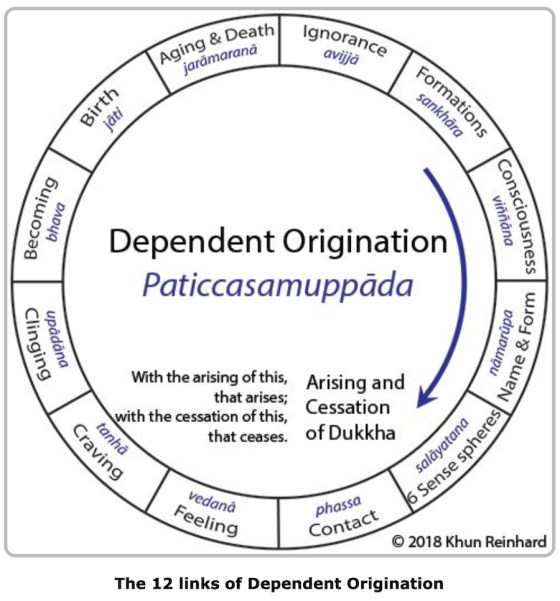
The cycle begins with Ignorance and ends with Aging & Death. It might seem curious that Birth is only one stage before Aging & Death, but Birth is to be understood as a momentary ‘birth’ and death is the end of the cycle. It is possible to go around the cycle in an instant.

We have to try to stop the cycle at Phassa (sense-contact) and not allow the cycle of dependent arising to take place; by sheer force of mind, cutting it off right at the moment of sense-contact. As soon as there is contact with a sense-object there is Phassa, and the subsequent development of Vedana, Tanha and so on, it happens immediately – right around the cycle. If, at the moment of sense-contact, when there is only Phassa, the cycle can be stopped, there is no arising of ‘I’, ‘me’ or ‘mine’.

If it is too difficult to stop the cycle at Phassa, we can focus on the next stage, Vedana and stop it there. By not allowing the development of Vedana, not allowing feelings of satisfaction or dissatisfaction to arise, there is no development of the next stage, Tanha (craving) and Upadana (clinging). So the cycle completes in an instant and there is no arising of the ‘I’ ‘me’ and ‘mine’.


Link to Heartwood from the Bo Tree

causally connected momentary dhammas

POSTCARD#371: Bangkok: A couple of weeks ago I wrote a very long post about the dentist. This post will be as short as possible. It’s like this, I went back for the follow-up appointment and started to think about aspects of No Self and the Paticca-samuppada Dependent Origination. That’ll come after this.

So anyway I went back to see the lady dentist on Tuesday 26 May and after five minutes of inserting needles to numb the nerves, a lower jaw extraction happened; so easy! Then prolonged drilling in the bone of my jaw to situate an anchor for a dental implant (in the x-ray it looked like a rawlplug in a masonry wall).

It was painless, amazing – yes my head was jerked around a bit, and there was the dentist adjusting her tools to get a hold of the tooth, to get maximum clench, grasp, grip so that it wouldn’t slip, then steady pulling to extract the tooth, with dental assistant behind me, arms around my head and holding, while pressing down hard on the lower jaw. Then one, two, three: ‘pop’ and it was out.

The painless aspect of it was breathtaking, especially as the lady dentist quietly told me what was going to happen next; drilling a hole in the jaw bone for the implant. It took about 30 minutes to get it finished – all without any person to feel the pain. An example of the Buddhist selflessness (anatta). There was no Self to whom this was happening – I could hear all the sounds of drilling inside my head… and there was nobody there to hold out against the sustained pain, It wasn’t happening to me. I felt like laughing out loud.

A note about the flow of changes to do with normal cognition: All dhammas (“phenomena”) arise in dependence upon other dhammas: “if this exists, that exists; if this ceases to exist, that also ceases to exist”. As a dhamma vanishes, it gives rise to a new dhamma which appears immediately afterwards. In this way, there is an uninterrupted flow of causally connected momentary dhammas. In this flowing continuum, there is no enduring Self since everything Is dependently originated.

Changes take place in the context of this momentary arising and falling away of dhammas. In the first list below, we see transitional stages that lead to Suffering. In the second list we can see how the problem can be solved; the step by step cessation of the preceding stage leads to the end of suffering

The Standard Description Of Dependent Origination

By Ajahn Bramavamso (click on this link for the whole essay)

From delusion as condition, volitional formations [come to be]; from volitional formations as condition, consciousness; from consciousness as condition, name-and-form; from name-and-form as condition, the six sense bases; from the six sense bases as condition, contact; from contact as condition, feeling; from feeling as condition craving; from craving as condition, clinging; from clinging as condition, existence; from existence as condition, birth; from birth as condition, aging-and-death, sorrow, lamentation, pain, displeasure, and despair come to be. Such is the origin of this whole mass of suffering.

But from the remainderless fading away and cessation of delusion comes cessation of volitional formations; from the cessation of volitional formations, cessation of consciousness; from the cessation of consciousness, cessation of name-and-form; from the cessation of name-and form, cessation of the six sense bases; from the cessation of the six sense bases, cessation of contact; from cessation of contact, cessation of feeling; from the cessation of feeling, cessation of craving; from the cessation of craving, cessation of clinging; from the cessation of clinging, cessation of existence; from the cessation of existence, cessation of birth; from the cessation birth, aging-and-death, sorrow, lamentation, pain, displeasure, and despair cease. Such is the cessation of this whole mass of suffering.

(SN 12, 1)

(dhamma = an aspect of the mind that captures the quality of an object, and that has the ability to colour the mind)


meditation and a dentist’s drill

POSTCARD#368: Bangkok: Practically no traffic in Bangkok on my first day out – clear blue sky because there’s no pollution. I’m going to the dentist, and fortunate that I’m able to share in a car with two other friends and a driver, all of us wearing face masks, venturing out for the day. Wonderful to be back in the outside world and I send best wishes to blogging friends in the UK and US, who are stepping out today, as the car seems to leap across empty Thai highways.

Almost nothing of my UK ‘self’ remains. I have a sister, the other chick in the nest. Also gratitude to our cousin who tries to keep the strands of family together. The others… all gone in the passing years, and all that I’m inclined towards is in my Thai family and the monks I’ve spent time with – Theravada Buddhism Ajahn Chah lineage.

Eyes closed and everything disappears… allow it all to fall away for a meditational moment; just the in-breath, the out-breath, but I can’t continue because thoughts of the dentist come crashing into mind. You may be surprised to know however that she’s a very good-looking lady, dazzlingly perfect teeth to smile by, and this makes the pain easier to bear. Also, I have to say they are generous with the Lidocain needle there, I haven’t experienced any pain after the needle goes in during the many extended restructure sessions I’ve had in the chair. Maybe also the meds I take for headaches combine with the dental painkillers and these contribute to a painless experience.

So I get to the building, up in the elevator and check in with the receptionist. Sit for a while in an empty waiting area, thinking of my old dentist in Switzerland, 18 years ago, who told me about stress and depression among dentists, and he did have a few personality quirks. I googled the subject and found the suicide rate of dentists is more than twice the rate of the general population. September 1, 2007 Randy Lang. DDS, D.Ortho

Then I’m escorted to the dentist’s room. Undo my mask as I enter and “Hello, how are you”, greeting also the dentist’s assistant, who seems less beautiful but happy enough with the way things are.

The Dentist is absolutely stunning, dressed in her PPE (Personal Protective Equipment) she has a mask and a face guard with shower cap covering her hair. Movie-star painted eyes, but it’s the whole body covering that gets my attention; it’s clear smooth plastic, not wrinkled as we see in the busy COVID-19 wards, and… it looks like it’s been made to measure?

Beneath that is a tight fitting white plastic suit with a black belt and she’s wearing white high-heeled shoes – very high, with slender heels. A vision of dental loveliness… she sees me watching and does a little-girl twirl, I think: should I say “cute” or otherwise remark on her costume. But I can only smile and that’s convincing enough because I am genuinely surprised.

Are there any traces of a personality disorder here, I wonder, remembering the google texts about Stress in Dentists:

“When performing dental procedures that evoke patient fear and anxiety, dentists experience patterns of physiological stress responses that parallel the patient’s responses.”

Seems to me it would be hard not to, being so close, head to head with a reluctant and disinclined patient.

Another factor is people just don’t like going to the dentist, evidenced by the frequency of missed appointments. Nobody wants to visit the dentist and it’s the last place they want to come back to.

In my case it’s different, I’m in a mesmerized state. We continue with the opening pleasantries, as I sit down in the fearful chair which sinks to a lower level that raises my feet slightly higher than my head – it seems very comfortable to me and I tell the dentist this, thinking I have to be nice to this lady who may have a personality disorder, and she’s hiding a razor sharp drill somewhere which is going into my mouth – no escape now.

Her assistant covers my upper body with these heavy green hospital linen covers and puts one over my whole head that has a round hole in the centre. I found it disarming and claustrophobic the first time but I’m used to it now. She adjusts the position of the hole and does an examination of my mouth, indicates that it’s all good, and starts numerous injections to block off an entire area on the right side

After that, I’m raised up to the normal sitting position, while we wait for the Lidocain to numb the jaw. I take the conversation further by asking how long she’s had a dentist practice here in this location. She tells me it’s been 11 years and likes the process very much. Then she says: “I was in the US for five years”. I understand her to mean she studied there and prefers the American way of operating a dental practice, therefore the Thai way seems really old fashioned to her. I think she thinks I’m American and therefore I should respond in a welcoming, member-of-the-family, ‘warm hug’, in a manner of speaking but I don’t know how to do that, coming from Scotland as I do, ancient and remote. Even though I feel like I should have been able to respond better than I did.

Sometime later in the sequence of time we were talking about something else I can’t remember exactly and “I was in the US for five years”, she says, unaware that it’s the second time she’s said this. Is she, a Thai person, so deeply acculturated in all things American, she has to tell me about it? It was difficult to see how this could be, having lived in Thailand for 35 years with its ups and downs – 5 years seems like such a short time to me.

I wasn’t able to figure out how best to deal with this. A big smile will suffice – anyway it was time to get down to business and she sends my chair back into that devastating lower position, it seemed to me now, where the drilling begins.

No choice, settle into a space in my being, and try to accept these fierce sounds. The dentist’s drill is a fearsome thing as we all know. it can change from high speed: tee-ee tee-ee to low speed: bhrrr-bhrr bhrr-bhrr and variations on that: bhaaa-bhee, chugga chagga, daaa dit daaa dit daaa!

The dentist’s assistant takes charge of all the sucking devices she holds in place in a way that obstructs the movement of the tongue and drains the blood or liquid or water from another device crammed into place leaving enough space for the Hollywood dentist to do her drilling.

Everything to do with my mouth is seen through the round hole, I’m aware of some movements in the darkness. An overwhelming experience if you’re not used to it, now trying to embrace these intense sounds as my jaw is being carved into a new shape. There’s a natural tendency to escape from the body. Then the attempt at meditation starts.

The sound and vibration is hostile and shocking and pulls my attention back into what is immediately present, I can’t find a balance at first… I feel confident enough about the painkillers, about how effective the headache meds are, but the vibration is traveling through every bone in my body. It’s possible for the first time in my life to ‘see’, to be aware of my skull and skeleton. Maybe I can be confident about the full extent and the limitations of the experience; the drilling sounds, the pushing and tugging. I know this and I know Consciousness is vast. This realization just tumbles out. For a few moments the drilling sound and scale or scope of the issue becomes smaller and smaller, less and less important.

After that I’m able to find a place up and above my head and focus on staying there, as all the unexpected jabs, jerks and vibrations shake my whole body. The dentist’s assistant pulling on one side of my mouth and the dentist shoving and tugging the other side. My awareness has to include having to deal with the gag reflex and involuntary swallowing – all this can be going on because there’s enough awareness to go around. I can stay in this space up and above, and contemplate the experience as if I were in a barrel being tumbled down a rocky hill road, and other images.

The chair is moved up and the drilling is over, now to take an impression. Liquid rubber material is spread inside both upper and lower jaws. I clench my teeth together and have to hold it for 3 minutes. This provides me with a sudden quiet time… up and above in the space where I was meditating, there’s a golden glow. If I focus on it, the glow expands; it’s unintentional and spontaneous. The golden glow is sending out warmth and happiness, an entirely unintended action spreading outwards and everywhere.

Sadly it’s interrupted by the dentist, green covers removed, moving along now. Put the mask on, fix the next appointment, and it’s time to say Bye-Bye.

Down from the 6th floor and the driver is at the car-park level getting a stamp on his entry ticket. We pick up our two other passengers and out over the deserted highways again. I feel liberated and glad the next dental appointment is not for a month and the remains of the golden glow is with me.


The Thai Government reported three new coronavirus cases and no new deaths on Sunday, May 10, 2020 with a total of 2,969 coronavirus cases and 54 deaths since the outbreak began in January

consciousness

OLD NOTEBOOKS: POSTCARD#355: Bangkok: Struggling to read my own handwriting as if it were written by someone else. Here and there, references to consciousness, the original sources not included – not thinking that one day I’d return here and want to know these sources. No time maybe, everything was in a rush. The energy in these old pages is noteworthy; scribbled thoughts, often not in any understandable word order, refer to a past I don’t remember. Years spent contemplating impossible things, and barking up the wrong tree completely. And all of that led up to this. It never occurred to me that I was finding parts of the framework of a greater Truth.

…not a drop in the ocean, you are the ocean!

Compassion for those who are caught in suffering; those who think life is only greed, hatred and delusion – or maybe so immersed in delusion they don’t think anything!

“In our reluctance to open to the possibility of another way of life; how to be completely alive, we prevent ourselves from dis-identifying with anything other than our conditioned states of mind. We will forever remain hypnotized by what our minds have absorbed from the outside world. We will remain a puppet of the society that has reared us.”

Caught in continued habituality, in cyclical existence; paired bully and victim etc. [see patisandhi]

This is where the Buddha’s Teachings enter. In meditation, the thinking mind disappears, no boundaries, a non-conceptual experience… no remainder – so, I can see now I had understood most of that but ‘no remainder’ I’d not investigated? The ‘remainder’ is consciousness, but what is consciousness? It’s a good question. Consciousness is without limitation so it can take whatever form. I’m thinking of words like universal, all-pervading, ever-present, omnipresent. Consciousness is the mystery all through the centuries – there’s so much more to be said about this.

Consciousness is everywhere and everything, to the extent that ‘everywhere’ and ‘everything’ are included in consciousness. It’s like a wave in an ocean, stretching as far as the eye can see, has suddenly swept up these small words, and they’re gone.

The self has no form, you cannot see it, you cannot grasp it, you cannot really define it. You can never say, “ Ah there it is! “ Because who is saying that? You are the consciousness, the perceiving, you are ‘it’. You can never see it as an object external to yourself, it’s the essence. You are not what is seeing, you are the seeing. You are the consciousness behind the seeing.

The paragraph above [no source] is the one that does it for me. I think I didn’t read the words properly the first time through. In my mind, I’d assumed consciousness had the same meaning as awareness, so when I read “You are the consciousness, the perceiving, you are ‘it’”, I was proven wrong and thus the ground beneath my feet gave way.


“And this, monks, is the noble truth of the cessation of dukkha: the remainderless fading & cessation, renunciation, relinquishment, release, & letting go of that very craving.” — SN 56.11


the teaching of the Headache

POSTCARD#354: Chiang Mai: Arrived here on a morning flight, Business class upgrade on Jiab’s air miles, and wheelchair at both ends because I’m not steady on my feet after the stroke last year. Physiotherapy sessions help me understand (body & mind) the impact of it and how exactly, the stroke knocked me off my balance and now, how to get back on my feet again.

A learning process and also I need to remind the physiotherapy staff of these headaches I suffer from, triggered by the smallest thing. So, to cut a long story short, I foolishly pushed myself too hard in physiotherapy exercises and strained something which affected whatever nerve group it is that led to this current gigantic headache (Post Herpetic Neuralgia, right occipital nerve).

So that was it, the last physiotherapy session had left me with a headache, that night, the next morning too. No time for Jiab to change the date of the Chiang Mai tickets so that I could stay at home and go to bed. Instead, I had to pack the Headache in my luggage and into the airport taxi.

A soft journey to Chiang Mai, thanks to the upgrade. In the apartment we had all the windows open, only the screens between our interior and the clear mountain air. It helped me to sleep for the rest of that afternoon and night, through till the morning and the Headache was now into its second day.

One thing that helps is that I’m familiar with being a prisoner of the Headache, at the mercy of monstrous thinking. Even though I daydreamed in awful dark wakefulness, I meditated and contemplated this discomfort all the way through until the Headache was nearly over. Next morning it was gone… “gone is gone,” words cannot express.

We got everything done that had to be done. Impossible to do much more, too long spent in that nether-world of sleep crowded with images I wanted to get rid of. I found a book I studied years ago: ‘Abhidhamma in Daily Life’ by Nina van Gorkom’, quite readable even though the exploration of the Buddhist network of cittas (realities) is vast. Interconnected mental factors that are useful to study in order to understand how the mind functions. It’s referred to as Buddhist psychology.

In this volume I was fortunate to find a few aspects of the Buddha’s teaching, that related very much to the experience (the teaching) of the Headache. For example the word ‘wholesome’ (kusala citta): conducive to or suggestive of good health and physical well-being. In the Buddhist dictionary, ‘kusala’ is explained as ‘kammically wholesome’, ‘salutary’, ‘morally good’, ‘skillful’ and ‘blamelessness’. Its opposite, ‘unwholesome’ (akusala citta) hence refers to the opposite – the ‘unwholesome’, ‘unskillful’, etc.

“Akusala citta is bound to arise more often than kusala citta because there have been countless akusala cittas in the past and thus the conditions for akusala have been accumulated. If there is no development of right understanding, akusala cannot be eradicated and we will continue to accumulate more akusala.”

There is that condition of mind where actions and thoughts take place as a result of automatic sensory responses. These states proliferate of their own accord, papanca. An opportunity arises here where I can escape from Akusala by seeing it for what it is, or I can be quite unaware of it…

Being unaware of it means unwholesome states arising from the Headache stimulate negative narratives (Akusala) and it becomes a story about ‘me’, attempting to assert myself; how am I to be seen in the eyes of my peers and others? Now it is so obviously Akusala imagery it’s easy to see there’s an opportunity here to leave it alone and let it all go.

Harder to see is the image of behaviour and speech seemingly agreeable and pleasant but what I really want to do is endear myself to others in the expectation of some gain or favour… multiple variations on this kind of thing; hard to see their realities – things are not always what they appear to be.

These are the kinds of images seen in the mind’s eye when extreme Akusala Citta is present, but I don’t have to have a three-day headache of course, to experience this, I can be quite conscious and wakeful whilst maintaining states of quiet anger or blaming.

So, how to escape from entanglements with Akusala? Mindfulness of the cittas as they arise, and through the development of insight the “escape” can be realized. Right understanding of realities eventually leads to freedom from all akusala, to the end of all sorrow.

The Buddha, when he was still a bodhisattva, considered the satisfaction in life, the misery and also the escape therefrom. We read in the Gradual Sayings (Book of the Threes, Chapter XI, par101, Before):

“Before my enlightenment, monks, this occurred to me: What, I wonder, is the satisfaction in the world, what is the misery in the world, what is the escape therefrom?

Then, monks, this occurred to me: That condition in the world owing to which pleasure arises, owing to which arises happiness,—that is the satisfaction in the world. That impermanence, that suffering, that changeability in the world,—that is the misery in the world. That restraint, that riddance of desire and passion in the world,—that is the escape therefrom…

  • Excerpts from: ‘Abhidhamma in Daily Life’ by Nina van Gorkom

on the way to the beach at Hua Hin

Episode1

POSTCARD#351: It was thought to be a special break for me after the fasting and then the anesthetic was over and the results of the MRI scan were given the next morning: I had no brain tumors, no signs of Alzheimer’s or dementia or any other danger signs. You will have guessed that I’m one of those who suffer claustrophobia if I’m in an enclosed space only inches from my face. So I managed the MRI scan with an anesthetist on hand monitoring levels while I was out of the picture having been given a general anesthetic. So I woke in the recovery room with a bottle of drinking water and happy because I knew it was over. The MRI scan is that thing that takes photos of your brain every 5 mm, you could say it looks like slices of meat from the butchers shop 5 mm thick which you can examine in detail.

The next day dawned and the news was ok, no life-threatening conditions, but there was a little black spot, on the right side of the brain – think of Google Earth and one of these small islands you can zoom in on and see all the mountains and rivers and forests… but it wasn’t as clear as that unfortunately the resolution wasn’t that good.

The question is, what is it? What caused the spot? And the answer is, it was the marks left behind when the patient has suffered a small stroke … a small stroke, quite common they say, among elderly patients – and there was I thinking I might be a special case or something.

It was quite likely I had lost my balance around that point in time. And I can fix that within a month or two because Jiab told me when she noticed the difference in my walking gait… it was say, November December 2018 just after the fall in Ch’mai, click ‘the big bang’ for the link

Episode 2

One day before the departure car to the beach at Hua Hin, and not connected with the MRI scan, a relative from the South I hardly ever see came to visit; in-laws from that part of the community, some would say ‘rural’, others say ‘remote’. Like Jiab’s own father, passed away many years ago, reaching back into the past where money was not exchanged for goods and services. Farm produce has its own value, also herbs, wild plants with medicinal properties. What is owed is given and taken according to the size, or lineage of the debt. Their loyalties do not include anything we (in the ordinary world) would immediately recognize, so there’s a tendency to leave it at that and it all gets soon forgotten about.

That’s why I never followed it up, you know, just because it was kinda interesting and the only time I’d ever hear about this side of the family was/is when someone comes to Bangkok, like this, for something to do with Government papers, or land documents. And this was the reason for the visit; spend the night at the house leave early morning to do the business and catch the afternoon train down South again.

But it was all done too fast! I was told about P coming about 10 minutes before she arrived, no time to think… then I remembered her mum had passed away recently and maybe I should offer some words of condolences or something but what to say?

I heard her voice downstairs and was thinking I should go down but just then a shadow flickered past my open door. It was the lady we shall call P, putting travelling bag away in the rooms next to me where she was for the night. “Ah hello P, “ I said, and she respectfully greeted me as they all do these days, me with the white hair, beard of the elderly and nearness to death.

“I was sorry to hear about your mum Khun Meh…” and P moved to acknowledge the reference, or whatever it is that they hold so dear, and it was to do with this mystery because, just then, something quite strange happened. A bolt of energy hit me in the chest and I wondered if P felt it too? I saw her crouch over and fall back away from me.

But who’s to say, it was all in shadow, we couldn’t see clearly and all I felt was the awkwardness of being found in a place I shouldn’t be. We went downstairs together, Jiab poured us some sweet drinks at the table and bit by bit the feeling disappeared. The lady P gave me a small book about her mother’s life printed simply and given to everyone who was at the funeral.

That’s it, it was done. So I left them talking together and went upstairs, preoccupied with: “Who is this person I hardly know and what are these goings-on?” Later on I spoke to Jiab and she played down the drama of events, while at the same time, conceding that all and everything was as it was and accepting that it happened as I’d described it.

All I can think is that I hardly knew her and her mother even less. I wasn’t expected in that context and this electric charge clicked the door closed.

Fine with me, no problem, my fault, I shouldn’t have started something I couldn’t finish. I’d like it all to go away now because maybe it was the other way round; the electric charge was something that pulled me rather than pushed me away. I’m definitely not inclined to like this idea, and would be glad if the whole thing could get or got or have got or had gotten itself forgotten about…

“Fear of death is ridiculous, because as long as you are not dead you are alive, and when you are dead there is nothing more to worry about!”

[Paramahansa Yogananda]


the way things appear to be

POSTCARD#349: Bangkok: It’s been three years coping with this pain hovering over me night and day. In the beginning my life was dominated by the headache (referred to here as: H) but I’ve discovered all kinds of things in the process. One thing not to be taken lightly; I learned the steps that lead away from suffering as if it were a code built into consciousness.

Another thing of course the severity of pain is not the same as it was. Maybe the mind gets used to it and there’s not the same urgency. But one aspect of it still strikes the nerve system on the right side of the head, the neck and shoulder. It can be any screeching sound like chairs being dragged across the floor, in a concrete room.

Here in Thailand there are some women whose voices, in laughter, are… utterly shrill. For me it’s a high frequency sound weapon, it penetrates through the auditory sensory organs and becomes something no longer heard. It feels like cold steel. I have to leave the room immediately, jump out the window into the garden and a forward roll gets me to a waiting taxi and away from that place forever.

But before anything else, it was necessary for me to be aware of the thinking mind. Mindfulness of it is not enough, it’s more like I needed to be aware of, how I think. I have to consciously take a step in that direction in order for things to have the momentum necessary to develop of their own accord.

So much of it is simply how it appears to be. The medicine plays tricks on me but I don’t pay it any mind. The effect begins to take place, H becomes non-hostile and becomes a tension band holding skull and neck muscles, tightly but secure. I can move away because there is nothing holding me. No pain. It’s detached, without a self to whom it would cause suffering. It’s the medicine that does this (necessary here to say). I put in these terms because that’s how it all seems to fit.

What is leftover is that part of the medicine that is the antidepressant. This is the place where I can gather up the mind, get it all in there, close the door, and melt into the darkness. From this comfortable place I can focus on the rest of the body/mind in a meditative way – an insightful contemplative state of mind.

As the years go by I see I’ve missed so much about the quantum world and how there seem to be groups of Buddhists who realise that we are consciousness itself. ‘When we rely on others to tell us their truth, we lose our power to actually realise pure spontaneous consciousness of independence.’

In the beginning I had to stay still for the medicine to have its effect. Nowadays I’m able to go around and just live with how it’s coming down. The large amount of medicine means I’m a bit unsteady on my feet, and I forget things – otherwise I’m okay.

‘see beyond the way things appear to be.’ Ajahn Munindo “Acceptance and Relinquishment” Volume 18

beyond victory and defeat

Victory leads to hatred,

for the defeated suffer.

The peaceful live happily,

Beyond victory and defeat.

  1. v. 201

Those who live beyond victory and defeat are called ‘the peaceful’, but not because they are devoid of feelings. They are not ‘beyond’ because they have escaped the confidence trick of self. Self is like a rainbow. From a distance it appears real and substantial; as you get closer it appears less solid. If we hold too tightly to our sense of self, we get lost in views about what makes us happy. We believe that winning is all that matters, not seeing that in the process we cause suffering to others. If we hold too loosely to our sense of self we get lost, this time from a lack of boundaries, becoming overly sensitive and lacking in confidence. Self-respect and self-confidence are the natural consequences of a life lived with integrity and understanding. [Ajahn Munindo, Verse 201, A Dhammapada For Contemplation (2nd edition), Aruna Publications 2006]

POSTCARD#342: There’s something about this one that takes me to a place where everything becomes clear. It’s like making space for it all so I can see what’s helpful and what’s not. I’m busy with treating my pain – a 24/7 headache situated in the right occipital nerve. There’s not much else that gets my attention these days.

The following are diary entries at the end of last year when I was working with low doses of meds (Gabapentin and Pregabalin), in order to see the differences and the qualities of each, if possible. Also to try to adjust from two years on a reckless maximum consumption drive, existing in a vague, pain-free haze every day. [H: the headache]

Self in itself is not anything of substance, but it activates all kinds of mind stuff, triggers all kinds of feelings of possessions; ‘me’ and ‘mine’. Basic instincts; catch, hold, kill, eat.

So, for me, it’s necessary to retract the claws that cling to things because it only makes the pain worse. It’s not ‘my’ pain, it’s just pain. Pain is pain no difference between your pain or mine. Pain is a non-countable noun; there is only one pain in the world, in the same way as there is water; there is only one body of water in the world.

Another thing, the negativity surrounding pain; I have pain, therefore I am a bad person. I must have done something bad to deserve this pain. That’s a ‘self’ concocted thing, let go of self and allow that to fall away

  1. One thing I’ve noticed about these pain meds is that they reduce the pain of course, but they also work on how the patient feels about the pain. There’s a distance between me and the pain. This is quite extraordinary sometimes when the pain feels like it’s here, but I can’t feel it because it’s behind a wall, or something. Or it’s in the next apartment, where a noisy party is going on… so I don’t have to pay attention to any of that any more.
  2. Sometimes it feels like a self takes shape and considers the situation… the pain is here but there’s no ‘me’ to whom it is directed. Self dissolves again. Another self comes into being with the question: To whom is this pain directed? “It is happening to me, myself!” Now I have full exposure to the pain! And I learn how to quickly let go of self when it’s not being helpful.
  3. Another self arises and says, “I’m going to suffer this Headache for the rest of my life!” So many times I’ve pondered this – how do I feel about this truth today? (compared with how I felt about it yesterday). Give it the attention it’s due then sidestep the awful self that wants to make a big thing out of it: “This is happening to me!” What are we going to do about it? And other unhelpful things.
  4. Next morning, wake up and no headache! At 9 am I take 900 mg Neurontin although there is still no headache, only small indications. It was like this all day.
  5. 1 pm, second dose of 900 mg Neurontin only small stabs of pain but not the huge deep stabs I’ve had in the past.
  6. 5pm: 900 mg Neurontin, so what’s going on here? I’m taking this medicine as a preventative measure? Let me think for a bit about this… how could it be? Anyway still no noticeable H and the day is over!
  7. Next day, H is back again but the pain not so bad, I’m able to get involved in small activities. Note: If I’m not able to forget the H, things become quickly unbearable, and I’m subject to the needs and requirements of the H. Things quickly get out of hand. This careless self-medicating takes up the whole afternoon, all in a dizzying spin. I’m grateful when 8pm comes around and the night meds send me off to sleep almost immediately.
  8. With these new meds, pain is masked off, forgotten about, for long periods of time… it’s like I forget about it. I forget also, other things I’d normally remember – is it this ‘forgetting’ that seals off pain from the mind? Is it the sense of ‘self’ that gets forgotten? There’s no ‘me’ to whom this is happening?
  9. And for quite a long time, things in the room I’m in are so fluid there’s only the forms I meet from time to time, forming, transforming… quite extraordinary…

that which is seen

POSTCARD#325: Bangkok: After the operation on the right eye, and the world seems different, everything suddenly seen in clear three-dimensionality. Reflected light, rich, deep colors and a strange familiarity of objects, things become somehow known. I’ve seen these things so often before but now seeing them with an expanded awareness. It sounds visionary, you could say revelatory but it’s the result of eye surgery, rather than insight… nonetheless quite astonishing. I have this clarity in one eye only; vision in the other eye is like an old yellowed photo, dull and indistinct.

The operation on that eye will be in October, back to the Rutnin Eye Hospital in Bangkok. The surgeon makes a hole in the eye and puts in a tool that uses ultrasound to emulsify the lens. The lens becomes liquid and is sucked away, then a plastic foldable lens is inserted in the place where the natural lens used to be. That’s it, done. Local anesthetic is enough, or general if you feel claustrophobic about the covers over the face as the procedure is going on. After the op there are different kinds of eye-drops that go on for about three weeks and it feels a bit itchy but that’s all.

I’m amazed that it’s possible to do this; the plasticity of the human body, parts can be taken out, replaced; systems are deconstructed, reconstructed, subject to change. It all supports the idea of anatta: no abiding self. There’s an underlying flexibility about the mind/body organism (namarupa). One example of this is that I have a very refined piece of plastic in my eye instead of a natural lens. And, looking through this at the world, I find there’s an affinity with clear-wrap, cling-film, transparent plastic food packaging – the way the plastic surface refracts the light. In this strong sunlight in Thailand, I notice the reflections on chrome and glass – the clarity is sparkling and beautiful. Also these enhanced colors, reds mostly, and an overall bright clear blueness in the white areas. All this has the quality of an iPad screen, retina display; high-density pixels merge into one – an extraordinary brightness.

At home, curious Thai faces examine my new eye, and I’m looking back at them looking at me, seeing subtleties in their features that I’ve never seen before. It’s all quite new, an extended reality. So, I’ll be going around for the next few weeks, looking at my surroundings and considering the phenomenon that I am experiencing this and the mystery of that which is seen.

‘… the remainderless fading & cessation, renunciation, relinquishment, release, & letting go of that very craving. (the noble truth of the cessation of dukkha)’ [SN 56.11 (dukkha nirodho ariya sacca)]


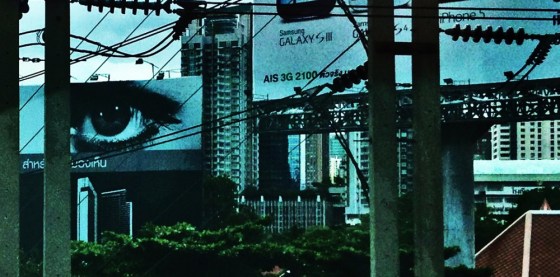
Photo image: Skyline at Ploenchit Bangkok. Reflections on an earlier post The Beholder

blessings fill the room

POSTCARD#312: Chiang Mai: 07.00 hours: The alarm rings…. and it takes a moment to recognize I’m in Chiang Mai, arrived last night. Heavy curtains over the window; a darkness I’m not used to. It’s quiet here, the sound of monks chanting anumodana on the edge of hearing. A motorbike whizzes by in the distance, nothing else. Senses are alert, listening, feeling, searching for a way to ‘become’ something that will establish ‘me’ in this place and time but I can’t, I’m distracted by these new surroundings and keep returning to the narrative associated with interesting objects.

Too many, too much, I go to the window, feet on cool tiles, flip flop, flip flop, a sense of empty rooms, as yet uninhabited; space/time occupied with the moving of its integral parts – chapters from a book about furniture being moved into a new apartment, the ending hasn’t been written yet and the beginning is a continuation of what happened before that.

Future time slides into present time, tomorrow becomes today, and ‘now’ becomes yesterday – here we are in the awareness of this moment, the means by which we arrive at this point in time remains a mystery.

Slide open the curtains of all the windows. A blaze of colour, monks in varying shades of orange, faded tangerine robes and a group of kneeling Thai tourists from the hotel opposite. (Note: the original post refers to Christmas Day 2012, and here in a Buddhist country it is just an ordinary day).

Jesus and all the other great teachers in history were really saying the same thing. In the peace and quiet emptiness of the moment there is no hungry ‘self’, no driving ‘urge’ and from this place in awareness, it’s possible to see that I am continually re-born in tiny slices of time, minutes, seconds, into this self-perpetuating loop due to the habituality of trying to get what I want or to get rid of what I don’t want. Thinking that yes, so life is about trying to get it right, but caught in attachment upadana; even this, the desired state, belongs to ‘me,’ the act of possessing it requires that there has to be a ‘me.’

Everything I have, everything I want, all of this is ‘mine.’ Even that which I consider to be ‘my’ enemy, is also ‘mine.’ Thus creating a self that is incomplete, unfulfilled, searching for the truth in all this and failing to see that it’s the searching that maintains the state of being lost. Layers of associated narrative obscure the issue. People say they are so busy with ordinary tasks; earning enough money to support the family and no time to think of anything else.

In the same way, belief in an external creator creates attachment and unthinking devotion to this returns me to the same point of entry, again and again. It’s not so much about taking refuge in the Jesus or Buddha of the mind. It’s about here-and-now behaviors: sila, samadhi, pannya (virtue/ mindfulness of present time/ and the applied intelligence that goes with it). The blessings of the monks fills the room; slowly waking up to an awareness of this reality….

‘If those who lead you say to you, “See, the kingdom is in the sky,” then the birds of the sky will precede you. If they say to you, “It is in the sea,” then the fish will precede you. Rather, the kingdom is inside of you, and it is outside of you. When you come to know yourselves, then you will become known, and you will realize that it is you who are the sons of the living father. But if you will not know yourselves, you dwell in poverty and it is you who are that poverty.’ [Selected Sayings of Jesus from Gospel of Thomas, Nag Hammadi manuscripts]


Reflections on an earlier post titled habituality of former lives