the mind state of contentment and wonder

POSTCARD#393: Bangkok: Last week I wrote about Contentment and Restlessness – there’s a lot to be said about contentment, in view of these last few days counting votes and sometimes the atmosphere heavy with suffering. This is how things are, it begins with impatience, and we start to get fired up in a negative, critical mind state. At any time, Trump slices into the moment with outrageous accusations, the latest in a litany of attacks. No rest for the mind, active thinking, the thinking ‘thing’ itself, sees the world in a bleak unforgiving way, and the word ’contentment’ doesn’t fit in the vocabulary of a restlessness mind, falling over itself in the search of something else to feel negative about, somewhere else to go.

Why is contentment so hard to find? It’s not about being in a state of contentment all the time, it’s about being content enough with the state of things as they are at this moment. A few deep in-breath/out-breaths will get me there and I start to create order in the small objects all around. I examine each part of my movements and slowly joyful awareness takes the place of the harsh interchange of the restless mind. Piece by piece I can start to step into the context of mindfulness in the world of contentment.

I’ve been watching the vote-counting on CNN from here in Bangkok and not familiar with the way they do things in this kind of news program. But it seems to me, if you want to have a restless mind, right now CNN is the place to be… suffering endures. (all the more reason to switch off the noise and find some ease from time to time). The counting of votes has been going on through the nights and into the days, while ongoing CNN discussions center on hypothetical projections that predict the winners before they finish counting the votes, and what the variables are that could change the state of play. It gives me a headache just to think about it! At any time the percentages of votes for each candidate could go spiraling up or spinning down. And that was the ‘roller-coaster’ ride we were on.

At the start, it was a huge disappointment for Democrats that the anticipated “big blue wave” never happened – hope went right out the window… with it went the prospects of black people, the unresolved pain of Black Lives Matter – they were hurting. All of us were, except the Republicans who were seeing a surge of popular vote, or so it seemed. Their numbers started to flood in, higher than ever before, and quite early into the counting, Trump announced he was the winner and the counting had to stop… even though there were hundreds of thousand of votes yet to be counted.

Typical Trump, I search in my mind for what the Buddha might say about this, with a focus on Doubt [Vicikicchā]. I can overcome doubt by ‘gathering clear instructions, and having a good map, in order to find the subtle landmarks’ in these hostile surroundings. There are so many detailed ancient writings on the mind in whatever state, I have to find something awesome that is easily understood on a vast scale:

“In his exposition of the contemplation of the state of mind, the Buddha mentions sixteen kinds of mental states to be noted: the mind with lust, the mind without lust, the mind with aversion, the mind without aversion, the mind with delusion, the mind without delusion, the cramped mind, the scattered mind, the developed mind, the undeveloped mind, the surpassable mind, the unsurpassable mind, the concentrated mind, the unconcentrated mind, the freed mind, the un-freed mind.

It is not identified with as “I” or “mine,” not taken as a self or as something belonging to a self. Whether it is a pure state of mind or a defiled state, a lofty state or a low one, there should be no elation or dejection, only a clear recognition of the state. The state is simply noted, then allowed to pass without clinging to the desired ones or resenting the undesired ones.” [Right Mindfulness, Satipatthana Sutta]

It helps of course if we can release the hold we have on Self for a moment. There’s no abiding self that does it all. The mind is not a lasting subject of thought, feeling, and volition, rather it is a sequence of momentary mental acts, each distinct and discrete, their connections with one another causal rather than substantial.

As the CNN broadcast was going on day after day, I was thrown into doubt many times, the sickness of being ensnared in the Trump trap with Trumpists calling out ‘voter fraud’. A scary time, we were propelled into a possible Biden Presidential success. Down the narrow end of the telescope, in sudden rush to the final countdown but we hadn’t arrived yet! Held in the inevitability of circumstances… surrounded by accusing Trumpists voices and their conspiracy theories.

Despite the hostility, I remained relatively unscathed. So good to have access to the mind state of contentment and wonder. I can breathe deeply and long. All these millions and hundreds of thousands of individual persons cast their votes, they’re counted and placed together in identifiable groups, and the vastness of it all without a Self.

Language is the metaphor, just in itself. Mysteriously incidental meanings arise of their own accord as if they’d been consciously created, contained by this form… it’s just like that. Everything made-to-measure, more or less exactly. We live in a bespoke world. Everything seemingly custom-built, social behaviour, language, there isn’t anything that’s not constructed.

Donald Trump is a noisy litigious being, capable of criminal acts. His threatening voice slices into my mind; Trumpist voices accuse us of hidden manipulating of the final countdown. At one point everything was hanging in the balance; it’s 2020 a double-double Georgia 49.4 and 49.4 waiting for the vote-counting lady to say which way it would go. Oh-no! I’m feeling sick again, an ache in the gut. Where is my contentment, the antidote to a restless mind? It’s within me, deep breathing ‘breathe in slow-ly, breathe out lo-ng. I left the broadcast with four states remaining, Georgia, Nevada, Pennsylvania, Arizona.  I see from this morning it looks good for Biden. The counting goes on and I am just so relieved we are in this world!


delete the ‘my’ in myself

POSTCARD#390: Bangkok: After hours of inert television watching I switch it off just to see what the room I’m in, looks like. The severity of greyness is devastating. All the appealing colour and images, and perfect celebrity dental work, all of it sucked into the silence of a room ‘on hold’. I’m not used to being absolutely with body and mind… by the way, where is Mind? Intrusive thinking nearly shoves me off my seat into an elbow-supporting-head and eyes blinded by the squabbling politician of recent TV watching, downloading a self that I hope knows how best to cope with these bad feelings that are quarreling and heckling in my head! The desire to punish, hurt destroy – the sheer hatred of a person/situation, generating energy both seductive and addictive. So much political ill-will and ambient anger about the place, a spark could ignite a storm.

Uninvited thoughts gate-crash the party, shouting out: “Stand back and stand by!” I shudder at the thought, four more years, maybe ongoing, and in a dystopian world, Donald and Covid re-elected (⌘C ⌘V) over and over. All I can see and hear is dark and does not bode well. Bleak TV documentaries showing in the Mind; a clamor of conjured-up characters and the story of their sad lives. “What am I looking for?” but the way is blocked by a dense cloud-like thought that states: “Searching for something creates the certainty that it’s lost.” I attempt to disown everything that belongs to me. Delete the ‘my’ in my-self. They’re not ‘my’ thoughts; they are just thoughts. None of this is ‘mine’, I don’t think these thoughts, these thoughts think me. I don’t breathe the air – the air breathes me.

Cognitive functions synchronize things so the world appears to be how I choose to see it. I don’t look out at the world, the world looks in at me, sees me, watches me… there, waiting for instructions. It’s another illusion of self because there is no “me” of substance in here. Sounds are heard, but there’s no listener. Smells, touch, tastes trigger responses I’m pulled towards or repelled by. It’s not what I thought – that the five senses are there to serve and protect the body. The body is there to serve the five senses ever seeking pleasure and delight one way or another.

Mind contemplating the experience of the body seated on the chair; aware of the places where legs touch the seat, the touch of arms on armrests, bearing the weight, and everything else is just this invisibility. I’m not aware of the mass of internal organs… slightly unnerving; get up and walk around. Feet appear down below: left, right, left, right. Images of wood-block-patterned flooring enter my vision, floor mats, legs of furniture – objects seem to pass through the body. All I can see is the flooring and bare feet walking, now left, now right. Now on the staircase descending, further and further away from the television room, reaching the downstairs room and (outdoor shoes on) out to the garden.

“Mindfulness is simply being aware of what is happening right now without wishing it were different; enjoying the pleasant without holding on when it changes (which it will); being with the unpleasant without fearing it will always be this way (which it won’t).”[Thich Nhat Hanh]


Photo: [Link] Sibylle Berg with T.Roadz, one of the British grime artists who joined her on a reading tour of Germany

a deep familiarity

POSTCARD#389: Bangkok: Somebody asked me if the headache was physical or mental, and it is difficult sometimes to say which is which, because the physical pain takes place in the same general area where mental or cognitive functions take place. Let’s say, it’s physical pain with associated mental events that are the origin of it sometimes; alarm signals that may bring my attention to some physical problem. Also, mental/cognitive activities in the form of discernment, investigate the best means of easing the discomfort. At the outset, I find it helps me travel through the pain if I can attribute it to the pain itself or to what extent it’s the pain I feel about having pain.

There are other situations, where I identify specific pain locations and relax the tightness. But these are all things I used to do at the beginning, finding my way around in a state of urgency. After five years of it, the actions have become automatic, I suppose. Or I don’t feel the pain as much as I did at the beginning when it was full catastrophe living, not the title of a book by Jon Kabat-Zinn, I was the escapee trying to disengage from the pain, but it would catch me again and again.

Remembering my lost non-pain state of mind, with a yearning for a world of impossible things, leads to nowhere (now here). There were some pain-free intervals created by nerve block treatment and pulsed radiofrequency procedures, lasting a few weeks only. Now there’s no motivation to continue with these neurological techniques because that non-pain state is long since dead and gone. Thinking about pain is pushed out of the way most of the time, there’s a particular focus of mind that just doesn’t go there. The meds sometimes give me a pain-free space – serotonin receptors and dopamine signaling, techno-speak, mumbo-jumbo… applause, and the curtains open on a short performance where the pain is almost not there at all.

Recently I bought a set of DIY tools and during these pain-free times I fixed  a flat-screen TV on the wall and mounted a set of shelves in the kitchen. But it took me a very long time, due to actions carried out in slow motion and short term memory loss; forgetting what I was doing and having to go back and do things again (and again), and sitting down to think about it for long periods.

Despite these blank states and on-going projects I ponder over, what I’m aiming at is simply a heart-felt state of well-being and regular visitors here will know that many years ago, I learned the Buddhist steps that lead to the end of suffering. There was a deep familiarity about this, as if it were a genetic code built into consciousness just waiting to be discovered). [Gratitude to the monks in Thailand, Switzerland and the UK]

The First Noble Truth: Pain is caused by wanting it to not be there (in a manner of speaking). The Second Noble Truth is finding the way out of suffering means I let go of the craving that feeds it – seeing it is really caused by holding on to the longing for impossible things. Then looking more carefully into the Third Noble Truth; the realization I don’t have to remain stuck in an unsatisfactory state. There is a way out: the Fourth Noble Truth; the Path and getting to know what all this actually means.

I understood the headache as an entity with detachment, it goes without a self to whom it would otherwise cause suffering. Long before it comes to be a headache, when it’s just neural sparks and a kind of ‘jitterieness’, there’s a transparency about it – a ‘becoming’ but no one who ‘becomes’. There’s no become-ee; a headache but no ‘headache-ee’ – it doesn’t belong to ‘me’. There’s an awareness of the headache, but no awareness of to whom it is happening. This is how it is at the best of times, less satisfactory states are forgotten and lost to memory.


“..when you listen to a thought, you are aware not only of the thought but also of yourself as the witness of the thought. A new dimension of consciousness has come in. As you listen to the thought, you feel a conscious presence your deeper self behind or underneath the thought, as it were. The thought then loses its power over you and quickly subsides, because you are no longer energizing the mind through identification with it. This is the beginning of the end of involuntary and compulsive thinking.” [Eckhart Tolle]

Photo: Phrenological diagram of the bumps in the head. Phrenology was a pseudoscience in Victorian times which involves the measurement of bumps on the skull to predict mental traits.
Many thanks to Elle who brought me back to Eckhart Tolle

letting it go

POSTCARD#388: Bangkok: The photo of the boy and his mum, and the old monk with hands that have done a lifetime of physical work reminds me of the automatic generosity of the Thais and how nothing is ‘held on to’ more than is necessary at the time. As far as I can see, the Thai culture is free of most of the typical psychological problems we have in the West.

There’s so much we could learn from sharing, giving things away, good-heartedness. Generosity, is letting it go; releasing the persistence of holding on to things; all that baggage we burden ourselves with can be removed in one single act of generosity.

I’m the same as most of us Western folks, internalizing all kinds of stuff without realizing. Holding on like that for a month or so and I’m talking here about a physical problem I had, uptight and worried about it. My health condition being as it is with my large consumption of water, a side effect of whatever it is in the meds for the headaches that makes me feel dry all the time. What happened was the sodium level dropped well below the norm, but more serious than that, was the throat now painfully raw due to what I thought was the excessive swallowing of liquid.

Whether it was that or not, I became aware by observing this sore throat, it did not feel like a benign thing. When the pain arose, it was like something that reached to the centre of my being. What could this be! A malign tumor hidden away somewhere in the digestive tract?

I wrestled with the thought for ages and eventually went to see the ENT doctor and in a few minutes, we were looking at a video screen showing the inside of the mouth cavity seen from the nasal passages, by way of an endoscope camera tube, passed through a nostril.

I was surprised and interested to learn the tube could not enter through the right nostril at the time because it was almost completely blocked, but the other nostril was clear. This is the nasal cycle where the actions of the blood flow according to the inflow/outflow of air, switch from one nostril to the other every 2 hours or so, and that’s just the way it works.

I was quite comfortable sitting there with this nice doctor and her assistant. Having the camera tube inside the throat cavity was painless and the video screen where I could see the funny-looking vocal cords and I felt even more relaxed when the ENT doc said there was no evidence of a tumor! The ghoulish presence hanging over everything was swept away and forgotten.

The doc said the deep pain was probably an aspect of the same neuralgia condition that causes the headaches. The Right Occipital Nerve Root is near to the back of the throat, and when a nerve is activated it sends off the same erroneous alarm signal that is characteristic of Post Herpetic Neuralgia. Ah well, same old thing, no worries I have learned how to cope with that ‘scary monster’.

It was learning about the nasal cycle, switching from one nostril to the other that was remarkable. I looked it up in Google and this is the gist of it: blood vessels in the sides of the nostrils warm and humidify the air coming in through the nose before it reaches the lungs. The process uses one nostril at a time rather than both at the same time. Blood flow is sent first to one nostril so that it warms the air coming in. The interior of the nostril receiving the blood flow starts to swell and blocks the space slightly. As a result, there’s less room for air to get in, that’s when it switches to the other nostril.

This little gem of info is important to meditators who spend time in meditation every day, focused on the in-breath and out-breath. It’s also a great example of the allowing, the giving of space, the widespread generosity found in nature; systems in place to allow more than enough of whatever it is.

“Species as diverse as bees, birds, bats, rats, and chimpanzees all exhibit forms of generosity, or what can be broadly described as ‘prosocial behavior’—acts that benefit others. The broad occurrence of generosity across species suggests that generosity may be an evolutionary adaptation that has helped promote the survival of these species—and our own.” [Summer Allen, Ph.D.]

Generosity is a glad willingness to share what we have with others. Give it away, we have more than enough. Ease the discomfort of being driven to fulfill that urge to ‘have’, to ‘possess’, a hunger created by always wanting more. All of it is gone when you’re generous.

Brainstorm the word ‘generosity’ and you come up with compassion, empathy, well-being, freedom. You find gratitude, grace, honour, motivation, encouragement. Generosity is everything. It’s nature is to share, recycle, circulate; it can only be given and never taken.


experiencing

POSTCARD#387: Bangkok: The headache is here and dizzy with the meds but a sense of self-congratulatory shaking of hands. This is the third day of the fast, now into15 weeks, the last day of the three day régime. I feel extraordinarily ravenous. A fierce hunger and gnawing in the innards, an outrageous voraciousness like the yellow red flames burning in the fire that’s suddenly gone in a moment (drenched in a rainstorm)… I choose to search for the lightness instead, reach outwards for the weightlessness, I have an affinity with effects that are unassuming and uninhabited.

I am not a substantial thing… sometimes not here at all, curiously adrift in some future time. A place of speculative conjecture and hypothetical likelihoods. The constant sweeping along of things brings me back to a recognition of the place of alertness, the emptiness of the moment; the sound of the ceiling fan, the movement of the air. There’s skin, hair; there are arms, legs, a head and eyes, ears, nose and tongue. I am a sensory-receptive organism. Just the warm air in my face and time rushing by.

It’s birth in the Buddhist sense jati: the I-am-here thing. It’s sometimes an uncomfortable, driven, locked-in state that arises through examining an event, and returning to it again and again, simply because I’m so used to seeing the situation from this perspective of holding on to it, I expect it to be the same starting point of my meanderings every time.

Mindfulness of this unaware habituality. Knowing it’s like this means ignorance (not knowing) is gone. I enter the space knowingly, intervention in the probability sequence. Instead of the intensity of mind, there’s just the intensity… a tightness of posture – maybe that’s how it started – relax the neck, the forehead. No thought associated with it. No goals to which I’m compelled to strive for; what the eye doesn’t see, the heart doesn’t grieve for. Undoing all the knots tied in memory, letting the mind untangle itself from the problem: good, bad, whatever. Letting it all go, giving it room.

“All we know of a thought is the experience of thinking, all we know of a sensation is the experience of sensing, all we know of a sight is the experiencing of seeing, all we know of a sound is the experience of hearing…. And all that is known of thinking, sensing, seeing, hearing, touching, tasting and smelling is the knowing of them. And what is it that knows this knowing? Only something that itself has the capacity to know could know anything. So it is knowing that knows knowing.” [Rupert Spira]


This post contains excerpts of other posts I’m gathering together like stringing coloured beads on a necklace.


the ability to discern

POSTCARD#386: Bangkok: Searching through a whole folder in the computer I didn’t know I had, no memory of it, and reading files as if for the first time. Most of it copied from some other page but no source cited – the urgency of getting it down before it got overlooked. Then no proper filing system and the entire thing forgotten before it even had time to be remembered… this is how it is for me these days, memory in pieces. Please let me know if you have any of the original sources, Gratitude.

The cause/effect duality implies an original cause. Brahman is the cause and the world is the effect. Buddhists may ask, if Brahman is the original cause then Brahman must be a supernatural being… impossible. We can speculate on meta-stories that had their origin in the Big Bang theory that might explain how this came to be, but it’s not up for discussion.

Brahman is the cause. Without the cause, the effect no longer exists. All names and forms are real when seen with Brahman but are false when seen independent of Brahman. Those of us who see without Brahman are living in an illusion (Shankaran).

In the West we find the same kind of ‘big bang’ reasoning. God is the cause, the world is the effect. Without the cause, the effect no longer exists. Everything in the world is real when seen with God but false when seen independent of God. Those of us who see without God are living in an illusion

Am I living in an illusion? It seems to be a valid point of entry in the investigation. For more than 25 years, I have been a Buddhist, Theravadin, lineage Ajahn Chah. If I’m living in an illusion, and maybe others think it’s an illusion… let them think so. I know it very well and it’s as clear as clear can be. Besides, these days I’m more flexible, not holding on to things that were formerly held.

Brahman alone is ultimately real, the phenomenal transient world is an illusory appearance (maya) of Brahman, and the true self, atman, is not different from Brahman.” I find that it feels okay to me to accept this worldview. The Buddha is part of the Hindu meta-story, a distant relative, but known for his refusing to answer speculative metaphysical questions because they led to further speculation and were not conducive to liberation.

On the question of why there is no Self, the Buddha refused to be drawn further than the guidelines in his teaching… Self is the illusion. Realizing the truth of the illusion of self leads to a detachment from things. It helps consciousness deal with existence as it is here and now. I am an embodiment of consciousness. The embodiment is a process, not a thing. As a process it is always in flux, always changing. It does not exist independent of the rest of creation. There is no separate, independent entity called the self.

Brahman: I perceive… the ‘I’ is the perception. I am that which perceives. Atman: the ‘I’ consciousness is split into 2 poles: That which perceives and that which is perceived. That which perceives is perceived. The I reflects upon what the I perceives: Perception and reflection. The Self is born, and duality follows. Duality is the next step in the propagation of the consciousness.

Duality: That which perceives vs. that which is perceived: Self and Other; I, Not I. This dichotomy is fundamental: Light and Dark, Self and Other, 1 and 0, male and female; all are incarnations of the principle of duality along the way. It may now be a barrier to further understanding, unless I can integrate the self and other into one big picture, one consciousness: non-duality, to see the distinct figure and the background from which it is carved as an integrated whole; to dissolve the border between that which is the Self and that which is not.


Photo: The swan is an important motif in Advaita Vedanta (Non Dualism). The swan symbolizes the ability to discern Satya (Real, Eternal) from Mithya (Unreal, Changing), just like the mythical swan Paramahamsa discerns milk from water.

mind is the sixth sense

POSTCARD#382: Bangkok: In Buddhism, there are 6 senses. The mind is a sense organ along with the other five senses. Mind is devoid of self, to become ‘self’, I just have to think ‘me’, and get it going in the head. I’ve known how to do this since we were all children in the reading class. We learned how to project a ‘self’ into the story when reading those brightly coloured picture-books, where we were invited to become a character in the story.

Then there were all the hundreds of books we studied in the schooling years, same extrapolative approach to finding an answer to the question, ‘who?’ with associated context, perspective, circumstance. Thus we know how to enter a situation as a person playing a part in a story. When it comes to an end we can become another player usually, or bring the session to a close.

If I’m watching a video – and nowadays I watch more videos than I read books – I recognize ‘self’ in the various actors and the parts that they play – some of which have been created deliberately to induce very strong emotional responses. I suspect I could become addicted, as others are, driven to seek more and more situations that’ll satisfy the ego cravings of ‘selfhood’.

“When the mind contains unknowing (avijja), it inevitably experiences all things as being ‘self’, the vast myriad of things seen as independent entities.”

I used to think that ‘self’ was the state of mind that attaches to ‘me’ and that’s how it goes for all of us. I didn’t realize there was more to it than that until I read the above B. Buddhadasa quote, and: the ‘vast myriad of things seen as independent entities’. Now I see how everything is subject to the naming function in language, also the Buddhist usage in ancient Indian Sanskrit: nāmarūpa (name and form)

“The mind and heart, thoughts and feelings, each thing is characterized by emptiness, absence of a permanent, independent entity.”

Politics has entered the television studio in a larger-than-life, dynamic form. A simple manipulation of events, insisting it’s the truth, but it’s a lie of course, and immediately I notice an uneasiness in the ‘self’ and distressing narratives in the mind. I don’t know how to get my ‘self’ out of here. Not so easy because the fact that it cannot be extricated from its context becomes what it is. My struggle simply enhances an already complex situation.

This is how it becomes like a bad dream – there’s no escape, it seems, and I struggle to create a way out by way of a kind of split ‘self’. One part listens to the dialogue, absorbing images and all kinds of stuff that support what’s being said, meanwhile the other part sees it as totally false. The urgency of it all causes me to split into two or more selves again and again.

I can’t bear this conflict of ‘selves’ and I feel I could give way to it all. Let them have what they ask for. I just want to hide somewhere and sleep for a long time. This is where we can return to Ajahn Buddhadasa’s teachings – in some quiet place, away from the television room. The focus of contemplation is on the empty mind.

“The word ’empty’ refers to the characteristic of mind that is free from all grasping and clinging. Although the mind is empty of self, it doesn’t realize that it is empty, because ordinarily, it is constantly enveloped and disturbed by the conceptual thought that feeds on sense contact.”

Note that these talks were recorded in 1961 and Ajahn doesn’t talk about ‘self’ in the context of television, movies, or radio because these kinds of media were not as developed as they are today. My own feeling regarding the mind as a sense organ is that ‘self’ arises as a result of sense contact (phassa) in the same way as the other sense organs. Speech, language are a trigger, of course, also conceptual thought, images arising in the mind as past memories or speculations about the future.

“[We] … prevent the arising of ‘self’ completely so that it has no way of arising at any moment in the here and now, nor at any time in the future.”

“… ego – consciousness has no way of arising in the future, in other words, not allowing it to arise at any moment.”

“Whatever sort of insight meditation you do, if you do it correctly, it will be in this same one form, that of not letting sense-data be compounded into the feeling of ‘I’ and ‘mine’.”


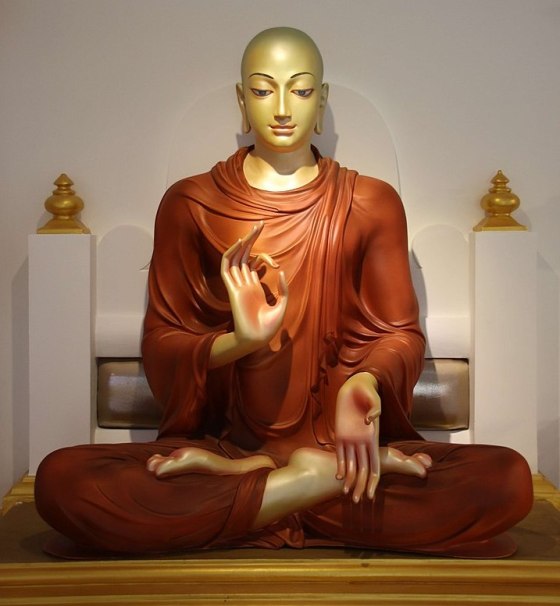
Photo: statue of the Buddha’s disciple Śāriputra. SadahamYathra – https://pixabay.com/photos/buddha-meditation-religion-3153417/, CC0, https://commons.wikimedia.org/w/index.php?curid=85420637


noticing

POSTCARD#381: Bangkok: Since my last post I had to miss the three day diet for one week, but starting again Wednesday August 19. The headache pattern has changed, headache all day and all night for 2 days last week. I haven’t had that kind of intensity for a long time. Today is ok (so far, so good). I’m trying a more directed meditation after reading again Buddhadasa Bhikkhu’s Heartwood from the Bo Tree, the last section – the part where he talks about a neutral object neither pleasant nor unpleasant, agreeable or disagreeable:

“It is sufficient to observe one’s reactions at the times that we glance in the direction of some neutral form or other. Try casting your eyes on the door or a window and you’ll notice that there is merely contact (phassa), there are no feelings. of satisfaction or dissatisfaction. When visible forms, sounds, odors, flavors and tangible objects enter as contact let them stop there in the same way.”

Sitting quietly and the mind clears for a bit, noticing the sensation of the breath gently touching the inner nasal passages… noticing a non-object is noticing the noticing. There is the feeling I experience and this must be the same for everyone. Look out through the eyes and see the sky, the same blue sky everyone else is seeing because the physiological process of seeing the sky is the same for everyone. The consciousness that recognizes this sense of subjectivity is the same for me as it is for you and everyone, everywhere. Photo: UV fluorescence photography shows us how insects are looking at flowers with different criteria.

By noticing aspects of my own sensory process of noticing in the here-and-now, I can know how the people felt in ancient times, how they noticed and understood their world; the sky they looked at, and sounds they heard, fragrances they smelled, food tasted, surfaces touched and their mind responses. All of that is more or less the same for me now as it was for the ancient people then in their time.

“Buddhists refuse to accept perception as a self, though the average person does choose to accept it as such, clinging to it as “myself.” Close examination along Buddhist lines reveals that quite the opposite is the case. Perception is nobody’s self at all; it is simply a result of natural processes and nothing more.” [Ajahn Buddhadasa, ‘The Things We Cling To’]

The ‘me’ and ‘mine’ I experience is not different from the ‘me’ and ‘mine’ anyone else experienced in the past, or at this moment, or any time in the future. The body/mind organism that receives the experience of this ever-present sensory data through the Five Khandas, is the same for me as it is for everyone on the planet. Outer and inner are both parts of the One, the Same, Inseparable.

To notice a non-object (a neutral object) is to notice the noticing itself. To notice a non-object is to notice the motionless space in which everything exists. Context and content are an inseparable balance. Obsession with objects is the inevitable result of not noticing the non-object realm of spacious being. Noticing is different from acquiring. Noticing refers to what is already here. Acquiring refers to what is lacking and therefore sought. Noticing is an openness to what had previously been unseen. The wealth of space in this moment can be noticed and made conscious. In the flood of present wealth, the old compulsion to acquire loosens its grip. [The Endless Further]


bhavaṅga

POSTCARD#380: Bangkok: I’m in the 8th week of my diet – three days approx 1450 calories per day, followed by four days approx 1500 calories per day. Then back to the three days again. I’ve managed the change in eating patterns without too much difficulty. It’s the long hours between meals that are the hardest.

Looking at my state of mind during these times, one thing that helps in the mornings in coping with the contractions of the empty stomach, is the remains of my Nortriptyline night medicine for the (PHN) headache condition I live with, and those chemicals may be still active in the dopamine receptors… neurological technospeak. Later in the morning when that medicine wears off I start the Neurontin and that goes for the rest of the day.

So today, I’m noticing there haven’t been any serious headaches and it’s been like this these last few days which is unusual. Does it have something to do with the way I’m managing the headache with pain meds and the same meds help with the hunger pangs? What I’m saying is, the reciprocal nature of the thing means I’m learning how to tolerate the hunger pangs at the same time as tolerating the headaches. Just allowing it to happen and there’s no conscious memory of it being painful.

It requires a certain kind of meditational attitude and I do have that, spending typically many hours seated in my chair with laptop on my knees, arms on each arm rest, and feet flat on the floor. and what might be a yawning cavern of hunger is simply a light, floating sensation because I’m in that meditational state “bhavaṅga” (luminous mind). “Bhavaṅga” occurs when there is no active cognitive processes going on. I’m in my chair, mind focused on nothing, or the space between things and this is the preferred state; agreeable enough to overlook the discomfort, therefore allowing the hours to pass in a gentle introspective mood.

Looking back on this whole thing, although I’d read about bhavaṅga a long time ago, I simply stumbled upon the way to do it in these circumstances; noticing how the body reacts, responds, and the mind reveals there’s a slightly deeper awareness in here, dormant until something like the correct password is entered then it’s activated… and I don’t need to know the password of course. It’s enough to know that this is how it works.

All kinds of other difficulties however and this morning is particularly awkward because I have to go and see the Neurologist about the headaches, and I need to have a blood test done before the appointment. So they tell me I have to fast (take no food) before the blood test. It means I can’t have breakfast until after 11.30 am – four hours later than the usual breakfast time, and I cannot take my headache medicine on an empty stomach, so if a serious headache comes along, no medicinal relief… I have to put up with it.

A ‘self’ arises, comes into being full of anxiety and scenarios of distress, anger and outrage… so it’s not hard to understand that this embodied identity I call ‘me’ is just not helpful at all. No, thank you. I will not get into this, and drawing confidence from the reserve of underlying calm, I’m able to find that space before it happens, and wait there for a moment until bhavaṅga arises, then watching the in-breath, the out-breath…

When I got to the Out Patients, the blood test was done then into the sandwich shop and the feeding frenzy (I must have eaten more than the approx. 450 calorie limit per meal). After that there was the medicine, three capsules of forget-me-nots in their crinkly acetate enclosures with a couple of gulps of water from a bottle I carry with me. I noticed again, to be honest, there hadn’t been any strong headaches that whole morning.

In to see the neurologist and she asked me how I was, I said yes ok, told her about the diet, now 2 months and about the meds, just last week I noticed I was forgetting to take the Neurontin doses. So I thought I’d try to intentionally reduce the Neurontin and it was easy, no problem. Now I’m taking less than 3000 grams per day, reduced by nearly half, and there are headaches but I’m able to put up with it until it eases off and lessens intensity.

That’s how it feels, but I don’t yet have the words to describe it adequately. Pain Management of headaches aligned with hunger pangs due to dieting for nearly 2 months (weight loss: 12 kg = 26.4 pounds). Also something learned is that the bhavaṅga practice can alter perception which enables me to endure the all-round discomfort better than before.


a hugeness of ordinary things

POSTCARD#379: Bangkok: Breath-taking expanse of forgotten afternoons and time just slipping away. For me the lock-down became television watching all through the day and night – an immense collage of overlapping images, and things of little consequence.

Working from home, or just sitting around, texting food deliveries, we always had enough. Now I see, all of that can be put aside, because “nothing is worth having or being”. Someday I’d like to return to Ajahn Buddhadasa’s words on Emptiness, Suññatā.

It was an opportunity to experience how it must be for those who live in a world of attachment and feel they can’t let go. But not the Thais… they don’t have that kind of problem. It was the Thais, in fact, and their small, slim stature who led to my awakening. One day in a shopping mall, I noticed my expanded waistline in a large mirror showing me and a section of the Thai public. I was a monster by comparison!

So I went on a diet. It is called “The Military Diet” (although it’s got nothing to do with the military as far as I can see), three days low-calorie diet followed by four days of light food, high protein, low fat, low carbs and low calories. Then back to the three days again. I’m now in my seventh week. I’ve lost the kilos I gained in the lock-down, and it continues to go down.

I’ll always be a giant compared to the Thais but I like my new lightness and more gentle impact on our surroundings. I’ve learned so much from this South East Asian Buddhist nation. Living here is like looking through a window on to the ‘old world’. Nearly everything happens in public, practically everything is known, is seen, is understood, and brought to a close in some form, in the eyes of who may be observing.

Fragments of people’s lives; a hugeness of ordinary things, a sense of well-being in the millions of every-day events taking place inside homes. It’s like the whole world is one large room; domestic life without walls, centuries of open-air living. There’s this quality about Asia, particularly India, where we lived for 7 years. It’s not about visiting ancient sites or jaw-dropping experiences that fill you with awe, it can be a single moment felt with the fragrance of something that’s suddenly gone; what was it? Incense, candlewax, ironed cotton clothes and the familiarity of the detergent they use there. I feel immediately at home in this place where multiple generations of other human beings have lived.

But the local people would be shocked to know I’m alone – Jiab my wife is Thai and we are together in this life, but there are no members of my own family here. Why? well… the aloneness is pleasing if you’re like me, an introspective person, practicing the ways and means of Right View, set in a wasteland of Wrong Views, populated by people with their handheld devices, mesmerized by the colorful window and three dimensional sound jamming in the ears.

Whenever there’s an opportunity, I’m letting it all go, and everything evaporates for a moment. In that instant there’s no thinking. The mind is alerted, an empty space opens up; if you are a contemplative and without wandering thoughts, then at times, there’s just this silence. It’s the space between things, easy to have it simply be here for a while. Silence and emptiness and everything held on ‘pause’. There’s the inclination to be actively thinking, the invitation to be involved with thought is there but it’s the novelty of no-thinking that holds my attention…

“Whatever method of practice you adopt, it should lead to equanimity with regards to the sense – objects which you contact, or to their cessation. Whatever sort of insight meditation you do, if you do it correctly without deceit, it will be in this same one form, that of not letting sense-data be compounded into the feeling of “I” and “mine”. Then it’s not difficult to destroy defilements since, when you practise like this, they are destroyed as a matter of course.” [Buddhadasa Bhikkhu, Heartwood from the Bo Tree]


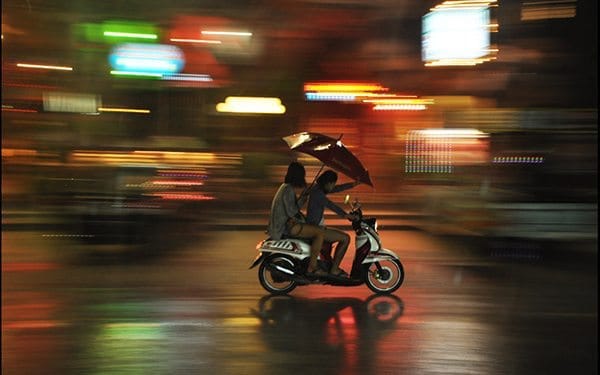
photo: Monsoon in Bangkok