off the wheel: follow-up

[Excerpts from a chapter in “Small Boat, Great Mountain” by Ajahn Amaro. This is about the Buddha’s Dependent Origination cycle, if you’re new to the subject, please take a look at last week’s post and the one before that.]

Exit Points from the Cycle

We don’t need to look very far to see the dependent origination pattern in our everyday lives. We can see how over and over again the cycle is enacted in our being, moment after moment, hour after hour, day after day. We get caught in things we love, things we hate, things we have opinions about, in feelings about ourselves, feelings about others, in liking, disliking, hoping, fearing. It goes on and on. The good news is that there are several different places where we can catch this cycle and ultimately free the heart.

One could do a month-long workshop on dependent origination and not exhaust it. So, I will just give a few of the key points here. Let’s say the worst has happened. Something very painful has taken place. We’ve come to be surrounded by broken glass. We’ve had an argument with someone. We took something that wasn’t ours. We were selfish or greedy. Someone has hurt us. How did we get ourselves into this mess? This is life. We are experiencing the anguish of dukkha. But we don’t need to feel like a victim or fly into a “Why me?” tantrum.

One of the Buddha’s most beautiful teachings is that the experience of suffering can go in two directions. One, it can compound our misery and confusion. Two, it can ripen in search. When everything has gone wrong, we have a choice. Do we just wallow? Or do we say: “Why is it like this? What am I doing to make this a problem?” The search kicks in, to find where we are clinging and why we are looking for happiness where it cannot be found. (A 6.63)

Even at the birth, ageing, sickness, death, sorrow, lamentation, pain, grief, and despair end of the cycle, we can use that pain as the cause to help us wake up. Actually, the Buddha points out in some of his teachings that the very experience of dukkha can cause faith to come into existence. (S 12.23) The pain is saying: “This really hurts. But somehow, I know that this is not the ultimate reality.” We also know that “I can do something about this; it’s up to me.” So, the faith that something is doable arises, and that faith is what launches us on the path of transcendence.

Another place to investigate is at the link between feeling and craving, between vedanā and tanha. Tanha literally means “thirst.” Often it is translated as “desire,” but there are wholesome desires as well as unwholesome ones. That’s why craving is a much better word. It has an intrinsic agitated, frantic, “me, me, me” element to it. Feeling is a world of innocence. We can have an intensely blissful, exciting, pleasant feeling. We can have an extremely painful feeling. We can have a fuzzy, neutral feeling through the body or the mind. Feeling by itself is utterly innocent. There is no intrinsic positive or negative quality to it at all. If there’s sufficient awareness, then all mental and sense phenomena, and the pleasant, painful, or neutral feelings associated with them, can be known, without clinging, as appearances. As soon as ignorance, marigpa, enters the picture, the heart begins to crave: if it’s beautiful, “I want it.” If it’s ugly, “Get it out of here; it stinks.” Somewhere between these two we will generally create an opinion about it. This is a point in meditation where we can clearly cut the cycle, where we can avoid getting reborn, where we can stay with the quality of the wholeness of the Dharma. There is feeling, sight, smell, taste, and touch, and we recognize the emotions that go along with them, but it’s just the world of feeling—pure and innocent.

The last part of the pattern I want to discuss is actually at the beginning of the story, at the very start of the dependent origination cycle: Avijjā paccayā sankhārā, ignorance conditions formations. In other words, ignorance complicates everything. What does this mean? Sankhāra is a broad term that fundamentally means “that which is compounded,” and it gets translated many ways: karmic formations, concoctions, fabrications, volitional formations, subject/object duality—there’s a large constellation of meanings.

What this phrase, “Ignorance complicates everything,” is saying is that as soon as there is avijjā, as soon as rigpa is lost, then instantly the seeds of duality start to form and sprout. There’s an observer and an observed; there is a this and a that; a here and a there; a me and a world. Even at its most subtle, germinal stage, this is what it is talking about. As soon as there is avijjā, sankhāra is caused to be there. Then it becomes a vortex; the tiniest little movement and it starts to grow, to spiral out. Sankhārā paccayā viññanam: sankhāra conditions consciousness. Consciousness conditions mind and body. Mind and body conditions the six senses. The six senses condition feeling, craving, and so on.

By the time we get down to the six senses, there is the body here and there’s the world out there, and we experience them as apparently solid realities.

If it’s only just started to head down the line, it’s a matter of quickly catching it. We can step back and see where an observer and an observed have already been created. As it is said, “Sankhāra sticks its head out” like a tortoise—meaning some form is trying to poke its head into rigpa. But if 80 percent of the rigpa, the knowing, is there, we can still catch it and come back to rest in that open awareness.

We are talking about the subtle area of movement where, as soon as there is a slippage of mindfulness or the faintest coloration or distortion of that awareness, duality kicks in. And that’s the seed of the whole thing. If it’s seen at that point and not followed, then that seed, that primal movement, will not grow further, it will cease right there. If it’s not seen, the vortex will build and build until there is “me in here, the world out there.” And then: “I want it, I can’t stand it, I’ve got to have it. How marvellous, how wonderful, I am going places”—sorrow, lamentation, pain, grief and despair.

Endless Hunger

What happens at that latter end of the cycle, when the dukkha hasn’t ripened in the search for truth and we’ve let our misery get compounded? We feel incomplete. There’s “me” feeling unhappy, miserable, insecure, incomplete, alienated. Then as soon as there’s an idea or a feeling or an emotion or a sense object that might possibly make us feel complete again, we jump on it. “Well, that looks interesting. Perhaps this will do the trick.” There is a feeling of hunger, a lack, or a longing that comes from the experience of suffering. If we are not awake to what’s going on, we think that what we lack is some ‘thing’—the new job, the new car, the new partner. Or we lack perfect health. We lack a decent meditation practice. We shouldn’t be hanging out with the Tibetan lamas; we should join the Theravādins at Abhayagiri. We should rejoin the Christians. We should move to Hawaii. It goes on and on. We go after any kind of external object or internal program to find the missing piece.

This is the cycle of addiction, and it is a very common experience. I am sure everyone has had such experiences. In spite of our best intentions, we find ourselves back in trouble again. We see that we have pursued some kind of desire—for a job, a partner, a meditation technique, a teacher, a car, something to satisfy us. Then we get it and believe, “Ah, this is great.” But is it really?

That something is going to make us happy and make things so completely better. And to a certain extent it does, no question about it. There is gratification for a while. That feeling is definitely there and it is real. The mind contracts around it and at that moment of “Yes!” we are absolutely gratified. The universe has shrunk to that one minuscule zone: “Me happy. Got nice thing.” The trouble is that the universe is not actually that small. We can only hold it together while the thrill lasts. We taste delicious food, we have an inspiring retreat, we see an exciting movie, we enjoy the smell of a new car, and then it’s gone. These objects don’t satisfy us anymore. The place where the piece was missing opens up again and there is dukkha once more. If we don’t realize what is happening, we seek another object to fill that gap, and the cycle of rebirth goes around and around, again and again. It happens thousands of times a day.

Map the process out for yourself. Take notes. You’ll see that it happens very quickly. Ajahn Chah used to say that following dependent origination is like dropping out of a tree and trying to count the branches on the way down. It’s that quick. The whole process can play out from beginning to end in a second and a half. Pow. We can hardly track what’s happening but—thump! —we know it hurts when we hit the ground. We can see the urge to cling in any moment. When we see this clearly, when we have made it deeply familiar to us, we can stop the process and let go of the cycle of birth and death.

To encourage this familiarisation and relinquishment it’s important to experience and acknowledge the disadvantages of cyclic existence. Above all, it hurts. Just as the thrill is real, so is the pain. We don’t get the thrill without the pain. That would be   nice, wouldn’t it? When the pain comes, we see that it is empty. When the thrill comes, we experience it as absolutely real. You’ve got to be really quick on your feet to pull that one off. There are a lot of people trying it, that’s for sure. As the pleasure is rising, we feel “real, real, happy, happy, happy, happy.” As the pleasant feelings diminish, we try to see that the pain and disappointment is “empty, empty, empty, empty.” As we say in California, “Dream on.” Life is not that way.

Header image by Dan Meyers: This is a lava tunnel created by a volcano near Bend, Oregon.It gets very dark and cold and goes for a mile.

off the wheel

Ajahn Amaro
[Excerpts from an article in Two Parts, link to original at the end of this text. This is Part 1]

When we talk about rebirth, people often think in terms of past lives, future lives—in what you could call a metaphysical way, beyond the scope of our everyday vision and perceptions. That perspective is understandable, and yet when the term “rebirth” or “the cycle of birth and death” is referred to, it is not always referring to a sequence of events over a number of lifetimes.

The Buddha does indeed refer matter-of-factly to our past lives and future lives in many instances throughout the teachings. That’s a very common way of speaking.

But when talking about the process of rebirth, what causes it and how it is brought to an end, particularly the teachings on what is called dependent origination, the Buddha is often referring to more of a moment-to-moment experience. The Commentaries tend to focus more on dependent origination as a process which takes place over the course of several lifetimes, but careful study has shown that in the Suttas themselves, a full two-thirds of the Buddha’s teachings on the subject refer to it as a momentary experience, a process that is witnessed in the here and now, in this very lifetime.

The cycle of dependent origination describes how a lack of mindfulness, a lack of awareness of experience, leads to dissatisfaction—the arising of dukkha. The first link of the whole sequence is avijjā: ignorance, not seeing clearly, nescience. This is the catalyst for the entire process. The root cause of suffering is, not seeing clearly. avijjā. If there’s vijjā, if there is knowing, and awareness, then suffering does not arise—there might be pain, but dukkha, anguish, dissatisfaction will not be caused.

As soon as avijjā is there, this leads to the fundamental delusion of subject and object. Avijjā, ignorance, leads to formations, sankhara – that which is compounded, that which is formed. When there is ignorance, when the mind doesn’t see clearly, this creates the foundation for the subject/object division. The subject/object division strengthens in the next stage of the sequence: formations lead to consciousness. Consciousness in turn leads to nāma-rūpa—body and mind. Once there is ignorance, there is the subject/object duality (a “here” and a “there”), which is like a whirlpool that gets stronger and stronger until it conditions the world of the senses.

The saḷāyatana, the six senses, are conditioned by that separation between subject and object, the knowing and the known. The spinning energy of the vortex makes it seem that seeing, hearing, smelling, tasting, touching, and thinking are all personal. Once there is the substantial feeling of a subject “here” and an object “there”, this gives rise to the impression that there is a “me” who is seeing, hearing, smelling, tasting, touching, and thinking. Attachment to the senses then strengthens that duality, and the vortex gains energy.

When something is seen, heard, smelled, tasted, touched, or thought about, when one of the sense organs contacts an object, that is what we call “sense contact” (phassa). Sense contact leads to feeling, vedanā. When there is phassa, there is an effect from that sense contact, a raw feeling that is either pleasant, painful, or neutral. That feeling then conditions craving, taṇhā. A pleasant feeling coupled with ignorance lead to a desire for more. An unpleasant feeling coupled with ignorance lead to a desire to get rid of. A neutral feeling coupled with ignorance is taken as a subtle kind of pleasant feeling; thus, the mind inclines toward desire, and craving rapidly escalates. If these conditions are not seen clearly, if ignorance persists, then craving leads to clinging (upādāna) and the clinging leads to becoming (bhava). As you reach bhava, what you can see is a rising wave of absorption. First of all, there is, say, a pleasant feeling. The mind thinks, “Ooh, what’s that?” and then “Oh, wow! I’d like one of those!”

Just so this isn’t too theoretical, imagine you are queuing up to get food. You see how many slices of cake there are left. As you approach the front of the queue you are thinking, “There are only three slices left and there are five people in front of me. Hmm…look at that person in front of me. Is he a cake kind of a person?” The mind sees an object; then there’s the craving and craving leads to clinging. You think, “I really deserve a piece of cake. I really need to have a piece of cake.” And then that clinging conditions becoming: “I’ve gotta have it! I’ve gotta have it!, and getting that cake becomes the only important thing in the world. Suddenly the whole universe has shrunk to taṇhā upādāna bhava—“craving, clinging, becoming.” The world narrows to that desire object. Bhava is that quality of the mind which is committed to getting its desire object. It is the thrill of riding the wave. When you see that last person in the food queue pass by the cake and you realize, “Yes! I’m gonna get it!”, bhava is that thrill of guaranteed getting, acquisition.

The peak of excitement is the moment when you know that you’re going to get the desired object. At that moment you are guaranteed to get the object of your desire, but it hasn’t reached you yet. That is the moment of maximum excitement—when you actually get the piece of cake and take a bite, from there on it’s all downhill. The moment of getting is already the beginning of the disappointment.

A. A. Milne, the author of Winnie the Pooh, makes this same observation: “Well!” said Pooh, “What I like best…” and then he had to stop and think because although eating honey was a very good thing to do, there was a moment just before you began to eat it which was better than when you were but you didn’t know what it was called.” (That was written in 1928, so he probably hadn’t yet come across a translation of bhava.)

Even before you’ve got the honey in your mouth, you’ve reached the height of excitement—this is bhava. This is becoming. And as the Buddha pointed out, living beings are committed to becoming, they relish becoming, they adhere to becoming. “Becoming” is the drug of choice. We love that feeling because at that point life is very, very simple. “I want it, I’m going to get it—yes!”

Everyone has their own particular desire objects, but in a way the specific object of desire is secondary to the actual process of desire and becoming. All of us will have particular things that we find compelling, where the mind picks that object up and gets deeply absorbed in it. What things really have a pull for you? The achievements of your children? The publication of your books? Or it could be getting any kind of affirmation. It can be wholesome or unwholesome, but in that process of bhava, the mind becomes completely absorbed, though it hasn’t quite got the object yet.

After bhava the next link in the chain of dependent origination is jāti, which is birth. This is the point of no return. Now you’ve purchased the item, now you’ve got it. Shortly after comes the bill. Having acquired the desired object, there is a price to pay. what follows is sorrow, lamentation, pain, grief and despair.

Having got what we wanted; we then get the whole package that comes along with it. If it was something pleasant, we are faced with the desire for more. If you are particularly enthusiastic about wonderful food, once you’ve eaten it you’ll find you are left with an empty plate, and you may think to yourself, “Oh! I’d better go and get some more.”

So, we end up with that feeling of despondency—you got what you wanted but then it didn’t really satisfy you, or it wore out, or it was so sweet at the beginning and then it turned into hard work. You thought it was going to be so great that you didn’t realize you were going to get all this other not-so-nice stuff with it. Thus, whatever shape it takes, whether it’s subtle or coarse, that dukkha feeling is one of disappointment, desolation, sadness, incompleteness; that sense of barrenness in the heart, feeling lonely, unsatisfied, insecure. Suddenly there is dukkha, it can happen very, very fast. The mind is caught by a sense object. There is the thought, “Oh, that looks interesting.” And there you are, you’ve eaten that slice of cake, in spite of the fact that you are supposed to be on a diet. The whole process of dependent origination can happen literally in a finger-snap.

But here we have time to contemplate the process, and see how it works. We can recognize that there are different elements to it. There are different ways of breaking free. This cycle is called bhavacakka, “the cycle of becoming” or “the wheel of rebirth.” It is called a cycle because at its end, it leaves us feeling incomplete, lonely, or sad, and the way we deal with that kind of unhappiness is by resuming the cycle as soon as the possibility of another gratification comes along.

This is how the deluded mind works—irrespective of whether the object is wholesome, unwholesome, or neutral, this is exactly how it works. The mind is caught in these cycles of dependency, cycles of addiction. With his teaching, the Buddha is trying to help us free the heart from this addictive process; the main form of which is addiction to becoming. The bhavacakka, the cycle of becoming—that is our drug of choice to which we are all habituated, whether it is becoming based on a coarse sense-pleasure, or becoming born of noble aspirations or caring for our family. The objects can vary from those which are reasonably wholesome to those which are downright destructive, but the process works in exactly the same way irrespective of the object, and if we don’t understand how it works, we are inevitably trapped in that endless cycle of addiction. The Buddha’s teaching helps us to recognize that trap and to break free from it. [Continued in Part Two: 07 December 23]

Link to the original: https://link.springer.com/article/10.1007/s12671-021-01621-9

spaciousness of being

IMG_0085POSTCARD #17: Nontaburi, Thailand: Here in this large house, surrounded by a garden of tall trees. Monsoon season, heavy rain all day, all night – oceans of frogs all around, hundreds of them, l’amour, croaking throughout the night in rising and falling waves as I sail off into sleep. Still raining next morning, then it stops about 10 o’clock, and the frogs are quiet now – I don’t know where they can be… submerged in mud with a bubble of air to breathe in? Frog heaven. A time for quiet reflection, the actuality of just being here; conscious experience. I’m alone in an empty house, walking around the hallway, bare feet on cool marble tiles; pita, pata, pit, pat, pata, pit, pit… stop and look out the window; everything is totally wet out there.

IMG_0170Conscious of cold feet – an unusual feeling in Thailand, it’s usually hot all the time. The skin sense (touch), contact with the world, consciousness of a physical object. Standing on the cool floor – the sensation. And the mind sense (cognition), ‘I like this coolness’, consciousness of a mind object. A pleasant wanting… hovering in a created sense of ‘self’. A whole lifetime taken up with the body/mind’s responses, reactions to the ‘outside’ world. Preoccupied with the doing of it, actively engaged with it; this is happening to ‘me’. Everything I see, hear, smell, taste, touch, feel and think, received through sense organs mostly situated around the face, means the head is thus spinning around constantly to engage with whatever it is; the object of consciousness.

‘A life guided by desire, a life contracted to the mind’s thirst, seldom has the spaciousness of being. That pure awareness which wants nothing, which yearns for nothing, which simply takes on the shape of whatever form comes within its natural spaciousness.’ [Stephen Levine]

There’s consciousness of thought and consciousness of no-thought; consciousness of the cognitive function triggered by a simple curiosity: what is going on here? Unattached consciousness, released from sensory experience – awareness of the awareness, seeing the seeing, knowing the knowing. One way or another, conscious experience is what I’m writing about; an all-inclusive thing. I try to be minimalist, writing as if it were text messaging. No real ‘story’, no sequence of events; it lacks content, barely enough to hold the reader’s attention. It just evolves, becomes something, gets broken down again and rebuilt. Often it feels like once it’s been taken apart, it’s not worthwhile putting it back together; everything in a state of disarray, prepositions and verbs scattered around, a small tribe of semi-colons nibbling at my ankles’, no subject, no object; no actual finished state.

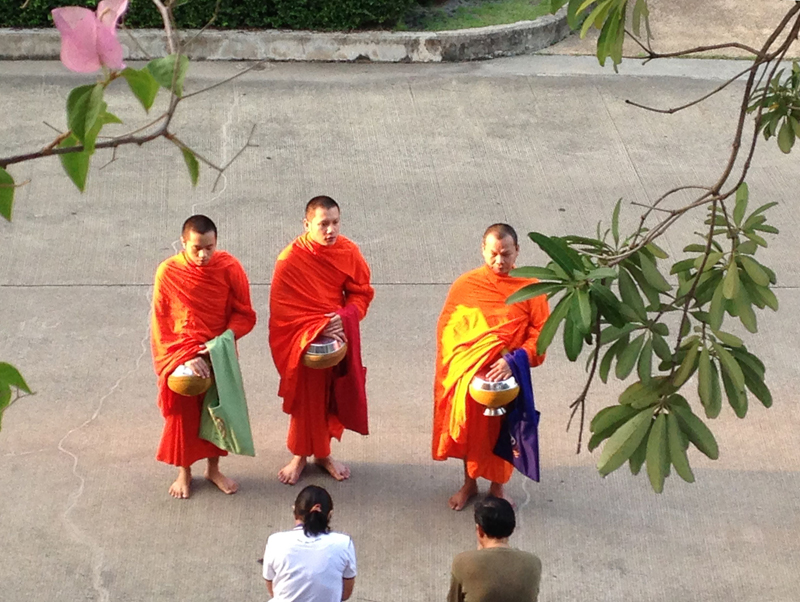
After another couple of days of just ‘me’ and the frogs in the rain, and I realize it must be Sunday because Naa J and Naa M arrive that evening with a take-out dinner. We talk for a while and they spend the night. Early next morning I hear the monks outside. Go to take a look, rain has stopped and it’s dry again, takbat, offering food. Generosity, J and M have this kindness. An hour later I come downstairs, and they’re gone…

‘Awareness could be said to be like water. It takes on the shape of any vessel that contains it. If one mistakes this awareness for its various temporary forms, life becomes a ponderous plodding from one moment of desire, from one object of the mind, to the next. Life becomes filled with urgency and the strategies of fear, instead of lightly experiencing all these forms, recognizing that water is water no matter what its form.’ [Stephen Levine , Ondrea Levine: Who Dies]

IMG_0179————————-

Note: ‘a small tribe of semi-colons nibbling at my ankles’, quote from Sue Vincent’s Daily Echo/ Sharpening The Quill. Thank you! (link in text)
Related post

nothing in particular

IMG_0132aPOSTCARD #16: Bangkok: Waiting for my number to be called… the figure 109 printed on a square of paper the receptionist gave me here at Rutnin Eye Hospital, outpatients department on the 2nd floor. People everywhere, very crowded today and only one seat available facing the white door that leads to examination room number 5. Fortunate because it’s where I’m supposed to be – at least I’m in exactly the right place. Yes, but there could be 108 people in front of me… an endless time to wait; nothing to read, nothing to look at, just watching the time go by. The second hand spinning round on a clock on the wall, designed like the hospital logo; it looks like an eye – someone has taken care to create this icon; it’s childlike, friendly, elegant.

3305480I’ve been struggling with poor eyesight for years and, since the surgery, seeing the world through ‘new eyes’ means anything happening in the field of vision immediately calls out for attention; a movement, a colour – it has to be noticed. The world is a great diversity of things. I see a tiny patch of colour at the bottom of the door about half an inch wide, where a piece of the surface of the door panel has chipped off, probably caused by moving some heavy equipment into the room and the door was struck in the process. It’s been repaired with something a slightly different colour and the coloured patch seems luminous, out of context with its surroundings… there’s also the glint of something like mica, something metallic. For a moment I’m immersed in this although it’s not important; it isn’t anything, there’s no attachment to it. It’s just a coloured patch, yet it’s fascinating. These days I’m often in the curious situation of having this intense visual awareness of an object and no subjective sense that it’s worth paying attention to at all; mind is not inclined to engage with it. This is just an ordinary mark on a door, nothing in particular; I have no desire for it, no pressing need to possess it. There is sensory data input by way of the eye and eye-consciousness; receiving the world through the six sense-doors: eye, ear, nose, skin, tongue and cognitive functions, without the idea of it happening to ‘me’. All that I’m aware of is a quiet presence, seen in peripheral vision and knowing it’s there.

 ‘… habitual desires manifest and condition awareness into a discriminative mode that operates in terms of subject and object held to exist on either side of the six sense-doors. These sense-doors open dependent on contact that can arouse varying degrees of feeling. Feeling stimulates desire and according to the power of desire, attention lingers… personal aims and obsessions develop and give rise to self-consciousness. That self-consciousness, mental or physical, once arisen must follow the cycle of maturing and passing away. When the mind looks into the sense of loss and comprehends (this) truth, the awareness is no longer bound by discrimination, the separation of subject and object is no longer held and one does not feel trapped behind or pulled through the sense-doors. There is freedom from desire… no personal image is created; there is nothing to lose, a sense of gladness, uplift, joy and serenity.’ [Ajahn Sucitto]

————————-

Lower image: Rutnin Eye Hospital logo   Note: Ajahn Sucitto’s poetry link: dhammamoon.org

suspended disbelief

StACaPOSTCARD #04: St Andrews, Scotland: It’s a sharp bright light, different from the sunshine of South East Asia, comes at a lower angle; the sunbeam seems to shine straight into my eyes. Quite blinding in the early morning, I’m dazzled and have to shade my eyes to look up at the ruins of the nave of St. Andrews Cathedral, against the Northern sky. A great emptiness, 12th century mediaeval folk saw it as the ‘Glory of God’, projecting a ‘self’ onto empty space and if there was an intuitive sense – a normal inquiring mind – that something about this is not quite right; the sense of lack, unconvinced, doubting – could it really be God? If it was like this, they were living in fear of their own natural thinking processes and reasoned that it must be because ‘we are all sinners’ and the Church is there to ‘save’ us. Religion was/is power; the Church of Rome, then the Scottish Reformation claimed all the wealth of the Cathedral of St Andrews. Not much in history about the spiritual life of those who lived in that place, studied, prayed, meditated; their compassion, or loving kindness…

I see the door arches and passageways, people walked through here and lived their lives, breathed this air. How was it then; the existential reality of these 12th Century Britains? Conscious experience was the same in mediaeval times as it is today: outer object triggers inner recognition/desire. Example found in the Old Testament: Adam sees the apple: I want that… Dependent origination (paticcisammupadda) in an Old Testament format: there’s an apple out there and I want it but there’s conflict in the mind, associating a fictional self with a normal response; sorry this apple belongs to someone else and you can’t have it. How to resolve this? The response to the apple is normal, the process of human consciousness must be universal – there was never any time when people didn’t react/respond like this. Today we can apply understanding; how does the process work? In those days, no other way to understand it, you have desire for the apple, you are a born sinner, believe in God, and have your sins forgiven… and that was it – no other instruction. Thank goodness I discovered Buddhism.

It’s daylight until very late at night here, a long twilight going through to dawn the next day – really no darkness at all. The morning gathers momentum and we’re flooded with sunshine, day after day, everybody stumbling around in a state of astonishment, suspended disbelief. The sense of being on an island doesn’t seem to be here in Scotland, we are not held, contained, more like we are dispersed, all the way to the Northern region; Orkney, Shetland, Faroe Islands, the Arctic Circle and beyond…

————————-

Ignorant of their ignorance, yet wise in their own esteem, these deluded men, proud of their vain learning, go round and round like the blind led by the blind [Mundaka Upanishad 18]