moment-to-moment consciousness

Leigh Brasington

Editorial Note: Some of you may have noticed that last week I placed the name Leigh Brassington as the author of Christina Feldman’s piece on Dependent Origination. Sorry about that, in fact, I corrected it a day later. Increasing difficulty with my vision (AMD macular degeneration in the right eye) has made it impossible to write my own material,

https://dhammafootsteps.com/2012/10/04/neverending/

(click on the link to read an early post that refers to Dependent Origination). For the time being I’m focused on republishing sections from Dhamma publications which I find particularly worthwhile. So, what follows is Leigh Brassington’s clearly stated piece on Dependent Origination [Image: close-up of a sunflower seed by Mathew Schwartz, unsplash]

Here’s an example of what’s meant by moment-to-moment Dependent Origination: let’s say you’ve never had a mango. You’ve heard about mangos, and one day you go to the grocery store, and in the produce section there’s a sign that says “Mangos.” You’re like “Oh, I’ve heard about mangos, they’re supposed to be good.” There’s this funny looking fruit and you think, “I’ll buy a mango.” So, you buy a mango and you take it home. You figure out you’ve got to peel it; and of course, you make a big mess because that’s what happens the first time you attack a mango. Then you cut off a piece, and now you’ve got a piece of mango in your sticky fingers. You are conscious, you’ve got a mind and body, you’ve got working senses. The mango hits the tongue – contact, vedanā, pleasant vedanā, craving; “I’ll have another bite” and another bite. “This is good; I’m going to get me some more mangos. In fact, my friends Bob and Carol and Ted and Alice, they’ve never had a mango. I’m going to turn them on to mangos.” You have just given birth to the mango bringer. You go see your friends and you turn them on to mangos and they’re like “Great, this is wonderful, thank you!” And the next time you go see your friends you bring a mango, and they’re like “Great, thank you for the mango.” And the next time you bring a mango, they’re like “Oh, another mango.” And the next time you bring a mango, they’re like “What’s with all the mangos?” Oh, dear! death of the mango bringer.

What’s happening is that based on your sensory input and your cravings and clingings, you’re creating a sense of self. It’s not your physical birth that’s happening with every sense-contact; it’s the birth of the self. When you crave, there’s a sense of the craver. When you cling, there’s an even stronger sense of the clinger – me, I own it, mine. At first, at the craving stage, it’s “I want it”. At the clinging stage, it’s “I’ve got it and I’m going to keep it.” And this results in “bhava,” which I’ve been translating as “becoming,” and which could also mean “being and having.” Now you have this thing you’re craving. You have become the one who owns it, and you just gave birth to yourself as this owner. But because your sense of self is rather fragile – notice how we’re always seeking self-validation – it keeps dying on you and you’ve got to think it or emote it up again.

Examining the twelve links of dependent origination from a moment-to-moment perspective is probably the deepest and most important way to look at them. This spinning of the wheel of dependent origination leads to old age, sickness, death, pain, sorrow, grief, lamentation, and all the rest of the dukkha. The Buddha’s teaching is about the end of dukkha, and there are two ways to work on this. One is when there’s a sense-contact, and it produces vedanā – Stop! don’t go any further. Don’t go into the craving. There’s not much you can do before that. You’re conscious, you have a mind and body, your senses are engaged with the environment. You’re inevitably going to get contacts, and the contacts are going to produce the vedanā which are not under your control. The vedanā are happening in the old brain, the so-called reptilian structure, and that’s not under your control. It’s only after the vedanā that you have some opportunity to control what happens next.

Thankfully, the craving isn’t inevitable. Some of these links are inevitable. In other words, if you get born, it’s inevitable you’re going to die. But if you get a pleasant vedanā, it’s not inevitable that you’re going to fall into craving. What comes after vedanā is perception – the naming or conceptualizing of that sense-contact – and that’s not even mentioned in the twelve links of dependent origination. After perception, mental activity arises – saṅkhāra again, the thinking and emoting about the sense-contact that produced this vedanā. Some of the thinking and emoting is no problem. It’s only when it gets into the “I gotta have it, I gotta keep it” that the craving and clinging set in. Or “I gotta get rid of it, I gotta keep it away.” That’s where it gets to be a problem.

This is why the Second Foundation of Mindfulness is to pay attention to your vedanā. This is so that when you experience a pleasant vedanā, you know it, and you’re right there in that gap after the vedanā and before the onset of craving – and you can actually deal with the experience wisely. You can enjoy the pleasant vedanā, and just leave it at enjoying the pleasant vedanā. You can experience the unpleasant vedanā, and act, if necessary, based on the unpleasant vedanā without falling into craving and clinging. This is the strategy on a sense-contact by sense-contact basis. It’s a lot of work because we get a lot of sense-contacts. However, you need to be in there every time checking because the craving is liable to come up; and when it comes up, it’s a setup for dukkha. We don’t really seem to be able to pull this off all the time. Sometimes, yes, good, diminish your dukkha, you experience the sense-contact with its vedanā, enjoy it, let it go. But sometimes, you get lost and fall into craving and clinging.

But a long-term strategy is to go back to the very beginning of the list of the twelve links, and uproot the ignorance. Because without the ignorance, there are not the saṅkhāras, and without the saṅkhāras there’s no consciousness, mind-and-body, etc. That sounds a bit like annihilation, but really what it’s saying is that without the ignorance this whole tendency to wind up in craving and clinging just isn’t there. The key thing is to uproot that sense of self that is the craver and the clinger, to gain the unshakable deep understanding, based on experience, that this feeling of self is simply an illusion. You want to penetrate that illusion to such an extent that you don’t conceive of a self. Similarly, when you go to the beach and look out and see a ship sail over the horizon, you know it didn’t fall off the edge of the world. That sensory input does not lead to conceiving any “the edge of the world” as part of the experience. Can you get to the same place about all of the stuff that normally generates the sense of “I”, the sense of me, the most important creature in the universe? This is the uprooting of ignorance, and when that’s done, then the whole edifice of self/craver/clinger falls apart. Furthermore, it’s taken care of forever.

You can read the est of this chapter (chapter 3) in the original, which is a free Dhamma book, as PDF, Epub, Mobi. Look for the link in Leigh’s Website:

https://leighb.com/index2.html#RightCon

https://www.youtube.com/watch?v=1pZQdBy3u84

Another link from the Website, a helpful video on emptiness. At the beginning of this video, you will see he uses the acronym: SODAPI (Note: the sound of the ending of the word rhymes with ‘eye’) Streams Of Dependently Arising Processes Interacting, SODAPI
Satipaṭṭhāna and Anattā

POSTCARD#457: Bangkok: [Editor’s note: this excerpt is from ‘The Thousand-Petaled Lotus’, last paragraph, page 109 in the print copy: “… when petal number one thousand opens up, so beautiful and unworldly, then you see the famed jewel in the heart of the lotus. Do you know what that jewel is? – a diamond? a ruby? No it’s emptiness. You see the priceless gem of emptiness in the very heart of the body-mind and this is not what you would ever have expected. That’s how you know it is not just another petal. Emptiness is something of a completely different nature to every other petal, to every other thing. Nothing! To reach this far usually requires superpower mindfulness sustained on its focus for a very long time.

The Purpose of Satipaṭṭhāna

So what is the purpose of satipaṭṭhāna? The purpose is to see anattā, that there is no self, no me, nor anything that belongs to a self. As it says in the texts, “Such mindfulness is established enough to discern that there are just the body, feelings, mind, and objects of mind” and that these are not me, not mine, nor a self (this is how I (the author) translate a phrase in the suttas).

When you keep in mind that the purpose of satipaṭṭhāna is to uncover the delusion of me, mine, or a self, to see anattā or the “emptiness in the heart of the lotus,” then the way of practice becomes clear. In particular you can appreciate why the Buddha taught just four focuses for mindfulness: body, feelings, mind, and mind objects. He taught these four because these are the major areas where life assumes a “me” or a “mine.”

So the satipaṭṭhāna practice sustains superpower mindfulness on each of the four objects in order to unravel the illusion of a self. You have been deluded for too long, identifying with the physical body, regarding your feelings as yours (and therefor subject to your control), assuming the mind (the process of knowing) to be your self and attaching to the objects of mind as matters of concern to you.

Summary of the Preliminaries

1. vineyya loke abhijjhā domanassam – first abandon the five hindrances through the practice of jhāna.

2. satimā – be possessed of superpower mindfulness resulting from jhāna.

3. atāpi – diligently sustain that superpower mindfulness on the focus.

4. sampajāno – keep in mind the purpose of satipaṭṭhāna on each of the four focuses in turn.

Body Contemplation

In the Satipaṭṭhāna Suttas there are fourteen areas for focusing mindfulness involving the body. They are grouped as follows: (1) breath, (2) bodily posture, (3) bodily activity, (4) composition of the body, (5) the body seen as four elements, and (6) the nine corpse contemplations. Here, I will discuss briefly all but the fifth.

Breath

In Indian philosophy, the breath (prāṇa in Sanskrit) is sometimes considered to be the vital essence of a human being. Indeed, the Pāli word for “animal” is the same as the word for “breath,” pāṇa. Similarly, the English word animal is derived from the Latin animalis, meaning “having breath.” Certainly, in ancient times the breath was considered to be such an important part of life that it was thought to be almost identical to a self or soul.

By focusing superpower mindfulness on the breath, it is possible to experience the breath as an empty process, completely subject to conditioning, with no being in here doing the breathing. Moreover, in deep jhāna, we can experience the breath disappearing altogether (in the fourth jhāna) with no danger to life.

During my teacher Ajahn Chah’s long sickness, he would often stop breathing. On one such occasion the new nurse on duty became alarmed. He knew that Ajahn Chah must die one day, but he didn’t want it to happen on his shift! The attendant monks on duty that night reassured him that Ajahn Chah had done the same many times before and that it was just a sign of deep meditation. The nurse was still worried and so took blood samples every few minutes during the hours without breathing to ensure that the blood was still well oxygenated. After all, as long as there is enough oxygen available in the blood there will be no harm to the body. The nurse discovered that even though Ajahn Chah was not breathing for a long time, the oxygen level in the blood remained constant. In jhāna, the metabolism is so slowed down that you are using almost zero energy. You don’t need to breathe.

Why is it that ordinary people gasp when they are excited, or struggle for breath just before they die? Perhaps their attachment to their breath is deeper than they realized. Remember, satipaṭṭhāna uncovers attachments that are completely unexpected. When you experience the cessation of breath, then it is obvious that it is not yours at all. From that insight, attachment to breath unravels.

Bodily Postures and Bodily Activities

There are two ways to understand something: by contemplating what it is made of and by contemplating what it does. Here we are analyzing this body by contemplating what it does. It is an illusion to think that I am walking, standing, lying down, sitting, stretching my arm, and so on. The truth is that there is a body doing this, not an I.

Many high achievers in sports, the arts, or even meditation, describe a state of selflessness called entering the “zone.” When a famous classical Indian dancer I knew was asked how she could perform to such a high standard, she replied that she practices and practices, but when the performance begins, she deliberately forgets everything she has been taught. She “gets herself out of the way” and allows the dance to take over. This is a classic description of entering the zone. When the athlete is in the zone, she can move effortlessly, gracefully, and faultlessly. When the meditator is in the zone, he can watch samādhi deepen beautifully, seamlessly, and wordlessly. You clearly experience all this as mere process, with no being driving the process. It is anattā, no-self.

You observe bodily postures and activities with superpower mindfulness and quickly enter a zone where all bodily postures and activities are seen to be mere cause-driven processes, not self-driven ones. You become less of a control freak concerning this body. You detach and live at ease.

Some teachers mistakenly think that mindfulness must always be focused on activities in the present moment. In fact the Pāli word for mindfulness, sati, also means remembering. Superpower mindfulness can focus on an object many moments old, bore into it without the object fading, and uncover its truth.

For example, in the Satipaṭṭhāna Sutta one is asked to practice mindfulness focused on sleeping. Even arahants are not aware when they’re asleep, so what does this mean? Some translators have attempted to solve this question by changing the meaning of the exercise to mindfulness on falling asleep. However, the Pāli word used in the Satipaṭṭhāna Sutta means “in sleep,” and there is a different phrase for falling asleep, niddaṃ okkamati. The practice of mindfulness focused on sleeping means one uses a previous experience of having been asleep as the focus of superpower mindfulness in the present. It is mindfulness that takes an old experience as its object. This may seem pedantic to you now, but it becomes crucially important, as you will see, when I explain the focus of mindfulness on the citta (mind consciousness).

Continued next week 11th Feb 2022 with Composition of the Body

surfing on the edge of dawn

birds-at-sunrisePOSTCARD #86: Delhi 05:00 hours: When I open the glass doors to the garden, the temperature outside is the same as it is inside. This is such a novelty for me, having recently arrived from Northern Europe where there’s always that early morning chill separating outer from inner. Over here, it’s all of a oneness. I want to drag my mattress and bedclothes through, spread them out on the paving stones here and lie down with my pillow. Then I could gaze up at the tall trees in the early morning sky and listen to the birds. A birdsong extravaganza, surfing on the edge of dawn… why this wild party and glorious singing? What’s going on? Such an accumulation of voice – is this what we call God? …somehow, it doesn’t cover it, ‘god’ is just a word, man-made. The actuality of it is as far as the eye can see, daylight spreading over the curvature of the planet and an immeasurable sense of sky.

Impossible to understand the totality of it, of course, the mind is a filter, selecting the data to suit the software, and this may be a sound-realm on a scale only birds are aware of. In the darkness they can hear the sound of the other birds over there on the other side of dawn, where it’s already light, and that’s the signal to engage in this shared event. It’s like a football stadium crowd performing “the wave.” A movement in time that’s always present in the here-and-now – same at every location. Light-colour-sound, daybreak and birdsong are inseparable. It fills the air for about 20 minutes then disappears. At the next place in time and space, the birds respond to it there; the Mother Ship – applause, celebration, rejoice, and it moves on. Incredible mystery… it’s the movement of the planet, I need to remind myself, the rotation of the Earth at more than 1000 miles per hour, and always happening like this, of course. The dawn chorus is always being experienced in some part of the world. Continuous birdsong since whenever birds first populated the planet…

From this location in North India, it’s shifting away Westerly, in the direction of the Middle East and on to the Mediterranean countries. The birdsong of Palestine, of Israel, Greece, then Florence, Portugal. Over the Atlantic Ocean, isolated flocks of gulls rise up from the water’s surface, calling and mewing in the golden sky. On from there to the Eastern Seaboard of the US, across the forests, rivers and mountains of the continent and out over the Pacific.

It does not appear or disappear.
It is not born and does not die.
It is neither constructed nor raised up,
Neither made nor produced.

It is neither sitting nor lying,
Neither walking nor standing still,
Neither moving nor turning over,
Neither at rest nor idle.

It does not advance or retreat,
Knows not safety or danger,
Neither right nor wrong.
It is neither virtuous nor improper.

It is neither this nor that,
Neither going nor coming.

 From the Lotus Sutra

————————-

Photo: Birds in sunrise sky/ID 7756984 Xdrew/ Dreamstime.com

relaxed resistance

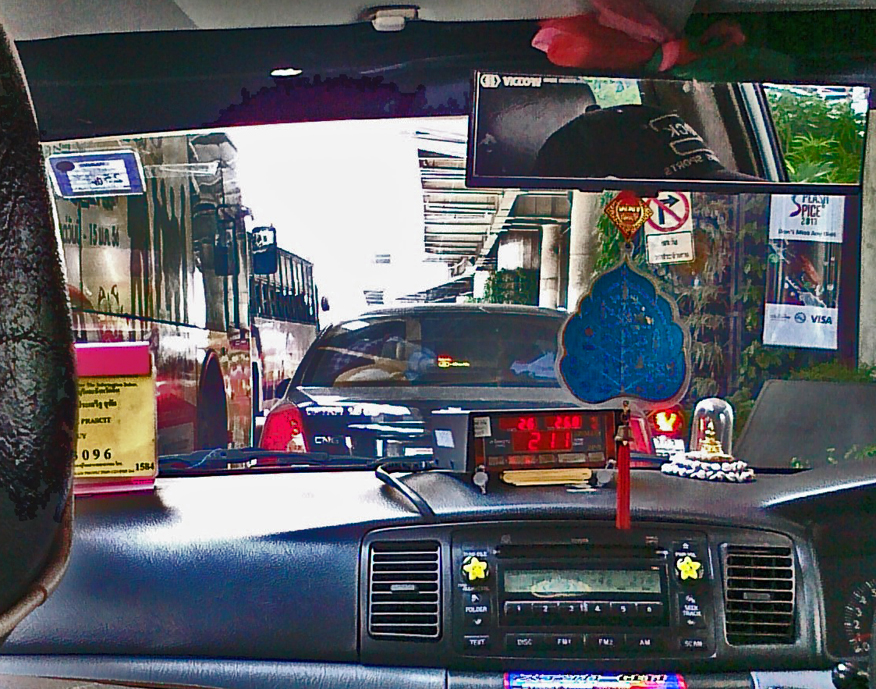
TaxiBKK2Bangkok: In a taxi on the expressway and it looks like the whole route is blocked with traffic but we are moving along slowly. A small voice is saying, we’d’ve been better off taking the ordinary route through streets with traffic lights and the congestion of that would’ve been quicker than this… yes, possibly, but hypothetical. And I’m not getting pulled into that scenario, thanks, no. Strangely, I feel no frustration sitting here. The taxi driver’s radio is playing; it’s a call-in chat dialogue with music.The mind isn’t absorbed into it, the sound is just there. It’s not loud, it’s not demanding; sometimes I notice it consciously then the mind moves on somewhere else. And, there’s that small voice again saying, wow! this could get really boring. But it’s not like that, it’s a neutrality maybe, there’s just this experience right now; the reality of being here. Nothing else to do, so obviously it’s okay to stay with what’s ‘here’ and see where that gets me.

One thing that helps is that there was this really nice post I read the other day [‘The Path of Waiting’] and I’m thinking of that now in this place where traffic is at a standstill, nearly. It’s the idea that we’re always waiting on something, somewhere, most of the time and it helps if you can be ‘willing to stand hand in hand with your waiting for a few moments.’ It was that, I think, that started me off in this mind direction of, let’s see what this waiting thing feels like. So now I’m hand in hand with my waiting and it feels nice.

The mind is clear, free and empty. There’s a careful observation and contemplation of everything that’s happening, it’s like being focussed on balance and openness – poised between things, in a sort of high altitude mind-place of emptiness. That’s all, and everything just seems to be slowly moving along here, the moment transforms itself and there’s this attitude of gentle curiosity, like what’s this now? I hear the small voice again; a shadowy question hovering on the periphery: how come I’m not frustrated by this endless traffic situation? Nope, it’s not necessary to go there; no desire to get pulled into that. It’s the wisdom of just mindfully placing one foot after the other on to stepping-stones that lead over the river to get to the other side. There’s something about the easy lightness of this that makes it obviously the right thing to do, and what else is there to do anyway? Not a lot, I look out the window and see the gridlock of slow-moving metal parts in this tremendous heat.

Amazing really because I’m not feeling the frustration of it. There have been times in the past when it would’ve resulted in a semi-suppressed raging inferno and getting engaged with it, or trying to get rid of it, would seem like the way to go. Getting rid of stuff always seems like the right thing to do; a kind of righteous feeling; got to clear up this mess, okay, let’s get on with it! But that hasn’t worked for me, experience has shown…. Long ago and far away, I remember the Ajahns telling me about this – well, I didn’t know what I was doing at that time – and the teaching was about how I was unintentionally holding on to some unpleasant mind state, even though I was sure that trying to get rid of it was the thing to do. The desire to get rid of, vibhava-tanha, is a desire, same as the desire to have something is a desire; they are the same. So the teaching is that trying to get-rid-of-it is like trying to get rid of the desire to get rid of it, and it doesn’t work like that – all I’d be doing is creating more suffering.

It’s fortunate for me that I’m seeing it like this today, I need to remember how it works. The problem is really with the resistance to frustration – so, relax the resistance, allow the frustration to come in. Know what it’s like when it’s present, know what it feels like (the holding on to it) when it’s there. Knowledge replaces ignorance, we are not deluded by it any more. So, I’m just moving along now; looks like the traffic flow is easing up a bit – getting there…

6388612-machomikemd

————————-

‘… in the context of the four noble truths, the origin of suffering (dukkha) is commonly explained as craving (tanha) conditioned by ignorance (avijja). This craving runs on three channels:

(1) Craving for sense-pleasures (kama-tanha): this is craving for sense objects which provide pleasant feeling, or craving for sensory pleasures.

(2) Craving to be (bhava-tanha): this is craving to be something, to unite with an experience. This includes craving to be solid and ongoing, to be a being that has a past and a future, and craving to prevail and dominate over others.

(3) Craving not to be (vibhava-tanha): this is craving to not experience the world, and to be nothing; a wish to be separated from painful feelings.’ [dukkha samudaya (wiki)]

Upper photo: collection of the author
Lower photo: Virtual Tourist/machomikemd

Long Journey Into Night

Delhi-Brussels flight: It’s been a long day’s journey into night, arriving in Brussels at dawn, get out of the plane and I’ll be on top of the world; the Northern Hemisphere. But before that, there’s the journey to get there. Yes, and that’s where I am right now, getting used to this seat that is contoured to fit the human body snugly, enough space for legs and knees with an inch of space from the seat in front – can see through the curtain into the business class, always the grass is greener…. I am one seated among many, perhaps 200 passengers, receiving services from the staff; a baby bird, beak wide open, feed me, please? Mind hungers to be stimulated by images, sound and pretty colours. It’s the movie – or the boredom of sitting in the dark. I choose the movie, kind of observing it, but not wearing the headset; just the silent visuals on the screens. It pulls me in; I feel I need to put the headset on to enter into the illusion more fully. And my hand reaches involuntarily towards the headset ear buds….

But it’s interesting enough without the sound. The structure of the movie is revealed. It’s a put-together thing, screen shots held for 5-10 seconds, a different camera angle presents a mini portrait of a talking head for a moment of drama; mouth moves in silence; face is there to be looked at, the hair style, the costume, fine dentistry, subtle cosmetics, the ‘mask’ – there’s a sense of how it is all so completely hollow.

Then another camera angle on another talking head, same thing again. Portraits of a created ‘self’. Pictures at an exhibition. Each portrait is an icon of the popular image: handsome, glamorous; the enigma of actor’s mask. There’s something about this that has no substance; ‘self’ masks the emptiness of no ‘self’. It hides nothing; nothing to hide, take the mask away and there’s nothing there, the void. Put the mask on again and it hides the gaping hole at the core of my being; nobody at home.

‘… each of us individually experiences this sense of unreality as the feeling that “something is wrong with me.” (We) pretend along with everyone else that “I’m okay; you’re okay.” A lot of social interaction is about reassuring each other and ourselves that we’re all really okay even though inside we feel somehow that we’re not.’ [David R. Loy]

A passenger howls like a dog, huge uninhibited yawns – deafened by the headset – immersed in his story; It’s like everything is layered in illusion, let’s pretend we are not here, somewhere in the air, well above the highest mountain peak, no oxygen to speak of…. Just this winged capsule, containing its own created environment and with sharp pointed nose, hurtling through space at 500 mph – as evidenced by the sound of displaced atmosphere shooshing and splooshing all around. And the subtle penetrating vibration beneath the feet. Gone is the reassuring sense of terra firma that was there back in Delhi about 3,000 miles in a sort of back-that-way direction.

There is also the mind-boggling thought that the plane drives itself, there’s no ‘self’ doing the driving. It’s the autopilot. The actual pilot is probably watching the movie, quite unconcerned about the fact that the plane is travelling at this immense speed and there’s nobody driving it? I am concerned, you could say: whelmed – not overwhelmed – there’s sufficient composure; I can see the scale of it and how that fits in with the way things are in our usual world down there on the surface of the planet. We generally avoid the emptiness in the centre of our being by holding on to something else we think will give us stability and security. Up here it’s more of a confrontation, we can’t avoid facing this emptiness all around, inside and out… there’s always the movie, of course and that holds the attention for a while. Then some other desire comes along and there’s always the response to that, and postponing the emptiness can go on indefinitely. In fact, accepting the emptiness is not the problem we make it out to be:

‘… the curious thing about (facing this) emptiness is that it’s not really a problem. The problem is that we think it’s a problem. Our ways of trying to escape it make it into a problem.’ …. Instead of experiencing a sense of lack, the emptiness becomes a place where there is now awareness of something other than, more than, my usual sense of self. I can never grasp that “more than,” I can never understand what it is – and I do not need to, because “I” am an expression of it.’

So, what is ‘it’, exactly? Buddhists call it Nibbana. Beyond that, there’s nothing here that my present state of consciousness can comprehend. To say it could be this or it could be that is speculative conjecture, and I’m caught again in grasping. Rather than contemplate what it could be, better to understand what it is not. Some time after that, I fall asleep, the passenger aircraft disappears in the dark night and the next day we are in Brussels.

————————-

‘Buddhism is a collection of paradoxes. Perhaps the greatest of these is all Buddhists are striving for a goal – Nibbana – that for the longest time they know virtually nothing about. Most people, Buddhists included, cannot bear living with uncertainty and so over the centuries attempts have been made to fill in the gaps left (deliberately) by the Buddha. Elaborate explanations and descriptions of Nibbana have been fashioned either to inspire or to placate this sense of dis-ease. The presentation by Venerable Payutto in Buddhadhamma keeps to the ‘bare bones’ approach delivered by the Buddha. The encouragement is not to try and reach Nibbana by intellectual acrobatics but rather by humble, sustained spiritual practice.’ [Link to: Buddhist Teachings]