infinite consciousness and the finite mind

Excerpts from a talk by Rupert Spira, titled “What is Reality?”

As a person, you have emerged from the universe, your body has been born from the earth so whatever you are as a person essentially must be the same as the universe from which you emerged. For the same reason… what a wave essentially is must be the same as what the ocean essentially is, because it is an emergence of that ocean. The reality of yourself and the reality of the world must be the same, the question then is what is that reality?

That reality is that which truly is. An illusion is not something that does not exist, it is something that does exist, but is not what it appears to be. Unlike, or instance, a square circle – not only does a square circle not exist, it doesn’t even appear as an illusion. What, then is an illusion? A landscape in a movie is an illusion, it does exist as something that is obviously there, but it is obviously not a real landscape. All illusions have a realty to them, and there must be something about the landscape in the movie that is real.

ln order to find out what is real we need to somehow penetrate through the illusion and touch its reality. We go up to the landscape in the movie, touch its reality, and we find the screen. We do exactly the same with this experience we are having, sitting together in this room. It is undoubtedly real, all experience is real, there is no such thing as an unreal experience. So, what is real about our current experience of the world? It could be an illusion, which doesn’t mean to say it’s not real, and doesn’t mean to say it doesn’t exist. It just means it may not be what it appears to be.

The way the world appears to be is directly correlated with our sense perceptions, our minds have the capacity of seeing, hearing, touching, tasting, and smelling and reality appears to us in the form of sights, sounds, tastes, textures and smells. There is a direct correlation between the perceiving apparatus and the world as it appears to be in accordance with the limitations of the apparatus through which it is perceived. So, do these sights, sounds, etc., we see out there, do they have their own standalone reality or do our minds confer upon them their appearance? For instance, what would the thing in itself be if we were to remove everything from it that our minds project on to it; the sights, sounds, tastes, textures, smells and concepts, perceiving and thinking, what would be left of reality? There would be no forms because these forms are what we see, hear, touch, taste, and smell. What would remain would be undoubtedly present, without any form it would be being itself – some would say, God’s being. When you go directly to that being in yourself you find the awareness that shines in each of us, the knowledge that ‘I am.’

The experience that I am is not mediated through thought or perception; I know that I am, I am not imagining it. So, is the ‘I’ that knows that I am, the same ‘I’ that knows I am, or is your being known by something other than itself? Are there two ‘I’s in you, one that is and the other that knows you are? It’s the same ‘I’, there is only one ‘I’ in you. Your being knows itself; it is self-aware. Here you could say that the Ultimate Reality of the universe is aware being, which is consciousness, and what we perceive as the world is the activity of reality, called Reality Consciousness, that moves or vibrates within itself, and that movement or vibration of consciousness, appears when viewed through our sense faculties as the physical world. When you fall asleep at night the activity of your own mind appears as a physical world from the perspective of a separate subject of experience in that world. So, what appears to us as a physical world is the activity of a universal mind or consciousness, whose nature is consciousness, not matter. It only appears as physical matter when perceived through the sense perceptions of a separate subject of experience within that world. There’s a beautiful line from Wordsworth’s “Lines Composed a Few Miles above Tintern Abbey,” dated July 13, 1798

“ [from line 106]…all that we behold from this green earth; of all the mighty world of eye, and ear,—both what they half create, and what perceive; well pleased to recognise in nature and the language of the sense, the anchor of my purest thoughts…”

This stunning realisation that, of this green earth, what we perceive is half created by us, half perceived by us. What he’s saying is that the reality of the world precedes the finite mind and is independent of it., and the mind creates its appearance but perceives its reality.  Our sense faculties, seeing, hearing, touching, tasting, and smelling create the way the word appears, the way reality appears to us. We perceive the reality of the world, we don’t create it, it’s already there.

To put it into more contemporary language, the world as we experience it is very close to quantum physics and I don’t want to go too far in this direction because I’m not a scientist. The world as we perceive it results from an interaction of infinite consciousness and a finite mind – a finite mind being a localization of infinite consciousness.

When we conceptualize independently existing selves and things, there is a separating-out… but it’s not what it seems. There’s something about this in Ian McGilchrist’s book “The Matter with Things.” He says: “Relationship precedes relata.” By this, he means relationship precedes things. What it means is that normally we think there are things – things come first, and then there are relationships between things. He’s suggesting it’s the other way round, there is relationship between the whole infinite consciousness and the finite mind and it is the interaction between these two that creates the appearance of things. So, things come about as a result of this interaction, rather than the relationship being created by the things. But don’t think Reality is just a dead, inert being or consciousness, it moves, it is moved but the whole cannot see itself … let me try to demonstrate first why the whole cannot see itself.

Look at this glass I’m holding, you see this glass from a single point of view and therefore see it as a single glass. If you were to take a snapshot of your view of the glass, then change your seat and go to the other side of the room, take another snapshot of the glass and superimpose the two images, like transparencies, one on top of the other, you’d now have two glasses looking roughly the same but it would begin to look blurred. Now, say you did that four times, eight times, 16 times, 32 times and you superimposed all the images on top of each other, it would begin to look like a Cubist painting, the integrity of the glass would begin to disintegrate, you’d see all different angles of the glass. Now keep on doing that, 64 times, 128 times, 200, 400, and so on from different points of view in space. The image would get darker and darker until it would be utter darkness and that’s why the whole cannot perceive reality, it cannot perceive the world directly – there’s no form.

From the point of view of the whole, consciousness has no view of the world directly, it cannot perceive itself directly, it just knows its own being but that being doesn’t appear in any form. In order for its movement to be perceived or known, it must be perceived or known through a localised perspective. That’s what each of our minds are; a localized point of view within consciousness, from which it is able to perceive its own movement, its own activity as an apparently physical world. The activity of consciousness is there prior to the finite mind but the finite mind lends the world its appearance. Hence the world that we experience is an interaction between these two segments of reality. It’s the same realty; infinite consciousness and the finite mind but they have to seem to separate in order to bring something into existence.

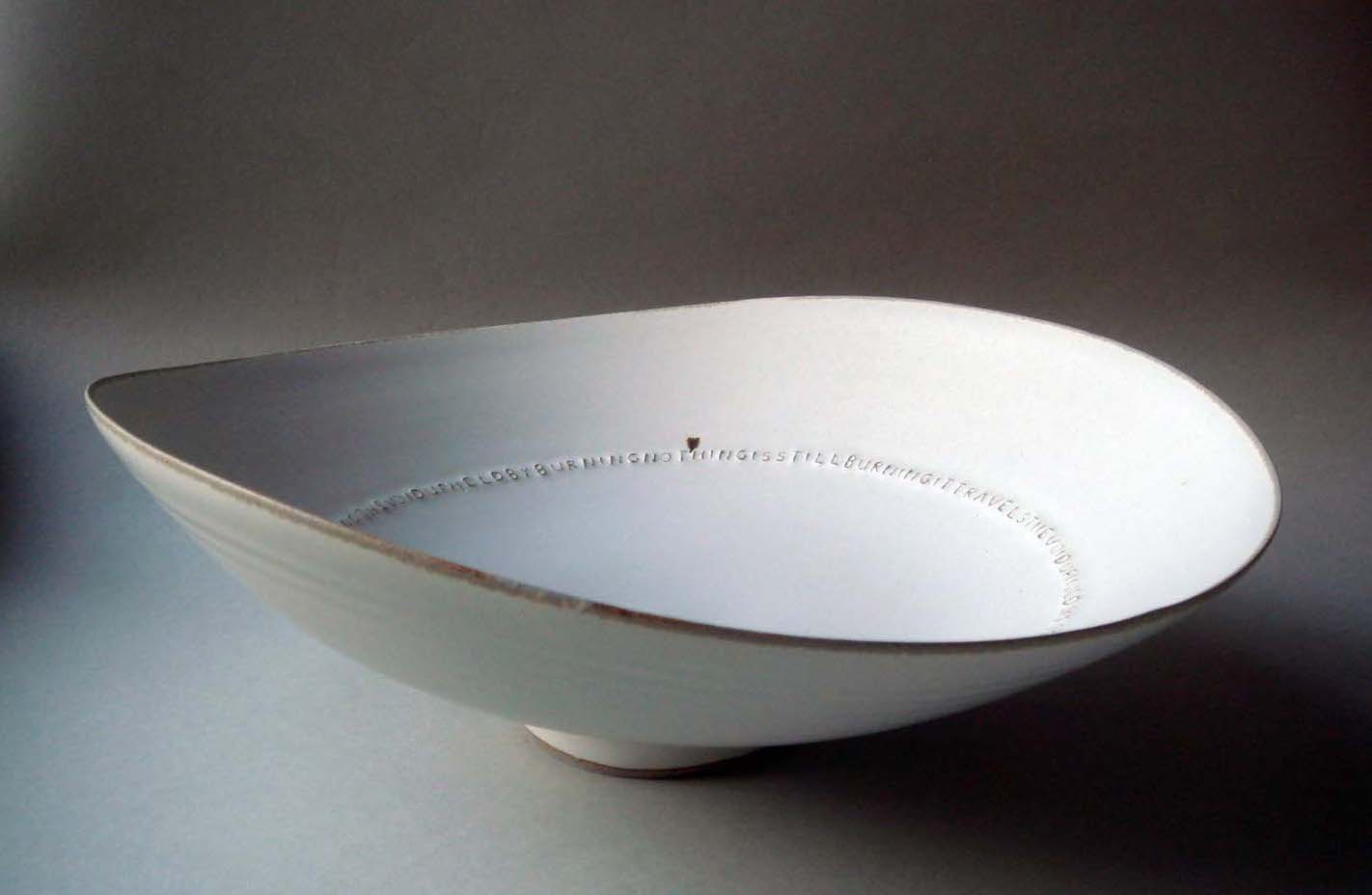
Image: Rupert Spira’s Open Bowl, 2007, a stoneware piece with embossed text under white titanium glaze. Acquired by Friends of the V&A in 2013.

Link to the Rupert Spira talk:https://www.youtube.com/watch?v=LyyojKcGDNY&t=1417s

About Rupert Spira, Wikipedia:https://en.wikipedia.org/wiki/Rupert_Spira

death and life in buddhism

Excerpts from: Care of the Dying – Buddhism HSE: Samye Ling, “Buddhism and Death” by Ken Holmes: “Kusala and Akusala” by Buddhistdoor Global BDG and: Abhidhamma in daily life, Chapter 10, “The First Citta in Life” by Nina Van Gorkom.

Buddhist teaching views life and death as a continuum, believing that consciousness (the spirit) continues after death and may be reborn. Death can be an opportunity for liberation from the cycle of life, death and rebirth.

Since Buddhism’s earliest days, Buddhist monks have gone to funeral grounds to meditate and contemplate death. This may seem macabre, to a modern Western mind, but for monks it is an invaluable and time-saving device. Most people have to wait decades – until parents or spouses die – to go through the unique learning cycle afforded by observing death at close hand; to see the biological shell as a guest-house in which the travelling consciousness sojourns but briefly, soon to go on to another place. This almost endless, age-old journey will involve staying in hundreds, thousands, of such temporary residences until liberating truths finally release the weary traveller.
Observing this ephemeral fragility of life can lead to an awakened appreciation of every precious moment of life. Each hour, each day, becomes a fresh opportunity for working for the long-term spiritual well-being rather than inconsequential material pleasure. On a deeper level, death is not only a physical reality but also a powerful metaphor for the psychological death of ego which must occur before the mind is liberated into limitless wisdom.

We are born in planes of existence where we can experience objects through the sense-organs. During previous lives as well as the present life we experienced colour, sound and other sense-objects. We were clinging to these objects in the past and we are clinging to them at present again and again, so that attachment has become a deep-rooted tendency. Attachment does not arise with each moment of consciousness, citta, but the tendency to attachment is “carried on” from one moment to the next moment, from life to life.

Cittas (moments of consciousness) arise and fall away and succeed one another, thus each citta conditions the next one. The last citta of the previous life (dying-consciousness) was succeeded by the first citta of this life. That is why tendencies one had in the past can continue by way of accumulation from one citta to the next one and from past lives to the present life. Since people accumulated different tendencies in past lives they are born with different tendencies and inclinations.

Since the first citta of a lifespan performs the function of rebirth there is only one patisandhi-citta in a life. There is no self which transmigrates from one life to the next life; there is only nama (mind) and rupa (body) rising and falling away. The present life is different from the past life but there is continuity in so far as the present life is conditioned by the past. Since the patisandhi-citta succeeds the last citta of the previous life the accumulated tendencies of past lives go on to the patisandhi-citta. Thus, inclinations one has in the present life are conditioned by the past.

There are many different types of citta and they can be classified by way of four groups: kusala cittas (wholesome cittas) akusala cittas (unwholesome cittas) vipakacittas (cittas which are result) kiriyacittas (cittas which are neither cause nor result). We may not know that both in a sense-door process (body) and in a mind-door process (mind) there are akusala cittas or kusala cittas arising. Because of our accumulated ignorance we do not clearly know our akusala cittas and kusala cittas and we do not recognize our more subtle defilements.

In Buddhism, all moral good and moral evil can be traced to six radical roots. All moral evil spring from the three radical roots of lobha (greed, covetousness), dosa (hatred, aversion) and moha (ignorance, delusion, mental confusion). All defilements and all unwholesome mental dispositions that manifest themselves either mentally, vocally or physically come into being. On the contrary, all moral good can be traced to three radical roots of alobha (non-greed, non-covetousness), adosa (non-hatred, non-aversion) and amoha (non-delusion, absence of ignorance). In other words, generosity, compassionate love and wisdom.

A mind obsessed with greed, malice and delusion is in bondage. It fails to see things in their proper pespective, and prevents one from acting properly. Thus it is called akusla or unskillful.

When kusala qualities are dominant, we experience mental health (arogya), mental purity (anavajjata), dexterity (cheka), mental felicity (sukha-vipaka). Such a mind is healthy and skillful.

It is said that kusala leads to Nibbana, the ultimate goal in Buddhism for nibbana means the complete elimination of all traces of self-eccentricity and ego-centric impulses. The more selfless acts (kusala) are done, the more selfless we become, and the closer we come to the realization of nibbana.

Hence, we must be mindful at all times for kusala and akusala thoughts and actions take us to opposite directions. We are the architects of our own fate. We are our own creators and destroyers.  We build our own heavens and hells.

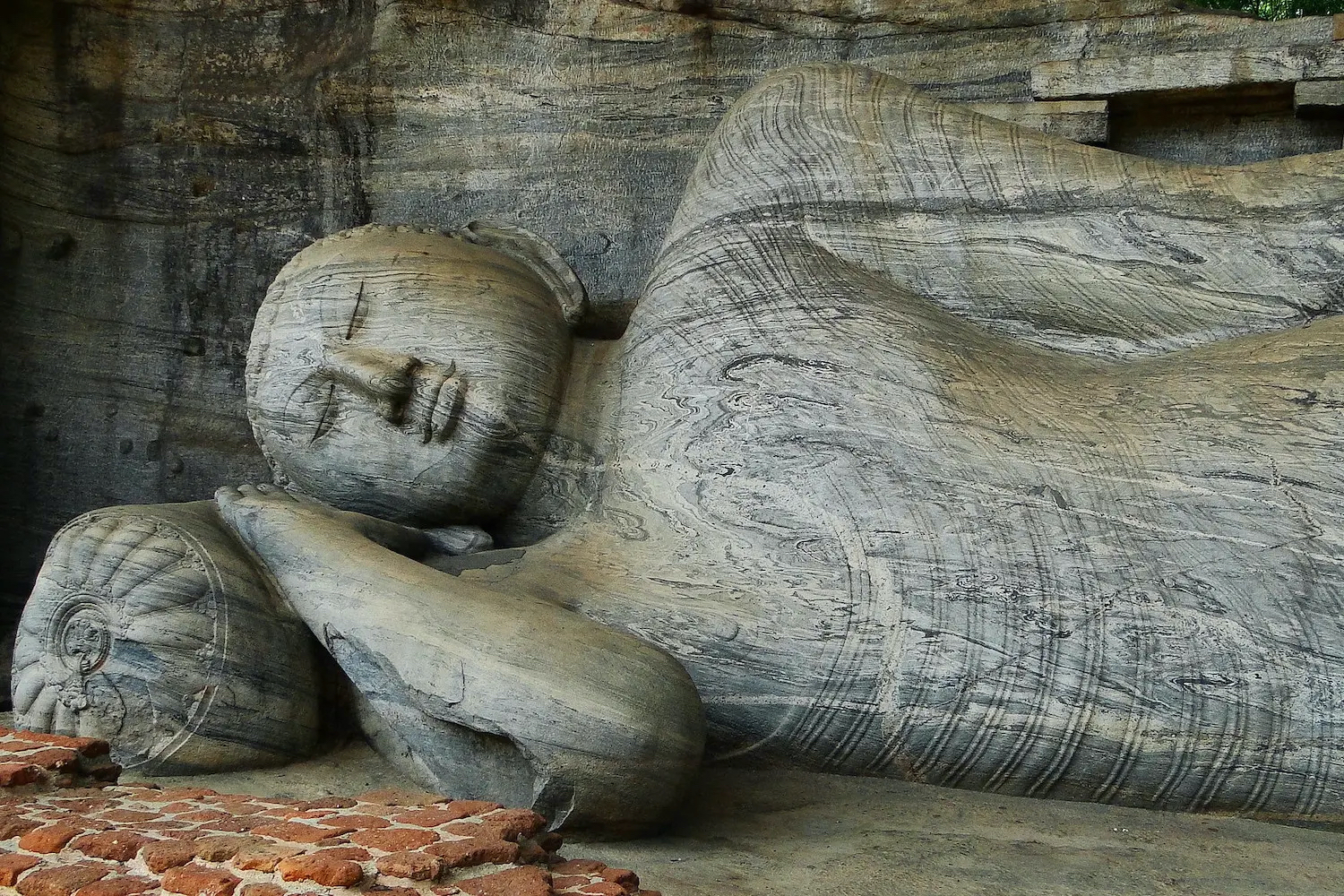
https://www.wildmind.org/blogs/on-practice/parinirvana-day-authors

Image source: Parinirvana Buddha

all the myriad things

“The doing is done but there is no doer. The principle of doerless doing must be taken up and utilized in our daily lives. Whether we’re eating, sitting, laying down, walking, using, seeking, whatever we’re doing we must have enough truth-discerning awareness to prevent the arising of ‘I’ – the feeling that ‘I’ am the doer. ‘I’ am the eater, the walker, the sitter, the sleeper, or the user. We must make the mind constantly empty of ego, so that emptiness is the natural state and we abide with the awareness that there is nothing worth having or being.” [Buddhadasa Bhikkhu, “Heartwood from the Bo Tree”]

Emptiness means that there is no feeling of ‘self’ or ‘belonging to self’, there is no feeling of ‘I’ and ‘mine’, which are the creations of craving and grasping. Being void of these things is ‘being empty’. What is it that is empty? It is the mind that is empty, emptied of the feelings of ‘self’, and of ‘belonging to self’, both in their crude and subtle forms. If the mind is empty to the degree of being free of even the most refined sense of self it is said that the mind is itself emptiness. This agrees with the teaching that mind is emptiness, emptiness is mind; emptiness is Buddha, Buddha is emptiness, emptiness is Dhamma, Dhamma is emptiness. There is only one thing… all the myriad things that we are acquainted with are nothing but emptiness.

The characteristic of all things is emptiness. This phrase ‘all things’ must be understood correctly as encompassing every single thing from a speck of dust up to Nibbana. It must be well understood that in a speck of dust there is emptiness or absence of self, absence of a permanent, independent entity. The mind and heart, thoughts and feelings, each thing is characterized by emptiness, absence of a permanent, independent entity.

The Buddhist Teachings, the study and practice of Dhamma have the characteristic of an absence of a permanent, independent entity. All the way through to the final Path Realizations, their Fruits and Nibbana itself, have this same characteristic, it’s just that we don’t see it. Even a sparrow flying to-and-fro has the characteristic of emptiness but we don’t see it. All things display the characteristic of emptiness, it’s just that we don’t see it.

The word ’empty’ also refers to the characteristic of the mind that is free from all grasping and clinging. Although the mind is empty of self, it doesn’t realize that it is empty, because ordinarily, it is constantly enveloped and disturbed by the conceptual thought that feeds on sense contact.

As a result, the mind is neither aware of its own emptiness nor the emptiness in all things. But whenever the mind completely throws off that which is enveloping it, the grasping and clinging of delusion and ignorance, and detaches from it completely, then the mind, through its non-clinging has the characteristic of emptiness.

Because all things do truly have the characteristic of being empty of a self, no permanent, independent entity to be grasped at or clung to, we are able to see the truth of emptiness. Thus, the mind seeing emptiness in all things collapses into itself, leaving only emptiness. It becomes emptiness and sees everything as emptiness. Material objects, people, animals, time and space, every sort of dhamma melts into emptiness through knowing this truth. The word empty is the remainderless extinction of ‘I’ and ‘mine’, the utter destruction of self.

So, how should we practice during those times when the mind is free of association with sense objects? Maybe we are doing some kind of work alone and unconcerned, performing our daily tasks or of practicing formal meditation. There is nothing arising from sense-contact. We may be reading a book or even thinking about something, as long as the mind is undisturbed by sense-contact. At such times our practice must be the study and clarification of the way in which things are empty and the way in which to make the mind empty and free of delusion. Think about it, study it for yourself, enquire from others, and discuss it regularly. Keep doing it.

Excerpts from three talks given by Ajahn Buddhadasa to a Dhamma study group in Siriraj Hospital, Bangkok in 1961 and 1962.

Dhammafootsteps, Postcards# 375,374, 373, 372

Image by Bella White, source: https://www.pexels.com/photo/body-of-water-and-seashore-during-sunset-635426/

soaring summits of silence

Excerpts from the Introduction to: “Mindfulness, Bliss, and Beyond,” by Ajahn Brahm

During meditation we should not develop a mind that accumulates and holds on to things. Instead, we should develop a mind that is willing to let go, to give up all the burdens we carry like so many heavy suitcases. In meditation unload as much baggage as you can. Think of duties and achievements as heavy weights pressing upon you. Abandon them freely without looking back. This attitude of mind that inclines to giving up will lead you into deep meditation.

Meditators are like birds that soar through the sky and rise to the peaks. It is on such summits of perception that meditators will understand, from their own direct experience, what we call “mind” and the nature of what we call “self,’ “God,” “the world,” “the universe,” the whole lot. It’s there that they become enlightened – not in the realms of thought, but on the soaring summits of silence within their mind.

“Mindfulness, Bliss, and Beyond” is a guided tour through the world of timeless Buddhist rapture. It describes how meditation literally implodes into the supreme bliss of the jhānas and how such states of letting go lift the veil of our fives senses, to reveal the awesome world of the mind, the magic inner garden where enlightenment is reached.

In the Mahāsaccaka sutta (MN 36) the Buddha relates, “I considered:… ‘Could that [jhāna] be the path to enlightenment?’ Then following on that memory, came the realization, ‘That is the path to enlightenment.’”

Image: detail of a photo by Simon Berger (Unsplash)

disembodied beauty

Excerpts from Mindfulness, Bliss, and Beyond: A Meditator’s Handbook by Ajahn Brahm.

[Note: The following is the beginning of the meditational guide that takes the reader to the jhānas, the higher states of bliss. Ajahn Brahm explains that even though the jhānas may seem distant and unreachable, for some meditators, discussing such sublime states can create inspiration, as well as map out the territory ahead. Some readers may have already gotten close enough to be able to understand this discussion from their own experience, and it may help them to make that last leap into the jhānas – eventually the seeds that are planted in this kind of discussion will someday bear fruit.]

It would be marvellous for each one of us if we could abandon all inner speech and abide in silent awareness of the present moment long enough to realize how delightful it is. Silence is so much more productive of wisdom and clarity than thinking. When one realizes that, silence becomes more attractive and important. The mind inclines toward it, seeks it out constantly, to the point where it engages in the thinking process only if it is really necessary, only if there is some point to it.

Once we have realized that most of our thinking gets us nowhere, we gladly and easily spend much time in inner quiet. Turn the awareness onto the breath and follow that breath from moment to moment without interruption. Notice the arising of inner speech and the mind’s tendency to go off into the past or future. Come back to the breath, and see how your attention expands to take in every single moment of the breath.

You know the inbreath at the very first moment, when the first sensation of inbreathing arises. Then you observe as those sensations develop gradually through the whole course of one inbreath, not missing even a moment of the in-breath. When that in-breath finishes, you know that moment. You see in your mind that last movement of the in-breath. You then see the next moment as a pause between breaths, and then many more moments of pause until the out-breath begins. You see the first moment of out-breathing and each subsequent sensation as the out-breath evolves, until the out-breath disappears when its function is complete. All this is done in silence and in the present moment.

You can attain this degree of stillness by letting go of everything in the entire universe except for this momentary experience of the breath happening silently. Actually “you” do not reach this stage, the mind does. This is where the doer, the major part of one’s ego, starts to disappear. One finds that progress happens effortlessly at this stage of meditation. We just have to get out of the way, let go, and watch it all happen. The mind will automatically incline toward this very simple, peaceful, and delicious unity of being alone with one thing, just being with the breath in each and every moment. This is the unity of mind, the unity in the moment, the unity in stillness.

The Beautiful Breath

This is what I call the “springboard” of meditation, because from it one may dive into the blissful states. When we simply maintain this unity of consciousness by not interfering, the breath will begin to disappear. The breath appears to fade away as the mind focuses instead on what is at the center of the experience of breath, which is awesome peace, freedom, and bliss.

When the breath disappears, all that is left is “the beautiful.” Disembodied beauty becomes the sole object of the mind. The mind is now taking the mind as its own object of contemplation. We are no longer aware of the breath, body, thought, sound, or outside world. All that we are aware of is beauty, peace, bliss, light, or whatever our perception will later call it. We are experiencing only beauty, continuously, effortlessly, with nothing being beautiful! We have long ago let go of chatter, let go of descriptions and assessments. Here the mind is so still that it cannot say anything. One is just beginning to experience the first flowering of bliss in the mind. That bliss will develop, grow, and become very firm and strong. And then one may enter into the jhānas.

The book has been extensively discussed in dhammafootsteps, Click on the link below for a more detailed presentation

Photo by Simon Berger

there’s no need to be busy

Excerpts from “The Path to Peace: A Buddhist Guide to Cultivating Loving-Kindness” by Ayya Khema

There’s no need to be busy. We should of course fulfill our obligations and responsibilities. The Buddha always gave guidelines in that direction. But to be overly busy cannot possibly bring peacefulness. It cannot bring contentment. It cannot bring a heart full of love; it cannot bring a heart that can actually bring the mind to meditation. So, we should check our activities and see which ones are totally unnecessary. And we should see whether, with the activities that we do, we are not only trying to escape our own suffering (dukkha) but also trying to prove something to ourselves and others—that we are somebody. The more we try to prove that we are somebody, the less we have a chance to become nobody. And that’s what nirvana is all about. It doesn’t sound appealing to some people, because they haven’t had enough dukkha yet. When we’ve had enough dukkha with the somebody, we can actually appreciate the fact that there’s only one way to get out of dukkha, and that’s being nobody.

We have the wealth of absolute truth, of immeasurable love and compassion—the whole wealth of the universe within us. It’s just waiting to be discovered. But within the hustle and bustle of morning-to-evening activity, we’ll never manage to find it. It’s like a golden treasure that is lying within us, that we can actually touch upon through the quiet mind. Anyone can do it, but they’ve got to become quiet. And we’ve got to stop trying to be something special. Only then can we get at it, and then, having found it, we can share it. That’s what the Buddha did. He shared it for forty-five years. With a few thousand people. And today we’re sharing it with five hundred million. That’s the value of enlightenment.

So, we have that treasure. But if we really get busy, we have no way of unlocking that treasure chest. Unlocking it takes time, and it takes the quiet mind, the contented mind, the satisfied mind. It needs the mind which knows that there is something to be found far beyond anything at all that we can ever find in the world. And then we will make an attempt at checking out what is really necessary to do.

Whatever we do out of compassion is well done. And this should be our checkpoint: what am I doing out of compassion, and what am I doing in order to assert that I am really here and to let as many people know about it as possible, and what am I doing in order to get out of my dukkha to keep busy? But whatever I do out of compassion, that is what we should pursue.

Ayya Khema (1923–1997) was an international Buddhist teacher, and the first Western woman to become a Theravada Buddhist nun. An advocate of Buddhist women’s rights, in 1987 she helped coordinate the first conference for the Sakyadhita International Association of Buddhist Women in Bodh Gaya, India.

selflessness

Excerpts from “A Path With Heart: A Guide Through the Perils and Promises of Spiritual Life” by Jack Kornfield (1993)

When Buddhists speak of emptiness and of no self, what do they mean? Emptiness does not mean that things don’t exist, nor does “no self” mean that we don’t exist. Emptiness refers to the underlying nonseparation of life and the fertile ground of energy that gives rise to all forms of life. Our world and sense of self is a play of patterns.

Any identity we can grasp is transient, tentative. When we are silent and attentive, we can sense directly how we can never truly possess anything in the world. Clearly, we do not possess outer things. We are in some relationship with our cars, our home, our family, our jobs, but whatever that relationship is, it is “ours” only for a short time. In the end, things, people, or tasks die or change or we lose them. Nothing is exempt.

We encounter another aspect of the emptiness of self when we notice how everything arises out of nothing, comes out of the void, returns to the void, goes back to nothing. All our words of the past day have disappeared. Similarly, where has the past week or the past month or our childhood gone? They arose, did a little dance, and now they’ve vanished, along with the twentieth century, the nineteenth and eighteenth centuries, the ancient Romans and Greeks, the Pharaohs, and so forth. All experience arises in the present, does its dance, and disappears. Experience comes into being only tentatively, for a little time in a certain form; then that form ends and a new form replaces it moment by moment.

As we open and empty ourselves, we come to experience an interconnectedness, the realization that all things are joined and conditioned in an interdependent arising. Each experience and event contains all others. The teacher depends on the student, the airplane depends on the sky.

When a bell rings, is it the bell we hear, the air, the sound on our cars, or is it our brain that rings? It is all of these things. As the Taoists say, “The between is ringing.” The sound of the bell is here to he heard everywhere—in the eyes of every person we meet, in every tree and insect, in every breath we take…

When we truly sense this interconnectedness and the emptiness out of which all beings arise, we find liberation and a spacious joy. Discovering emptiness brings a lightness of heart, flexibility, and an ease that rests in all things. The more solidly we grasp our identity, the more solid our problems become. Once I asked a delightful old Sri Lankan meditation master to teach me the essence of Buddhism. He just laughed and said three times, “No self, no problem.”

Jack Kornfield was trained as a Buddhist monk in Thailand, Burma, and India, and holds a Ph.D. in clinical psychology. He is a psychotherapist and founding teacher of the Insight Meditation Society and the Spirit Rock Center. His books include Seeking the Heart of Wisdom and Still Forest Pool.

Image: Giant Buddha statue under construction at the Khai Nguyen Pagoda in Son Tay, on the outskirts of Hanoi, Vietnam, on May 18, 2019

Guanyin, gender-neutral bodhisattva

The Guanyin of Nanshan is a 108-metre statue of the bodhisattva Guanyin, sited on the south coast of China’s island province Hainan near the Nanshan Temple of Sanya.

Guanyin is the Chinese translation of Avalokiteśvara, the bodhisattva of compassion. Bodhisattvas are enlightened beings who chose to stay on earth as accessible examples for Buddhist faithful to follow. Originally depicted as a male or gender-neutral entity able to take on thirty-three manifestations, Avalokiteśvara is a compassionate savior who hears the woes of humankind, regardless of age, gender, or social class.

https://www.metmuseum.org/art/collection/search/42731

However, in imperial China, Guanyin became increasingly cemented as a female figure. Similar to the Virgin Mary, Guanyin became a popular intercessor for humanity to understand divine salvation. While there are a few different names to refer to this Bodhisattva, there are even more different forms that Guanyin can take when appearing to sentient beings in order to guide them away from suffering.

Traditionally, China was a very patriarchal society; a system reinforced by Confucian principles which put pressure on women to obey their husbands and give birth to sons (instead of daughters). As a result, women were generally the ones asking for Guanyin’s help in order to achieve these goals. In addition, it was thought that a woman must commit to one man for her whole life (even after his death), therefore it seemed more appropriate for a woman to worship a deity in female form. In this way, Guanyin starts to take on more feminine qualities such as kindness and grace and, in female form, she is seen as more accessible to women.

It is believed that Guanyin is androgynous or perhaps without gender. According to the Mahāyāna sūtras, it makes no difference whether Guanyin is male, female, or genderless, as the ultimate reality is in emptiness (Skt. śūnyatā). Guanyin can take the form of any type of God including Indra or Brahma; any type of Buddha, as well as any gender male or female, adult or child, human or non-human being, in order to teach the Dharma to all sentient beings.

This post comprises excerpts from:

Wikipedia Guanyin page

Guanyin: the Bodhisatva of Great Compassion

the fifth hindrance – doubt

POSTCARD#438: Bangkok: Doubt can be toward the teaching, about the teacher, or toward yourself. Regarding doubt toward the teaching, you should have enough confidence by now to know that some beautiful results come from practicing meditation. You may have experienced many of them already. Allow those positive experiences to strengthen your confidence that meditation is worthwhile. Sitting in meditation, developing the mind in stillness, and especially developing the mind in jhānas are all tremendously worthwhile and will give you clarity, happiness, and understanding of the Buddha’s teachings.

With regard to teachers, they are often like coaches of sports teams. Their job is to teach from their own experience and, more important, to inspire students with words and deeds. But before you put your confidence in a teacher, check them out. Observe their behavior and see for yourself if they are practicing what they preach. If they really know what they are talking about, then they will be ethical, restrained, and inspiring. Only if teachers lead by example—a good example, that is—should you place your confidence in them.

Self-doubt—which thinks, “I’m hopeless, I can’t do this, I’m useless, I’m sure everyone else who practices meditation, except me, has got jhānas and is already enlightened”—is often overcome with the help of a teacher who inspires and encourages you. It’s the teacher’s job to say, “Yes, you can achieve all of these things. Many other people have achieved them, so why not you?” Give yourself encouragement. Have confidence that you can achieve whatever you want. In fact, if you have sufficient determination and confidence, then it’s only a matter of time before you succeed. The only people who fail are those who give up.

Doubt can also be directed toward what you are experiencing now: “What is this? Is this jhāna? Is this present-moment awareness?” Such doubts are hindrances. They are inappropriate during meditation. Just make the mind as peaceful as you can. Let go and enjoy the peace and happiness. Afterward, you can review the meditation and ask, “What was that? That was really interesting. What was happening there?” That’s when you’ll find out whether or not it was a jhāna. If while meditating the thought “Is this jhāna?” arises, then it cannot be jhāna! Thoughts like that can’t come up within these deep states of stillness. Only afterward, when you review those states, can you look back and say, “Ah, that was a jhāna.”

If you get into any difficulty in your meditation, stop and ask yourself, “Which of the hindrances is this?” Find out what the cause is. Once you know the cause, then you can remember the solution and apply it. If it’s sensory desire, just take the attention away from the five senses little by little and apply it to the breath or the mind. If it’s ill will, do some loving-kindness. For sloth and torpor, remember “give value to awareness.” If it’s restlessness and remorse, remember “contentment, contentment, contentment” or practice forgiveness. And if it’s doubt, be confident and be inspired by the teachings. Whenever you meditate, apply the solutions methodically. That way, the obstacles you experience won’t create long-term barriers. They’re things that you can recognize, overcome, and move beyond.

Preview of next week’s text:

“All the Hindrances emanate from a single source. They are generated by the control freak inside of you that refuses to let things go. Meditators fail to overcome the hindrances because they look for them in the wrong place. It is crucial to success in meditation to understand that the hindrances are to be seen at work in the space between the knower and the known. The hindrances’ source is the doer, their result is lack of progress, but their workshop is the space between the mind and its meditation object. Essentially, the five hindrances are a relationship problem.”

More next week Saturday 02 October 2021

the second hindrance – ill will

POSTCARD#435: Bangkok: [Editors note: Last week we learned something about how the hindrances stop you from entering into the jhānas. This week we understand the extent to which Ill Will (vyāpāda) obstructs or weakens wisdom and strengthens delusion.] Text begins here: The second hindrance, ill will or vyāpāda, is a major obstacle to deep meditation, especially for Western meditators. The usual understanding of this second hindrance is anger toward another person. But that is not the full extent of ill will, because it is more likely to be toward yourself or even toward the meditation object.

Ill Will toward Yourself

Ill will toward yourself can manifest as not allowing yourself to bliss out, become peaceful, or become successful in meditation. There are many people who have very deep guilt complexes. This is mostly a Western trait because of the way that many of us have been brought up. Ill will toward yourself is something that you should watch out for in meditation. It may be that is the main hindrance that’s stopping you from getting deep into meditation.

We feel we don’t deserve so much bliss. You do deserve so much bliss! Why should you not? There’s nothing against it. There are some kinds of bliss in this world that are illegal. There are others that break the Buddhist precepts, cause disease, or have terrible side effects. But jhānas have no bad side effects, they’re not illegal, and the Buddha specifically encouraged them. If you look very carefully at the way you meditate, you may find that you encounter the hindrance of ill will, but not at that last step before jhānas. You encounter it at some earlier stage of meditation. An aversion to inner happiness is a sure sign of guilt. When someone is found guilty, punishment usually follows – guilt and punishment are inseparable in our culture and in our minds. If we feel guilty about something, the next thing we think of is punishing ourselves—denying ourselves some type of pleasure, happiness, or freedom.

Goodwill toward Yourself

To overcome that hindrance of Ill-Will, do some loving-kindness meditation. Give yourself a break. Say to yourself, “The door to my heart is open to all of me. I allow myself happiness. I allow myself peace. I have goodwill toward myself, enough goodwill to let myself become peaceful and to bliss out on this meditation.” If you find it hard to extend loving-kindness toward yourself, ask why. There may be a deep-seated guilt complex inside, and you still expect punishment. You haven’t given yourself unconditional forgiveness.

A beautiful ethic of Buddhism is that it does not matter what anyone else does to you or how long they have done it to you; it doesn’t matter how unfair, cruel, or undeserving their treatment has been—you may still forgive them absolutely. I hear people saying that sometimes there are things you cannot forgive. That’s not Buddhism! There’s nothing, absolutely nothing, you can’t forgive in Buddhism. Some years ago, a demented man went to a primary school in Scotland and killed many small children. At the religious service after the massacre, a prominent cleric asked God not to forgive this man, arguing that some things you cannot forgive! My heart sank when I heard that a religious leader would not offer forgiveness and show the way to heal people’s pain in the aftermath of tragedy.

As far as Buddhism is concerned, you can forgive everything. Your forgiveness is healing. Your forgiveness solves old problems and never creates new ones. But because of ingrained attitudes you may have toward yourself, you think you cannot forgive yourself. Sometimes the problem is buried deep inside – it could be you’ve forgotten how things ended up like this, you just know there is something inside of you that you feel guilty about, that you can’t forgive. You have some reason for denying yourself freedom, jhāna, and enlightenment. That ill will toward yourself may be the main reason why your meditation is not successful. Check that one out.

Ill Will toward the Meditation Object

Ill will toward the meditation object is a common problem for people who have been meditating on the breath without much success yet. I say “yet” because it’s only a matter of time to me . Everyone will have success if they follow the instructions. But if you haven’t succeeded yet, you may have some ill will toward meditation or the meditation object. You may sit down and think, “Oh, here we go again,” “This is going to be difficult,” “I don’t really want to do this,” “I have to do this because it’s what meditators do,” or “I’ve got to be a good Buddhist, and this is what Buddhists are supposed to do.” If you start the meditation with ill will toward meditation, doing it but not liking it, then it’s not going to work. You are putting a hindrance in front of yourself straight-away.

I love meditation. I enjoy it so much. Once when I led a meditation retreat I said to my fellow monks upon arriving, “Great, a meditation retreat!” I got up early every morning really looking forward to it. “Wow, I’m on meditation retreat. I don’t have to do all the other stuff that I do in the monastery.” I love meditation so much, and I’ve got so much goodwill toward it that there isn’t the slightest bit of aversion. Basically I’m a “meditation junkie,” and if you’ve got that sort of attitude, then you find that the mind, as the Buddha said, “leaps toward meditation” (AN IX, 41). As for the meditation object, the breath, we’ve had such good times together, my breath and I. We’re the best of friends. If you regard the breath with that sort of goodwill, you can see why it’s so easy to watch the breath in your meditation.

The opposite, of course, is when you know you have to be with the breath and you don’t like it. You’ve had so much difficulty with the breath, you just want to escape. Unfortunately people do develop such ill will toward the breath. If it’s not pointed out to them, they will regard meditation as a chore. There’s no happiness in it. It becomes something like weight-lifting: “No pain, no gain.” You lift weights until it really hurts – if that’s the way you enter meditation, then you’ve got no hope.

So cultivate goodwill toward the meditation object. Program yourself to delight in this meditation. Think, “Wow! Beautiful! All I’ve got to do is just sit and do nothing else—nothing to build, no letters to write, no phone calls to make. I just need to sit here and be with my good old friend, my breath.” If you can do that, you’ve abandoned the hindrance of ill will, and you’ve developed the opposite—loving-kindness toward your breath.

To sum up, ill will is a hindrance, and you overcome that hindrance by compassion to all others, forgiveness toward yourself, loving-kindness toward the meditation object, goodwill toward the meditation, and friendship toward the breath. You can have loving-kindness toward silence and the present moment too. When you care for these friends who reside in the mind, you overcome any aversion toward them as meditation objects. When you have loving-kindness toward the meditation object, you do not need much effort to hold it. You just love it so much that it becomes effortless to be with.

Image note: Buddha-Maitreya will be the fifth and future Buddha of the bhadrakalpa, and his arrival will occur after the teachings of Gautama Buddha are no longer practiced

Text continued next week: 10 September 2021