Excerpts from “The Path to Peace: A Buddhist Guide to Cultivating Loving-Kindness” by Ayya Khema
There’s no need to be busy. We should of course fulfill our obligations and responsibilities. The Buddha always gave guidelines in that direction. But to be overly busy cannot possibly bring peacefulness. It cannot bring contentment. It cannot bring a heart full of love; it cannot bring a heart that can actually bring the mind to meditation. So, we should check our activities and see which ones are totally unnecessary. And we should see whether, with the activities that we do, we are not only trying to escape our own suffering (dukkha) but also trying to prove something to ourselves and others—that we are somebody. The more we try to prove that we are somebody, the less we have a chance to become nobody. And that’s what nirvana is all about. It doesn’t sound appealing to some people, because they haven’t had enough dukkha yet. When we’ve had enough dukkha with the somebody, we can actually appreciate the fact that there’s only one way to get out of dukkha, and that’s being nobody.
We have the wealth of absolute truth, of immeasurable love and compassion—the whole wealth of the universe within us. It’s just waiting to be discovered. But within the hustle and bustle of morning-to-evening activity, we’ll never manage to find it. It’s like a golden treasure that is lying within us, that we can actually touch upon through the quiet mind. Anyone can do it, but they’ve got to become quiet. And we’ve got to stop trying to be something special. Only then can we get at it, and then, having found it, we can share it. That’s what the Buddha did. He shared it for forty-five years. With a few thousand people. And today we’re sharing it with five hundred million. That’s the value of enlightenment.
So, we have that treasure. But if we really get busy, we have no way of unlocking that treasure chest. Unlocking it takes time, and it takes the quiet mind, the contented mind, the satisfied mind. It needs the mind which knows that there is something to be found far beyond anything at all that we can ever find in the world. And then we will make an attempt at checking out what is really necessary to do.
Whatever we do out of compassion is well done. And this should be our checkpoint: what am I doing out of compassion, and what am I doing in order to assert that I am really here and to let as many people know about it as possible, and what am I doing in order to get out of my dukkha to keep busy? But whatever I do out of compassion, that is what we should pursue.
Ayya Khema (1923–1997) was an international Buddhist teacher, and the first Western woman to become a Theravada Buddhist nun. An advocate of Buddhist women’s rights, in 1987 she helped coordinate the first conference for the Sakyadhita International Association of Buddhist Women in Bodh Gaya, India.
Excerpts from “A Path With Heart: A Guide Through the Perils and Promises of Spiritual Life” by Jack Kornfield (1993)
When Buddhists speak of emptiness and of no self, what do they mean? Emptiness does not mean that things don’t exist, nor does “no self” mean that we don’t exist. Emptiness refers to the underlying nonseparation of life and the fertile ground of energy that gives rise to all forms of life. Our world and sense of self is a play of patterns.
Any identity we can grasp is transient, tentative. When we are silent and attentive, we can sense directly how we can never truly possess anything in the world. Clearly, we do not possess outer things. We are in some relationship with our cars, our home, our family, our jobs, but whatever that relationship is, it is “ours” only for a short time. In the end, things, people, or tasks die or change or we lose them. Nothing is exempt.
We encounter another aspect of the emptiness of self when we notice how everything arises out of nothing, comes out of the void, returns to the void, goes back to nothing. All our words of the past day have disappeared. Similarly, where has the past week or the past month or our childhood gone? They arose, did a little dance, and now they’ve vanished, along with the twentieth century, the nineteenth and eighteenth centuries, the ancient Romans and Greeks, the Pharaohs, and so forth. All experience arises in the present, does its dance, and disappears. Experience comes into being only tentatively, for a little time in a certain form; then that form ends and a new form replaces it moment by moment.
As we open and empty ourselves, we come to experience an interconnectedness, the realization that all things are joined and conditioned in an interdependent arising. Each experience and event contains all others. The teacher depends on the student, the airplane depends on the sky.
When a bell rings, is it the bell we hear, the air, the sound on our cars, or is it our brain that rings? It is all of these things. As the Taoists say, “The between is ringing.” The sound of the bell is here to he heard everywhere—in the eyes of every person we meet, in every tree and insect, in every breath we take…
When we truly sense this interconnectedness and the emptiness out of which all beings arise, we find liberation and a spacious joy. Discovering emptiness brings a lightness of heart, flexibility, and an ease that rests in all things. The more solidly we grasp our identity, the more solid our problems become. Once I asked a delightful old Sri Lankan meditation master to teach me the essence of Buddhism. He just laughed and said three times, “No self, no problem.”
Jack Kornfield was trained as a Buddhist monk in Thailand, Burma, and India, and holds a Ph.D. in clinical psychology. He is a psychotherapist and founding teacher of the Insight Meditation Society and the Spirit Rock Center. His books include Seeking the Heart of Wisdom and Still Forest Pool.
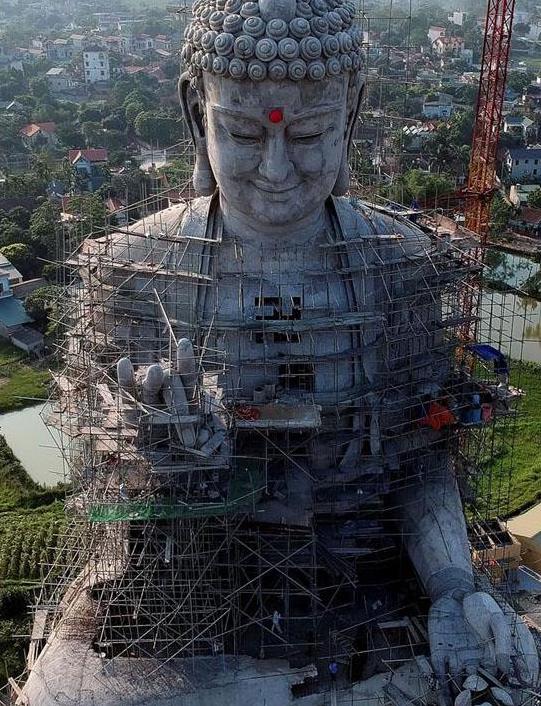
Image: Giant Buddha statue under construction at the Khai Nguyen Pagoda in Son Tay, on the outskirts of Hanoi, Vietnam, on May 18, 2019
The Guanyin of Nanshan is a 108-metre statue of the bodhisattva Guanyin, sited on the south coast of China’s island province Hainan near the Nanshan Temple of Sanya.
Guanyin is the Chinese translation of Avalokiteśvara, the bodhisattva of compassion. Bodhisattvas are enlightened beings who chose to stay on earth as accessible examples for Buddhist faithful to follow. Originally depicted as a male or gender-neutral entity able to take on thirty-three manifestations, Avalokiteśvara is a compassionate savior who hears the woes of humankind, regardless of age, gender, or social class.
However, in imperial China, Guanyin became increasingly cemented as a female figure. Similar to the Virgin Mary, Guanyin became a popular intercessor for humanity to understand divine salvation. While there are a few different names to refer to this Bodhisattva, there are even more different forms that Guanyin can take when appearing to sentient beings in order to guide them away from suffering.
Traditionally, China was a very patriarchal society; a system reinforced by Confucian principles which put pressure on women to obey their husbands and give birth to sons (instead of daughters). As a result, women were generally the ones asking for Guanyin’s help in order to achieve these goals. In addition, it was thought that a woman must commit to one man for her whole life (even after his death), therefore it seemed more appropriate for a woman to worship a deity in female form. In this way, Guanyin starts to take on more feminine qualities such as kindness and grace and, in female form, she is seen as more accessible to women.
It is believed that Guanyin is androgynous or perhaps without gender. According to the Mahāyāna sūtras, it makes no difference whether Guanyin is male, female, or genderless, as the ultimate reality is in emptiness (Skt. śūnyatā). Guanyin can take the form of any type of God including Indra or Brahma; any type of Buddha, as well as any gender male or female, adult or child, human or non-human being, in order to teach the Dharma to all sentient beings.
POSTCARD#438: Bangkok: Doubt can be toward the teaching, about the teacher, or toward yourself. Regarding doubt toward the teaching, you should have enough confidence by now to know that some beautiful results come from practicing meditation. You may have experienced many of them already. Allow those positive experiences to strengthen your confidence that meditation is worthwhile. Sitting in meditation, developing the mind in stillness, and especially developing the mind in jhānas are all tremendously worthwhile and will give you clarity, happiness, and understanding of the Buddha’s teachings.
With regard to teachers, they are often like coaches of sports teams. Their job is to teach from their own experience and, more important, to inspire students with words and deeds. But before you put your confidence in a teacher, check them out. Observe their behavior and see for yourself if they are practicing what they preach. If they really know what they are talking about, then they will be ethical, restrained, and inspiring. Only if teachers lead by example—a good example, that is—should you place your confidence in them.
Self-doubt—which thinks, “I’m hopeless, I can’t do this, I’m useless, I’m sure everyone else who practices meditation, except me, has got jhānas and is already enlightened”—is often overcome with the help of a teacher who inspires and encourages you. It’s the teacher’s job to say, “Yes, you can achieve all of these things. Many other people have achieved them, so why not you?” Give yourself encouragement. Have confidence that you can achieve whatever you want. In fact, if you have sufficient determination and confidence, then it’s only a matter of time before you succeed. The only people who fail are those who give up.
Doubt can also be directed toward what you are experiencing now: “What is this? Is this jhāna? Is this present-moment awareness?” Such doubts are hindrances. They are inappropriate during meditation. Just make the mind as peaceful as you can. Let go and enjoy the peace and happiness. Afterward, you can review the meditation and ask, “What was that? That was really interesting. What was happening there?” That’s when you’ll find out whether or not it was a jhāna. If while meditating the thought “Is this jhāna?” arises, then it cannot be jhāna! Thoughts like that can’t come up within these deep states of stillness. Only afterward, when you review those states, can you look back and say, “Ah, that was a jhāna.”
If you get into any difficulty in your meditation, stop and ask yourself, “Which of the hindrances is this?” Find out what the cause is. Once you know the cause, then you can remember the solution and apply it. If it’s sensory desire, just take the attention away from the five senses little by little and apply it to the breath or the mind. If it’s ill will, do some loving-kindness. For sloth and torpor, remember “give value to awareness.” If it’s restlessness and remorse, remember “contentment, contentment, contentment” or practice forgiveness. And if it’s doubt, be confident and be inspired by the teachings. Whenever you meditate, apply the solutions methodically. That way, the obstacles you experience won’t create long-term barriers. They’re things that you can recognize, overcome, and move beyond.
Preview of next week’s text:
“All the Hindrances emanate from a single source. They are generated by the control freak inside of you that refuses to let things go. Meditators fail to overcome the hindrances because they look for them in the wrong place. It is crucial to success in meditation to understand that the hindrances are to be seen at work in the space between the knower and the known. The hindrances’ source is the doer, their result is lack of progress, but their workshop is the space between the mind and its meditation object. Essentially, the five hindrances are a relationship problem.”
POSTCARD#435: Bangkok: [Editors note: Last week we learned something about how the hindrances stop you from entering into the jhānas. This week we understand the extent to which Ill Will (vyāpāda) obstructs or weakens wisdom and strengthens delusion.] Text begins here: The second hindrance, ill will or vyāpāda, is a major obstacle to deep meditation, especially for Western meditators. The usual understanding of this second hindrance is anger toward another person. But that is not the full extent of ill will, because it is more likely to be toward yourself or even toward the meditation object.
Ill Will toward Yourself
Ill will toward yourself can manifest as not allowing yourself to bliss out, become peaceful, or become successful in meditation. There are many people who have very deep guilt complexes. This is mostly a Western trait because of the way that many of us have been brought up. Ill will toward yourself is something that you should watch out for in meditation. It may be that is the main hindrance that’s stopping you from getting deep into meditation.
We feel we don’t deserve so much bliss. You do deserve so much bliss! Why should you not? There’s nothing against it. There are some kinds of bliss in this world that are illegal. There are others that break the Buddhist precepts, cause disease, or have terrible side effects. But jhānas have no bad side effects, they’re not illegal, and the Buddha specifically encouraged them. If you look very carefully at the way you meditate, you may find that you encounter the hindrance of ill will, but not at that last step before jhānas. You encounter it at some earlier stage of meditation. An aversion to inner happiness is a sure sign of guilt. When someone is found guilty, punishment usually follows – guilt and punishment are inseparable in our culture and in our minds. If we feel guilty about something, the next thing we think of is punishing ourselves—denying ourselves some type of pleasure, happiness, or freedom.
Goodwill toward Yourself
To overcome that hindrance of Ill-Will, do some loving-kindness meditation. Give yourself a break. Say to yourself, “The door to my heart is open to all of me. I allow myself happiness. I allow myself peace. I have goodwill toward myself, enough goodwill to let myself become peaceful and to bliss out on this meditation.” If you find it hard to extend loving-kindness toward yourself, ask why. There may be a deep-seated guilt complex inside, and you still expect punishment. You haven’t given yourself unconditional forgiveness.
A beautiful ethic of Buddhism is that it does not matter what anyone else does to you or how long they have done it to you; it doesn’t matter how unfair, cruel, or undeserving their treatment has been—you may still forgive them absolutely. I hear people saying that sometimes there are things you cannot forgive. That’s not Buddhism! There’s nothing, absolutely nothing, you can’t forgive in Buddhism. Some years ago, a demented man went to a primary school in Scotland and killed many small children. At the religious service after the massacre, a prominent cleric asked God not to forgive this man, arguing that some things you cannot forgive! My heart sank when I heard that a religious leader would not offer forgiveness and show the way to heal people’s pain in the aftermath of tragedy.
As far as Buddhism is concerned, you can forgive everything. Your forgiveness is healing. Your forgiveness solves old problems and never creates new ones. But because of ingrained attitudes you may have toward yourself, you think you cannot forgive yourself. Sometimes the problem is buried deep inside – it could be you’ve forgotten how things ended up like this, you just know there is something inside of you that you feel guilty about, that you can’t forgive. You have some reason for denying yourself freedom, jhāna, and enlightenment. That ill will toward yourself may be the main reason why your meditation is not successful. Check that one out.
Ill Will toward the Meditation Object
Ill will toward the meditation object is a common problem for people who have been meditating on the breath without much success yet. I say “yet” because it’s only a matter of time to me . Everyone will have success if they follow the instructions. But if you haven’t succeeded yet, you may have some ill will toward meditation or the meditation object. You may sit down and think, “Oh, here we go again,” “This is going to be difficult,” “I don’t really want to do this,” “I have to do this because it’s what meditators do,” or “I’ve got to be a good Buddhist, and this is what Buddhists are supposed to do.” If you start the meditation with ill will toward meditation, doing it but not liking it, then it’s not going to work. You are putting a hindrance in front of yourself straight-away.
I love meditation. I enjoy it so much. Once when I led a meditation retreat I said to my fellow monks upon arriving, “Great, a meditation retreat!” I got up early every morning really looking forward to it. “Wow, I’m on meditation retreat. I don’t have to do all the other stuff that I do in the monastery.” I love meditation so much, and I’ve got so much goodwill toward it that there isn’t the slightest bit of aversion. Basically I’m a “meditation junkie,” and if you’ve got that sort of attitude, then you find that the mind, as the Buddha said, “leaps toward meditation” (AN IX, 41). As for the meditation object, the breath, we’ve had such good times together, my breath and I. We’re the best of friends. If you regard the breath with that sort of goodwill, you can see why it’s so easy to watch the breath in your meditation.
The opposite, of course, is when you know you have to be with the breath and you don’t like it. You’ve had so much difficulty with the breath, you just want to escape. Unfortunately people do develop such ill will toward the breath. If it’s not pointed out to them, they will regard meditation as a chore. There’s no happiness in it. It becomes something like weight-lifting: “No pain, no gain.” You lift weights until it really hurts – if that’s the way you enter meditation, then you’ve got no hope.
So cultivate goodwill toward the meditation object. Program yourself to delight in this meditation. Think, “Wow! Beautiful! All I’ve got to do is just sit and do nothing else—nothing to build, no letters to write, no phone calls to make. I just need to sit here and be with my good old friend, my breath.” If you can do that, you’ve abandoned the hindrance of ill will, and you’ve developed the opposite—loving-kindness toward your breath.
To sum up, ill will is a hindrance, and you overcome that hindrance by compassion to all others, forgiveness toward yourself, loving-kindness toward the meditation object, goodwill toward the meditation, and friendship toward the breath. You can have loving-kindness toward silence and the present moment too. When you care for these friends who reside in the mind, you overcome any aversion toward them as meditation objects. When you have loving-kindness toward the meditation object, you do not need much effort to hold it. You just love it so much that it becomes effortless to be with.
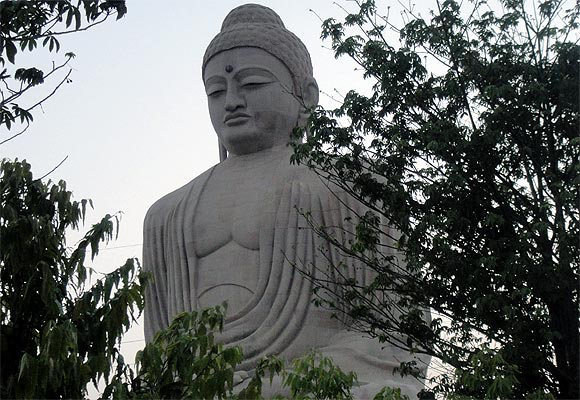
Image note: Buddha-Maitreya will be the fifth and future Buddha of the bhadrakalpa, and his arrival will occur after the teachings of Gautama Buddha are no longer practiced
POSTCARD#434: Bangkok: In this chapter and the next I will explain in detail the five hindrances, obstacles that you will meet in your meditation and that you should learn to overcome. These obstacles to deep meditation are called in the Pāli language nīvarana. Literally that means “closing a door” or “obstructing entering into something,” and this is exactly what the hindrances do. They stop you from entering into the deep absorption states, or jhānas. They also obstruct or weaken wisdom and strengthen delusion. So if one is going to say anything in Buddhism about the enemies to meditation, one can say that the five hindrances are Public Enemy Number One. They stop people from becoming enlightened, and it’s precisely for this reason that understanding these five hindrances and overcoming them is crucial. When you don’t fully understand them, you cannot overcome them. Some teachers fail to explain the hindrances clearly enough, especially the hindrances that are very subtle. These refined hindrances prevent you from getting into deep meditation. If you do not even try to identify them and surpass them, then they will hold sway over your mind. You will be obstructed from enjoying the bliss of the mind and from developing the great insights of enlightenment. Basically, these five hindrances stand between you and enlightenment. When you know them, you have a good chance of overcoming them. If you have not achieved the jhānas yet, it means you have not fully understood these five hindrances. If you have gotten into such deep states, then you have overcome the hindrances. It’s as simple as that.
The Buddha named the five hindrances as follows: sensory desire (kāma-cchanda), ill will (vyāpāda), sloth and torpor (thīna-middha), restlessness and remorse (uddhacca-kukkucca), and doubt (vicikicchā). This is the usual order in which the Buddha lists them, and this is the order in which they will be presented here, too.
The First Hindrance—Sensory Desire, Kāma-cchanda, is first on the list of hindrances because of its importance. It is the major obstacle preventing one from entering deep meditation. Few meditators fully understand its scope. It is not just sensory desire as that term is commonly understood. First of all, the Pāli word kāma means anything pertaining to the five senses of sight, hearing, smell, taste, and touch. Chanda means to delight in or agree with. Together the compound kāma-cchanda means “delight, interest, involvement with the world of the five senses.” For example, when we are meditating and hear a sound, why can’t we simply ignore it? Why does it disturb us so? Many years ago in Thailand the local villages surrounding our monastery held a party. The noise from the loudspeakers was so loud that it seemed to destroy the peace in our monastery. So we complained to our teacher, Ajahn Chah, that the noise was disturbing our meditation. The great master replied, “It is not the noise that disturbs you, it is you who disturb the noise!” In the above example kāma-cchanda was the mind getting involved with the sound. Similarly, when your meditation is interrupted by a pain in your legs, say, then it is not the pain that disturbs you but it is you who disturb the pain. If you had been mindful, you would have seen your awareness go out to your body, becoming interested in sensations again. That was kāma-cchanda at work. It is difficult to overcome kāma-cchanda because we are so attached to our five senses and their affairs. Whatever we are attached to we find impossible to release. To understand this attachment it is useful to examine the connection between our five senses and our body. It is commonly claimed that the five senses are there to protect our body, but insight will tell you the opposite: that the body is there to provide a vehicle for your five senses to play in the world. You will also notice that when the five senses disappear so does your body. Letting go of one means letting go of the other.
Abandoning Kāma-cchanda Little by Little
You can’t simply decide to let go of the five senses and the body through a single effort of will. The abandoning of kāma-cchanda in meditation is achieved little by little. You start by choosing a comfortable, quiet place in which to meditate. You may sit on a chair if it is more comfortable for you, remembering that even the Buddha sat on a chair sometimes. When you first close your eyes you will be unable to feel much of the body. In the same way that it takes a few minutes to see when you go out from a well-lit room into the dark, so it takes a few minutes to become sensitive to your bodily feelings. Thus the final adjustments to our body posture are made a few minutes after closing our eyes. Indulging kāma-cchanda in this way will subdue it for a while. Your body will feel comfortable and the five senses satisfied, but not for long. You must use this initial freedom to start placing the mind beyond the reach of the five senses. You begin with present-moment awareness. Most if not all of our past and future is occupied by the affairs of our five senses. Our memories are of physical sensations, tastes, sounds, smells, or sights. Our plans are likewise filled with five-sense business. Through achieving present moment awareness we cut off much of kāma-cchanda.
The next stage of meditation is silent present-moment awareness. In this you abandon all thought. The Buddha identified an aspect of kāmacchanda that is called kāmavitakka, meaning thinking about the five-sense world. For the new meditator, the most obvious form of kāma- vitakka is sexual fantasy. One can use up many hours, especially on a long retreat, with this type of kāma-vitakka. This obstacle to progress in meditation is transcended by realizing, through insight or faith, that total freedom from the five senses (i.e., jhāna) is more ecstatic and profound than the very best of sexual experiences. A monk or nun gives up their sexuality not out of fear or repression, but out of recognition of something superior. Even thoughts about lunch belong to kāma-vitakka. They disturb the silence. And few meditators realize that noting bodily sensations, for example thinking to oneself “breath going in” or “hearing a sound” or “feeling a stabbing pain,” is also part of kāmavitakka and a hindrance to progress.
Lao Tzu, the great Taoist sage, would allow one student to accompany him on his evening walk, as long as the student maintained silence. One evening, as they reached a mountain ridge, the student remarked, “What a beautiful sunset.” Lao Tzu never let that student accompany him again. When others asked why, the master explained, “When that student said, ‘What a beautiful sunset,’ he was no longer watching the sunset, he was only watching the words.” That is why you have to abandon noting, for watching the words is not being mindful of the thing it tries in vain to describe. In silent present-moment awareness it is as if the world of the five senses is confined in a cage, unable to roam or create any mischief…
Editor’s note, the five senses confined in a cage; this is the end result, so how did we get there? I found it easier to reorder the sequence of events in this part of Ajahn’s teaching on the method for abandoning kāma-cchanda little by little. I broke it down to the simple directives, getting rid of unnecessary words. The following is what I comprehend the teaching is today at the time of writing. Please refer back to the original for anything I might have missed, page 32 – 33 print copy.
First, settle into meditation posture, some adjustments are made a few minutes after closing the eyes. Indulging kāma-cchanda in this way will subdue it for a while. Your body will feel comfortable and the five senses satisfied, but not for long. You must use this initial freedom to start placing the mind beyond the reach of the five senses. Begin with present-moment awareness. Our past and future are occupied by the affairs of our five senses, memories physical sensations,. Through achieving present moment awareness we cut off much of the kāma-cchanda multi-purpose affairs.
The next stage is where we abandon all thinking about the five-sense world. Using present moment awareness we can choose to focus our mindfulness on a small part of the five-sense world to the exclusion of the rest. You focus your mindfulness on the physical sensation of the breath, paying no attention to other sensations in your body, nor to sounds and so on. The breath becomes the stepping stone from the world of the five senses over to the realm of the mind. It is as if the world of the five senses is confined in a cage, unable to roam or create any mischief.
When you succeed in full sustained attention on the breath you will notice the absence of any sound. For a period your mind was impervious to any sound. You also notice that your body had disappeared, that you could not feel your hands, nor did you receive any messages from your legs. All that you knew was the feeling of the breath. Some meditators become alarmed when parts of their body seem to vanish. This shows their strong attachment to their body. This is kāmacchanda at work, hindering progress in their meditation. Usually you soon become familiar with the fading away of bodily sensations and start to delight in the wonderful tranquility beyond their reach. It is the freedom and joy born of letting go that repeatedly encourages you to abandon your attachments.
Soon the breath disappears and the awesome nimitta fills your mind. It is only at this stage that you have fully abandoned kāma-cchanda, your involvement in the world of the five senses. For when the nimitta is established, all five senses are extinguished, and your body is out of range. The first and major hindrance has now been overcome and it is blissful. You are at the door of the jhānas. This is the method for abandoning kāma-cchanda little by little.
POSTCARD#432: Bangkok: Welcome again to our analysis of Mindfulness, Bliss, and Beyond: A Meditator’s Handbook by Ajahn Brahm. We rejoin the text on page 20 ( print book layout ) and Ajahn is saying: “We are passively observing the beautiful breath in the moment, and the perception of “in” (breath) or “out” (breath), or the beginning, middle, or end of a breath, disappears. All that remains is the experience of the beautiful breath happening now. The mind is simplifying the object of meditation and the breath is experienced in the moment, moving beyond the duality of “in” and “out” whilst the beautiful breath appears smooth and continuous, hardly changing at all… see how smooth, beautiful, and timeless the breath can be! See how calm you can allow it to be – take time to savor the sweetness of the beautiful breath – ever calmer, ever sweeter.”
Only “the Beautiful” Is Left
“Soon the breath will disappear, not when you want it to but when there is enough calm, leaving only the sign of “the beautiful. The story of the Cheshire Cat in Lewis Carroll’s Alice in Wonderland is an eerily accurate analogy for the meditation experience. Alice is startled to see the Cheshire Cat sitting on a bough of a nearby tree and grinning from ear to ear. Like all the strange creatures in Wonderland, the Cheshire Cat has the eloquence of a politician. Not only does the cat get the better of Alice in the ensuing conversation, but it also suddenly disappears and then, without warning, just as suddenly reappears.”
Alice said,“… I wish you wouldn’t keep appearing and vanishing so suddenly: you make one quite giddy!”
“All right,” said the Cat; and this time it vanished quite slowly, beginning with the end of the tail, and ending with the grin, which remained some time after the rest of it had gone.
“Well! I’ve often seen a cat without a grin,” thought Alice; “but a grin without a cat! It’s the most curious thing I ever saw in all my life!”
Just as the Cheshire Cat disappeared and left only its grin, so the meditator’s body and breath disappear, leaving only the beautiful. For Alice, it was the most curious thing she ever saw in all her life. For the meditator it is also strange, to clearly experience a free-floating beauty with nothing to embody it, not even a breath. The beautiful, or more precisely the sign of the beautiful, is the next stage on this meditation path. The Pāli word for “sign” is nimitta. So this next stage is called “experiencing the beautiful nimitta.”
Experiencing the Beautiful Nimitta
“This sixth stage is achieved when one lets go of the body, thought, and the five senses (including the awareness of the breath) so completely that only a beautiful mental sign, a nimitta, remains. This pure mental object is a real object in the landscape of the mind (citta), and when it appears for the first time, it is extremely strange. One simply has not experienced anything like it before. Nevertheless, the mental activity we call perception searches through its memory bank of life experiences for something even a little bit similar. For most meditators, this disembodied beauty, this mental joy, is perceived as a beautiful light. Some see a white light, some a golden star, some a blue pearl, and so on. But it is not a light. The eyes are closed, and the sight consciousness has long been turned off. It is the mind consciousness freed for the first time from the world of the five senses. It is like the full moon—here standing for the radiant mind, coming out from behind the clouds—here standing for the world of the five senses. It is the mind manifesting —it is not a light, but for most it appears as a light. It is perceived as a light because this imperfect description is the best that perception can offer.”
For other meditators, perception chooses to describe this first appearance of mind in terms of a physical sensation such as intense tranquility or ecstasy. Again, the body consciousness (that which experiences pleasure and pain, heat and cold, and so on) has long since closed down, so this is not a physical feeling. It is just perceived as being similar to pleasure. Although some meditators experience sensations while others see light, the important fact is that they are all describing the same phenomenon. They all experience the same pure mental object, and these different details are added by their different perceptions.”
The Qualities of a Nimitta
“One can recognize a nimitta by the following six features: (1) it appears only after the fifth stage of the meditation, after the meditator has been with the beautiful breath for a long time; (2) it appears when the breath disappears; (3) it comes only when the external five senses of sight, hearing, smell, taste, and touch are completely absent; (4) it manifests only in the silent mind, when descriptive thought (inner speech) is totally absent; (5) it is strange but powerfully attractive; and (6) it is a beautifully simple object. I mention these features so that you may distinguish real nimittas from imaginary ones.”
“Sometimes when the nimitta first arises it may appear dull. In this case, one should immediately go back to the previous stage of the meditation, full sustained attention on the beautiful breath. One has moved to the nimitta too soon. Sometimes the nimitta is bright but unstable, flashing on and off like a lighthouse beacon and then disappearing. This too shows that the meditator has left the beautiful breath too early. One must be able to sustain one’s attention on the beautiful breath with ease for a long, long time before the mind is capable of maintaining clear attention on the far more subtle nimitta. So you should train the mind on the beautiful breath. Train it patiently and diligently. Then when it is time to go on to the nimitta, it will be bright, stable, and easy to sustain.”
Letting Go
“The main reason why the nimitta can appear dull is that the depth of contentment is too shallow. You are still wanting something. Usually you want the bright nimitta or you want jhāna. Remember—and this is important—jhānas are states of letting go, incredibly deep states of contentment. So give away the hungry mind. Develop contentment on the beautiful breath, and nimittas and jhānas will happen by themselves. Put another way, the nimitta is unstable because you, the doer, just will not stop interfering. The doer is the controller, the backseat driver, always getting involved where it does not belong and messing everything up. Meditation is a natural process of coming to rest, and it requires you to get out of the way completely. Deep meditation only occurs when you really let go. This means really letting go—to the point that the process becomes inaccessible to the doer.”
“A skillful means to achieve such profound letting go is to deliberately offer a gift of confidence to the nimitta. Very gently interrupt the silence for a moment and whisper, inside your mind, that you are giving complete trust to the nimitta, so that the doer can relinquish all control and just disappear. The mind, represented here by the nimitta before you, will then take over the process as you watch. You do not need to do anything here, because the intense beauty of the nimitta is more than capable of holding your attention without your assistance.”
“Be careful here not to start asking questions like “What is this?” “Is this jhāna?” “What should I do next?” which all come from the doer trying to get involved again. Questioning disturbs the process. You may assess everything once the journey is over. A good scientist only assesses the experiment at the end, when all the data are in. There is no need to pay attention to the shape or edges of the nimitta: “Is it round or oval?” “Is the edge clear or fuzzy?” These are all unnecessary queries, which just lead to more diversity, more duality of inside and outside, and more disturbance. Let the mind incline where it wants, which is usually to the center of the nimitta. The center is where the most beautiful part lies, where the light is most brilliant and pure. Let go and just enjoy the ride as the attention gets drawn right into the center, or as the light expands and envelops you totally. Let the mind merge into the bliss. Then let the seventh stage of this path of meditation, the jhāna, occur.”
POSTCARD#431: Bangkok:Hello and welcome again to our study group of Mindfulness, Bliss, and Beyond: A Meditator’s Handbook by Ajahn Brahm. This time it begins with request for help with a perceptual difficulty I found in the last two paragraphs of last week’s study on the breath. The two paragraphs are presented under the sub-heading as follows:
Stage Four: Full Sustained Attention on the Breath (page 16 print copy)
“The fourth stage occurs when your attention expands to take in every single moment of the breath….”
The text goes on with a wonderfully detailed analysis of the breath as it’s going through a complete cycle. Maybe it’s my 24/7 headache that’s pushing me to take short cuts all the time, but I think that what Ajahn is saying here is these are the collected moments of the breath in all their stages and describing a number of breaths, not just one. The presentation is as if it were being shown in slow-motion. If the camera was shooting in ‘real time’, I would have to control my breath for as long as it takes to read the text describing the stages of the breath in its whole cycle, for say, 30 – 45 seconds. Then, without a break, to move on to the next breath cycle for the same duration. Is it possible? Is this how it seems to you? If someone could help me with this I’d be very grateful.
Now returning to our summary and analysis of the text. This where the meditator is asked to notice the following:
“Actually “you” do not reach this stage, the mind does. The mind does the work itself. The mind recognizes this stage to be a very peaceful and pleasant place to abide, just being alone with the breath. This is where the doer, the major part of one’s ego, starts to disappear. One finds that progress happens effortlessly at this stage of meditation. We just have to get out of the way, let go, and watch it all happen. The mind will automatically incline, if we only let it, toward this very simple, peaceful, and delicious unity of being alone with one thing, just being with the breath in each and every moment. This is the unity of mind, the unity in the moment, the unity in stillness.”
The Beginning of the Beautiful Breath
“The fourth stage is what I call the “springboard” of meditation, because from it one may dive into the blissful states. When we simply maintain this unity of consciousness by not interfering, the breath will begin to disappear. The breath appears to fade away as the mind focuses instead on what is at the center of the experience of breath, which is awesome peace, freedom, and bliss.”
“Now as I will explain further in the next chapter, when the breath disappears, all that is left is “the beautiful.” Disembodied beauty becomes the sole object of the mind. The mind is now taking the mind as its own object. We are no longer aware of the breath, body, thought, sound, or outside world. All that we are aware of is beauty, peace, bliss, light, or whatever our perception will later call it. We are experiencing only beauty, continuously, effortlessly, with nothing being beautiful! We have long ago let go of chatter, let go of descriptions and assessments. Here the mind is so still that it cannot say anything. One is just beginning to experience the first flowering of bliss in the mind. That bliss will develop, grow, and become very firm and strong. And then one may enter into those states of meditation called the jhānas.”
“I have described the first four stages of meditation. Each stage must be well developed before going on to the next. Please take a lot of time with these four initial stages, making them all firm and stable before proceeding. You should be able to maintain with ease the fourth stage, full sustained attention on the breath, during every moment of the breath without a single break for two or three hundred breaths in succession. I am not saying you should count the breaths during this stage; I am just giving an indication of the approximate span of time that one should be able to stay in stage four before proceeding further. In meditation, as I indicated earlier, careful patience is the fastest way!”
The fifth stage is called Full Sustained Attention on the Beautiful Breath.
“When one’s full attention rests easily and continuously on the experience of breathing with nothing interrupting the even flow of awareness, the breath
calms down. It changes from a coarse, ordinary breath to a very smooth and peaceful “beautiful breath.” The mind recognizes this beautiful breath and delights in it. It experiences a deepening of contentment. It is happy just to be watching this beautiful breath, and it does not need to be forced.”
Do Nothing
‘“You”’ do not do anything. If you try to do something at this stage, you will disturb the whole process. The beauty will be lost. It’s like landing on a snake’s head in the game of snakes and ladders—you must go back many squares. From this stage of meditation on, the doer has to disappear. You are just a knower, passively observing. A helpful trick at this stage is to break the inner silence for a moment and gently say to yourself: “calm.” That’s all. At this stage of the meditation, the mind is usually so sensitive that just a little nudge causes it to follow the instruction obediently. The breath calms down and the beautiful breath emerges.”
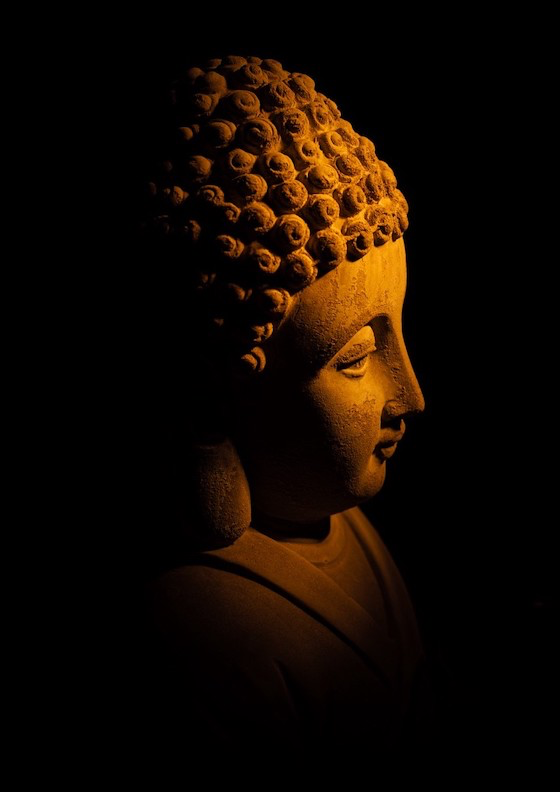
Image: Wikipedia. Seated Buddha, Gandhara, 1st-2nd century CE, at the Tokyo National Museum.
POSTCARD#421: Bangkok: Excerpts from Ajahn Sucitto’s “Pāramī, Ways to Cross Life’s Floods”. Click on the link for a download or print copy. We are coming to the end of the text, and I’d like to open up this series on The 10 Pāramī for discussion. Put your thoughts in the comment box at the end of this post and I’ll try to reply immediately – please allow for time zone difference: Indochina Time, Bangkok (GMT+7hrs. EDT + 11hrs. PDT + 14 hrs.)
Cultivating a Boundless Mind
The way it works is that you see where development can occur and widen it from there. You keep expanding and deepening the sphere of kindness in all directions. This is because there are near misses. For example, there’s an altruism that seems like kindness, and may carry some of its features, but is mixed with the need to feel that one is being loving and useful to others. We impose a requirement on others that they benefit from our love. This is missionary kindness. It doesn’t always allow people to be the way they are; we want to convert the nasty into the loving and make the sick get well. Now mettā may indeed have such effects, but as a Dhamma practice it’s focused on intent rather than arrival at a specific state. So we don’t practise kindness in order to make others into our idea of what a nice person is. Instead, the practice is to cultivate a conscious field of kindness in which – as aspects of ourselves and others arise in our awareness – they will not be met with fear or negativity. Then we trust the removal of ill-will and self-view to have its effect.
Of course we can’t just bring kindness to others without having felt it in ourselves, which means that our limitations, fears, doubts and pains are an essential part of our fieldwork. So it’s useful to check whether we have mettā for ourselves, and when we lose it. Do we beat ourselves up and feel guilty when we make a mistake, are late, or don’t live up to others’ expectations? Do we feel shadow impressions hovering around us over things we have or haven’t done? Does our conceiving mind create an image of how great somebody else is and therefore how inferior we are? The learning point is that as long as we pick up on, and attach to, particular features as self or other, good or bad, we never arrive at holistic goodwill. With self-view, sooner or later someone’s going to be inferior and someone superior.
Instead, we have to connect goodwill to the experience of self and other as it happens; that is, how I feel about you in the moment. Then we bring the intention of goodwill to the uncertainty, or fear or irritation as we experience it. And we’re also prepared to be affected: we stay open to what’s happening for self and other, without having an answer as to who’s right and who’s wrong.
One of the nuns in the monastery was born and married in Cambodia. At the time of the Cambodian holocaust, her husband put her and the children on a plane, promising to follow them when he’d concluded some business. She never saw him again. She got busy with life in the U.S.A, not only raising three children, but also studying for and gaining a Masters’ degree. She had to, in order to keep her mind away from dwelling on the past. But all the time she could feel hatred for the Khmer Rouge (who had killed her husband) seething inside her. Eventually her intention to help the people of Cambodia rebuild their country brought her into confrontation with that ill-will. How could she bring around reconciliation, when she still hadn’t reconciled herself? Through a series of encounters, she learned about meditation, and started to clean her mind of its hatred. However the real test came when she had to go to Cambodia to meet and work with members of the Khmer Rouge, one of whose leaders was still advocating that the children should be taught to fight to cleanse their country of foreign influence. Looking straight in the eye of the leader of the faction that had destroyed her husband and a quarter of the population of her country, she asked him to pause, and then she asked forgiveness for the hatred that she had felt for him and his faction. She followed that with offering her forgiveness for the pain that they had caused. Some of the assembly wept, some embraced each other. A few remained aloof, but for many the process moved on.
So in working with others as with oneself, we have to go deeply into the mind. In the direct contemplation of what is arising — at the dividing line between what we’re comfortable with and what we’re not — simply note the flavour of consciousness. Is it contracted, defensive, anxious, demanding? Listen to the tones and the energies behind the topics that the mind brings up; tune in to the waves of irritation, fear, guilt, and so on; and extend empathy and non-aversion. It’s about not fighting, blocking or running. Holding our centre, we thus can soften the edginess of the mind. We can open to include the experience of ourselves and others in our awareness. This is the cultivation of the boundless mind; over time, it widens to include it all.
(Continued next week, 28 May 2021, Holistic Kindness, the Mettā Pāramī Part 3)
Ajahn begins with mettā as loving-kindness that includes releasing others from being the objects of our projections, lust and idealism – self and other. Mettā allows others to not be the way I want them to be for me. Mettā means ‘recognizing otherness’. We don’t have to make people the same as ourselves or judge ourselves, based on what we think about other people.
It’s valuable to bring to mind that each of us has at some time been on the receiving end of freely given goodwill. So when you’re feeling bitter, anxious or lonely – remember this: at some time you have been seen with a loving and sympathetic eye.
The Mind of Self and Other
Mettā is an extension of the affective and responsive mind or heart. How crucial its alignment is! On the one hand, the mind can get trapped by fear, greed, hatred and delusion, and on the other hand it can extend in generosity and other perfections. The main issue for the mind is how it relates to what happens. Relationship is fundamental, because we are actually never a stand-alone being, but always a ‘being with’ or a ‘being in,’ or even a ‘being with the sense of being without.’
Consciousness is just this awareness of ‘being with’ in the various fields of seeing, hearing, tasting, smelling, touching and thinking. And in that process of being with, consciousness automatically establishes the sense of a subject and an object: a seer who sees a visible object, a hearer who hears an audible object, etc. Out of that duality, the sense of self and other arises. That’s the program of consciousness.
Notice that self and other are relative positions that depend on each other. You can’t have an experience of self without an other (animate or inanimate) that is in contrast to it. However for each mind, the emphasis is on the self; the ‘me, mine’ part is the crucial aspect in a world of changing others. Even in your own mind, there appears the self (the subject) as a watcher and the other (the object) as thoughts and emotions. Or the self is how you conceive yourself as being, and other is what you should be, might be, or were.
This is self-view, and it’s the norm for unawakened beings. Self-view rests on the assumption that these dependently-arisen polarities are actually separate and autonomous. It infers a self, despite the inability of that self to own or control the body or mind that it adopts as its own; despite its genetic and psychological inheritance from others; and despite its inability to rest unsupported by sights, sounds, affection and purposeful activity – all of which are outside its dominion. Self-view is blind to interdependency. Consequently, its flooding ignorance sweeps us into a sense of separation and alienation, whilst all the time asserting that this is our empire.
Accepting Otherness
In the practice of kindness, we look into the mind as it is happening, a moment at a time, with the intention to gentle it out of the hold of aversion, depression and anxiety. To support this, the teaching is that, although the sense of self-other happens by default, we can have some say over its emotional and energetic flavouring. Our current intention doesn’t need to be tense, inadequate and critical; it can be uplifted and uncramped. The sense of self-other can catalyse and give occasion for an intention to offer support. This intention is essential for a happy life, because if we don’t use the relational experience in a kind and generous way, then defensiveness, anxiety, fault-finding and grudges are going to haunt our lives and impair the lives of others.
Mettā is non-aversion, but it’s also non-fascination and non-projection. It releases others from being the objects of our projections, lust and idealism. It allows others to not be the way I want them to be for me. True love for another means that you don’t appropriate someone or project your unfulfilled wishes or needs onto them. Instead, mettā means recognizing otherness, and feeling that it’s OK. We don’t have to make people the same as ourselves or judge ourselves, based on what we think about other people. We don’t have to feel we have to win them over, or feel that they should satisfy our emotional hunger. And when mettā is fully developed it can allow us to be with the irritating and the unfair and the messy, so that such perceptions no longer even take hold.
It’s the same for ourselves: when we hold ourselves with the mind of goodwill, we don’t have to feel intimidated and compelled to prove ourselves. We have all been small, weak and stupid. We have all been totally irresponsible infants, awkward adolescents, made a mess of things, lied, cheated and maybe even killed. Yet we changed. These were all visitors and forces that occupied the mind. Now there’s no denying the responsibility for allowing one’s mind to be so occupied, but our current responsibility is one of cultivating virtue, discernment and kindness, not of obsessing and sustaining the burden of guilt and denial. And one of the major healing tools for this process is mettā. With this we take on samsāra with non-aversion and non-projection. We can accept the presence of the petty-mindedness, the guilt and anxiety as visitors conditioned into the mind, and work with them. Then there is nothing to hide from or dread anymore. This is a more useful approach than going through another round of anguish, self-hatred and defensiveness. By stilling these reactions, mettā enables us to penetrate to, and remove, the root cause of ill-will – often towards ourselves – underneath the complexes.
Start with Empathy
If you can regard this mind as it really is, you become compassionate. People’s minds are conditioned and formed around circumstances. You realize that people may not know much about kindness simply because they haven’t received much of it. Hurtful, abusive things may have been done or said to them; appreciation and warmth may have been in short supply. Consequently, such minds can have sour flavourings which attach to their sense of self and others, and which engender aversive or mistrustful responses. The default then is a distorted relational sense in which pleasure and personal security come from besting others, even through making fun of or scapegoating them. A boundary has been created which blocks empathy. And it doesn’t even feel bad at first: getting more than another, putting others down or taking revenge has the same sweet burst to it as a drug. That’s why it takes over.
But it doesn’t have to, all that’s needed is for someone to tell the truth about suffering and the note of empathy is struck: ‘You mean you feel like that too!’ Suddenly the conflict, the ‘you’re so different from me,’ falls away. No one has changed anything except the self-other line up, but in that moment of empathy there is a mutual deepening. The way out of ill-will is not through judging who’s right, but through finding common ground. Kindness, or non-aversion, begins with empathy, the sense that we’re all in this same samsāric ocean together, struggling in the floods.
(Continued next week 21 May 2021 with Holistic Kindness, the Mettā Pāramī) Part 2)
"To me, photography is an art of observation. It’s about finding something interesting in an ordinary place. . . I’ve found it has little to do with the things you see and everything to do with the way you see them." – Elliott Erwin (Documentary photographer)







 dhamma footsteps
You must be logged in to post a comment.