POSTCARD#445: Mettā meditation softens the mind and turns it toward care, goodwill, and acceptance. You become more selfless, less concerned with your own needs and more willing to peacefully interact with others. The emotion that is mettā feels delightful and pure. As you develop it repeatedly, it soon remains constant in your heart. You become a compassionate person, and your kindness is a source of joy to all beings and to yourself.
Mettā enables you to embrace another being just as they are. Most people find this impossible because of their fault-finding mind. They only see part of the whole, the part that is flawed, and refuse to accept it. Loving-kindness, on the other hand, embraces the wholeness of something and accepts it as it is. Through the practice of mettā meditation, you find yourself becoming less conscious of the faults in yourself and other beings, and more able to embrace them just the way they are. This ability to see the beauty in an object and ignore its flaws is a powerful aid to all types of meditation. To sustain your attention in the present moment, for example, you must accept the way things are now, embracing this moment and not being critical. When you persist in finding faults in the present moment, you will find you cannot remain there.
It is possible to combine mettā meditation with breath meditation. When you begin stage three, awareness of the breath, you observe your breath with loving-kindness. You think something like “breath, the door of my heart is open to you no matter how you feel, no matter what you do.” You will soon be looking at your breathing with compassion, embracing it as it is instead of finding fault. By adding mettā to the process of awareness, you have no expectations, since the breath seems more than good enough. Because of loving-kindness, you soon feel this attractive warmth toward the breath that brings joy to every in-breath and out breath. It becomes so nice to watch your breath that in a very short time you have reached stage five, the beautiful breath.
Taking Mettā into Jhāna
Jhānas are emotional summits and not intellectual heights. You cannot think your way into a jhāna, you can only feel your way in. To succeed you require familiarity with your emotional world, enough to trust in it silently without any controlling. Perhaps this is why female meditators seem to enter jhāna more easily than males. Mettā meditation trains everyone to become more at ease with the power of emotions. Sometimes you may cry during mettā meditation, even weep uncontrollably. If so, let it come. On the path to nibbāna we all have to learn to embrace the intensity of the purest emotions, and the jhānas are the purest of all. Therefore mettā meditation makes jhāna more accessible. You can even take mettā meditation directly into jhāna. When you have reached the stage described above where you are radiating this limitless golden glow of loving-kindness throughout the whole universe, drenching every sentient being with the immense power of your boundless love, then take the next step. Forget about all beings and ignore where the power is coming from. Focus your attention instead on the experience of mettā in itself. This step often happens automatically with no decision coming from you. The meditation object is being simplified, freed from the perception of separate beings. All that remains in your mind is what I call disembodied mettā, similar to the disembodied grin of the Cheshire Cat in the simile in chapter 2. You experience this as a blissful sphere of gorgeous golden light in your mind’s eye. It is a nimitta. It’s the mettā nimitta.
A nimitta that is generated through mettā meditation is always incredibly beautiful, only sometimes it isn’t so stable. Excitement is the usual problem. However, its nature is so alluring that you cannot resist hanging out with such intense bliss. Thus, in a short time the brilliant golden mettā nimitta becomes still and you fall into jhāna. This is how mettā meditation takes you into jhāna.
POSTCARD#438: Bangkok: Doubt can be toward the teaching, about the teacher, or toward yourself. Regarding doubt toward the teaching, you should have enough confidence by now to know that some beautiful results come from practicing meditation. You may have experienced many of them already. Allow those positive experiences to strengthen your confidence that meditation is worthwhile. Sitting in meditation, developing the mind in stillness, and especially developing the mind in jhānas are all tremendously worthwhile and will give you clarity, happiness, and understanding of the Buddha’s teachings.
With regard to teachers, they are often like coaches of sports teams. Their job is to teach from their own experience and, more important, to inspire students with words and deeds. But before you put your confidence in a teacher, check them out. Observe their behavior and see for yourself if they are practicing what they preach. If they really know what they are talking about, then they will be ethical, restrained, and inspiring. Only if teachers lead by example—a good example, that is—should you place your confidence in them.
Self-doubt—which thinks, “I’m hopeless, I can’t do this, I’m useless, I’m sure everyone else who practices meditation, except me, has got jhānas and is already enlightened”—is often overcome with the help of a teacher who inspires and encourages you. It’s the teacher’s job to say, “Yes, you can achieve all of these things. Many other people have achieved them, so why not you?” Give yourself encouragement. Have confidence that you can achieve whatever you want. In fact, if you have sufficient determination and confidence, then it’s only a matter of time before you succeed. The only people who fail are those who give up.
Doubt can also be directed toward what you are experiencing now: “What is this? Is this jhāna? Is this present-moment awareness?” Such doubts are hindrances. They are inappropriate during meditation. Just make the mind as peaceful as you can. Let go and enjoy the peace and happiness. Afterward, you can review the meditation and ask, “What was that? That was really interesting. What was happening there?” That’s when you’ll find out whether or not it was a jhāna. If while meditating the thought “Is this jhāna?” arises, then it cannot be jhāna! Thoughts like that can’t come up within these deep states of stillness. Only afterward, when you review those states, can you look back and say, “Ah, that was a jhāna.”
If you get into any difficulty in your meditation, stop and ask yourself, “Which of the hindrances is this?” Find out what the cause is. Once you know the cause, then you can remember the solution and apply it. If it’s sensory desire, just take the attention away from the five senses little by little and apply it to the breath or the mind. If it’s ill will, do some loving-kindness. For sloth and torpor, remember “give value to awareness.” If it’s restlessness and remorse, remember “contentment, contentment, contentment” or practice forgiveness. And if it’s doubt, be confident and be inspired by the teachings. Whenever you meditate, apply the solutions methodically. That way, the obstacles you experience won’t create long-term barriers. They’re things that you can recognize, overcome, and move beyond.
Preview of next week’s text:
“All the Hindrances emanate from a single source. They are generated by the control freak inside of you that refuses to let things go. Meditators fail to overcome the hindrances because they look for them in the wrong place. It is crucial to success in meditation to understand that the hindrances are to be seen at work in the space between the knower and the known. The hindrances’ source is the doer, their result is lack of progress, but their workshop is the space between the mind and its meditation object. Essentially, the five hindrances are a relationship problem.”
POSTCARD#437: Bangkok: The fourth hindrance is among the most subtle of hindrances. The main component of this hindrance is restlessness of mind. But first let me briefly address the matter of remorse. Editor’s note: Here, Ajahn Brahm tells us the story of Angulimāla. I have moved it the end of this Chapter where you can read it there, for a wider picture of remorse.
Remorse
Remorse is the result of hurtful things that you may have done or said. In other words, it is a result of bad conduct. If any remorse comes up in meditation, instead of dwelling on it, you should forgive yourself. Everyone makes mistakes. The wise are not people who never make mistakes, but those who forgive themselves and learn from their mistakes. Some people have so much remorse that they think they can never become enlightened. Forgiveness, letting go of the past, is what overcomes remorse.
Restlessness
Restlessness arises because we do not appreciate the beauty of contentment. We do not acknowledge the sheer pleasure of doing nothing. We have a fault-finding mind rather than a mind that appreciates what’s already there. Restlessness in meditation is always a sign of not finding joy in what’s here. Whether we find joy or not depends on the way we train our perception. It’s within our power to change the way we look at things. We can look at a glass of water and perceive it as very beautiful, or we can think of it as ordinary. In meditation, we can see the breath as dull and routine, or we can see it as very beautiful and unique. If we look upon the breath as something of great value, then we won’t get restless. We won’t go around looking for something else. That’s what restlessness is, going around looking for something else to do, something else to think about, somewhere else to go—anywhere but here and now. Restlessness is one of the major hindrances, along with sensory desire. Restlessness makes it so hard to sit still for very long.
I begin meditation with present-moment awareness, just to overcome the coarse restlessness that says, “I want to be somewhere other than right here, right now.” No matter what this place is, no matter how comfortable you make it, restlessness will always say it’s not good enough. It looks at your meditation cushion and says it’s too big or too small, too hard or too wide. It looks upon a meditation retreat center and says, “It’s not good enough. We should have three meals a day. We should have room service.”
Beware of finding fault in your meditation. Sometimes you may think, “I’m not going deep enough. I’ve been watching the present moment for so long, and I’m not getting anywhere.” That thought is the very cause of restlessness. It doesn’t matter how the meditation is going in your opinion. Remember that contentment is the opposite of a faultfinding mind. You should develop the perception of contentment with whatever you have, wherever you are, as much as you can. Be absolutely content with your meditation and it will go deeper. If you’re dissatisfied with your progress, then you’re only making it worse. So learn to be content with the present moment. Forget about jhānas, just be content to be here and now, in this moment. As that contentment deepens, it will actually give rise to jhānas.
Watch the silence and be content to be silent. If you’re truly content, you don’t need to say anything. Don’t most inner conversations take the form of complaining, attempting to change things, or wanting to do something else? Or escaping into the world of thoughts and ideas? Thinking indicates a lack of contentment. If you’re truly contented, then you’re still and quiet. See if you can deepen your contentment, because it is the antidote for restlessness.
Even if you have an ache in the body and don’t feel well, you can change your perception and regard that as something quite fascinating, even beautiful. See if you can be content with the ache or pain. See if you can allow it to be. A few times during my life as a monk I have been in quite severe pain. Instead of trying to escape, which is restlessness, I turned my mind around to completely accept
the pain and be content with it. I have found that it is possible to be content with even severe pain. If you can do that, the worst part of the pain disappears along with the restlessness. There’s no wanting to get rid of it. You’re completely still with the feeling. The restlessness that accompanies pain is probably the worst part. Get rid of restlessness through contentment, and you can even have fun with pain.
Develop contentment with whatever you have—the present moment, the silence, the breath. Wherever you are, develop that contentment, and from that contentment—out of the very center of that contentment—you’ll find your meditation will deepen. So if you ever see restlessness in your mind, remember the word contentment. Contentment looks for what is right, and it can keep you still. But restlessness will always make you a slave. The tyrant is the faultfinding mind. Subdue this tyrant through contentment.
After you’ve overcome the more general forms of restlessness, a very refined form often occurs at the deeper stages of meditation. I am referring to the time when you first see a nimitta. Because of restlessness, you just can’t leave it alone. You mess around with it. You aren’t content with the nimitta as it appears right now. You want something more. You get excited. Restlessness is one of the hindrances that can easily destroy the nimitta. You’ve arrived already. You don’t have to do any more. Just leave it alone. Be content with it and it will develop by itself. That’s what contentment is—complete non-doing, just sitting there watching a nimitta blossom into a jhāna. If it takes an hour, if it takes five minutes, if it never even happens, you’re content. That’s the way to get into jhānas. If the nimitta comes and goes, that’s a sign of restlessness in the mind. If you can sustain attention effortlessly, restlessness has been overcome.
The story of Angulimāla (MN 86)
Angulimāla was a serial killer. He killed 999 people. He cut off a finger from each of his victims and put them in a garland he hung around his neck. The one-thousandth victim was to be the Buddha but, of course, you can’t kill a buddha. Instead the Buddha “killed him,” killed his bad ways, killed his defilements. Angulimāla became a Buddhist monk. Even a serial killer like Angulimāla could achieve the jhānas and become fully enlightened. So have you ever killed anybody? Are you a serial killer? You probably haven’t done anything like that. If such people can become enlightened, surely you can. No matter what bad things you’ve done in your past or what you feel remorseful about, always remember Angulimāla. Then you won’t feel so bad about yourself.
Continued next week, September 24th 2021, with the Fifth Hindrance, Doubt (Vicikicchā).
POSTCARD#436: Bangkok: I don’t need to describe sloth and torpor in detail, because I’m sure we know it all too well through our experience of meditation. We sit in meditation and don’t really know what we are watching, whether it’s the present moment, silence, the breath, or whatever. This is because the mind is dull. It’s as if there are no lights turned on inside. It’s all gray and blurry.
Making Peace with Sloth and Torpor
The most profound and effective way of overcoming sloth and torpor is to make peace with the dullness and stop fighting it! When I was a young monk in the forest monasteries in Thailand and became sleepy during the 3:15 A.M. sitting, I would struggle like hell to overpower the dullness. I would usually fail. But when I did succeed in overcoming my sleepiness, restlessness would replace it. So I would calm down the restlessness and fall back into sloth and torpor. My meditation was like a pendulum swinging between extremes and never finding the middle. It took many years to understand what was going on.
The Buddha advocated investigation, not fighting. So I examined where my sloth and torpor came from. I had been meditating at 3:15 in the morning, having slept very little, I was malnourished, an English monk in a hot tropical jungle – what would you expect! The dullness was the effect of natural causes. I let go and made peace with my sleepiness. I stopped fighting and let my head droop. Who knows, I might even have snored. When I stopped fighting sloth and torpor it did not last all that long. Moreover, when it passed I was left with peace and not with restlessness. I had found the middle of my pendulum swing and I could observe my breath easily from then on.
Dullness in meditation is the result of a tired mind, usually one that has been overworking. Fighting that dullness makes you even more exhausted. Resting allows the energy to return to the mind. To understand this process, I will now introduce the two halves of the mind: the knower and the doer. The knower is the passive half of the mind that simply receives information. The doer is the active half that responds with evaluating, thinking, and controlling. The knower and the doer share the same source of mental energy. Thus, when you are doing a lot, when you have a busy lifestyle and are struggling to get on, the doer consumes most of your mental energy, leaving only a pittance for the knower. When the knower is starved of mental energy you experience dullness.
At a retreat I led in Sydney a few years ago, a retreatant arrived late from her high-stress job as an executive in the city. In her first sitting that evening her mind was almost as dead as a corpse. So I gave her my special teaching on how to overcome her sloth and torpor: I told her to rest. For the next three days she slept in until dawn, went back to bed again after breakfast, and had a long nap after lunch. What a brilliant meditator! After three days of no fighting, giving hardly any mental energy to the doer but letting it flow to the knower, her mind brightened up. In another three days she had caught up with the rest of the group in her progress through the stages. By the end of the retreat she was way ahead and one of the star meditators of that retreat.
The most profound and effective way to overcome sloth and torpor is to stop fighting your mind. Stop trying to change things and instead let things be. Make peace not war with sloth and torpor. Then your mental energy will be freed to flow into the knower, and your sloth and torpor will naturally disappear.
Giving Value to Awareness
Another method for overcoming sloth and torpor is to give more value to awareness. All Buddhist traditions say that human life is valuable and precious, especially a life like this one where you have encountered the Buddha’s teachings. Now you have the opportunity to practice. You may not realize how many lifetimes it has taken and how much merit you’ve had to accumulate just to get where you are now. You’ve invested lifetimes of good karma to get this close to the Dhamma. Reflecting like this means you will incline less to sloth and torpor and more to bright awareness.
The path of meditation sometimes comes to a fork in the road. The left path leads to sloth and torpor while the right path leads to bright awareness. With experience you will recognize this fork. This is the point in meditation where you can choose between the alley to sloth and torpor or the highway to mindful stillness. Taking the left path you give up both the doer and the knower. Taking the right path you let go of the doer but keep the knower. When you value awareness you will automatically choose the right path of bright awareness.
Sloth and Torpor and Ill Will
Sometimes sloth and torpor is the result of ill will, the second hindrance. When I used to visit Australian prisons to teach meditation, I would often hear the following prison proverb: “an extra hour of sleep is an hour off your sentence.” People who don’t like where they are will try to escape into dullness. In the same way, meditators who easily get negative will tend to drift into sloth and torpor. Ill will is the problem.
In our monastery in Thailand we would meditate all night once a week. During those all-night sittings, sloth and torpor would regularly conquer me an hour or two after midnight. Since it was my first year as a monk, I reflected that less than twelve months previously I would spend all night at parties, rock concerts, and clubs. I recalled that I never experienced sloth and torpor when listening to the music of the Doors at 2 A.M. Why? It became clear that when you are enjoying what you are doing then you don’t tend to get sloth and torpor, but when you don’t like what you are doing then sloth and torpor comes in. I did not like those all-night sits. I thought they were a stupid idea. I did them because I had to. I had ill will, and that was the cause of my sloth and torpor. When I changed my attitude and put joy into the all-night sittings, making them fun, then sloth and torpor rarely came. So you should investigate whether your sloth and torpor is the result of an attitude problem—the attitude of ill will.
Using Fear
When I was a lay Buddhist I attended a Zen retreat in the north of England. It was very early in the morning, and the meditation hall was freezing cold. People had their blankets around them. When you meditate with a blanket anywhere close to you, you tend to get sleepy. The teacher was walking up and down with a big stick, and the fellow next to me who had started nodding got hit. Everyone’s sloth and torpor suddenly disappeared right then. We only needed one person to get hit and that was enough. The problem was that the fear that woke me up remained with me, preventing further progress. Experience teaches that you can’t generate wholesome states like peace and freedom by using unwholesome methods like fear or violence.
In the old forest tradition of northeast Thailand, monks would meditate in dangerous places such as platforms high in the trees, on the edge of cliffs, or in jungles full of tigers. The ones who survived said they got good meditation, but you never heard from the monks that didn’t survive!
Continued next week 17 September 2021, with the remaining two hindrances: restlessness and remorse (uddhacca-kukkucca) and doubt (vicikicchā)
POSTCARD#434: Bangkok: In this chapter and the next I will explain in detail the five hindrances, obstacles that you will meet in your meditation and that you should learn to overcome. These obstacles to deep meditation are called in the Pāli language nīvarana. Literally that means “closing a door” or “obstructing entering into something,” and this is exactly what the hindrances do. They stop you from entering into the deep absorption states, or jhānas. They also obstruct or weaken wisdom and strengthen delusion. So if one is going to say anything in Buddhism about the enemies to meditation, one can say that the five hindrances are Public Enemy Number One. They stop people from becoming enlightened, and it’s precisely for this reason that understanding these five hindrances and overcoming them is crucial. When you don’t fully understand them, you cannot overcome them. Some teachers fail to explain the hindrances clearly enough, especially the hindrances that are very subtle. These refined hindrances prevent you from getting into deep meditation. If you do not even try to identify them and surpass them, then they will hold sway over your mind. You will be obstructed from enjoying the bliss of the mind and from developing the great insights of enlightenment. Basically, these five hindrances stand between you and enlightenment. When you know them, you have a good chance of overcoming them. If you have not achieved the jhānas yet, it means you have not fully understood these five hindrances. If you have gotten into such deep states, then you have overcome the hindrances. It’s as simple as that.
The Buddha named the five hindrances as follows: sensory desire (kāma-cchanda), ill will (vyāpāda), sloth and torpor (thīna-middha), restlessness and remorse (uddhacca-kukkucca), and doubt (vicikicchā). This is the usual order in which the Buddha lists them, and this is the order in which they will be presented here, too.
The First Hindrance—Sensory Desire, Kāma-cchanda, is first on the list of hindrances because of its importance. It is the major obstacle preventing one from entering deep meditation. Few meditators fully understand its scope. It is not just sensory desire as that term is commonly understood. First of all, the Pāli word kāma means anything pertaining to the five senses of sight, hearing, smell, taste, and touch. Chanda means to delight in or agree with. Together the compound kāma-cchanda means “delight, interest, involvement with the world of the five senses.” For example, when we are meditating and hear a sound, why can’t we simply ignore it? Why does it disturb us so? Many years ago in Thailand the local villages surrounding our monastery held a party. The noise from the loudspeakers was so loud that it seemed to destroy the peace in our monastery. So we complained to our teacher, Ajahn Chah, that the noise was disturbing our meditation. The great master replied, “It is not the noise that disturbs you, it is you who disturb the noise!” In the above example kāma-cchanda was the mind getting involved with the sound. Similarly, when your meditation is interrupted by a pain in your legs, say, then it is not the pain that disturbs you but it is you who disturb the pain. If you had been mindful, you would have seen your awareness go out to your body, becoming interested in sensations again. That was kāma-cchanda at work. It is difficult to overcome kāma-cchanda because we are so attached to our five senses and their affairs. Whatever we are attached to we find impossible to release. To understand this attachment it is useful to examine the connection between our five senses and our body. It is commonly claimed that the five senses are there to protect our body, but insight will tell you the opposite: that the body is there to provide a vehicle for your five senses to play in the world. You will also notice that when the five senses disappear so does your body. Letting go of one means letting go of the other.
Abandoning Kāma-cchanda Little by Little
You can’t simply decide to let go of the five senses and the body through a single effort of will. The abandoning of kāma-cchanda in meditation is achieved little by little. You start by choosing a comfortable, quiet place in which to meditate. You may sit on a chair if it is more comfortable for you, remembering that even the Buddha sat on a chair sometimes. When you first close your eyes you will be unable to feel much of the body. In the same way that it takes a few minutes to see when you go out from a well-lit room into the dark, so it takes a few minutes to become sensitive to your bodily feelings. Thus the final adjustments to our body posture are made a few minutes after closing our eyes. Indulging kāma-cchanda in this way will subdue it for a while. Your body will feel comfortable and the five senses satisfied, but not for long. You must use this initial freedom to start placing the mind beyond the reach of the five senses. You begin with present-moment awareness. Most if not all of our past and future is occupied by the affairs of our five senses. Our memories are of physical sensations, tastes, sounds, smells, or sights. Our plans are likewise filled with five-sense business. Through achieving present moment awareness we cut off much of kāma-cchanda.
The next stage of meditation is silent present-moment awareness. In this you abandon all thought. The Buddha identified an aspect of kāmacchanda that is called kāmavitakka, meaning thinking about the five-sense world. For the new meditator, the most obvious form of kāma- vitakka is sexual fantasy. One can use up many hours, especially on a long retreat, with this type of kāma-vitakka. This obstacle to progress in meditation is transcended by realizing, through insight or faith, that total freedom from the five senses (i.e., jhāna) is more ecstatic and profound than the very best of sexual experiences. A monk or nun gives up their sexuality not out of fear or repression, but out of recognition of something superior. Even thoughts about lunch belong to kāma-vitakka. They disturb the silence. And few meditators realize that noting bodily sensations, for example thinking to oneself “breath going in” or “hearing a sound” or “feeling a stabbing pain,” is also part of kāmavitakka and a hindrance to progress.
Lao Tzu, the great Taoist sage, would allow one student to accompany him on his evening walk, as long as the student maintained silence. One evening, as they reached a mountain ridge, the student remarked, “What a beautiful sunset.” Lao Tzu never let that student accompany him again. When others asked why, the master explained, “When that student said, ‘What a beautiful sunset,’ he was no longer watching the sunset, he was only watching the words.” That is why you have to abandon noting, for watching the words is not being mindful of the thing it tries in vain to describe. In silent present-moment awareness it is as if the world of the five senses is confined in a cage, unable to roam or create any mischief…
Editor’s note, the five senses confined in a cage; this is the end result, so how did we get there? I found it easier to reorder the sequence of events in this part of Ajahn’s teaching on the method for abandoning kāma-cchanda little by little. I broke it down to the simple directives, getting rid of unnecessary words. The following is what I comprehend the teaching is today at the time of writing. Please refer back to the original for anything I might have missed, page 32 – 33 print copy.
First, settle into meditation posture, some adjustments are made a few minutes after closing the eyes. Indulging kāma-cchanda in this way will subdue it for a while. Your body will feel comfortable and the five senses satisfied, but not for long. You must use this initial freedom to start placing the mind beyond the reach of the five senses. Begin with present-moment awareness. Our past and future are occupied by the affairs of our five senses, memories physical sensations,. Through achieving present moment awareness we cut off much of the kāma-cchanda multi-purpose affairs.
The next stage is where we abandon all thinking about the five-sense world. Using present moment awareness we can choose to focus our mindfulness on a small part of the five-sense world to the exclusion of the rest. You focus your mindfulness on the physical sensation of the breath, paying no attention to other sensations in your body, nor to sounds and so on. The breath becomes the stepping stone from the world of the five senses over to the realm of the mind. It is as if the world of the five senses is confined in a cage, unable to roam or create any mischief.
When you succeed in full sustained attention on the breath you will notice the absence of any sound. For a period your mind was impervious to any sound. You also notice that your body had disappeared, that you could not feel your hands, nor did you receive any messages from your legs. All that you knew was the feeling of the breath. Some meditators become alarmed when parts of their body seem to vanish. This shows their strong attachment to their body. This is kāmacchanda at work, hindering progress in their meditation. Usually you soon become familiar with the fading away of bodily sensations and start to delight in the wonderful tranquility beyond their reach. It is the freedom and joy born of letting go that repeatedly encourages you to abandon your attachments.
Soon the breath disappears and the awesome nimitta fills your mind. It is only at this stage that you have fully abandoned kāma-cchanda, your involvement in the world of the five senses. For when the nimitta is established, all five senses are extinguished, and your body is out of range. The first and major hindrance has now been overcome and it is blissful. You are at the door of the jhānas. This is the method for abandoning kāma-cchanda little by little.
POSTCARD#432: Bangkok: Welcome again to our analysis of Mindfulness, Bliss, and Beyond: A Meditator’s Handbook by Ajahn Brahm. We rejoin the text on page 20 ( print book layout ) and Ajahn is saying: “We are passively observing the beautiful breath in the moment, and the perception of “in” (breath) or “out” (breath), or the beginning, middle, or end of a breath, disappears. All that remains is the experience of the beautiful breath happening now. The mind is simplifying the object of meditation and the breath is experienced in the moment, moving beyond the duality of “in” and “out” whilst the beautiful breath appears smooth and continuous, hardly changing at all… see how smooth, beautiful, and timeless the breath can be! See how calm you can allow it to be – take time to savor the sweetness of the beautiful breath – ever calmer, ever sweeter.”
Only “the Beautiful” Is Left
“Soon the breath will disappear, not when you want it to but when there is enough calm, leaving only the sign of “the beautiful. The story of the Cheshire Cat in Lewis Carroll’s Alice in Wonderland is an eerily accurate analogy for the meditation experience. Alice is startled to see the Cheshire Cat sitting on a bough of a nearby tree and grinning from ear to ear. Like all the strange creatures in Wonderland, the Cheshire Cat has the eloquence of a politician. Not only does the cat get the better of Alice in the ensuing conversation, but it also suddenly disappears and then, without warning, just as suddenly reappears.”
Alice said,“… I wish you wouldn’t keep appearing and vanishing so suddenly: you make one quite giddy!”
“All right,” said the Cat; and this time it vanished quite slowly, beginning with the end of the tail, and ending with the grin, which remained some time after the rest of it had gone.
“Well! I’ve often seen a cat without a grin,” thought Alice; “but a grin without a cat! It’s the most curious thing I ever saw in all my life!”
Just as the Cheshire Cat disappeared and left only its grin, so the meditator’s body and breath disappear, leaving only the beautiful. For Alice, it was the most curious thing she ever saw in all her life. For the meditator it is also strange, to clearly experience a free-floating beauty with nothing to embody it, not even a breath. The beautiful, or more precisely the sign of the beautiful, is the next stage on this meditation path. The Pāli word for “sign” is nimitta. So this next stage is called “experiencing the beautiful nimitta.”
Experiencing the Beautiful Nimitta
“This sixth stage is achieved when one lets go of the body, thought, and the five senses (including the awareness of the breath) so completely that only a beautiful mental sign, a nimitta, remains. This pure mental object is a real object in the landscape of the mind (citta), and when it appears for the first time, it is extremely strange. One simply has not experienced anything like it before. Nevertheless, the mental activity we call perception searches through its memory bank of life experiences for something even a little bit similar. For most meditators, this disembodied beauty, this mental joy, is perceived as a beautiful light. Some see a white light, some a golden star, some a blue pearl, and so on. But it is not a light. The eyes are closed, and the sight consciousness has long been turned off. It is the mind consciousness freed for the first time from the world of the five senses. It is like the full moon—here standing for the radiant mind, coming out from behind the clouds—here standing for the world of the five senses. It is the mind manifesting —it is not a light, but for most it appears as a light. It is perceived as a light because this imperfect description is the best that perception can offer.”
For other meditators, perception chooses to describe this first appearance of mind in terms of a physical sensation such as intense tranquility or ecstasy. Again, the body consciousness (that which experiences pleasure and pain, heat and cold, and so on) has long since closed down, so this is not a physical feeling. It is just perceived as being similar to pleasure. Although some meditators experience sensations while others see light, the important fact is that they are all describing the same phenomenon. They all experience the same pure mental object, and these different details are added by their different perceptions.”
The Qualities of a Nimitta
“One can recognize a nimitta by the following six features: (1) it appears only after the fifth stage of the meditation, after the meditator has been with the beautiful breath for a long time; (2) it appears when the breath disappears; (3) it comes only when the external five senses of sight, hearing, smell, taste, and touch are completely absent; (4) it manifests only in the silent mind, when descriptive thought (inner speech) is totally absent; (5) it is strange but powerfully attractive; and (6) it is a beautifully simple object. I mention these features so that you may distinguish real nimittas from imaginary ones.”
“Sometimes when the nimitta first arises it may appear dull. In this case, one should immediately go back to the previous stage of the meditation, full sustained attention on the beautiful breath. One has moved to the nimitta too soon. Sometimes the nimitta is bright but unstable, flashing on and off like a lighthouse beacon and then disappearing. This too shows that the meditator has left the beautiful breath too early. One must be able to sustain one’s attention on the beautiful breath with ease for a long, long time before the mind is capable of maintaining clear attention on the far more subtle nimitta. So you should train the mind on the beautiful breath. Train it patiently and diligently. Then when it is time to go on to the nimitta, it will be bright, stable, and easy to sustain.”
Letting Go
“The main reason why the nimitta can appear dull is that the depth of contentment is too shallow. You are still wanting something. Usually you want the bright nimitta or you want jhāna. Remember—and this is important—jhānas are states of letting go, incredibly deep states of contentment. So give away the hungry mind. Develop contentment on the beautiful breath, and nimittas and jhānas will happen by themselves. Put another way, the nimitta is unstable because you, the doer, just will not stop interfering. The doer is the controller, the backseat driver, always getting involved where it does not belong and messing everything up. Meditation is a natural process of coming to rest, and it requires you to get out of the way completely. Deep meditation only occurs when you really let go. This means really letting go—to the point that the process becomes inaccessible to the doer.”
“A skillful means to achieve such profound letting go is to deliberately offer a gift of confidence to the nimitta. Very gently interrupt the silence for a moment and whisper, inside your mind, that you are giving complete trust to the nimitta, so that the doer can relinquish all control and just disappear. The mind, represented here by the nimitta before you, will then take over the process as you watch. You do not need to do anything here, because the intense beauty of the nimitta is more than capable of holding your attention without your assistance.”
“Be careful here not to start asking questions like “What is this?” “Is this jhāna?” “What should I do next?” which all come from the doer trying to get involved again. Questioning disturbs the process. You may assess everything once the journey is over. A good scientist only assesses the experiment at the end, when all the data are in. There is no need to pay attention to the shape or edges of the nimitta: “Is it round or oval?” “Is the edge clear or fuzzy?” These are all unnecessary queries, which just lead to more diversity, more duality of inside and outside, and more disturbance. Let the mind incline where it wants, which is usually to the center of the nimitta. The center is where the most beautiful part lies, where the light is most brilliant and pure. Let go and just enjoy the ride as the attention gets drawn right into the center, or as the light expands and envelops you totally. Let the mind merge into the bliss. Then let the seventh stage of this path of meditation, the jhāna, occur.”
POSTCARD#431: Bangkok:Hello and welcome again to our study group of Mindfulness, Bliss, and Beyond: A Meditator’s Handbook by Ajahn Brahm. This time it begins with request for help with a perceptual difficulty I found in the last two paragraphs of last week’s study on the breath. The two paragraphs are presented under the sub-heading as follows:
Stage Four: Full Sustained Attention on the Breath (page 16 print copy)
“The fourth stage occurs when your attention expands to take in every single moment of the breath….”
The text goes on with a wonderfully detailed analysis of the breath as it’s going through a complete cycle. Maybe it’s my 24/7 headache that’s pushing me to take short cuts all the time, but I think that what Ajahn is saying here is these are the collected moments of the breath in all their stages and describing a number of breaths, not just one. The presentation is as if it were being shown in slow-motion. If the camera was shooting in ‘real time’, I would have to control my breath for as long as it takes to read the text describing the stages of the breath in its whole cycle, for say, 30 – 45 seconds. Then, without a break, to move on to the next breath cycle for the same duration. Is it possible? Is this how it seems to you? If someone could help me with this I’d be very grateful.
Now returning to our summary and analysis of the text. This where the meditator is asked to notice the following:
“Actually “you” do not reach this stage, the mind does. The mind does the work itself. The mind recognizes this stage to be a very peaceful and pleasant place to abide, just being alone with the breath. This is where the doer, the major part of one’s ego, starts to disappear. One finds that progress happens effortlessly at this stage of meditation. We just have to get out of the way, let go, and watch it all happen. The mind will automatically incline, if we only let it, toward this very simple, peaceful, and delicious unity of being alone with one thing, just being with the breath in each and every moment. This is the unity of mind, the unity in the moment, the unity in stillness.”
The Beginning of the Beautiful Breath
“The fourth stage is what I call the “springboard” of meditation, because from it one may dive into the blissful states. When we simply maintain this unity of consciousness by not interfering, the breath will begin to disappear. The breath appears to fade away as the mind focuses instead on what is at the center of the experience of breath, which is awesome peace, freedom, and bliss.”
“Now as I will explain further in the next chapter, when the breath disappears, all that is left is “the beautiful.” Disembodied beauty becomes the sole object of the mind. The mind is now taking the mind as its own object. We are no longer aware of the breath, body, thought, sound, or outside world. All that we are aware of is beauty, peace, bliss, light, or whatever our perception will later call it. We are experiencing only beauty, continuously, effortlessly, with nothing being beautiful! We have long ago let go of chatter, let go of descriptions and assessments. Here the mind is so still that it cannot say anything. One is just beginning to experience the first flowering of bliss in the mind. That bliss will develop, grow, and become very firm and strong. And then one may enter into those states of meditation called the jhānas.”
“I have described the first four stages of meditation. Each stage must be well developed before going on to the next. Please take a lot of time with these four initial stages, making them all firm and stable before proceeding. You should be able to maintain with ease the fourth stage, full sustained attention on the breath, during every moment of the breath without a single break for two or three hundred breaths in succession. I am not saying you should count the breaths during this stage; I am just giving an indication of the approximate span of time that one should be able to stay in stage four before proceeding further. In meditation, as I indicated earlier, careful patience is the fastest way!”
The fifth stage is called Full Sustained Attention on the Beautiful Breath.
“When one’s full attention rests easily and continuously on the experience of breathing with nothing interrupting the even flow of awareness, the breath
calms down. It changes from a coarse, ordinary breath to a very smooth and peaceful “beautiful breath.” The mind recognizes this beautiful breath and delights in it. It experiences a deepening of contentment. It is happy just to be watching this beautiful breath, and it does not need to be forced.”
Do Nothing
‘“You”’ do not do anything. If you try to do something at this stage, you will disturb the whole process. The beauty will be lost. It’s like landing on a snake’s head in the game of snakes and ladders—you must go back many squares. From this stage of meditation on, the doer has to disappear. You are just a knower, passively observing. A helpful trick at this stage is to break the inner silence for a moment and gently say to yourself: “calm.” That’s all. At this stage of the meditation, the mind is usually so sensitive that just a little nudge causes it to follow the instruction obediently. The breath calms down and the beautiful breath emerges.”
POSTCARD#430: Bangkok: Here we are again in our study group of Mindfulness, Bliss, and Beyond: A Meditator’s Handbook by Ajahn Brahm. Something I notice about this book, the ‘bliss, and beyond’ aspect is presented up-front and in the centre of our vision from the very beginning. I suspect some readers might not seem to be able to keep the ‘bliss and beyond’ going, uppermost in the mind. Maybe it was a lack of belief in the fact that I could get there too, but not having spent enough time on the first stages… so I went back to reading the book
“It often happens that meditators start breath meditation when their minds are still jumping around between past and future, and when awareness is being drowned out by inner commentary.”
“When you know the breath is going in or going out for about one hundred breaths in a row, not missing one, then you have achieved what I call the third stage of this meditation, which involves sustained attention on the breath. This again is more peaceful and joyful than the previous stage. To go deeper, you aim next for full sustained attention on the breath.”
So I meditated on and off all day on Wednesday, not sure if I was doing it correctly. Then again all day Thursday more meditation and I started to notice it was easier and I was sure I was doing everything correctly because I could just fall into the ideal sitting posture. There a strange dream-like quality about it all… a sense that nothing is solid, everything has the characteristic of fluidity, a smoothness. The ‘world’ was the colour of maple syrup or crème caramel, resonating like a deep long note played on a cello. Shiny, smooth walls with no texture lack friction like resin on highly polished hardwood floors.
But I was unable to stay there, suddenly the mind jumped in and identified it as the comfort state created by the meds I take, and that’s a whole nother thing. For those of you who don’t know, I suffer from a permanent headache. I’ve had it for six years now – mostly it is kept in background by the meds I take. So there is an opportunity to win back the ground I used to have in meditation and that’s all well and good but then the headache breaks through and that is devastating. This is when I find the comfort state created by the meds… It lifts me out of the worst of it and I’m back in the cycle of it again. So the familiar meds state took over and I missed the ‘bliss and beyond.’
More meditation, listening to Ajahn Sumedho on Friday, and in the afternoon things started to have that familiar clear deep quality again. Rather than have the mind intervene and say what it is, I went back to the book.
Full Sustained Attention on the Breath
“The fourth stage occurs when your attention expands to take in every single moment of the breath. You know the inbreath at the very first moment, when the first sensation of inbreathing arises. Then you observe as those sensations develop gradually through the whole course of one inbreath, not missing even a moment of the in-breath. When that in-breath finishes, you know that moment. You see in your mind that last movement of the in-breath. You then see the next moment as a pause between breaths, and then many more moments of pause until the out-breath begins. You see the first moment of out-breathing and each subsequent sensation as the out-breath evolves, until the out-breath disappears when its function is complete. All this is done in silence and in the present moment.”
Getting out of the way
“You experience every part of each in-breath and out-breath continuously for many hundred breaths in a row. That is why this stage is called full sustained attention on the breath. You cannot reach this stage through force, through holding or gripping. You can attain this degree of stillness only by letting go of everything in the entire universe except for this momentary experience of the breath happening silently. Actually “you” do not reach this stage, the mind does. The mind does the work itself. The mind recognizes this stage to be a very peaceful and pleasant place to abide, just being alone with the breath. This is where the doer, the major part of one’s ego, starts to disappear. One finds that progress happens effortlessly at this stage of meditation. We just have to get out of the way, let go, and watch it all happen. The mind will automatically incline, if we only let it, toward this very simple, peaceful, and delicious unity of being alone with one thing, just being with the breath in each and every moment. This is the unity of mind, the unity in the moment, the unity in stillness.”
POSTCARD#429: Bangkok: Hello and welcome back to our analysis of Mindfulness, Bliss, and Beyond – A Meditator’s Handbook by Ajahn Brahm.
“It would be marvellous for each one of us if we could abandon all inner speech and abide in silent awareness of the present moment long enough to realize how delightful it is. Silence is so much more productive of wisdom and clarity than thinking. When one realizes that, silence becomes more attractive and important. The mind inclines toward it, seeks it out constantly, to the point where it engages in the thinking process only if it is really necessary, only if there is some point to it. Once we have realized that most of our thinking gets us nowhere, we gladly and easily spend much time in inner quiet.”
“If you have developed silent awareness of the present moment carefully for long periods of time, then you will find it quite easy to turn that awareness onto the breath and follow that breath from moment to moment without interruption. This is because the two major obstacles to breath meditation have already been overcome. The first of these two obstacles is the mind’s tendency to go off into the past or future, and the second obstacle is inner speech. This is why I teach the two preliminary stages of present-moment awareness and silent present-moment awareness as a solid preparation for deeper meditation on the breath.”
“When you focus on the breath, you focus on the experience of the breath happening now. You experience what the breath is doing, whether it is going in, going out, or is in between. Some teachers say to watch the breath at the tip of the nose. I have found through experience that it does not matter where you watch the breath. In fact it is best not to locate the breath anywhere. If you locate the breath at the tip of your nose then it becomes “nose awareness,” not breath awareness. Just ask yourself right now: “Am I breathing in or breathing out? How do I know?” There! The experience that tells you what the breath is doing, that is what you focus on. Let go of the concern about where this experience is located. Just focus on the experience itself.”
“When you know the breath is going in or going out for about one hundred breaths in a row, not missing one, then you have achieved what I call the third stage of this meditation, which involves sustained attention on the breath. This again is more peaceful and joyful than the previous stage. To go deeper, you aim next for full sustained attention on the breath.”
Ajahn Brahm’s teaching continued next week 30 July 2021
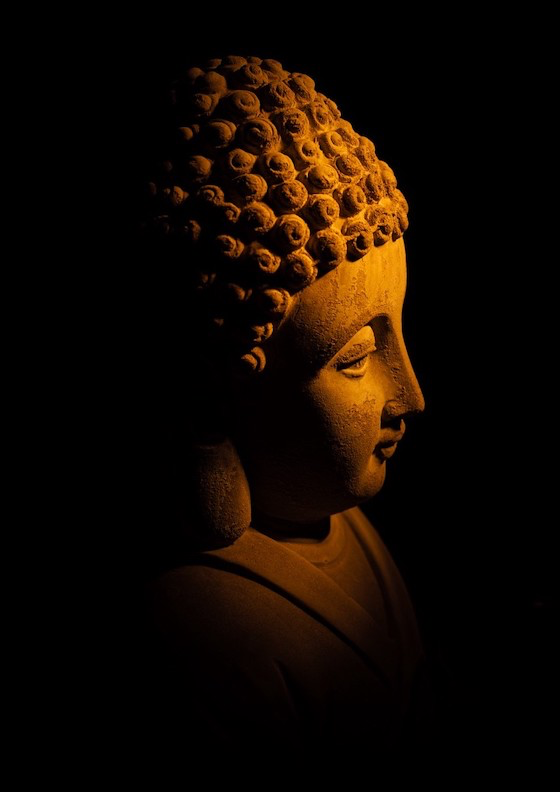
About the image above; Amida, lord of the Western Paradise, is seated in deep concentration with half-closed eyes and hands held in the gesture of meditation. During the eleventh and twelfth centuries, images of Amida were created in large numbers as a direct result of the popularity of Pure Land Buddhism in Japan. The above statue is dated circa 1863 –1866. This Pure Land teaching celebrated the glories of the Western Paradise, which can be attained through meditation and recitation of Amida’s name.
POSTCARD #184: Geneva, Switzerland, August 28, 2012: The number 9 bus drops me near a shopping mall coffee shop. Order something and open my book: ‘Satisfaction is a moment of relief from the pressure of wanting.’ That instant relief from the pressure of wanting comes with a thirst for more.
Just then, a little bird appears at the table; hops over, quite close to me, where there are crumbs scattered, looks at me with a flick of the head, picks up a crumb and flies away, whrrrt. Mall sparrows are incredible; evolved as these urban forms in an artificial environment that doesn’t really look like what it’s trying to be; high ceilings, glass roof, obviously ‘real’ foliage descending from stylized pillars made from polystyrene, surfaced with a resin that makes it look like marble – a hybrid reality form, an act, stage-set for a performance.
I go on reading and the bird comes back, picks up another big crumb and flies off, whrrrt. I can see it going up to the top of a pillar and now perched on the plastic leaves, then disappears in the foliage. Hmmm… a nest constructed from woven drinking straws, paper serviettes, fragments of cash till receipts, hidden in the simulated foliage up there? Generations of sparrows and other creatures have lived inside these places for years, long since lost the inclination to find the way out. The birds wouldn’t survive out there, they’ve adapted to conditions in here; proximity to table crumbs…
The small sparrow comes back to my table, takes another crumb, flies off again, whrrrt. The speed of the action… snatch, fly, eat. Feed the offspring and that’s how it evolved here. The dukkha of endless searching is not an issue for this bold little bird. It has everything it needs. I wait to see if it comes again, there are still crumbs, more than enough. But I don’t see it again, time for me to go. Across the road and the tram I need is arriving at the stop, traffic lights change just at the right time, I cross over and jump on. Light and easy, moving from one thing to the next. Not driven by wanting things to be how I’d like them to be and never quite getting enough. It’s got to do with the way you see it; the tram speeds up and glides along on smooth rails.
‘When desire does not shape the mind and limit it to thought, consciousness becomes translucent. Entering into the spaciousness of the original mind, we become the vastness itself. Inseparable from all else, at one with all that is.’ [Stephen and Ondrea Levine, ‘Who Dies’, chapter 4: ‘The Thirsty Mind’] ————————-
Reblogged, edited post, original title ‘bird in the mall’
"To me, photography is an art of observation. It’s about finding something interesting in an ordinary place. . . I’ve found it has little to do with the things you see and everything to do with the way you see them." – Elliott Erwin (Documentary photographer)





 dhamma footsteps
You must be logged in to post a comment.