
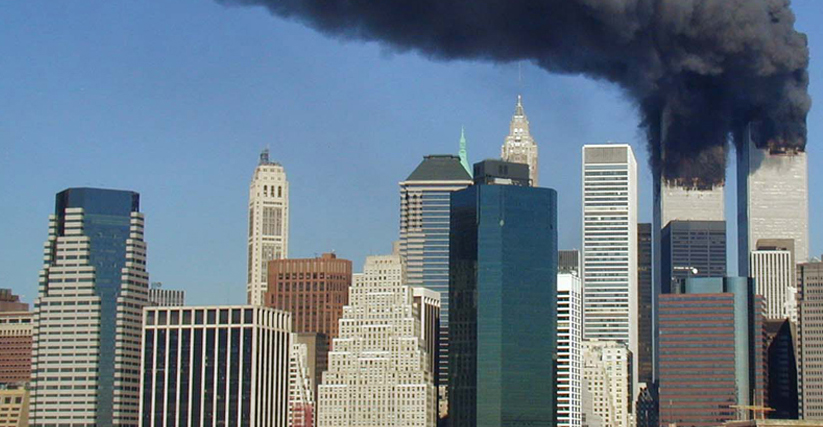
 Excerpt from ‘A Buddhist Reflection on the Tragedy of September 11’ by Ajahn Jayasaro, 2001: In this excerpt, Ajahn Jayasaro is talking about how we can learn, through the Buddha’s Teaching, to face this tragedy and here he refers to the three-fold training: sila (morality) samadhi (focus) panya (wisdom). Excerpt begins with sila (morality) and the link with volition: ‘Linking morality to volition means that to be consistently moral we need to educate ourselves about volition, not in the abstract as an intellectual exercise, but in the concrete present, as it manifests in our experience. The central role played by volition demands that we develop a power of introspection, an honesty and willingness, and an ability to look very clearly at our mind. We need to develop this form of education to the extent that we don’t rationalize our cravings and fears so automatically, that we are unable to lie to ourself as we used to do. In responding to a painful situation, for instance, we have to observe to what extent we are affected by the desire for justice, and to what extent for revenge. Is anger present, self-righteousness, fear? Are these wholesome or unwholesome qualities of mind, — to be trusted or not?
Morality here then is not a matter of following a number of rules or commandments, but of using precepts as tools in which to be clearly aware of and responsible for the motives behind one’s actions. Although the moral training in Buddhism demands a certain amount of awareness and a capacity for introspection, it is not the whole of the training. There are also specific practices for educating our emotions and discernment.
Thus we refer to a three-fold training, one which provides a framework within which to address the difficulties or dilemmas that we face in our lives. The training in morality is the foundation. It involves firstly the intelligent adoption of standards of conduct towards the external world and particularly other human beings, and then learning how to be mindful of them in daily life and bring them to bear on our behavior.
It is at this level of the training that we see the central role of self-discipline. But self-discipline is far from being a panacea for all our ills. We can’t decide not to get angry as an act of will, we can’t decide not to feel vengeful, we can’t decide not to have emotions. If we misapply self discipline then we create the conditions for guilt and repression.
Emotions are one natural part of our life. We have to understand them. Some emotions deserve to be cultivated, others do not. In our gardens we distinguish between weeds and flowers. Although we remove weeds we don’t consider our garden evil for having them. So the first principle of training the emotions and mental states is that force doesn’t work; intelligence, sincerity and patience do.
The second can soon be clearly seen: the ability to abandon the unwholesome qualities in our minds and encourage the wholesome is conditioned to a great extent by our ability to focus and concentrate our mind. This aspect of mental culture has been neglected in the Western world for many centuries. An educated person, in Buddhist view, is not only someone who can think rationally, analytically, but is also someone who can, on the necessary occasion, stop thinking altogether.
The mind, which is bound to mental states, tends to see things as clear cut, black-and-white, and often over simplifies the complexity of situations; it reacts in habitual ways. The mind which can put down habitual thinking processes, stand back from the rush of thought and emotion, suddenly has access to far more choices and pathways.
The Buddhist insistence is merely that the most constructive action springs from stillness. The wisest reflection takes into consideration, not only our own immediate interest or the interest of our particular group or nation; it also bears in mind the interests of our children, our children’s children and many generations in the future who are yet to be born. And this kind of thinking demands the ability to step back from one’s immediate attachments. It is dependent on mental culture, mental development.
 The third aspect of this training is the training of wisdom and understanding, teaching people how to really look at their actions and their consequences, seeking to understand situations more clearly. Initially it means regularly contemplating the very simple facts of life which we tend to overlook, in particular the nature of change. Changes may be slow methodical, expected, welcome but they may also quite often be sudden, unexpected and unwelcome. It is an inarguable fact that every one of us, sooner or later, will have to be separated from those whom we love.
The Buddha encouraged us to be students of change and to understand its nature. We should be looking at change, looking at uncertainty, looking at insecurity face-to-face everyday. Life is insecure. There is no real security in a changing world and the frantic search for an unrealistic security is only going to lead to tension and pain. There has to be a certain point where we create the conditions for security as best we can, but humbly acknowledge the fact that ultimately we have no defence against uncertainty and change. We have no rights. We can and should create conventions about human rights and it is important that such rights are vigorously upheld in human society. But ultimately, we have rights to nothing except the way things are: we are born, we get old, we get sick, and we die. We must be patient and willing to keep going against the grain of self-indulgence, looking again and again at the way things are; educating ourselves about those things which brighten and clarify our minds; those attitudes, those thoughts, those emotions which cloud and brutalize our minds. The more we do this work, the more we see that we have a choice which way we want to go, the way of darkness or the way of light.’
————————
Lower photo by Louk Vresswijk, taken in July before the attacks, shows the twin towers in a modern New York setting. Location, a column in Cathedral Saint John the Divine, 1047 Amsterdam Avenue, NYC.

Ajahn Jayasaro [Link to: 9/11 A Buddhist Reflection pdf]
 dhamma footsteps
You must be logged in to post a comment.