the who-I-am thing

BTS_Skytrain_over_Sala_Daeng_Intersection

Bangkok: Flying above street level and over the rooftops in the BTS Skytrain on elevated track, bright yellow seats, red holding straps and blue wall sections. Primary colours; diminutive, childlike and cute; it’s a toytown train. Brushed steel, shiny chrome and a smooth metallic click of wheel on rails, rushing through a landscape of blue sky over the city as far as the eye can see; billboards and upper storeys of town houses, moving past in the foreground, tall buildings of steel and glass standing like pillars in the background urban concrete environment. Here and there on the train, are TV monitors fixed at eye level with adverts running continuously so that we can enter into a world of consumer preferences: the Western model, East Asian style, adapted to fit Thai cultural attitudes to spending. Stories acted out by adults who look like children; cute ‘faces’, attractive personalities, ‘charm’. Products presented as if it were a game, makes it all seem acceptable; we don’t see the high-voltage sales strategy, cloaked in naïvity – a new society, a whole new generation of consumers – the corporate entity engaged in long term planning.

coke ad.ploenchitBKKI can get caught by it, drawn towards the TV screen, something I see in the advert triggers it, and the who-I-am thing arises: I LIKE THIS and it all gets to be really important, relevant, vivid and intense. I feel suddenly energised, compelled and, I WANT TO HAVE IT, ready to start discussing with sales staff at the retail point and proceed with the purchase; the plastic in my wallet, the samsara of advertising. For me, no worries, it will cease of its own accord if I can allow it to become nothing, and fortunately it’s all in a language I can switch off from so it fizzles out…

To become a person, I have to ‘believe’ in it – I have to consciously engage with it. To become me, I have to think ‘me’. The ‘me’ that I believe in depends on me thinking it. I am conditioned to be attached to my opinions, my emotionality, and the sense of self in all kinds of ways. I can manipulate the conditioned world so that, from this perspective of thinking, I see (my)self situated favourably – or it could be unfavourably if I’m caught in being the victim (but there is a way out). Everything arises due to causes and conditions, then thinking about it, excessively and often enough to have it embedded in the fabric of this self construct I recognise as ‘me,’ subject to its perceived whims and waywardness, as some kind of fictional character.

But there is a way out; an intelligent reflection on the human predicament; a proximity-to but distance-from situation: the Middle Way. The practice is about this simple truth: don’t mess with it, it won’t arise if I don’t think it into being. And I am my own boss, the nearest thing to God, as we know it, is viññāṇa, conscious awareness, self-sustaining; I don’t create it. There’s the body, sitting here in this yellow plastic seat, minding its own business, other than that, anatta, no personal essence or substance or core or soul given to me by the grace of (some external force); nothing added, nothing extra. The simplicity of this seems to immediately throw everything to do with ‘self’ into disarray; enough to cause it all to come tumbling down; a house of cards. And an artificial voice announcement gets my attention: Siam-interchange-station-doors-will-open-on-the-right-hand-side-of-the-train. I join the throng of passengers squeezing through the door and pouring out like liquid into the centre of the shopping mall heaven realm experience. There’s nothing wrong with personality, it’s the attachment to it that’s the problem…

————————-
Upper photo image: http://commons.wikimedia.org/wiki/File%3ABTS_Skytrain_over_Sala_Daeng_Intersection.jpg
Lower photo image: Coke ad Ploenchit, collection author

somewhere over the rainbow

A burst of light from behind clouds

Bangkok-Delhi flight: Something happens to interrupt the dream… it wakes me up and I remember I’m on the plane. It’s a window seat, clouds outside and a huge horizon – the curvature of the earth. Here in the confines of economy class, the large man next to me wears a short-sleeved shirt and has hairy arms, the passenger in front has extended his seat all the way back, and it’s like his head is in my lap. I feel I’m part of the South Asian population already. Stewardess announcement:  ‘raydee and gentermens…’ Thai, mispronunciation of the L and R consonant and a plurality problem, ‘.. ensure window shades are up, armrest is down, fold away table up, and chair forward… If I think too much about it, I get lost with the instructions. ‘And this concludes our fright service…’ Reminds me of a flight to Jakarta once; and the last part of the stewardess announcement: ‘… and the penalty for dlug tlafficking is death, thank you.

The final part of the Woody Allen movie I was watching before I went to sleep is still showing on the screens. I don’t have the sound plugged in, just looking at the actors fumbling around like serious, grown-up children. The ‘I’ metaphor is an image projected on a screen; reassuring in the midst of our existential anxiety. Consciousness plays the game of hide-and-seek, concealment and obscuring – if consciousness is revealing itself, it means it’s also obscuring itself and things appear to be what they are not. Woody Allen has a cartoon face, he was born with it, that was/is his destiny. I plug-in the sound to see what it’s about – the idleness of it is immense, samsara, conversations of no consequence unravel here during the time it takes from departure point A, to arrival point B at the speed of 600 miles per hour.

Watching other people looking around, heads spinning left and right, down, up, coordinating body movements; going along the aisles and coming back to their seat, holding on to chair backs as they go, simply occupied with the physicality of being in the limited interior of this aircraft, mesmerized by the phenomenon of individuality. There’s not anything beyond the mind’s perception of itself as the leading actor in this movie; the assumption is that, one way or another, everything coming through the sense gates and into the mind is about ‘me.’

‘Infinite being playing the game of limited being. The limited being is a construct we’ve taken on; it’s like this because the infinite being that we are isn’t bothered by limitations and permits everything with infinite love…’ [David Bingham, Conscious TV]

Plane tilts over and makes a left-hand turn. Sunlight comes in through the cabin windows on the right side and sweeps around the interior as the plane changes direction, circles around and goes into descent. It’s as if it were a flying house, spinning around on its axis (We’re not in Kansas anymore, says Dorothy to Toto. We must be somewhere over the rainbow.’) Audio switched on; music for arriving. Slow calm triumphant music has a kind of congratulatory sound; the final approach; our journey’s end. And the digital map of the world shown on the monitor has the illuminated flight path BKK/DEL as a diagonal line about 30 degrees North East with the small icon of the plane now circling over New Delhi – population 16 million, including rural/urban seasonal migrants. A few moments later: BUMP BUMP wheels touch down on runway. Population increased by one planeload.

————————-

‘I’m not afraid to die, I just don’t want to be there when it happens’ [Woody Allen]

backstory

Iceland wave1Chiang Mai: Skype call from P in the North of Scotland, walking through a shopping mall interior, holding up his phone camera in front of him and I’m able to enter into a view of the world at this moment, about 5500 miles away. It feels like I’m really there; a chromium steel, tiled and glass environment with Starbucks and everything is recognizably ‘the mall’. People wearing scarves and hats, thick clothing – it’s below freezing outside that building. Light from the mall windows fading out to zero white, pixelated edges of electric blue and turquoise suggests air so cold it’s like an ice-cream headache, chilled nasal passageways and cranial cavities. I’m thinking of ice-rinks, peppermint and menthol. Words come out with vigour in great gusts of steamy vapour.

I lived there in a former life – long ago and far away. The sharp clear air, constant wind, and winter daylight lasts only a few hours; it was a world without colour. Cold, wet, windy and the mind is saying: ‘No, I don’t like this. I want sunshine, I want warmth,’ the samsara of wanting it to be different from how it is. And eyes looking through the gap between hat and scarf, out into the world but inwardly removed and seeing the sunshine in some fictional landscape created in the mind. I didn’t know anything about the Buddhist perspective on Suffering, dukkha nirodho ariya sacca, at that time, just ‘driven’ by a sadly dysfunctional family and nameless hunger that arises from the feeling that there has to be something better than this.

So, one thing led to another, and it’s a long story, but eventually I discovered it’s not ‘me’, it’s just the way it is. I can have loving-kindness, mettā, for the created ‘me’ and lighten up about that. I don’t get seriously into it any more, now there’s that distance from my constructed identity. It’s been with me all those years, wow, like something historical: ‘This is the house that Jack built.’ And now I’m here in South East Asia; not too hot at this time of year, warm like a Mediterranean summer; rubber slippers, shorts and a T-shirt. The quality of light is amazing, colours of things are outstanding, as if lit from within – a Disney cartoon – papaya fruit is an amazing fluorescent, magic-marker orange; green trees against blue skies and the whole thing feels like it’s been photo-shopped. The air is warm like a soft quilt cover wrapped around the shoulders, with no weight, so you feel this lightness – ‘Unbearable Lightness of Being ‘ by Milan Kundera, worth reading if only for the title.

But all this coming to an end very soon, less than a week to go before the time comes to go back to Delhi and the colder climatic conditions of the North. Not able to flop around in thin cotton clothing any longer… nope. This time next week I’ll be socked and shoed and trousered, and scarved and coated, hair-combed, passported and ticketed and transported to the North of India in a passenger jet, but that’s not happened yet so there’s time to reflect on that difference and get ready for the adjustment.

I’ve been living in other people’s countries for more than 30 years; met Jiab on the way. She still identifies with her Thai cultural context. I’ve nearly forgotten mine. I used to go back to the family home up there at the top of the world and most people couldn’t remember me; all the elders’ hair going grey, and greyer then white, Now I go there for funerals and people just don’t know me at all. I’m a foreigner there and a foreigner everywhere else. I’m more into the Thai world than any other culture – they see me as a kind of cultural hybrid.

There’s a shrine in Jiab’s family home; a structure of tiny ornate tables placed one on top of each other, in a hierarchy of size. The larger ones are at the bottom and smaller ones placed on top and even smaller ones placed on top of them. It’s built up to about five levels. An ascending, perspective effect as things recede above eye level with candles and an image of the Buddha on the topmost table. It’s the one where he’s protected by the hooded snake god Naga, extending Cobra neck hood and curved over the head of the Buddha forming a kind of umbrella (there was a rainstorm at the time of approaching enlightenment). Above that, framed on the wall, there’s a row of these faded old sepia photos of Jiab’s ancestors. There they all are, looking down at me. I feel their gaze because I’m not just a cultural hybrid in their eyes, I’m from a different planet too. I sometimes feel they need to look at me more carefully than they look at other visitors to the shrine. So I just let them do that, it’s a kindly gaze, without the burden of thought, comfortably dwelling in a state of wakefulness, and understanding things in their actuality.

P1030977

————————-

Photo (upper) Iceland wave, Peter H. Photo (lower) Chinese temple BangPah-in, Elaine H

how it is

2013-01-10cables1‘All conditioned Dharmas are like dreams, illusions, bubbles, shadows. Like dew drops, a lightning flash. Contemplate them thus.’

Chiang Mai: It’s late morning, getting near to noon and I have to go out and get something from 7-Eleven. Down in the elevator and it’s not far, along to the end of the lane, tall buildings on either side and the brightness of the daylight is astonishing as I step out of the shadow into the open space of the main road. Intensity of colour, noise, people and everything is undeniably what it is, no room for considering what it might be or might have been, a tendency we have – those of us originating in the indistinct climates of the northern hemisphere, colourless eyes and no pigmentation of the skin – to ponder like this over hypothetical situations, papañca, that proliferate without end.

This is the tropical, the equatorial, and all in uncompromisingly vivid maximum pixel, vibrant colour. This is how it is; clearly defined, good looking people with black hair and golden skin. And all with a will to go out there and get it done. We’re all in this together, including the pale foreigners, who live here with us for part of the year. This is the public domain, the shared environment, we are a large population accommodated in small houses and rooms and we like it like that. No allowances for personal space – what is ‘personal’ space? It’s structured to allow for large numbers of human beings who may carry with them their ‘personal’ space and other needs and requirements, their babies their infrastructural support systems, schools, hopitals, shopping malls, cars, motorbikes and everything as it is here and now, inherited from generations before us to whom we are grateful and pray for earnestly.

I’m having some resistance to the immediacy of it, I don’t want it to be like this; too bright, too public; I feel like an owl in the daylight, a nocturnal shadow, like I shouldn’t be here, cloaked in the darkness of my quiet space, buddhist vampires wither away. Same old story, just see this aversion without being overly attached to the thing.  Have metta for the state of mind. There’s the getting into it; there’s the attachment, the ‘hook’ to get caught… or is it a ‘perch’ to rest on for a moment and look at the view… waves of samsara all around; I’m wanting ‘it’ to be ‘this’ and believing this is really how it is – the experience of being able to change the image in the mind’s eye, to make it be how I want it to be – a skill I  learned as part of childhood conditioning. I can see the folly of it, the baseless fabric of this vision… all which it inherit, shall dissolve…’  it leads nowhere, exists for it’s own sake, momentarily and comes to nothing in the brightness. The sun shines through all parts of it; they become shadows, vapours and disappear.

It’s that ‘letting-go’ thing again. Why does it have to be like this? You could say there’s a kind of glue spread over objects and attention gets stuck on that. Seeing it like this means, of course, I recognise the possibility that there’s also a solvent that renders the glue unstickable, it doesn’t adhere and, there’s no need to remind myself to ‘let go’ because everything has been let go of already? There isn’t anything anyway that has the power to cause one to attach. It’s the mind that’s doing it. Stop creating it and there’s nothing there!  I get what I need from 7-Eleven and back upstairs to the apartment, where it’s cool and quiet and shady.

————————-

‘Our revels now are ended. These our actors,
 As I foretold you, were all spirits, and 
Are melted into air, into thin air: 
And like the baseless fabric of this vision, 
The cloud-capp’d tow’rs, the gorgeous palaces,
 The solemn temples, the great globe itself,
 Yea, all which it inherit, shall dissolve, 
And, like this insubstantial pageant faded,
  Leave not a rack behind. We are such stuff
 As dreams are made on; and our little life 
Is rounded with a sleep.’ [The Tempest Act 4, Prospero, scene 1, 148–158]

the end of the line

IMG_4239 (1)Safdurjung station: Welcoming committee, red carpets and flower petals strewn around the platform, it’s the end of the line; the end of the trip. It’s where the train stops and we get off, but not really the end of the line. The line goes on from here and connects up with other lines in the network and links up with neighbouring countries then ultimately with the network that stretches out over the whole planet. It doesn’t start anywhere and it doesn’t end. There’s an interesting reference to this in the Hermann Hesse novel, ‘Siddhartha’, saying that time doesn’t exist in a flowing river, it’s everywhere at the same time, only the present exists, no past, no future….

There’s something about being on a train that imposes a kind of inevitability of circumstances on everything. There’s no deviation from the direction the train is moving in. The thought sequence, following an ongoing linking, travels along of its own volition, and takes shape as it goes; episodes from an anthology of short stories. It stops sometimes but that’s not the end; the stopping/starting of it is a characteristic of the story’s unfolding.

A particular event occurs somewhere in the process that suggests how the beginning might have taken place. Later this goes into ‘refresh’ and there’s a new possible beginning. Then another one after that and again, then it’s not important anymore. Mind links it all up or associates random parts of it in some barely satisfactory way and this is how the whole thing seems to sustain itself from moment to moment. It’s samsara; driven by some kind of underlying seeking-for-something that can never be found; there’s only the ‘seeking’. A slightly suffocating, enclosed feeling about it all – it can’t be “held” beyond a certain limit, and eventually I wake up. Everything still quite clear in the memory for a while then completely forgotten.

With mindfulness of papañca (mental proliferation), the process of conceptualising is just a process – no person there doing it. The application of mindfulness, which puts an end to belief in the fictional ‘self’, is also just a process – no person there doing it. It sort of does it itself. As long as there is an intuitive notion of “wholesomeness”, the recognition that what I’m doing is ethically correct sila, then there’s an opportunity to sense if something is right, or it’s the right way to go about it and the process of mindfulness runs by itself. No self, anatta, nobody at home; just an operating system, Windows 8, MacOS Lion, and beyond. A determined and purposeful search to find out exactly where this ‘no self’ exists will yield nothing, of course, because ‘no self’ doesn’t exist. Follow this reasoning to its obvious conclusion and it’s a way of saying nothing exists. So, if there is no ‘self’, who or what ‘sees’ there is no ‘self’ and I asked Ajahn about it: ‘If everything without exception is “not self” including the “I” that’s investigating this – then where does it all lead?’ Without hesitation, Ajahn said “enlightenment” and looked at me with these grey eyes, waiting for the next question ….

IMG_4241

Many thanks to Khun Witit Rachatatanun for the photos in this series of posts

things not being right

121120121558Road to Gorakhpur: 18.00 hours, we’re on the bus, there’s an immense noise from the engine and the driver is pressing the shrill, twin-pitched, piercing horn continuously as if he were practising a Miles Davis piece on the trumpet, over and over. Three and a half hour journey and I’m getting thrown around all over the place on this unbelievably rough road. The bus makes a sudden lurch and overtakes a slow moving vehicle; then again, rapidly making our way past all these trucks, one after another. It’s a convoy of Diwali Lakshmi Puja pickup trucks, each one with a generator throbbing in the back: boom, boom, boom, boom. And there’s the Lakshmi shrine all lit up with flashing red, blue and orange disco-lights and Hindi dance music at max volume: thud, thud, thud, thud, thud, thud – followed by a long line of young people running and dancing behind it. The distraction of this holds my attention for a while. It’s really like being on another planet – after a day spent in the silence of Lumbini and minimalism of Theravadin Buddhism.

It wasn’t a good day, pity. I was in the park with the group doing a couple of 45 minute meditation sits on the grass under the Bodhi trees in that historical place and it didn’t come together for me – just one of those things. I spent most of the time tossed around in the samsara of mind stories and now here on the bus, the difficulty of this journey propels me further into a small vortex of thoughts that I failed something, hopelessness and… what to do?

Try deep breathing, keep it simple and allow the chaos to be what it is. See it harden into a grasping knot of discontent and stay with the focus on breathing as I tightrope walk across the raging inferno of things not being right, not being the way I want them to be. It goes on like that for a while and eventually the fierceness of it lessens. The fires reduce to smouldering ashes and there’s a moment of relief. The pain of it is not there now – wait to see what this change will bring and when I look for it again it’s like there’s an empty space where the suffering used to be. I realize it’s gone.

Now it’s later. I’m looking through various notes and there’s a reference to the Noble Truth of Suffering that I copied from somewhere and I can’t remember where: ‘…the disenchantment, listlessness that arises from familiarity with fearfulness, unsatisfactoriness and the comfortless nature of things.’ Hardly an inspiring statement and I can understand why people see dukkha as pretty negative – what is this… masochism? It’s not that, it’s just facing up to it, no avoidance behaviour. I’m saying this because there was one time I was in a situation of no escape from serious physical pain; just no way out, the only thing to do, the only way to go was towards it; no more backing off from it. I had to accept it, let it in. Immediately I notice a small easing, enough to somehow find a release from it – not hard to do when there’s no choice and there’s no other direction to go but straight into it. In hindsight it seems as if I didn’t know it at the time but this was an important part of finding the way out? That’s how it was in the end; I could see the suffering, identify it – it’s like, oh yeh! I see now… and seeing it dispels the ignorance of not having any idea what’s going on and being controlled by it. That’s what lets it go (frees it). Off it goes, bye bye and the suffering is suddenly not there anymore. [Link to: Homer & the 1st Noble Truth]

The struggle itself is what causes the suffering. It’s about the energy used in trying to get away from it just fans the flames and makes it worse. And, because it’s habitual, maybe a lifetime of allowing it to be like this, it’s chronic and things just go on like that until I see the only thing that’s preventing me from letting go of suffering is that I’m still holding on to it….

————————-

‘We learn how to let go, in the process of observing the consequence of our grasping.’  [Ajahn Munindo, Dhammasakaccha]

how it looks from here

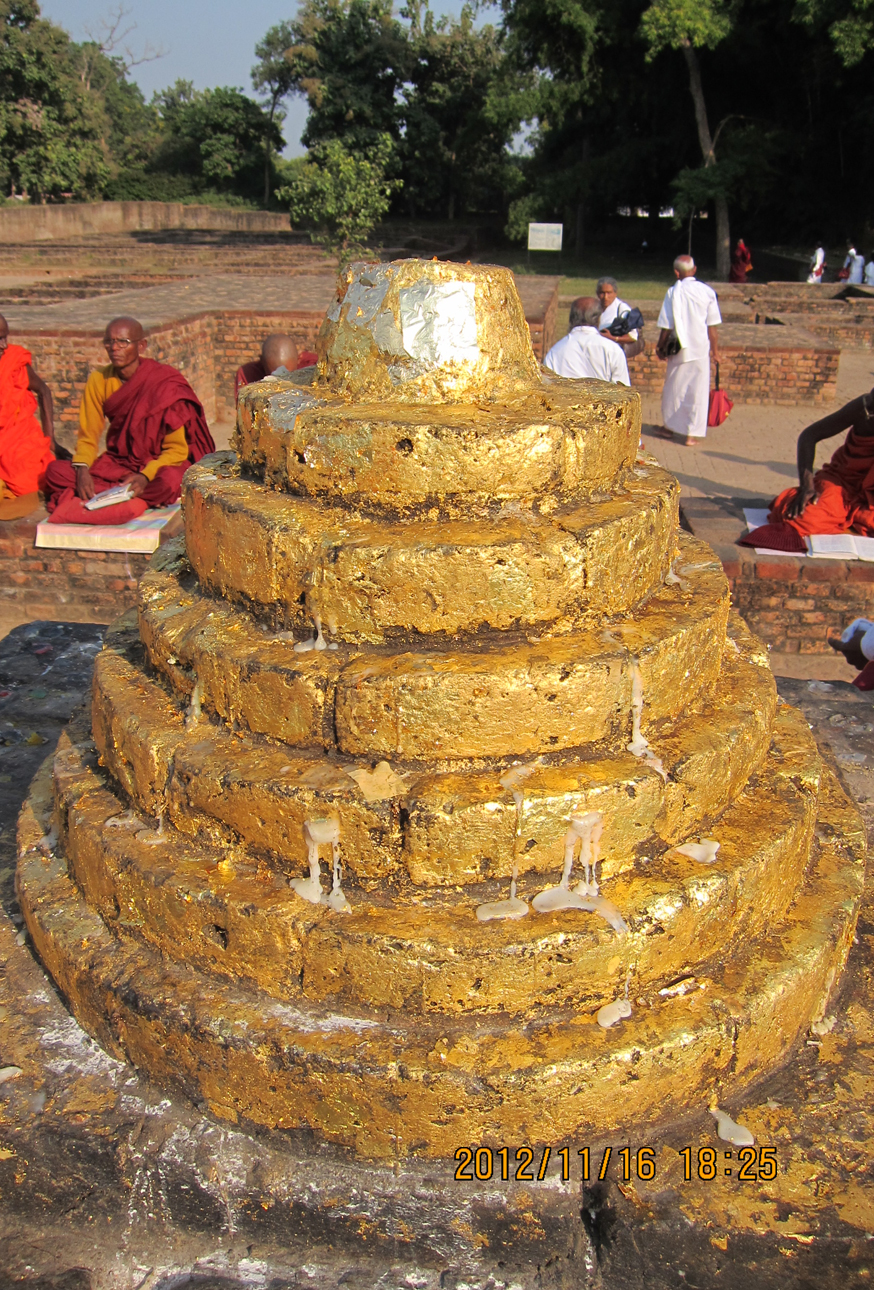
Sravasti: These shrines and monuments stay the same, perhaps sunk deeper into the landscape than they were in ancient times; there’s a presence. The seasons revolve around them, rainfall, heat, sand storms and the centuries come and go. People from all over the world come to visit, pray, bow, apply goldleaf, string garlands, light incense, show reverence and take pictures of their friends standing next to them. A great shower of digital flashes lights up the environment like a fireworks display; camera phones, iPads held up like a tray, with an image as large as a small television, ‘and here is the place where the Buddha was enlightened:’ flash, click! Thus, a small piece of the outer world is captured; perhaps a small landscape showing the shrine, prayer flags strung across branches of a huge Bodhi tree and my friends standing below smiling for the camera. Everybody hurries to look at the picture just taken; camera device held by finger tips, the image never quite hits the spot. So we reach into the outer world and ‘take’ another one, a nicer one maybe, have a look, but it doesn’t hit the spot either.

Taking a picture is a reflex action, a simple curiosity; I want to ‘take’ a picture of it and there are hundreds of images in this camera memory we have to load somewhere else to make room for more. All of them are simply showing the passage of time: people get older. But it’s meaningful to us, a metaphor we’re deeply familiar with; consciousness of outer object meeting inner sense base and we respond to it in much the same way as sensory input, by way of eye/ ear/ nose/ tongue/ skin/ mind, is the means by which the outer world enters the inner being.

Receiving data from the outer world through sense organs situated around the face and head has the odd effect, somehow, of pushing the whole head into the bubble of the outer world and I can understand what Douglas Harding was saying when he spoke about ‘having no head’, and the rest of the body, seemingly connected. That’s how it looks from here. I can see all these other beings walking around too. Some of them seem to know what’s going on and some don’t know at all because they’re preocccupied with taking a photo of the event, or maybe they’re watching the video they made of it. Some believe it’s God’s world and contemplate experiential responses to outer stimuli, thinking God created this, so it must be okay. The idea that God also gave us the gift of insight to see for ourselves is not something they feel they need to take into consideration and just leave it at that. Others are walking around just browsing the options, hoping to stumble upon something soon. It could take eons for them to find it, stuck in the samasara of Search Mode. Other beings are in a historical time period but otherwise the same as what we have today and I am here thinking about the possibility that the Buddha was standing in the same place where I’m standing now.

————————-

‘At Savatthi. Then the Venerable Kaccanagotta approached the Blessed One, paid homage to him… : “In what way, venerable sir, is there right view?”

“This world, Kaccana, for the most part depends upon a duality—upon the notion of existence and the notion of nonexistence. But for one who sees the origin of the world as it really is with correct wisdom, there is no notion of nonexistence in regard to the world. And for one who sees the cessation of the world as it really is with correct wisdom, there is no notion of existence in regard to the world.

“This world, Kaccana, is for the most part shackled by engagement, clinging, and adherence. But this one [with right view] does not become engaged and cling through that engagement and clinging, mental standpoint, adherence, underlying tendency; he does not take a stand about ‘my self.’ He has no perplexity or doubt that what arises is only suffering arising, what ceases is only suffering ceasing. His knowledge about this is independent of others. It is in this way, Kaccana, that there is right view.

“‘All exists’: Kaccana, this is one extreme. “All does not exist’: this is the second extreme. Without veering towards either of these extremes, the Tathagata teaches the Dhamma by the middle: ‘With ignorance as condition, volitional formations [come to be]; with volitional formations as condition, consciousness…. Such is the origin of this whole mass of suffering. But with the remainderless fading away and cessation of ignorance comes cessation of volitional formations; with the cessation of volitional formations, cessation of consciousness…. Such is the cessation of this whole mass of suffering.”’[SN 12.15(5)]

Photos from the Witit Rachatatanun Collection

Responsibility

Bangkok: We arrived at the Golden Palace in a taxi but at the wrong entrance, unfortunately, and the man there said this is not the entrance, you have to go down that way and he pointed down the road – but, the thing is, and didn’t we know, the Golden Palace is closed in the morning today? So we hesitate and he says, yes there’s some kind of ceremony taking place, so it’s closed to the public but why don’t you go round to some other temples and palaces for an hour or two then come back in the afternoon and it’ll be open at 1pm? So we’re thinking about that and he takes us over to the the tuktuk guys and starts to sell us a deal for going around the area on a tuktuk. That’s when we figure it’s a scam, say to the guy, thank you very much and walk around for a bit to decide what to do, then down to the main entrance where everything is open as usual with a sign saying: ‘Open Every Day’.

It comes as a bit of a shock and makes you wonder, what is it with that guy? How can a Thai have such blatant wrong intention; absolutely contrary to normal cultural behaviour and doing this on the doorstep of one of the most cultularly significant sites in Thailand. Its a bit like someone working a scam on tourists entering the Vatican. He must know he’s creating very bad karma and why would he do that? I asked Jiab afterwards and she didn’t have a lot to say except that the guy was probably in such dire straits he must be in a living hell realm already so let’s not talk about that okay?

I’m not sure how this works, it’s one of those things that everybody just puts up with, so it has space to continue as it is; nothing really comes along to stop it, or give it proper direction. You take responsibility for your own actions here because, up to a point, you can do anything you want in Thailand, except that if it’s wrong action, you have to know that it’ll eventually bring bad results to the wrongdoer and every Thai knows this, fears this and is in awe of this. Why, then, do we have people doing things that’ll create bad karma? Because they are already trapped in pre-existing karma; due to avidyā, a fundamental misunderstanding of the nature of reality and over time have become inseparable from bad actions and have obligations to other unfortunate characters equally lost in the cycle of bad karma. So they have to take on things like this to earn a living – for the guy at the tuktuk stand, it’s not much maybe, but he has to go on creating unpleasant situations for other people as he’s slowly working his way out of his unfortunate karmic situation. He’s just trying to survive and will ask for blessings from the monks, the same as everyone else. If it looks like he’s genuinely trying to do something about his predicament, society tolerates his behaviour – up to a point.

And what, then, if you have some seriously bad guy like a gang boss in the underworld who has such large accummulated wrong action and the bad karma that goes with it? Let’s say he’s at the end of his life, a Buddhist, and clear in the knowledge that he can’t put off having to face the consequences of his actions one day quite soon. What can he do? Assuming he’s not already lost in the cycle of deluded and obscure karmic forces, he may offer to the temple, very large amounts of the money he took from others, in his lifetime or he may even offer to finance the building of a new temple or a monument of religious significance. Whatever; he’ll try to do something to put right the wrong things in his life. Although it will bring benefit to many, it won’t work for the gang boss because he left it too late and is now in the situation of being old and weak and having to face the knowledge of his wrongdoings on the threshold of death; a crash course in learning what remorse is and coping with a fearful mind rapidly moving in the direction towards: ‘the downfall, the woeful way, the sorrowful state, the cycle of birth-and-death.’ There’s just no getting away from it. It’s about samsara and, depending on the particular circumstances, could be unfortunate. We can’t take anything in this life on to the next life; only karma. There’s every reason to feel compassion for the guy standing outside the Golden Palace and hope that eventually he finds the way out.

————————-

‘Like a seed waiting for rain, our karma shadows us, waiting for the opportunity to grow and ripen. Our intentional actions will produce a result at some time. People in their present lives, are experiencing the effects of their past actions or karma.… it is possible to alter or reduce the effects of these past actions through present actions. These will also have effect on future lives. Understanding the law of Karma helps us realise that we are, whatever we make ourselves to be. We are entirely responsible for our own destiny.’ [Hwa Tsang Buddhist Monastery]

Photo Image: Elaine Henderson

the doorway

London-Bangkok flight: What a strange way to spend the afternoon… brilliant clear light enters the window as if we were in a room high up in an apartment building. Purple carpet with yellow stars, walls are grey, the fittings are of brushed steel, but I’m somewhere in the air, and thousands of miles away from where I was 8 hours ago. The little old house in East Anglia is empty now, I packed up and left it behind.

Last thing was to bless the room; a blessing and a ‘thank you’ for providing shelter, and doing this also helps me to be alert, mindful and ready for the next thing. Hands held in anjali, and walking through all the rooms in that small dwelling saying in my mind: ‘May all beings live in safety, be happy, be healthy, live with ease. May all persons who come here after me find the same feeling of security and stability I found in this place.’ Then step outside, close the door, double lock it and into the taxi. It helps give a sense of closure, or something, at the end of an event. I recommend it. Recently I came across something very similar about blessings that I liked [Link]

After that, walking through the airport halls and passageways and all these people just moving along with their bags; as you pass them there’s a hint of something familiar – it’s that transitory ‘thing’. Airports and stations are an extraordinary example of it, in fact it’s always there – there at the corner of one’s vision. We’re all having the same kind of experience; we’re all going ‘away’; we’re all in transit; this is the time after we left and before we arrive. This is aniccan the ‘in-between’; the moment of transforming.

Change is there all the time – might seem like a contradiction. There’s a Nagarjuna quote: ‘All things are impermanent, which means there is neither permanence nor impermanence…’  could be a koan; the constant sweeping along of aniccan and waves of change. But immediately it says to me, first I need to lighten up and there’s always something new, gently nudging at the elbow and that’s what makes it possible to ease away from attachment.

If I’m free from ‘holding’, I can easily pass through the layers and corridors of the travel experience, part of the great river of human beings, all of us on the way to ‘somewhere’, surrounded by advertising images of well-off, good-looking people smiling all the time; Julia Roberts doing a Gucci advert? Celebrities I know but can’t remember their names, just posing as ‘themselves’ wearing a watch the cost of a small car. I look closely, trying to remember who it is, and fall into the dream.

They look secure, confident, happy and everything is going allright for them. They don’t seem to suffer from that great chasm of nothingness situated in the centre of everything; the ‘me’ I live with. What is it they have that I don’t? If I could have whatever it is they have, I could be happy, like them…? I’m drawn towards ‘the purchase’ by scenarios and strategies created by commercial psychologist witchdoctors who can manipulate my conscious experience.

Mindfulness means I stay free of the hunger and the urge. Here on this plane I can see  a small piece of  sky out there. It’s sufficient to remind me that if I get pulled into consumerist samsara too much, there’s a doorway in the mind which leads to freedom from sufferingthe remainderless fading & cessation, renunciation, relinquishment, release, & letting go of that very craving. Just knowing this is enough.

‘Within that cycle [the wheel of birth and death (samsara)], there is one doorway through which we can step out, namely, between feeling[Vedana] and craving[Upadana]. All the other steps of dependent arising are automatic causes and effects. Unless we learn to live with unpleasant and pleasant feelings without wanting to get rid of the one or keeping and renewing the other, we don’t have access to that doorway.’ [Aaya Khema, When the Iron Eagle Flies, Transcendental Dependent Arising p55]

Success-Failure

Switzerland: I’m on the DOWN escalator at Gare Cornavin leading to the underground shopping area, and up to where the bus stop is. Phone rings in my pocket. Hello? It’s Jiab calling from the house in Delhi. Reception is not good so when I reach the bottom, I change to the UP escalator and come back to street level. How’s things? In the background I can hear the neighbour’s dog barking: woof-woof, woof-woof, woof-woof, woof! [Link to: Mindfulness of Irritation] The familiarity of it … for a moment I’m there; the sense of ‘me’ from that time starts to  become the ‘me’ here 5,737 miles away (as the crow flies). Interaction with the feeling only serves to energise it. The ‘I’ wants to experience it again but that’s gone now. ‘Did you see the end of the Olympics?’ Jiab asks me. And I did but have to say that watching the Olympics hasn’t been a priority these last couple of weeks. So, if you asked me about who won which medal, I couldn’t tell you. ‘Hello?’ no signal… I go down the escalator to the bus stop, pulling my small case on wheels behind.

There is this sports enthusiast friend of mine who was coming round to watch the tennis on TV and I’d be sitting there reading a book in the TV room with him, not really involved in the game, then he’d suddenly BELLOW without warning. I’d jump out of my chair, and he’d apologise for giving me a fright; thrust into the euphoric awareness of the tennis court ‘moment’. It isn’t very ‘sporting’ of me but when I see the athletic events on TV, it’s more like an opportunity to practice non engagement; being ‘with’ it and not ‘in’ it than something I ‘enjoy’ watching. The fierce competiveness is a bit unnerving; winner gloats triumphantly and loser totally devastated – gladiators slaughtering their opponents in the arena, spectators wild with joy. And if we are cheering in excitement about our athlete winning the gold medal, the opposing side will be groaning in despair about their athlete losing; making a big thing out of our success encourages their failure. It works both ways, of course, we may be on the losing side as often as we’re on the winning side.

The number 3 bus arrives and I put my bag in the luggage section; no seat, hold on to the hand supports as the bus swings off. Holding on to what I like means that some things I dislike come along as well; two for the price of one. The feeling that I ‘like’ something will stay around for as long as I hold on to it. If it’s something I ‘dislike’, the aversion I feel towards it is an attachment I struggle to disengage from. It’s a form of holding and that means the ‘dislike’ tends to stay around as much as the ‘like’ does. In terms of the Buddhist experience, like-dislike are the same thing; I’m driven endlessly to seek what I like because I dread having only what I dislike – thus end up holding on tightly to both.

These are the Eight Worldly Dhammas: ’… four pairs of opposites – four things that we like and become attached to and four things that we don’t like and try to avoid [pleasure/pain, praise/criticism and blame, fame/disgrace, gain and getting what we want/losing what we have]. We might feel that somehow we should try to eradicate these feelings of pleasure and pain, loss and gain, praise and blame, fame and disgrace. A more practical approach would be to get to know them, see how they hook us, see how they color our perception of reality, see how they aren’t all that solid. Then the eight worldly dharmas become the means for growing wiser as well as kinder and more content.’ [Pema Chodron]

The dilemma of the ‘I’ experience caught in the Eight Worldly Dhammas is serious and traumatic in the context of violence, war and natural disasters. The Pakistan earthquake in 2005 where 3.3 million people became homeless and so many lives were lost is one example [Link to: Power Failure/ Comments/ Saadya]. Many people there were convinced about a sort of Sodom and Gomorrah type of retributional justice; it’s all our fault, etc. We are being blamed for ‘our’ actions in the past. An extreme reaction in an extraordinary situation. Samsara of distress, pain, fear and the sense that something is ‘wrong’. The human tendency is to contract into ‘self’ and the assumption arises that ‘I’ caused it to be ‘wrong’ – I am to ‘blame’. It troubles me to think that this may be quite a common reaction when people are faced with death. When there’s no knowledge or experience of how to be mindful and aware, the mind follows this route.

This guilt syndrome that happened during the Pakistan earthquake was/is another example of the habitual ‘self’ response, no more than that, when everything came back to normal, the intense urgency of thought simply evaporated. ‘Everything that arises passes away.’ At the time it’s happening, it’s difficult to see that. What can I do to abide in equanimity….

Bus arriving, get off at the stop, cross the road and well-behaved Swiss traffic actually stops at the pedestrian crossing to allow me to cross. I hesitate, Bangkok traffic has the right of way, then I remember it’s ok to cross. How nice! Up the hill to the apartment building, pulling my small case on wheels behind. Good to be back in the fresh air and chilly mountain winds.

————————-

‘External conditions don’t make you suffer, suffering arises from wrong understanding. Feelings of pleasure and pain, like and dislike, arise from sense-contact – you must catch them as they arise, not follow them, not giving rise to craving and attachment – which is in turn causing mental birth and becoming. If you hear people talking, it may stir you up, you think it destroys your calm, your meditation, but you hear a bird chirping and you don’t think anything of it, you just let it go as sound, not giving it any meaning or value.’ [Ajahn Chah]