being here

131120121589

New Delhi: This is the 100th post! I feel like I should celebrate, I’m a blogger centenarian! But still a youngster, I think. Many bloggers are much older than me. So, what’s going on here? This blog is about the Buddha’s teachings, Advaita Vedanta, non-duality. I went public on July 6th, 2012 and I’ve been putting up new posts every three days, mostly, since that time. Now it’s ‘The One Hundredth’, and I was going to use that title for this post but it’s been used already – the 100th in the TV series: ‘Friends.’ The dhammafootsteps blog is, of course, about reaching out to friends, but the discussion is about just being ‘here.’ We’re all here in our various states of being, in different parts of the world; in different time zones and we’re all individually contemplating our own experience of being ‘here.’ Blogging is a good medium for this kind of thing because, just being ‘here’ is what everybody is talking about or describing, one way or another – isn’t it?

Here’s something from: Beyond The Dream: ‘…the awareness that looked out of our eyes as a five year old is the awareness that’s looking out of our eyes now.’ When I read that sentence it had a curious effect; there was an instant understanding of what being ‘here’ means. Then the next thought was, what is ‘the awareness’? And it’s a good question, that one, you can just go on asking it…. It’s like trying to understand sati-sampajañña, clear comprehension; what does that mean? And maybe I’m off somewhere searching for the meaning of clear comprehension, overlooking the fact that all the confusion is still there in my head. So, I’ll never find clear comprehension that way, because every time I think I’ve found it, the confusion just jumps up in its place. Eventually I realize clear comprehension means understanding the confusion. It has to be that way; clear comprehension of the confusion, and not some kind of desired state of clarity that doesn’t exist. The confusion is, I can’t see reality because I’m too engaged with the idea of it.

In the West we suffer from the creator-god condition; God made the world so the world and God are two separate things. I see the world from some impossible place outside of it; I’m on shaky ground here, in control mode, there’s the paranoia of thinking I can’t let it go and the fear of having to hold on indefinitely. All the clutter and stuff and mental goings-on and stumbling over all the indistinct, half-seen, misunderstood truths – believing that this is what life is about. Not able to see that it just doesn’t matter what kind of story is showing on the screen, it’s all fiction, created by the mind, arising and ceasing, dependent on causes and conditions and the karmic outcome of past events.

The mind doesn’t create awareness, mind is contained in the awareness. It’s something like, awareness is there, I just think I can’t see it. Thinking I can’t see it, is another mind moment that exists temporarily in the awareness. Being here is about getting to know everything there is to know about what that means….

————————-

uncreated

22012013326Chiang Mai: Sitting at my desk and there’s somebody drilling in the floor of the apartment upstairs, just above my head. Renovations are going on up there. There’s been a lot of banging and drilling these last few days but this sound is incredible. It’s a hammer drill drilling through hard concrete; the sound is vibrating through the structure of the building and if I lean my elbow on my desk heavily, the vibration is conducted through the elbow and bone structure of my arm, to cupped hand holding my jaw, clenched teeth and the skull is vibrating in resonant frequency. I’d really like that sound not to be there and it takes a moment for the thinking mind to create a background to this event. Maybe I should go out for a walk somewhere. Is there somewhere I can hide away?

Then a child starts crying, it’s small voice going on in a seemingly inconsolable way. I can hear mother’s voice there as well. Yes, I’d be upset too if I was woken up by this kind of noise… and there’s a resentment about the noise building up inside me; a very large complaint-mode beginning to take shape. In an instant it’s formed. Who is responsible for this? I’m looking for somebody to be at fault here, who’s to blame for this? I come from a society conditioned by blaming; searching for the scapegoat. Blame it on somebody – or blame myself, that’s just as effective: I should never have taken the lease for this place…. Then that whole emotional thing just disappears as quickly as it arose.

I hear a plane approaching; it’ll fly over in a few seconds. We’re in the flight path here – departing flights, from Chiang Mai airport, flying quite low and heavy with fuel. Some are very large passenger jets that go to Singapore and this must be one of them. In a moment, the immense sound is present;  everything in the apartment, and outside too, submerged in a collosal din. This is like an epic disaster movie! I can hear the hammer drill and the child crying but it’s as if I’ve gone deaf, the sounds are so faint. The thinking mind is quiet, only the presence of this noise; a great chasm opening up in the fabric of reality, getting wider and wider and the receiving of this whole experience.

I’m drawn to these strange moments when there seems to be no thought at all. The mind just stops, allowing the immense sound to exist. There’s mindfulness of ‘self’ continuing as it always does but there’s no connection with it. I can be aware of this automatic self, just go along with what it’s doing as if it were something separate. The applied thinking mind; just seeing it and everything that arises, ceases.

The totality of aircraft noise recedes and hammer drill sensory impingement returns. Crying child remains unconsoled and for a little while I give way to the raging fire of emotion again. The thinking mind is engaged: a kind of intensly gridlocked traffic of thoughts driven into near collision with other thoughts and backing up and trying to find a way out of this cramped condition.

Then I step out from it. There’s a pause and in the small space that exists I remember the Ajahn talking about sati-sampajañña, saying consciousness is a natural function, it is ‘uncreated’, there is no sense of self associated with consciousness. Outside the thinking mind there is only the uncreated. I look around for the pause… it’s still there, a curious extended, stretched-out moment when there’s just no thought at all….

It’s getting easier now, the child is not crying anymore. When the drilling stops, the silence is overwhelming. Mango trees outside my window; sunlight on leaves, branches move slightly as tiny squirrels leap around in playfulness.

————————-

the whole nine yards

2013-01-18 16.29.22

Chiang Mai: Somebody gives me a lift downtown and she’s upset about the traffic, shouting at the other drivers, voice echoing around in the acoustics of our small vehicle, really letting it all go. She’s a local person and this kind of pressure-valve release is weird, like a bad dream; road rage is the same everywhere, I suppose. We’re accelerating down these narrow sois (small streets) lined with parked cars, pedestrians everywhere, sudden braking and lurching around corners, then reversing all the way out of there because there’s an obstruction. I’m sitting in the back seat, she’s twisted around peering through the rear window, as she negotiates reverse gear, so I get to look at this tense face, complaining about how these drivers all come from the hills; they don’t know anything about road courtesy; the whole nine yards …

Maybe she’s just having a bad day – correction, she is having a bad day. What to do? I can get upset about how upset the driver is, or I can just watch the road on her behalf – two options. I opt for watching the road; the mindfulness thing, and immediately I’m into this kind of alert awareness of everything that’s happening. I’m discovering this (or maybe I always knew) instinctive preparedness that just seems to engage: life is fragile and tenuous. At the same time struggling a bit with the other option: Hey! what’s all the fuss about? Smile and pretend it’s not happening. But there’s just no getting away from it, and this fully switched-on-headlight of fierce alertness is locked in and focused.

Part of me is asking what is going on here? There’s awareness, conscious awareness and then consciousness itself – so this is it, the big question… what is consciousness? Turn the mirror around like that, and consciousness sees itself; there’s a duality and we return to the default reality of ‘me’ in here and ‘that’ out there. It’s this thing about mirrors again; ‘I’ become the subject of what is being mirrored: you can see for yourself, it’s saying, this is proof of how it is… right? But I choose to take refuge in awareness of the danger, rather than do the ostrich-head-in-the-sand thing. I can take sati-sampajañña, awakened awareness, as my refuge. The inclination is to be awake, to be watchful, all sensory receptors are switched on full blast; any little sense of ‘me’ as a person is a distraction. So this is the way to go, I stay with that and there’s a clear knowledge that it’s not a ‘created’ mind state. It’s something Ajahn Sumedho would call the Unconditioned [see link below].

We get to the destination and I’m very glad to get out of the car, ‘thanks for the lift!’ Wow, life, as we know it, returns – it puts on its appearance of comfortable familiarity. Amazing, how does it do that? It really is such a fine balance, we are just on the edge of all this disappearing, all the time! And with conscious awareness the system is more inclined to go directly with what is really happening than run for safety in some kind of ‘pretend’ world. I wonder, though, what happens to people who’ve never bothered to look beyond the reality of the fictional ‘self’. It would require a lot of last minute revisions; could it all be done in time?  Maybe it’s possible.

The driver… well I dunno, but she was pretty good. Somebody told me later she did a training course in driving emergency vehicles, so maybe that’s it – life for her is just one continuing emergency. That’s OK too….

————————-

‘… We take that which is aware of the conditioned realm, sati-sampajañña, awakened awareness, as our refuge, rather than trying to find or create a condition that will give us a false sense of security. We are not trying to fool ourselves, to create a sense of security through positive thinking. Our refuge is awakening to reality, because the unconditioned is reality. Awareness, awakeness, is the gate to the unconditioned…. You can’t take refuge in your thoughts or your perceptions. That’s just the way the conditioned mind functions. It can’t help it. It can’t do anything other than that. You can only take refuge in awareness. All the problems are resolved right there. Of course, the conditioned mind thinks that awareness is nothing; it not worth anything – but it’s everything….Whatever assumptions you have about yourself, no matter how reasonable they might be, they are still a creation in the present. By believing in them, by thinking and holding to them, you’re continually creating yourself as a personality.’ [Ajahn Sumedho, ‘The Problem of Personality’]

Listening 2

kalighat4New Delhi: [Link to: Listening 1] Sitting here, listening to sounds all around, far away and just on the edge of hearing. The process itself seems to select the sound – or the sound is selected (by some unseen process) and ‘I’ don’t have control over it. Kitchen noises, isolated clatter of plates: clink, rolling-around clunking sounds, as objects gently collide with the environment: bump, scrape; cupboard doors close, metal sink noises, cutlery makes high frequency sounds I can’t easily identify. Jiab is doing something in there. Some time later, she comes into the room with a tray and plates, maple syrup and banana: ‘Pancakes!’ she says, and I go to the table. Taste the pancakes. There’s a cognitive function which investigates the senses, different from the receptivity of the sense base āyatanāni; the gates through which the flow of sensory data enters. It’s like a security system which monitors events taking place and identifies objects from outside the body that enter inside by way of taste, tactile sense, mind sense, ear, eye and nose,.

Other sounds come into auditory range; there is recognition, they are registered, processed; memory updated. It happens in a tiny fraction of a second, so fast it feels like trying to find words for it now is in slow motion, another kind of temporality. Auditory events jump out of the background, enough to be perceived consciously rather than just being part of the general surroundings of mixed ‘noise’. The process selects one and it’s not there until I focus on it – or until the mechanisms of focussing are turned in that direction. I listen rather than just hear – see, rather than just watch. It’s the gate of awareness sati sampajañña, through which there is awareness of all the other senses and the sense of being aware itself. It’s an alertness, a presence, the eye that turns inwards – a consciousness of the sensory experience that’s superimposed on sensory consciousness. Cognitive functioning is a sensory organ – consciousness is a sensory organ.

There’s always a returning to look for the beginning of it, how did it start? I only know that at some point, before I was properly aware of it, the parts came together into some kind of recognizable whole and now a thought appears in a small window, the story of it unfolds and ‘I’ am immediately part of this. ‘I’ am involved in the story and the story is about ‘me’. When I leave the story and the window closes, I get a short glimpse of something that tells me there was a window there – and it’s not there anymore. There is no ‘I,’ it just looks like that because everything has the quality of being seen in hindsight.

The process is seemingly directed towards a ‘self’ but if there’s no input, there’s no ‘self.’ Sensory mechanisms are functioning without ‘my’ involvement anattā; they’re waiting for things to arrive because it’s in their nature to do that. All there is, is this alertness. Seeing, hearing, smelling, tasting, touching and cognitive functioning; all are receiving the universe and, since all are also a part of the universe, it’s an all-inclusive experiencing of the universe that’s receiving itself. Just a state of ‘listening’, like a radio telescope dish situated in the middle of a desert somewhere pointing at the sky.

1317385111831

Buddhist tourists

Angulimala stupa, Śrāvastī: The Buddha is gone from here, it’s like languages that become extinct; if the language is not used, refreshed and evolving continuously, it disappears in history. And there are no signs of Buddhism beyond the gates of these historical places, no characteristics of mindfulness, compassion, there’s not even an understanding of it. It can so easily fragment and we can’t hold on to these historical times, annica, impermanence; what’s left are the teachings and sati sampajañña (mindfulness and clear comprehension); a deep and thorough understanding of impermanence. This teaching helps me to understand impermanence in a way that suggests some other kind of temporality. It’s enough to know such a thing is possible and this helps me accept the fact that things are so completely changed now, in the places where the Buddha used to be.

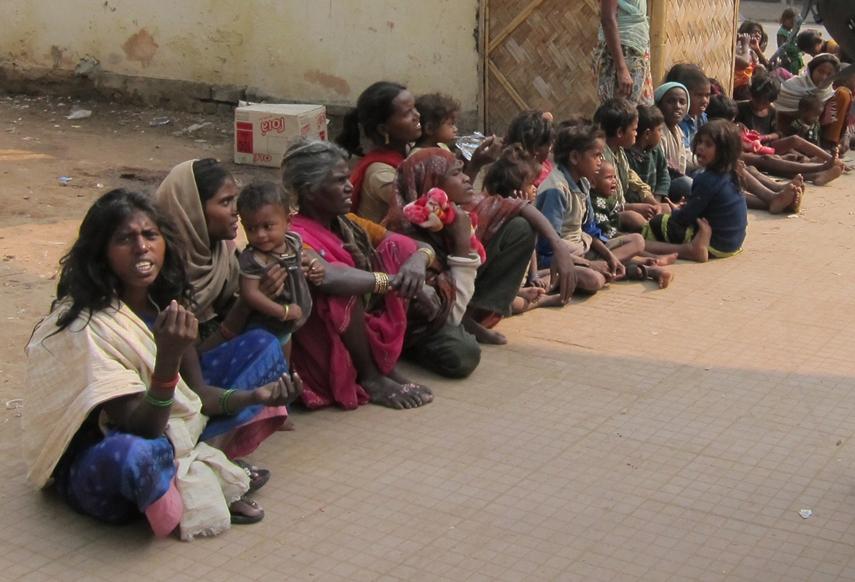
Begging children gather outside the gates and as we are leaving, the tour guide gives us packets of sweets to give to them – intended as a gesture we can make, reflecting on the generosity of Anathapindika (“feeder of the orphans or helpless”), all those centuries ago. But when we start to distribute these small packets, there’s such a fierce clawing and snatching that most of us have to drop the gifts and make a dash for the bus, chased by beggars. Last thing I see is a scuffle amongst them fighting for the ’gifts’. It was a feeling so completely different from the generosity of the historical figure who covered Jeta’s grove with gold coins in order to buy it from Prince Jeta. The Prince was so impressed with the generosity of Anathapindika, he gave the rest of it to him for free and joined with Anathapindika in offering the whole grove as a gift to the Buddha.

Is it possible that the presence of Buddhist tourists has created a generation of beggars at the gates? Anyway, this kind of thing seems to be unavoidable in India; there are beggars in other tourist places also. But the giving of money and gifts is a bit of a shambles and it would be better for everybody if this could be properly organized. What I did see that seemed more positive was a couple of people giving money to the beggars with an honest generosity, joyfully sharing; they were very good at doing it. I learned from this, it seemed to me to have a quality of dignity and mindful generosity and I tried to do it that way afterwards.

So, I wasn’t expecting the presence of beggars to have such an impact during this visit to the Buddhist holy places. Maybe it seems so dominant because what else is there here to see? Only ancient mounds and reconstructed low walls that show the location. I doubt if the bricks are original. There are very old Bodhi trees decorated with prayer flags but not of an age that could be anywhere near to the Buddha’s time. Otherwise there’s the earth and the sky; the air, nothing more than that. What is present is a special kind of sensitivity; visitors are all Buddhists or persons that way inclined, respectful and sincere and what we’re all considering is something that is unseen. If you can focus on being in these places where the Buddha used to be, and allow space for mindful contemplation, just being here becomes part of conscious experience; there’s a reality of that ancient time that comes through, such a fragile thing, barely noticed. It triggers something about these events that happened here all these centuries ago – just knowing it’s possible is enough.

The light and warmth; coolness in shadows in the afternoon, sense impressions, the laughter of a child in the trees and I’m thinking, yes, there would have been this also. I can allow it to be present for a moment and I’m in the 5th Century BC. It’s a simple feeling of just being here. I know how it must be for all other beings to experience this feeling; just like this. Subjectivity; we’re linked like this. The feeling stays for as long as I’m aware of it then it falls away.

————————-

Photos – Upper: Bodhi tree with prayer flags.  Middle: Beggars at the gate [Witit Rachatatanun Collection]

no-thingness

Chiang Mai: I’m in this 3rd floor apartment, lying on the sofa and the balcony door is open. The sound of a plane coming in to land (this building is near the airport and in the flight path), I’ll resist the impulse this time to try to take a photo of it – lean backwards over the balcony… scary. So I lay down flat on the sofa, ready for the immense noise, and the aircraft flies over. The sound is absolutely devastating. The glass of windows, masonry walls, ceiling and floor vibrate… and just at that moment I see the upside-down reflection of the plane in the highly polished floor tiles. It’s there for an instant, flying away across the floor, out to the balcony, and leaves my vision at the same time as the huge sound ends.

An upside down passenger jet flying across my room; such an extraordinary event, I think I need to write that down – where’s my pen? Something to write on? Look in my wallet, and a piece of paper falls out. It’s an old, creased, folded, coffee-shop receipt and on the back of it is written the word ‘extrinsic’. Hmm… so what is this? I made a note of that word for a reason, but what was it? Can’t remember, and now here it is again: extrinsic: adjective: not essential or inherent; not a basic part or quality; extraneous’ (extrinsic at Dictionary.com).

What is it connected with? There’s no context and it doesn’t seem to belong anywhere, yet there’s a familiarity… I feel I should know what it is – the essence of the object seen from outside of it? Something that would answer the question: What is its ‘whatness’? How is its ‘howness’? Somewhere in the realm of seemingly incidental meanings that arise of their own accord as if they’d been consciously created, contained in words, and language itself is the metaphor.

This word ‘extrinsic’ appears to be outside of the moment I’m in, and as soon as I think that, everything shifts to include it. Interesting, maybe, simply because I’m now outside the aircraft and usually I’m inside the aircraft, going between India and Thailand. It’s as if ‘extrinsic’ is a location in the construct, the object seen from the outside, looking in. And ‘intrinsic’ is another location, the subjective sense of the object. The ‘all-aroundness’ and the ‘all-it-isness’ is the totality of the ‘world’.

Everything is interrupted by the sound of another passenger jet approaching. I drop everything and lie back on the sofa to get the full impact of the sound… upside down plane flies across the floor.


“All life is a single event: one moment flowing into the next, naturally. Nothing causing everything. Everything causing everything.” [Wu Hsin]