maya & christmas

IMG_0220POSTCARD #36: Chiang Mai: Going around town in a tuk-tuk, seeing all these new shopping areas getting built and a huge shopping mall opens here soon called MAYA – a Sanskrit word meaning illusion. In Thailand the word maya is applied to the lifestyle of movie stars who have everything money can buy and their lives are thought to be unreal. In an intelligent way, everybody knows what maya is and what ‘reality’ is. But in the shopping mall context maya is presented as an attractive idea; it’s appealing, even though it’s an illusion, we’re partly agreeing with it; complicit in its being there. We might say well, okay it’s an illusion, but what’s wrong with that? Nobody wants to see it as calculated corporate planning to create a market for consumer goods… that would destroy the pretty illusion. Nobody wants to know that the local population, sons and daughters of rural/urban migrants, and naïve hill-tribe folk are likely to be swept away in the wave of purchasing choices. Unseen, built-in strategies contained in an imported Western model that doesn’t suit this culture… and we’re not willing to say there’s anything wrong with it because we’re all in some way compromised.

A kind of tacit approval of consumerist schemes embedded in our lives that has resulted in our losing so much of our inherited cultural traditions. The Christmas festival is layered over with the maya of santaclausisms and the Jesus Teachings are nearly lost in it. It’s as if the essential part of our spiritual Truth got forgotten along the way and consumerism came along in its place. It’s a mystery really, why it should be like this, but for some reason the early Church disapproved of the gnosis (knowledge) part of the teaching. Out went the pragmatic instructions on seeing the constructed nature of appearances and the stepping-through to discover the non-duality between ourselves and God. ‘His disciples said to him, “When will the kingdom come?” 
<Jesus said,> “It will not come by waiting for it. It will not be a matter of saying ‘here it is’ or ‘there it is.’ Rather, the kingdom of the father is spread out upon the earth, and men do not see it (113).”’[Nag Hammadi Manuscripts].

After an extended period of study and contemplation, one simply ‘wakes up’ to the Truth of it; the reality that surrounds us all the time; Brahman, the Oneness, the God state that’s here and now. You’ll notice I’m presenting the Jesus teachings as an instance of the Advaita experience, sourced in the Upanishads [I wrote another post about this, link to: Jesus and Advaita Vedanta]. I’m also including the Jesus Teaching in a oneness of spiritual teaching centred in that geographical region where the three Abrahamic religions arose: Christianity, Judaism, Islam and the connection with Brahmanic religions and Advaita Vedanta. Others related to this include Buddhism and Jainism. That region, from North India through to Israel and the Mediterranean, a distance of about 3000 miles, say from New York to San Francisco? I see it like a highway of knowledge, wisdom and information. All of it coming and going along the route many centuries before Jesus was born and many centuries after. All the world’s religions arose here.

Somewhere in this context lies the actuality of our Jesus experience; only traces of it remain – enough to know there is this huge feeling of goodwill towards all beings in the world and the universe.

Merry Christmas friends and fellow bloggers ~ Christmas 2013

————————-
Excerpts from: meta-narratives

story within a story

IMG_0095aPOSTCARD #15: Rutnin Eye Hospital, Bangkok: I’m back in the outpatients for a routine eye examination after surgery – the peppermint green and menthol coloured room, etched glass and white ceiling. Receptionist gives me a number, 109, and I look around for a seat. It’s crowded in here today… are all these people in front of me? It’ll be a long wait. What to do to pass the time when I can’t read? I need glasses to read and have to wait 3 weeks for a new lens prescription; the eye has to settle after they take out the stitch – okay, let’s not talk about needles and eyes… the eye of the needle? Easier for a camel to pass through the eye of the needle than for a rich man to enter the kingdom of God… they don’t make it easy. For ‘rich’ substitute ‘greedy’ lobha and it makes sense.

Generosity is the antidote for the ‘holding-on’ disease; fixating on a thing we think we need to make us happy. Apply the sense of generosity to the problem of being a compulsive reader and I should be able to let go of this reading habit – see what it’s like to do that. For backup I have the basic Kindle 6” with the font set nearly to maximum; digital words, the physical substance of the book is absent – switch it off and there’s nothing there. I like the emptiness of it, yet a whole library could be on this small device that fits in my pocket. Yes but I forgot to bring it with me today… terrific, so I have to learn how to sit in this waiting area doing nothing for maybe a couple of hours.

Language creates fiction – a story carried over from a former life, kamma, an extension of another story written long ago, once upon a time…. a story within a story, in which one of the characters in the narrative will pause and say, ‘this reminds me of a story…’ and goes on to relate a story inside the current story that the reader gets so immersed in the starting point is forgotten and it becomes just part of the whole; a vast structure of inter-related, nested stories enclosed by the original, frame story. Lost in the samsara of forgetfulness, caused by the holding-on disease, greed, tanhã (craving) passed on from former lives; seeking gratification in whatever sense object presents itself and wherever it finds rebirth.

‘… if I were born again as a fruit fly I would think that being a fruit fly was the normal ordinary course of events, and naturally I would think that I was a highly cultured being, because probably they have all sorts of symphonies and music, and artistic performances in the way light is reflected on their wings in different ways, the way they dance in the air, and they say, “Oh, look at her, she has real style, look how the sunlight comes off her wings.” They in their world think they are as important and civilized as we do in our world.’ [The Essence of Alan Watts, Vol. 4: “Death”]

————————-

a kind of analogy

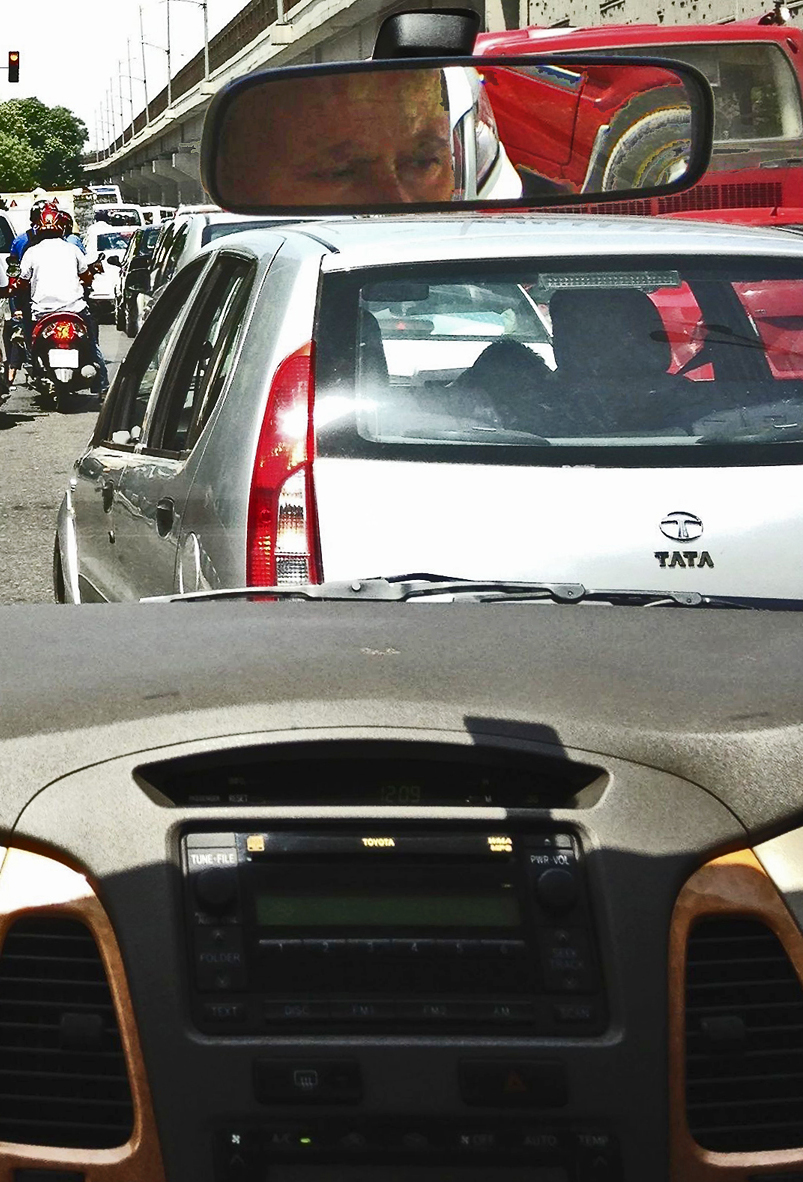
IMG_0114POSTCARD09: Delhi: The flight from Bangkok arrives at Delhi mid-morning. I’m identified, processed and out in the crowd. Shym is waiting with the car, bags inside and we’re in the huddle of traffic. Not so much give-and-take, more like push-and-shove. They’re opportunists; mindfulness is a necessity. Same old thing. Looking around, what’s different? An unusual brightness, it’s the lens implant, the operation on the left eye in Bangkok. I have to put up with this one-eyed vision only for a little longer. Next week I go back for the second op. All these flights are possible, fortunately, due to some free airmiles we have to use before the end of the year. And coming back to Delhi means I’m noticing the difference in vision here. So nice, much clearer now through the left eye, it looks… clean? What I thought was urban pollution, may have been obscured vision – or what I’m seeing now is an enhancement, a brightened-up version of everything. Close the left eye and look through the right; that’s how Delhi used to be, a dull, indistinct, old, yellowed photograph. Close the right eye and look through the left again and it’s like the Nat Geo channel, as clear as the iPhone5 retina display, 326 pixels per inch; using the techno-device metaphor to describe reality.

The world is a kind of analogy, a figure of speech, the conceptual metaphor. In my case the lens in one eye is plastic, not God-given – the same as having an artifical leg or a dental crown. Nothing special about it except that you walk around with an artificial leg, you chew with a dental crown but I’m seeing the world through this artificial lens. There’s a difference. The world is coming in, ‘seen’ through the plastic. The lens is a functioning part of the cognitive process.

Light passes through the lens, images appear, mind figures it out based on received experience of similar images, and says, there you go, what you see is like this. It resembles something I know, so I accept it, and that’s what it becomes. The metaphor pushes the whole thing over the edge; one thing becomes another. There’s that thing out there and ‘me’ in here, looking at it; so ‘I’ must be on the receiving end, somehow…. the link creates the metaphorical self; conscious experience ‘is’ individual identity: ‘I think, therefore I am.’

The assumption is that everything coming through the senses is real; sight, sound, smell, taste, touch, cognition – and it’s all coming to (((me))). That’s reality, that’s the point of the exercise. I like it, I want it, I want more of it, and so closing the door on other ways of seeing things. Saying this is how it is, means I get all the joy and pain, the good with the bad, love and hate, heaven and hell – thus I have to spend a major part of my life (maybe many lifetimes) trying to control this craving and desire [tanha] that I accidentally created, thinking I was doing the right thing.

“… craving the ensnarer that has flowed along, spread out, and caught hold, with which this world is smothered & enveloped like a tangled skein, a knotted ball of string, like matted rushes and reeds, and does not go beyond transmigration, beyond the planes of deprivation, woe, & bad destinations.” [Tanha Sutta]

What to do? How to not be a slave to it? Just the intention to be mindful is enough, the tipping point, sufficient to disengage from the automatic reaction. Not caught up in the experience of it, far enough back, one step removed, just knowing it’s there; that’s all. Knowing it takes the place of not knowing it. Step by step, learning how to do it….

————————–

‘… look upon the events occurring in your mind-and-body with the very same impartiality that you would look upon clouds floating through the sky, water rushing in a stream, rain cascading on a roof, or any other objects in your field of awareness.’ [Ken Wilbur, No Boundaries’]

Gratitude to Roger at One Garden for The Ken Wilbur quote above

plasticity

190320131769Chiang Mai: Holding the inverted eye-dropper bottle close to the eye, head back and squeeze a drop… it goes in, blink, and overflows, trickles out of the corner of the eye down the cheek like a tear drop and falls into the ear. I wipe it away with a tissue – the action triggers a memory, something emotional. I have new vision now, eye surgery for cataracts. The left eye is done, the right eye will be operated on next month. I’m seeing everything with such clarity; hard to believe the natural process of seeing that I’ve taken for granted all these years now involves a plastic lens. I see the world refracted through a man-made device and it doesn’t make any difference – well it does make a difference, of course, it’s very much better. My glasses don’t do anything any more; in the good eye the lens distorts vision, in the bad eye it enhances some things but it’s dull, blurred and yellowish in colour. I’ve had an overhaul – like taking the car to the garage to have new parts fitted. Or it’s how the system gets updated, the latest version is now installed. I feel renewed.

There’s this plasticity about the human body (and mind) that allows all kinds of changes to take place. I’m a Buddhist and I’m inspired by the thought that things can adapt, evolve, move on. It feels like there’s no such thing as getting stuck with anything or any state of mind, because we can learn to ‘unstick’ from it. In the same way, we can study a new subject; we put our minds to it, get interested in it and learn how it works. If I’m stuck with something, I’m attached to that thing in a strange kind of way; a locked-in response to adversity – more of a driven, unaware action than something done knowingly, mindfully. It’s a deluded attachment to habituality and I’m inspired by the very real possibility of working towards being free of this; acting always in awareness, seeing clearly.

Metaphors like ‘clouded vision’ describe tanha, habitual craving for something thought to be deservedly earned because of the endured hardship seemingly required to get there, unaware that one gets lost in the getting-there and there’s no end to it. Because I don’t normally understand things as they truly are, usually it’s how they’re seen habitually, I choose to see everything according to what’s already known; apperception, understanding newly observed data in terms of past experience. Before I get stuck in the delusion that it’s unavoidably like this, an opportunity arises to escape the cycle at Step 7 vedana in the paticcasamuppada (Cycle of Dependent Origination). Interrupt the causality sequence, go to the door leading to the emergency exit, aware that in the Buddhist sense of ‘no-self’, the habituality of mind’s perception of itself as the central actor in its own world, personality-view (sakkaya-ditthi), is the root of the problem. Step out of the cycle and I’m free…

Then later that night, walking to 7-eleven to get a few grocery items and I leave my glasses at home because they don’t help – I’ve worn glasses for most of my adult life and this is the first time I’m going out without them and at night time too. It’s been raining, there’s the glare of car headlights, and street lights reflected in large puddles. Only a short walk and arriving there, I notice some of the tiles on the floor of the lobby forecourt at the supermarket are shiny, glossy, and these must be new ones, replacements for the ones that were damaged? Why am I seeing this? I cover the good eye and look at the tiles with the old eye, no it can’t be seen, but I can see them with the good eye. It’s a repair I’d not have noticed before. People must think I’m acting strangely, better move along. So many discoveries about the world, and I’m stumbling around like this, seeing everything for the first time…

800px-ChiangMaiNightMarket————————-

‘Instead of starting with a perception or a conception of anything, the Buddha established a way based on awareness, or awakened attention. This is an immanent act in the present. It is sati-sampajañña, an intuitive awareness that allows the consciousness to be with the present moment. With this attention, you begin to explore personality-view (sakkaya-ditthi) in terms of the perceptions you attach to as yourself.’ [Ajahn Sumedho, The Problem of Personality]

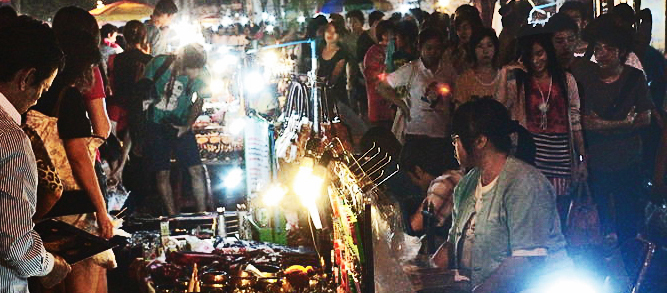
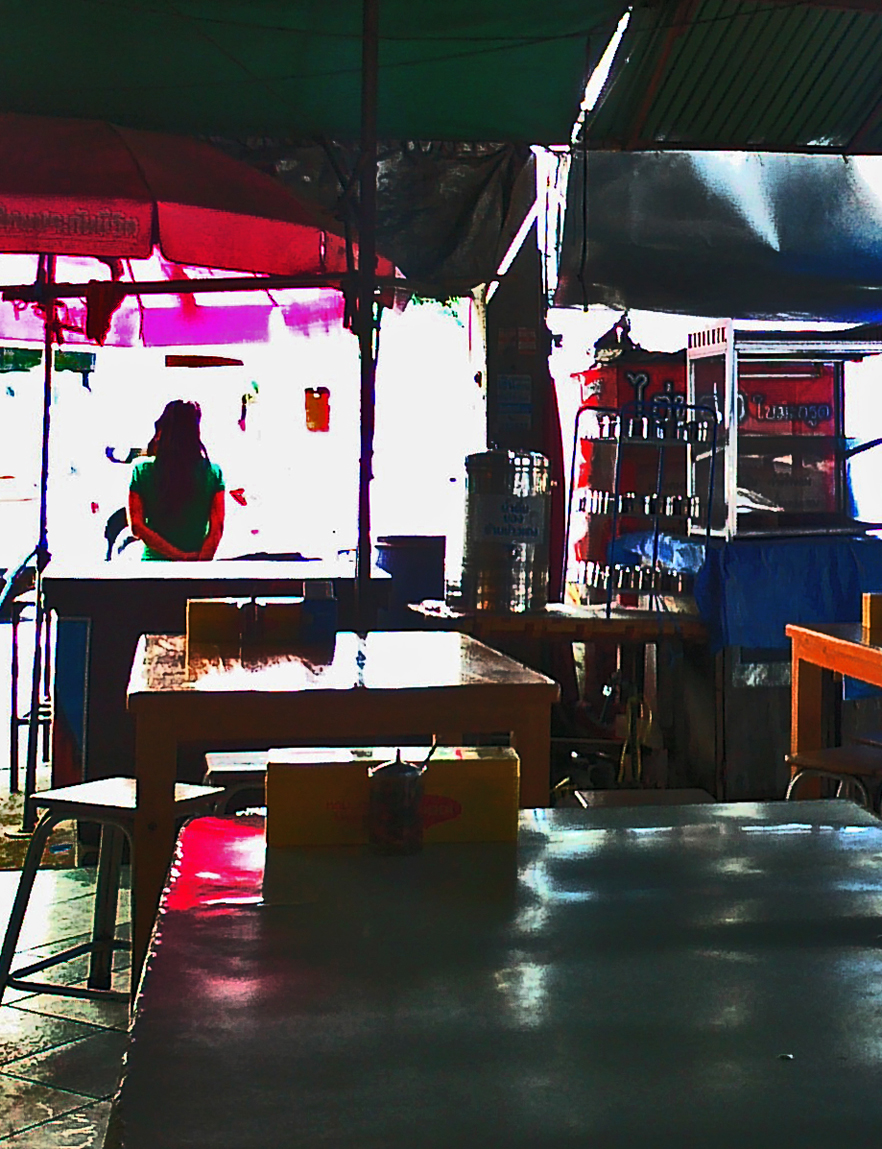
Upper photo: Interior of Chiang Mai songteaw (public transport vehicle). Lower photo: Night Market, Chiang Mai


nothing cannot be anything

hand image3Delhi: There’s a needle in my arm. Strange how the body accepts this intrusive object and the antibiotic fluid coming through it that enters the blood stream. Veins have a plasticity like something synthetic we recognize from the world of manufactured polymer substances. But human tissue is better; you can make a hole in it and it repairs itself. You can cut it, stitch it up, remove parts of it and replace these with other parts that fit. The human body is a miracle. The pain of this needle, though, has a directness, increasing, then easing off, over and over, dukkha, there’s no getting away from it.

I don’t want it to be there, vibhava-tanha, I want to disconnect it from the plastic tube leading to the upside-down bottle suspended from the hook above my head. It feels unnatural; it shouldn’t be like this…. Lying here on the bed looking up and counting the drips that fall into the receptor that fills the tube; one drop every 4 seconds and that’s the rate of the fluid flowing down the tube into my pierced blood vessel. It’s a full bottle, and there are others I have to take after this one… treatment for an intestinal infection – nothing really extraordinary in a country like India, in the hot season, when all kinds of bacteria thrive. Caused by drinking water from a filtered system that didn’t filter. Organisms survive the filtering system; bugs everywhere in this intensity of 43°C.

I need to find a way of getting through this period of invalid status and prolonged boredom of a plain room with hospital fittings, plugs and sockets in the walls, hospital furniture and a TV screen I’m not interested in. Dissatisfaction with things; clicking the buttons that control the position of the hospital bed; down/up and up/down. Lying here with eyes closed, listening to the metal trash bin; it makes a satisfying percussive sound when the cleaner presses the pedal with his foot, lid springs open and strikes the wall next to it Clang! He releases the pedal and the lid closes: Flumpf an airtight trash bin with plastic bag liner. Crash! Flumpf! again and it’s joyful and funny.

I need some joy here, there are men in dark navy uniforms in the room; cleaners with large grey floor mops that look like they’re soaked in muddy water swabbing the tiles; smell of Dettol stings the eyes. Muddy grey mops and dark navy uniforms seem out of place in an environment of lemon yellow, soft pink walls; pastel shades and shiny chromium fittings. The muddy grey mops are a bit scary also, because I’m sensitive to things that appear dirty, having fallen into this sickness as a result of drinking water from a filter machine installed at home that allows dirty water to come through.

‘We’re not in Kansas anymore Toto…’ The doctor said always drink boiled water in the hot season, organisms are present in the water, filter or no filter. I feel some frustration with the company that sold me the water filter: ‘it shouldn’t be like this’but we don’t live in a world of ‘should’ and ‘shouldn’t – western theory applied in an Indian context. We expect it to work, and it doesn’t. Western systems are deductive and life is inductive. Organic growth has no beginning no end. How to understand that, what to do? Don’t make it into a structure. Let it be nothing.

So I can lie here on the bed with my eyes closed and the cleaners expect me to be like this because I’m a hospital patient. And in this curious public place, enter meditative contemplation, watching the breath, the rising and falling of the chest. Allow the thoughts that arise to fall away and be replaced by others that I allow to fall away and allow everything to fall away and cease, as far as possible – just the effort of trying to do this leads to a quietness in the mind; spaces of no thought. There’s some peace to be found in this activity. And from here consider nothingness, just nothing, no thought. It’s not an idea of nothingness, that’s a concept. Nothing cannot be  anything. Nothing cannot be located anywhere in time or space; no before, no after. If it is truly nothing, it can have no cause or effect. I can’t work towards some mind state in future time when I’ll see what ‘nothing’ really is, it has to be now, it’s always ‘now’. Nothing cuts through, penetrates, and dissolves everything. It’s just nothing.

————————-

‘One must have a mind of winter… (to behold) the nothing that is not there and the nothing that is.’ [ Wallace Stevens, The Snow Man]

Photo image: http://www.jeffzinn.com/wp-content/uploads/2011/12/poor.jpg

the holding-on habit

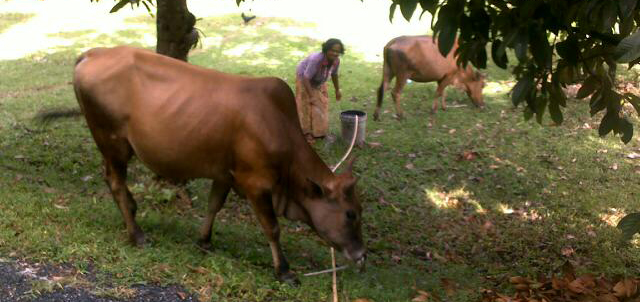
2012-06-01 17.46.31A village near Hat Yai: Sitting in the house with M, it’s been raining and the farmyard is a plethora of muddy things. M is inclined to stay indoors and that’s how it is today, a day of uncertainty, the catastrophe of failed projects, unfinished paper structures, and fooling around with the camera phone. M is tired with the stories in her 9 year-old world. Some excitement and interest when: clacka-clacka, the sound of the cow with the bamboo bell around its neck, energetically chomping the grass that grows around the house – all this thick lush grass in the wetness. The other cows, four altogether, have been brought home because it’s the end of the day and soon they’ll be herded into the cowshed and closed in for the night. I ask M if she’d like to go out? We can get the big umbrella and go look at the cows? But this is not a good question to ask right now.

Complex emotions, M is suffering a disappointment. We took her to the bookshop in town. There was a book about science with a ‘SUPER SCIENCE KIT’ in a large box that went with it. The thing is, it was really too advanced for M but she became convinced she had to have it. So we got it, came back to the house and I started to look at the instructions. Opening the box and assembling the pieces of the kit, test tubes and small pieces of plastic equipment – all that goes okay, but following the instructions to carry out the experiments, has no meaning for her. She simply doesn’t know where to begin and I can’t explain because of our limited communication. She tries to enter a created story with a ‘pretend’ thing but science doesn’t work like that. Somebody thoughtfully removes the difficult SUPER SCIENCE KIT and all that can be done now is damage repair. M is quiet. I ask her if there’s anything I can do, and she says, ‘… no, is OK, Toong-Ting.’ (Toong-Ting is M’s pet name for me.) I suggest we read a book or play with the iPad… then I remember there’s no Internet and some of her apps don’t work. That’s part of the problem. ‘No, Toong-Ting, is OK,’ she says.

So I sit with her, everything is dull and meaningless – I can feel it too. M makes small, whimpering sounds like her digital kittens on the iPad. She’s holding my arm, cuddled up in a small ball next to me, eyes closed and face hidden away, struggling with the uncertainty of her world. Thai children are taught othon [khanti] patient endurance – or it could be an inherited character trait. I don’t have any children of my own, so no experience; having M in my world is an opportunity for me to learn. What I notice is, there are no tears or tantrums that I’d expect (from Western children). Here, it’s more like a locked-in holding. I’m available, ready to support, but I can’t do much to divert her attention. It’s the holding-on habit and what this is about is just allowing for these moments of not knowing that we’ve all got to get through, somehow, and the uncomfortable feelings that go with it. Just letting them go…

I’m affected by the mood, it’s really tense, but can sit quietly without making a ‘thing’ out of it. The self is a sensory experience. The experiencer is itself an experience. Consciousness is the sensory organ of the void. There can be nothing separate from this, except the ability to think about things. The question, then, is: what is thought? And thinking about thought, itself, leads only to the empty space where the question used to be…

Some time after that somebody finds a small bottle of food colouring in the kitchen and I show M what happens when you put a tiny drop of it into a test tube of clear water. The violet colour is like a tendril of descending smoke curling around the inside of the test tube and her whole attention is focused on this extraordinary event; the world is opening up again… wow! how to develop this? The uncertainty of the moment has vanished and suddenly everything seems full of wonderful choices….

Cowscrop

————————-

‘What effort should I make? Should I do something about this situation or simply watch my mind?’ Such moments of not-knowing are precious. Uncertainty does not have to be seen as failing. In fact we might lose something important if we are in a hurry to push past it. The actuality is I don’t know what to do and there is not necessarily any fault in that. If, however, I’m completely caught in the momentum of wanting to escape suffering, I may miss the truth of the situation, as it is, and learn from it. With the confidence that comes from our commitment to precepts we can afford to trust in being patient and aware of ‘not-knowing’, and the uncomfortable feelings that come with it. Feel the force of the momentum of wanting to get away from it, to ‘solve it’; stubbornly refuse to be drawn along. We can experiment with waiting until the feeling of being driven subsides and quietly listen to what intuition suggests we could do.’ [Ajahn Munindo, Dhammapada v. 276]

 [Note: There are references here to, ‘the experiencer is itself an experience’, taken from an Internet source I can no longer find. If anyone knows the origin of it, please let me know, thank you!]
Upper Photo: My pic of M taking a photo of me. Lower photo: The cows coming home

remains of the dream

tuk18March

Chiang Mai: 05.00 hrs, phone alarm goes off, ascending ring tones of celestial music and the small window of digital light illuminates the dark room. Too bright, it’s difficut to see how to switch it off. OK, I got it…

Peace and quiet, it’s a Chiang Mai morning. Difficult to wake up because I just arrived from Delhi and there’s a time difference of 1½ hours – neither one thing nor the other and the remains of the dream scattered around. Fragments of a story and the urge to try to put the pieces together and recreate the dream. There’s this built-in curious ‘wanting’ tanha. Maybe I’ll find out what the story is about in the process of looking for the pieces that are lost?

Impossible. The predicament of the dream, the tendency to be wanting something… anything, it doesn’t matter; something to attain, obtain, procure, secure – a mood, a good feeling – the language of consumerism – wanting something, but I can never seem to narrow down the options sufficiently to actually get what I want, and all that’s left is the ‘wanting’ itself. Ungratified desire, just the wanting, hungry and dissatisfied, I feel like I want to get rid of the ‘wanting’ but wanting the ‘wanting’ to stop doesn’t make it stop. It only increases the level of ‘wanting’ and this is my suffering, dukkha….

Slowly moving up through the layers into a more wakeful consciousness, here. Difficult. All the pain meds for backache coming to an end now, very nearly pain-free for the first time in 10 days. Wonderful. So, I think I’m nearly able to pull the body into a meditational posture. Try it and see. Carefully adjusting the pillows and cushions on the bed to get myself sitting upright with folded legs. Aching knees because it’s been a while but it comes allright, settles down, and everything just falls into place again.

Mindfulness. The presence of the body, just quietly sitting here, and the mind slowly moving from sleep to wakefulness. The in-breath and the out-breath seem like incremental steps going higher and higher up a narrow winding stone staircase until it doesn’t go any higher and when I let go of that, the mind eases off into this state of peace. ‘… meditation is not an activity; it’s the cessation of an activity’ [Rupert Spira]. It’s about consciously not doing anything.

Peacefulness and fragments of the dream remain, pieces of a jigsaw puzzle. I’m drawn towards it, still, and inclined to try to put the pieces together again. The peaceful state becomes blissful, nice – if I merge with it, I’ll fall asleep and there’s a reluctance to do that. I’m holding on to it again, I see I’m trying to make it do what I want it to do, even though the blissful state is incidental, subject to change, annican, and I’ll never succeed with it.

It’s the ‘wanting’ thing again. I could ‘modify’ this and get it to be what I want? It would be nice if it were blissful all the time but I recognize something; the bliss can become irritation and sometimes it’s a hell realm and I have to get out of it quick… Heaven/hell, there’s no way of knowing which way it’s going to go, so I need to remove the function that tries to manipulate the pleasant state through greed and wanting.

This helps me to detach from it; let go of the bliss, bye bye… but it’s still there; just feels like it’s happening to someone else; generosity, share it with the world. Can’t find words to express. Leave it at that. I’m really a minimalist, anatta. No God, no ‘self’, no I, you, he, she, it, we, you, they – and the sentence often makes no sense because there’s no subject, no object. No problem, the feeling is too large, no words for it…

————————

“As far as the suns and moons extend their courses and the regions of the sky shine in splendour, there is a thousandfold world system. In each single one of these there are a thousand suns, moons, Meru Mountains, four times a thousand continents and oceans, a thousand heavens of all stages of the realm of sense pleasure, a thousand Brahma worlds. As far as a thousandfold world system reaches in other words [the universe], the Great God is the highest being. But even the Great God is subject to coming-to-be and ceasing-to-be.”[Anguttara-Nikaya X 29]

relaxed resistance

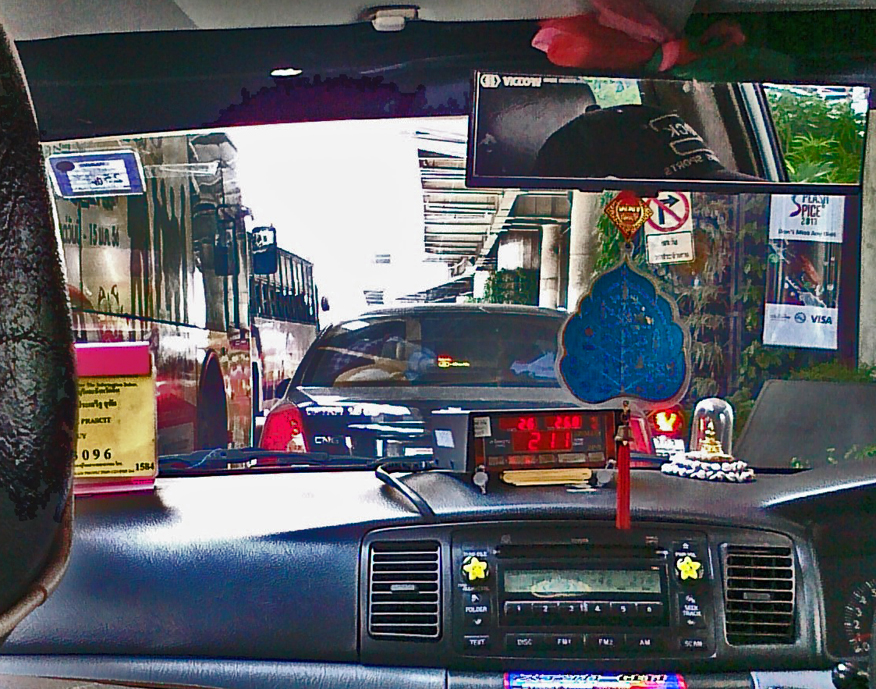
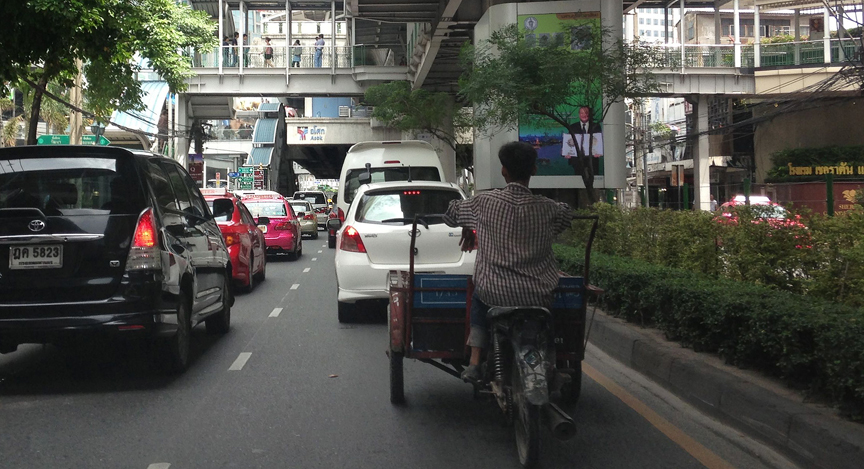
TaxiBKK2Bangkok: In a taxi on the expressway and it looks like the whole route is blocked with traffic but we are moving along slowly. A small voice is saying, we’d’ve been better off taking the ordinary route through streets with traffic lights and the congestion of that would’ve been quicker than this… yes, possibly, but hypothetical. And I’m not getting pulled into that scenario, thanks, no. Strangely, I feel no frustration sitting here. The taxi driver’s radio is playing; it’s a call-in chat dialogue with music.The mind isn’t absorbed into it, the sound is just there. It’s not loud, it’s not demanding; sometimes I notice it consciously then the mind moves on somewhere else. And, there’s that small voice again saying, wow! this could get really boring. But it’s not like that, it’s a neutrality maybe, there’s just this experience right now; the reality of being here. Nothing else to do, so obviously it’s okay to stay with what’s ‘here’ and see where that gets me.

One thing that helps is that there was this really nice post I read the other day [‘The Path of Waiting’] and I’m thinking of that now in this place where traffic is at a standstill, nearly. It’s the idea that we’re always waiting on something, somewhere, most of the time and it helps if you can be ‘willing to stand hand in hand with your waiting for a few moments.’ It was that, I think, that started me off in this mind direction of, let’s see what this waiting thing feels like. So now I’m hand in hand with my waiting and it feels nice.

The mind is clear, free and empty. There’s a careful observation and contemplation of everything that’s happening, it’s like being focussed on balance and openness – poised between things, in a sort of high altitude mind-place of emptiness. That’s all, and everything just seems to be slowly moving along here, the moment transforms itself and there’s this attitude of gentle curiosity, like what’s this now? I hear the small voice again; a shadowy question hovering on the periphery: how come I’m not frustrated by this endless traffic situation? Nope, it’s not necessary to go there; no desire to get pulled into that. It’s the wisdom of just mindfully placing one foot after the other on to stepping-stones that lead over the river to get to the other side. There’s something about the easy lightness of this that makes it obviously the right thing to do, and what else is there to do anyway? Not a lot, I look out the window and see the gridlock of slow-moving metal parts in this tremendous heat.

Amazing really because I’m not feeling the frustration of it. There have been times in the past when it would’ve resulted in a semi-suppressed raging inferno and getting engaged with it, or trying to get rid of it, would seem like the way to go. Getting rid of stuff always seems like the right thing to do; a kind of righteous feeling; got to clear up this mess, okay, let’s get on with it! But that hasn’t worked for me, experience has shown…. Long ago and far away, I remember the Ajahns telling me about this – well, I didn’t know what I was doing at that time – and the teaching was about how I was unintentionally holding on to some unpleasant mind state, even though I was sure that trying to get rid of it was the thing to do. The desire to get rid of, vibhava-tanha, is a desire, same as the desire to have something is a desire; they are the same. So the teaching is that trying to get-rid-of-it is like trying to get rid of the desire to get rid of it, and it doesn’t work like that – all I’d be doing is creating more suffering.

It’s fortunate for me that I’m seeing it like this today, I need to remember how it works. The problem is really with the resistance to frustration – so, relax the resistance, allow the frustration to come in. Know what it’s like when it’s present, know what it feels like (the holding on to it) when it’s there. Knowledge replaces ignorance, we are not deluded by it any more. So, I’m just moving along now; looks like the traffic flow is easing up a bit – getting there…

6388612-machomikemd

————————-

‘… in the context of the four noble truths, the origin of suffering (dukkha) is commonly explained as craving (tanha) conditioned by ignorance (avijja). This craving runs on three channels:

(1) Craving for sense-pleasures (kama-tanha): this is craving for sense objects which provide pleasant feeling, or craving for sensory pleasures.

(2) Craving to be (bhava-tanha): this is craving to be something, to unite with an experience. This includes craving to be solid and ongoing, to be a being that has a past and a future, and craving to prevail and dominate over others.

(3) Craving not to be (vibhava-tanha): this is craving to not experience the world, and to be nothing; a wish to be separated from painful feelings.’ [dukkha samudaya (wiki)]

Upper photo: collection of the author
Lower photo: Virtual Tourist/machomikemd

how it seems (2)

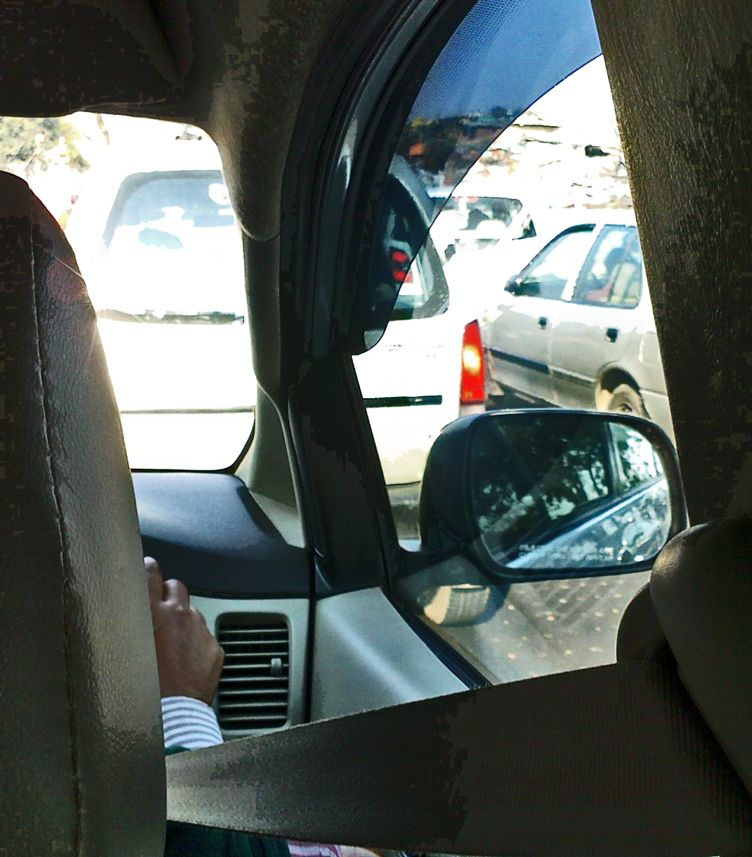
080220131699New Delhi: Travelling across town, Shym is driving. He drives slowly and carefully, surrounded by vehicles honking their horns, cutting in on the nearside; they don’t like it that he’s driving slowly. But Shym remains calm – much ado about nothing – he’s an older man. Out there, fierce displays of male feathers in a ritual display resemble pure outrage, shouts and gestures through wound-down windows. If looks could kill… eyes sparkling with diamonds of malice, giving him ‘the daggers’…. Shym stays solidly as he is. Ah well, people, you can’t always get what you want. Sometimes you’re just stuck with it, you know? It’s how you respond to that unhappy state of ungratified wanting that determines the future for you; cause/effect – if you react with anger, it’ll lead to more anger. But these drivers seem to have gone way past that stage: up-to-their-eyes in the world of anger. Without their anger there’s no purpose in life. They thrive on the struggle; mythical realms of the Titans, and the Asuras, declaring a state of war that lasts an eternity. All this doesn’t phase Shym, at the correct time he slides the steering wheel slowly through his fingertips, indicators flashing clicka-clicka-clicka, telling the world, I am now turning right, and the car sweeps around like a large boat in a wide arc. The surrounding traffic forced to move out of the way. The response is plosive, to say the least. But, well that’s just how it is.

I’m sitting in the back, looking out through tinted windows, incognito, people can’t see me in here – a car wearing dark glasses. Nobody knows I’m inside, the voyeur, the invisible man, looking out at the world all around. I feel like I’m not here. Everything passing by outside the windows of the car; events come and go, arrive and leave. Things occur in random order and drift away without leaving anything behind, video images recorded on security cameras from various places in the 360 degree coverage, showing the car entering the car park, that I’ll never see. I say something to Shym and I hear my own voice in the acoustics of the car; the sound of it causes me to pause for a moment. Everything stops… it takes an effort to get started again. Before it happens, just this silent space. The body feels light and I’m seeing through it.

We turn into the car park. Parking attendant looks like ex-military, sharp uniform, whistle held in his teeth, a piercing blast, signals for us to go left but Shym indicates right. Outrage, more whistle blasts, and he comes up to the car, peers in through the tinted glass, hand cupping the space around his eyes to shade from the sun, I see a large bristly moustache and yellow teeth, the glass fogs up slightly and there are small bits of spittle from his hot breath and shouted words. But Shym gently points with an inclination of the body and politely insists that he’d prefer to go right, not left. More displays of warlike behaviour but I can see this is an act, it’s only how it seems to be. So we are allowed to go right, there’s no problem.

I’m amazed how this system works. All my assumptions are wrong. Attachment due to causes and conditions, that’s all. It’s like everything is a continuation of how things have been; inherited from some former time, or former life, the outcome of actions still hanging around due to tanha, attachments… velcro fastenings, super glue, magnets, welded bridge structures and all the mind stuff about wanting things to be like this or like that or wanting things to be different from what they are. The created ‘self,’ seeing the world according to likes, dislikes and preferences, obscures cessation; doesn’t see that things stay as they are only for as long as it takes. Then it all dissolves in a myriad of changes, disintegrates, crumbles away. We can’t hold on to anything. It all comes to an end.

[Link to: how it seems (1)]

————————-

‘…when attention is drawn to the presence of the Knower, to that which knows and experiences, whatever that is, it immediately becomes obvious that there is something present that is conscious of the body, the mind and the world. As we do this, whatever it is that knows seems suddenly to become more present. It shines. In fact it is simply discovered to have been always present, but apparently eclipsed by our exclusive focus on the known.’ [Rupert Spira, ‘The Transparency of Things’]

how it seems (1)

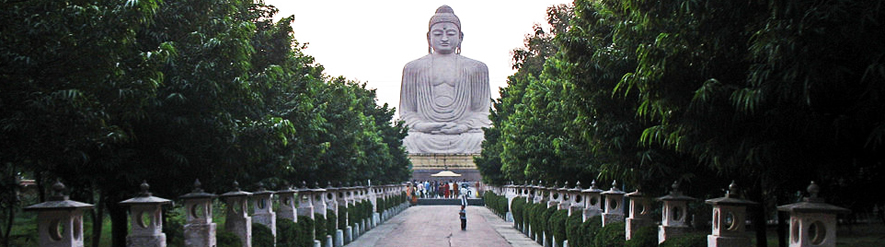
2013-01-09 11.48.37I SEE THE WORLD through a built-in selection process that reflects and supports the default state of mind; it’s like fish cannot see the water they swim in; so obvious, yet… but I can get it to fit, more or less, according to my likes and dislikes and fall deeper into the dream. I make it into something good or bad or whatever and the fact that I can’t see it – well, it just does that. I call it reality. How I perceive the world is dependent on causes and conditions that were here before I was born; you could say it comes with the software. I think I’m an independent being not affected by anything or not affecting or influencing anything else. I can’t see this is a work of fiction and it’s all being monitored by the ongoing needs and requirements of an entity I created; a ‘self’ that has no real substance. I’m dismayed, of course, by how it all gets swept away in randomness; subject to the kamma, unknowingly created at some earlier time.

 ‘… It’s because of not understanding and not penetrating this Dhamma that this generation is like a tangled skein, a knotted ball of string, like matted rushes and reeds, and does not go beyond the cycle of the planes of deprivation, woe, and bad destinations.’ [Tanha Sutta: Craving” (AN 4.199)]

The outer world just rolls along, as it does, in all its diversity, and totally neutral. Whether there’s belief it’s this or that, makes no difference; it’s just how it seems. The devastating emptiness of it all means the population is driven to get and do and attain and protect and defend. It’s a battlefield. To avoid and deny, to have fear and anxiety and be controlled by authority and feel threatened with the flimsy nature of existence, although the absolute fragility anicca, is the beauty of it. But the population can’t see it like that. They are clutching at straws but don’t see it like that; don’t see they are maintained in an unknowingness of the world like penned animals are by the farmer, well intentioned though he may be, in order to cultivate a special kind of hunger, upadana tanha (clinging and craving) – and the economy depends on this. The greater the craving, the faster the turnover of stock and the Western style of God together with governments and the corporations are simply involved in farming the population.

I can understand why the Buddha was thinking the Dhamma was too subtle and there was no point in teaching it because no one would understand. I can see how, in those historical times of feudal hierarchy, it would have seemed impossible to create social change…. and is it any different now? It seems just as impossible for people to understand today. I wonder if I really fully understand it myself. I’m no different from other people, this is our shared suffering. But the Buddha changed his mind about it being too subtle. He said there is a way out and we can find it in the framework of the Four Noble Truths. The teaching has survived 2600 years. Understanding replaces misunderstanding; ignorance is pushed out. There’s a simple curiosity and this quiet state of at-ease knowingness….

Big_Buddha_statue,_Bodhgaya

————————-