full sustained attention on the breath

POSTCARD#430: Bangkok: Here we are again in our study group of Mindfulness, Bliss, and Beyond: A Meditator’s Handbook by Ajahn Brahm. Something I notice about this book, the ‘bliss, and beyond’ aspect is presented up-front and in the centre of our vision from the very beginning. I suspect some readers might not seem to be able to keep the ‘bliss and beyond’ going, uppermost in the mind. Maybe it was a lack of belief in the fact that I could get there too, but not having spent enough time on the first stages… so I went back to reading the book

“It often happens that meditators start breath meditation when their minds are still jumping around between past and future, and when awareness is being drowned out by inner commentary.”

“When you know the breath is going in or going out for about one hundred breaths in a row, not missing one, then you have achieved what I call the third stage of this meditation, which involves sustained attention on the breath. This again is more peaceful and joyful than the previous stage. To go deeper, you aim next for full sustained attention on the breath.”

So I meditated on and off all day on Wednesday, not sure if I was doing it correctly. Then again all day Thursday more meditation and I started to notice it was easier and I was sure I was doing everything correctly because I could just fall into the ideal sitting posture. There a strange dream-like quality about it all… a sense that nothing is solid, everything has the characteristic of fluidity, a smoothness. The ‘world’ was the colour of maple syrup or crème caramel, resonating like a deep long note played on a cello. Shiny, smooth walls with no texture lack friction like resin on highly polished hardwood floors.

But I was unable to stay there, suddenly the mind jumped in and identified it as the comfort state created by the meds I take, and that’s a whole nother thing. For those of you who don’t know, I suffer from a permanent headache. I’ve had it for six years now – mostly it is kept in background by the meds I take. So there is an opportunity to win back the ground I used to have in meditation and that’s all well and good but then the headache breaks through and that is devastating. This is when I find the comfort state created by the meds… It lifts me out of the worst of it and I’m back in the cycle of it again. So the familiar meds state took over and I missed the ‘bliss and beyond.’

More meditation, listening to Ajahn Sumedho on Friday, and in the afternoon things started to have that familiar clear deep quality again. Rather than have the mind intervene and say what it is, I went back to the book.

Full Sustained Attention on the Breath

“The fourth stage occurs when your attention expands to take in every single moment of the breath. You know the inbreath at the very first moment, when the first sensation of inbreathing arises. Then you observe as those sensations develop gradually through the whole course of one inbreath, not missing even a moment of the in-breath. When that in-breath finishes, you know that moment. You see in your mind that last movement of the in-breath. You then see the next moment as a pause between breaths, and then many more moments of pause until the out-breath begins. You see the first moment of out-breathing and each subsequent sensation as the out-breath evolves, until the out-breath disappears when its function is complete. All this is done in silence and in the present moment.”

Getting out of the way

“You experience every part of each in-breath and out-breath continuously for many hundred breaths in a row. That is why this stage is called full sustained attention on the breath. You cannot reach this stage through force, through holding or gripping. You can attain this degree of stillness only by letting go of everything in the entire universe except for this momentary experience of the breath happening silently. Actually “you” do not reach this stage, the mind does. The mind does the work itself. The mind recognizes this stage to be a very peaceful and pleasant place to abide, just being alone with the breath. This is where the doer, the major part of one’s ego, starts to disappear. One finds that progress happens effortlessly at this stage of meditation. We just have to get out of the way, let go, and watch it all happen. The mind will automatically incline, if we only let it, toward this very simple, peaceful, and delicious unity of being alone with one thing, just being with the breath in each and every moment. This is the unity of mind, the unity in the moment, the unity in stillness.”

Continued next week 06 August 2021

silent present-moment awareness of the breath

POSTCARD#429: Bangkok: Hello and welcome back to our analysis of Mindfulness, Bliss, and Beyond – A Meditator’s Handbook by Ajahn Brahm.

“It would be marvellous for each one of us if we could abandon all inner speech and abide in silent awareness of the present moment long enough to realize how delightful it is. Silence is so much more productive of wisdom and clarity than thinking. When one realizes that, silence becomes more attractive and important. The mind inclines toward it, seeks it out constantly, to the point where it engages in the thinking process only if it is really necessary, only if there is some point to it. Once we have realized that most of our thinking gets us nowhere, we gladly and easily spend much time in inner quiet.”

“If you have developed silent awareness of the present moment carefully for long periods of time, then you will find it quite easy to turn that awareness onto the breath and follow that breath from moment to moment without interruption. This is because the two major obstacles to breath meditation have already been overcome. The first of these two obstacles is the mind’s tendency to go off into the past or future, and the second obstacle is inner speech. This is why I teach the two preliminary stages of present-moment awareness and silent present-moment awareness as a solid preparation for deeper meditation on the breath.”

“When you focus on the breath, you focus on the experience of the breath happening now. You experience what the breath is doing, whether it is going in, going out, or is in between. Some teachers say to watch the breath at the tip of the nose. I have found through experience that it does not matter where you watch the breath. In fact it is best not to locate the breath anywhere. If you locate the breath at the tip of your nose then it becomes “nose awareness,” not breath awareness. Just ask yourself right now: “Am I breathing in or breathing out? How do I know?” There! The experience that tells you what the breath is doing, that is what you focus on. Let go of the concern about where this experience is located. Just focus on the experience itself.”

“When you know the breath is going in or going out for about one hundred breaths in a row, not missing one, then you have achieved what I call the third stage of this meditation, which involves sustained attention on the breath. This again is more peaceful and joyful than the previous stage. To go deeper, you aim next for full sustained attention on the breath.”

Ajahn Brahm’s teaching continued next week 30 July 2021

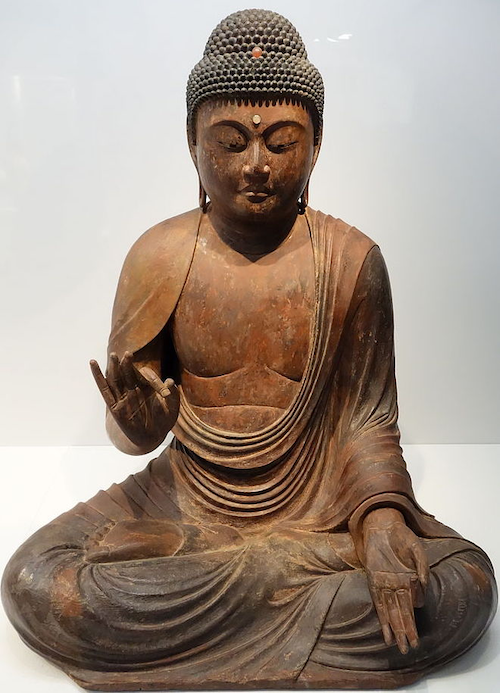
About the image above; Amida, lord of the Western Paradise, is seated in deep concentration with half-closed eyes and hands held in the gesture of meditation. During the eleventh and twelfth centuries, images of Amida were created in large numbers as a direct result of the popularity of Pure Land Buddhism in Japan. The above statue is dated circa 1863 –1866. This Pure Land teaching celebrated the glories of the Western Paradise, which can be attained through meditation and recitation of Amida’s name.

mindfulness, bliss, and beyond

POSTCARD#428: Bangkok: Note: Last week’s post was a re-blog of one written in Switzerland in 2012. This allowed me some time to get over a bad reaction to the AstraZeneca vaccine and there’s much to be said about that experience. As I was coming out of the sickness I got interested in a book by Ajahn Brahm, “Mindfulness, Bliss and Beyond, A Meditator’s Handbook”, and the plan is to research and share this with you. The book is available free online as a pdf file which can be downloaded.

I started to read the book about 10 years ago but never finished it. My intention now is to use the book to try to find a way back into meditation after contracting a neurological condition in 2015 which results in headaches – or you could say the ‘Headache’, as one continuous form, sometimes shadowy and indistinct, other times upfront and centre-staged. Is it possible to find mindfulness, bliss and beyond in these circumstances? This is the question, how can it be done?

The answer is letting go. From the beginning, Ajahn Brahm insists meditation is relinquishment. “You let go of the complex world outside in order to reach a powerful peace within; beautiful silence, stillness, and clarity of mind. The effort is directed to developing a mind that inclines to abandoning.” I can jump ahead by a few chapters and consider letting go of Self – there is no Self to whom this headache is happening, a headache without a self.

Ajahn insists, “Silence Means No Commentary”, no inner speech. “It is helpful to clarify the difference between experiencing the silent awareness of the present moment and thinking about it…. “An effective way to overcome the inner commentary is to develop a refined present-moment awareness. You watch every moment so closely that you simply don’t have the time to comment about what has just happened.”

“Another useful technique for developing inner silence is recognizing the space between thoughts, or between periods of inner chatter. Attend closely with sharp mindfulness when one thought ends and before another thought begins—there! That is silent awareness! It may be only momentary at first, but as you recognize that fleeting silence you become accustomed to it. And as you become accustomed to it, the silence lasts longer. You begin toenjoy the silence, once you have found it at last, and that is why it grows.

One of the many simple but profound statements of the Buddha is that “a meditator who makes letting go the main object easily achieves samādhi,” that is, attentive stillness, the goal of meditation (SN 48,9).1 “Such a meditator gains these states of inner bliss almost automatically.”

Continued next week 23 July 2012

snatch, fly, eat

sparrowPOSTCARD #184: Geneva, Switzerland, August 28, 2012: The number 9 bus drops me near a shopping mall coffee shop. Order something and open my book: ‘Satisfaction is a moment of relief from the pressure of wanting.’  That instant relief from the pressure of wanting comes with a thirst for more.

Just then, a little bird appears at the table; hops over, quite close to me, where there are crumbs scattered, looks at me with a flick of the head, picks up a crumb and flies away, whrrrt. Mall sparrows are incredible; evolved as these urban forms in an artificial environment that doesn’t really look like what it’s trying to be; high ceilings, glass roof, obviously ‘real’ foliage descending from stylized pillars made from polystyrene, surfaced with a resin that makes it look like marble – a hybrid reality form, an act, stage-set for a performance.

I go on reading and the bird comes back, picks up another big crumb and flies off, whrrrt. I can see it going up to the top of a pillar and now perched on the plastic leaves, then disappears in the foliage. Hmmm… a nest constructed from woven drinking straws, paper serviettes, fragments of cash till receipts, hidden in the simulated foliage up there? Generations of sparrows and other creatures have lived inside these places for years, long since lost the inclination to find the way out. The birds wouldn’t survive out there, they’ve adapted to conditions in here; proximity to table crumbs…

The small sparrow comes back to my table, takes another crumb, flies off again, whrrrt. The speed of the action… snatch, fly, eat. Feed the offspring and that’s how it evolved here. The dukkha of endless searching is not an issue for this bold little bird. It has everything it needs. I wait to see if it comes again, there are still crumbs, more than enough. But I don’t see it again, time for me to go. Across the road and the tram I need is arriving at the stop, traffic lights change just at the right time, I cross over and jump on. Light and easy, moving from one thing to the next. Not driven by wanting things to be how I’d like them to be and never quite getting enough. It’s got to do with the way you see it; the tram speeds up and glides along on smooth rails.

‘When desire does not shape the mind and limit it to thought, consciousness becomes translucent. Entering into the spaciousness of the original mind, we become the vastness itself. Inseparable from all else, at one with all that is.’ [Stephen and Ondrea Levine, ‘Who Dies’, chapter 4: ‘The Thirsty Mind’]
————————-

Reblogged, edited post, original title ‘bird in the mall’

inclusion


Image: seated Amida Nyorai (Amitabha Buddha), 12th-13th century, wood with gold leaf and inlaid crystal eyes – Tokyo National Museum

POSTCARD#427: Bangkok: The series on “Ways to Cross Life’s Floods” and the discussion about equanimity has come to an end. Instead of Ajahn Sucitto’s “voice” to guide everyone, you have mine. I have selected some short pieces from the text and pulled them into a different context in order to examine Upekkhā [equanimity] more closely. I am an observer, I do short periods of meditation at a time, or not at all, due to the headache, now in its 6th year. This has been documented over and over and it’s enough to say here that I simply live with it.

There was a time before the headache’s arrival when I was able to sit for 45 minutes at a time but I don’t remember much about that and how the mind was able to enter these states surrounding Equanimity. So I must have understood the teaching on equanimity but that’s all gone now, except that it can be awakened depending on the circumstances – for example I receive some encouragement from Ajahn’s words in the following: “(there is a way) to develop equanimity, through the intelligent and insightful capacity of the mind. This is an aspect of wisdom (pannā) called nāna: a penetrative knowing. Such discernment can be trained to be equanimous and unbiased; whilst being touched by thoughts, sensations and mind states.

We understand that with Upekkhā [equanimity], the mind is able to operate outside of the continual enactments and parades of self-view. Most commonly a situation of conflict in the mind, resolved by inclusion rather than trying to analyse further or bringing it to an end by some other means. In this way, “we can emerge from the negative overwhelm of self-view and experience this sense of grace, of receiving compassion that is greater and more boundless than any of one’s personal attributes or efforts”.

When painful memories or ugly mind states come up, we pause, set aside how things should be, and let go of trying to analyse or fix the mind. There are three stages: pay attention; meet what arises; and include it all. That is, feel the thoughts, feelings and emotions as they are; widen the focus to feel how they’re affecting the body; and let empathic attention rest over the whole of it. Don’t get busy, and don’t just wait for things to end – that isn’t a full inclusion. Instead, soften those attitudes and include it all. And let that process continue for whatever arises next.

“The Buddha’s middle way takes in the knowledge of cause and effect while making intention, rather than self, the owner of action.” There’s a kind of glorious transparency about it all. The process is just a process – things are done but there is no do-er. One event is naturally linked to the one it’s most likely to link with, and that linked to the next and on it goes, round and round as in the Buddhist Chakra wheel turning.

02 July 2021