dhamma values become strengths

Ajahn Sucitto

To establish mindfulness and full knowing in daily life relies on filtering the input of stuff coming at us from all directions, because the sheer deluge can overwhelm us. Because we build up saṇkhāra tracks and programs based on contact, we need to be responsible about what we give attention to. Part of cultivation therefore is about turning away from input and actions that pull the mind into craving or aversion or distraction. Hence the function of deep attention is to be discriminative. Rather than have the mind absorb into whatever is being pumped out by the media, we cultivate sense-restraint so that the citta doesn’t compulsively go out into the sense-fields without a filter. As in cases like the following: you’re walking down the street, or browsing the internet – do you need to gaze into the shop windows and advertisements? Does that hand you over to the consumer demon? Do you need to immediately switch on your phone as soon as you get up in the morning – get busy, get out there before you fully know where you are? With wise reflection, you can recognize a habitual saṇkhāra, and give attention to one or two long in-breaths and out-breaths to balance its impetus.

Recollecting Dhamma themes adds further support to the mind and heart. As in the case of the Triple Gem, recollection entails bringing up a concept and dwelling on it steadily and repeatedly until it touches the citta. Then a felt sense is established that can steady, rein in or gladden the heart. This process goes deeper than merely thinking: people can think about anything without necessarily reflecting on how the heart has been affected. And we can forget to think deeply about what would serve us best – like attuning to integrity. So, when you have the five precepts, you can make a daily practice of checking in with the harmlessness, honesty, reliability and clarity that they signify, and what heart-tones they give rise to. You may have wavered from these, but with recollection, you repeatedly bring them to mind, gain their meaning and settle into that. From there you can review your actions and attitudes towards other people, other creatures, and material resources: am I living with an attitude of respect towards the world I inhabit? Can I bring forth bright kamma – or at least turn away from dark kamma?

Once you’ve established values, you can recollect them, and linger on them until you feel the tonal qualities of non-violence, integrity, honesty, modesty, generosity and so on. These tones carry the energy of the value, and as you linger on them, you can discern a bodily effect: you feel cleaner, lighter and firmer. Worry, anger, passion and despair, on the other hand, have negative bodily effects. In simple instances like these you learn a useful truth: heart and body share the same energy, and the purity of the energy of bright intentions clears and strengthens them. This consolidated effect is called ‘goodness’, ‘merit’, or ‘value’ (puñña). Puñña steadies and supports you, not only when it comes to meditation, but also with resilience in the face of crisis. So, the advice is to recollect bright intentions that you’ve sustained in the course of each day; linger on the goodness and let the puñña sustain you. Shifts can then happen – if you let them.

Beware of idealism though. With that attitude the mind grabs hold of the ideas, proliferates around them, and creates a self who does or doesn’t have those qualities. All this contracts the heart and cuts off the body – until you lose touch with the body altogether. So, when people are not in touch with the embodied feel of the good heart, there are quarrels over truth, peace, love and freedom and the like. Passions or fears get mixed up with those ideals; and as the heart contracts and clinging to a view occurs, a righteous self is born.

I remember an incident in the accommodation block of a centre during a silent meditation retreat when one night two people started arguing over the relative importance given to compassion in Tibetan or Theravada Buddhism, and which was more compassionate. They were talking so loudly that the person in the next room started beating on the wall to get them to be quiet! Obviously, they missed the point: if you really get the feel of a value, you can’t quarrel over who’s more compassionate – because the grabbing, the contraction of the citta that accompanies attachment to a view, doesn’t support a heart-opening quality like compassion. Needing to be right is a source of suffering!

Another heart-opening recollection is of mortality. This is because the perception of mortality causes some of the sticky stuff the mind contracts around to lose its grip. Where’s the pressure to get, consume, or even be, something when everything you get, you lose? What is really worth giving time and attention to? If you are to die this very night, why hold grudges? Such recollection supports the quality of dispassion (virāga). With dispassion, we get a clear perspective: better centre attention in your values and your puñña. The recollection of mortality also reminds us that our energy, mental agility and health are finite and dwindling. We must use such resources in a way that will enhance or free our lives, or we will waste the time in fantasies and frustrations. Used wisely then, the recollection of death keeps the heart attuned to the good, the clear and the present.

One of the greatest sources of affliction and negative kamma is a loss of empathy with others. In modern urban life, we may experience many people through media stereotypes, or in the no man’s land of busy streets and public places. People then become ‘other’ – other nationalities, other customs, etc. – and we may feel either nothing, or mistrust, for them. In a relational field with such a bias, indifference and brutality find room to breed. But if we consider the common ground – that, like us, others have to endure stress, illness, bereavement and death – this generates empathy (anukampa), the basis of all forms of goodwill. For example, a friend of mine recounted having a picture of famine victims and people with terrible afflictions, and whenever he was starting to feel irritable or lose perspective, he would look at these individuals. Then he’d experience a sense of compassion for the human realm, as well as gratitude for the blessing of being healthy, free from punishment and well-fed.

Can we see the actions of others in a more tolerant or reflective way? ‘Other people’ are experiences that can teach you a lot. We can get good advice from wise people – and also learn from how they act and speak. Confused or misguided people can strengthen our patience and wisdom: ‘She’s showing me how “not to act! Thank you!’ And we can broaden empathy to recollect that ‘others too have joy and despair, humour and fear, birth, families, and their kamma – then why don’t I relate to others in the way that I’d like them to relate to me?’ Morality is empathy in terms of behaviour.

Another classic recollection feels disturbing at first. It’s the recollection of the unattractive aspects of the body (asubha); that is, the organs and fluids that lie under the skin: in fact, most of what makes up a body and keeps it going. The aim of this recollection is not to make us morbid, but to relieve the heart from obsession with the current notion of beauty. How much effort, time and money goes into glamourizing the most superficial aspect of our inheritance? How much anxiety, vanity, jealousy and passion does this give rise to? How much deep happiness or contentment can the outward appearance of the body bring? “And as you can’t see much of your own body, the outward appearance is for other people; it’s not even ‘your’ body.

After the initial shock of recognizing what anyone’s body consists of, what can arise is a cooling effect. This is the tone of dispassion. Then we associate with others, not through outward appearance but through the heart, and our perspective opens accordingly.

All these recollections, if lingered on with mindfulness, will evoke a steadying tone. This tone affects the body’s nervous energies; we feel stable, cool and open to a degree that exceeds a purely emotional effect. Such heart-opening qualities, if you give them deep attention and linger on them with mindfulness, lead into a place of stillness. Furthermore, even when the heart gets shaken with fear or grief or other forms of suffering, the puñña of repeated recollection is that its embodied effect can still be accessed. Then the reactive saṇkhāra that would otherwise rush out as ‘I’m this, it’s not fair, I can’t stand it’ (and so on) doesn’t arise, or having arisen, ceases quickly. It also leads into the place of stillness that is unoccupied, yet without boundaries – this is where intention and impulse come to rest and kamma ends.

[Continued next week 5 September 2024]

Link to the original, download:

https://www.abhayagiri.org/books/458-kamma-and-the-end-of-kamma

the skills of attention

Ajahn Sucitto

[From last week… “If you use pūja on a regular basis, it aligns you to the ‘Triple Gem’ – Buddha, Dhamma and Sangha – by presenting content in terms of images, ideas and themes, and values and practices that guide the heart. It also occasions acts of steering and composing attention. So pūja works both on what the mind is dealing with, and how it operates.”]

Obviously, there’s a lot more to anyone’s life than doing pūja, but such ritual does support training in attention – the what and the how of experience – as well as in mindfulness and full knowing (sampajañña); they provide a skilful container and stable reference to the ongoing flow of experience. With these, we have some say over where our minds are running and how.

The what and the how of attention are co-dependent. Any kind of attention selects certain data from a wide range. It seeks content. But if, for example, you review your visual experience, you’ll note that although there is a wide field of seeing, the mind selects only a small portion of that to focus the eyes on. Then whatever attention has focused on leads the mind and affects the heart. How we attend selects what we notice, and what we notice affects how we attend – and that determines where the mind will go and what action will ensue. In detail: an underlying intention steers what attention selects, and through the twofold process of contact, a mind-state is born that sends out a train of thought.[16]

For example, an architect sees a house and notices the design and structure; a burglar sees it and notices the windows and doors. Even if the architect and the burglar don’t follow through with physical action, their hearts will have been aroused in certain ways and their minds will have considered and calculated. This mental process conditions their behaviour and even who they experience themselves as being. In abstract: underlying intention steers attention, attention gives rise to contact, and contact generates meaning and intention. Intention, attention and contact are all saṇkhārā; they lay down or “strengthen a track of mental kamma – and with that, the sense of ‘I am’ is born.

So, deep attention arises with the intention to consider how a perception of the scenario is affecting the citta. Rather than just reacting to sense-contact (including that of thought), you listen more deeply and sift through the flood of interpretations or digressions with an attention that looks into whether the sight, sound or thought (and so on) is useful or relevant, what the arousing or threatening feature of it is, and whether that sign is to be followed or not. Whereas untrained attention is like a bird that rapidly picks up any crumb and hastily moves onto the next crumb, deep attention is like a baleen whale that, while steering towards food, allows the ocean to pass through its mouth, catching edible krill in its baleen and letting everything else pass. This kind of attention is not judgemental, but it filters and gets “to the point, and thus moderates the psychologies that direct your life.[17]

This process reveals underlying biases – such as gratification impulses or impressions of being threatened – and it may also reveal unquestioned assumptions that program how we think and what we think about. So, if deep attention is strong, we can put analysis and further action on hold; we don’t try to fix things; we don’t go spasming into an opinion about ourselves based on that survey. And the simple beauty of this process is that when we suspend the reactions of what we assume we should and shouldn’t be feeling, there is clarity and spaciousness. That gives room for compassion or dispassion to arise.

Deep attention gets strengthened by mindfulness. Mindfulness is the ability to bear a theme, mood, thought or sensation in mind; it is defined in the discourses as ‘[one] bears in mind and recollects what was done and said long ago.’ When it is based on right view, ‘right’ mindfulness can linger on what deep attention locates in a way that corresponds to that view of cause and effect. For example, as it meets unskilful qualities like anger or greed, right mindfulness will bring around restraint and relinquishment; and as it meets skilful qualities such as generosity or truthfulness, the right view behind right mindfulness will support appreciation and lingering.

The steadying effect of mindfulness also allows for a fuller kind of knowing. This full knowing is of knowing qualities (dhammā) just as they are – void of the inference of ‘me, mine and myself’. Through freeing thoughts and moods from the reactive process of taking them personally, full knowing allows them to arise and pass. It’s also holistic and knows how the heart is being affected.

So, if the mind is getting overwhelmed or strained, full knowing may determine a shift of attention or of attitude. Guided by this, we may turn our minds to a more useful topic, or shift our attitude away from the notion of ‘making progress’ towards the practice of patience, inquiry and receptivity.

Without the filtering of deep attention, the mind loses direction and authority; without the lingering effect of mindfulness, there can be no steadying and moderating; and without full knowing, there would be no liberating insight. Instead, felt senses, meanings and mental feeling will tend to flood the citta, and become ‘What can I do? I’m stuck. I always will be …’ and thereby block a skilful response. But with the wisdom that trained attention brings, the first response we make is not to say or do something, but rather to firm up skilful qualities in the mind – and let go of reactions or hurtful responses. Consider the alternative: if I focus on my mental impressions and states through unprepared, insecure or biased attention, or view the world and others from the same basis, the more potent and firmly established afflictive meanings get. If I listen with an unsympathetic ear, or look with a critical stare, pre-judge, or fixate on what others do and say – all that will lead to suffering and stress. This is because such attention notices what it’s become accustomed to notice: her gracious demeanour (so much better than mine!), his irritating mannerisms (why can’t he be normal, like me?), my frustration at her inability to listen to me (just like my mother!), etc. It’s all about me; and it’s particularly sensitive to what I find uncomfortable. But if that’s all I notice, I get fixated on it, and these fixations psychologically locate me. I feel that ‘he’s always this way’ or I ‘see’ you in a certain way; or I only notice my bad habits. Careless, untrained attention is set to look out for old impressions, and is particularly attuned to any perception that fits the biases and wounds in the heart. It’s as if our wounds are looking for arrows to fill them. Thus, when we grab hold of wounded meanings, mental kamma is laid down, and the old perception is affirmed. Or even intensified. But if you want to get to the end of this cycle of kamma-vipāka, you have to cultivate skilful attention within the heart. [Continued next week 29 August 2024]

Link to the original: “Kamma and the End of Kamma” by Ajahn Sucitto. [Note, this is a Dhamma publication and you can download free of charge]:

https://www.abhayagiri.org/books/458-kamma-and-the-end-of-kamma

bright kamma: pūja

By Ajahn Sucitto

(From last week): Thus, the old perception shapes me; in this case, as a fearful or confident person. And I act from that basis. This is why it is said: ‘Contact is the cause of kamma.’

To summarize: contact touches the citta, attention focuses it, and intention launches its response. This dynamic and formative process and the ‘track’ or ‘formation’ that it leaves in the citta is a saṇkhāra – the formative aspect of mental kamma, and what it forms. Saṇkhārā are crucial because they shape both action and actor – following their tracks, I become the tracker.

Now you could say that all meaning is factual: in the above instance, maybe a dog did bite me when I was four. That’s why I see dogs like that, and it’s quite reasonable. And it may well be the case that men in uniforms/red-headed women/people who talk fast (etc., etc.) have frightened me or let me down at some time or another. And it may also be the case that my fear or suspicion is based purely on somebody else’s opinion. But what the Buddha is pointing to is not historical circumstance or the attitudes of others – over which we have no say – but how fresh action arises when the felt sense that comes with designation-contact pushes a button on the citta and the established meaning jumps up.

What we might be encouraged to do then, is not to run away from, poison, slander, or get paranoid about dogs or people, but to handle the felt meaning and assess its validity in the here and now. Because to base one’s responses on one piece of data alone, even though it touches a sensitive spot, is only going to intensify the impression and bind you to it. Yes, as that’s a sensitive spot, that felt meaning should be responded to – but with skilful attention both to the actual dog, now (‘Is this dog, here and now, growling or baring its teeth? Or just sniffing around?’), and to your state of mind (feel the fear and pause on reacting to it). This is the kamma of handling and reviewing contact, attention and impulse – the kamma that leads to the end of further kamma (from that historical bias, at any rate).

Otherwise, it can be the case that even when there are no dogs (and so on) around, one can still be anxious that one might come by soon. Sounds ridiculous? No, paranoia is part of social life, even encouraged: look out for ‘suspicious’ people, Communists, radicals, atheists, men wearing hoodies, etc. … and when the citta collapses under all this, it’s chronic anxiety and medication. However, if we at least get the idea that these felt meanings are established in the citta, not in the object, we might also acknowledge the possibility that these historically-based perceptions could be reset or disbanded; also that positive ones – such as those associated with goodwill, generosity, integrity, and the many qualities perfected by the Buddha, proclaimed in his Dhamma teachings, and practised by his disciples – could be established. These perceptions can help the heart settle and bring forth the truth of its own goodness. This is the rationale behind devotion and recollection.

Pūja’: Ritual that Brightens the Heart

In Buddhism, and in other religions, access to and dwelling in the heart-tone of bright kamma is occasioned by devotion and recollection. In Buddhism, this is called ‘pūja’ – an act of raising up, and honouring that which is worthy of our respect. The very fact that there are human models and actions that one can feel deep respect for is itself a blessing to take note of: honouring opens and uplifts the heart. With pūja, we attend to a skilful felt meaning, linger there and allow the effects to nourish the citta. From this basis, it’s likely that inclinations or even specific ideas in line with bright kamma will arise. Either that, or the mind easily settles into a state that supports meditation. This is how and why one should linger in any bright kamma.

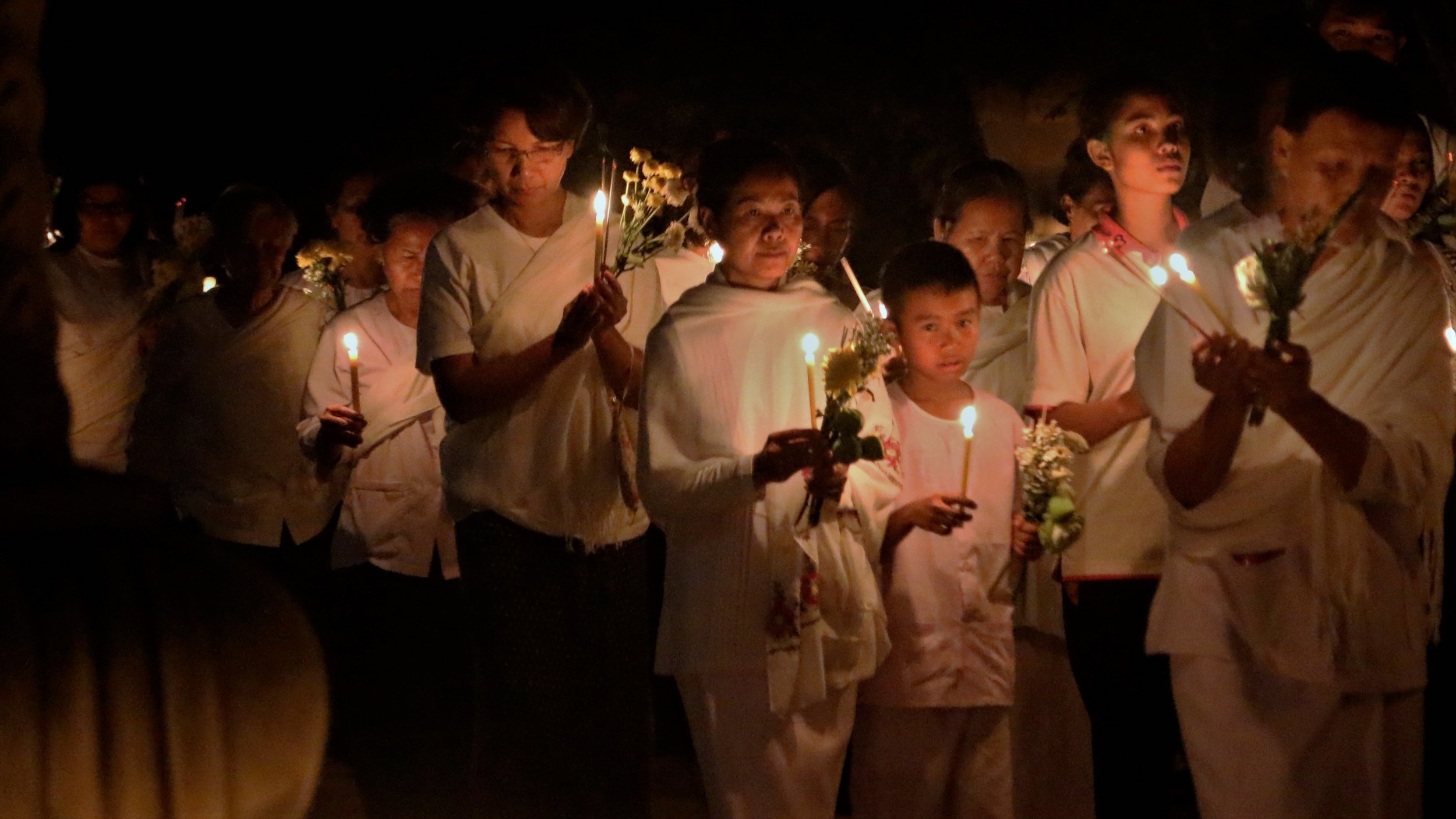
So, in the act of honouring the Buddha, one first opens the heart in respect and brings to mind the meaning of an Awakened One: someone of deep clarity; a speaker of truths that penetrate and bring healing to the human condition; one accomplished in understanding and action – a sage whose teachings can still be tested and put into action. If one has a Buddha-image, it’s something that should be held with respect – one cleans it, illuminates it with light, and offers flowers and incense to it. We place it on an altar, bow to it and chant recollections and teachings.

This is not a mindless activity; we use ritual means and resound words and phrases because this full engagement embodies and strengthens the quality of respect in a way that thinking can’t. With the openness of heart that these attitudes bring, any aspect of the teaching that’s brought to mind goes deeper. The act of offering that begins a pūja is a case in point: offering flowers “symbolizes bringing forth virtue, offering light is about bringing forth clarity, and incense does the same for meditative concentration. In this way, pūja introduces the heart to important Dhamma themes.

Pūja is especially helpful when people perform it as a group. Then we are participating in the Dhamma as both the expression and the Way of awakening, as well as in the collective commitment to, and engagement with, that Dhamma. This collective engagement ritualizes the ‘Sangha’, that is, the assembly of disciples. Chanting in a group has a harmonizing, settling effect: sonorous and unhurried, it steadies bodily and mental energies and supports an atmosphere of harmony with fellow practitioners. Tuning in and participating brings us out of ourselves and into a deep resonance with heart-impressions of the sacred. We can be touched by a sense of timeless stability, purpose and beauty. If these intentions, felt senses and recollections are established regularly, we know where to find good heart, how to attend to it, and how to allow ourselves to be uplifted. Such kamma feels bright.

The Benefits of Recollection

‘At any time when a disciple of the noble ones is recollecting the Tathāgata … the Dhamma … the Sangha … their own virtues: “[They are] untorn, unbroken, unspotted, unsplattered, liberating, praised by the wise, untarnished, conducive to concentration.” At any time when a disciple of the noble ones is recollecting virtue, his mind is not overcome with passion, not overcome with aversion, not overcome with delusion. His mind heads straight, based on virtue. And when the mind is headed straight, the disciple of the noble “ones gains a sense of the goal, gains a sense of the Dhamma, gains joy connected with the Dhamma. In one who is joyful, rapture arises. In one who is rapturous, the body grows calm. One whose body is calmed experiences ease. In one at ease, the mind becomes concentrated.

‘Mahānāma, you should develop this recollection of virtue while you are walking, while you are standing, while you are sitting, while you are lying down, while you are busy at work, while you are resting in your home crowded with children.’

(A.11:12; B. BODHI, TRANS.)

The expressions that are used in recollecting Dhamma are that it is experienced directly (not just as a theory), is of timeless significance, and is accessible and furthering for those who practise it. So that gives us an encouragement to look into what the Buddha taught and modelled: the way to the end of suffering and stress. With this, we recollect aspiration, learning and commitment as our common touchstone, and suffering and ignorance as our common challenge. Then we no longer feel so alone with our difficult mind-states, and we can handle them in a more open and aware way. Recollection of Sangha reminds us that although there is greed, anger and confusion in the human world, there are also people who cultivate a way out of that.

If you use pūja on a regular basis, it aligns you to the ‘Triple Gem’ – Buddha, Dhamma and Sangha – by presenting content in terms of images, ideas and themes, and values and practices that guide the heart. It also occasions acts of steering and composing attention. So pūja works both on what the mind is dealing with, and how it operates [Continued next week 22 August 2024].

Link to the original:

https://www.abhayagiri.org/books/458-kamma-and-the-end-of-kamma

bright kamma

Ajahn Sucitto

The Blessing of Skilful Attention

Whoever cultivates goodness is made glad,

right now and in the future – such a one is

gladdened in both instances.

The purity of one’s deeds, if carefully recollected,

is a cause for gladness and joy.

Dhammapada: ‘The Pairs’, 16

In the last few weeks, a Buddha-image has been created in this monastery by Ajahn Nonti. He’s a renowned sculptor in Thailand, and he came to Cittaviveka to fashion this image as an act of generosity. It’s been a lovely occasion because the Buddha-image is being made in a friendly and enjoyable way. Many people have been able to join in and help with it. Yesterday there were nine people at work sanding the Buddha-image. It’s not that big, yet nine people were scrubbing away on it, and enjoying doing that together.

Bright and Dark Kamma Arise from the Heart

Nine people working together in a friendly way is a good thing to have happening. Moreover, the work was all voluntary, and came about with no prior arrangement: people got interested in the project and gathered around it. It’s because of what the Buddha represents, and because people love to participate in good causes. That’s the magic of bright kamma. It arises around doing something which will have long-term significance, and also from acting in a way that feels ‘bright’ rather than intense or compulsive. Kamma – intentional or volitional action – always has a result or residue, and here it’s obvious that the bright kamma is having good results. There’s an immediate result – people are feeling happy through working together. And there’s a long-term result – they are doing something that will bring benefit to others.

In a few days we hope to install the Buddha-image in the meditation hall. It’s an image that makes me feel good when I look at it. It has a soft, inviting quality that brings up a sense of feeling welcome and relaxed. This is a very good reminder for meditation. Sometimes people can get tense about ‘enlightenment’, and that brings up worries, pressure, and all kinds of views; but often what we really need is to feel welcomed and blessed. This is quite a turnaround from our normal mind-set; but when we are sitting somewhere where we feel trusted, where there’s benevolence around us, we can let ourselves open up. And as we open our hearts, we can sense a clarity of presence, and firm up around that. This firmness arising from gentleness is what the Buddha-image stands for. It reminds us that there was an historical Buddha whose awakening is still glowing through the ages – but when this is also presented as a heart-impression in the here and now, rather than as a piece of history, it carries more resonance. Then the image serves as a direct impression of what bright kamma feels like.

‘Bright’ kamma is the term used in the scriptures to denote good action, or that which leads to positive results. This is not a theory or a legal judgement; if you linger in the heart behind skilful actions, you can feel a bright, uplifting tone. Bright kamma is steady and imparts clarity; it has an energy that’s conducive to meditation. Dark kamma, on the other hand, lacks clarity and feels corrosive. As it makes the heart feel so unpleasant, mostly attention doesn’t want to go there; the heart gets jittery and distracts instead. So, this is something to check inwardly: can we rest and comfortably bear witness to the heart behind our actions? Do our thoughts and impulses come from a bright or dark state? Even in the case of owning up to some painful truth about our actions, isn’t there a brightness, a certain dignity, when we do that willingly? Look for brightness in occasions when your heart comes forth rather than in times of superficial ease or of being dutifully good. That bright, steady tone rather “than casualness or pressurized obedience, indicates the best basis for action.

Sense and Meaning: The Perceptual Process

The energy of kamma originates in the heart, citta. It can move out through body (kāya) and speech (vāca – which includes the ‘internal speech’ of thinking) and mind (manas). Both manas and citta can be translated as ‘mind’, but the terms refer to different mental functions. ‘Manas’ refers to the mental organ that focuses on the input of any of the senses. This action is called ‘attention’ (manasikāra). So manas defines and articulates; it scans the other senses and translates them into perceptions and concepts (saññā). Tonally, it’s quite neutral. It’s not happy or sad; in itself, it just defines, ‘That’s that.’

Citta, on the other hand, is the awareness that receives the impressions that attention has brought to it, is affected and responds. It adds pleasure and pain to the perceptions that manas delivers, and these effects generate mind-states of varying degrees of happiness and unhappiness. Owing to this emotional aspect, I refer to citta as ‘heart’. Note that citta doesn’t access the senses directly. Instead, it adds feeling to the perceptions that attention has brought it; but with that, the initial moment of perception gets intensified to give a ‘felt sense’. This is a simple note such as ‘smooth’, ‘glowing’, ‘foggy’, ‘intense’. Then as attention rapidly gathers around that sense, a felt meaning crystallizes. For example, manas may decide that an orange-coloured globe of a certain size is probably an orange. From that meaning, further felt senses such as ‘tasty, healthy’ may arise and resonate in the heart. So, a mind-state based on desire arises. And even though all this originates in mere interpretations, intention springs up – and citta moves attention, intention and body towards the orange with an interest in eating it.

In this way, impulse/intention occurs as a response to a felt meaning that itself has been conjured up by a graduated and felt perceptual process. This is how mental kamma arises. And the result of citta being affected in this way is that the meaning is established as a reference point. Then the next time I see or think of an orange, that established perception that ‘Oranges are tasty; they’re good for me’ becomes the starting point for action. But is that interpretation always correct? Ever bitten into a rotten orange, or been fooled by a plastic replica? More significantly, don’t perceptions of people need a good amount of adjustment over time? How true is perception?

Perception is initiated when attention turns towards a particular sense-object. So, all contact depends on attention. Take the case of when you’re intensely focused on reading a book or watching a movie: awareness of your body, of the pressure of the chair, and maybe even a minor ache or pain, disappears. The mind’s attention is absorbed in seeing and processing the seen, so other impressions don’t get registered. Contact with the chair has disappeared because one’s attention was elsewhere. How real then is contact?

Contact is actually of two kinds. The contact that occurs when the mind registers something touching the senses is called ‘disturbance-contact’ (paṭigha-phassa). But when manas ‘touches’ the citta at a sensitive point, ‘designation-contact’ (adhivacana-phassa) is evoked – along with a felt sense. Disturbance-contact occurs in the mind-organ, and designation-contact occurs in the heart; and it is designation-contact, the heart’s impression, rather than contact with something external, that both moves us and stays with us as a meaning. For example, ‘dog’ is tonally a neutral perception that we would agree upon as a definition of a certain kind of animal. But in terms of citta, that ‘dog’ could mean ‘savage creature that can bite or has bitten me’ or ‘loyal, cuddly friend that will protect me.’ Such contact is therefore formed by previous action, but present-day impulses and actions are based on it. Thus, the old perception shapes me; in this case, as a fearful or confident person. And I act from that basis. This is why it is said: ‘Contact is the cause of kamma.’

Continued next week 15 August 2024

Link to the original text. Download a few pages, or the whole book free of charge. It’s a Dhamma publication:

https://www.abhayagiri.org/books/458-kamma-and-the-end-of-kamma

vipāka, ‘old kamma’ being born

Ajahn Sucitto

Excerpts from: “Kamma and the end of Kamma”, Chapter 1: “Action that Leads to Liberation” (continued from last week) “These impressions and interpretations begin with the external mind, but get settled in the heart through the agreeable or disagreeable feeling (vedanā) or the prior association it evokes. In other words, citta doesn’t receive sights, sounds, smells and tastes; it receives the perceptions that mind-consciousness brings in.”

Consequently, the pairing of the objective mind and subjective heart builds meaning. The spiritual quest is based on the understanding that there is ageing, sickness and death; and with that the experience of separation from the loved, and being disagreeably affected by these facts of life – while at the same time being powerless to do much about it. Even on the level of daily life, what we think about, and how we conceive of people and things, washes over the heart with pleasant or unpleasant feeling, arouses gladness or disappointment, and may lead us into action. This is how the world of sights and sounds and people and events gets into us and gets us going (even when the event happened long ago). The inheritance, the vipāka or ‘old kamma’ of being born, is that whether the mind interprets things accurately or not, the heart stores its interpretations. And it bases intentions, responses and reactions – kamma – on those stored-up meanings. It’s a questionable basis.

The basis is as much psychological as sensorial. We need to, and do, seek to understand and otherwise manage our circumstances. Therefore, one of our most continual mental actions is that of interpreting and filing away experience to derive meaning and purpose. And, as with other creatures, part of that meaning and purpose has to do with getting support from, or participating within, a group. In our case, this ‘belonging’ also entails participation in a complex weave of social programs, customs and attitudes. “that tell us how to operate in order to be accepted. This also affects our kamma, because although some advice is wise, we may also act upon socially-derived prejudices that cause us to contribute to hurting others – so we become arrogant or insensitive. Some social customs are about bypassing uncomfortable truths (such as mortality), or not giving deep attention to the heart: a life of golf and parties fails to come to terms with the facts of life. Another big effect comes from the views and opinions of others: being praised or blamed, valued or neglected, lingers as perceptions by which we sense ourselves. This self-reference then becomes an identity. As a general principle then, how we have been (and are being) affected by others solidifies into who we are.

This psychological program of being affected and responding is called the ‘mental (or heart) formation’ (citta-saṇkhāra). Installed at birth, at any given moment this ‘master program’ responds to present experience in terms of what it has learnt that experience is like. It is informed through a library of perceptions, or ‘felt meanings’, that the manas aspect has encoded, even though these perceptions are all only representations of an object, an event, or of course a person. And also, saññā adds subjective tints to any object-definition, such as: ‘Will she like me?’, ‘He looks threatening’ – and so on. These tinted perceptions become the basis of many spur-of-the-moment responses in our lives.

Meanwhile, the mind has responded on many fronts: we may be involved with business, but are challenged by the result of hearing of a relative’s death an hour ago. Even as we struggle with this, other long-term aims or social obligations apply their pressure. Bodily health and energy also have their effects. In addition to this, our attention span fluctuates, particularly if we’re tired – so we can be running on automatic, attending in a habitual or blurred way, and acting on outdated or biased programs. Rather like the tides of an ocean that can lift us up, engulf us, or sweep us in any direction, this kammic process is then a dynamic field of the interplay between established aims, former or current input, and responses to any of these. The mind-sets, attitudes and interpretations that have become established in our hearts carry the potential to shape our present actions; and the future will arise according to whichever mixture of these effects we act upon.

Steering Through the Causal Field

From the above, you’ll see that kamma is potent and multi-dimensional. Steering through its causal field is possible, but it does require a reliable and trained mind; training is then an imperative. Dark kamma weakens the mind and destroys people; bright kamma is a source of strength and nourishment. On account of bright kamma, such as ethical integrity and goodwill, we can establish the calm and clarity that supports training manas and citta. Together, these two aspects of mind can then handle, understand and release the causal tangle.

Look after yourself!

‘And for the sake of what benefit should a woman or a man, a householder or one gone forth, often reflect thus: “I am the owner of my kamma, the heir of my kamma; I have kamma as my origin, kamma as my relative, kamma as my resort; I will be the heir of whatever kamma, good or bad, that I do”? People engage in misconduct by body, speech, and mind. But when one often reflects upon this theme, such misconduct is either completely abandoned or diminished.’

(A.5:57; B. Bodhi, Trans.)

So kamma is not an imprisonment, but a matter to be mastered. Firstly, if we must generate kamma, we can at least determine whether it will be bright or dark. Remember, there’s a choice: kamma depends on impulse or intention – but ‘intention’ is not just a deliberate plan; in fact, we’re not always that clear about what we’re doing and why. Many of our troubles come from just being preoccupied, or getting stuck in habits, or from inattention or misunderstanding; then intention is not guided by clarity. “Complacency or, on the other hand, pessimistic fatalism may also weaken the clarity and firmness of intention.

We might wonder why we are who we are and what made us like this, but such speculation just activates the mind to no good end. The details of kamma are too complex to understand – it would be like trying to figure out which river or rain-cloud gave rise to which drop of water in the ocean.[4]

 The most direct and helpful way to steer kamma begins with ‘right view’ (sammā-diṭṭhi). Right view is the view that there is the bad and it can be steered away from, and there is the good and it can be cultivated. And cultivation entails training one’s attention. An attention that’s firm, clear and not flustered by moods and sensations can enter the underlying currents of the mind and turn a tide of heedlessness and self-obsession that would otherwise steer intention. In this way, right view leads into ‘right attitude’ (sammā-saṇkappā), which is the aim to set one’s attention on a skilful footing. With these two steps, the Eightfold Path out of suffering and stress gets established.[5]

The first responsible and accessible action on this Path is to pause on an emotional response and ask yourself whether this response is reliable and aims in a wholesome direction. Even this brief breaking of the reactive link that engages fresh intention with an old habit, if done repeatedly, can dissolve that link and cause that mental habit to cease. You find that you don’t have to retort, that you don’t have to rush to the deadline, and you don’t have to binge. Then different responses can arise – such as patience, forgiveness and tolerance. In ways like this, you can get out of the gridlock of ‘I’m stuck in this habit; I am this’, and make meaningful choices in your life. The “basis of any such choices is gaining the capacity to choose. And this heedfulness (appamāda) is what pausing and considering offers: I can pause, come out of a mind-state, give it due consideration, and decide to act on it – or let its accompanying impulse pass. I don’t have to be compulsive or reactive. Just taking this step, that of disengagement (viveka), opens the possibility for the fourth type of kamma, the kamma that leads to the end of kamma.

 This is what ‘liberation’ and ‘awakening’ refer to.

[Please find the last part of this chapter in the original, (see the link below), under the subhead: ‘Liberation Begins with Mindfulness,’ which can be found in the Contents listing. I decided not to continue with it here because it is of interest to a limited readership, in my opinion, and it’s best to move on to another aspect of this subject.]

https://www.abhayagiri.org/books/458-kamma-and-the-end-of-kamma