
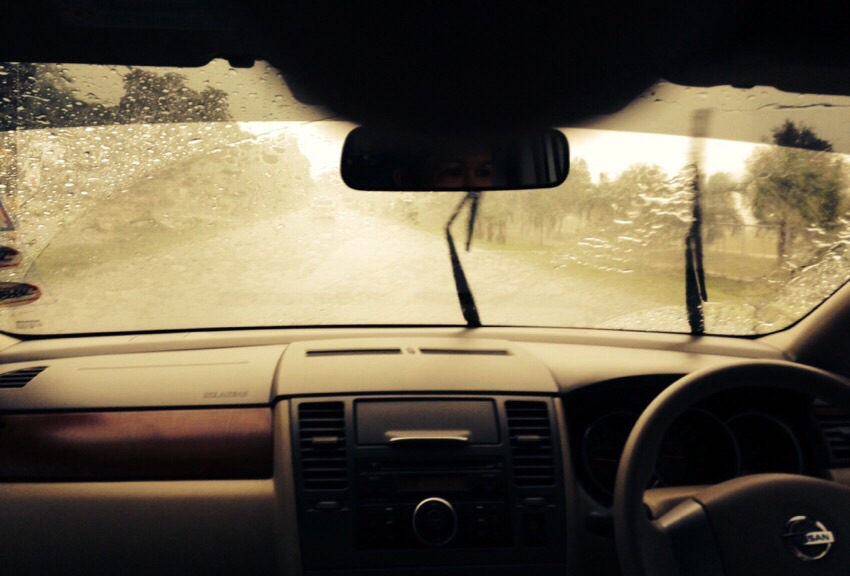
POSTCARD #97: Bangkok 06:00 hours: Heavy rain, the sound of it is hypnotic. M sits at the breakfast table, eyes glazed over and chewing in slow motion, falls into a dream in mid-chew and needs a gentle poke to remind her to keep going… not properly awake yet; this world emerging from the one before. Somebody says there’s no time left – got to go now. M holds up her watch to look at the time and beneath her raised elbow the plate is taken away to the kitchen sink, clink-ding, and all around there’s a kind of speeded-up blur of movement – things vanish, table top is wiped. M, still in the dream maybe, looking at her watch, unsticks it from where it’s gotten slightly adhered to skin; it’s a blue and yellow bubble-like kiddy object, I ask her if she is good at telling the time, she looks at the flower-patterned dial and thinks for a moment; I no can tell you Toong-Ting (her name for me)… meanwhile all around us, doors open and close, toilets flush and there’s a clatter of voices as the whole scene gets folded into itself and packed away… suitcases zipped up. It’s as if there are at least two versions of this particular reality running at the same time.
I ask M if she learned about telling the time in school; only the Thai way. I don’t know in English how to say… I’d forgotten about the Thai way of telling the time, of course, it’s a slightly different system [link], and I’m reminded there are other perceptions of the world that run parallel to the Western way. No time for discussion, we’re hustled out the door to the car that takes us to the airport – but unprepared for the huge puddle at the gate. M gets her feet wet as she’s climbing in the car, sits in the back with me, takes wet foot out of rubber slipper and asks me for a tissue; something to dry her feet with. I don’t have anything except for a crumpled one in my pocket; unfolding it carefully and she says, Did you sneeze in it Toong-Ting? I tell her no I didn’t; looks at it doubtfully… dries her foot.
The rest of the journey is about the car making its way through flooded areas and the sloshing sound beneath where we are sitting. M looking around wide-eyed, listening – there’s another world out there through the thin fabric of the vehicle… so near. All kinds of splashing but the rain doesn’t last long, we can see it starting to ease off and when we reach the airport there’s blue sky and sunshine, as if the rain had never happened.
Out of the car, and we have to say bye-bye to mummy who’s not coming, a hug and they’re a bit tearful. So there’s only us now but we’ve done this before, been on a few journeys together. Through the Xray, the check-in and into departures. We find two seats and M wants to use the iPad for her Minecraft… all kinds of apps with their sudden ringtones wake me up in the night reminding me they need to be upgraded. Sharing the iPad with M means I don’t get overly attached to it and when I do have access, there’s a sense of urgency; writing as in text-message minimalism. A lightness too, because being with a 10 year old who speaks English as a foreign language reduces gravity and the slow moving dinosaur of thinking about things for too long.
Shortly after that we’re boarding, the flight leaves on time and the great leap up… catapulted into the sky, 5 miles above the surface of the planet. M is quietly looking around, a discrete twirling and spinning of small head, checking out everything inside the aircraft and out through the window; fluffy clouds in a pale blue heaven realm – the world is a simulation, overlay upon overlay of illusions I feel I’m deeply familiar with…
‘There is no thing there. There is no real substance, no solidity, and no self-existent reality. All there is, is the quality of experience itself. No more, no less. There is just seeing, hearing, feeling, sensing, cognizing. And the mind naming it all is also just another experience.’ [Ajahn Amaro]
————————-










You must be logged in to post a comment.