rooms

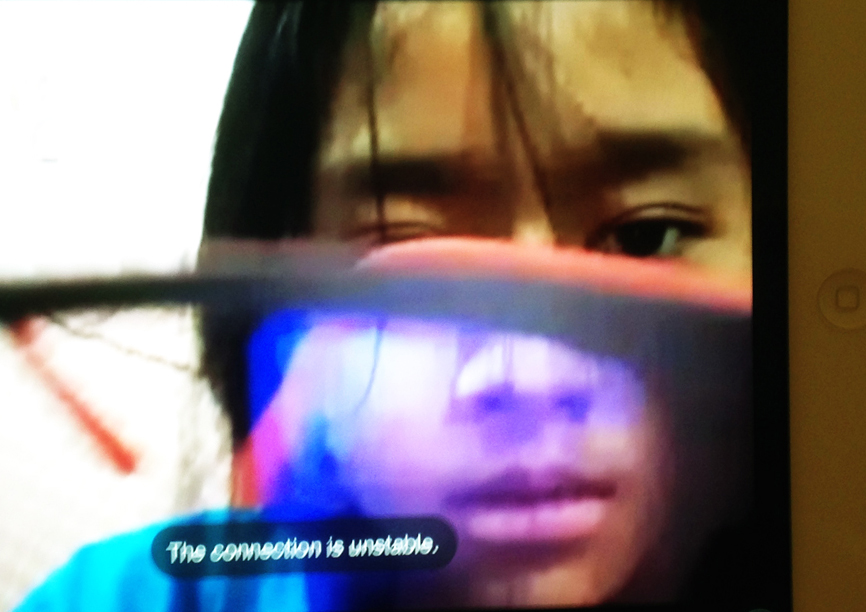
IMG_2081bPOSTCARD #155: Chiang Mai: Home is three rooms on the third floor in a condominium. Arrived in the evening, up in the elevator, unlock the door and enter. Lights on, blinded for a moment, drop everything, close door. It’s airless, windows closed – how long was I away? Must have been the end of August? A scatter of things left at the doorway as I stumble around absorbing the environment, trying to recreate the last time I was here, searching for familiarity in the furniture… things, objects which carry meaning. Anjali to the Buddha statue, books on shelves… and I find the memory of it all is displaced by present experience, as I step into a new time. Sensory data, the smell of detergent products (the cleaners came). It’s so quiet here, open curtains with a great sweep, sliding back screens, open the windows with a bang (unintentional), birds outside flutter and chirp and there’s the mountain air. Crash around the apartment, disturbing the space held by these rooms, what is contained is squeezed outside and new air enters. My shoes are lying in the hallway as if the owner has flown away, bathroom door flung open. It’s like a catastrophe in reverse – everything is suddenly peopled, inhabited, okay, this is where I live.

Router is flickering green lights, switch on laptop, available networks… okay I’m online. What else is here? Clothes hanging in the closet, whose are these? Looks like they fit me, must have been ‘me’ in a former life. Case lying on the bed, its cover open so wide it looks like the extended mouth of an opera singer reaching the high note… the emotionality of arriving at the final destination. All my clothes coming out, folded to a flatness like envelopes and layered, they feel cold from the aircraft. Flat-pack systems, I have to reassemble according to numbered diagrams and the hologram arises like magic; a sense of ‘self’ in these surroundings, clothed and cloaked in suitable disguise; everything needed for this temporary mode of being.

Head spinning with the varying ear-popping air pressures and momentum of the great storm that brought me here, the travel industry, largest network in the world. Taxis, escalators, miles of corridors, two planes, Delhi/ Bangkok/ Chiang Mai, everything is linked with everything else. Who runs it all? … is there a God? Inappropriate question right now, the spinning flow of it is just moving along by itself, I jump on as it’s going past, join the other passengers already there, get my seat, fasten seat belts and we’re all swept away like flotsam and jestam taken by river currents.

So now I’m here, j’arrive! Let’s see now, what’s in the fridge? Onions with long shoots growing in the darkness. Soy milk not yet past its sell-by-date and some dry oats that seem to be okay. Plenty coffee. Good! I can do grocery shopping tomorrow. Time to reverse in, switch off engine, lights flash in acknowledgement, and be horizontal for 8 hours…

“As wave is driven by wave
And each, pursued, pursues the wave ahead,
So time flies on and follows, flies, and follows,
Always, for ever and new. What was before
Is left behind; what never was is now;
And every passing moment is renewed.”
[Ovid, Metamorphoses]

————————-

before already

IMG_0574bPOSTCARD #153: Delhi: Getting things organized for the flight to Thailand, I go through my files and find this photo taken at Delhi Airport Departures last time I was there. Unfamiliar with this kind of airport signage: STOP/ LOOK/ GO, I’m lost for a moment in the what-came-first directionality, then I see it’s meant to be for vehicles approaching from the left. The driver is supposed to stop at the word STOP, then drive to the word LOOK, then he is ready to GO. Curious incongruities for me, an observer at the window on the third floor of the passenger terminal, I feel like a tiny speck in a huge transparent glass and steel building. A time/space anomaly, I’m reminded of something somebody said; part of a conversation with a married couple I know, in Chiang Mai. German husband and Thai wife – she doesn’t speak German, he doesn’t speak Thai. They use English to communicate, husband speaks it with traces of Thai pronunciation, and wife has a slightly German accent. We’re having tea together and I’m the only native speaker in the room so I naturally start to facilitate their searching for words, then realise I don’t have to do that, of course – English is their link language and over the years they’ve worked out their own system.

Their dialogue is a hybrid of grammar forms improvised as they go along. We’re getting ready to go out and husband says to wife, Where my blue socks. Wife tells husband: in the ironing basket… (mumbling quietly to herself in Thai: he can’t find anything because he doesn’t look properly). As he’s walking off to the laundry basket husband says, why you can move things without telling to me, and she follows it up with, I tell you before already.  I lose track of the conversation then, thinking… before already, huh? Is it a point in time somewhere before ‘already’ happened? Or is it that she already told him about the socks, and that was before something happened that’s not referred to here.

You can say it in Thai (bok gon laew*) but in English it suggests there’s an instant in time we are searching for but haven’t discovered yet. Miniscule shavings of time, events that last for 100 attoseconds, or 100 quintillionths of a second (note: 100 attoseconds is to one second as a second is to 300 million years). The illusion of duration, I’m experiencing a before/already disorientation, the present moment constantly updating itself in an attempt to find out where we are now. Cause and effect are parts of the same event; ‘before already’ is a screenshot capture of karma particles (cittas) in the time construct we inhabit. Lost in translation, so vast it doesn’t matter any more.

One moon shows in every pool;
in every pool, the one moon.
[Zen Forest Saying]

————————-

*bok gon laew: บอกก่อนแล้ว say before already

pasta in the past

IMG_2234bPOSTCARD #152: Delhi: Video call from M, my Thai niece, she’s showing me her new glasses… they make her look so grown-up, hard to believe she’s only 11 years old. I remember when she was little, using English words and that creative playfulness: ‘pasta in the past’, something she learned about the word ‘pasta’ having its origins in China and brought to Italy by Marco Polo in the 13th century. So it became pasta (in the past) – as in pasta/ presenta/ futura – but it was also from the movie ‘Frozen’ where the main character (Elsa) sings the song, ‘Let It Go’ and there’s the line ‘the past is in the past…’ (click here for 9 second link) and M was singing along with a video of it as, ‘pasta in the past’, either because that’s how she heard it in some other animation, or she thought it was funny, or both… I can’t remember.

The wisdom of this childlike intelligence that seeks/finds creative solutions to problems – I must have had in my own childhood, over many horizons, long ago and far away. All the ups-and-downs; all the dramas embedded in our history that make us who we are now and form the characteristics of our future time. Births, deaths, marriages; I have a fragile, old, yellowed newspaper clipping of an obituary column that describes my grandfather who came from the Orkney Islands in the North of Scotland and was drowned in a fishing boat in the Moray Firth before I was born. The unseen cause/effect of emotional catastrophes enduring for decades; we’re unknowingly driven to take responsibility for things over which we have no control, thinking (or believing) that by chance we might stumble upon the key to unlock it all; the karma that’ll undo the karma that led to this.

M asks me: Toong Ting, you feel better now? How about your Chingo? (Shingles)… I tell her, yes, I’m okay now, thanks. She looks at me, Did you go to the hospital? (we go to the outpatients section of the local hospital rather than a private doctor) Yes, I went to the hospital, showed the doc my skin rash, looked really yukky, told him about the bad headache all the time. Did you eat the medicine Toong Ting? Yes… we take medicine, we don’t eat medicine, and she knows this but can’t be bothered to make the change from the Thai translation: kin ya

I took homeopathic medicine towards the end of the three-week frenzy of stabbing pain, then the recovery and falling into a huge landscape of pain-free, ease and gentleness. Altered state, revisiting old memories with such vivid clarity it all seemed quite different – I thought the past was irredeemable but it’s not. The past changes according to how it is perceived in present time. And I’d been so firmly attached to the endless thinking-about-thinking, watching the same old rendition of the story I’d assembled over the years.

My world was transformed, ideas and perceptions started to change; a fierce face appears in a kindly way, the scary familiarity of events unfolding but portrayed differently… a completely new production of an old movie. Kindnesses and sorrows, things I’d not noticed at the time become redefined in the process of mindfully remembering the situation. It’s as if I’m seeing my missing grandfather coming back to life; a rebirth happening here and now – in the same way this video call from M is happening now, although she is 2000 miles away. Toong Ting?, M asks, when you come to Thailand? I tell her it’ll be 29 September, that’s next Tuesday… Okay, bye! Everything comes full circle again.

A monk asked Yueh-shan, “What does one think of while sitting?”
“One thinks of not thinking,” the Master replied.
“How does one think of not thinking?” the monk asked.
“Without thinking,” the Master said.
[Zen mondo]

————————-

awesome selfie stick

IMG_2296POSTCARD 150: Delhi: To start with, it felt like a small insect bite. The painful part was just out of my vision on the back of my shoulder – impossible to see it in the mirror, so I ask Jiab to come and take a look. She studies the mark on my shoulder and says, “it’s a…” (pause), silence for a moment – looking at it thoughtfully, “It’s a…” (can’t think of the English word). I find a small hand mirror and try to see my reflection in the large bathroom mirror. Twisted around, contorted and awkward, but still can’t see it so I ask Jiab to tell me what she thinks it looks like. She says, “peempo” (pimple) her voice is so close to my ear it’s like she’s shouting. Then, silence, focused on trying to squeeze it with fingertips… doesn’t answer my questions because one can’t squeeze pimples and speak English at the same time. I can hear her holding her breath, small sounds of effort: mmmnh… but I find it’s too painful; get the phone out of my pocket, go to the camera app and ask her to take a photo of it. She takes a close-up: click! Shows it to me… oh, I see! It’s not “peempo” (pimple), singular; it’s pimples, plural. Many of them… and then I’m aware they reach up under my hair too.

We go to see the doc, show him the unpleasant skin rash and tell him about the headache and neck pain all the time. He takes one look and says: herpes zoster virus, it’s Shingles – Jiab says chingo… in Thai they call it ngoo sawatdi (snake says hello again). The doc tells me it’s the chicken pox virus we get when we’re children that remains dormant in the body for decades, then “wakes up,” or reactivates. Why? Maybe because I just came back from four weeks in Scotland, fresh hilltop air, and must have lost the immunity to infection I’d acquired as a long-term resident foreigner in South Asia. Who knows… it just comes back.

This is how it is for me now, headache, pulsating on and off, all over the right side of the head and neck. Doc gave me ant-viral tabs, ointment and pain med, saying it’s a neural reaction to the skin lesions, and (interestingly) the nerves below the surface of the skin tell the brain there’s pain inside the body. This sets off major alarm systems and you feel it deep inside. I have to get around the fact it’s telling me all the wrong things about the location of the pain – stated also with a kind of urgency, like, Pay attention! This is serious… so I’m starting to worry it’s a brain tumor. And it’s not that, it’s actually in the upper skin layers.

Sometimes I sit on the meditation cushion and wait for quietness to come; thinking and thought has its own momentum, takes time to settle down, then the openness to the pain experience is just totally there for a moment. There’s the default sense of self: hey, this must be happening to ‘me!’ then an initial frantic search for an alternative that runs on automatic takes it out of the normal context. Mind does a bypass, and for an instant the pain is not happening to anyone – there’s no ‘me’ engaging with these thoughts. The awareness that a thought was just there, but now nothing remains except the awareness that I can’t remember what it was… and the sensation of pain, like the hummmm of an old fluorescent tube light that needs to be replaced.

‘The mind is the canvas on which our thoughts are projected and is part of consciousness. Our body is a holographic projection of our consciousness.’ [B. M. Hegde, cardiologist]

————————-

Photo source: PnnB on Thai social network

improvisation

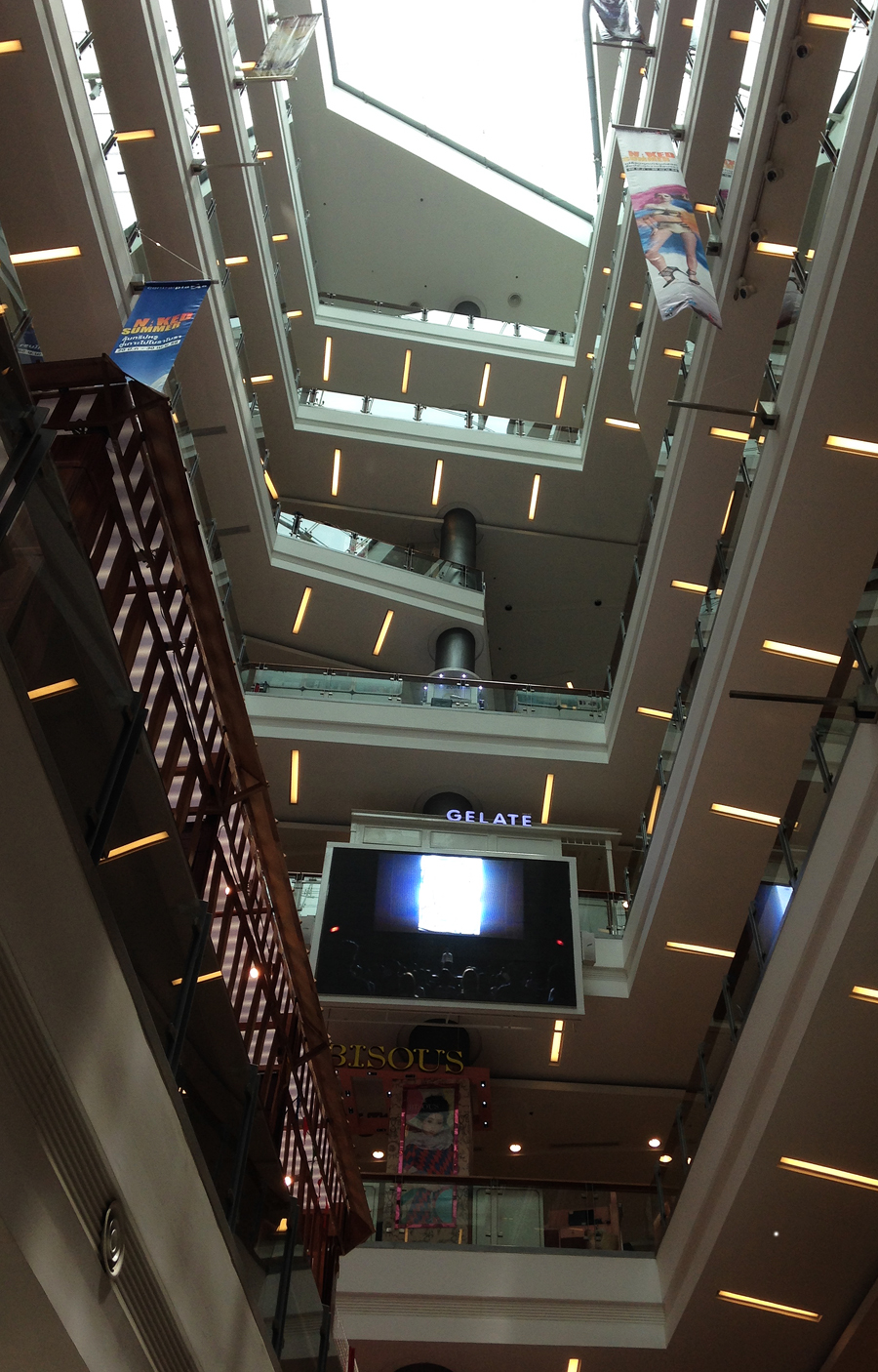
IMG_2123POSTCARD 149: Delhi: Mall architecture, astonishingly playful buildings, concrete and steel monuments and shrines to maya (sanskrit: illusion) – in Chiang Mai they even named a shopping mall ‘MAYA’. The population welcomes the idea; step into the illusion… air-conditioned, bright and colourful. More and more of these in Bangkok, over the top – a lightweight upbeat city culture, low labour cost and construction projects are ongoing. Something hopelessly inevitable about it careering towards the relentless consumer culture of the West – except that in the East, people are more likely to ‘know’ when they’re stepping into the illusion. Cultural tradition, awareness and vestiges of spirituality; besides, everybody here knows that if somebody is in the market trying to sell you something, it means you have the option to negotiate a fair price… not so in the Mall, and that’s why so few people go there.

The Mall culture affects only a small percentage of the population (sounds like a virus) and, I have to say I’m sometimes part of that minority; the need for essential things for devices, bookshops and a good baker. To get to our mall we have to drive out of town and the three-building complex is situated in an undeveloped area – there’s a fourth building going up at the time of writing. Construction site workers’ community nearby, chickens and goats in a hot dry, dusty landscape. Come off the highway, through a great winding turn of rough unsurfaced road, potholes and puddles of water and into the short entry, manned by security – car examined, mirrors held underneath, look in the trunk, the engine. More security at the entrance, metal detector and security guards carry out a full body search before you get in the door.

It’s as if the whole concept of consumerism is subject to scrutiny; not as easy as it is in the West to simply be ‘pulled’ into the Mall like a magnet and disinclined to escape from the illusion. For many people the whole thing seems impossible to change, situated at the end of the consumerist food chain, as they are, and trapped in that predicament. No alternative, we have to purchase the product because we can’t create it ourselves – so far away from the artisan, so far away from doing things ourselves. People believe they can’t improvise… forgetting that the whole thing is improvised… language is improvised, life itself is improvised. All the systems that are in place were improvised to start with, and even though we may be subject to skillful marketing strategies, there’s still the innate ability to be creative, to improvise, to invent, to innovate, to find a way out of the illusion.

These carnivorous marketing creatures have to be gently pushed into the background in order to bring what’s really meaningful in life into focus. There’s a lightness, a floating in the air… the open-endedness of the human situation, groundlessness.

“What can we gain by sailing to the moon if we cannot cross the abyss that separates us from ourselves?” [Thomas Merton]

————————-

photo: shopping mall Bangkok

immediacy

IMG_2161dPOSTCARD 146: Delhi: The early flight from Bangkok arrives in Delhi mid-morning local time. It feels like everything that brought me here has vanished; a curious missing piece of time, the four hours of travelling, and before that the Thai departures, the check-in desk, and before that the taxi that took me to the airport from my house in the darkness of very early morning, more like the middle of the night – all that has gone, the past is like a half-remembered dream.

I suddenly wake up in the middle of a Delhi traffic jam and it’s really confusing to be in this bright daylight after the darkness of the aircraft cabin. The transition into this reality so rapid, the split-second required for it to take form is… missing, yet an awareness of it having taken place remains – or the feeling that something just happened, whatever, and having to allow for the curious delay in the time it takes to recognize what’s going on. Suddenly there’s the blare of car horns from behind and vehicles overtaking as the driver adjusts to avoid a motorbike coming towards us on the nearside (why’s that man driving on the wrong side of the road?).

There’s an alertness, anticipated danger, preparedness… the car is buffeted around, rock-and-roll, accelerated, braked, jerked, vibrated and three lines of speed bumps one meter apart cause the vehicle to jolt six times. Then it stops. There’s an obstruction up front. Horns continue to blare and protest. What to do? The one-way system in Delhi is unrelenting; it can take a very long time to get back to where you want to be. So when the driver sees a gap in the flow and makes a smooth wide U-turn straight across four lanes of traffic, I feel like breaking into applause as we speed away in the opposite direction.

A few short turns through streets I’ve never been in before and we arrive at the house. Me and my suitcase of compressed, flat-pack clothing, ‘self’ assembly; get into the bathroom, shower, put on new clothes, and become someone else, an assumed identity. Step into the room: So, how was the flight? Yes okay not too crowded. Suddenly aware of having to speak in codes, chunks of language created by air forced through vocal cords squeaks like the reed of a wind instrument, and rolling articulated back throat cavities, deep volumes of sound, gasp and split bits of wet air that whistle and chirp for an instant in tongue, teeth and lip. Thought associates words which insist on naming things, integrate pieces of the jigsaw puzzle; a picture emerging as I speak, yet changing constantly according to the way the parts fit together.

Objects have that strange familiarity, rush towards me like old acquaintances… remember me? There’s a book on the desk, open it at the page where the marker was left the last time I visited. Return to that place but can’t recognize anything. The ‘now’ moment is here and in all other locations at the same time. All I can do is dig up a few artifacts from recent history before I have to go on again; the point of origin is so distant, I’d never find the way back to the beginning …

“The intimacy and immediacy of the now… is our only security. It is utterly vulnerable and completely secure. No harm can come to us in the now, no sorrow and no death. All our longing longs only for this.” [The Intimacy and Immediacy of the Now, by Rupert Spira]

————————-

why?

matichon.cov1827POSTCARD 145: Bangkok: The front cover of the Matichon newspaper weekly supplement shows pictures of the Erawan Shrine with the headline: ‘why’, ทำไม (tham mai). Whoever is responsible for the bomb would have been aware of the damage to relationships with China, and aware of the damage to the Thai government for failing to protect the public. Seems strange to me that even though it’s a four-headed Hindu, Brahmin shrine, worshippers are mostly Chinese Thais and it’s popular with Chinese tourists from Hong Kong, Singapore, and the new wealth of mainland China, group-tours of families and young people mostly. Maybe it’s not political, an act of madness – the shrine has a curious history. Inevitable, though, that everyone assumes it’s political; the small cartoon character in the lower right appears in every edition of the Matichon weekly. In this one the character wears a black armband and is saying: “So now we have finally come to this!” A provocative statement – a comment about anti-government groups, trying to harm the Thai economy.

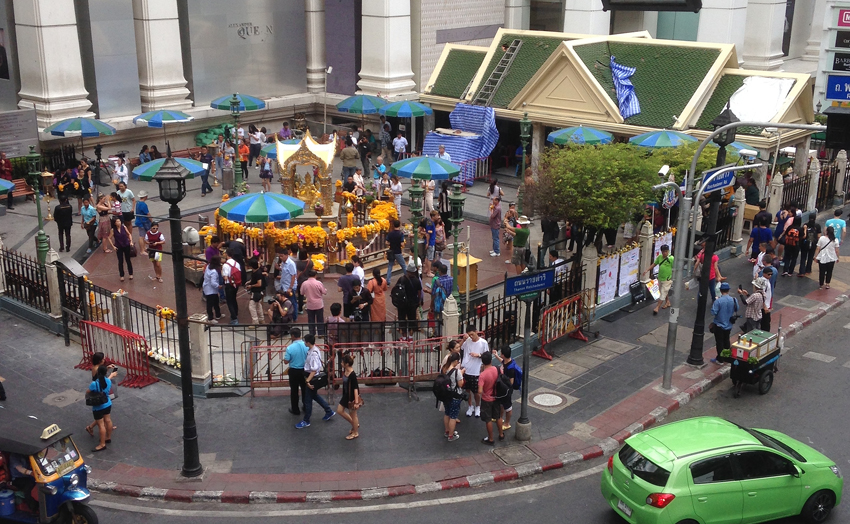
IMG_2291It’s a mystery. I visited the shrine yesterday, most of the barriers are moved away now, some repairs still to be done to the roof where the explosion blew off roof tiles. The pedestrian bridge is cordoned off with tape to stop people leaning over to take photos. The same great cloud of incence hangs in the air above a continuing throng of hundreds of people visiting throughout the day and night with their offerings and countless bowings of head and hands, burning incence sticks held in hands, and palms together as if in prayer (anjali). I’m amazed by the passion of the ritual, there’s always been some intensity of thought here – not an open free mind, it’s not meditative… it’s something ‘willed’. There’s an undercurrent of some sort of unknown energy, people cling to the idea of it, the deity can save us if we believe in Him; we worship somebody else ‘doing it’ on our behalf – we are subject to that.

Strange to see this, because Thailand is a Buddhist country and Buddhism is about not engaging with the ‘story’, it’s about understanding the constructed nature of what has been handed down to us and stepping outside of that to see the non-duality between ourselves and the world. Like the original Jesus Teachings, you simply ‘see’ the Truth of it; the reality that surrounds us all the time; like the Hindu Brahman, the Oneness, the God-state that’s here and now.

The people who visit here every day must be sincerely involved in mindfully finding their way through the busyness of their lives. Others may visit when they have an extreme situation they’re worrying about, they come for help; a desperate prayer for what ‘I’ want, what I think I need. I can’t imagine what they receive from this, only more of a focus on situations that are absent of that thing that is desired. Why? What can I learn from this? Is there a Teaching here? Or maybe there’s something wrong with the question. It could be superstition, misguided intentions, living in illusion; ‘the futile pursuit of happiness’ it’s always disatisying because it doesn’t do enough, I want more of it – the fleeting happiness found in consumerism doesn’t hit the spot.

Traffic noise echoes off the concrete structures all around. Heat and incence smoke rising…

IMG_2281

‘The ego’s attachment to power of any kind is linked inextricably to the fear of losing that power and thus becomes a source of suffering.” (Ramdas)

————————–

History: In 1956, an astrologer advised building the The Erawan Shrine to counter negative influences and the bad karma believed caused by laying the foundations of the Erawan Hotel on the wrong date. Furthermore, the Ratchaprasong Intersection had once been used to put criminals on public display. The hotel’s construction was delayed by a series of mishaps, including cost overruns, injuries to laborers, and the loss of a shipload of Italian marble intended for the building. In 2006, the shrine was vandalised by a Thai man believed to be mentally ill. After smashing the statue with a hammer, he was himself beaten to death by angry bystanders.

gentle ways

IMG_2243POSTCARD 144: Bangkok: Impossible to write about Thailand without reference to the car bomb last night in downtown Bangkok, the Thai word for it is ‘baa’ (insanity), was it a madman or was it a politically motivated act intended to provoke retaliation? There’ll be a long investigation and what it means is ordinary people will endure the traffic jams as roads are blocked off; life will go on as usual. Extremists give Thailand a bad reputation; it’s a story we know all too well these days – a created enemy.

I wasn’t able to discuss it with M my Thai niece in Chiang Mai, who’s thinking of things much more important than crazy people with bombs and anyway I’d left for Bangkok the day before, and had no idea there was a bomb because my place there is nowhere near the disaster area and I don’t watch TV. M told me when I called her about the pictures of the chocolate tart she sent me that we made when I was in Chiang Mai. She got the recipe from a YouTube video; created from a packet of Oreo cookies and 2 bars of good quality dark chocolate and one bar of milk chocolate. Open up the cookies and discard the pasty yucky bit in the middle. Smash the Oreo itself to a fine powder and mix with butter to make the base. Then break up the chocolate and melt in milk in a bowl inside a larger bowl of hot water. Pour on top of the Oreo base and put in the freezer overnight.

It’s a kinda reconstituted thing, I thought, yeh nice! Fun thing to do with M and she liked the idea that we are engaged in this activity together, impressed that I was able to scrunch up the Oreo with a spoon really well because of large strong fingers. I was rushing to get it finished though and M was holding things up with her attention to detail, The sequence is important, you have to do properly Toong-Ting, its work like that, she says. I correct her because, well, it’s natural to do that: ‘it works like that,’ I say. She looks at me, then goes back to her scrunching of Oreo: Why he, she and it have ‘s’, and the others don’t? And I say it’s because it’s Third Person Singular, you know? (knowing I’ll have to think up an explanation fast).  But… Why? So I decide to try this: it’s just the way words relate to each other, the way things fit together, and the he-she-it one is different from the others. Just different, that’s all. M accepts this explanation and I’m relieved. We go on scrunching…

The Thai culture values peaceful, gentle ways. The Buddhist teachings guide people through the delusion arising from hot emotions like confusion, anger; the mindfulness of knowing that whatever arises, falls away. Thais have this deeply felt jai-yen (keep a cool heart) attitude that’ll hopefully allow things to remain calm in the years to come. Everyone is quite well aware of the danger. It’ll take more than a single bomb at Erawan Shrine to cause a reaction.
(Note: At the time of writing a second bomb has exploded in the river at Sathorn Bridge)

“Security is mostly superstition. It does not exist in nature, nor do children as a whole experience it. Avoiding danger is no safer in the long run than outright exposure. Life is either a daring adventure or nothing.” [Helen Keller]

————————-

Note about Helen Keller: Helen was frustrated, at first, because she did not understand that every object had a word uniquely identifying it. [The] big breakthrough in communication came when she realized that the motions her teacher was making on the palm of her hand, while running cool water over her other hand, symbolized the idea of “water”.
Photo: Flower seller Phuket

looking out and looking in

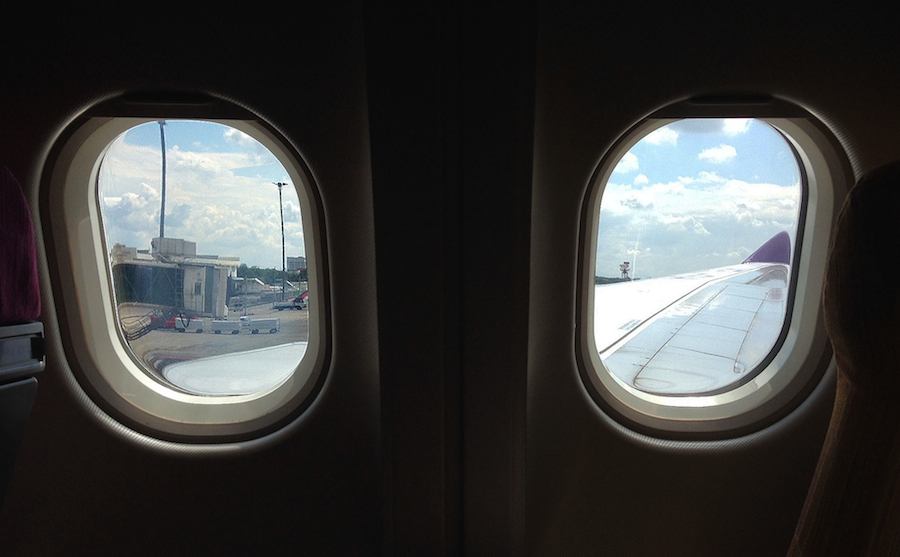
IMG_0627POSTCARD 143: Delhi-Bangkok-Chiang Mai flight: The flight from Delhi arrives at Bangkok a bit behind schedule so we have to move along quickly to the transit desk and transfer to the domestic terminal for the next flight to Chiang Mai. In-flight bags on a small trolley, and we’re zooming along on the moving walkways in this celestial structure of steel and glass. As yet, passports are unstamped, les frontaliers, the no-man’s land between country borders. We’re unregistered, no identity, invisible data.

It’s always the journey to get there… after I get to where I think is ‘there’, there’s another ‘there’ to get to, and all of it leads back to ‘here’, an ‘everywhere’ place made up of everywhere else… then it’s extending away again. It can only be the journey itself, not the destination – the Path is the goal, this is where we live. Isolated scenes from parts of the surroundings seen flashing by as we’re soaring along the high speed walkways; smooth as swans gliding on the surface of a lake. Two thousand miles of transportation corridors from Delhi to here, flight corridors connected end-to-end, through which we travel in the sensory cloud of transient ‘now’ consciousness looking out and looking in. There is nowhere that consciousness isn’t present. Consciousness is everywhere, so vast – indeed everywhere is included in consciousness, “And the deep lane insists on the direction”, an extended corridor projected out towards the designated destination where everything in the perspective it creates seems to disappear in a vanishing point.

An incidental episode of familiarity comes along… the déjà vu of cups of coffee taken at these restaurants, bars where they have wifi. Have I been here before? Must be the last time I came through, or was it the time before that? Was I going – or was I coming back, transit to New Delhi? I spoke with some people there, if I happened to meet them now, I wouldn’t remember. No time this time, we’re at immigration, passport stamp thump! through to security, take off my belt, shoes, my watch. Laptops out of bags and put them into the tray together with my phone to go through the X-ray machine.

Just then, the phone rings… reflex movement to reach for it, but it’s too far and the security officer shakes her head… let it go through. Phone ringing happily as it rumbles on its rollers into the machine. I pass through the X-ray, muffled ringtone continues then lovely ascending increased volume as it comes out the other side. I want to pick it up but people are waiting, a bit harrassed; there’s the putting-on-of-the-belt and shoes. Security officials seem unmoved by the tremendous ascending 4D heavenly ringtone, probably happens all the time… eventually I get the phone. Hello?’ It’s M, my Thai niece: Where are you now Toong Ting? I tell her we are boarding the plane in a minute and will be in Chiang Mai in about one hour. Silence for a moment, then she says: I make choc-o-late-cake. Clearly punctuated percussive articulation, she speaks English as a second language. I tell her, oh nice! and try to explain how the phone got X-rayed as she was calling me, but she can’t find anything to say to that… attempting to find a link with something else it could be related to, mind travels away with this information. No time to discuss, we have to go now, bye. Speedwalking through to the Departure gate and they’re boarding just as we get there; processed, find seats, strapped in and ready for take-off… engines roar, climbing again up into higher altitudes.

You hide me in your cloak of Nothingness
Reflect my ghost in your glass of Being
I am nothing, yet appear: transparent dream
Where your eternity briefly trembles [Rumi]

————————-

awareness of awareness

wesak_lanterns‘Our awareness is like the air around us: we rarely notice it. It functions in all our waking moments and may even continue in sleep. Usually we are caught up in the content of our awareness, preoccupied with what we think, feel, and experience. Becoming aware of awareness itself is Receptive Awareness, very close to the idea of a witnessing consciousness. Resting in receptive awareness is an antidote to our efforts of building and defending a self: the assumption that there is “someone who is aware” falls away. Self-consciousness falls away; the distinctions between self and other, inside and outside, perceiver and perceived disappear. There is no one who is aware; there is only awareness and experience happening within awareness. We learn to hold our lives, our ideas, and ourselves lightly and rest in a spacious and compassionate sphere of awareness that knows, but is not attached.’ [Link to: Receptive Awareness]

POSTCARD #132: Delhi: Today, June 1st, 2015 is Visakha Puja – a special day in Thailand, Laos, Vietnam and Singapore. This day commemorates the birth, enlightenment (nirvāna), and death (Parinirvāna) of Buddha in the Theravada tradition. So you get all three on the same day. The events that take place on this day go all the way back to the time of the Buddha twenty-five centuries ago, monks chanting verses, there is a talk by a senior monk, listeners seated on the floor, and it fills me with awe to consider that it’s the same now as it was all those years ago; this moment here and now is actually that moment there and then. Everything about who I am, the clothes I wear, my appearance, identity, gender; all of that disappears for an instant in the huge span of time that appears to lie in between. There’s only awareness, I experience it physically, somewhere in the centre of the chest, spreading out to the shoulders. In Pali it’s called the citta, the heart.

Thought and mental activity are all located in the brain area; flashing like electricity voltage sparks, but awareness is in the centre of my being. Experientially I’m conscious that awareness is prior to thought and mental activity, awareness comes before everything. It’s there all the time, even when I’m asleep. I may assume that awareness is ‘me’, ‘self’. This ‘self’ says it’s ‘my’ awareness, ‘I’ am aware. But when this ‘self’ that I believe to be me starts to look for the ‘me’ that possesses awareness, it finds that it’s the other way round: awareness has to first start looking for the ‘me’ (and the ‘me’ can’t be found).

The question then arises, ‘who am I?’ I might say, well, I have an identity given to me by my parents, and a birth certificate, driving license, passport, ID card, and all this documentation is saying this is ‘me’. I have a personality; I’m like this, I’m like that. But it’s awareness that sees all this, the feelings, emotions, moods and I find the question: ‘who am I?’ is itself focusing attention, opening the mind, thoughts flicker and disappear, sparks fly, awareness sees all this. The identity, the personality is witnessed by awareness. Awareness was there before it all; before feelings, moods – emotions are objects of perception that awareness perceives. Awareness is what I am, it’s what all sentient beings are, it’s not personal, it’s everything. No beginning, no end, awareness has always been there. Awareness is spirit. Spirit is awareness

Most of the time I live with my small self, worn like a costume in a fancy-dress party, and function with other small selves doing the same thing. Same with everybody here today, at Vesakh time seated in meditation and focused on the Buddha’s teaching. But the Buddha wouldn’t have wanted us to say anything like, “I am a ‘Buddhist’”… beliefs appear in awareness, awareness is there before beliefs, before thought, before all that. There’s an awareness of a constructed ‘self’ – necessary for getting around. There’s this awareness and an awareness of the awareness itself.

————————

Photo source: http://asiaplacestosee.com/wesak-day-celebration/
Note: some parts of this post inspired by an Adyashanti talk in a post on the website: To Know Beauty/ Meditative Self Inquiry